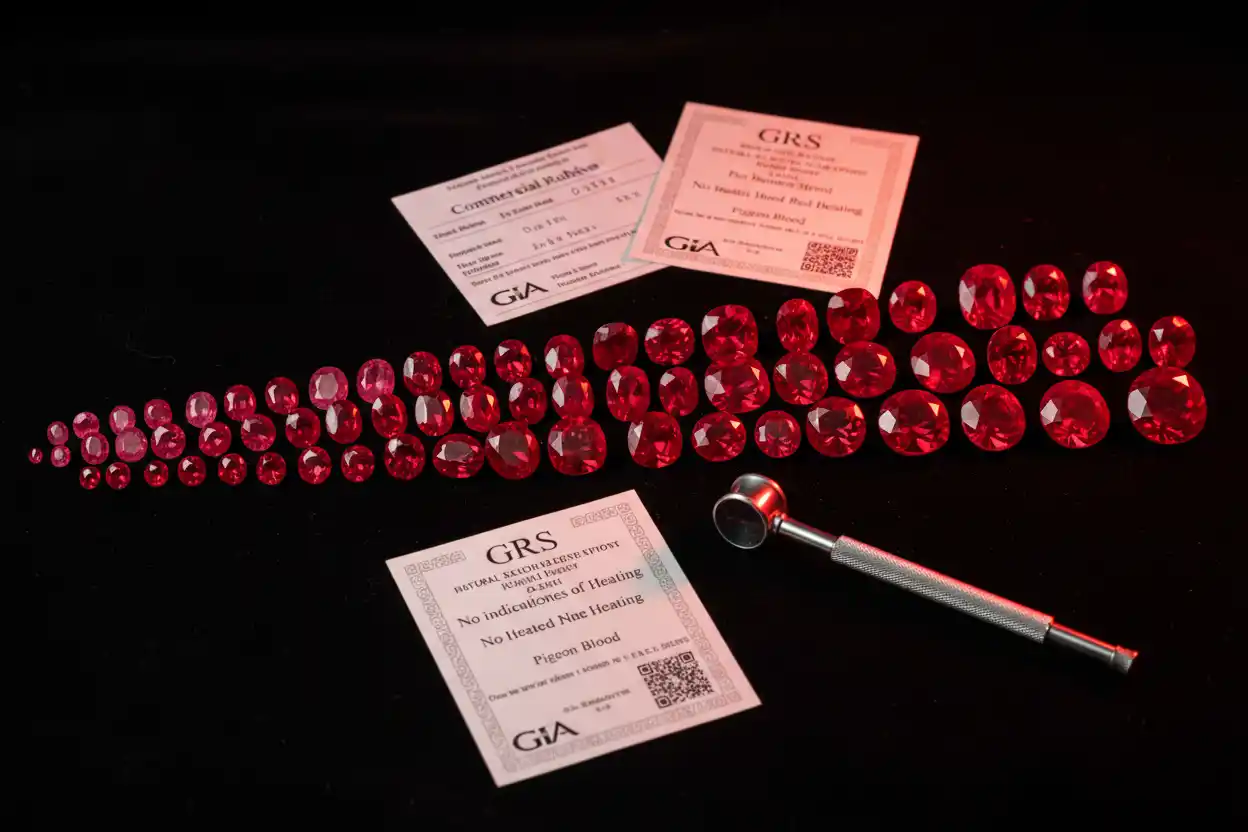
Ruby Price Guide: Value and Cost in 2026
Natural Ruby prices in 2026 range from less than $100 per carat for heavily treated or low-grade material to more than $100,000 per carat for exceptional unheated gems. Most attractive transparent jewelry Rubies sell between approximately $500 and $10,000 per carat.
Color, treatment, origin and size create enormous differences between stones that may look broadly similar in photographs. A respected laboratory report becomes essential when an unheated designation, prestigious locality or pigeon-blood description accounts for a significant share of the price.
Ruby Price per Carat in 2026
The following ranges describe broad U.S. retail expectations for loose natural Ruby. Finished jewelry, signed pieces and historically important stones can cost substantially more.
| Ruby category | Typical characteristics | Approximate 2026 retail price |
|---|---|---|
| Lead-glass-filled or composite Ruby | Fracture-filled, translucent to transparent, often heavily included | $20–$300 per carat |
| Commercial heated Ruby | Pinkish red to dark red, visible inclusions and ordinary cutting | $200–$1,500 per carat |
| Good heated Ruby | Attractive red, reasonable transparency and competent cutting | $1,000–$5,000 per carat |
| Fine heated Ruby | Vivid red, good clarity, strong proportions and established origin | $4,000–$12,000 per carat |
| Fine unheated Ruby | Strong red color, natural inclusions, respected report and rare size | $7,500–$30,000 per carat |
| Premium Burmese or Mozambique Ruby | Vivid red, excellent transparency, no heat and strong provenance | $20,000–$100,000 per carat |
| Exceptional auction quality | Rare size, pigeon-blood designation, top origin and important provenance | $100,000–$500,000+ per carat equivalent |
The upper end is not representative of ordinary retail Ruby. It reflects an exceptionally small market of major gems that combine rare color, large size, minimal treatment and international collector demand.
The broader relationship among color, clarity, size, treatment and demand appears in How Gemstone Prices Are Determined.
What Is Ruby?
Ruby is the red gem variety of corundum, an aluminum-oxide mineral with a Mohs hardness of 9.
Chromium creates the red color. Its concentration and interaction with iron influence whether the gem appears pinkish red, vivid red, purplish red, dark red or brownish red.
The boundary between Ruby and Pink Sapphire is partly dependent on trade and laboratory color interpretation. A light red stone may be classified as Ruby by one market and Pink Sapphire by another.
The completed Ruby guide owns the gemstone’s mineralogy, formation, history and symbolic traditions. The completed Types of Ruby page owns the variety-level classification.
This guide remains focused on price, treatment, origin and market value.
Color Is Ruby’s Most Important Value Factor
Fine Ruby displays vivid red to slightly purplish red without looking excessively dark, brown or pale.
The preferred tone is usually medium to medium-dark. A stone should remain clearly red under ordinary indoor lighting rather than becoming black around the edges or dull burgundy across the center.
Slight purple can remain attractive and may be reduced visually by yellow-gold surroundings. However, strong brown, orange or gray modifiers usually lower value.
Brightness matters alongside saturation. A deeply colored stone with severe extinction can cost less than a slightly lighter Ruby that returns light across most of its face.
Photographs should be examined under neutral lighting. Warm lamps and digital saturation can make an average purplish-red gem look far richer than it appears in person.
The family-wide comparison among Ruby, Sapphire and Emerald appears in Sapphire vs Emerald vs Ruby.
Pigeon-Blood Ruby Prices
Pigeon blood is a high-value trade description for vivid red Ruby with a specific balance of hue, saturation and tone.
The name is not a universal color grade. Major laboratories apply their own criteria, and a stone may receive the description from one laboratory but not another.
Fine pigeon-blood Rubies commonly cost tens of thousands of dollars per carat. Exceptional unheated Burmese stones can exceed $100,000 per carat, particularly above three or five carats.
A laboratory designation should be reviewed together with the full report. Treatment, origin, fluorescence, clarity and weight remain essential.
The seller’s use of pigeon blood without independent documentation should not create a premium. Similarly, a laboratory phrase cannot compensate for an overly dark, heavily fractured or poorly cut stone.
Tone, Saturation and Fluorescence
Chromium-rich Ruby can fluoresce strongly red under ultraviolet-rich daylight. This fluorescence may strengthen the apparent glow and make the stone look more vivid.
Iron can suppress fluorescence. Rubies from iron-rich geological environments may therefore show attractive color without the same luminous response associated with some marble-hosted material.
Fluorescence is not an independent grade. A strongly fluorescent stone can still have poor tone or clarity.
The best market result comes from a balanced interaction among red body color, transparency, fluorescence and cutting. A Ruby that looks lively in several lighting environments normally commands more than one that depends on direct sunlight.
Clarity and Natural Inclusions
Natural Ruby is commonly included. Fine needles, crystals, healed fissures, fingerprints and color zoning can support geological origin.
The market accepts more inclusions in Ruby than in Aquamarine, Topaz or many Garnets because clean, strongly colored Ruby is much scarcer.
However, inclusion tolerance has limits. Large black crystals, open fractures, dense clouds and surface cavities reduce brilliance, durability and value.
A small crystal near the girdle may be less distracting than a reflective fracture crossing the table. Likewise, evenly distributed silk can soften the color attractively, while coarse silk may create cloudiness.
Eye-clean Ruby commands a strong premium, particularly above one carat. A transparent three-carat stone with vivid color and limited inclusions belongs to a fundamentally different market from a translucent commercial Ruby of the same weight.
Silk and Rutile Needles
Fine rutile needles are commonly called silk. Their condition can provide useful evidence about treatment history.
Intact silk may indicate that the stone has not experienced conventional high-temperature heating. Partially dissolved or altered silk can support evidence of heat.
Silk can also scatter light and create a softer appearance. When the needles align correctly and the stone is cut as a cabochon, they may produce asterism.
No buyer should infer unheated status from visible needles alone. Some heating leaves partial silk intact, and laboratory interpretation requires a broader examination of inclusions, spectroscopy and chemistry.
Heat-Treated Ruby Prices
Heating is widely accepted in the Ruby market.
Conventional heat can improve color, reduce blue or purple modifiers, dissolve rutile silk and heal some fissures. Heated Ruby remains natural corundum, but its price normally falls below that of a comparable unheated stone.
Commercial heated stones may cost a few hundred dollars per carat. Fine heated gems with strong color and transparency can reach several thousand or more than $10,000 per carat.
The discount depends on the intensity and consequences of treatment. A lightly heated Ruby with minimal residues occupies a stronger market than a heavily heated stone whose appearance depends on extensive flux-assisted fissure healing.
The dedicated How to Spot Treated or Synthetic Ruby page owns the detailed laboratory evidence and treatment-identification process.
Unheated Ruby Prices
Unheated Ruby receives a substantial premium because fine natural color and clarity occur without conventional thermal improvement.
An unheated statement on a credible report does not automatically make a stone exceptional. Color, transparency, cut and condition must still justify the price.
Fine unheated one-carat Rubies commonly begin in the several-thousand-dollar-per-carat market. Strong two- and three-carat stones can reach $10,000 to $50,000 per carat.
Premium Burmese or Mozambique stones may rise higher, while major gems above five carats can enter international auction territory.
A seller’s verbal statement is insufficient. The report should explicitly state that no indications of heating were observed.
Lead-Glass-Filled Ruby
Lead-glass filling transforms low-quality fractured corundum into material that appears more transparent.
Glass fills surface-reaching fissures, reduces their visibility and can make an otherwise opaque stone suitable for inexpensive jewelry.
The finished product contains natural Ruby and manufactured glass. In heavily filled examples, the treatment contributes substantially to appearance and practical integrity.
Lead-glass-filled Ruby should remain in the lowest price tier, often between $20 and $300 per carat. It should not be priced as ordinary heated natural Ruby.
The material can be damaged by heat, acids, ultrasonic cleaning and some jeweler’s torches. Repairs require clear disclosure to the jeweler.
A large transparent-looking Ruby at an unusually low price frequently belongs to this category.
Flux-Healed and Fissure-Healed Ruby
High-temperature treatment with flux can partially heal fractures and leave residues within them.
Flux-healed Ruby differs from low-temperature lead-glass filling. The treatment occurs during high-temperature processing and may create fingerprint-like structures or glassy residues.
Value depends on the degree of healing and the amount of foreign residue. Minor residues may be accepted in the heated market, while extensive fissure filling creates a larger discount.
Reports may use phrases such as residues in healed fissures, minor residues or significant residues. Buyers should read the comments rather than relying only on the word heated.
The broader treatment vocabulary appears in Gemstone Treatments Explained.
Diffusion-Treated Ruby
Diffusion treatment introduces coloring elements into the surface or lattice of corundum at high temperature.
Beryllium diffusion is better known in orange, yellow and Padparadscha-like Sapphire, but it can also modify Ruby and other corundum colors.
Diffusion-treated material should cost less than conventionally heated Ruby with comparable appearance.
Color penetration can vary. Surface-concentrated treatment may become visible around facet junctions, girdles or recut areas.
Advanced laboratory testing is necessary because visual inspection alone cannot reliably exclude diffusion.
Burmese Ruby Prices
Myanmar’s Mogok region has produced many of the world’s most famous Rubies.
Fine Mogok material may display vivid red, strong fluorescence and marble-hosted inclusion characteristics. Such stones receive substantial provenance premiums when accompanied by respected origin reports.
Commercial Burmese Ruby can still be dark, included or treated. The country name does not guarantee top quality.
Fine unheated one- to three-carat Burmese Rubies commonly reach $15,000 to $100,000 per carat, depending on color and transparency. Exceptional larger stones can exceed those figures.
Mong Hsu, another Myanmar source, produced substantial Ruby quantities, much of which required heating to improve dark cores and fissures. Mong Hsu material should not be priced automatically against exceptional unheated Mogok stones.
Mozambique Ruby Prices
Mozambique has become one of the most important modern Ruby sources.
Montepuez and surrounding deposits have produced commercial through exceptional stones, including vivid red gems in substantial sizes.
Heated commercial Mozambique Ruby can cost hundreds to several thousand dollars per carat. Fine unheated material may reach $5,000 to $30,000 per carat.
Exceptional stones with pigeon-blood descriptions, strong transparency and large size can compete with Burmese Ruby at auction.
Comparable Burmese origin often retains a historical premium. Nevertheless, a beautiful Mozambique stone can be worth more than a weak or heavily treated Burmese gem.
Madagascar, Tanzania, Sri Lanka and Vietnam
Madagascar produces Ruby in multiple geological environments and quality levels. Fine transparent stones occur, although much commercial material is included or treated.
Tanzania has supplied Ruby from areas such as Winza and Longido. Some material displays vivid color, while other rough occurs with Zoisite or green Fuchsite.
The latter combinations belong to separate materials covered in the completed Ruby in Zoisite and Ruby in Fuchsite guides. They should not be priced as transparent faceted Ruby.
Sri Lanka commonly produces lighter red and pinkish-red corundum. Vietnam has yielded fine marble-hosted Ruby with strong fluorescence.
Origin creates value only when the visible quality and independent report support it.
Ruby Size Premiums
Fine Ruby receives one of the steepest size premiums in the colored-gem market.
| Ruby weight | Commercial heated | Fine heated | Fine unheated |
|---|---|---|---|
| Under 1 ct | $200–$2,000 per carat | $1,500–$6,000 per carat | $3,000–$12,000 per carat |
| 1–2 ct | $400–$3,000 per carat | $3,000–$10,000 per carat | $7,500–$25,000 per carat |
| 2–3 ct | $600–$5,000 per carat | $5,000–$15,000 per carat | $12,000–$40,000 per carat |
| 3–5 ct | $800–$7,500 per carat | $8,000–$25,000 per carat | $20,000–$75,000 per carat |
| Above 5 ct | Individually evaluated | $15,000–$50,000+ per carat | $30,000–$150,000+ per carat |
These ranges assume reasonable transparency and color. A five-carat translucent filled Ruby can cost less than a fine half-carat unheated stone.
Price increases become nonlinear because large transparent rough is exceptionally scarce.
Cut Quality
Ruby cutters must balance expensive weight, color zoning, crystal shape and inclusions.
Ovals and cushions dominate because they preserve rough efficiently. Rounds usually require greater weight loss and can receive premiums.
A shallow pavilion may create a transparent window. Excessive depth can produce dark extinction and hidden weight.
Fine cutting should distribute red color across most of the face while preserving brightness. Symmetry may be slightly irregular when the cutter follows a valuable color zone, but severe bulges and uneven girdles should reduce price.
Dimensions should always be compared with carat weight. A deep two-carat Ruby may face up smaller than a well-proportioned 1.60-carat stone.
Detailed proportion screening belongs to the Ruby Buying Guide.
Star Ruby Prices
Star Ruby displays asterism caused by oriented inclusions, commonly rutile needles.
Commercial star stones may cost approximately $50 to $500 per carat. Fine examples with a sharp centered six-rayed star and attractive red body color can reach $500 to $5,000 per carat.
Exceptional unheated Burmese star Rubies may rise far higher, particularly in large sizes with strong transparency or a milk-and-honey effect.
The star should move smoothly across the dome under a direct light source. Weak, incomplete or off-center rays reduce value.
Synthetic star Ruby is widely available and often shows an unnaturally perfect star. The completed Star Ruby guide owns the phenomenon’s material context.
Natural Ruby vs Lab Ruby Prices
Laboratory-grown Ruby is genuine synthetic corundum but lacks natural geological origin.
Flame-fusion Lab Ruby can cost only a few dollars per carat, while premium flux-grown products may cost several hundred per carat.
Natural Ruby can cost thousands or tens of thousands because its value includes geological scarcity, origin and treatment history.
Current manufactured-stone pricing appears in the Lab Ruby Price Guide. The wider origin decision appears in Lab-Grown vs Natural Gemstones.
A Lab Ruby should never be represented as mined material, even when its color and physical properties closely resemble natural corundum.
Ruby vs Garnet and Spinel
Red Garnet can resemble dark or purple-red Ruby, but most Garnet costs far less.
Red Spinel has historically been confused with Ruby and can produce vivid natural color without routine treatment. Fine Spinel can be expensive, although top Ruby usually occupies the higher market.
The three-way identification guide appears in Ruby vs Garnet vs Spinel.
The more focused distinction appears in Ruby vs Spinel.
Material identity should be established before applying any Ruby price table. A beautiful Spinel or Garnet deserves its own market rather than a misleading Ruby label.
Ruby Jewelry Prices in 2026
| Jewelry type | Broad U.S. retail range |
|---|---|
| Silver jewelry with filled or commercial Ruby | $50–$500 |
| Gold earrings or pendant with commercial Ruby | $500–$4,000 |
| One-carat heated Ruby ring | $2,000–$15,000 |
| One-carat fine unheated Ruby ring | $10,000–$50,000+ |
| Three-carat premium Ruby jewel | $50,000–$500,000+ |
| Signed high-jewelry Ruby piece | Hundreds of thousands to millions |
The center stone commonly dominates the price in fine jewelry, while gold, Diamonds, design and branding add further value.
Style-specific selection belongs to the Ruby Ring Guide, Ruby Engagement Ring Guide, Ruby Earrings Guide, Ruby Necklace Guide and Ruby Bracelet Guide.
Ruby’s birthstone role belongs to the July Birthstone Guide.
Certification Is Essential for Fine Ruby
A major laboratory report should accompany any Ruby whose price depends on treatment, origin or a prestigious color description.
A useful report may state:
- Natural or laboratory-grown origin
- Ruby identity
- Evidence of heating
- Fissure-healing residues
- Lead-glass or other filling
- Diffusion treatment
- Geographic origin, when determinable
- Pigeon-blood or comparable color terminology, when offered by the laboratory
The laboratory does not set the retail price. It establishes facts that allow the stone to be placed in the correct market tier.
The Gemstone Certification Labs comparison explains report scope and limitations.
Durability and Care
Ruby is hard and generally tough enough for rings and other frequently worn jewelry.
Existing fractures, fillings and thin girdles still create vulnerability. Lead-glass-filled stones require especially careful handling.
Warm soapy water is normally safe for untreated and conventionally heated Ruby. Filled stones may require cleaning only with a damp cloth.
A jeweler must be informed about treatment before resizing or repairing the mounting. Torch heat can damage glass filling or worsen fractures.
Complete maintenance guidance belongs to How to Clean Ruby Jewelry Safely.
Does Ruby Hold Its Value?
Fine unheated Ruby has one of the strongest collector markets among colored gemstones.
The best resale position belongs to vivid stones with respected reports, rare size and desirable origin. Burmese and top Mozambique Rubies can attract international competition.
Commercial heated and filled stones generally resell below retail. The original purchase may include retailer margin, setting cost and branding that a secondhand buyer will not repay.
A fine gem can be valuable without being immediately liquid. Auction commissions, dealer margins and testing costs reduce net proceeds.
The broader resale framework appears in Do Gemstones Hold Their Value?.
Price Guide vs Buying Guide
This page owns Ruby’s 2026 price ranges and value factors. Detailed inspection, report verification and seller questions belong to the dedicated buying guide.
Authenticity tests remain on Real vs Fake Ruby rather than being repeated here.
Online purchasers should verify the report directly with the laboratory, obtain multiple lighting videos and secure a practical return period using How to Buy Gemstones Online Without Getting Scammed.
The Buying & Value hub connects Ruby pricing with certification, treatments, comparisons and resale guidance.
Frequently Asked Questions
1. How much is Ruby worth per carat in 2026?
Natural Ruby ranges from below $100 per carat for heavily treated material to more than $100,000 per carat for exceptional unheated stones. Most transparent jewelry Rubies cost approximately $500 to $10,000 per carat.
2. What Ruby color is most valuable?
Vivid red to slightly purplish red with medium-to-medium-dark tone generally receives the strongest price.
3. How much is a one-carat Ruby?
A commercial heated one-carat Ruby may cost $500 to $5,000. Fine unheated material commonly costs $7,500 to $30,000 or more.
4. How much is a three-carat Ruby?
A three-carat stone may cost a few thousand dollars when commercial or more than $100,000 in total when fine, unheated and well documented.
5. Is heated Ruby valuable?
Yes. Fine heated Ruby can cost several thousand dollars per carat, although comparable unheated material receives a premium.
6. What is lead-glass-filled Ruby worth?
Most lead-glass-filled Ruby costs approximately $20 to $300 per carat, depending on appearance and construction.
7. Does Burmese origin always make Ruby expensive?
No. Myanmar produces several quality levels. The strongest premium applies to fine transparent stones with exceptional color and respected origin reports.
8. Is Mozambique Ruby valuable?
Yes. Fine Mozambique Ruby can reach tens of thousands of dollars per carat and compete with Burmese stones at auction.
9. What does pigeon-blood Ruby mean?
It is a prestigious trade or laboratory color description for a narrowly defined vivid red appearance. Criteria vary among laboratories.
10. Does Ruby need a laboratory report?
A report is essential when treatment, origin, natural status or a premium color description materially affects the price.
11. Does Ruby hold its value?
Fine unheated Ruby can retain strong collector demand. Commercial heated, filled and heavily marked-up jewelry often resells below retail.
12. Is Ruby a good investment?
Exceptional documented Ruby may appreciate, but liquidity, transaction costs and future demand remain uncertain. It should not be purchased on guaranteed-return claims.
Ruby Value Begins With Color but Depends on Treatment
A red corundum stone cannot be valued from color and weight alone. The financial difference between lead-glass-filled Ruby, fine heated Ruby and an unheated Burmese gem can exceed one hundred times.
In 2026, good transparent Ruby commonly falls between $1,000 and $10,000 per carat. Prices above that level become defensible when vivid color, rare clean size, minimal treatment, prestigious origin and independent laboratory evidence support one another.