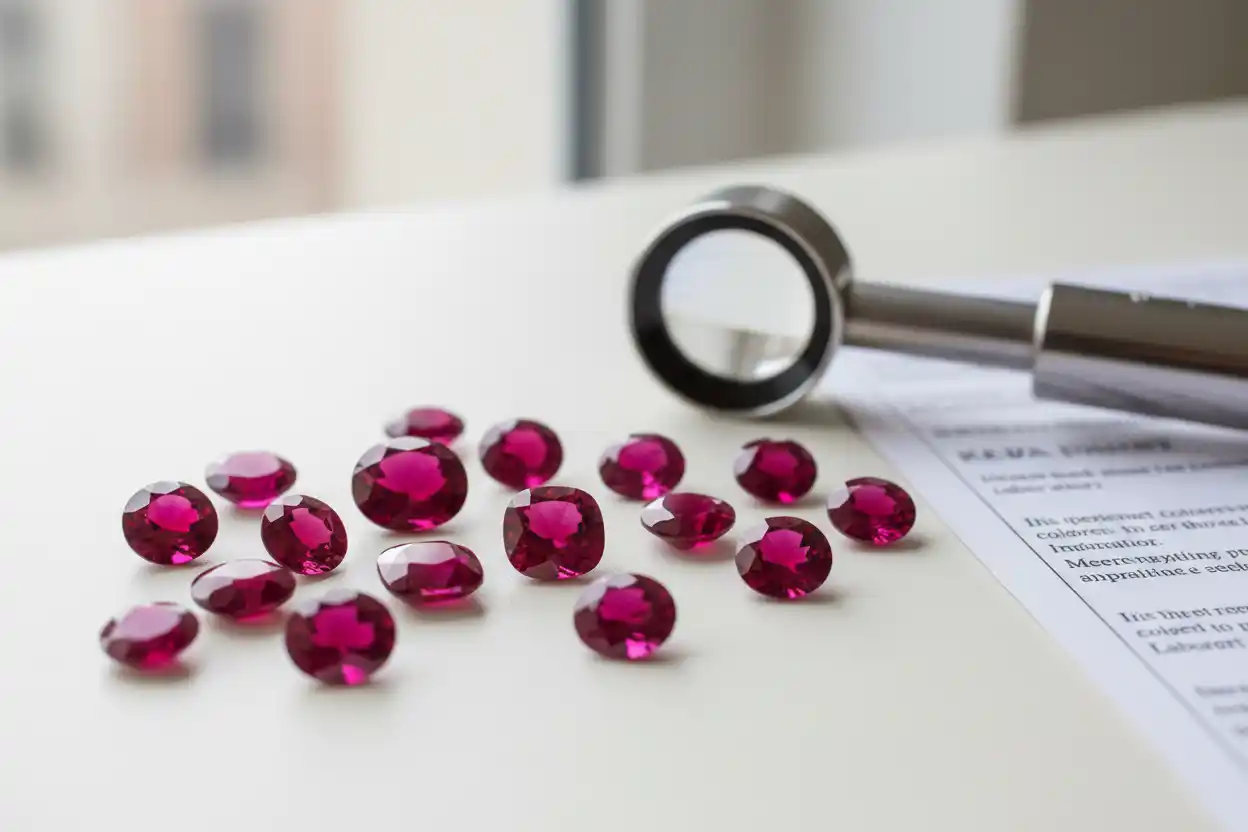
Buy Ruby: 9 Essential Quality Checks & Confident Value Tips
To buy Ruby confidently, judge color first, then clarity, cut, carat weight, treatment, origin, laboratory documentation, condition, and asking price. Fine Ruby can be one of the most expensive colored gems, but the market also contains affordable heated stones, heavily fracture-filled gems, laboratory-grown Ruby, and stones whose country-of-origin claims add more to the sales pitch than to actual quality.
Current retail examples show how large the differences can be. Heat-only stones around 1 to 1.7 carats in the current sample sit near roughly $580 to $713 per carat. Current untreated 2-carat stones range from about $3,700 to $6,100 per carat, while an unheated 1.36-carat Ruby with a GIA report is currently offered at about $8,610 per carat. The Ruby price therefore changes dramatically when color, treatment, size, clarity, origin, and documentation improve together.
1. Ruby Color Quality: Pure Red, Vivid Red, and Purplish Red
Color is the most important Ruby quality factor. GIA identifies pure vibrant red to slightly purplish red as the traditional top range, with strong saturation and a tone that is neither too dark nor too light.
A Ruby can look richly red under strong jewelry-store lamps yet turn dull, brownish, or nearly black indoors. Compare the stone in diffused daylight, normal room light, and directional light before deciding.
Very orangy or excessively purple stones usually occupy lower market tiers than fine balanced red stones. Extremely light red may cross into the commercial pink-sapphire category depending on the laboratory and market.
The Ruby quality grading should therefore begin with hue, saturation, tone, brightness, and evenness rather than clarity or country name.
Ruby Pigeon Blood Color Claims
Pigeon blood is a high-value trade description associated with vivid red Ruby, but sellers do not all apply the phrase consistently. Do not pay an extreme premium because a product title uses the term.
If a seller is charging collector-level prices for a Ruby described as pigeon blood, a respected laboratory report should support the relevant color and treatment information.
Face-up appearance remains more important than dramatic terminology.
2. Ruby Clarity: Which Inclusions Reduce Value?
Natural Ruby commonly contains inclusions. GIA notes that inclusion-free Rubies are rare, so buyers should not expect diamond-like perfection.
The important question is whether inclusions reduce transparency, brightness, durability, or face-up beauty.
Fine silk, tiny crystals, healed fissures, and other internal features may be acceptable. Large white fractures, dark crystals beneath the table, heavy clouds, or open cracks can reduce value substantially.
A slightly included vivid red Ruby may be much more desirable than a cleaner stone with weak color. Color remains dominant until inclusions become visually or structurally disruptive.
Ruby Silk and Star Effects
Fine rutile needles can create a soft appearance in some Rubies and can contribute to asterism when the crystal orientation and cabochon cut align correctly.
Star Ruby belongs to a different comparison group from transparent faceted Ruby. A strong six-rayed star, centered movement, appealing red color, and good surface quality drive value there.
Do not compare an opaque star cabochon directly with a transparent faceted Ruby using one price scale.
3. Ruby Cut Quality: Brightness, Windows, and Face-Up Size
Ruby rough is expensive, so cutters often preserve as much weight as possible. That can produce deep pavilions, uneven outlines, asymmetry, or stones that face up smaller than expected.
A good cut should balance weight retention with brightness and useful face-up dimensions.
Large transparent windows through the center reduce visual intensity. Excessive depth can hide expensive weight below the girdle.
Compare millimeter measurements along with carat weight. A 1.5-carat Ruby with strong spread and even brightness can look more impressive than a deeper 1.8-carat stone.
Rubies priced per carat should therefore be compared only after checking dimensions and cut performance.
4. Ruby Treatment: Heat, Glass Filling, and Diffusion
Treatment status can change Ruby value enormously.
GIA advises buyers to assume a Ruby has been heated unless a respected laboratory reports no evidence of heat. Traditional heating is widely accepted in the trade and can improve color and clarity.
Fracture filling with lead-rich glass belongs to a much lower value tier. Glass can make heavily fractured Ruby look more transparent, but the underlying cracks remain present.
Diffusion treatment can also alter surface color and is generally valued below conventional heat-only Ruby.
The treated Ruby distinction is therefore critical when comparing stones that look similar in photographs.
Heated Ruby vs Unheated Ruby Value
An unheated Ruby with excellent natural color can command a major premium because fine color without heating is rarer.
Current retail evidence demonstrates this difference. Several current heat-only Rubies around 1 to 1.7 carats are priced near $580 to $713 per carat, while current untreated 2-carat examples sit around $3,700 to $6,100 per carat.
The difference cannot be attributed to heat alone because the stones also vary in color, clarity, cut, origin, and seller selection. It does show why treatment disclosure is financially important.
5. Ruby Carat Weight: Why Price Jumps Above 1 Carat
Fine Ruby becomes much scarcer as size increases.
GIA specifically notes that high-quality Rubies above 1 carat are rare and that price per carat can increase dramatically with size.
That means a fine 2-carat Ruby can cost far more than twice the total price of a comparable 1-carat stone. The effect becomes even stronger at 3, 5, or more carats when vivid color and transparency remain strong.
Size should never override quality. A 3-carat heavily filled Ruby may cost less than a 1-carat fine heated stone.
The premium appears when size combines with vivid color, good transparency, strong cut, limited enhancement, and credible documentation.
6. Ruby Origin: Myanmar, Mozambique, Sri Lanka, and Other Sources
Myanmar has exceptional historical importance in the Ruby trade, especially the Mogok region. Fine Rubies documented as Burmese can command significant premiums.
GIA warns, however, that origin does not guarantee quality. Every mining region produces a range from weak commercial stones to exceptional gems.
Mozambique has become one of the world’s most important modern Ruby sources, particularly through deposits around Montepuez. Sri Lanka, Thailand, Madagascar, Tanzania, Afghanistan, Vietnam, and other areas also produce Ruby.
A vivid Mozambique Ruby can be much more valuable than a poor Burmese Ruby.
Origin becomes financially meaningful when the gem itself is excellent and a respected laboratory supports the locality claim.
7. Real vs Fake Ruby: Natural, Laboratory-Grown, and Imitation Stones
The real vs fake Ruby question is more complicated than simply natural versus glass.
Laboratory-grown Ruby has the same corundum identity and chromium-related red color as natural Ruby but grows under controlled conditions rather than in the earth. It generally costs far less because production is repeatable.
Red spinel, garnet, glass, synthetic products, and other red gems can also be mistaken for Ruby.
Scratch tests, flame tests, and other destructive home methods are unreliable and can damage jewelry.
When a natural Ruby carries a substantial price, proper gemological identification is much safer than judging authenticity from color alone.
8. Ruby Certification: When a Laboratory Report Is Worth Paying For
For an inexpensive heated commercial Ruby, extensive laboratory testing may not always make economic sense.
For a multi-thousand-dollar natural Ruby, a report from a respected independent laboratory can be extremely valuable.
A GIA report can identify whether the stone is natural or laboratory-grown, record detectable treatments, and provide an origin opinion when requested and scientifically possible.
Gemstone certification becomes especially important when the seller charges premiums for unheated status, Burmese origin, exceptional rarity, or unusually high quality.
Check that report weight, dimensions, shape, and identifying details match the exact stone being offered.
9. Ruby Price Checks: Compare Treatment Before Comparing Carats
Current retail listings provide useful context.
| Current Ruby example | Weight | Treatment | Asking price | Approx. price per carat |
|---|---|---|---|---|
| Red oval Ruby | 1.37 ct | Heat only | $795.97 | $581 |
| Red pear Ruby | 1.28 ct | Heat only | $783.01 | $612 |
| Red pear Ruby | 1.01 ct | Heat only | $720.47 | $713 |
| Red pear Ruby | 1.73 ct | Heat only | $1,167.76 | $675 |
| Red cushion Ruby | 2.02 ct | Untreated | $7,507.62 | $3,717 |
| Red pear Ruby | 2.36 ct | Untreated | $11,133.44 | $4,718 |
| Red oval Ruby | 2.00 ct | Untreated | $12,234.65 | $6,117 |
| Fine round Ruby with GIA report | 1.36 ct | Unheated | About $11,710 | $8,610 |
These are retail asking prices, not completed-sale values. Differences in color, clarity, cut, origin, laboratory documentation, and seller selection make direct averaging misleading.
Current retail guidance also places many fracture-filled Rubies around $15 to $80 per carat, heat-only Ruby around $250 to $10,000 per carat, and untreated Ruby around $2,000 to $20,000 per carat.
Those are wide market bands rather than guarantees.
Ruby Ring Durability: Is Ruby Safe for Everyday Wear?
Ruby is corundum and ranks 9 on the Mohs hardness scale, placing it just below diamond for scratch resistance.
That makes Ruby durability excellent for rings, including jewelry worn frequently.
Ruby can still chip along exposed edges if struck hard, and heavily fracture-filled stones require more cautious treatment.
A Ruby ring designed for regular wear should protect vulnerable corners, especially on pear, marquise, and other pointed shapes.
Stone condition and treatment should influence the setting choice as much as appearance.
Ruby Jewelry Cleaning: Care Depends on Treatment
Untreated and conventionally heated Rubies generally tolerate normal jewelry wear well. Warm soapy water is a safe cleaning method.
Glass-filled, cavity-filled, or dyed Ruby requires more caution. GIA recommends gentler cleaning for heavily treated stones because fillers can react to heat and chemicals.
Cleaning Ruby jewelry safely starts with knowing the treatment status.
If that information is uncertain, use lukewarm soapy water, a soft brush, gentle rinsing, and a soft cloth rather than aggressive heat or chemical cleaning.
Ruby Resale Value: Quality Matters More Than Retail Hype
Fine natural Ruby has a strong collector market, but that does not mean every purchase will resell at the original price.
Retailers include selection costs, documentation, overhead, inventory risk, and profit in the asking price. A dealer buying from a private owner may offer significantly less.
Whether gemstones hold value depends heavily on rarity, treatment, color, origin, documentation, condition, purchase price, and selling venue.
High-quality unheated Ruby can have strong long-term demand, but no seller can guarantee appreciation.
Ruby Buying FAQs
What Ruby color is most valuable?
Pure vibrant red to slightly purplish red with strong saturation and medium to medium-dark tone is traditionally the most desirable range.
Should I buy heated Ruby?
A well-colored heat-only Ruby can offer excellent value. Heating is widely accepted, but the treatment should be disclosed.
Is unheated Ruby better?
Unheated status can add a significant premium when color, clarity, and cut are already strong. A poor unheated Ruby is not automatically better than a beautiful heated one.
How much does a 1-carat Ruby cost?
Current heated examples around 1 carat can be several hundred dollars per carat, while fine untreated stones can cost thousands per carat.
Why are some Rubies only $30 per carat?
Very low prices often indicate heavy fractures, filling, opacity, weak color, small size, or lower commercial quality.
Does Burmese Ruby always cost more?
Fine laboratory-documented Burmese Ruby can command a premium, but Burmese origin does not guarantee high quality.
Is Mozambique Ruby valuable?
Yes. Mozambique produces Ruby across commercial and exceptional quality levels and has become a major modern source.
How can I tell if a Ruby is glass filled?
Professional gemological examination is the safest approach. Flash effects, gas bubbles, and filled fractures can be diagnostic under magnification.
Does Ruby need a certificate?
Not every inexpensive stone does, but independent documentation is highly valuable for expensive natural, unheated, or origin-sensitive Ruby.
Is Ruby suitable for everyday jewelry?
Yes. Corundum’s hardness of 9 and good toughness make Ruby one of the strongest choices for frequently worn jewelry.
Conclusion
A confident Ruby purchase starts with vivid balanced red color and then considers clarity, cutting, size, treatment, origin, documentation, condition, and price. Current heat-only stones can cost hundreds per carat, while fine untreated examples can reach several thousand dollars per carat or much more. Treatment disclosure and independent documentation become increasingly important as the asking price rises.