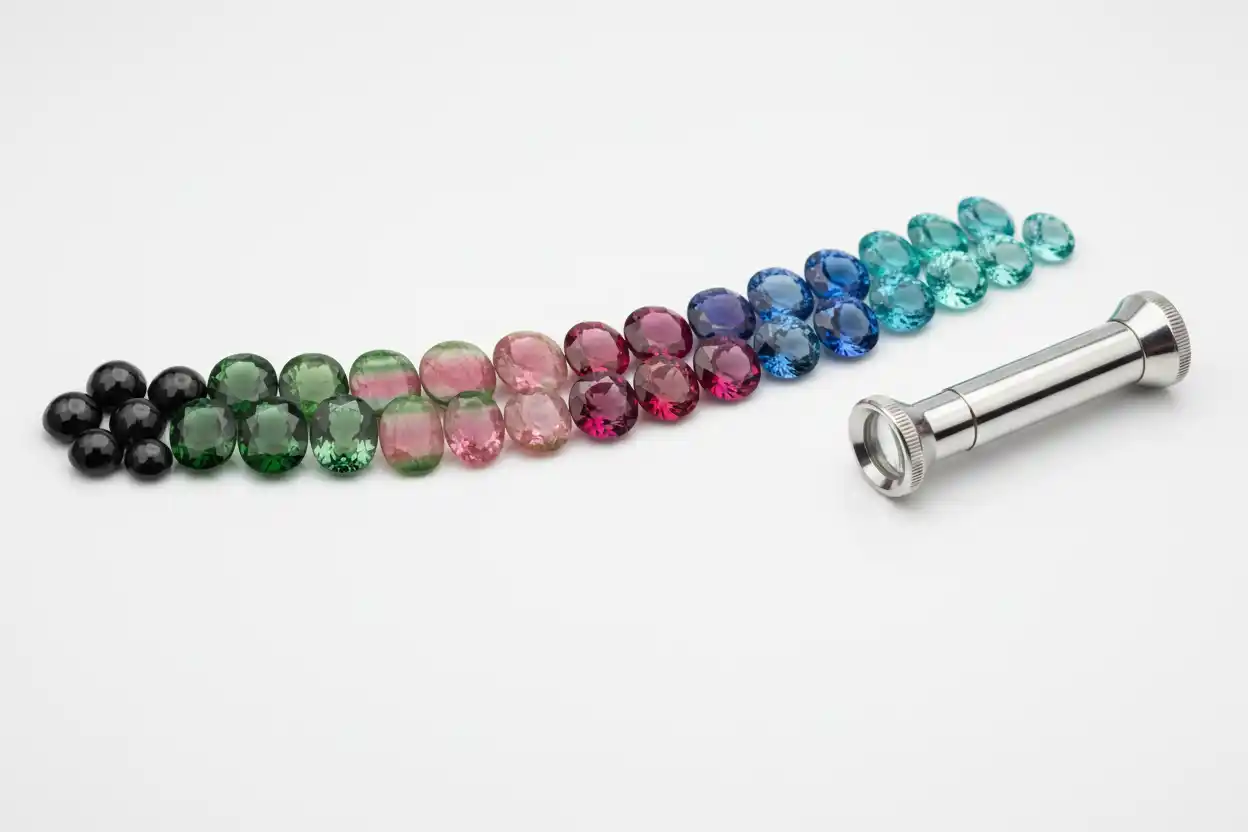
Tourmaline Price Guide: Value and Cost in 2026
Tourmaline prices in 2026 range from below $10 per carat for ordinary Black Tourmaline to more than $100,000 per carat for exceptional Brazilian Paraíba Tourmaline. Most attractive green, pink, blue and multicolored jewelry Tourmalines sell between approximately $50 and $2,000 per carat.
The variety must be identified before comparing prices. Rubellite, Indicolite, Chrome Tourmaline, Watermelon Tourmaline and Paraíba Tourmaline follow different markets, while ordinary black, brown and pale-green material remains comparatively inexpensive.
Tourmaline Prices by Variety in 2026
| Tourmaline variety | Broad 2026 retail range | Main value factors |
|---|---|---|
| Black Tourmaline | $1–$50 per carat equivalent | Crystal form, polish and size |
| Commercial Green Tourmaline | $20–$200 per carat | Saturation, tone and cut |
| Fine Verdelite | $150–$800 per carat | Bright green color and clarity |
| Pink Tourmaline | $50–$800 per carat | Saturation, clarity and cut |
| Rubellite | $100–$3,000+ per carat | Vivid red color, transparency and size |
| Indicolite | $100–$2,000+ per carat | Blue color, clarity and cutting |
| Watermelon Tourmaline | $20–$500+ per carat | Zoning, symmetry and cutting style |
| Chrome Tourmaline | $200–$2,000+ per carat | Vivid green color and rare size |
| Paraíba Tourmaline | $1,000–$100,000+ per carat | Neon color, copper, origin and size |
| Color-Change or rare collector Tourmaline | $300–$5,000+ per carat | Strength of change and rarity |
These ranges overlap. A fine vivid green non-cuprian Tourmaline may cost more than a weak low-saturation copper-bearing stone, while a clean Rubellite can outperform an included Indicolite.
The broader relationship among color, size and demand appears in How Gemstone Prices Are Determined.
What Is Tourmaline?
Tourmaline is a complex group of boron-bearing silicate minerals.
The major gem species include elbaite, liddicoatite, dravite, uvite and schorl. Their compositions vary, producing an unusually broad color range.
Tourmaline occurs in black, brown, yellow, green, blue, pink, red, purple, colorless and multicolored crystals.
Some gems display several colors within one crystal, while others show strong pleochroism or color change.
The completed Tourmaline guide owns the family’s mineralogy, formation and traditional symbolism. The completed Types of Tourmaline page owns the full variety classification.
This article compares their current markets without replacing dedicated variety price guides.
Color Is the Main Tourmaline Value Factor
Tourmaline prices are driven primarily by color.
Fine stones should show attractive hue, strong saturation and enough brightness to avoid extinction.
Paraíba’s neon blue-green, Rubellite’s vivid raspberry red, Chrome Tourmaline’s saturated green and Indicolite’s fine blue command strong premiums.
Pastel colors can also be valuable when they are clean, well cut and fashionable. Gray, peach, lilac and mint Tourmalines have developed designer markets despite lower traditional saturation.
Brown, muddy, overly dark and weakly saturated material normally costs less.
Color should be evaluated under daylight-equivalent and indoor light because Tourmaline can shift noticeably with illumination and viewing direction.
The symbolic associations of these colors belong to Tourmaline Color Meaning and Symbolism.
Green Tourmaline Prices
Green Tourmaline is one of the largest commercial categories.
Ordinary dark or yellowish-green stones may cost approximately $20 to $100 per carat. Attractive bright-green gems commonly range from $100 to $500 per carat.
Fine blue-green, forest-green or mint-green material with strong transparency can reach $500 to $1,000 per carat.
Excessively dark stones may look almost black indoors. A premium green gem should remain lively and reveal color across most of its face.
Green Tourmaline may be described as Verdelite, although the term is used broadly rather than as one strict laboratory grade.
Larger clean stones are available, so size premiums remain moderate unless the color is exceptional.
Chrome Tourmaline Prices
Chrome Tourmaline is vivid green Tourmaline colored principally by chromium, often with vanadium also contributing.
Most fine stones come from East Africa and belong to the dravite or uvite side of the Tourmaline group rather than ordinary green elbaite.
Commercial material may cost approximately $200 to $600 per carat.
Fine bright-green stones commonly range from $500 to $2,000 per carat. Exceptional gems above three or five carats can rise higher.
Chrome chemistry does not automatically create value. The stone must remain vivid, transparent and well cut.
Dark green material containing chromium can still be less valuable than a brighter non-chrome Tourmaline.
Pink Tourmaline Prices
Pink Tourmaline ranges from pale blush and peach-pink to bubblegum, hot pink and reddish pink.
Commercial stones commonly cost approximately $50 to $300 per carat.
Fine saturated and eye-clean gems may reach $300 to $800 per carat, while vivid red-pink material can move into the Rubellite market.
Pink Tourmaline is commonly more included than green material, particularly when its saturation approaches red.
The completed Pink Tourmaline guide owns the variety’s meaning and material context.
A pale pink stone should not receive Rubellite pricing merely because a seller uses the more prestigious red-variety name.
Rubellite Prices
Rubellite is the saturated red-to-pink-red Tourmaline market.
Most commercial-to-fine stones range from approximately $100 to $1,500 per carat. Premium clean and vivid gems may reach $1,500 to $3,000 per carat or more.
The completed Rubellite guide owns the material’s identity, while current price tiers appear in the Rubellite Price Guide.
Rubellite should remain red, raspberry or pink-red under several lighting conditions. Stones that become brown, nearly black or weakly pink indoors receive lower prices.
Visible inclusions are accepted more readily than in pastel Tourmaline, but open fractures and extensive filling reduce value.
Indicolite Prices
Indicolite is blue Tourmaline whose color is not primarily defined by the copper-bearing Paraíba category.
Commercial blue-green or gray-blue stones may cost approximately $100 to $500 per carat.
Fine saturated blue and teal-blue gems commonly range from $500 to $2,000 per carat. Exceptional clean stones in rare sizes can cost more.
Dark tone is one of the main market problems. Many Indicolites appear attractive under backlighting but almost black face-up.
The completed Indicolite guide owns material context, while detailed price tiers appear in the Indicolite Price Guide.
The Indicolite Buying Guide owns detailed inspection rather than this family summary.
Paraíba Tourmaline Prices
Paraíba Tourmaline occupies the highest Tourmaline market.
Copper and manganese create vivid blue, greenish-blue, turquoise and violet colors.
Commercial copper-bearing material may begin near $1,000 to $5,000 per carat. Fine Mozambique gems commonly reach $10,000 to $35,000 per carat.
Fine Brazilian stones may range from $30,000 to $100,000 per carat or more.
The Paraiba Tourmaline Price Guide owns detailed origin and pricing tiers. The Paraiba Tourmaline Buying Guide owns laboratory and seller checks.
The completed Paraiba Tourmaline guide owns the variety’s identity.
A copper result does not guarantee neon appearance. Weak, gray or overly green material should remain below top market prices.
Watermelon Tourmaline Prices
Watermelon Tourmaline displays pink or red centers surrounded by green outer zones, or related combinations of green and pink.
Commercial slices and cabochons may cost approximately $20 to $100 per carat.
Fine transparent slices, matched zoning and well-cut faceted stones can reach $100 to $500 per carat or more.
The Watermelon Tourmaline Price Guide owns detailed pricing. The completed Watermelon Tourmaline guide owns material context.
Detailed selection belongs to the Watermelon Tourmaline Buying Guide.
The ideal color distribution depends on the cutting style. A slice is valued for graphic zoning, while a faceted stone must also return light effectively.
Black Tourmaline Prices
Black Tourmaline usually refers to schorl, the iron-rich Tourmaline species.
Raw crystals, polished pieces and beads are widely available.
Commercial material may cost only a few dollars per carat equivalent or be sold by gram, kilogram or specimen.
Fine terminated crystals with strong luster and documented locality can cost considerably more as mineral specimens.
The Black Tourmaline guide owns material context, while seller selection belongs to Where to Buy Real Black Tourmaline.
Black Tourmaline should not be priced from transparent red, blue or Paraíba markets simply because it belongs to the same mineral group.
Bicolor and Multicolor Tourmaline
Tourmaline crystals can display two, three or several color zones.
Bicolor stones may combine pink and green, blue and green, yellow and green or colorless sections with saturated ends.
Commercial bicolor stones may cost approximately $50 to $300 per carat. Fine clean gems with distinct attractive zoning can reach $300 to $1,000 per carat.
The cutter must orient the zones so they remain visible through the crown. A strong side view with weak face-up separation has less value.
Symmetrical zoning is desirable but not mandatory. Artistic color placement can create premiums when the stone remains bright and well proportioned.
Color-Change Tourmaline
Color-Change Tourmaline shifts under different lighting conditions.
Possible changes include green to red, olive to brownish red, blue-green to purple or violet to red.
Commercial stones may cost approximately $300 to $1,000 per carat.
Fine gems with a strong and attractive change can reach $1,000 to $5,000 per carat.
Both colors must be desirable. A shift from pleasant green to muddy brown creates less value than a strong green-to-red change.
Color-change claims should be demonstrated in video under standardized daylight-equivalent and incandescent illumination.
Clarity and Inclusion Standards
Clarity expectations vary by Tourmaline color.
Green and many pastel Tourmalines are usually expected to appear eye-clean.
Pink, red, blue, bicolor and Paraíba material commonly contains more tubes, healed fissures and liquid inclusions.
Fine color can justify some inclusion tolerance. However, dense clouds, open fractures and black crystals still reduce price.
Surface-reaching fissures deserve particular attention because they may contain oil or resin.
A seller’s clarity grade should not be treated as a universal laboratory standard.
Cut Quality and Pleochroism
Tourmaline crystals commonly grow as elongated prisms and show strong pleochroism.
Cutters often use emerald cuts, long ovals, cushions, pears and rectangular mixed cuts.
The darkest optical direction may be oriented through the narrow side rather than the table. Poor orientation can make a blue or green stone look nearly black face-up.
A shallow pavilion creates windowing. Excessive depth adds hidden weight and can intensify darkness.
Fine cutting must balance color direction, inclusions, zoning and face-up size.
Detailed purchasing criteria belong to the Tourmaline Buying Guide.
Tourmaline Prices by Size
| Carat weight | Ordinary green, pink or bicolor | Fine Rubellite or Indicolite | Paraíba or exceptional rare color |
|---|---|---|---|
| Under 1 ct | $20–$300 per carat | $200–$1,000 per carat | $1,000–$20,000+ per carat |
| 1–3 ct | $50–$500 per carat | $400–$2,000 per carat | $3,000–$50,000+ per carat |
| 3–5 ct | $75–$700 per carat | $700–$3,000 per carat | $5,000–$75,000+ per carat |
| 5–10 ct | $100–$1,000 per carat | $1,000–$4,000 per carat | Individually evaluated |
| Above 10 ct | Color and cutting dominate | Rare clean stones gain premiums | Major collector market |
Size premiums differ sharply by variety. Large green and pink Tourmalines are available, while clean Brazilian Paraíba and fine cobalt-like blue stones become exceptionally scarce.
Brazil, Africa, Afghanistan and Pakistan
Brazil is one of the most diverse Tourmaline sources, producing green, pink, red, blue, multicolor and copper-bearing material.
Mozambique and Nigeria produce Paraíba-type, Rubellite, green and multicolored Tourmalines.
Tanzania supplies Chrome, Rubellite and other varieties.
Afghanistan and Pakistan are known for pink, green, blue and bicolor elbaite crystals, often in attractive mineral-specimen form.
Madagascar produces a similarly broad palette.
Origin affects price strongly only in specific markets, such as Brazilian Paraíba or documented classic mineral specimens. Visible quality remains central.
Treatments
Tourmaline treatments include:
- Heat to lighten dark stones or modify secondary colors
- Irradiation to create or strengthen pink and red
- Oil or resin filling of surface-reaching fractures
- Coatings for unusual surface colors
- Experimental color treatments
Heat and irradiation can be difficult to detect in some stones.
Clarity filling is particularly relevant in Rubellite, Paraíba and bicolor material because fractures are common and the varieties have enough value to justify enhancement.
The completed family care guide How to Clean Tourmaline Jewelry Safely owns maintenance consequences.
The general treatment framework appears in Gemstone Treatments Explained.
Tourmaline Jewelry Prices in 2026
| Jewelry type | Broad U.S. retail range |
|---|---|
| Silver jewelry with Black or commercial Tourmaline | $30–$500 |
| Gold pendant or earrings with green or pink Tourmaline | $400–$4,000 |
| Fine Rubellite or Indicolite ring | $2,000–$15,000+ |
| Watermelon or multicolor designer jewel | $1,000–$10,000+ |
| Fine Paraíba jewel | $20,000 to millions |
| Signed high-jewelry Tourmaline piece | Individually evaluated |
Style-specific guidance belongs to the Tourmaline Ring Guide, Tourmaline Earrings Guide, Tourmaline Necklace Guide and Tourmaline Bracelet Guide.
Tourmaline’s birthstone role belongs to the October Birthstone Guide.
Certification and Resale Value
Ordinary Black, green and pink Tourmaline often does not require a major laboratory report.
Documentation becomes more important for:
- Paraíba identity and geographic origin
- Cobalt, chrome or other premium color claims
- Significant fracture filling
- Natural versus synthetic identity
- High-value Rubellite or Indicolite
- Major bicolor or collector stones
Fine Paraíba, Rubellite, Indicolite and Chrome Tourmaline have stronger collector potential than ordinary commercial material.
However, resale remains dependent on finding a specialist buyer. The broader framework appears in Do Gemstones Hold Their Value?.
Online buyers should verify reports and return terms through How to Buy Gemstones Online Without Getting Scammed.
The Buying & Value hub connects this family guide with its dedicated variety pages.
Frequently Asked Questions
1. How much is Tourmaline worth per carat in 2026?
Tourmaline ranges from below $10 per carat for ordinary Black Tourmaline to more than $100,000 per carat for exceptional Brazilian Paraíba.
2. Which Tourmaline color is most valuable?
Neon Paraíba blue-green generally occupies the highest market, followed by top cobalt-like blue, vivid red Rubellite and Chrome-green stones.
3. How much is Green Tourmaline?
Most Green Tourmaline costs approximately $20 to $800 per carat. Exceptional vivid stones may cost more.
4. How much is Pink Tourmaline?
Commercial Pink Tourmaline commonly ranges from $50 to $300 per carat. Fine saturated stones may reach $300 to $800 per carat.
5. How much is Rubellite?
Most Rubellite costs approximately $100 to $1,500 per carat. Exceptional clean stones may exceed $3,000 per carat.
6. How much is Indicolite?
Indicolite commonly ranges from $100 to $2,000 per carat, depending on blue saturation, darkness and clarity.
7. How much is Watermelon Tourmaline?
Most Watermelon Tourmaline costs approximately $20 to $500 per carat, depending on zoning, transparency and cut.
8. Why is Paraíba Tourmaline so expensive?
Its neon copper-bearing color, limited fine supply, origin premiums and international high-jewelry demand create exceptional prices.
9. Does large Tourmaline cost more per carat?
Only in scarce quality categories. Large ordinary green and pink stones are available, while top Paraíba and vivid red-blue material receive steep premiums.
10. Is Tourmaline normally treated?
Heat, irradiation and fracture filling occur, although treatment frequency differs by color and variety.
11. Does Tourmaline need a laboratory report?
Commercial stones often do not. Reports are advisable for Paraíba, premium origin, major filling and expensive rare-color claims.
12. Is Tourmaline a good investment?
Exceptional Paraíba, Rubellite, Chrome and blue stones can attract collectors, but ordinary Tourmaline has limited resale liquidity.
Tourmaline Is a Family of Separate Price Markets
A Black Tourmaline crystal, a pink elbaite, a Rubellite and a Brazilian Paraíba share a mineral-group name but differ enormously in appearance, scarcity and demand.
In 2026, ordinary transparent Tourmaline commonly falls between $50 and $1,000 per carat. Prices above that range should correspond to vivid rare color, unusual clean size, specialized origin or laboratory evidence—not the Tourmaline name alone.