Buy Diaspore: Buyer Essentials, Provenance, Treatments & Returns
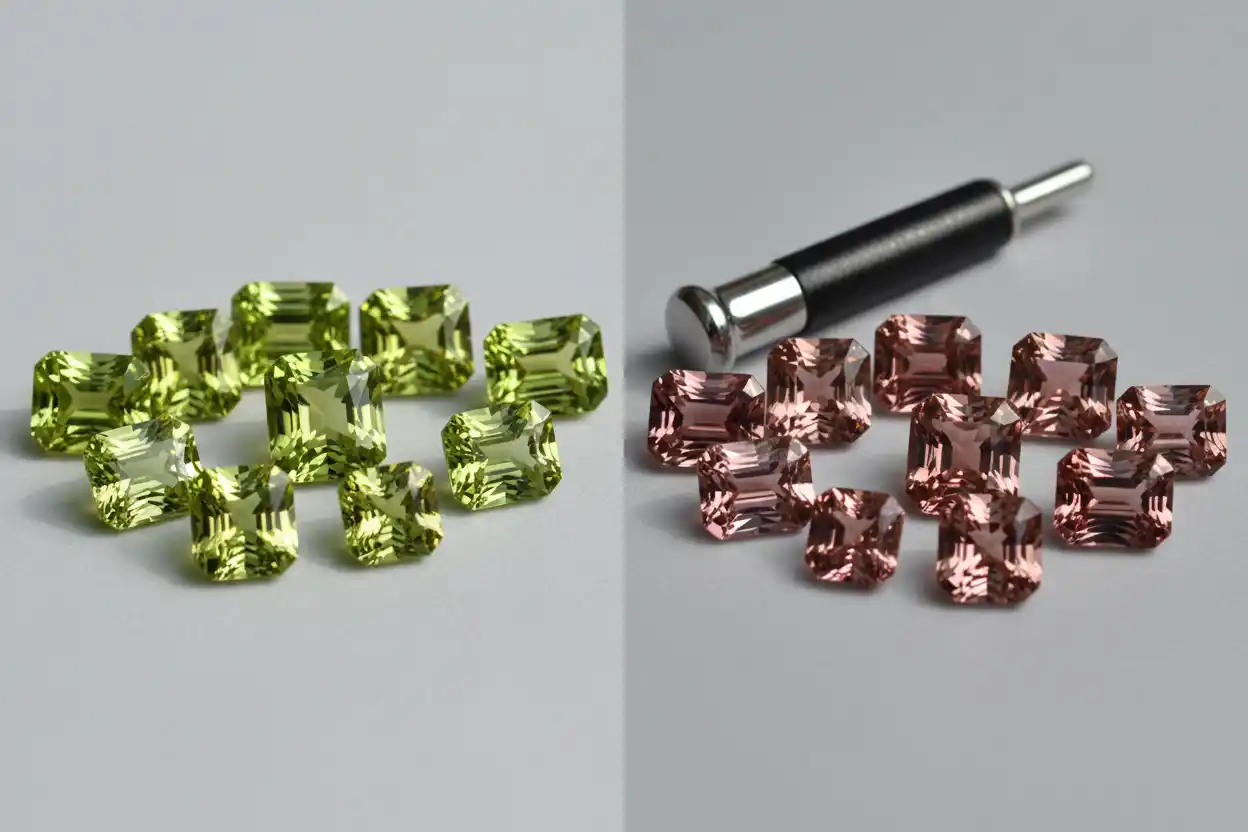
Buying diaspore requires more than finding a gemstone that appears green in one photograph and pink in another. Fine color-change diaspore is valued for the way its color responds to different illumination, so the most important buying question is whether the change is genuinely strong, attractive, and visible under realistic lighting rather than created by photography, editing, or unusually colored lamps.
Current retail inventory also shows why price comparisons need context. Many unbranded yellow color-change diaspore stones below about 1.5 carats currently sell around $30 to $55 per carat, while larger examples can rise sharply. A 6.65-carat cushion has recently been listed around $3,132, or roughly $472 per carat. Branded Zultanite with strong color change can be positioned much higher, with published suggested retail figures beginning around $750 per carat for stones below one carat.
That spread makes provenance, trade-name use, color-change strength, cut orientation, transparency, size, and seller disclosure central to a sensible purchase. Do not assume that every diaspore showing some color change belongs in the same price tier.
Buy Diaspore At a Glance
| Buying factor | Stronger buying signal | Warning sign |
|---|---|---|
| Color change | Clear shift between daylight-balanced and warm light | Only one heavily edited comparison photo |
| Daylight appearance | Lively greenish or yellowish-green hue | Flat gray or muddy brown |
| Warm-light appearance | Distinct pinkish, peach, champagne, or brownish-pink shift | Almost no visible difference |
| Transparency | Bright face-up appearance with limited distracting inclusions | Heavy cloudiness or fractures |
| Cut | Good orientation that shows color change and brightness | Deep, windowed, or poorly oriented cut |
| Provenance | Seller explains source and basis for the claim | Turkish origin claimed without support |
| Trade name | Zultanite or Csarite used with clear explanation | Trade name presented as a different mineral species |
| Treatment | Written disclosure or clear untreated statement | Seller refuses to discuss enhancement |
| Condition | Clean facet edges and sound girdle | Chips, fractures, abrasion, or damaged corners |
| Returns | Inspection period under your own lighting | Final sale with weak photography |
A good purchase should remain attractive before, during, and after the color change. A dramatic shift is less valuable if one lighting condition makes the gemstone look dull or muddy.
Understand What Diaspore Is Before Comparing Listings
Diaspore is an aluminum oxyhydroxide gemstone with the formula AlO(OH). Gem-quality transparent crystals can display strong pleochroism, meaning different colors appear along different crystal directions. Some specimens also show a distinct color change between daylight-equivalent and warmer illumination.
GIA research has documented color-change diaspore shifting from brownish green or yellowish green under daylight-style illumination toward brownish pink or pinkish brown under warmer light. The change is linked to trace elements including chromium, vanadium, iron, and titanium, while crystal orientation strongly affects what the viewer sees.
That directional behavior matters when buying because two gemstones with similar weight can look very different after cutting. A cutter who understands the crystal can orient the stone to emphasize its most appealing combination of color change, pleochroism, and brightness.
The diaspore meaning separates the gemstone’s mineral identity and history from the symbolic associations attached to it. Those symbolic interpretations should not be used as evidence of quality or financial value.
Judge the Color Change Under Realistic Lighting
Color change is usually the first characteristic buyers notice, but photographs can exaggerate it easily. White balance, camera processing, colored backgrounds, LED spectrum, exposure, and image editing can make two photographs of the same gemstone appear far more different than the stone looks in person.
A stronger listing shows the same diaspore under at least two clearly identified light sources. Daylight-balanced illumination should reveal its greenish, yellowish-green, or related face, while a warmer source may move it toward pinkish, champagne, peach, or brownish-pink tones.
Ask for video if the price is substantial. Continuous video showing the stone moving from one lighting environment to another is harder to manipulate convincingly than two unrelated still images.
The best specimens maintain brightness in both conditions. A gemstone that shifts dramatically but becomes dark and lifeless in one environment may be less attractive than a subtler stone that remains lively throughout the change.
Zultanite and Csarite Are Trade Names
Zultanite and Csarite are commercial names associated with color-change diaspore rather than separate mineral species. A seller using either term should still identify the gemstone as diaspore.
This distinction matters because branded pricing can be much higher than ordinary unbranded diaspore pricing. Current mainstream inventory contains many small color-change stones around $30 to $55 per carat, yet published Zultanite suggested retail pricing begins around $750 per carat below one carat and rises through higher weight bands.
Those figures describe different commercial positions, not a contradiction in mineral identity.
A trade name can reflect branding, provenance claims, controlled distribution, cutting standards, or seller positioning. It should not be treated as proof that one gemstone is automatically superior to every unbranded diaspore.
The diaspore price therefore makes more sense when branding, actual appearance, size, provenance, and retail channel are separated rather than blended into one average figure.
Provenance Claims Need Careful Interpretation
Turkey, particularly southwestern Turkey, has become strongly associated with transparent color-change diaspore in the modern gem trade. Important commercial production from this region helped establish Zultanite and other trade-name branding.
Diaspore itself occurs in other parts of the world. GIA has also documented gem-quality examples reported from Myanmar and purplish-pink specimens reportedly originating in Afghanistan. Geographic occurrence alone does not mean every locality produces equivalent transparent color-change stones.
A seller claiming Turkish provenance should be able to explain the basis for that statement. Mine invoices, established supply relationships, older documentation, or specialist provenance records can add credibility, but appearance alone cannot prove a precise source.
Origin becomes more important when it carries a substantial premium. A lower-priced attractive diaspore does not necessarily need elaborate provenance paperwork, while a high-priced branded or collector stone deserves stronger support.
Cut Orientation Can Matter More Than Weight
Diaspore is strongly directional optically, so cutting has an unusually important role in what the buyer sees. Poor orientation can emphasize a weak or unattractive hue while reducing the apparent strength of the color shift.
A properly oriented gem should show an appealing dominant color face up rather than forcing the buyer to tilt it sharply to find the best hue. The facets should also return enough light to keep the gemstone lively.
Windowing is a common issue worth checking. If you can see straight through the center of the gem instead of seeing returned light, the cut may have sacrificed brilliance. Excessive depth creates the opposite problem by hiding weight underneath without adding much visible size.
The diaspore quality grading is therefore best judged through color change, face-up color, transparency, cut orientation, dimensions, condition, and provenance together.
Size Can Change the Price Sharply
Current diaspore inventory demonstrates that price does not rise evenly with weight. Small commercial-quality stones around 0.5 to 1.5 carats can sell for only a few tens of dollars each. Current examples include a 0.90-carat emerald cut around $28, a 1.18-carat emerald cut near $55, a 1.37-carat pear around $66, and a 1.50-carat emerald cut around $81.
A current 6.65-carat cushion is listed near $3,132, equivalent to roughly $472 per carat. That difference reflects more than weight. Maintaining attractive color change, transparency, and good cutting becomes harder as the finished gemstone becomes larger.
Branded suggested pricing introduces another tier entirely, with per-carat figures increasing through defined size bands. Buyers should therefore determine whether they are comparing ordinary retail inventory, branded stock, precision-cut collector gems, or another market segment.
The diaspore price per carat is useful only after the gemstones being compared have similar color-change strength, quality, provenance, and commercial positioning.
Transparency and Inclusions Need Context
Fine faceted diaspore should transmit light well enough to show its colors clearly. Eye-visible fractures, heavy clouds, or dense inclusions can reduce brightness and lower value, particularly in a gem sold at a premium.
Absolute perfection is not required. A minor inclusion near the edge may have little effect on beauty, while a large fracture through the center can be much more significant. Surface-reaching fissures deserve attention because diaspore already has perfect cleavage and can be vulnerable to impact.
Clarity should therefore be judged face up first and under magnification second. If the stone looks bright and clean during normal viewing, a small internal feature may matter less than strong color change and effective cutting.
Do not pay heavily for a seller-created VVS or “flawless” label without considering the complete gemstone. Diaspore does not have one universal commercial grading system used consistently by every retailer.
Treatments Should Be Disclosed Clearly
Natural color-change diaspore does not need enhancement to display its characteristic optical effect. GIA literature on Turkish gem-quality diaspore has described naturally attractive color-change stones without a need for routine color or clarity enhancement.
Research has also documented experimental irradiation involving purplish-pink diaspore reportedly from Afghanistan. Those experiments produced an undesirable dark brownish-orange result and were not evidence of a normal commercial treatment practice.
The sensible buying approach is therefore simple: ask the seller whether the gemstone has received any known color, clarity, coating, irradiation, filling, or other enhancement. If the answer is “untreated,” request that description on the invoice when the claim materially affects the price.
A laboratory identification report can support identity and detectable treatment findings when the purchase price justifies testing. A report should not be confused with a monetary appraisal.
Perfect Cleavage Changes the Durability Question
Diaspore has a Mohs hardness around 6.5 to 7, but hardness does not tell the whole durability story. The gemstone has perfect cleavage in one direction, meaning a sufficiently strong impact along that plane can split or chip it. GIA describes diaspore as brittle despite its useful hardness.
This makes earrings and pendants easier everyday choices than exposed rings. A ring can still work, particularly for occasional wear, but protective setting design deserves attention.
Inspect pointed shapes and thin girdles especially carefully. Marquise ends, pear tips, corners, and surface-reaching fractures can increase vulnerability. A setter experienced with cleavage-sensitive gems is preferable for an expensive loose stone.
Returns are particularly important if the gemstone will be mounted after purchase. Inspect it carefully before setting because many sellers will not accept a return after a loose gem has been altered or mounted.
How Much Should You Pay?
There is no single fair diaspore price because current markets overlap. Mainstream dealer inventory shows many smaller yellow color-change stones around roughly $30 to $55 per carat. Larger attractive stones can move into the hundreds of dollars per carat, as demonstrated by a current 6.65-carat example near $472 per carat.
Branded Zultanite occupies a different tier. Published suggested retail figures from the brand holder start around $750 per carat below one carat, rise to $1,000 per carat from 1.00 to 1.24 carats, $2,400 per carat from 2.00 to 2.99 carats, and $4,000 per carat from 5.00 to 7.99 carats. These are suggested brand pricing figures, not evidence that every diaspore of the same weight has that market value.
A reasonable price should match the exact gemstone you are receiving: color-change strength, brightness, clarity, cutting, size, condition, provenance, branding, documentation, and return rights.
Returns Are Especially Important for Diaspore
Diaspore is unusually dependent on lighting, which makes a return period more valuable than it is for many straightforward single-color gemstones. A gem that looks spectacular under a dealer’s photography setup may show a weaker change in your own home, office, or outdoor environment.
Check the gemstone under daylight, warm household lighting, and mixed indoor light before deciding to keep it. Look at the change itself, but also ask whether you like each individual color.
Inspect the facet edges, girdle, corners, and surface under magnification. Small chips are particularly important because of diaspore’s cleavage.
The seller should also allow enough time to compare the gemstone with the description and any accompanying documentation. Final-sale terms are much harder to justify when the listing relies heavily on dramatic color-change photography.
Do Not Pay for Symbolism as Though It Were Gem Quality
Diaspore has acquired symbolic interpretations in modern crystal culture, but these ideas are separate from gemological evaluation. They do not make one stone cleaner, rarer, better cut, or more valuable.
The diaspore benefits should therefore be understood within cultural and personal-practice contexts rather than used as evidence for therapeutic effectiveness or a financial premium.
Market value comes from observable gem characteristics and commercial demand. A seller charging more because a particular diaspore supposedly attracts wealth, changes energy, or produces medical effects is not providing a recognized gemological value factor.
Conclusion
A strong diaspore purchase combines a convincing color change, attractive colors under more than one light source, good transparency, effective cut orientation, sound condition, credible provenance, clear treatment disclosure, and fair return terms. Compare unbranded and branded stones separately, verify how photographs were made, and do not judge value by carat weight or trade name alone.
FAQs
What should I look for when buying diaspore?
Look for an attractive color change, bright face-up appearance, good transparency, effective cutting, sound facet edges, credible provenance, treatment disclosure, and a practical return period.
How much does diaspore cost?
Many current small unbranded color-change diaspores sell around $30 to $55 per carat, while larger or stronger examples can rise into hundreds of dollars per carat. Branded Zultanite can be positioned considerably higher.
Is Zultanite the same as diaspore?
Zultanite is a commercial trade name associated with color-change diaspore. It is not a separate mineral species.
Is Csarite also diaspore?
Yes. Csarite is another trade name used for color-change diaspore.
How can I tell whether diaspore really changes color?
View the same gemstone under daylight-balanced light and a warm incandescent-style source. A genuine color-changing stone should show a repeatable shift rather than only looking different in unrelated photographs.
Is Turkish diaspore more valuable?
Turkish color-change diaspore has strong commercial recognition, especially through branded goods. Value still depends on the individual gem’s color change, transparency, cutting, size, condition, and provenance.
Is diaspore usually treated?
Natural diaspore can display its color change without enhancement. Buyers should still request written disclosure of any known treatment, especially when paying a premium.
Is diaspore good for a ring?
Diaspore can be worn in a ring, but its perfect cleavage makes it more vulnerable to impact than its hardness alone suggests. Protective settings and careful wear are sensible.
Why are large diaspore gemstones more expensive?
Large stones that retain strong color change, transparency, and good cutting are more difficult to obtain. Their per-carat price can therefore rise significantly rather than increasing only with total weight.
Does a laboratory report prove Turkish origin?
An identification report can support gemstone identity and detectable treatments, but buyers should verify exactly what the specific laboratory report states. Do not assume every report establishes geographic origin.
Does an AAA grade mean high-quality diaspore?
Not necessarily. AAA and similar labels are seller-created unless a specific grading system is clearly defined. Evaluate actual color change, transparency, cutting, size, condition, and documentation.
Does diaspore have good resale value?
Resale depends on quality, branding, provenance, documentation, size, collector demand, and the buyer available at the time. A high retail asking price does not guarantee an equal future cash resale price.
Price disclaimer: Diaspore prices vary with color-change strength, size, transparency, cutting, provenance, branding, condition, treatment disclosure, seller margins, and market demand, so current retail figures should be treated as comparison benchmarks rather than guaranteed resale values.