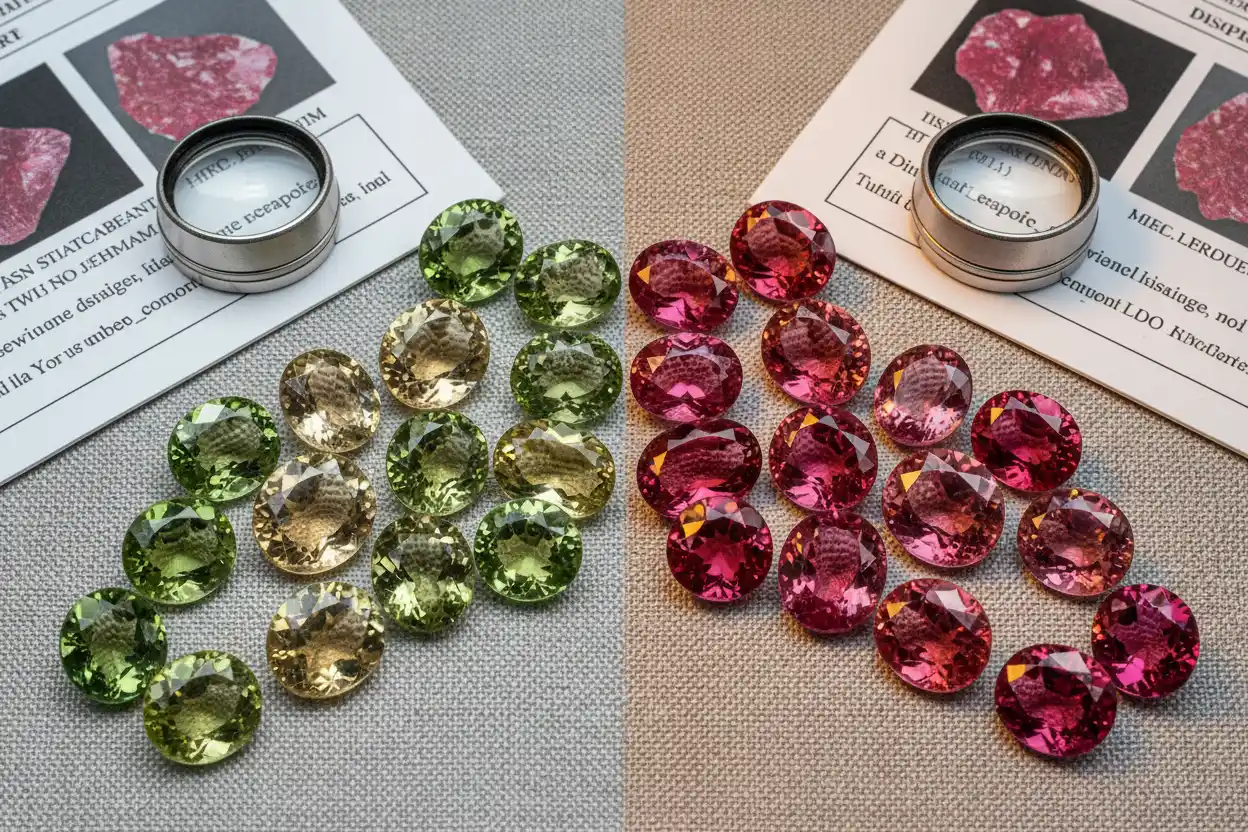
Diaspore Price: Buyer Value Guide, Rarity, Demand & Treatments
Diaspore price is determined by a combination of color-change strength, daylight and warm-light color quality, pleochroism, transparency, cut orientation, size, condition, provenance, treatment disclosure, and market demand rather than by carat weight alone. Gem-quality diaspore is an aluminum oxyhydroxide mineral, and notable color-change material can shift from greenish or yellowish tones under daylight-equivalent illumination to pinkish or brownish tones under warmer incandescent-style light. GIA research connects this phenomenon with trace-element chromophores and emphasizes that crystal orientation is important when studying and cutting diaspore because its optical response changes strongly with direction.
That directional behavior makes diaspore especially difficult to reduce to a simple price-per-carat chart. Two stones of identical weight can display very different strength of color change, face-up brightness, pleochroic balance, cutting quality, visible fractures, and dimensions. A beautifully oriented smaller gem may therefore command stronger demand than a larger stone whose cutter retained more weight but sacrificed the optical effect. Buyers researching an actual purchase should begin with the Gems Lore guide on how to buy diaspore, because identity, trade names, cleavage, lighting conditions, and seller provenance all influence whether two quoted prices are truly comparable.
Diaspore Price At a Glance
| Value Factor | Stronger Value Signals | Factors That Can Lower Value |
|---|---|---|
| Color Change | Distinct, attractive shift between cool and warm light | Weak, muddy, incomplete, or heavily brown-dominated change |
| Daylight Color | Lively greenish, yellowish-green, or attractive balanced hue | Dull gray, weak yellow-brown, or low brightness |
| Warm-Light Color | Appealing pinkish, peach, rose-brown, or related shift | Flat brown appearance with little attractive contrast |
| Pleochroism | Attractive directional colors used effectively by the cut | Poor orientation that presents the least desirable directional color |
| Cut | Strong brightness, balanced proportions, minimal windowing | Excess depth, large window, weak symmetry, poor orientation |
| Size | Larger gem retaining excellent color change and transparency | Extra weight with weaker optics or hidden depth |
| Clarity | High transparency with limited distracting fractures | Cleavage-related fissures, chips, cloudy zones, durability concerns |
| Phenomenon | Fine cat’s-eye effect combined with color change | Weak or poorly centered eye |
| Provenance | Credible Turkish or other documented source history | Seller-only locality story without supporting evidence |
| Treatment | Clear, documented treatment status | Unexplained enhancement or unsupported “untreated” premium |
| Condition | Crisp facets, intact girdle, no cleavage damage | Chips, bruises, scratches, fractures, repolishing |
| Documentation | Reliable identification report | Trade-name card or seller certificate presented as independent laboratory proof |
| Market Context | Strong collector demand for fine optical performance | Generic commercial material with weak change or poor cutting |
Color Change Is Usually the Central Value Driver
Color-change diaspore is sought because the stone can present visibly different dominant hues under different light sources. GIA has documented Turkish material shifting from brownish green or yellowish green in daylight or fluorescent illumination to brownish pink or pinkish brown under incandescent light. Historical GIA examination of Turkish stones with a distinct change included faceted examples from 3.38 to 16.44 carats, showing that jewelry-sized material can occur across a meaningful range of sizes.
The strongest color-change premium generally requires more than two different photographs. A fine gem should produce a convincing visual shift when the same stone moves between appropriately different light sources, while retaining enough brightness to remain attractive in each environment. A stone that appears greenish only under one highly specific LED and brown under nearly everything else may not attract the same demand as one that shows a cleaner and more balanced transition under practical lighting.
Magnitude of change also needs to be separated from beauty of color. A dramatic shift from an unattractive muddy green to an unattractive dark brown can be stronger numerically than a subtler green-to-pink transition, yet the second stone may be more desirable because both appearances are visually pleasing. Price therefore reflects both change strength and the quality of each endpoint color.
Lighting Can Make Diaspore Price Comparisons Difficult
Color-change gems are unusually vulnerable to photographic exaggeration because camera white balance, exposure, background, color-temperature settings, and image processing all influence recorded color. Diaspore can look dramatically different when photographed under a cool daylight-equivalent lamp and a warm incandescent-style source, but the buyer needs to know whether the images represent what the human eye actually sees.
Continuous video is far more informative than two isolated promotional photographs. The best comparison keeps the same stone, camera position, and background while changing only the illumination. Sellers who disclose the approximate lighting conditions give buyers a stronger basis for judging whether the premium attached to the color-change effect is justified.
A meaningful return period also has economic value. Diaspore may be accurately identified and still disappoint a buyer if the actual change under home, office, or outdoor lighting differs from the seller’s presentation. Transaction protection should therefore be considered part of total value rather than an unrelated service.
Pleochroism Adds Another Layer to Diaspore Value
Color change and pleochroism are different phenomena. Color change depends on the spectral composition of the light source, whereas pleochroism results from different absorption behavior along different crystallographic directions. GIA documented strong trichroism in diaspore, including yellowish green, purple, and brown directional colors in one cat’s-eye specimen.
This directional color makes orientation exceptionally important. A cutter can choose an orientation that strengthens the most attractive face-up hue, improves the warm-light shift, or balances size against optical quality. Poor orientation can leave the buyer looking into a less appealing brownish direction even when the rough possessed more attractive colors along another axis.
The result is a market where cutting decisions can alter value substantially. Carat weight retained through a poor orientation may be less valuable than weight sacrificed to place the best combination of color and change face-up.
Cut Quality Has an Unusually Strong Effect on Diaspore Price
Diaspore’s optical anisotropy and perfect cleavage complicate cutting. A cutter must consider pleochroism, color-change response, cleavage direction, rough shape, inclusions, potential face-up spread, and weight retention simultaneously. The quality of this decision can determine whether a finished stone looks lively or merely heavy.
A large central window can reduce apparent saturation and brightness, while excessive pavilion depth can retain carats that add little visible size. Symmetry and polish also matter because crisp facets help transmit and return light cleanly across the changing color environment.
A precision or custom cut may therefore deserve a legitimate premium over ordinary commercial cutting even when the raw material is comparable. The premium represents skilled orientation and lapidary work, not simply the rarity of the mineral.
Larger Diaspore Can Be Valuable, but Size Is Not a Quality Grade
Diaspore can occur in substantial gem sizes. GIA’s published examples include a 24.60-carat color-change faceted stone used in color-origin research and a 60.71-carat color-change cat’s-eye cabochon examined by the Tokyo laboratory. These examples show that large size is possible and should not automatically be viewed as proof of misrepresentation.
The important question is what happens to quality as size increases. Large clean material with strong color change, good orientation, attractive brightness, and limited cleavage damage can command stronger collector demand because maintaining all of those characteristics in a substantial finished gem is more difficult than producing size alone.
A large stone with a weak change, brown-dominated appearance, poor cut, or major fissures may still be less desirable than a smaller gem with superior optical performance. Weight becomes a value multiplier only when the quality it carries is worth multiplying.
Millimeter Dimensions Matter Alongside Carat Weight
Carat weight measures mass, not face-up visual size. Two diaspores with equal weight can have very different length, width, and depth because one cutter preserved a deep pavilion while another removed more rough to improve proportions.
This is particularly important for a cleavage-sensitive gem. The cutter may retain thickness for structural reasons or avoid certain orientations because of fractures and cleavage planes. The resulting weight can be completely legitimate, yet buyers should still understand whether the stone presents a broad face-up appearance or concentrates its mass underneath the girdle.
For fair comparison, record weight and all three dimensions rather than relying on carat weight alone.
Clarity Has Both Visual and Durability Consequences
Transparent diaspore can show attractive clarity, but internal fissures deserve more attention than simple visual grading because the mineral is brittle and has perfect cleavage. GIA describes gem diaspore as very brittle with perfect cleavage, and its study of cat’s-eye material documented fissures associated with repeated cleavage.
A small internal feature far from the surface may have limited effect on beauty, while a surface-reaching fissure near a corner or girdle can influence setting risk and long-term durability. The buyer should distinguish internal inclusions from actual chips, cleavage cracks, or damage caused after cutting.
Eye-clean material can command a premium when color change and cutting are also strong, but clarity should not be pursued without considering optical personality. Certain included stones may show chatoyancy or other unusual effects that place them in a separate collector category.
Cat’s-Eye Diaspore Occupies a Specialized Market
GIA has documented color-change cat’s-eye diaspore in which aligned needles, tubes, thin films, and fissures created chatoyancy in addition to the change between greenish-yellow and pinkish-brown appearances. Such material combines two optical phenomena and can appeal strongly to collectors when the eye is sharp, centered, mobile, and visible across appropriate lighting.
A cat’s-eye label by itself does not guarantee a high price. Diffuse, broken, off-center, or weak chatoyancy should not receive the same premium as a crisp luminous line. Bodycolor, color-change quality, transparency, size, and condition continue to matter.
Cabochon orientation becomes especially important because the cutter must align the reflective internal structures correctly to create the eye. Poor orientation can waste a rare natural feature.
Turkish Material Has Strong Market Recognition
The modern commercial history of gem color-change diaspore is closely associated with deposits near Pınarcık in Turkey’s Muğla Province. GIA reporting notes that transparent jewelry-quality crystals were historically strongly associated with this area and that consistent commercial supply later entered the market under names such as Zultanite and Csarite.
This history can create a provenance premium, but Turkish origin should not be inferred solely from color change or a trade name. Diaspore exists outside Turkey, and GIA has documented gem material from other localities, including Myanmar and purported Afghan material.
The safest approach is to distinguish a seller’s provenance statement from an independent laboratory origin conclusion. That distinction is especially important because GIA’s current Colored Stone Identification & Origin Report is offered only for a defined list of gemstones, and diaspore is not currently among them.
Zultanite and Csarite Are Trade Names, Not Separate Mineral Species
GIA notes that color-change diaspore is marketed under trade names including Zultanite and Csarite. Those names may carry branding, mine association, or commercial recognition, but the underlying mineral identity remains diaspore.
A higher price attached to a branded name may reflect controlled distribution, provenance documentation, cutting standards, marketing, warranties, or seller positioning. It should not be interpreted automatically as evidence that the material belongs to a mineral species superior to ordinary diaspore.
The most defensible comparison asks whether two stones differ in color-change quality, size, cutting, clarity, provenance, treatment, and documentation—not whether one listing uses the word diaspore and another uses a branded trade term.
Imitation Risk Makes Identification Important
GIA has documented man-made glass sold or represented as Zultanite-like color-change material, demonstrating that a convincing change between different lighting conditions does not establish diaspore identity by itself.
An imitation can reproduce visual color behavior while having completely different chemical composition and physical properties. This matters for price because a visually effective glass imitation may be attractive jewelry material but should not be valued as natural diaspore.
For expensive stones, professional identification reduces the risk of paying a natural-gem premium for another material. GIA’s Colored Stone Identification Report can identify polished loose or mounted material and list detectable treatments while also recording measurements, weight, cutting style, color, and a photograph.
Treatment Status Should Be Considered Without Unsupported Assumptions
Diaspore does not have the same widely publicized routine enhancement profile as emerald, sapphire, or aquamarine, but buyers should not convert that fact into a universal “always untreated” claim. A laboratory identification report is designed to list detectable treatments when applicable.
If a seller charges a significant premium for an untreated statement, ask what supports the claim. Seller knowledge, mine-to-market control, laboratory testing, and assumption are different levels of evidence.
Treatment status should also remain separate from origin. A stone can be natural Turkish diaspore and still require its treatment status to be described independently.
Condition Can Affect Resale More Than Buyers Expect
Diaspore’s perfect cleavage means chips and fractures deserve serious attention in pre-owned material. A stone can retain beautiful color while losing marketability because a corner has split, a girdle is bruised, or an old setting has placed pressure on a cleavage-sensitive area.
Repolishing can sometimes improve surface condition but may remove weight and alter proportions. A collector stone with original precision cutting may also lose part of its craftsmanship value if significantly recut.
Condition should therefore be evaluated separately from natural inclusions. A growth feature inside the gem is not the same thing as damage created after cutting.
Retailer Grades Are Not Universal Diaspore Standards
Terms such as AAA, AAAA, top color, museum grade, collector grade, or investment grade can be useful within one seller’s inventory, but they do not create an internationally standardized diaspore grading system.
Translate every grade into observable characteristics: how strong is the color change, how attractive are the two dominant colors, how well oriented is the stone, how transparent is it, how effective is the cut, how large does it face up, and what evidence supports its provenance?
An undefined grade should never justify a premium on its own.
Retail Asking Price Is Different From Appraisal and Resale Value
A specialist retailer may include cutting costs, sourcing, laboratory testing, photography, returns, warranties, inventory risk, marketing, and profit margin in the asking price. An appraisal may estimate replacement value for insurance or another defined purpose, while a dealer buying a used stone must leave room for testing, holding time, repolishing risk, and resale margin.
A high retail purchase price therefore does not guarantee an equivalent future cash offer. This distinction is particularly important in a specialized market where finding the right collector can take time.
The Gems Lore alexandrite price guide provides a useful comparison because another color-change gem also requires careful separation between optical quality, rarity, laboratory facts, and actual resale value. The andalusite price guide similarly shows why pleochroic appearance and cutting orientation can matter as much as raw weight.
What Usually Raises Diaspore Price?
Stronger prices are easiest to justify when several favorable traits occur together: a distinct and attractive color change, appealing daylight and warm-light hues, effective pleochroic orientation, high transparency, lively cutting, useful face-up dimensions, sound condition, and credible provenance. A fine cat’s-eye effect can create an additional collector premium when the eye is sharp and well positioned.
Large size can magnify those qualities because a substantial stone that retains strong change and clean transparency is more impressive than size alone. Branding or Turkish provenance may create further market premiums, but those should be understood separately from intrinsic gem quality.
What Usually Lowers Diaspore Price?
Weak or unattractive color change, muddy brown appearance, poor orientation, heavy windowing, excessive depth, distracting fissures, chips, cleavage damage, questionable identity, unsupported origin claims, weak documentation, or no meaningful return policy can all reduce what an informed buyer should be willing to pay.
A lower price can still represent excellent value if the compromise matches the buyer’s preferences. Someone who prefers a pale lively stone may not care that its change is less dramatic, while another collector may accept visible inclusions to obtain a rare cat’s-eye effect.
How to Compare Diaspore Prices Fairly
Compare stones on:
- Verified material identity.
- Daylight-equivalent color.
- Warm-light color.
- Strength and attractiveness of color change.
- Pleochroic orientation.
- Carat weight and millimeter dimensions.
- Transparency and fissures.
- Cut proportions, brightness, and windowing.
- Cleavage damage or chips.
- Cat’s-eye effect when present.
- Treatment disclosure.
- Provenance documentation.
- Laboratory identification.
- Seller return and inspection rights.
- Retail, appraisal, or resale context.
Only after those characteristics align reasonably well does price per carat become a useful secondary comparison.
Conclusion
Diaspore price is best understood as the value of an optical performance rather than the value of weight alone. Strong color change, attractive directional colors, careful orientation, transparency, effective cutting, substantial size, condition, and provenance can combine to create a desirable gem, while perfect cleavage and brittleness make durability a genuine part of valuation. GIA’s research confirms both diaspore’s strong trichroism and the importance of trace elements and orientation in its color-change behavior.
Buyers should also keep trade language separate from gemological facts. Zultanite and Csarite are commercial names used for color-change diaspore, Turkish provenance is not proven by appearance alone, and GIA’s current standard geographic-origin service does not include diaspore even though its general Colored Stone Identification Report can establish material identity and detectable treatments. A fair diaspore price therefore depends on how well the individual stone’s documented quality supports the seller’s claims.
Frequently Asked Questions
How much is diaspore worth per carat?
There is no universal diaspore price per carat. Color-change strength, quality of the daylight and warm-light colors, pleochroism, cutting, size, clarity, condition, provenance, treatment disclosure, and documentation can produce major differences between stones of equal weight.
What makes color-change diaspore more valuable?
A distinct and attractive shift between cool and warm illumination, combined with bright face-up appearance, good transparency, strong cutting, and useful size, generally supports stronger demand. GIA research confirms that color-change diaspore owes its phenomenon to specific trace-element absorption behavior and that crystal orientation strongly affects its optical response.
Is Turkish diaspore more valuable?
Turkish material has strong commercial recognition because important modern color-change production came from the Muğla region. A Turkish provenance premium can be reasonable when supported, but individual color change, cut, clarity, condition, and size remain essential.
Does Zultanite mean a different gemstone from diaspore?
No. GIA identifies Zultanite and Csarite as trade names used for color-change diaspore. The name alone does not establish a separate mineral species or a universal quality grade.
Are large diaspores rare?
Large gem-quality examples do exist. GIA has documented substantial faceted and cabochon specimens, including a 24.60-carat color-change stone and a 60.71-carat cat’s-eye example. Large size becomes more valuable when fine color change, clarity, cutting, and condition are preserved.
Does diaspore have good durability?
Diaspore has reasonable scratch resistance for jewelry but is very brittle and has perfect cleavage, which makes it vulnerable to splitting from impact or setting pressure. Hardness and toughness should therefore not be treated as the same property.
Can diaspore be imitated?
Yes. GIA has documented man-made glass represented as Zultanite-like color-change material. A convincing lighting-dependent color shift does not prove that a stone is natural diaspore.
Can GIA identify diaspore?
Yes. GIA’s Colored Stone Identification Report can identify polished loose or mounted material and list detectable treatments along with descriptive characteristics.
Can GIA confirm Turkish origin for diaspore?
Diaspore is not currently included in the list of gemstones eligible for GIA’s standard Colored Stone Identification & Origin Report. A seller’s Turkish-origin representation should therefore be evaluated according to the provenance evidence actually available.
Is diaspore a guaranteed investment?
No. Fine diaspore can be rare and collectible, but future prices depend on demand, quality, condition, provenance, liquidity, and transaction costs. Neither a trade name nor a rarity claim guarantees appreciation.