Buy Kunzite: Smart Buying, Color, Clarity & Value
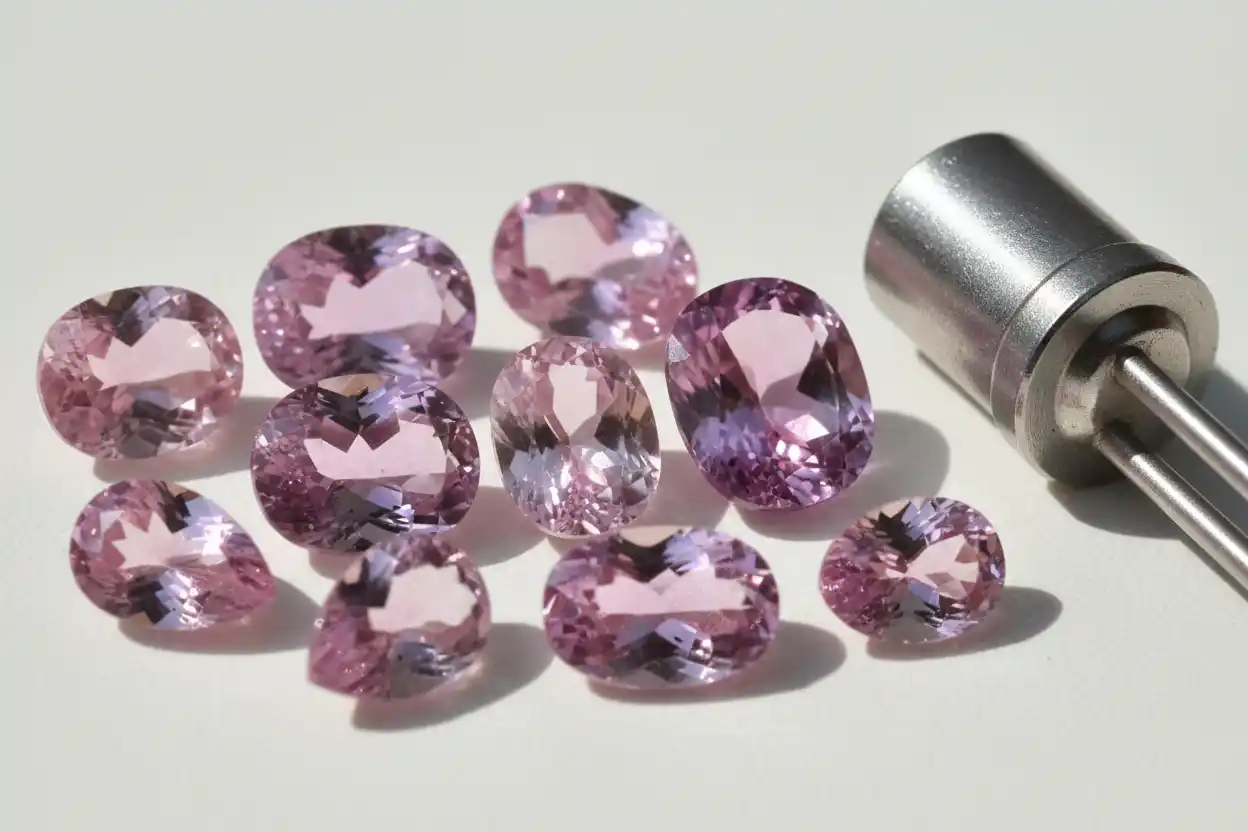
To buy kunzite intelligently, focus first on the actual face-up color, because GIA identifies color as kunzite’s most important value factor and states that more vivid pink-to-violetish-purple material commands stronger value than weakly colored stones. Kunzite is the light pink to violetish-purple gem variety of spodumene, a lithium aluminum silicate mineral whose crystals can become exceptionally large. GIA notes that large kunzite is not unusual—the Smithsonian even holds an 880-carat faceted example—so carat weight by itself should never be used as proof that an ordinary pale stone is exceptionally rare.
Kunzite also demands a different durability mindset from many similarly colored gems. It has a Mohs hardness of about 6.5 to 7 but two perfect cleavage directions and poor toughness, meaning a hard blow, extreme pressure, or sudden temperature change can split the gemstone even though its surface has reasonable scratch resistance. Its color can also fade after prolonged exposure to strong light or heat, and GIA notes that both naturally colored and irradiated-and-heated kunzite can show this sensitivity. A good purchase therefore depends on color, clarity, pleochroic orientation, cut, dimensions, cleavage condition, treatment disclosure, color stability, setting design, and seller protections together.
Buy Kunzite At a Glance
| Buying Factor | What to Examine | Why It Matters |
|---|---|---|
| Identity | Natural pink-to-violet spodumene | Similar color alone does not prove kunzite |
| Color | Pink, lilac, violetish pink, violetish purple; strength and saturation | Color is kunzite’s leading value factor |
| Pleochroism | Directional variation in color | Orientation determines how much of the best color shows face-up |
| Light Stability | Seller disclosure and realistic care guidance | Natural and treated kunzite can fade under strong light and heat |
| Clarity | Eye-visible inclusions, clouds, fractures | Kunzite is commonly clean, so inclusions can reduce value |
| Cut | Orientation, depth, windowing, symmetry, polish | Cutters often use depth to strengthen pale color |
| Carat Weight | Weight together with dimensions | Large kunzite is available, so size alone is not a rarity grade |
| Cleavage | Cleavage fractures, chips, stress around corners | Perfect cleavage creates breakage risk |
| Treatment | Irradiation and heat disclosure | Treatment can enhance color and may share fading concerns |
| Origin | Afghanistan, Brazil, Madagascar, California, or other source | Source is secondary to color and quality for most jewelry |
| Condition | Scratches, chips, worn facets, previous repolishing | Important for pre-owned material |
| Documentation | Laboratory identification for expensive or unusual stones | Useful when natural identity or treatment claims affect price |
| Setting | Protective ring design versus pendant/earring use | Kunzite is poorly suited to severe impact and pressure |
Kunzite Is Pink to Violetish-Purple Spodumene
GIA defines kunzite as the light pink to violetish-purple variety of spodumene and notes that it occurs in important deposits including Afghanistan, Brazil, Madagascar, and California. The color is associated with trace manganese, while the crystal structure produces strong pleochroism and two perfect cleavage directions.
This mineral identity separates kunzite from morganite, pink sapphire, pink tourmaline, amethyst, and other similarly colored gemstones. Each of those materials has different hardness, toughness, optical properties, treatment patterns, supply, and market demand.
Buyers should therefore avoid listings that rely primarily on generic phrases such as natural pink gemstone while failing to identify the material clearly.
Color Is the Most Important Kunzite Quality Factor
GIA states directly that color is kunzite’s most important value factor and that stronger, more vivid color brings higher value. Kunzite can range from delicate blush pink through lilac, pinkish violet, and stronger violetish purple, giving buyers considerable aesthetic choice.
A saturated stone does not need to be dark. Kunzite often performs best when the pink or violet tone remains bright and transparent, allowing the gem to look luminous rather than murky.
Pastel material can still be beautiful, particularly in large precision cuts, but a seller should not charge a strong-color premium for a stone whose color disappears under ordinary neutral lighting.
Judge Color Under Realistic Lighting
Kunzite’s subtle colors are particularly vulnerable to photographic exaggeration. A lavender background, warm skin tone, strong LED source, image saturation, or camera white balance can make pale material appear substantially richer.
Ask to see video against neutral white or gray backgrounds under ordinary indoor light and daylight-equivalent illumination. The stone should remain recognizably pink or violet without requiring extreme backlighting.
This check is especially important because GIA notes that some cutters deliberately cut kunzite deeper to intensify pale color. A photograph showing only the strongest angle may therefore conceal how the stone looks in everyday conditions.
Pleochroism Makes Orientation Important
Kunzite is pleochroic, meaning the crystal can display different color intensities or hues when viewed from different directions. GIA notes that the best kunzite color is visible when looking down the length of the crystal and that cutters account for this directional behavior when orienting gems.
A poorly oriented stone can retain significant weight but face up noticeably paler. A skilled cutter may sacrifice rough to place the strongest pink or violet direction where the viewer sees it most effectively.
Rotate an unset kunzite before purchasing. Pleochroism itself is natural and desirable, but the finished gem should present its best color in the normal face-up position.
Deep Cutting Can Sometimes Be Appropriate
Gem buyers often hear that deep cutting is automatically poor cutting, but kunzite provides an important exception. GIA’s colored-stone cut research specifically uses kunzite as an example where deeper proportions can produce stronger face-up saturation and reduce an otherwise obvious window.
The question is whether the depth improves appearance enough to justify the additional hidden weight. A carefully designed deep stone can be beautiful, while a commercial stone cut deep merely to retain carats may still show weak brilliance or poor spread.
Compare the face-up dimensions, saturation, and light return instead of applying a universal shallow-versus-deep rule.
Kunzite Is Usually Clean
GIA notes that kunzite is commonly very clean and that inclusions reducing transparency can lower value. This gives buyers relatively high clarity expectations compared with gems in which eye-visible inclusions are routine.
A clean transparent kunzite can display large uninterrupted areas of pastel color, making it particularly attractive in statement-size cuts.
Surface-reaching fractures deserve more concern than small internal inclusions because of spodumene’s poor toughness and cleavage. A reflective crack near a corner or girdle can create both an aesthetic and structural weakness.
Eye-Clean Does Not Mean Microscopic Perfection
Because clean kunzite is available, retailers may use exaggerated clarity language such as flawless, VVS, or AAAA. GIA states that it evaluates kunzite but does not grade it and that no single standardized A/AA/AAA quality scale exists for the gemstone.
Buyers should judge whether inclusions are visible without magnification and whether they affect transparency or durability.
Paying substantially more for a microscopic difference invisible in ordinary wear may not make sense unless the stone has specialist collector importance.
Carat Weight Does Not Automatically Create Rarity
Large kunzite crystals are well known. GIA notes that large fashioned stones are not unusual and cites an 880-carat faceted Smithsonian example, while its quality guide illustrates exceptionally large kunzite as part of the normal discussion of the variety.
A twenty-carat kunzite can therefore be impressive without being extraordinarily rare simply because of weight.
Size becomes more valuable when the larger stone also maintains vivid color, strong transparency, excellent clarity, efficient cutting, and sound structural condition.
Small Vivid Kunzite Can Be Unusually Desirable
Colored-stone value research from GIA notes that some materials, including kunzite, may need greater thickness or size before pale rough produces enough saturation, which can make strongly colored smaller stones unexpectedly scarce.
This is an important counterpoint to the assumption that bigger is always better. A small but genuinely saturated kunzite can represent unusually strong color concentration in less material.
Buyers should therefore compare color quality and face-up beauty before comparing raw weight.
Millimeter Dimensions Matter With Large Kunzite
Large kunzites can be cut very deep to increase saturation or preserve weight. Two stones of equal carat weight may therefore have very different visible size.
Compare length, width, and depth rather than relying solely on the carat figure. A well-proportioned twelve-carat gem may look broader and more impressive than a deeper fifteen-carat stone.
This is especially important in rings and pendants where visual coverage, not hidden mass, determines much of the aesthetic result.
Perfect Cleavage Is the Most Important Durability Issue
GIA reports kunzite at 6.5 to 7 on the Mohs scale but emphasizes that two perfect cleavage directions give it poor toughness. A hard blow can split it, while extreme pressure or sharp temperature changes can also cause breakage.
Hardness and toughness should not be confused. Kunzite can resist ordinary surface scratching better than many softer gems yet still break abruptly along a cleavage plane.
This makes setting quality, jewelry type, and owner habits important components of a sensible purchase.
Rings Need More Protection Than Pendants or Earrings
GIA specifically notes that valuable kunzite is often placed in protective settings or jewelry less exposed to wear, such as pendants and pins, because of its cleavage and poor toughness.
A kunzite ring can still be beautiful, but a buyer intending frequent wear should favor protected corners, secure prongs, bezel-like support where appropriate, and designs that reduce direct impact.
Very large statement kunzites may be more practical in pendants, brooches, or occasional-wear rings where the gem is exposed to fewer hard knocks.
Kunzite Can Fade With Strong Light
One of kunzite’s best-known ownership considerations is light sensitivity. GIA states that prolonged exposure to strong light or heat can fade kunzite color.
This does not mean the gem instantly becomes colorless when worn outdoors. The practical guidance is to avoid prolonged storage in direct intense sunlight, display lighting, hot windows, or other environments that expose the gem unnecessarily to strong light and heat.
A buyer should consider this before purchasing kunzite for jewelry intended for constant outdoor use.
Natural Color Can Fade Too
Light sensitivity should not automatically be interpreted as evidence that a stone was treated. GIA specifically notes that both treated and naturally colored kunzite can fade under strong heat and light.
That means a seller cannot prove untreated status merely by claiming that a stone is light sensitive, nor does fading automatically mean the gemstone was artificially colored.
Treatment and color stability are related but separate questions.
Irradiation and Heating Can Enhance Kunzite Color
GIA states that kunzite can be irradiated and then heated to enhance its color. Treated kunzite remains spodumene, but the color history differs from material sold as naturally colored.
The commercial effect depends on disclosure and market preference. A beautifully colored treated stone can make excellent jewelry when sold honestly and priced appropriately.
A buyer paying a substantial premium specifically for natural-color kunzite should ask what evidence supports the representation.
Treatment Does Not Solve the Light-Sensitivity Issue
GIA warns that color in irradiated-and-heated kunzite can fade with heat and light just as naturally colored kunzite can.
Treatment therefore should not be marketed as permanently stabilizing kunzite’s color unless reliable evidence exists for the specific material.
Regardless of color origin, sensible storage and wear habits remain appropriate.
Warm Soapy Water Is the Safest Cleaning Method
GIA recommends warm soapy water for kunzite and advises against steam and ultrasonic cleaning because cleavage, fractures, heat sensitivity, and pressure can create unnecessary risk.
This care requirement matters when buying mounted jewelry because some retail cleaning routines rely heavily on ultrasonics.
A jeweler should know the center stone is kunzite before cleaning, resizing, retipping prongs, or applying nearby heat.
Origin Is Usually Less Important Than Color
GIA’s kunzite buyer guidance states directly that color is more important than where the gemstone was mined and advises buyers to seek the most vividly colored kunzite they can find.
Important sources include Afghanistan, Brazil, Madagascar, and California, but a famous locality does not automatically improve a pale or poorly cut stone.
Origin can matter for mineral collectors, historically important crystals, or documented locality specimens, yet ordinary jewelry pricing should focus primarily on the actual gem.
California Has Historical Significance
Kunzite was named after gemologist George Frederick Kunz and became strongly associated with California’s Pala mining district after its discovery and identification in the early twentieth century. GIA continues to feature California kunzite crystals in its educational material.
Documented California material can attract collector interest, particularly in crystal form.
A faceted jewelry buyer should still prioritize color, clarity, cut, condition, and light stability over a locality premium unless the provenance itself is part of the collecting goal.
Kunzite and Hiddenite Are Both Spodumene but Different Markets
Kunzite is pink to violetish-purple spodumene, while hiddenite is the rare green variety associated with chromium-bearing color under stricter usage. Gems Lore’s buy hiddenite guide explains the identity and color-stability issues in green spodumene, while hiddenite price covers the rarity premium associated with fine stable green material.
Sharing a mineral species does not make the two varieties interchangeable financially. Hiddenite can be much scarcer in fine quality, whereas large kunzite is comparatively available.
Kunzite Versus Amethyst
Kunzite and amethyst can overlap visually in pale violet and lavender tones, but amethyst is quartz while kunzite is spodumene.
The Gems Lore amethyst price guide covers a market where hardness, cleavage behavior, supply, treatment, and typical sizes differ substantially.
A buyer should therefore identify the material rather than choosing solely from photographs of similar purple hues.
Kunzite Versus Morganite-Like Pink Gems
Kunzite can resemble pink beryl, pink tourmaline, and certain synthetic or imitation materials, particularly in pale pastel shades. Pleochroism, refractive properties, density, spectroscopy, and other gemological tests can separate them.
For significant purchases, a laboratory identification report can determine whether the gemstone is natural kunzite and list detectable treatments. GIA states that it evaluates kunzite through its Colored Stone Identification Report but does not issue an overall quality grade.
AAA Kunzite Has No Universal Meaning
GIA explicitly states that AAA, AA, and A descriptions may be created by individual companies but that no single standard kunzite quality-grading scale exists.
One retailer’s AAA kunzite can therefore have weaker color or cutting than another seller’s ungraded stone.
The meaningful characteristics are actual hue, saturation, face-up color, transparency, clarity, cut, dimensions, treatment, light stability, and condition.
Pre-Owned Kunzite Needs Careful Condition Inspection
Check estate or secondhand kunzite for chipped corners, cleavage fractures, worn facet junctions, scratches, damaged girdles, prong pressure, and evidence of repolishing.
A stone that has spent years in strong display lighting may also have a different color from when it was first purchased.
Condition and present color should therefore be valued as they exist now rather than according to an old appraisal photograph.
Common Red Flags When You Buy Kunzite
Be cautious when a seller describes a pale stone as exceptionally rare solely because it is large, presents AAA as an international laboratory grade, recommends prolonged sunlight to “charge” or deepen the gem, ignores cleavage when recommending rugged daily ring wear, claims irradiation makes color permanently fade-proof, refuses to discuss treatment, photographs the stone only under intense purple-enhancing light, supplies a large carat figure without dimensions, or presents a laboratory identification report as proof of financial value.
A reputable seller should be comfortable explaining kunzite’s light sensitivity and cleavage instead of treating those characteristics as inconvenient details to hide.
How to Compare Kunzite Listings Fairly
A fair comparison aligns the stones by natural spodumene identity, hue, saturation, pleochroic orientation, face-up color, transparency, eye-visible clarity, carat weight, millimeter dimensions, cutting proportions, cleavage condition, treatment disclosure, current color stability, surface condition, setting type, and return rights. Only once these characteristics are reasonably matched should the numerical asking prices drive the decision.
Conclusion
To buy kunzite well, prioritize vivid attractive face-up color and skilled orientation rather than carat weight alone. GIA identifies color as kunzite’s most important value factor, notes that the gem is usually very clean, and confirms that large sizes are readily available enough that exceptional weight does not automatically establish exceptional rarity.
Durability and stability require equal attention. Kunzite’s Mohs hardness of 6.5 to 7 can sound reassuring until its two perfect cleavage directions and poor toughness are considered, and both natural and irradiated-and-heated material can fade under prolonged strong light or heat.
A strong purchase therefore combines vivid color, good transparency, appropriate clarity, thoughtful pleochroic orientation, effective cut, useful dimensions, sound cleavage condition, honest treatment disclosure, protective setting design, and realistic care expectations. Those qualities matter far more than seller-defined grades or the simple fact that the stone is large.
Frequently Asked Questions
What color kunzite is most valuable?
GIA identifies color as kunzite’s most important value factor and states that more vivid color brings higher value. Fine stones can range through attractive pink, lilac, violetish pink, and violetish-purple tones, with saturation, brightness, and face-up orientation all affecting desirability.
Is large kunzite rare?
Large kunzite is not unusual. GIA cites an 880-carat faceted Smithsonian example and illustrates other exceptionally large stones in its quality guidance. Fine vivid color in a particular size can still be scarce, but weight alone is not enough to establish rarity.
Should kunzite be eye-clean?
Kunzite is commonly quite clean, so inclusions that visibly reduce transparency can lower value. Small microscopic inclusions are less important than prominent eye-visible features or fractures associated with cleavage.
Why are some kunzites cut very deep?
Kunzite can be cut deeper to intensify pale color and reduce windowing, and GIA specifically discusses this as a legitimate colored-stone cutting strategy. Depth should still be judged against face-up spread, brightness, and the additional weight being paid for.
Does kunzite fade in sunlight?
Prolonged exposure to strong light or heat can fade kunzite color. Sensible care means avoiding long-term intense sunlight or hot display conditions rather than assuming ordinary brief wear will immediately destroy the color.
Does fading prove kunzite was treated?
No. GIA notes that both naturally colored and irradiated-and-heated kunzite can fade with strong light and heat. Color stability and treatment history are separate questions.
Can kunzite be treated?
Yes. Kunzite can be irradiated and then heated to enhance color. Treatment should be disclosed when known, especially when the seller charges a premium for natural color.
Is kunzite durable enough for a ring?
It can be worn in rings, but GIA describes its toughness as poor because of two perfect cleavage directions. Protective settings and careful wear are advisable, while pendants and earrings generally expose the stone to fewer impacts.
How should kunzite be cleaned?
GIA recommends warm soapy water and advises against steam and ultrasonic cleaning. Sudden temperature changes, pressure, and hard blows should also be avoided.
Does mine origin determine kunzite quality?
No. GIA specifically states that color matters more than where kunzite was mined. Provenance can interest collectors, but ordinary jewelry buyers should emphasize color, clarity, cut, condition, and treatment.
Does AAA kunzite have an official meaning?
No. GIA states that no single standard A/AA/AAA quality scale exists for kunzite. Such labels should always be translated into actual measurable or visible characteristics.
Is kunzite a guaranteed investment?
No. Kunzite can be beautiful and collectible, but large supply, light sensitivity, cleavage, quality variation, condition, demand, and resale liquidity all affect future value. No size, grade label, or origin can guarantee appreciation.