Amethyst Price: Market Benchmarks, Quality, Treatments & Availability
Amethyst price varies mainly with color, cut, clarity, treatment, natural or laboratory-grown origin, craftsmanship, and the type of product being sold rather than with carat weight alone. Amethyst is the purple variety of quartz, and comparatively plentiful natural supplies make good material far more accessible than many similarly attractive colored gemstones. GIA identifies color as the most important value factor and notes that large amethyst is readily available, so its price per carat does not normally rise dramatically simply because a faceted stone becomes larger. A 20-carat amethyst can therefore remain commercially accessible, while a smaller stone with exceptional reddish-purple color, excellent brilliance, minimal zoning, and superior cutting may be more desirable on a quality basis.
That abundance is precisely why amethyst needs a different valuation approach from rarer gems such as fine alexandrite, ruby, or emerald. Size can still influence total price, especially in exceptional designer cuts, matched jewelry suites, large clean stones, or mineral specimens, but buyers should not assume that a high carat weight automatically creates rarity. Finished-jewelry prices introduce another layer because gold, platinum, diamonds, brand prestige, craftsmanship, age, provenance, and design can easily cost more than the amethyst itself. A realistic amethyst valuation therefore begins by identifying what is being priced: a loose natural gemstone, laboratory-grown quartz, a crystal specimen, commercial jewelry, an antique jewel, or a signed designer piece.
Amethyst Price at a Glance
| Value Factor | Typical Effect on Amethyst Price |
|---|---|
| Color | Strong reddish purple to attractive purple usually commands the greatest premium |
| Tone | Medium to medium-dark material that stays bright generally performs better than excessively dark stones |
| Saturation | Strong, vivid-looking purple is usually preferred over grayish or weak color |
| Color zoning | Obvious light and dark patches generally reduce value in faceted gems |
| Clarity | Eye-clean faceted stones are expected in much of the market |
| Cut | Excellent brilliance, symmetry, polish, and limited windowing support higher prices |
| Carat weight | Increases total price, but large sizes are sufficiently available that per-carat value usually does not rise steeply |
| Natural vs laboratory-grown | Natural geological origin generally carries more market value than comparable synthetic material |
| Treatment | Dyeing, fracture filling, or other disclosed enhancement can affect value and buyer preference |
| Origin | Geographic name alone generally does not add value; quality remains more important |
| Designer cutting | Exceptional custom or artistic cutting can command premiums independent of raw material cost |
| Jewelry setting | Precious metal, diamonds, construction, and workmanship can exceed the value of the center amethyst |
| Brand / maker | Signed jewelry may sell for multiples of an unsigned piece containing a similar stone |
| Provenance | Antique importance, documented ownership, or historical significance can create a separate premium |
| Documentation | Independent identification may support confidence in significant natural stones but is uncommon for ordinary commercial amethyst |
GIA specifically states that no universal standardized quality-grading scale exists for amethyst despite the widespread use of retailer terms such as A, AA, or AAA. Any amethyst price comparison should therefore focus on observable characteristics rather than accepting a seller’s letter grade as an independent standard.
Why Amethyst Is Usually More Affordable Than Many Colored Gems
Amethyst was historically regarded as a highly prestigious gemstone, but large discoveries dramatically expanded the available supply. Today, it is the most commercially important gem-quality variety of quartz and appears in everything from inexpensive mass-market jewelry to high-end designer pieces. GIA notes that its relatively plentiful supply has made amethyst broadly available while preserving strong demand for attractive material. This combination produces an unusual market: ordinary amethyst can be affordable, yet exceptional color, inventive cutting, important provenance, or luxury-jewelry design can support much higher prices.
The affordability of amethyst does not mean quality differences are insignificant. Fine reddish-purple color can look dramatically richer than pale or grayish commercial material, and a well-cut stone may appear far more brilliant than a larger poorly proportioned gem. The market simply has enough supply that consumers can often be selective without paying the scarcity premiums associated with much rarer gemstone species. That makes visual quality particularly important because buyers frequently have multiple comparable stones to choose from.
There Is No Single Reliable Amethyst Price per Carat
A universal amethyst price per carat would require stones of similar color, clarity, cut, treatment status, origin status, and sales context to behave as interchangeable commodities. They do not. GIA notes that amethyst occurs across all size ranges and that larger stones do not experience a dramatic per-carat increase simply because of additional weight. This means a fixed rate multiplied by carat weight can easily overvalue weak material or undervalue a stone with exceptional color and cutting.
Price-per-carat comparisons become more useful only after quality has been aligned. Two natural five-carat amethysts can differ substantially if one is pale, strongly zoned, and windowed while the other displays saturated reddish purple, excellent symmetry, strong brilliance, and an eye-clean face-up appearance. A detailed per-carat analysis also belongs to a narrower valuation question than the broader market discussion here, particularly because different retail and wholesale venues can produce different numbers even for similar gemstones.
Color Is the Strongest Amethyst Value Factor
GIA identifies strong reddish purple to purple as the finest amethyst color and specifically notes that obvious brownish or bronze modifiers lower value. Dealers generally prefer strong saturation while still wanting enough brightness for the stone to remain lively. An amethyst that becomes so dark that it appears nearly black under ordinary lighting can lose desirability even though its saturation initially seems impressive.
This balance between saturation and tone explains why simply ordering amethyst from pale to dark does not create an accurate price hierarchy. A moderately dark gemstone with vivid reddish-purple color can look more valuable than an extremely dark stone whose facets disappear into black areas. Likewise, very pale lavender material may remain attractive for certain jewelry designs but usually occupies a lower commercial tier than strongly saturated fine-color material.
Color should therefore be assessed under several realistic lighting conditions. Concentrated jewelry-store lights can make dark stones appear livelier, while smartphone processing can exaggerate saturation. A meaningful price comparison considers how the gemstone looks in daylight-type illumination and normal indoor light rather than relying exclusively on a highly optimized product photograph.
Reddish-Purple Color Usually Commands a Premium
Fine amethyst often includes a noticeable reddish component within its purple bodycolor. GIA describes strong reddish purple as especially desirable, provided color zoning is minimal and the stone retains adequate brightness. This does not mean that every buyer must prefer the reddest possible purple, but it explains why richly saturated reddish-purple stones commonly receive stronger market positioning.
Retail terminology can complicate this preference. Sellers may use phrases such as deep royal purple, Siberian color, raspberry purple, royal amethyst, or red-flash amethyst. Some of these terms can be useful descriptions, yet none automatically establishes standardized quality. A stone still needs to show attractive hue, tone, saturation, brightness, and cutting in person.
Someone comparing several amethysts should therefore look at the complete face-up appearance rather than one descriptive adjective. A seller’s color name becomes secondary once the actual gemstones can be compared side by side.
Excessively Dark Amethyst Can Be Worth Less Than a Brighter Stone
An amethyst can contain plenty of purple color yet still lose visual appeal because its tone is too dark. GIA specifically warns that some dark amethyst can appear black under dim lighting. Large areas of extinction can reinforce that effect when poor cutting prevents light from returning through the crown.
This issue is especially important when shopping online because strong photographic lighting can hide excessive darkness. A seller may show a deeply saturated purple stone under bright direct illumination, while the same gemstone looks almost opaque in an ordinary room. Asking for video under neutral indoor light often reveals whether the stone retains recognizable purple color away from spotlights.
A fine amethyst does not need to be pale, but its facets should remain visually active. Rich color and brightness together usually create stronger value than darkness alone.
Pale Amethyst Is Usually More Affordable
Pale violet and lavender amethyst can be attractive, particularly in minimalist jewelry or larger statement cuts, but GIA’s buying guidance notes that pale colors are generally more affordable than vibrant purple or reddish-purple material. This price difference reflects consumer preference rather than a change in mineral identity.
A large pale stone can therefore cost less than a much smaller intensely colored gem. Buyers who genuinely prefer softer lavender shades may find excellent visual value because they are not competing for the market’s most prized color category.
Pale material should still be assessed for cut quality, zoning, and clarity. Low saturation does not excuse poor workmanship, especially because quartz is sufficiently abundant that buyers can often find a well-cut alternative.
Color Zoning Can Lower Amethyst Price
Amethyst commonly grows with uneven purple distribution. GIA notes that many stones contain zones of lighter and darker color and that obvious zoning lowers value, particularly when it remains visible face-up. Cutters can sometimes orient the rough so that zoning becomes less apparent through the crown, making orientation an important part of skilled amethyst cutting.
A loose stone can be examined table-down against a white background to make zoning easier to see. A gemstone may look evenly purple from the top while revealing strong bands from the pavilion, yet the commercial effect depends primarily on what the wearer sees face-up.
Some types of amethyst intentionally celebrate zoning. Chevron amethyst, banded quartz, fantasy cuts, and mineral specimens may derive visual interest from contrasting purple and pale areas. Those products belong to a different aesthetic category from a conventional transparent faceted stone, so zoning should be judged according to the intended object.
Clarity Usually Matters Less Than Color Until Inclusions Become Distracting
Most faceted amethyst in the market is eye-clean, meaning inclusions are not easily visible without magnification. GIA notes that this level of clarity is common enough that obvious inclusions can reduce value, particularly in paler stones. Strongly colored African material can contain more inclusions while remaining commercially desirable because exceptional saturation may compensate for modest clarity limitations.
The practical implication is that buyers generally do not need to accept a heavily included ordinary faceted amethyst. A small internal feature that disappears during normal viewing may have little impact, while an obvious fracture, dark inclusion, cloudy region, or surface-reaching crack deserves closer attention.
Clarity should never be considered independently from color. An eye-clean pale gem does not automatically outrank a slightly included stone with outstanding reddish-purple color. Value depends on the overall visual result.
Eye-Clean Amethyst Is Not Automatically Rare
Because eye-clean faceted material is common, sellers should not imply that every transparent clean stone is exceptional merely because no inclusions are visible. GIA explicitly describes much of the faceted market as eye-clean. Premium pricing therefore requires additional justification through superior color, cutting, size, provenance, designer workmanship, or another uncommon characteristic.
The situation differs with mineral specimens. Collectors may value internal veils, phantoms, zoning, associated minerals, or other growth features that would reduce the commercial value of a transparent faceted gem. Valuation must follow the product category rather than applying one clarity standard to every form of amethyst.
Cut Quality Can Change Amethyst Price More Than Buyers Expect
Amethyst rough is sufficiently available that cutters have room to prioritize beauty, yet poorly cut stones remain common because maximizing retained weight can increase the number of saleable carats. GIA advises buyers not to compromise on cut and notes that poor cutting reduces beauty, brilliance, and marketability. A well-proportioned stone should return light across most of its face and display the color effectively.
Windowing occurs when the pavilion is too shallow and a broad central area allows the viewer to see through the gemstone rather than returning light. The result can make even richly colored material appear washed out. Heavy extinction creates the opposite problem, with large black or inactive areas dominating the face-up appearance.
Premium cutting may also introduce artistic value. Concave facets, precision patterns, unusual outlines, and one-of-a-kind designer cuts can command prices far above commercial calibrated stones because the buyer is paying for lapidary skill as well as the quartz itself.
Designer Cutting Can Create a Premium Independent of Raw Amethyst Value
Amethyst is particularly popular with gem cutters because large clean crystals allow freedom to create complex designs. GIA documents its extensive use in freeform and fantasy cuts, including pieces where concave faceting or unusual geometry becomes a central part of the finished gemstone. A precisely executed designer amethyst should therefore not be compared directly with a mass-produced oval of equal carat weight.
The material value may form only one portion of the selling price. Cutting time, design originality, yield loss, reputation of the lapidary, and artistic execution can all contribute substantial premiums. This is especially relevant when a cutter deliberately removes considerable rough to create symmetry, brilliance, or a signature pattern.
Someone valuing a designer-cut amethyst should therefore separate the price of the quartz from the value added through craftsmanship.
Large Amethyst Is Readily Available
Amethyst occurs in unusually large crystals and geodes, and faceted stones weighing tens of carats are not inherently extraordinary. GIA notes that single crystals can reach enormous sizes and that amethyst is commonly fashioned into large gemstones because its per-carat price does not increase dramatically with size. This availability distinguishes amethyst from gem materials where clean, fine-color crystals become exceptionally scarce beyond a few carats.
Large size still increases total price because the buyer receives more material and a more visually substantial object. However, quality should remain the first filter. A 40-carat stone with weak lavender color, strong windowing, or obvious zoning may be less desirable than a finely cut 10-carat stone with outstanding color.
Buyers should also compare face-up dimensions, not just carat weight. An excessively deep stone can hide considerable weight beneath the setting without appearing much larger from above.
Availability Keeps Amethyst from Developing a Steep Size Premium
The supply structure of amethyst has a direct effect on price. GIA states that fashioned amethyst is available in all size ranges, including calibrated cuts, and that larger sizes do not experience a dramatic per-carat price rise. This means buyers can often choose substantial center stones without entering the exponential pricing seen in certain rarer colored gems.
That does not mean supply is uniform across every quality tier. Fine reddish-purple color with excellent cutting, minimal zoning, and high clarity is less common than ordinary material. Large stones possessing all of those characteristics can still command meaningful premiums because superior quality becomes harder to match consistently.
The distinction is between large amethyst generally and large exceptional amethyst. The first is readily available; the second deserves more selective comparison.
Natural and Laboratory-Grown Amethyst Should Not Share the Same Price Assumptions
Synthetic amethyst is laboratory-grown quartz rather than an imitation such as purple glass. GIA notes that synthetic counterparts can have essentially the same fundamental chemical, physical, and optical properties as their natural equivalents while forming through human-controlled growth rather than geological processes. Because manufacturing can supply clean, strongly colored material more predictably, laboratory-grown amethyst generally lacks the geological rarity component that supports natural-gem pricing.
Appearance alone may not resolve the distinction. High-quality synthetic quartz can look highly convincing, and natural amethyst can also be extremely clean. A buyer paying a strong premium specifically for geological origin should therefore rely on a knowledgeable seller or independent laboratory rather than assumptions based on clarity or color.
For practical purchasing checks, the Gems Lore guide to buy amethyst explains natural versus laboratory-grown material, color evaluation, documentation, treatments, and seller questions in greater detail.
Natural Does Not Automatically Mean Untreated
A natural amethyst formed geologically, but it may still have been modified after mining. GIA reports that heat can lighten overly dark material, pale amethyst and light-colored quartz can be dyed purple, and fracture filling is occasionally used to improve the apparent clarity of surface-reaching fractures. These treatments affect value differently depending on their type, visibility, stability, and disclosure.
The word natural should therefore answer only the origin question unless the seller explicitly adds untreated. “Natural amethyst” and “natural untreated amethyst” are not necessarily equivalent descriptions.
In much of the ordinary jewelry market, treatment may have a smaller economic effect than color and cutting because amethyst itself is relatively accessible. Collector-grade or unusually expensive material deserves more careful disclosure because treatment can influence both rarity and buyer preference.
Heat Treatment Can Affect Amethyst Value
Heat treatment is used primarily to modify color. GIA notes that heat can lighten very dark amethyst and remove certain unwanted brownish components, while stronger heating can convert some amethyst into yellow-to-orange citrine. A stone that remains purple after appropriate treatment can still be attractive natural quartz, but its treatment history should be disclosed when known.
Heat-induced color changes are generally permanent under normal conditions, although intense heat can damage quartz and some amethyst can fade after prolonged exposure to strong light. Price differences between treated and untreated stones depend on market context rather than one universal discount.
For ordinary jewelry, buyers may care more about attractive color and fair disclosure than untreated rarity. Serious collectors may place a stronger premium on material with documented natural color.
Dyeing Usually Belongs to a Lower Value Category
GIA reports that lower-quality pale amethyst and even light-colored quartz can be dyed to create stronger purple appearance. Dyed material may still be decorative, but its enhanced color does not carry the same natural rarity as equivalent naturally saturated amethyst.
Dye can concentrate in fractures or irregularities, although identifying treatment reliably may require more than casual inspection. A seller should disclose dyeing rather than using intense color as evidence of superior natural quality.
The price difference should reflect the nature of the enhancement. A visually attractive dyed stone may offer inexpensive fashion value, but it should not command the same premium as a naturally saturated, fine-color gem.
Fracture-Filled Amethyst Requires Separate Consideration
Fracture filling is relatively uncommon in amethyst, but GIA recognizes that it can occur when surface-reaching fractures are filled to improve apparent clarity. Such treatment can make an included stone look cleaner while introducing additional care considerations.
A fracture-filled amethyst should not automatically be rejected. The important questions concern disclosure, stability, appearance, and whether the price reflects the treatment.
Cleaning methods may also change. GIA recommends warm soapy water for fracture-filled material rather than assuming that ultrasonic cleaning is appropriate. This practical difference is another reason treatment history belongs in the value discussion.
Geographic Origin Usually Matters Less Than Quality
Amethyst comes from many important deposits, including Brazil, Zambia, Uruguay, and other regions, but GIA states directly that country of origin alone does not add value. Color remains the most important value factor regardless of where the stone was mined. This differs from markets such as ruby, sapphire, or alexandrite, where documented geographic origin can sometimes carry substantial premiums.
Regional names can still provide useful descriptive context. Zambian material may be associated with highly saturated raspberry-purple color, while Brazilian deposits are famous for enormous geodes and substantial crystal production. Those tendencies do not guarantee individual quality.
A fine Brazilian amethyst can exceed a weak Zambian stone, and vice versa. Buyers should pay for what the gemstone actually shows rather than for a country label alone.
“Siberian” Amethyst Should Be Treated as a Descriptive Term Unless Proven Otherwise
The phrase Siberian amethyst has historically been associated with highly desirable purple material, but modern sellers sometimes use it primarily to describe color rather than verified Russian provenance. Because GIA states that origin itself does not add value to amethyst, buyers should avoid paying a major premium simply because a listing uses the word Siberian.
Ask whether the seller is making an actual geographic-origin claim or merely using a trade description for reddish-purple color. Those are different statements.
If the attraction is the color, judge the hue, saturation, tone, and brilliance directly. A gemstone does not need a prestigious historical label to possess fine amethyst color.
AAA and AAAA Amethyst Are Seller Grades, Not Universal Standards
The use of AAA, AAAA, premium, royal, super fine, investment grade, and similar terms can make amethyst price comparison unnecessarily confusing. GIA explicitly states that companies may create their own quality descriptions but that no standard quality-grading scale exists for amethyst.
A seller’s AAA stone may therefore resemble another seller’s AA inventory, while a third retailer may apply AAA broadly to most dark-purple merchandise. Without published criteria, the label cannot be compared objectively.
A better description would specify hue, tone, saturation, visible zoning, clarity, cut quality, weight, dimensions, natural or synthetic status, and known treatment. Those characteristics remain meaningful regardless of where the gem is sold.
Market Benchmarks Need to Separate Gem Value from Jewelry Value
Public auction results demonstrate why finished amethyst jewelry should not be used as a direct loose-stone price chart. A Chantecler ring containing a stated 27.49-carat amethyst received an estimate of CHF 2,600–4,200, while a vintage Van Cleef & Arpels amethyst-and-diamond ring received an estimate of US$15,000–20,000. The enormous difference does not mean one amethyst necessarily possessed several times the intrinsic gemstone value of the other.
The Van Cleef piece included diamonds, platinum, signed provenance, period design, and luxury-brand collectibility. The Chantecler ring likewise carried a recognized maker but occupied another design and auction category. These examples demonstrate that auction pricing often reflects the entire jewel.
For loose-stone valuation, signed-jewelry auction estimates should therefore be treated as contextual evidence rather than divided mechanically by carat weight.
Recent Auction Examples Show How Strongly Brand and Design Influence Price
| Example | Amethyst Information | Auction Estimate | What the Example Shows |
|---|---|---|---|
| Chantecler amethyst and diamond ring | Circular-cut amethyst stated at 27.49 ct | CHF 2,600–4,200 | Large amethyst alone does not guarantee an enormous auction value |
| Van Cleef & Arpels amethyst and diamond ring | Central amethyst cabochon with additional amethyst and diamonds | US$15,000–20,000 | Signed provenance and period design can dominate price |
| David Webb amethyst and diamond pendant-earclips | Signed high-jewelry pair | US$30,000–50,000 | Brand, diamonds, workmanship, and design can outweigh raw amethyst cost |
| Cartier turquoise, amethyst and diamond parure | Amethyst used within signed Cartier suite | HK$150,000–300,000 | A luxury jewel should not be valued as loose amethyst multiplied by weight |
Sotheby’s listed the David Webb pendant-earclips at US$30,000–50,000 and the Cartier parure at HK$150,000–300,000, reinforcing the importance of maker, design, diamonds, metalwork, and collectibility. These figures should not be interpreted as representative prices for comparable weights of loose amethyst.
Large Amethyst Jewelry Can Still Be Surprisingly Accessible
The abundance of large quartz crystals means substantial amethyst center stones can appear in jewelry without automatically pushing a piece into extremely high gemstone-value territory. Sotheby’s offered a signed Chantecler ring with a stated 27.49-carat amethyst at CHF 2,600–4,200. This is a useful reminder that amethyst weight behaves differently from the weight of much scarcer gems.
The specific auction estimate included the complete ring rather than an isolated gemstone value, so it should not be converted directly into a universal per-carat number. Its broader lesson is more important: a large amethyst can remain economically accessible even in signed jewelry.
Quality still matters. A large stone with unusually fine color and exceptional cutting can command considerably more than a typical commercial example.
Signed Jewelry Can Be Worth Far More Than Its Amethyst
A signed jewel can derive much of its price from design and maker reputation. Sotheby’s estimated a Van Cleef & Arpels amethyst-and-diamond ring at US$15,000–20,000, far above what ordinary commercial amethyst of similar visible scale might suggest on raw material alone.
The same principle applies to major houses such as Cartier, Bulgari, David Webb, JAR, and other recognized designers. Collectors may pay for period style, rarity of a particular design, signed provenance, workmanship, precious metal, accompanying diamonds, and condition.
Anyone valuing inherited amethyst jewelry should therefore avoid removing the stone’s estimated material value from the context of the entire object. In some cases, the setting and maker are the primary sources of value.
Auction Estimates Are Not Retail Price Lists
Auction houses publish estimates for specific objects offered under specific conditions. Those estimates may reflect maker, age, condition, provenance, rarity, competing gemstones, precious metal, and anticipated bidder demand. They are not equivalent to a universal retail or wholesale price for amethyst.
A final auction result can also differ substantially from the estimate. Buyer’s premiums, taxes, currency, bidder competition, and condition terms further complicate direct comparison.
Auction evidence is most useful when comparing genuinely similar jewelry objects or demonstrating how market context affects value. It should not be treated as a substitute for appraising a loose amethyst.
Retail, Wholesale, Auction, and Resale Amethyst Prices Differ
A gemstone dealer’s wholesale transaction, an online retail listing, a luxury boutique price, an auction estimate, an insurance appraisal, and a private resale offer can all produce different values for the same physical stone. Each market includes different costs, risks, and margins.
Retail prices compensate the seller for sourcing, inventory, cutting, photography, marketing, returns, overhead, and customer service. A reseller purchasing from a consumer needs enough margin to verify, hold, and eventually remarket the item. An insurance appraisal may focus on replacement cost rather than immediate cash resale.
The existence of several legitimate numbers does not mean valuation is arbitrary. It means that a price is meaningful only when the market and purpose are defined.
Natural Amethyst Crystal Specimens Follow Different Price Rules
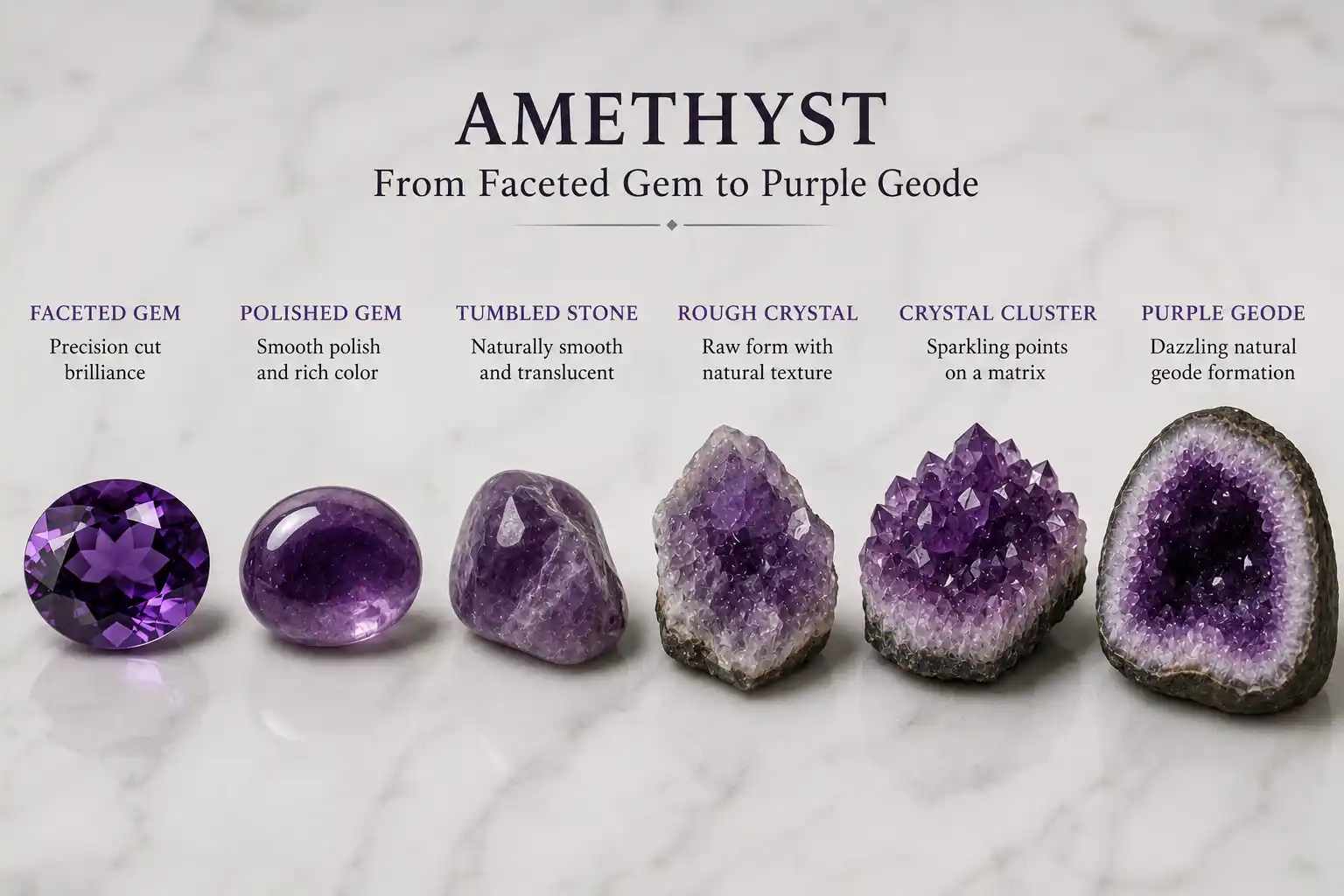
Faceted amethyst quality centers heavily on color, clarity, and cut, while mineral specimens introduce crystal form, termination quality, luster, damage, matrix association, aesthetics, locality, provenance, and natural presentation. Large geodes can be impressive but are not automatically rare because certain deposits produce enormous crystal-lined cavities.
GIA notes that amethyst geodes from locations such as Brazil can be large enough for a person to stand inside them. A large commercial geode therefore needs evaluation of color saturation, crystal coverage, damage, symmetry, matrix stability, treatment, and display quality rather than size alone.
Collector specimens from important or exhausted localities may also command premiums that have little connection with jewelry-grade amethyst pricing. Mineral provenance can matter more in that specialist market than it normally does for a faceted commercial gemstone.
Geodes Should Be Priced by More Than Height and Weight
Amethyst geodes are often sold by physical size or weight, which provides a convenient starting point but does not capture quality. Two geodes of equal height can look radically different if one has richly saturated crystals, clean intact terminations, attractive geometry, and dense crystal coverage while the other contains pale, damaged, or sparsely distributed material.
Base preparation also matters. A cut and stabilized bottom can make a heavy geode safer to display, while excessive cement, repair, dye, or undisclosed reconstruction can affect collector interest.
Shipping logistics can become a significant part of total cost because large geodes are bulky even though quartz itself is not rare enough for weight alone to justify a luxury premium.
Chevron Amethyst and Banded Material Belong to a Different Market
Chevron amethyst contains visible purple-and-white growth banding and is commonly fashioned into towers, spheres, cabochons, beads, and carvings. Its price depends more on pattern, contrast, polish, shape, craftsmanship, and overall aesthetics than on the even-color standards used for transparent faceted amethyst.
Strong zoning that would reduce the value of a conventional faceted gem can actually increase visual interest in a chevron piece. These categories should therefore not be compared using the same quality language.
Collectors interested in patterned quartz can read the Gems Lore guide to chevron amethyst meaning for a separate discussion of the material, its patterns, and the distinction between mineral facts and later symbolism.
February Birthstone Demand Supports a Large Consumer Market
Amethyst’s role as the principal February birthstone creates steady demand across rings, earrings, necklaces, bracelets, and personalized gifts. GIA recognizes amethyst as the February birthstone and notes its long history as a popular jewelry gem. This consistent cultural association supports broad commercial availability rather than extreme scarcity.
Birthstone status does not automatically raise the value of one stone over another. Color, cutting, clarity, natural or synthetic origin, treatment, craftsmanship, and jewelry construction still determine commercial quality.
Readers interested in that tradition separately can explore the Gems Lore guide to the February birthstone, which focuses on amethyst’s month association, history, color, and symbolism rather than market valuation.
Documentation Is Usually Unnecessary for Ordinary Amethyst
Independent laboratory reports are valuable when they resolve meaningful uncertainty, but GIA notes that reports are not commonly requested for amethyst because testing cost can represent a substantial proportion of the value of ordinary stones. This economic reality distinguishes amethyst from many expensive rubies, sapphires, emeralds, or alexandrites where a laboratory report may be expected.
An inexpensive commercial amethyst ring generally does not need laboratory documentation if the seller is credible and the description is clear. A very expensive natural stone, unusual collector gem, important antique jewel, or specimen represented as exceptional untreated material may justify independent examination.
Documentation should solve a problem rather than exist merely as a marketing prop.
A Laboratory Report Does Not Create an AAA Grade
A gemological identification report can help determine whether the submitted material is natural or laboratory-grown quartz and may identify detectable treatments. It does not transform an amethyst into an officially standardized AAA gemstone because GIA states that no universal amethyst quality-grading scale exists.
Seller descriptions such as “GIA-certified AAA amethyst” should therefore be read carefully. GIA may have identified the material, while the AAA wording may come from the retailer rather than the laboratory.
Buyers should distinguish laboratory findings from commercial grading language. Identity and treatment can be objectively investigated; overall beauty and market quality still require visual evaluation.
Condition Matters in Used and Antique Amethyst Jewelry
Amethyst has Mohs hardness 7 and good toughness, making it suitable for many jewelry styles, but it is not immune to scratching or chipping. GIA notes that amethyst rings can show wear over the years and may eventually need repolishing. Facet-edge abrasion, scratches across the table, chips at corners, and worn settings can therefore reduce the resale appeal of older pieces.
Antique jewelry requires a more nuanced approach because some surface wear may be expected and the historical object can remain valuable despite minor gemstone abrasion. Restoration, replacement stones, damaged metalwork, and altered settings should still be considered.
A pristine stone in a historically important signed mounting may command a stronger premium than a similar amethyst in heavily modified jewelry.
Amethyst Durability Supports Broad Jewelry Use
Amethyst ranks 7 on the Mohs scale and has good toughness, so GIA considers it appropriate for all jewelry types when reasonable care is used. This durability contributes to market demand because amethyst can function as rings, pendants, earrings, necklaces, bracelets, and larger statement pieces without the extreme fragility associated with some organic or cleavage-prone gem materials.
Hardness should not be confused with indestructibility. Quartz-bearing dust can contribute to surface wear, and strong blows can still chip a gemstone.
Jewelry design can preserve value over time. Protective settings, secure prongs, and avoiding unnecessary impact help reduce damage that could require repolishing or recutting.
Light and Heat Can Affect Amethyst
GIA states that some amethyst can fade with prolonged exposure to intense light and that abrupt temperature changes can cause fracturing. These stability considerations are particularly relevant to mineral specimens and jewelry displayed continuously in bright windows.
Normal wear does not require extreme precautions, but leaving valuable amethyst under powerful sunlight for extended periods is unnecessary. High heat should also be avoided during jewelry repair.
A well-preserved stone maintains greater visual and resale appeal than one that has lost color or suffered thermal damage.
Cleaning Practices Can Protect Value
Warm soapy water is the safest general cleaning method for amethyst. GIA notes that ultrasonic cleaning is usually acceptable for untreated material but should be avoided for dyed or fracture-filled stones, while steam cleaning is not recommended.
This guidance matters economically because damage caused by careless cleaning can create scratches, worsen fractures, or compromise a treatment. A high-quality stone with chipped facet edges may require repolishing, which removes material and can alter dimensions.
Gentle cleaning is sufficient for most amethyst and reduces unnecessary risk.
How to Compare Two Amethyst Prices Properly
Begin by confirming that both stones belong to the same broad category. Natural amethyst should be compared with natural amethyst rather than laboratory-grown quartz, dyed material, or glass imitation. Next compare hue, saturation, tone, color zoning, clarity, cut, weight, dimensions, treatment, and whether the gemstone is loose or mounted.
After aligning those factors, examine the sales context. A mass-market calibrated oval and a one-of-a-kind precision cut may contain similar quartz yet belong to different price categories. A signed luxury ring should not be compared directly with an unsigned loose gemstone.
Only after these variables are reasonably similar does a direct price comparison become meaningful.
A Practical Amethyst Value Checklist
Before accepting a quoted amethyst price, confirm the major factors behind it:
Verify whether the stone is natural amethyst, laboratory-grown quartz, dyed quartz, or another imitation.
Compare color before carat weight, especially hue, saturation, tone, and brightness.
Look for strong visible color zoning in conventional transparent faceted gems.
Examine the stone for eye-visible fractures, clouds, or distracting inclusions.
Check whether the cut creates a large window or excessive dark extinction.
Compare millimeter dimensions with carat weight so hidden depth does not masquerade as visual size.
Ask about heat treatment, dyeing, fracture filling, or other known enhancement.
Treat AAA, AAAA, royal, premium, or investment-grade labels as seller terminology unless clearly defined.
Do not assume that Brazilian, Zambian, Uruguayan, or Siberian wording automatically increases value.
Separate loose-gem value from gold, diamonds, brand name, and workmanship in finished jewelry.
Consider an independent laboratory report only when the purchase value or uncertainty justifies it.
Review return terms before paying a substantial premium for online color that you have not seen in person.
This framework is more dependable than multiplying weight by an arbitrary online price.
Why Online Amethyst Price Charts Often Disagree
Price charts can differ because they may describe different markets, quality tiers, units, treatments, currencies, or retail markups. One chart may treat pale commercial amethyst as the baseline while another focuses only on fine reddish-purple material. A third may mix natural and laboratory-grown stones or include designer-cut pieces.
Undefined quality labels magnify the problem. A chart that lists AAA amethyst without explaining color, zoning, clarity, and cut cannot be compared reliably with another seller’s AAA category.
The broad principles published by GIA provide a stronger foundation: color is most important, most faceted material is eye-clean, cut affects marketability, and large sizes are sufficiently available that per-carat price does not rise dramatically with weight.
Amethyst Availability Remains Strong
Amethyst remains widely available across commercial jewelry and collector markets. GIA describes it as one of the world’s most popular colored gemstones and the most commercially important gem-quality quartz variety. Its large supply base allows manufacturers to produce calibrated stones for standardized jewelry as well as major custom cuts and carvings.
Availability is not identical across every quality level. Fine strongly saturated reddish-purple material with minimal zoning and excellent cutting represents a smaller portion of supply than pale commercial quartz. Unusual precision cuts, historically important specimens, and major designer jewels are rarer for reasons unrelated to raw quartz abundance.
Buyers should therefore avoid both extremes: amethyst is neither universally rare nor universally cheap.
Is Fine Amethyst Rare?
Fine amethyst is less common than ordinary amethyst, but the species is sufficiently abundant that buyers can often find large attractive stones without extreme scarcity pricing. GIA’s observation that large amethyst does not show a dramatic per-carat price increase confirms the relative availability of sizable material.
Exceptional combinations still deserve attention. A large gem with top reddish-purple color, strong brightness, minimal zoning, excellent clarity, and superior cutting is harder to replace than an average commercial stone.
The most accurate statement is therefore that amethyst is broadly available while fine quality remains selective.
Does Amethyst Hold Its Value?
Amethyst can retain meaningful value as jewelry, a collectible specimen, or a work of lapidary art, but it should not be presented as a guaranteed investment. Its broad availability limits scarcity-driven appreciation for ordinary material, while resale prices can differ significantly from retail.
Exceptional designer jewelry, antique pieces, signed works, important provenance, or outstanding mineral specimens may behave differently because their value comes from factors beyond generic amethyst supply.
Anyone purchasing primarily for financial return should distinguish collectible-object value from ordinary gemstone value and should not rely on claims of guaranteed appreciation.
Why Retail Amethyst Can Cost Much More Than the Loose Stone
A finished jewel includes expenses that do not exist in loose-gem pricing. Precious metal, labor, design, diamonds, casting, hand fabrication, setting, polishing, brand overhead, warranties, retail premises, marketing, packaging, and after-sales service can all contribute to the final price.
Luxury brands add intellectual and collectible value through recognizable design and signed provenance. Sotheby’s auction estimates for Van Cleef & Arpels, David Webb, and Cartier amethyst jewelry demonstrate that the complete jewel can reach five-figure or higher levels even though amethyst itself is generally accessible.
Dividing a luxury jewelry price by the number of amethyst carats therefore does not produce a meaningful gemstone benchmark.
Why Resale Offers Can Be Lower Than Retail Prices
A dealer purchasing used amethyst jewelry needs to account for authentication, cleaning, repair, inventory time, photography, marketing, potential returns, and future profit. The offer to a private seller will therefore often sit below the eventual retail asking price.
Unsigned commercial jewelry may be valued primarily for recoverable metal and the resale appeal of the gemstone. Signed designer jewelry can receive stronger secondary-market demand, while ordinary amethyst itself may contribute a smaller proportion of total value than owners expect.
An insurance replacement appraisal follows another methodology again, so it should not be treated as a guaranteed resale amount.
Amethyst Symbolism Does Not Determine Market Value
Amethyst has extensive historical and modern symbolic associations involving sobriety, clarity, contemplation, protection, spirituality, and calm. Those traditions can influence why someone wants the stone, but they are not measurable gemological quality factors.
A gemstone does not become more valuable because a seller calls it more spiritually powerful, higher vibration, stronger for meditation, or better for a particular chakra. Market quality depends on observable characteristics, provenance, workmanship, and buyer demand.
The Gems Lore guide to amethyst meaning discusses its mineral identity, history, and symbolism while keeping traditional interpretations separate from scientific properties.
Practical Use Can Matter More Than Investment Potential
Amethyst’s accessible price, broad availability, attractive color, and Mohs hardness of 7 make it practical for people who actually want to wear or display their gemstone. Someone may choose a larger stone because the visual impact matters more than maximizing rarity.
The same accessibility allows amethyst to work well in personal symbolism, décor, meditation objects, or gifts without requiring exaggerated financial claims. The Gems Lore guide to how to use amethyst covers practical jewelry, display, reflection, and symbolic uses separately from market value.
A gemstone can be worthwhile because it is beautiful, durable enough for its purpose, and personally meaningful even when it is not an investment asset.
When an Independent Appraisal Makes Sense
An appraisal can be useful for valuable designer jewelry, significant antique pieces, insurance scheduling, estate planning, or unusual custom gemstones. The appraiser should identify the valuation purpose because replacement value, fair-market value, and liquidation value are different concepts.
An independent gemological report and an appraisal also serve different functions. The laboratory focuses on material identification and detectable treatment, while the appraiser assesses economic value within a defined market.
For ordinary amethyst jewelry, the cost of extensive documentation may exceed the benefit. The need becomes stronger as design value, provenance, or financial exposure rises.
Conclusion
Amethyst price is shaped primarily by color, followed by the stone’s overall face-up beauty, cutting, clarity, treatment, origin status, craftsmanship, and market context. Fine strong reddish-purple color with adequate brightness and minimal zoning receives the greatest gemological preference, while pale, brownish, grayish, heavily zoned, excessively dark, or poorly cut material generally occupies lower commercial levels. GIA confirms that large amethyst is readily available and that price per carat does not normally rise dramatically with size, making carat weight a less powerful value driver than it is for many rarer gemstones.
Natural and laboratory-grown stones should be distinguished, treatments should be disclosed, and commercial grades such as AAA should not be mistaken for universal standards. Finished jewelry also requires a completely different valuation approach because precious metal, diamonds, designer reputation, age, and craftsmanship can exceed the value of the amethyst itself. The most reliable amethyst valuation therefore begins with material identity and visible quality, then considers market context rather than relying on a single online per-carat figure.
Frequently Asked Questions About Amethyst Price
How much is amethyst worth?
Amethyst value ranges widely according to color, cut, clarity, treatment, size, natural or laboratory-grown origin, and whether it is sold loose or in finished jewelry. GIA identifies color as the most important value factor and notes that amethyst remains relatively plentiful compared with many other colored gemstones. A pale commercial stone and a finely cut reddish-purple gem can therefore have very different values despite similar weight.
Why is amethyst relatively affordable?
Large natural supplies make amethyst broadly available, including in substantial sizes. GIA notes that the gem is widely used in both mass-market and designer jewelry and that its price per carat does not rise dramatically as size increases. Scarcity is therefore less extreme than in many high-value colored gems.
What is the most valuable amethyst color?
GIA identifies strong reddish purple to purple as the finest color, particularly when the stone has no obvious face-up zoning and is not so dark that brightness suffers. Brownish or bronze modifiers generally reduce desirability.
Is darker amethyst always more expensive?
No. Strong saturation can increase value, but an excessively dark stone may appear nearly black in ordinary or dim lighting. GIA specifically warns that very dark amethyst can lose brightness. Fine color balances saturation with sufficient light return.
Is pale amethyst valuable?
Pale amethyst can be attractive and useful in jewelry, but GIA notes that pale material is generally more affordable than vibrant purple or reddish-purple stones. Fine cutting can still add significant appeal to lighter material.
Does red flash make amethyst more valuable?
A reddish component can support fine color because GIA favors strong reddish purple, but occasional red flashes alone do not establish exceptional quality. Tone, saturation, zoning, brilliance, clarity, and cut should all be evaluated.
Does amethyst carat weight strongly increase price?
Total price usually rises with size, but GIA states that amethyst price per carat does not increase dramatically in larger stones because sizable material is readily available. Quality can matter more than weight.
Is a 20-carat amethyst rare?
Not simply because it weighs 20 carats. Large faceted amethyst is commonly available compared with many rarer gemstones. A 20-carat stone becomes more noteworthy when it also has exceptional color, clarity, brightness, and cutting.
Why can a smaller amethyst cost more than a larger one?
A smaller stone may show much stronger reddish-purple color, better saturation, less zoning, superior brilliance, cleaner clarity, or better cutting. Because size premiums are relatively modest in amethyst, superior quality can outweigh additional carat weight.
What is AAA amethyst?
AAA is normally a commercial grade created by an individual seller. GIA states that no standardized universal quality-grading scale exists for amethyst. Buyers should ask what the seller’s AAA designation actually means.
Is AAAA amethyst an official grade?
No universal GIA AAAA amethyst grade exists. Terms such as AAAA, royal, super premium, and investment grade are commercial descriptions unless a seller defines a specific internal system. Observable quality remains more important than the label.
Does GIA grade amethyst quality?
GIA provides authoritative information about amethyst quality factors and offers identification services, but it does not operate a universal A-to-AAA quality scale for amethyst.
Does amethyst origin affect price?
GIA states that country of origin alone does not add value to amethyst and that quality, especially color, remains more important. A fine stone should therefore be judged on its actual appearance rather than a Brazilian, Zambian, Uruguayan, or other locality name.
Is Zambian amethyst more valuable than Brazilian amethyst?
Not automatically. Zambian material can show strongly saturated color, while Brazil produces a broad range of amethyst, but GIA states that origin itself does not determine value. The better individual stone may come from either source.
Is Siberian amethyst expensive?
Material described as Siberian color may command strong interest when it displays desirable reddish-purple characteristics, but the word should not automatically be treated as proof of Russian origin or exceptional value. Quality remains the primary consideration.
Does clarity affect amethyst value?
Yes, although most faceted amethyst is sufficiently clean that eye-clean appearance is common. GIA notes that visible inclusions generally lower value, especially in pale stones, while highly saturated material may remain attractive despite minor inclusions.
Does color zoning affect price?
Visible zoning generally lowers the value of conventional faceted amethyst. GIA notes that obvious lighter and darker purple zones reduce desirability. Patterned materials such as chevron amethyst belong to a different category where zoning can be part of the appeal.
Does cut affect amethyst price?
Yes. Poor cutting can create windowing, extinction, weak brilliance, or unattractive proportions. GIA advises buyers not to compromise on cut because cutting quality strongly affects beauty and marketability. Precision and designer cuts can command additional premiums.
Why are designer-cut amethysts expensive?
The buyer is paying for more than quartz weight. Custom design, cutting skill, time, reduced yield, polishing quality, artistic reputation, and one-of-a-kind geometry can all contribute to the final price. Amethyst’s availability makes it particularly suitable for ambitious lapidary designs.
Is natural amethyst more valuable than laboratory-grown amethyst?
Natural geological origin generally carries stronger market value because synthetic production can supply attractive amethyst more predictably. Laboratory-grown amethyst is still quartz rather than merely purple glass, but it should be disclosed as laboratory-grown.
Can synthetic amethyst look as good as natural amethyst?
Yes. Laboratory-grown quartz can be clean and strongly colored, so appearance alone does not prove natural geological origin. Buyers paying a substantial premium specifically for natural material should use reliable disclosure or independent testing.
Does heat treatment lower amethyst value?
It can influence collector preference, but there is no universal percentage discount. GIA notes that heat may lighten overly dark amethyst and that treatment can modify marketability. Treatment should be disclosed when known.
Can amethyst be dyed?
Yes. GIA reports that lower-quality pale amethyst and light-colored quartz can be dyed purple. Dyed material generally belongs to a different value category from naturally saturated amethyst.
Is fracture-filled amethyst common?
No. GIA describes fracture filling as a rare treatment used on some surface-reaching fractures. When present, it should be disclosed because it can influence value and cleaning requirements.
Is untreated amethyst always worth more?
Untreated condition can appeal to collectors, but quality still matters more broadly. A poorly colored untreated stone may remain less desirable than a beautiful treated stone sold with full disclosure. Value depends on the complete set of characteristics.
Why can an amethyst ring cost thousands when amethyst itself is affordable?
The ring may contain expensive precious metal, diamonds, designer workmanship, signed provenance, antique value, or brand prestige. Sotheby’s estimates for signed Van Cleef & Arpels and David Webb amethyst jewelry show how the complete jewel can reach five-figure values even though amethyst itself is broadly available.
Can I estimate loose amethyst value from a designer jewelry auction?
Not reliably. Auction jewelry prices include the setting, maker, design, diamonds, precious metal, provenance, and collector demand. Those prices should not be divided by amethyst carat weight to create a loose-stone benchmark.
Does a GIA report increase amethyst value?
A report can reduce uncertainty by providing independent identification, but GIA notes that reports are not commonly requested for ordinary amethyst because their cost may be high relative to the gemstone’s value. Documentation becomes more useful as the purchase becomes more significant.
Is a certificate necessary for amethyst?
Usually not for modest commercial stones from a reliable seller. Independent testing makes more sense for unusually expensive natural stones, major collector gems, important antique jewelry, or transactions where natural versus synthetic origin materially affects price.
Is amethyst suitable for valuable daily-wear jewelry?
Yes, with reasonable care. GIA gives amethyst Mohs hardness 7 and good toughness, making it suitable for all jewelry types, although rings can show wear over time. Condition affects long-term appearance and resale appeal.
Can sunlight reduce amethyst value?
Prolonged intense light can fade the color of some amethyst, which may reduce visual appeal. GIA also warns that abrupt temperature changes can cause fractures. Appropriate display and storage help preserve quality.
How should valuable amethyst be cleaned?
Warm soapy water is the safest general method. GIA states that ultrasonic cleaning is usually acceptable for untreated stones but should be avoided for dyed or fracture-filled amethyst, while steam cleaning is not recommended.
Are amethyst geodes expensive?
They can range widely in price. Height and weight matter, but crystal color, coverage, termination quality, damage, geometry, treatment, base preparation, and provenance can be equally important. Amethyst geodes can become enormous, so size alone does not establish rarity.
Is amethyst a good investment?
Ordinary amethyst should not be treated as a guaranteed investment because supply is broad and large sizes are readily available. Exceptional designer jewelry, important antique pieces, fine lapidary work, or significant mineral specimens may have collectible markets, but future appreciation cannot be guaranteed.
Does amethyst hold resale value?
It can retain value, but resale often occurs below original retail because dealers and auction houses must account for verification, inventory, commissions, and future margins. Signed, antique, or unusually fine pieces can follow different market patterns from ordinary commercial jewelry.
What makes amethyst expensive?
The strongest price drivers are exceptional reddish-purple color, good brightness, minimal zoning, eye-clean clarity, excellent cutting, unusual craftsmanship, premium jewelry settings, signed maker attribution, provenance, or collector significance. Large weight alone usually has a smaller effect than buyers expect.
What makes amethyst inexpensive?
Pale color, obvious zoning, poor cut, abundant commercial supply, mass production, synthetic origin, dyeing, or weak consumer demand can all keep prices modest. Genuine natural amethyst can still be inexpensive because the material is broadly available.
What is the biggest mistake when estimating amethyst price?
The biggest mistake is multiplying carat weight by a generic online number before assessing the stone itself. Amethyst value begins with color, cut, clarity, natural or laboratory-grown origin, treatment, and market context. Carat weight matters, but GIA confirms that large sizes are sufficiently available that size alone does not create a dramatic per-carat premium.