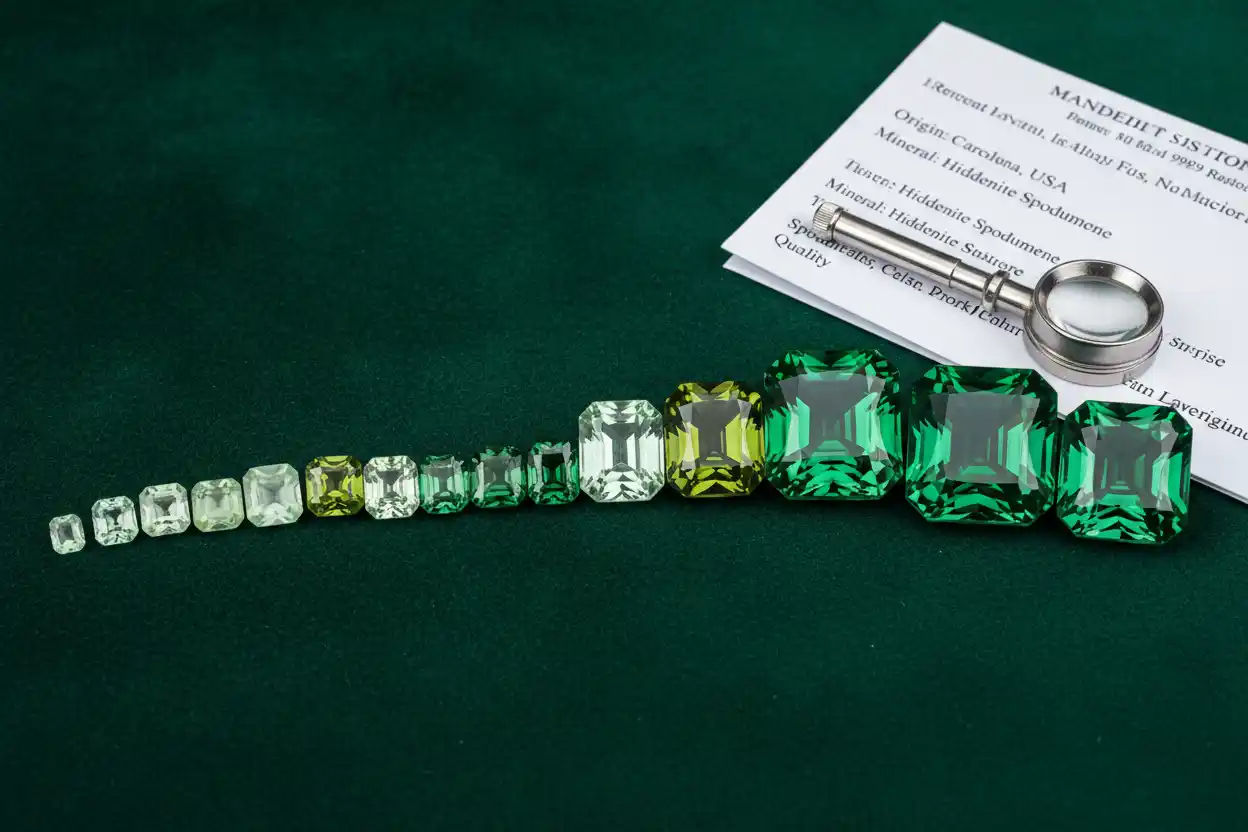
Hiddenite Price: Value, Cost & What Affects Price
Hiddenite price is unusually difficult to summarize with one dollar-per-carat range because the market does not use the word hiddenite consistently. Strict gemological usage associates hiddenite with stable chromium-bearing green spodumene, while many retail listings apply the name far more broadly to pale green, yellow-green, blue-green, yellow, or even nearly colorless spodumene. GIA describes hiddenite as rare chromium-colored green spodumene and documents irradiation as a way of producing unstable green spodumene that can mimic hiddenite.
That naming problem is visible directly in the current retail market. One specialist loose-gem seller currently groups stones described as turquoise, green, white, and yellow under its Hiddenite inventory, with displayed asking prices concentrated around roughly $21–$25 per carat for many examples. A separately indexed 16.49-carat blue-green stone from the same seller was offered at $493.12, or about $29.90 per carat. Marketplace listings labeled hiddenite are dramatically cheaper, including current examples that calculate to roughly $1–$9 per carat.
Those numbers should not be interpreted as proof that genuine fine chromium-bearing hiddenite is intrinsically a $1, $10, or $25-per-carat gemstone. They demonstrate something more useful: the label being priced is often broader than the strict material definition. Before interpreting hiddenite price, the buyer has to establish what material the seller actually means by hiddenite.
Readers comparing gemstone markets more broadly can browse Buying & Value. This page owns the valuation methodology, current market sample, quality factors, documentation premium, and limitations. Transaction-level seller selection belongs in the separate Buy Hiddenite guide.
Hiddenite Price at a Glance
| Pricing question | Evidence-aware answer |
|---|---|
| Is there one reliable hiddenite price per carat? | No |
| Why not? | The trade uses “hiddenite” for materially different green and non-green spodumene |
| Current specialist-market cluster observed | Roughly $21–$30/ct for many stones marketed as hiddenite |
| Current marketplace listings observed | Roughly $1–$9/ct in selected examples |
| One recent claimed North Carolina completed sale | About $65.57/ct for a 3.05 ct item |
| Does that define fine hiddenite value? | No; none of these examples alone establishes strict chromium-bearing quality |
| Most important value variable | Authentic, attractive, stable green color supported by credible material identification |
| Does chromium matter? | Yes when the premium depends on strict hiddenite identity |
| Does North Carolina provenance matter? | Potentially, especially for collectors, if documented |
| Does size always raise price per carat? | No |
| Does an expensive laboratory report guarantee value? | No |
| Can irradiation affect value? | Yes, especially when green color is unstable or undisclosed |
| Can cut affect value materially? | Yes |
| Are asking prices the same as sale prices? | No |
| Is hiddenite a guaranteed investment? | No |
| Best valuation method | Separate material identity from visual quality, then compare like with like |
The broader physical and nomenclatural boundary is covered in Hiddenite Meaning. For pricing purposes, the critical point is that the market can price two very different objects under the same variety name.
What Is Actually Being Priced?
A hiddenite price comparison can refer to at least four different market categories.
The first is strict hiddenite: stable chromium-bearing green spodumene, historically associated with North Carolina but now analytically confirmed from at least one other locality. GIA used Raman spectroscopy to establish spodumene identity in an Idaho specimen and EDXRF to identify chromium as the chromophore before calling it hiddenite.
The second category is naturally green spodumene whose precise relationship to the strict hiddenite definition is debatable. GIA has documented chromium- and vanadium-bearing Afghan green spodumene and explicitly noted that published definitions of hiddenite have not always been consistent.
The third category is broadly marketed green spodumene, where the seller may use hiddenite without showing chromium evidence, color-stability evidence, or locality documentation.
The fourth category includes weakly related commercial labels—yellow, white, turquoise, or nearly colorless spodumene listed within a hiddenite inventory. Those products may still be genuine spodumene, but they should not establish the market value of strict green hiddenite.
A useful hiddenite price guide has to keep these categories separate.
Original Information Gain: Current Hiddenite Market Sample
The following sample uses publicly visible asking prices and one publicly visible completed marketplace sale. Seller names are intentionally omitted from the table because the objective is market analysis rather than endorsement.
Calculated price per carat = displayed price ÷ stated carat weight
| Source type | Seller label | Weight | Displayed price | Calculated price/ct | Pricing interpretation |
|---|---|---|---|---|---|
| Specialist loose-gem retailer | Turquoise hiddenite | 30.58 ct | $759.00 | $24.82 | Broad trade usage |
| Specialist loose-gem retailer | Turquoise hiddenite | 23.63 ct | $586.50 | $24.82 | Broad trade usage |
| Specialist loose-gem retailer | Turquoise hiddenite | 13.37 ct | $276.54 | $20.68 | Broad trade usage |
| Specialist loose-gem retailer | Green hiddenite | 9.73 ct | $241.50 | $24.82 | More color-compatible label |
| Specialist loose-gem retailer | Green hiddenite | 9.83 ct | $243.98 | $24.82 | More color-compatible label |
| Specialist loose-gem retailer | Green hiddenite | 13.80 ct | $342.52 | $24.82 | More color-compatible label |
| Specialist loose-gem retailer | Yellow hiddenite | 5.15 ct | $106.52 | $20.68 | Does not fit strict hiddenite color usage |
| Specialist loose-gem retailer | Yellow hiddenite | 11.36 ct | $281.96 | $24.82 | Does not fit strict hiddenite color usage |
| Specialist indexed example | Blue-green hiddenite, untreated claim | 16.49 ct | $493.12 | $29.90 | Seller-stated Afghan origin and untreated status |
| Marketplace listing | Green hiddenite/spodumene | 15.59 ct | $85.00 | $5.45 | Variety claim not independently verified |
| Marketplace listing | Green hiddenite/spodumene | 12.70 ct | $90.00 | $7.09 | Variety claim not independently verified |
| Marketplace listing | Green hiddenite/spodumene | 13.41 ct | $120.00 | $8.95 | Variety claim not independently verified |
| Marketplace listing | Green-yellow hiddenite | 31.90 ct | $47.50 | $1.49 | Very low asking price; strong verification need |
| Marketplace listing | Green hiddenite | 17.55 ct | $21.99 | $1.25 | Very low asking price; strong verification need |
| Completed marketplace sale | Claimed North Carolina hiddenite | 3.05 ct | $200.00 | $65.57 | Completed sale, but claim not independently lab-verified here |
The specialist inventory supporting the first group currently displays many stones marketed as hiddenite at highly similar per-carat prices despite major differences in listed color. The 16.49-carat indexed blue-green example was listed at $493.12 with seller-stated Afghan origin, VS-SI clarity, and no treatment. Current marketplace examples show far lower asking prices. A 3.05-carat item specifically claimed as North Carolina hiddenite shows a completed sale at $200, approximately $65.57 per carat.
None of the stones in this sample was purchased, physically examined, chemically analyzed, tested for chromium, tested for light stability, or independently graded for this article. Seller labels are therefore recorded as claims rather than treated as laboratory facts.
What the Market Sample Actually Proves
The strongest conclusion is not that hiddenite price “normally” equals $25 per carat.
The strongest conclusion is that broad-market terminology compresses many different spodumene products under one word. The specialist inventory contains green, turquoise, yellow, and white material under the hiddenite category, while strict gemological sources tie hiddenite to chromium-bearing stable green spodumene.
That makes cheap online pricing difficult to interpret. A $5-per-carat green spodumene may be natural, attractive, and honestly sold as spodumene while still lacking the chromium-related evidence required for a strict hiddenite premium. A $25-per-carat stone can have the same problem.
Conversely, a seller asking a high price cannot establish rarity merely by adding the words “rare hiddenite.”
Price must follow evidence.
Working Hiddenite Price Bands
The current sample supports a market-label framework more confidently than a universal quality-price chart.
| Observed market band | Approximate current context | What the number really tells you |
|---|---|---|
| Ultra-low marketplace | About $1–$5/ct | Material needs strong identity, treatment and label verification |
| Low marketplace | About $5–$10/ct | Frequently broad green-spodumene marketing rather than proven premium hiddenite |
| Main specialist inventory observed | About $20–$30/ct | Established retailer pricing for stones marketed broadly as hiddenite |
| Documented-looking locality claim | Around $65/ct in one completed example | Shows locality claims can move pricing, but one sale cannot define the market |
| Fine verified chromium hiddenite | No responsible universal band derived from this sample | Requires specimen-specific comparison |
| Exceptional North Carolina collector material | Individually negotiated market | Provenance, crystal quality, rarity and collector demand can dominate |
The final two rows deliberately avoid fabricated precision.
Public listings for strictly verified chromium-bearing hiddenite are too thin and inconsistent to justify publishing a confident “fine hiddenite is always $X–$Y per carat” range from this sample alone.
That absence of precision is useful information.
Why Some Published Hiddenite Price Guides Look Much Higher
Online gemstone content often publishes hiddenite price ranges of hundreds or thousands of dollars per carat while simultaneously showing ordinary green spodumene retailing for a fraction of those amounts.
Part of the mismatch comes from collapsing three markets together: commercial green spodumene, fine chromium-bearing faceted gems, and rare North Carolina collector material.
The higher-end categories may genuinely command strong premiums when the identity and provenance are convincing. Historical sources show that North Carolina hiddenite attracted substantial prices very early in its commercial history, and collector interest in the locality remains strong.
But historical scarcity or museum significance cannot simply be applied to every pale green spodumene offered online today.
The First Price Question: Is It Really Hiddenite?
Before evaluating hiddenite price, establish the material category.
If the seller is charging ordinary commercial-spodumene pricing, an exact variety dispute may have limited financial significance. If the seller is charging a large premium because the stone is said to be rare natural chromium hiddenite, the burden of evidence becomes much stronger.
Useful evidence can include standard gemological identification, UV-Vis spectroscopy, X-ray fluorescence or other elemental analysis, credible treatment disclosure, and documented provenance where locality drives value.
GIA’s own hiddenite identification work demonstrates this sequence: establish spodumene, identify chromium, then apply the variety name.
The specimen-scale inclusions that may support natural origin or geological context are handled separately in the Hiddenite Microscope Inclusion Notebook.
Color Is the Leading Visual Value Factor
GIA’s colored-gem value framework emphasizes color as the dominant quality factor in most colored stones, while also considering uniformity, origin, size, clarity, shape, and quality of cutting.
That principle is highly relevant to hiddenite price.
A weak yellow-green stone with low saturation will usually have less visual rarity than a transparent, lively medium-to-strong green stone with attractive face-up color. A green that becomes too dark can also lose brightness and visual appeal.
The key variables are hue, saturation, tone, uniformity, and pleochroic orientation.
“Darkest green” is not automatically “best.”
Chromium Evidence Can Support a Premium
Strict hiddenite terminology gives chromium unusual importance.
When a seller’s premium is based on calling a stone true hiddenite rather than ordinary green spodumene, independent evidence of chromium can materially improve the credibility of that premium. GIA’s hiddenite descriptions repeatedly center chromium-colored spodumene, while CIBJO-related discussion summarized by GIA likewise recognizes green spodumene colored by chromium under the hiddenite term.
Chromium detection alone is not a complete valuation report.
The stone still needs attractive color, transparency, condition, cutting, and treatment context.
But it addresses one of the market’s most important identity uncertainties.
Chromium Plus Poor Color Does Not Guarantee High Value
A laboratory can confirm chromium in a green spodumene without making the gem beautiful.
A grayish, overly dark, heavily included, badly windowed, cracked, or poorly oriented chromium-bearing stone can reasonably sell for less than a visually superior example.
GIA’s colored-stone value methodology makes the same broader point: value emerges from interacting factors rather than from one chemical characteristic.
A chromophore can support identity.
It cannot replace quality.
Treatment and Color Stability Can Change Hiddenite Price
Irradiation is one of the most important treatment issues in green spodumene.
GIA documents that irradiation can transform spodumene into deep green material that resembles hiddenite, while the induced color may bleach rapidly during exposure to bright light. GIA’s broader treatment reference also notes that irradiated spodumene colors may be short-lived and fade with bright-light exposure.
If the value proposition depends on a stable natural green color, undisclosed irradiation can materially affect hiddenite price.
A stone should not be deliberately exposed to destructive sunlight as a casual buyer test. Professional gemological assessment is safer when value justifies the cost.
“Untreated” Is a Claim, Not a Color
An intense green stone does not prove treatment.
A pale stone does not prove natural color.
An online description saying “natural hiddenite” may mean only that the underlying spodumene formed naturally, not necessarily that its current color is untreated.
When color origin supports a premium, the seller should state treatment status explicitly.
The optical consequences of chromium, vanadium, manganese-related centers, irradiation, fading, and pleochroism belong in Hiddenite Optical Properties and Color Behavior.
North Carolina Provenance Can Create a Collector Premium
The classic Hiddenite district in North Carolina has historical significance beyond ordinary green spodumene.
GIA’s geological work describes “true” hiddenite from the region as chromium-bearing spodumene formed in a distinctive hydrothermal fissure environment rather than ordinary lithium-rich pegmatite pockets. It also describes bright emerald-green material as the rarest and most desired color within that classic context.
A convincingly documented North Carolina gem or crystal can therefore combine three value drivers: attractive green color, strict hiddenite identity, and locality history.
But provenance needs evidence.
A seller typing “North Carolina” into a listing title does not create geological provenance.
Origin Claims Outside North Carolina
Green spodumene is known from other regions, and chromium-bearing material is not geographically exclusive to North Carolina.
GIA documented chromium-colored hiddenite from Idaho and has discussed Cr/V-bearing green spodumene from Afghanistan.
Therefore, “not from North Carolina” does not automatically mean “not hiddenite.”
The market question is more precise:
Is this stone actually stable green spodumene whose chemistry supports the hiddenite label, and does its particular locality carry collector demand?
The geological differences among localities belong in Hiddenite Formation and Deposit Geology.
Size Does Not Create a Simple Premium Curve
Colored gemstones do not all follow the same size-price relationship.
GIA explains that price per carat can increase as size reaches scarce and desirable ranges, but it can also flatten or fall when very large stones move beyond mainstream jewelry demand.
Hiddenite adds another complication: some broad-market listings offer very large stones at low per-carat prices. That alone suggests size is not scarce within every material category being marketed under the hiddenite name.
A 30-carat pale or ambiguously labeled green spodumene can therefore cost less per carat than a much smaller, richly colored, documented chromium-bearing gem.
Weight is not rarity.
Fine Hiddenite Size Is a Different Question
Large strict hiddenite with strong stable chromium green, useful transparency, attractive pleochroic orientation, limited cleavage damage, and credible documentation can be much rarer than large pale green spodumene.
That is the size combination that may justify a nonlinear premium.
The word may is important because public transaction data remain thin.
A price guide should not manufacture a size premium where completed evidence is unavailable.
Clarity Influences Hiddenite Price
Transparent faceted hiddenite benefits from good clarity because inclusions and fractures can interrupt color and brilliance.
However, the practical value question is not simply whether inclusions exist. Spodumene commonly contains fractures, growth features, tubes, and other internal structures. Some may be harmless under normal wear; others may reach the surface or intersect cleavage planes and create significant durability concerns.
An eye-clean stone with attractive color generally presents a stronger jewelry proposition than a heavily fractured one.
But a natural crystal with scientifically interesting inclusions may carry specimen value that operates under a different market logic.
Cleavage Fractures Matter More Than Minor Inclusions
Spodumene has strong cleavage.
That makes one open or poorly positioned fracture potentially more important than numerous tiny internal inclusions that are invisible face-up.
A fracture intersecting the girdle or running through an exposed corner can increase setting and wear risk, which may reduce hiddenite price even when the stone appears clean in a front-facing photograph.
The mechanical implications belong in Hiddenite Setting and Wear Engineering.
Cut Quality Can Add or Destroy Value
A colored stone can be naturally rare and still lose visual value through poor cutting.
GIA identifies cut quality—including proportions, symmetry, polish, windowing and how facets manage color—as one of the principal colored-gem value factors.
Hiddenite presents a special cutting challenge because spodumene is strongly pleochroic and has perfect cleavage. A cutter has to balance face-up green, yield, cleavage orientation, rough shape, and mechanical risk.
A large window can wash out color.
Excess depth can preserve carat weight while making the gem face up smaller.
Poor orientation can show the weaker pleochroic direction.
A well-cut smaller stone can therefore justify a higher hiddenite price per carat than a larger poorly oriented gem.
The lapidary decisions belong in Hiddenite Cutting, Orientation and Polish.
Pleochroism Changes Face-Up Value
Spodumene can show substantial directional color.
Two stones cut from similarly colored rough may therefore look different after faceting if one is oriented to emphasize attractive green and the other presents a weaker yellow-green direction.
This creates a valuation issue that photographs can hide.
A seller may photograph the stone at the most favorable angle even though the normal face-up orientation is less saturated.
Comparison should use face-up neutral-light images rather than only hand-held tilted views.
Windowing Is Particularly Important in Pale Material
Shallow pavilions can create a large central window through which the background remains visible.
In a strongly saturated stone, some buyers may tolerate modest windowing.
In pale hiddenite, a window can remove much of the already limited color and make the stone look washed out.
That can materially lower value even when the carat weight is large.
A large stone should therefore be compared by both weight and face-up optical performance.
Price per Carat Can Mislead
Price per carat is useful for normalization, but it should not become the entire comparison.
Consider two hypothetical stones.
Stone A weighs 15 carats and costs $8 per carat. It is pale green, heavily windowed, seller-labeled hiddenite, and has no chromium or treatment evidence.
Stone B weighs 2 carats and costs much more per carat. It is saturated stable green, well cut, eye-clean, chromium-bearing, and supported by reputable testing.
The first is not automatically the better value simply because the per-carat number is lower.
They are different market products.
Rough Hiddenite and Faceted Hiddenite Need Separate Valuation
Rough material is priced partly according to potential yield.
A transparent crystal can look valuable but contain cleavage, fractures, color zoning, unfavorable orientation, and shape that reduce the amount of finished gem recovered.
An intact documented North Carolina crystal can also be worth more as a collector specimen than as cutting rough.
The valuation therefore begins with intended use.
A crystal should not automatically be priced by multiplying its rough carat weight by a faceted gemstone price.
Collector Specimen Value
Collector hiddenite can be valued for crystal completeness, termination quality, natural etching, color distribution, matrix relationship, locality, rarity, old labels, historical significance, and association with a recognized collection.
Those factors do not map cleanly onto per-carat gem pricing.
A 20-carat crystal with excellent provenance can be more desirable intact than a theoretical faceted yield of a few carats.
The recordkeeping questions belong in the Hiddenite Specimen Conservation Record.
Current Retail Asking Price Versus Completed Sale
Most public hiddenite price information comes from asking prices.
An asking price is what a seller hopes to receive.
A completed sale is what a buyer actually paid.
The distinction matters because current marketplace listings can remain active at optimistic prices or be discounted aggressively.
The one completed marketplace example in the documented sample—a 3.05-carat item claimed as North Carolina hiddenite sold at $200—has more transaction value than an unsold listing, but it still does not provide independent laboratory confirmation or enough observations to establish a broad market rate.
One sale is evidence.
It is not a price index.
Sale Price Versus Reference Price
Discounts create another distortion.
A listing may show a high crossed-out “regular” price and a much lower active price. Recording the reference price can make a gemstone appear much more expensive than the amount a buyer actually needs to pay.
For market sampling, use the currently actionable price and record that a promotion or coupon applies.
Do not treat the crossed-out number as a completed historical sale unless evidence shows buyers actually paid it.
Original Hiddenite Price Decision Matrix
| Value factor | Lower-value signal | Intermediate | Stronger premium signal |
|---|---|---|---|
| Material label | Generic green spodumene or vague “hiddenite” | Seller identifies natural spodumene | Hiddenite identity supported by appropriate evidence |
| Color | Pale, grayish, yellowish or washed out | Pleasant medium green | Attractive stable vivid green |
| Chromium evidence | None | Seller claim | Credible spectroscopy/chemistry |
| Color stability | Unknown | No obvious fading history | Stable natural color supported |
| Treatment | Unknown or undisclosed | Clear seller disclosure | Strong evidence supporting natural-color claim |
| Transparency | Cloudy or heavily included | Mostly transparent | Transparent with minimal distracting inclusions |
| Cleavage/fractures | Open, risky, surface reaching | Minor | Sound stone with limited structural risk |
| Cut | Large window, poor orientation | Commercial | Strong face-up color, symmetry and polish |
| Size | Large but ordinary | Good quality retained | Rare combination of size and top quality |
| Provenance | Unsupported locality | Credible seller documentation | Strong collector chain of custody |
| North Carolina claim | Marketing wording | Plausible documentation | Robust provenance |
| Laboratory report | None where claims are ambitious | Basic identification | Appropriate report supporting premium claims |
| Market channel | Anonymous/weak disclosure | General retailer | Specialist seller with detailed evidence |
| Sale status | Heavy promotion | Normal asking price | Price supported by unusual quality rather than artificial reference discount |
A higher hiddenite price becomes easier to justify when multiple premium signals align.
One strong attribute should not compensate automatically for several weak ones.
Hiddenite Price Versus Heliodor Price
Both hiddenite and heliodor can be transparent colored silicates, but their price logic differs.
Heliodor Price deals with yellow beryl, a market in which substantial clean stones are relatively available and current specialist inventory can cluster within fairly compressed commercial ranges.
Hiddenite’s market is more difficult because the variety label itself is inconsistent.
For hiddenite, identity and color-origin evidence often need to be resolved before conventional color, clarity, cut, and size comparisons become meaningful.
How Hiddenite Fits the Broader Gemstone Price Model
The general framework in How Gemstone Prices Work applies here: colored-gem value reflects interacting characteristics rather than one universal formula.
Hiddenite simply adds a preliminary gate:
Is the stone being compared genuinely equivalent material?
Only after that should color, clarity, size, cut, treatment, provenance, and retail context be compared.
This prevents an inexpensive pale green spodumene from setting the benchmark for rare documented chromium hiddenite—and prevents a rare collector specimen from being used to justify an inflated price for ordinary commercial material.
Does a Laboratory Report Increase Hiddenite Price?
A laboratory report can increase confidence.
That confidence may support value when the report confirms a claim that materially affects the market—such as natural spodumene identity, detectable treatment information, or relevant analytical data.
But a report does not make a pale, poorly cut, fractured stone beautiful.
Nor does every standard report necessarily state chromium content or geographic origin.
The report has value only in relation to the claim it actually resolves.
Is North Carolina Origin Usually Laboratory-Proven?
Origin determination for unusual colored stones can be difficult.
A seller may have strong documentary provenance without a laboratory making a geographic-origin determination. Old mine labels, direct collection history, photographs, chain of custody, and reputable specialist sourcing can therefore matter heavily in collector markets.
The buyer should distinguish “laboratory identified as hiddenite” from “laboratory confirmed North Carolina origin.”
Those are not automatically the same statement.
Can Extremely Cheap Hiddenite Be Genuine?
Yes, depending on what the seller means.
A cheap stone can be naturally mined green spodumene. It may even contain chromium.
The low price can result from pale color, weak saturation, large supply, poor cutting, fractures, unclear variety definition, aggressive marketplace pricing, or seller economics.
Cheap does not automatically mean synthetic or fake.
But when the price is extremely low and the description simultaneously claims vivid rare chromium hiddenite, untreated color, exceptional clarity, and premium provenance, the mismatch deserves verification.
Can Expensive Hiddenite Be Overpriced?
Also yes.
Rarity language can encourage sellers to price ordinary green spodumene as though every specimen were classic North Carolina chromium hiddenite.
A high hiddenite price does not prove color stability, chromium content, or provenance.
The evidence has to support the story.
Historical Price Does Not Equal Current Price
Historical accounts show that early North Carolina hiddenite could command remarkable prices for its time. Mindat’s historical review records strong per-carat values for early production and notes how highly prized fine crystals were.
That history supports the gemstone’s collector significance.
It should not be converted directly into a modern inflation-adjusted retail formula.
Markets, supply, treatment knowledge, gem cutting, collector demand, and competing material have all changed.
Historical price is context, not today’s appraisal.
Does Hiddenite Hold Its Value?
There is no reliable basis for guaranteeing that hiddenite will preserve its original retail price or appreciate.
Retail gemstone prices include dealer margin, cutting labor, documentation costs, overhead, platform fees, marketing, and sometimes large premiums for rarity narratives.
A private owner reselling the same stone may have fewer buyers and less bargaining power.
Collector-quality provenance can improve liquidity among specialists, but it still does not guarantee a future sale price.
The financial boundary for gemstone content is stated in the Gems Lore Disclaimer.
Hiddenite Should Not Be Sold as an Investment Guarantee
A rare stone can appreciate.
It can also become less fashionable, prove incorrectly labeled, suffer damage, be superseded by new supply, or simply fail to find a buyer at the desired price.
Therefore, hiddenite price analysis should support purchase decisions—not promises of returns.
Buy the gem because its identity, appearance, provenance, craftsmanship, or collecting significance justifies the cost to you.
A Repeatable Hiddenite Price Worksheet
A useful comparison should record the same information for every candidate stone.
| Field | What to record |
|---|---|
| Weight | Carats |
| Displayed total price | Current actionable price |
| Price per carat | Price ÷ weight |
| Market channel | Specialist, cutter, marketplace, auction, private sale |
| Seller material label | Hiddenite, green spodumene, Cr-bearing spodumene |
| Base mineral confirmation | Whether spodumene identity is supported |
| Color | Hue, tone, saturation and modifiers |
| Color stability | Known, claimed, unknown |
| Chromium evidence | None, seller claim, laboratory data |
| Treatment disclosure | Untreated, irradiated, unknown, other |
| Transparency | Transparent, translucent, cloudy |
| Eye-visible inclusions | None, minor, obvious, heavy |
| Cleavage/fractures | None visible, minor, significant, surface reaching |
| Cut | Shape, windowing, extinction, symmetry, polish |
| Pleochroic orientation | Attractive face-up green or weaker direction |
| Origin claim | Country/locality |
| Provenance evidence | None, seller records, collection chain |
| Laboratory report | Issuer and exact conclusions |
| Sale status | Normal price, promotion, auction, completed sale |
| Notes | Anything preventing a like-for-like comparison |
Using the worksheet turns hiddenite price from an arbitrary number into an evidence-based comparison.
Example Comparison: $6/ct Versus $30/ct
Suppose one 15-carat stone costs roughly $6 per carat and another 10-carat stone costs roughly $25–$30 per carat.
The higher-priced stone is not automatically better.
First compare whether both sellers mean the same thing by hiddenite. Check green saturation, transparency, treatment disclosure, chromium evidence, cleavage damage, cut, and provenance.
If neither has documentation, the price difference may primarily reflect seller channel.
If the higher-priced stone has materially stronger evidence and better appearance, its premium becomes more understandable.
Example Comparison: $30/ct Versus a Documented Collector Gem
Now compare a $30-per-carat commercial stone with a smaller gem carrying credible chromium evidence, stable vivid color, strong North Carolina provenance, excellent cutting, and no significant cleavage damage.
Those stones belong to different value categories even if both are technically spodumene.
The commercial stone provides jewelry-size green material.
The collector gem combines rare appearance, gemological evidence, and historical provenance.
One price-per-carat chart cannot capture the distinction without context.
Current Market Limitations
This price sample has important limits.
The sample is small. Most observations are retail asking prices rather than completed transactions. Seller claims regarding natural origin, chromium, treatment, clarity, and geographic source were not independently verified. Marketplace prices can change without notice. Currency, tax, shipping, return policies, negotiation, and platform discounts were excluded.
Most importantly, the market repeatedly uses the hiddenite label more broadly than strict gemological usage.
That means today’s visible online inventory is not a clean dataset of one standardized material.
Why This Page Does Not Publish a $1,000-or-$3,000 Ceiling
A rare, historically documented North Carolina hiddenite can plausibly exceed ordinary commercial green spodumene by a large margin.
But an evidence-based guide should not invent a universal upper price simply because rare stones exist.
Public fine-material transactions are sparse.
Collector pieces can be individually negotiated.
Large premiums may reflect provenance, cutting, historical importance, unusual size, or private-market scarcity.
A false ceiling would be just as misleading as a false floor.
Corrections and Evidence Standard
Gems Lore does not claim to be a wholesale pricing service, auction house, gemstone trading desk, or appraisal laboratory. The broader sourcing and evidence approach is described on About Gems Lore.
This price sample records publicly visible market claims rather than certifying the stones behind those claims.
Readers with documented completed-sale evidence, laboratory-confirmed chromium data, treatment findings, provenance corrections, or stronger market samples can submit them through Contact Gems Lore. Information submitted through site channels is handled according to the Privacy Policy.
Frequently Asked Questions About Hiddenite Price
What is the current hiddenite price per carat?
There is no defensible universal number. In the documented current sample, many specialist-retailer stones marketed as hiddenite cluster around roughly $21–$30 per carat, while selected marketplace listings fall around approximately $1–$9 per carat. Those categories include material whose strict hiddenite identity has not been independently established.
Why is the hiddenite price range so wide?
The market uses the hiddenite name inconsistently. Color quality, chromium evidence, treatment, color stability, clarity, size, cutting, cleavage, provenance, and seller channel also differ substantially.
Is $5-per-carat hiddenite fake?
Not necessarily. It may be natural green spodumene sold under broad trade terminology. The low price means identity and quality should be evaluated rather than automatically rejected.
Is $25-per-carat hiddenite realistic?
Yes for commercial material marketed as hiddenite. A current specialist inventory contains many stones around that level. It does not follow that every such stone meets a strict chromium-hiddenite definition.
Is genuine chromium hiddenite more valuable?
It can be, particularly when the green is attractive, stable, transparent, well cut, and credibly documented. Chromium evidence strengthens the variety identification but does not alone determine market value.
Is North Carolina hiddenite expensive?
Well-documented North Carolina material can receive collector interest because the locality is historically important and associated with classic chromium-bearing hiddenite. Exact value remains specimen-specific.
Does North Carolina origin automatically make a stone valuable?
No. Weak color, damage, poor transparency, poor cutting, or unsupported provenance can reduce value.
Can hiddenite come from outside North Carolina?
Yes. GIA has analytically confirmed chromium-colored hiddenite from Idaho and documented Cr-bearing green spodumene from other regions.
Does a large hiddenite always cost more per carat?
No. Current listings show large commercial stones at modest per-carat prices. Size creates a premium only when desirable quality remains scarce at that size.
What hiddenite color is usually most desirable?
Attractive stable medium-to-vivid green is generally more compelling than pale, grayish, or washed-out material. Extremely dark color can also reduce brilliance.
Does chromium automatically make hiddenite expensive?
No. Chromium helps establish strict hiddenite identity, but color quality, transparency, cut, size, condition, treatment, and provenance still influence value.
Does irradiation reduce hiddenite value?
It can, especially if a seller is charging a natural-color premium. GIA documents irradiation-induced green spodumene that can fade strongly with light.
Can hiddenite color fade?
Some irradiation-induced green spodumene can fade rapidly in bright light. Classic chromium-colored hiddenite is valued partly because its green is comparatively stable.
Does clarity matter?
Yes. Transparency and freedom from distracting inclusions can improve visual value, while major cleavage fractures can create both appearance and durability problems.
Does cutting affect hiddenite price?
Yes. Pleochroic orientation, windowing, symmetry, polish, depth, and cleavage management can materially affect face-up quality.
Is rough hiddenite priced the same as faceted hiddenite?
No. Rough must be discounted for expected cutting yield, cleavage risk, fractures, color orientation, and labor. Fine crystals may instead have collector value intact.
Is a laboratory certificate worth paying for?
It can be when the premium depends on material identity, treatment, chromium evidence, or another technical claim. The report should be read for exactly what it confirms rather than treated as a generic value certificate.
Does a lab report tell me what hiddenite is worth?
No. A laboratory report provides gemological information. Market value still depends on appearance, rarity, workmanship, provenance, demand, and sales context.
Is hiddenite a good investment?
No guaranteed investment case can be made. Gemstone resale markets are thin, retail markups vary, and future demand is uncertain.
What is the best way to compare hiddenite prices?
First ensure the stones are genuinely comparable materials. Then compare color, chromium evidence, treatment, color stability, clarity, fractures, cutting, size, provenance, laboratory information, and source type before interpreting price per carat.
Final Perspective
Hiddenite price is not difficult because spodumene is impossible to value. It is difficult because the market frequently prices different kinds of spodumene under the same variety name. Current specialist listings marketed as hiddenite cluster around roughly the low-to-upper $20s per carat, while marketplace listings can fall into single-digit or even approximately $1-per-carat territory.
That spread should not become a simplistic $1-to-$30 “true hiddenite” price range. The specialist inventory itself includes turquoise, yellow, white, and green stones under the hiddenite label, while authoritative gemological references define hiddenite much more narrowly around chromium-bearing green spodumene and distinguish it from unstable irradiation-produced green material.
The correct valuation sequence is therefore identity first and price second. Establish whether the stone is spodumene, determine what supports the hiddenite label, assess whether the green is stable and whether treatment is disclosed, then evaluate hue, saturation, transparency, cleavage damage, cutting, size, provenance, and market channel. Only after those questions are answered does price per carat become genuinely useful.
Fine documented chromium-bearing hiddenite—especially material with convincing historical provenance—may occupy a market far above ordinary commercial green spodumene. Public transaction evidence is too thin to justify manufacturing a universal premium ceiling, and that uncertainty should remain visible.
A credible hiddenite price is the price supported by the stone’s actual evidence and quality, not by the rarity adjectives in its listing title.