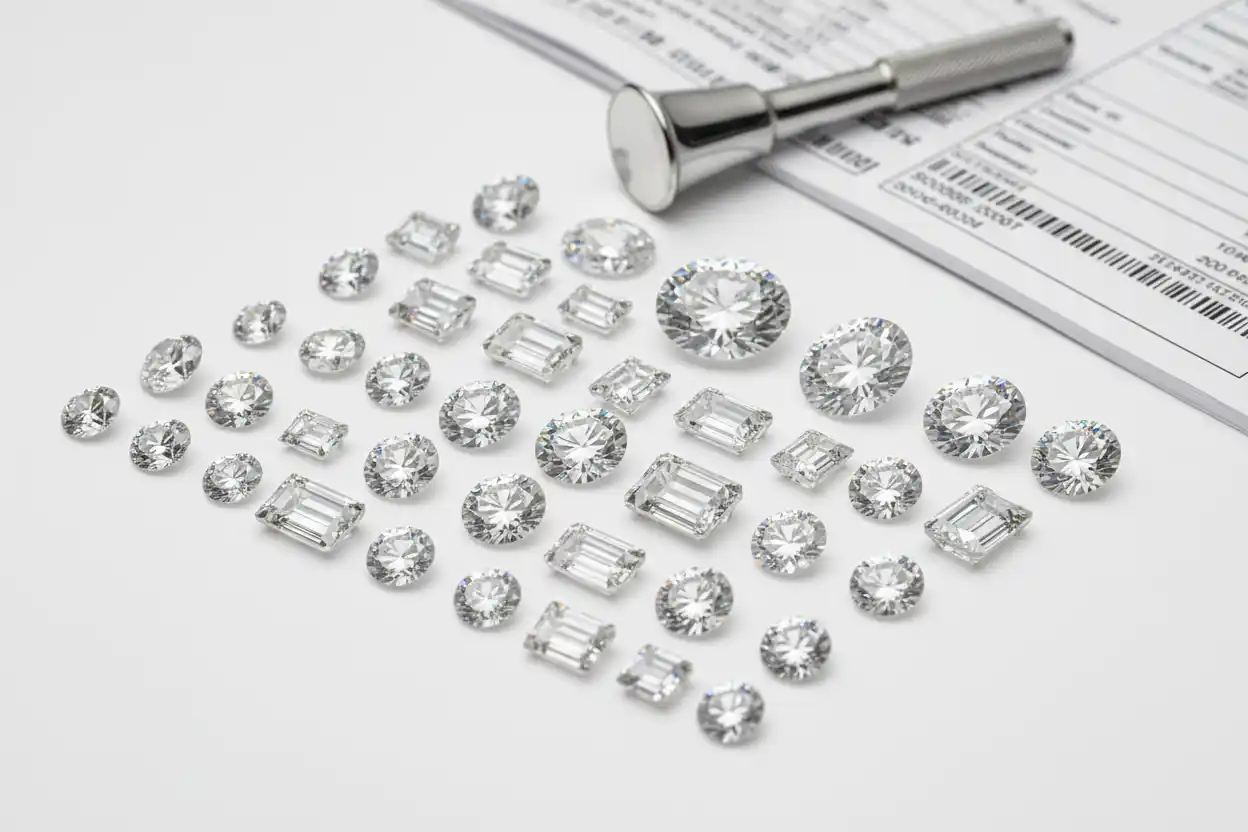
Buy Lab Diamond: How to Compare Quality, Value Factors & Seller Claims
When you buy lab diamond jewelry, the first decision is not whether the stone is “real,” because a laboratory-grown diamond is diamond rather than a diamond imitation. Laboratory-grown diamonds possess essentially the same fundamental chemical, physical, and optical properties as natural diamonds, but they crystallize through technological growth rather than geological formation deep within the Earth. GIA distinguishes laboratory-grown diamonds from simulants such as cubic zirconia and moissanite because simulants imitate diamond’s appearance without sharing diamond’s material identity. This distinction should shape every later buying decision, from documentation and cutting quality to price comparison and resale expectations.
The current reporting landscape also deserves special attention because GIA changed its approach to colorless-to-near-colorless laboratory-grown diamonds. Beginning October 1, 2025, qualifying stones submitted to GIA receive a Laboratory-Grown Diamond Quality Assessment using the terms Premium or Standard rather than the traditional natural-diamond grading nomenclature GIA previously used for its lab-grown reports. Premium requires the stone to meet GIA’s higher criteria across color, clarity, polish, symmetry, and round-brilliant cut where applicable, while Standard covers qualifying stones that meet its published minimum requirements. Each assessed stone is also laser inscribed with “Laboratory-Grown” and its assessment number. Buyers should therefore understand both current assessments and legitimate older grading reports when comparing inventory.
Buy Lab Diamond At a Glance
| Buying Factor | What to Check | Why It Matters |
|---|---|---|
| Identity | Verified laboratory-grown diamond | Separates genuine lab-grown diamond from CZ, moissanite, and other simulants |
| Growth Method | CVD or HPHT when disclosed | Both produce genuine laboratory-grown diamond |
| GIA Documentation | Premium, Standard, or legitimate older report | GIA changed its lab-grown reporting system |
| Cut | Brightness, scintillation, symmetry, proportions | Cut strongly controls visible beauty |
| Shape | Round, oval, radiant, cushion, emerald, pear, others | Shape influences spread, pattern, bow tie, and price |
| Carat Weight | Weight plus face-up measurements | Equal-weight stones can look different in size |
| Color | Face-up tint under neutral light | Subtle color becomes more visible in some shapes |
| Clarity | Eye-visible inclusions and transparency | Extremely high clarity may add cost without visible benefit |
| Post-Growth Processing | Treatment information when available | Post-growth treatment is common in modern CVD production |
| Girdle Inscription | Assessment/report number and laboratory-grown wording | Helps connect the physical stone with its documentation |
| Seller Disclosure | Clear laboratory-grown terminology | Prevents confusion with mined diamond |
| Sustainability Claims | Specific evidence rather than broad assumptions | Lab-grown origin alone does not establish total environmental impact |
| Return Policy | Inspection and refund terms | Appearance can differ from online imagery |
| Resale Expectations | Current secondary-market reality | Retail price is not guaranteed future cash value |
Laboratory-Grown Diamond Is Not Cubic Zirconia
Consumers sometimes use “synthetic diamond,” “fake diamond,” “lab diamond,” and “diamond alternative” interchangeably, but those expressions can refer to very different materials. A laboratory-grown diamond is crystallized carbon with diamond’s fundamental properties, while cubic zirconia is zirconium dioxide and moissanite is silicon carbide. This is why a buyer using Gems Lore’s buy cubic zirconia guide or cubic zirconia price guide is evaluating a different material category from someone deciding to buy lab diamond jewelry.
The difference is also why basic handheld diamond testers can be inadequate for separating mined and laboratory-grown diamond. Both can conduct heat and display diamond-like responses because both are diamond. Professional laboratories instead examine growth structures, fluorescence patterns, trace defects, spectroscopy, strain, and other diagnostic properties to establish origin. GIA’s research documents characteristic features of both CVD and HPHT production and explains why advanced laboratory identification is necessary as manufacturing technology improves.
CVD and HPHT Are Both Genuine Laboratory-Grown Diamond
The two principal commercial growth methods are chemical vapor deposition and high-pressure, high-temperature growth. HPHT growth recreates very high pressure and temperature conditions around a diamond seed, while CVD deposits carbon from a carbon-containing gas onto a substrate in a controlled reactor environment. Both methods can produce high-quality jewelry diamonds, and neither growth method automatically guarantees superior color, clarity, cut, or value.
A buyer should therefore resist claims that one method is inherently premium while the other is inferior. A beautifully cut HPHT diamond can outperform a poorly cut CVD stone visually, and the reverse is equally possible. Growth method can influence characteristic internal features and treatment history, but the finished diamond still needs to be judged individually.
GIA’s current research shows that CVD-grown material has become especially prominent in laboratory submissions and that manufacturing capability has advanced rapidly in both quality and size. This expanding production is one reason laboratory-grown diamond should be evaluated within its own supply structure rather than priced from assumptions borrowed directly from mined diamond.
Understand GIA Premium and Standard Before Comparing Prices
GIA’s current Laboratory-Grown Diamond Quality Assessment uses Premium and Standard for qualifying D-to-Z laboratory-grown diamonds rather than the traditional nomenclature developed for natural diamonds. Premium requires D color, Very Very Slightly Included or better clarity, Excellent polish and symmetry, and Excellent cut for round brilliants. Standard encompasses stones meeting GIA’s published minimum qualifying criteria, including E-to-J color, Very Slightly Included clarity, Very Good polish, specified symmetry standards, and Very Good cut for round brilliant diamonds.
A Premium assessment does not mean every buyer will see enough visual difference to justify every retail premium. A properly cut Standard stone can look outstanding in ordinary wear, especially when its color and inclusions are visually unobtrusive.
The most efficient purchase therefore balances the assessment with what the buyer actually sees. If two diamonds look equally colorless and eye-clean from normal viewing distance, paying substantially more for the stricter classification becomes a preference rather than an automatic necessity.
Older GIA Reports Can Still Be Legitimate
Inventory graded before October 1, 2025 may carry older GIA laboratory-grown diamond reports using individual color and clarity grades rather than Premium or Standard. The existence of D, E, F, VVS, or VS information on such a document is not by itself a warning sign.
Check the report date, verify its number independently, compare the listed measurements with the physical diamond, and examine any girdle inscription.
A seller should not rewrite an older report as though it were a current Premium assessment unless the stone has actually received that newer assessment. The reporting systems belong to different periods, and the document should be represented according to what it actually states.
Cut Usually Matters More Than Chasing Maximum Clarity
A laboratory-grown diamond can possess exceptional chemical purity yet look disappointing if the cut produces weak brightness, uneven contrast, excessive depth, windowing, or poor scintillation. Round brilliants benefit from well-developed proportion analysis, while fancy shapes demand additional visual judgment because no single specification captures every bow tie, light pattern, outline, or face-up character.
A buyer familiar with Gems Lore’s buy diamond guide will recognize the same core principle: cut is not merely a shape name. It determines how efficiently the polished stone returns light.
For most jewelry buyers, a beautifully cut eye-clean diamond generally produces more visible benefit than spending the same extra budget to move from an already-clean clarity level to a microscopic level that cannot be distinguished without magnification.
Fancy Shapes Need Individual Inspection
Oval diamonds can show bow ties, radiant cuts can vary widely in facet pattern, cushions can range from broad chunky flashes to crushed-ice appearance, and emerald cuts expose color and inclusions through large step facets. A report can document dimensions and technical characteristics but cannot tell you whether you personally prefer the diamond’s visual pattern.
Request clear face-up video in neutral lighting, especially for ovals, pears, marquises, cushions, radiants, and step cuts. Rotate the stone and look for persistent dark zones, asymmetry, excessive windowing, or weak centers.
A fancy shape that looks larger per carat can offer strong visual value, but only when its outline and light return are pleasing rather than simply broad.
Compare Carat Weight With Face-Up Measurements
Carat measures mass rather than visible size. A deeply proportioned diamond can hide weight below the girdle and present a smaller face-up area than another stone of equal or even slightly lower carat weight.
This matters particularly in the laboratory-grown market because buyers can often access larger carat weights within the same budget. Once the desired weight becomes affordable, efficiency of spread becomes a more useful differentiator.
Compare diameter for rounds and length-by-width measurements for fancy shapes. A 1.90-carat diamond that looks as large as a poorly proportioned 2.00-carat alternative can represent better practical value when cut and appearance are superior.
Color Should Be Evaluated in the Intended Setting
A near-colorless laboratory-grown diamond can appear fully colorless to many observers once mounted, particularly in brilliant cuts. Step cuts and larger stones can reveal bodycolor more easily because their facet patterns produce broad transparent flashes rather than intense scintillation.
White gold and platinum can emphasize subtle warmth more than yellow or rose gold, where some warmth can blend naturally with the setting.
GIA’s current assessment includes color within its Premium and Standard criteria, but a buyer should still judge actual face-up appearance rather than treating the classification as the only decision.
Clarity Should Be Purchased for Appearance, Not Prestige Alone
Modern laboratory-grown production can deliver high-clarity diamonds consistently, and GIA research shows that much current production falls into comparatively high color and clarity ranges. Once a stone is eye-clean at normal viewing distance, moving upward in technical clarity can provide little visible improvement.
Emerald and Asscher-style cuts deserve somewhat greater clarity attention because broad facets can reveal inclusions more readily. Brilliant cuts can conceal small inclusions more effectively through their busier optical pattern.
The best clarity level is therefore the one that produces a clean face-up appearance without consuming budget that would create more visible improvement elsewhere.
Post-Growth Processing Is Common
Post-growth treatment does not make a laboratory-grown diamond an imitation. GIA reports that roughly 80% of CVD-grown diamonds submitted since 2020 had undergone post-growth processing, often HPHT annealing used to reduce brown coloration and improve final appearance.
A buyer should therefore treat post-growth processing as an important disclosure point rather than an automatic defect. Manufacturing, growth, and subsequent processing form part of the modern laboratory-grown diamond supply chain.
If a seller charges a premium specifically for an untreated or as-grown CVD diamond, ask what documentation establishes that status and whether the visual or collector difference justifies the additional cost.
Girdle Inscription Adds Useful Verification
Under GIA’s current service, qualifying laboratory-grown diamonds receive a laser inscription containing the term “Laboratory-Grown” and the quality-assessment number. A jeweler can usually show the inscription under magnification before the stone is permanently mounted.
The inscription should match the assessment document and the listed measurements. This does not replace full gemological verification, but it provides a useful physical link between the diamond and its paperwork.
For an expensive loose stone, checking the inscription before final payment is a simple precaution.
Seller Disclosure Should Be Clear
The FTC states that sellers should clearly and conspicuously disclose laboratory-created diamond origin using terms such as laboratory-grown, laboratory-created, manufacturer-name-created, or wording of like meaning that communicates that the diamond is not mined.
That disclosure should appear prominently rather than being buried at the bottom of a page or hidden on a separate education section.
A listing whose title simply says diamond while disclosing laboratory-grown origin only after several screens of text deserves caution because transparent origin information should be part of the primary product description.
Environmental Claims Need Evidence Beyond “Lab-Grown”
Laboratory-grown production removes the need to mine the diamond crystal itself, but it does not automatically establish the full environmental footprint. Electricity source, reactor efficiency, production location, equipment, carbon feedstock, cutting and polishing, transportation, jewelry metals, packaging, and the methodology used to calculate emissions all matter.
If carbon-neutral, renewable-powered, zero-emission, or sustainable claims influence your purchase, ask what those words measure and what independent evidence supports them.
Laboratory-grown is an origin description, not a complete environmental certification.
Price Savings Are Not the Same as Investment Value
A laboratory-grown diamond can cost substantially less than a visually comparable mined diamond, but that comparison does not prove that the lab-grown diamond is intrinsically worth the mined diamond’s price difference. The natural and laboratory-grown markets have different supply mechanics and secondary-market behavior.
Use the Gems Lore diamond price guide to understand the mined-diamond market separately rather than treating its prices as a valuation anchor for a manufactured diamond.
A lower acquisition cost can be an excellent consumer benefit while still coexisting with weaker resale retention.
Setting Quality Deserves Independent Evaluation
A low-priced center stone can be placed in a poorly made mounting with thin prongs, weak finishing, hollow construction, or low-quality side stones, while another retailer may charge more for a durable custom setting and strong after-sales service.
Ask what precious-metal purity is used, whether side diamonds are laboratory-grown or natural, how the prongs are finished, whether sizing is included, and what warranty covers manufacturing defects.
A laboratory-grown diamond ring should be valued as both a gemstone purchase and a piece of jewelry.
Return and Upgrade Policies Can Add Real Practical Value
An inspection period is useful because videos cannot fully communicate finger coverage, fancy-shape bow ties, color in a specific metal, or how the diamond behaves in varied lighting.
Upgrade programs can also be valuable if the buyer expects to trade into a larger stone later, but read the contract carefully. Some programs require spending a fixed multiple of the original price, keeping the original documentation, or applying credit only toward another purchase rather than receiving cash.
An upgrade policy is a retailer benefit rather than proof of universal resale value.
Common Red Flags When You Buy Lab Diamond
Be cautious when:
Laboratory-grown origin is hidden or minimized.
Cubic zirconia or moissanite is described as laboratory-grown diamond.
A GIA report number cannot be independently verified.
A seller presents an older grading report as a current Premium assessment.
A fancy-shape diamond is sold only by technical specifications without useful video.
CVD or HPHT is marketed as universally superior without explaining the individual stone.
Post-growth processing is concealed while untreated status is used as a premium claim.
Environmental claims lack supporting information.
A high appraisal is presented as guaranteed resale value.
A natural diamond comparison is used to promise appreciation.
Return or upgrade conditions are vague.
How to Compare Lab-Grown Diamond Listings Fairly
Compare stones with similar shape, weight, dimensions, face-up appearance, report framework, color, clarity, cutting quality, treatment information, inscription, setting status, warranty, return policy, and retailer service. Do not compare a loose Standard oval with a Premium round in a finished designer ring and expect the price difference to reveal the value of the diamond alone.
Conclusion
To buy lab diamond jewelry successfully, understand both what the stone is and what the current market is. Laboratory-grown diamonds are genuine diamonds produced through CVD or HPHT methods rather than simulants, but their manufactured origin gives them supply economics different from geologically formed diamonds. GIA research documents rapid growth in laboratory-grown diamond size, quality, and production volume, together with widespread post-growth processing in CVD material.
Current GIA documentation also requires updated knowledge because Premium and Standard assessments replaced GIA’s previous approach to qualifying colorless-to-near-colorless laboratory-grown diamonds beginning October 1, 2025. Buyers should verify the actual report format, check inscriptions when present, prioritize cut and face-up appearance, compare dimensions with carat weight, and keep resale expectations separate from retail savings.
The strongest purchase is not automatically the largest laboratory-grown diamond or the one with the highest technical specification. It is the diamond whose beauty, documentation, craftsmanship, price, and seller protections make sense together.
Frequently Asked Questions
Is a lab-grown diamond a real diamond?
Yes. Laboratory-grown diamonds possess essentially the same fundamental optical, physical, and chemical properties as mined diamonds, although their growth origin is technological rather than geological.
Is lab-grown diamond the same as cubic zirconia?
No. Cubic zirconia is a diamond simulant, while laboratory-grown diamond is diamond material. The FTC specifically distinguishes laboratory-grown diamonds from imitations and simulants.
What is the difference between CVD and HPHT?
They are different diamond-growth technologies. CVD deposits carbon in a reactor onto a diamond substrate, while HPHT grows diamond under extremely high pressure and temperature. Both can produce gem-quality laboratory-grown diamonds.
What does GIA Premium mean?
GIA Premium requires its higher published criteria, including D color, Very Very Slightly Included or better clarity, Excellent polish and symmetry, and Excellent cut for round brilliant diamonds.
What does GIA Standard mean?
Standard is GIA’s other qualifying current assessment category and requires the stone to meet its published minimum color, clarity, polish, symmetry, and round-brilliant cut criteria.
Are older GIA lab-grown reports still valid?
Legitimate reports issued under GIA’s previous laboratory-grown reporting framework can still exist in the market. Buyers should verify the report number and understand its date rather than assuming every older color-and-clarity report is suspicious.
Are CVD diamonds usually treated after growth?
Post-growth processing is common. GIA reports that about 80% of CVD laboratory-grown diamonds submitted since 2020 showed post-growth treatment intended primarily to improve color.
Should I choose Premium instead of Standard?
Not automatically. Premium meets stricter criteria, but a well-cut Standard stone can look outstanding in ordinary wear. Compare visible appearance and price rather than purchasing the label alone.
Can a lab-grown diamond be independently identified?
Yes. Advanced gemological testing can distinguish laboratory-grown and natural diamond using growth-related and spectroscopic characteristics.
Must sellers disclose laboratory-grown origin?
FTC guidance states that laboratory-created diamonds should be clearly described with qualifying terminology such as laboratory-grown or laboratory-created so buyers understand they are not mined diamonds.
Does lab-grown automatically mean environmentally friendly?
No. Environmental performance depends on factors including energy source, production technology, location, transport, cutting, and jewelry manufacture. Claims such as carbon neutral require their own supporting evidence.
Is a lab-grown diamond a guaranteed investment?
No. Manufacturing technology, supply, retail competition, secondary-market demand, condition, and seller policies can all influence future value.