Buy Malachite: How to Compare Quality, Treatments, Grading & Cost
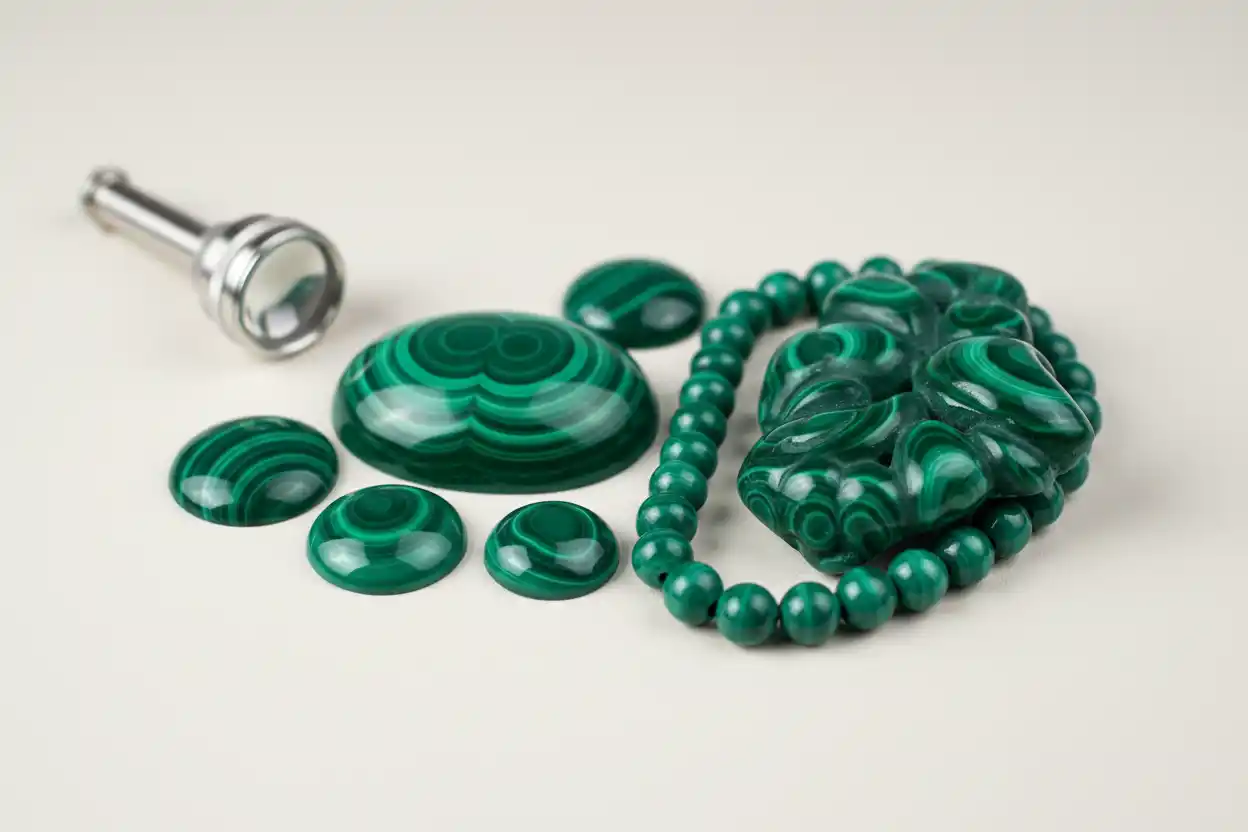
If you want to buy malachite, judge the individual stone by its green color, banding, pattern, polish, condition, authenticity, treatment disclosure, and workmanship before paying attention to size or seller-created grades. Good natural malachite often shows crisp bands, concentric rings, waves, eyes, or flowing green patterns with attractive contrast between light and dark shades. Poorly finished stones may look dull, heavily fractured, scratched, patched, or visually flat even when they are genuine.
Malachite is generally affordable. Current untreated Congo cabochons commonly appear around roughly $0.75 to $2 per carat in active specialist retail inventory, while very large decorative pieces can fall below $0.50 per carat. Exceptional patterning, unusual crystal formations, chatoyancy, strong craftsmanship, antique work, or important provenance can cost more. Understanding the malachite price therefore requires more than comparing carat weight.
Start With the Pattern, Not the Size
Malachite is famous for its banding. Natural pieces can show stripes, curved lines, concentric circles, bull’s-eye formations, feather-like structures, and irregular waves created during growth. These changing patterns are one of the strongest reasons buyers choose one cabochon over another.
A visually successful stone should have enough contrast for the pattern to remain clear after polishing. Dark and light green bands often create the most dramatic look, although softer patterns can also be attractive. A completely plain green stone may still be natural, but it usually lacks the visual character that creates stronger jewelry demand.
Pattern should look organic rather than mechanically repetitive. Natural banding can be surprisingly regular in places, so pattern alone cannot prove authenticity, but overly uniform printed-looking stripes deserve closer inspection.
Current Malachite Price Examples
Current untreated Congo listings show how accessible ordinary natural malachite can be.
| Current loose malachite example | Weight | Asking price | Approx. price per carat |
|---|---|---|---|
| Oval cabochon | 3.67 ct | $3.65 | $0.99 |
| Oval cabochon | 4.66 ct | $3.58 | $0.77 |
| Baguette cabochon | 5.28 ct | $6.37 | $1.21 |
| Oval cabochon | 6.76 ct | $13.46 | $1.99 |
| Baguette cabochon | 13.07 ct | $18.62 | $1.42 |
| Oval cabochon | 30.12 ct | $33.00 | $1.10 |
| Square cabochon | 68.84 ct | $68.57 | $1.00 |
| Large oval decorative piece | 3,000 ct | $1,220.10 | $0.41 |
These examples show why malachite price per carat often decreases as size rises. Malachite occurs in large masses, so weight does not create the scarcity premium seen in many transparent gems.
Color Quality Is About Richness and Contrast
Natural malachite is green because of its copper content. Color can range from relatively light green through saturated emerald-like green to very dark green. Many of the most attractive polished stones combine several tones in one pattern.
Uniform dark green does not automatically indicate superior quality. What matters is whether the stone has lively color, appealing contrast, and a pattern that works with its shape.
Brown stains, dull gray zones, weak polish, or unattractive matrix can reduce value when they interrupt the design. Some collectors enjoy rough natural sections or mixed copper-mineral associations, but jewelry buyers usually favor a cleaner finished appearance.
The malachite quality grading is therefore most useful when color, pattern, polish, structure, condition, treatment, and workmanship are assessed together.
Treatments Are Usually Limited but Still Worth Checking
Malachite is not commonly subjected to the intensive color treatments seen in some gems. International Gem Society guidance notes that natural malachite rarely receives treatment.
Lower-quality or less compact pieces can sometimes be strengthened with plastic resin. Wax can also be used on the surface to improve polish or appearance. These processes do not automatically make a piece unsuitable, but they should be disclosed when they meaningfully affect durability or value.
An untreated stone with strong natural polish may deserve more confidence than a heavily stabilized piece at the same price. Treatment becomes especially relevant for carvings, beads, thin slabs, or porous examples that need added support.
Synthetic Malachite Exists
Laboratory-grown malachite is real enough to require attention. GIA has documented synthetic malachite with color, structure, chemistry, density, and other properties close enough to natural malachite that laboratory separation can require advanced analysis.
More recent GIA work continues to address methods for separating natural and synthetic examples. This matters because a buyer cannot assume that convincing green banding automatically proves natural geological origin.
Synthetic malachite is not necessarily a low-cost imitation. Specialist references note that producing it can actually cost more than abundant natural malachite. The issue is disclosure, not simply price. A seller should state clearly whether the stone is natural or laboratory-grown.
Glass Can Imitate Malachite
Glass is another important authenticity issue. GIA shows that layered or patterned glass can imitate malachite convincingly. Artificial products can reproduce green bands and swirls well enough to look attractive in jewelry photographs.
The real vs fake malachite question should therefore be approached with more than a visual color check. Natural malachite may display irregular band widths, changing curves, subtle color variation, and geological texture that differ from many manufactured patterns, but appearance alone is not always decisive.
For an inexpensive cabochon, a reputable seller and return policy may provide reasonable protection. For expensive jewelry, antique objects, collector specimens, or unusually large pieces sold at a premium, professional identification can be worthwhile.
Watch for Reconstructed and Composite Products
Small malachite fragments or powders can be combined with binders and fashioned into beads, cabochons, or decorative objects. These products may still contain genuine malachite but should not be represented as solid natural stone if they have been reconstructed.
Composite pieces can also combine malachite with other stones for intentional decorative effects. Such work can be attractive when correctly described.
The red flag is vague wording. Terms such as natural-style, malachite look, reconstructed green stone, simulated malachite, or composite malachite should be read carefully. Ask what percentage, if any, is natural malachite when the description is unclear.
Congo Origin Is Common in Today’s Trade
The Democratic Republic of the Congo supplies a large amount of the banded malachite seen in contemporary jewelry and loose-stone markets. Namibia, Russia, the United States, Zambia, Australia, and other localities are also known sources.
Origin can add collector interest, especially for distinctive specimens from famous mines, but ordinary cabochon value is usually controlled more by pattern and workmanship than by locality alone.
A beautifully cut Congo cabochon can therefore be more desirable than a poorly finished stone carrying a rarer source name. Pay an origin premium only when locality is meaningful to the item and supported by credible information.
Larger Stones Are Not Necessarily Rarer
Malachite can occur in enormous masses, and it has historically been used for carvings, boxes, architectural decoration, inlay, and large ornamental objects. Very large polished pieces are therefore possible.
Current retail inventory includes a 3,000-carat oval piece priced at about $1,220, which works out to only around $0.41 per carat. Smaller calibrated stones in the same market often sit closer to $1 or $2 per carat.
The difference reflects cutting, calibration, demand, pattern, and sales format rather than a simple rule that larger always means more valuable.
Cutting Can Add More Value Than Weight
Malachite takes a strong polish despite its relatively low hardness. Skilled cutting can position concentric bands into striking bull’s-eyes, create symmetrical book-matched patterns, or orient flowing lines to fit the shape of a pendant or ring.
Poor cutting wastes this potential. A cabochon may be natural and richly colored but still feel ordinary if the pattern has been cut at an awkward angle.
Matching pairs deserve particular attention because producing earrings with complementary patterns requires selection and cutting skill. Large carvings can also carry substantial workmanship value even when the underlying stone itself is not especially expensive.
Condition Is Important Because Malachite Is Soft
Malachite has a Mohs hardness around 3.5 to 4.5 and is somewhat brittle. It can scratch more easily than quartz, sapphire, or diamond, and it is sensitive to acids and heat.
Inspect polished pieces for scratches, chips, open fractures, pits, dull spots, and edge wear. These issues matter particularly in rings and bracelets, where repeated contact can damage a soft stone.
Pendants, earrings, brooches, and protected settings usually present fewer durability concerns. A smooth undamaged surface with good polish should receive preference over a similarly patterned stone with visible wear.
Avoid Steam, Ultrasonic Cleaning, and Acids
Malachite needs gentle care. Mechanical cleaning systems such as steam and ultrasonic cleaners are generally unsuitable, and acidic cleaners should be avoided.
This care requirement affects buying decisions for daily-wear jewelry. A highly exposed malachite ring may require more attention than a protected pendant.
Ask whether a used jewelry piece has already been repolished or repaired if surface condition looks inconsistent. Repeated polishing can gradually change contours and reduce sharp pattern definition.
Seller Grades Are Not Standardized
AAA, AAAA, premium, collector grade, royal green, and similar phrases are seller-defined. There is no universal market system assigning one letter grade to every malachite cabochon.
A shop may use AAA to describe vivid color and crisp banding, while another applies the same term to ordinary inventory. Compare actual stones rather than comparing labels.
Pattern sharpness, color contrast, polish, structural condition, natural versus synthetic origin, treatment disclosure, dimensions, and workmanship provide much stronger buying information.
Retail Price and Finished Jewelry Price Are Different
A loose malachite cabochon may cost only $10 or $20 while a finished ring or pendant costs hundreds of dollars. Gold, silver, setting labor, designer work, accent gems, branding, and retail service can easily exceed the value of the center stone.
This distinction is especially important with luxury jewelry. A high retail price does not necessarily mean the malachite itself is rare.
Evaluate the stone and the jewelry construction separately. A simple natural cabochon in an elaborate gold setting belongs to a different price market from the same cabochon sold loose.
Symbolic Uses Do Not Establish Quality
The malachite benefits described in cultural or crystal traditions may include personal associations with change, protection, reflection, or confidence. Such beliefs do not create a recognized gem-market premium.
Likewise, malachite healing properties discussed in wellness traditions are belief-based rather than proven medical treatment. Buying quality should be judged through identity, pattern, color, treatment, polish, condition, workmanship, and market comparison.
FAQs
How much does natural malachite cost?
Many current untreated loose cabochons sell around roughly $0.75 to $2 per carat. Exceptional specimens, carvings, antiques, unusual patterns, or designer jewelry can cost considerably more.
Is dark green malachite more valuable?
Not automatically. Strong color contrast and attractive banding usually matter more than darkness alone.
What malachite pattern is best?
There is no single best pattern, but crisp concentric bands, eyes, flowing waves, and high-contrast stripes often receive strong buyer interest.
Is malachite usually treated?
Treatments are relatively uncommon. Some lower-quality pieces may be strengthened with resin or polished with wax.
Does synthetic malachite exist?
Yes. Laboratory-grown malachite has been produced and can resemble natural malachite closely.
Can glass look like malachite?
Yes. GIA documents patterned glass that can imitate malachite’s green banding.
Is Congo malachite valuable?
Congo supplies much of the attractive banded malachite in today’s market. Value depends primarily on the individual piece’s pattern, color, polish, condition, and workmanship.
What does AAA malachite mean?
AAA is usually a seller-created grade rather than a universal standard. Compare the actual stone instead.
Is malachite suitable for rings?
It can be used in rings, but its softness and brittleness mean protective settings and careful wear are important.
Does malachite hold resale value?
Ordinary loose malachite generally has modest resale value because supply is plentiful. Exceptional specimens, antiques, signed jewelry, and fine carvings can behave differently.
Conclusion
To buy malachite successfully, focus on natural-looking banding, strong green contrast, clean polish, sound condition, honest treatment disclosure, and convincing authenticity. Ordinary untreated cabochons are affordable, so there is little reason to accept poor workmanship or unclear seller claims. Large size alone does not create rarity, while exceptional patterning, unusual formations, and skilled cutting can justify meaningful premiums.