9 Smart Ways to Buy Rose Quartz: Proven Quality Checks & Costly Red Flags
To buy Rose Quartz confidently, focus on even pink color, suitable transparency, attractive cutting, treatment disclosure, natural identity, condition, size, star quality when present, and a realistic asking price. Rose Quartz is abundant compared with many colored gems, so ordinary stones should not carry extreme rarity premiums simply because they are large or described with impressive seller grades.
Current loose-gem listings reinforce that point. Untreated transparent Rose Quartz in the current sample ranges from about $1.30 to $6.60 per carat across stones from roughly 4 to almost 100 carats. A 20.08-carat South African cabochon is currently around $26.40, while a 12.09-carat transparent octagonal stone is about $79.80. Exceptional cutting, richer pink color, a sharp star, designer work, unusual provenance, or finished jewelry can move considerably higher. Rose Quartz price therefore makes the most sense when similar stones are compared rather than when size alone drives the decision.
1. Rose Quartz Color Quality: Choose Even Pink With Useful Saturation
Rose Quartz ranges from almost white pink to medium-dark pink. GIA notes that stronger appealing color often occurs in larger stones, while small gems with good pink saturation can be less common. This is important because many inexpensive stones are extremely pale and may lose much of their pink appearance once mounted against reflective metal.
Look for color that remains recognizably pink in ordinary daylight rather than only beneath strong seller lighting. Even distribution is usually more attractive than obvious patches of color zoning, although some natural variation is normal. A richer rose, pastel pink, or purple-pink appearance can justify a premium when transparency and cutting are also strong.
Rose Quartz quality grading should consider color together with clarity, cut, star effect, condition, and overall appearance rather than treating deeper pink as an automatic top grade.
2. Rose Quartz Clarity: Transparent, Translucent, and Cloudy Gems
Most Rose Quartz has a softly translucent appearance because microscopic inclusions and tiny internal features scatter light. This cloudiness is part of the gem’s familiar look and does not automatically indicate poor quality.
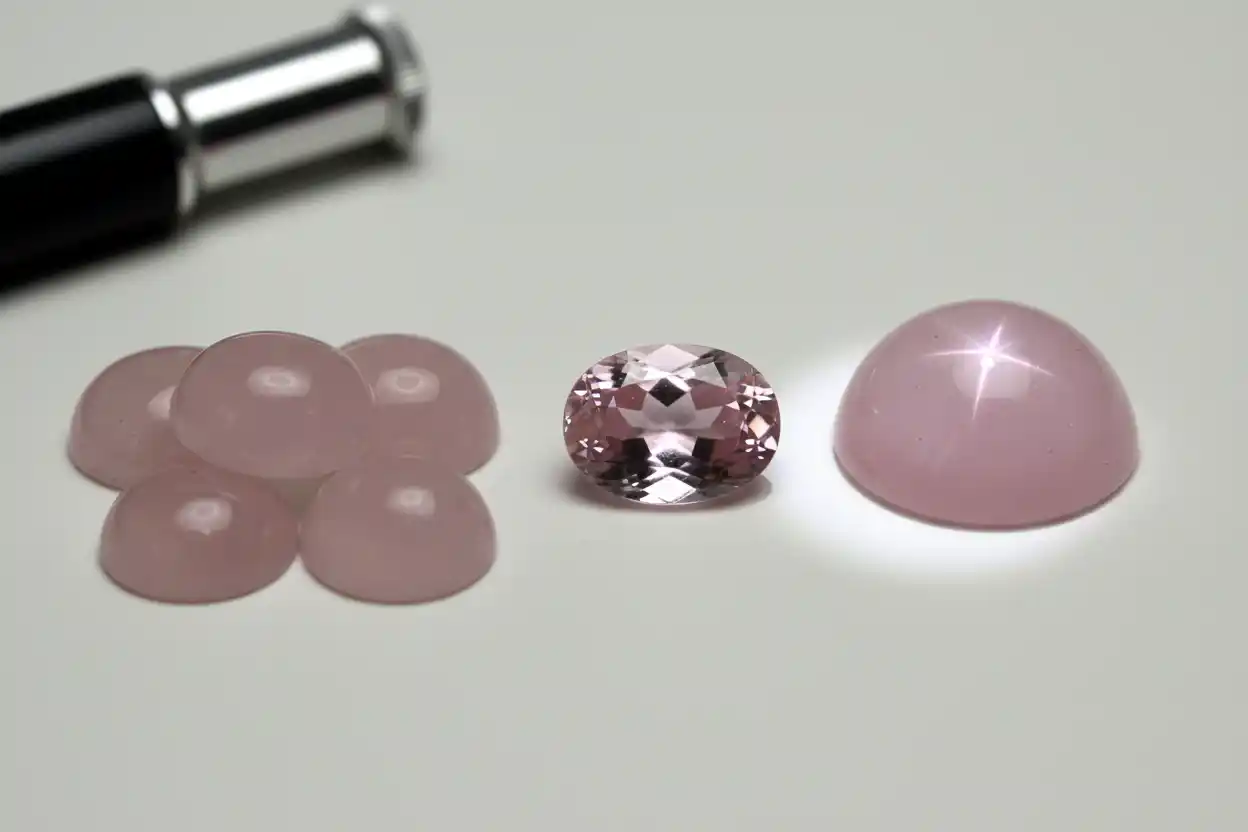
Fine transparent Rose Quartz also exists and is commonly faceted. Transparent gems should look clean enough to show crisp reflections without large distracting fractures or obvious dark inclusions. Translucent stones are more often cut as cabochons, beads, carvings, or spheres because their soft internal glow suits those shapes.
The best clarity depends on the intended style. A transparent faceted ring stone and a silky star Rose Quartz cabochon should not be judged by identical standards. Avoid paying a clarity premium merely because a retailer uses terms such as VVS or flawless without showing why that difference improves the face-up appearance.
3. Rose Quartz Cut Quality: Faceted Gems, Cabochons, and Carvings
Cut should suit the optical character of the individual Rose Quartz. Transparent rough can support faceted ovals, pears, rounds, emerald cuts, Asscher-style cuts, and designer shapes. More translucent rough often looks better as a cabochon or carving.
A faceted gem should return light across the face without a large transparent window through the center. Excessive depth can hide carat weight beneath the girdle and make a heavy stone appear disappointingly small from the top.
Large Rose Quartz carvings can be impressive, but carving quality matters. Uneven polish, scratches, poorly finished edges, and rough tool marks should reduce the price. A carefully cut 10-carat stone can offer more visual value than a poorly shaped 30-carat gem.
4. Star Rose Quartz Quality: Sharp Asterism, Pink Color, and Orientation
Some Rose Quartz contains aligned microscopic inclusions that produce a six-rayed star when the gem is cut correctly as a cabochon. GIA notes that a well-defined star can add value.
A fine star should appear reasonably centered, with recognizable rays that move across the dome as the light source moves. Weak, broken, off-center, or difficult-to-see stars are less desirable. Body color still matters, so a sharp star over attractive pink can be more appealing than a stronger optical effect over dull gray-pink.
Current star Rose Quartz listings demonstrate that very large examples are available. Stones above 200 and even 500 carats appear in current inventory, which means large weight by itself does not prove rarity. Star definition, color, transparency, shape, and polish should determine whether the premium is justified.
5. Rose Quartz Treatment: Check Irradiation and Enhanced Color Claims
Rose Quartz is sometimes irradiated to intensify its pink color. GIA specifically notes irradiation as an occasional treatment.
A treated gem can still be natural quartz, but the color treatment should be disclosed. The treated Rose Quartz distinction becomes more important when a seller charges extra for unusually strong pink color while implying that the appearance is completely natural.
Ask whether any color enhancement has been identified or disclosed. For inexpensive ordinary Rose Quartz, a major laboratory report may cost more than the stone itself. For unusually expensive, intensely colored, or provenance-sensitive pieces, documentation becomes more reasonable.
Do not assume that untreated automatically means expensive. Untreated commercial Rose Quartz remains widely available.
6. Real vs Fake Rose Quartz: Check Identity Before Paying a Premium
The real vs fake Rose Quartz distinction matters most when the seller makes strong claims about rarity, origin, or natural color. Glass, dyed products, synthetic quartz, and other pink gems can sometimes enter the same retail searches.
Color alone does not prove identity. Natural Rose Quartz often shows internal haze, fine inclusions, color variation, or subtle growth-related features, but these clues are not universal enough to replace proper testing.
Avoid destructive home tests. Scratching the stone, exposing it to high heat, or using chemicals can damage jewelry while providing poor evidence. A reputable seller, accurate disclosure, sensible pricing, clear return terms, and professional identification when necessary provide a much stronger buying process.
7. Rose Quartz Size and Face-Up Color: Why Large Stones Are Common
Rose Quartz commonly occurs in sizes large enough for substantial carvings, cabochons, spheres, and faceted gems. GIA notes that larger stones can display stronger pink color, while small deeply colored examples are less common.
This creates a pricing pattern that differs from many rare gems. A 50-carat Rose Quartz is not automatically an elite collector stone simply because of its weight.
Current retail examples include a 34.50-carat transparent marquise around $91, a 46.16-carat oval around $122, and a 98.09-carat transparent pear around $259. Their per-carat prices remain modest.
Rose Quartz price per carat can therefore decrease or remain flat as weight rises because large clean rough is available.
8. Rose Quartz Durability and Jewelry Care: Protect a Mohs 7 Gem
Rose Quartz has a Mohs hardness of 7, making it suitable for many jewelry styles when worn with reasonable care. It is durable enough for pendants, earrings, bracelets, necklaces, and rings, although repeated hard impacts can still chip or scratch a stone.
The Rose Quartz durability question matters particularly for rings because they receive more contact with hard surfaces than earrings or pendants.
GIA recommends warm soapy water as a safe cleaning method and advises avoiding steam and ultrasonic cleaning. Cleaning Rose Quartz jewelry gently also protects polish, settings, and any internal fractures.
Inspect secondhand pieces for scratches, edge chips, worn polish, loose settings, and damaged drill holes before paying a premium.
9. Rose Quartz Price Checks: Spot Costly Seller Red Flags
Current untreated transparent Rose Quartz listings show how affordable ordinary loose gems can be. A 20.08-carat cabochon is around $26.40, a 10.23-carat transparent Asscher-style stone is about $56, a 4.35-carat medium rose-pink octagon is about $29, and a 12.09-carat rose-pink octagon is about $80.
These examples sit from roughly $1.30 to $6.60 per carat. Individual custom cuts, unusual stars, specialized collector pieces, or premium jewelry can cost more, but an ordinary pale commercial stone should not suddenly become extremely expensive because a seller calls it rare, spiritual grade, AAAA, or investment quality.
Large unexplained premiums deserve questions. Ask what exactly creates the higher price: deeper natural color, exceptional transparency, custom cutting, a sharp star, unusual provenance, important jewelry design, or independent documentation.
Rose Quartz Origin: Brazil, South Africa, Madagascar, and Other Sources
Rose Quartz occurs in several countries, including Brazil, South Africa, Madagascar, India, and other quartz-producing regions. Current retail inventory includes Brazilian and South African stones across wide sizes.
Origin generally matters less than actual color, cut, clarity, star effect, and condition for ordinary commercial Rose Quartz. Country names should not create a major premium by themselves.
Where Rose Quartz is found becomes more relevant for collectors interested in locality, geological history, or well-documented specimens.
For routine jewelry purchases, visual quality and honest disclosure usually deserve more attention than an unsupported mine or country story.
Rose Quartz Seller Grades: Why AAA and AAAA Need Context
Commercial Rose Quartz has no universal AAA or AAAA grading system shared by every seller. One store may reserve AAA for transparent deep-pink stones, while another may apply the same label to ordinary polished beads.
Compare the actual photographs, weight, dimensions, color, clarity, treatment, cut, and condition instead.
A seller using a top grade should explain what that grade means within its own system. If the definition is absent, the label adds little useful information.
The same caution applies to phrases such as collector grade, premium, healing grade, investment quality, and museum quality.
Rose Quartz Resale Value: Buy for Quality, Not Guaranteed Appreciation
Ordinary Rose Quartz is abundant enough that resale prices can sit well below retail. Dealers have access to fresh rough, calibrated stones, carvings, beads, and finished jewelry, which reduces the need to pay a private owner close to retail replacement price.
Exceptional designer work, impressive star stones, important provenance, antique jewelry, or unusual collectible specimens can behave differently.
Rose Quartz is therefore best purchased because you appreciate the color, symbolism, design, or jewelry rather than because a seller promises future price growth.
The Rose Quartz benefits described in crystal traditions may add personal significance, but those beliefs do not establish financial quality or medical effectiveness.
Rose Quartz Buying FAQs
What is the best Rose Quartz color?
An even, attractive pink with useful saturation is generally preferred. GIA notes that stronger appealing pink often appears in larger stones.
Should Rose Quartz be transparent?
Not necessarily. Most Rose Quartz is translucent because of microscopic inclusions. Fine transparent examples are often faceted.
Is cloudy Rose Quartz poor quality?
No. A soft cloudy appearance is characteristic of much natural Rose Quartz. Excessive dullness or major fractures are more important concerns.
Is star Rose Quartz more valuable?
A sharp, well-centered star over attractive pink color can add value, although very large star stones are available and size alone is not rare.
Is Rose Quartz treated?
It can be. GIA states that irradiation is occasionally used to intensify pink color.
How much does loose Rose Quartz cost?
Current ordinary untreated examples reviewed here span roughly $1.30 to $6.60 per carat, although specialized stones and custom cutting can cost more.
Does Brazilian Rose Quartz cost more?
Not automatically. Origin usually has less impact than color, clarity, cutting, condition, and optical effects.
Is Rose Quartz suitable for rings?
Yes, with sensible care. Its Mohs hardness of 7 gives it useful jewelry durability.
Does Rose Quartz need certification?
Usually not for inexpensive commercial stones. Independent identification becomes more reasonable for unusually expensive pieces or strong rarity claims.
Does Rose Quartz hold its value?
Ordinary stones often have limited resale strength because supply is abundant. Exceptional jewelry or collectible specimens can behave differently.
Conclusion
A smart Rose Quartz purchase depends on color, transparency, cutting, treatment disclosure, authenticity, condition, star quality when present, and realistic pricing. Large stones are common, ordinary untreated gems can cost only a few dollars per carat, and seller-created grades do not replace visible quality. The strongest purchase is the stone that looks attractive in normal lighting and has claims that match its price.