How to Clean Rose Quartz Jewelry Safely
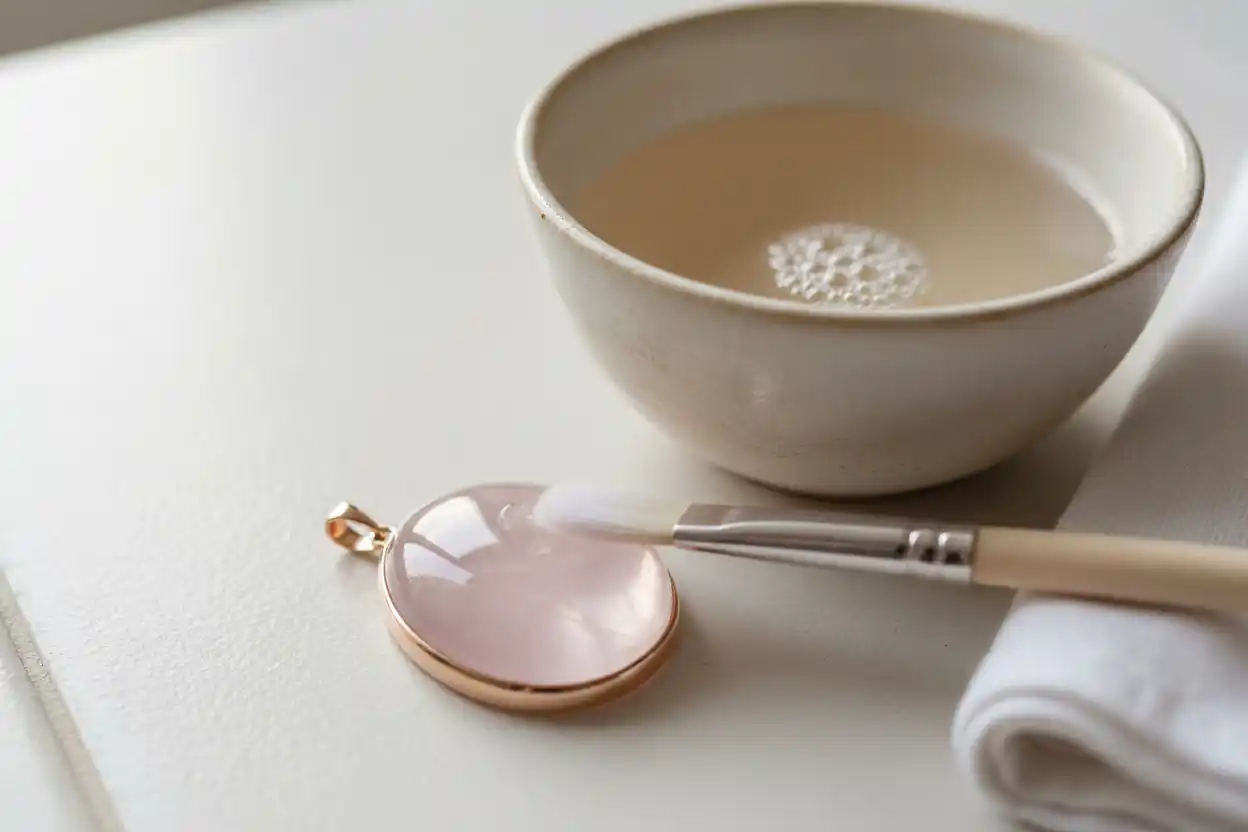
Rose Quartz jewelry should be cleaned with warm water, mild liquid soap, and a soft cloth or brush. Ultrasonic and steam cleaners should be avoided, even though Quartz is relatively hard, because internal fractures, inclusions, treatments, glue, carvings, beads, and settings may be vulnerable to vibration, heat, and pressure.
Rose Quartz is generally stable under normal light and heat. Nevertheless, prolonged intense exposure and repair heat should be avoided, especially when the gemstone has been irradiated, dyed, coated, filled, or assembled.
Why Rose Quartz Requires More Care Than Its Hardness Suggests
Rose Quartz is the pale-to-medium pink variety of quartz. It commonly appears translucent, cloudy, or milky rather than fully transparent.
Its geology, color, sources, and symbolic associations belong to the Rose Quartz guide, while its mineral-family background appears in the Quartz guide.
Quartz ranks 7 on the Mohs scale and has no true cleavage. However, Rose Quartz may contain fine fractures, inclusions, internal stress, cloudy structures, and polished carvings that require conservative cleaning.
| Property | Cleaning implication |
|---|---|
| Mineral species | Quartz |
| Composition | Silicon dioxide |
| Typical appearance | Pale to medium pink, commonly translucent or cloudy |
| Mohs hardness | 7 |
| Cleavage | None |
| Fracture | Conchoidal |
| Safest routine cleaning | Warm water, mild soap, and a soft cloth or brush |
| Ultrasonic cleaning | Avoid |
| Steam cleaning | Avoid |
| Main risks | Fractures, inclusions, coatings, dye, glue, abrasion, and settings |
The gemstone hardness chart explains Rose Quartz’s useful scratch resistance.
However, hardness does not guarantee structural soundness or setting security. The distinction appears in Gemstone Toughness vs Hardness and Gemstone Cleavage Explained.
Why Rose Quartz Is Usually Cloudy
Much Rose Quartz contains microscopic inclusions and structural features that scatter light.
These features can create its soft, hazy appearance. Cloudiness inside the stone is not soap film and cannot be removed through stronger cleaning.
Some transparent pink quartz material differs structurally and gemologically from common massive Rose Quartz, although trade terminology is not always applied consistently.
Cleaning should be judged by surface luster and the removal of residue rather than by whether the stone becomes fully transparent.
Star Rose Quartz Needs Conservative Cleaning
Some cabochon-cut Rose Quartz displays asterism—a star that appears when a concentrated light source reflects from oriented microscopic inclusions.
The star is an internal optical effect. It should not be scrubbed, polished, or chemically treated in an attempt to make it brighter.
Asteriated Rose Quartz is commonly cut with a broad curved dome. That surface can be scratched or altered through household polishing.
Use warm soapy water and very gentle wiping. Repolishing belongs to an experienced lapidary because changing the dome can weaken the star’s visibility.
Inspect the Jewelry Before Washing
Examine the jewel under bright, indirect light.
Look for loose prongs, gaps around bezels, chipped carvings, open fractures, cloudy glue, damaged drill holes, peeling coatings, worn stringing, and missing accent stones.
Natural internal veils and cloudy zones do not necessarily indicate damage. However, a line that reaches the surface or catches against cloth should be treated as a fracture.
Do not immerse a cracked, glued, backed, antique, or visibly unstable piece.
Check for Irradiation, Dye, and Coatings
Rose Quartz is occasionally irradiated to intensify its color. It may also be dyed, coated, filled, backed, stabilized, or imitated with glass or manufactured material.
Radiation-induced color is generally intended to remain stable during ordinary use, but repair heat and intense exposure should still be avoided when treatment is known or suspected.
Dye may concentrate inside fractures and drill holes. A coating may appear as a highly saturated or unnaturally uniform surface layer.
The complete treatment workflow belongs to How to Spot Treated or Synthetic Rose Quartz and Gemstone Treatments Explained.
The broader authenticity process belongs to Real vs. Fake Rose Quartz.
Test Unusually Strong Color
Dampen a white cloth or cotton swab with clean water.
Touch a hidden area briefly, especially near a drill hole, setting edge, bead opening, or carving recess.
Stop if pink color transfers to the cloth. Unstable dye requires dry cleaning and professional assessment.
Do not use acetone, alcohol, bleach, acid, or heat as a treatment test. These methods may damage the jewel without producing a reliable answer.
Prepare a Mild Cleaning Solution
Fill a small bowl with warm—not hot—water and add several drops of mild liquid dish soap.
Prepare a second bowl of clean warm water for rinsing.
Use a soft toothbrush, jewelry brush, makeup brush, or lint-free cloth. A carved or polished object needs softer contact than a faceted stone in a secure mounting.
Place a folded towel beneath the work area and avoid cleaning over an uncovered drain.
Clean Rose Quartz Briefly
Place a sound, securely mounted jewel briefly in the cleaning solution or dampen a soft cloth with the mixture.
Brush gently around the cabochon, facets, bezel, prongs, bail, gallery, drill holes, and setting edges.
Rinse loose dust before rubbing the stone. Although Rose Quartz is hard enough for routine jewelry, harder grit can scratch its polish.
Do not press against a visible fracture or thin carved section.
Long soaking is unnecessary and may affect dye, filler, glue, stringing, plating, or companion materials.
Rinse and Dry Naturally
Rinse the jewel in the second bowl of clean warm water or remove soap with a fresh damp cloth.
Blot it with a lint-free towel. Allow hidden moisture to evaporate at room temperature.
Do not use a hair dryer, radiator, heated cabinet, steam jet, or intense lamp.
Inspect the setting after drying. A moving cabochon, loose bead cap, or catching prong requires repair.
Never Use an Ultrasonic Cleaner
Rose Quartz should not enter an ultrasonic cleaner.
Vibration can enlarge fractures, loosen cabochons, disturb filling, release accent stones, and damage glued or carved components.
The equipment may be suitable for some sound Quartz varieties, but GIA’s Rose Quartz guidance specifically favors warm soapy water and advises against ultrasound.
The wider machine-safety boundaries belong to Which Gemstones Can Go in an Ultrasonic Cleaner?.
Never Steam Clean Rose Quartz
Steam combines heat, pressure, and rapid temperature change.
These conditions may affect fractures, treatment, glue, coatings, antique solder, and companion materials.
Warm manual cleaning restores surface luster without thermal risk.
Cleaning a Rose Quartz Ring
A Rose Quartz ring receives frequent impact, hand lotion, soap, sanitizer, and household exposure.
Clean around the cabochon or faceted stone without pressing against its edge.
Remove the ring before gardening, exercise, cleaning, swimming, showering, and heavy manual work.
A protective bezel is preferable to a highly exposed setting for regular wear.
Cleaning Rose Quartz Earrings
Rose Quartz earrings usually face less impact but collect cosmetics, hair products, and skin oils.
Clean posts, hooks, backs, caps, baskets, and hinges separately.
Keep alcohol-based disinfectant on compatible metal fittings and away from the Rose Quartz, glue, dye, filler, and coatings.
Dry drill holes and metal caps completely before storage.
Cleaning a Rose Quartz Necklace
A Rose Quartz necklace or pendant may contain beads, cabochons, carvings, knots, silk, elastic, wire, or glue.
Lay bead strands flat and wipe individual beads instead of soaking the entire necklace.
Apply perfume, sunscreen, and lotion before putting on the jewel and allow those products to dry.
Prevent chains and clasps from rubbing across the polished surface.
Cleaning a Rose Quartz Bracelet
A Rose Quartz bracelet combines repeated wrist movement with impact against desks, doors, and furniture.
Inspect every bead, drill hole, knot, elastic section, link, and clasp.
Wipe corded or elastic bracelets rather than immersing them. Dry the strand flat so wet stringing does not stretch.
Remove the bracelet before activities that repeatedly strike the wrist against hard surfaces.
Rose Quartz Versus Morganite and Rhodonite
Rose Quartz, Morganite, and Rhodonite can all appear pink, but they are different materials with distinct transparency, hardness, composition, and market uses.
The comparison with pink beryl belongs to Morganite vs Rose Quartz.
The distinction from the manganese silicate Rhodonite appears in Rose Quartz vs Rhodonite.
A broader comparison of pink materials belongs to Pink Gemstones.
Cleaning behavior should not be used as an identification test.
Buying, Price, and Surface Quality
The Rose Quartz buying guide covers color, translucency, clarity, star effects, cut, carving, treatment, and seller disclosure.
Market factors belong to the Rose Quartz price guide.
Fine color does not require perfect transparency. Much desirable Rose Quartz has a soft, evenly distributed glow.
Cleaning can reveal polish and color more clearly, but it cannot remove internal milkiness or turn pale material into saturated pink.
Sunlight, Water, and Storage
GIA describes Rose Quartz as generally stable to normal light and heat. Even so, prolonged intense exposure and concentrated heat should be avoided, especially when treatment is unknown.
The broader exposure discussions belong to Which Crystals Can and Can’t Go in the Sun and Which Crystals Can and Can’t Go in Water.
Store Rose Quartz separately in a soft pouch or padded compartment.
Diamond, Sapphire, Ruby, Topaz, and harder stones can scratch it. Rose Quartz can also scratch softer ornamental materials.
Frequently Asked Questions
1. What is the safest way to clean Rose Quartz?
Use warm water, mild liquid soap, and a soft cloth or brush, then rinse and dry it naturally.
2. Can Rose Quartz get wet?
Brief washing is normally safe for sound material. Avoid soaking dyed, coated, filled, glued, strung, or fractured jewelry.
3. Can Rose Quartz go in an ultrasonic cleaner?
No. GIA recommends avoiding ultrasonic cleaning for Rose Quartz.
4. Can Rose Quartz be steam cleaned?
No. Steam may affect fractures, treatments, glue, settings, and companion materials.
5. Is dish soap safe for Rose Quartz?
A few drops of mild liquid dish soap are suitable. Avoid abrasives, bleach, and aggressive degreasers.
6. Can vinegar clean Rose Quartz?
Vinegar is unnecessary and may affect the setting, glue, filler, plating, or companion stones.
7. Can toothpaste polish Rose Quartz?
No. Toothpaste can scratch metal, dull polished surfaces, and leave residue in carvings or settings.
8. Does Rose Quartz fade in sunlight?
It is generally light stable, but prolonged intense exposure should still be avoided, particularly when the stone is treated or dyed.
9. Why is Rose Quartz still cloudy after cleaning?
Most cloudiness comes from internal inclusions and light-scattering structures rather than surface dirt.
10. Can a star in Rose Quartz be cleaned brighter?
Cleaning may remove oil from the surface, but the star depends on internal inclusions, cut orientation, and lighting.
11. How often should Rose Quartz jewelry be cleaned?
Wipe it after wear and wash it when oils, cosmetics, or residue visibly reduce its luster.
12. When should Rose Quartz receive professional care?
Professional care is appropriate for cracks, damaged carvings, unstable dye, loose settings, deep scratches, or asteriated cabochons needing repolishing.
Conclusion
Rose Quartz is durable enough for many jewelry styles, but its soft visual character often comes from internal features that no cleaner can remove. Warm soapy water restores surface luster without exposing fractures, treatments, or carvings to vibration and steam. When the stone remains cloudy, its natural structure should be distinguished from removable residue before stronger cleaning is considered.