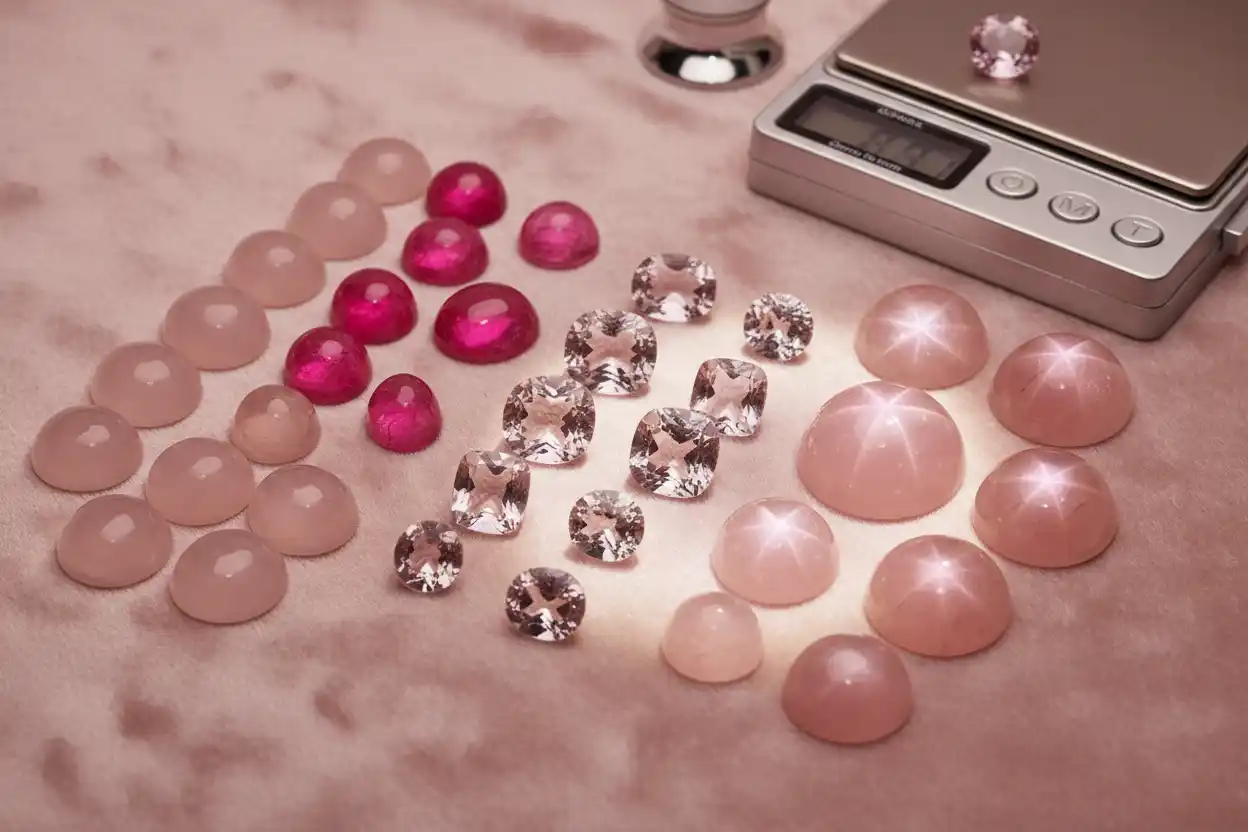
Rose Quartz Price: How Value Is Judged, Size, Grade & Provenance
Rose quartz price is usually modest compared with rare transparent colored gemstones because the material occurs in large masses and is commonly fashioned into beads, cabochons, carvings, spheres, and substantial faceted gems, but individual pieces can still vary widely in value according to color, transparency, star phenomena, cutting, craftsmanship, natural crystal rarity, provenance, treatment, condition, and jewelry setting. GIA describes rose quartz as ranging from almost white pink through medium-dark pink and notes that its most appealing color typically appears in larger sizes, while small strongly colored specimens can actually be relatively scarce. Consequently, a simple per-carat table can be misleading because size alone does not follow the steep scarcity curve associated with gems such as ruby, alexandrite, benitoite, or Paraíba tourmaline.
A second complication is that the phrase rose quartz can cover products serving different markets. Traditional massive translucent rose quartz, transparent facetable material, star rose quartz, carved objects, polished spheres, bead strands, and rare transparent euhedral pink quartz crystals can have fundamentally different value drivers. GIA distinguishes conventional massive rose quartz from exceptionally rare transparent crystalline pink quartz, whose color mechanism and stability can differ and whose finest natural specimens may be prized primarily as mineral collectibles rather than as ordinary jewelry rough. A reliable rose quartz price therefore begins by identifying the exact type of material and product before evaluating weight.
Rose Quartz Price At a Glance
| Value Driver | What Usually Raises Rose Quartz Price | What Can Lower Rose Quartz Price |
|---|---|---|
| Color | Even, clearly visible, attractive pink | Nearly colorless, grayish, brownish, or weak pink |
| Saturation | Richer pink while remaining attractive | Washed-out color |
| Color Distribution | Uniform face-up color | Distracting zoning |
| Transparency | Fine transparent material for faceting | Cloudiness that looks coarse rather than softly translucent |
| Traditional Translucence | Smooth glowing appearance | Dense opaque patches or major fractures |
| Asterism | Sharp centered moving six-rayed star | Weak, off-center, fuzzy phenomenon |
| Cut | Good brilliance or polished cabochon symmetry | Windowing, poor proportions, weak polish |
| Carving Quality | Skilled artistic execution | Rough mass-produced workmanship |
| Size | Large stone with exceptional color or phenomenon | Large ordinary material without quality |
| Natural Crystal Form | Rare documented transparent pink crystal | Common massive material presented as crystal rarity |
| Provenance | Important locality, historical collection, documented specimen | Unsupported country or mine story |
| Treatment | Natural color or disclosed irradiation | Undisclosed color enhancement |
| Synthetic Origin | Clearly disclosed | Laboratory-grown material represented as rare natural quartz |
| Condition | Clean polish, intact edges, sound fractures | Chips, scratches, open cracks |
| Jewelry Setting | Quality craftsmanship | Metal/design markup confused with gem rarity |
Color Is the Strongest Routine Price Factor
GIA places rose-quartz color from very light pink through medium-dark pink and identifies even color as particularly desirable. Commercial value therefore rises when a stone displays an unmistakable pink rather than approaching colorless quartz, provided the color remains attractive and the material does not become muddy, grayish, or brownish.
The premium can be visible even between two inexpensive pieces because a richly pink cabochon or bead strand can look substantially more luxurious than pale material despite identical size and polish. The Gems Lore buy rose quartz guide provides the correct starting point: compare the hue, saturation, evenness, translucency, and cutting before interpreting a seller’s price.
Small Strongly Colored Pieces Can Be More Selective Than Large Pale Pieces
GIA specifically states that rose quartz often shows its strongest color in larger sizes and that small specimens with good color can be scarce. This unusual relationship means carat weight cannot be interpreted with the simple assumption that every larger stone deserves a higher per-carat price.
A small richly pink faceted gem may require unusually suitable rough, while a huge pale sphere can be cut from a large but commercially common mass. Total price can still be greater for the sphere because of material volume and lapidary labor, but the fine small stone may be more selective on a quality basis.
Large Ordinary Rose Quartz Is Readily Available
GIA notes that rose quartz is available in sizes large enough to inspire major gem designs and carvings and illustrates substantial fashioned examples. Large size therefore should not be marketed as extraordinary rarity without additional justification.
A twenty-carat faceted stone, several-hundred-carat cabochon, or kilogram-scale carving can be impressive, but value depends on how much of that material has attractive pink color, good polish, limited damaging fractures, and skilled workmanship.
This differs sharply from markets such as the Gems Lore alexandrite price guide or benitoite price guide, where fine material becomes substantially more difficult to obtain as size rises.
Transparent Faceting Quality Can Command More Than Ordinary Cloudy Material
Most classic rose quartz owes its soft translucence partly to microscopic fibrous inclusions, but GIA notes that the finest-quality material can be transparent and is often faceted. Transparent material with clearly visible pink color, high clarity, strong polish, and good cutting can therefore occupy a higher price category than routine cloudy bead or cabochon rough.
The increase should remain realistic because quartz itself is not a scarce mineral family. A transparent stone deserves a quality premium, not an automatic transformation into an ultra-rare gemstone.
Smooth Translucence Can Be More Valuable Than Poor Transparency
Rose quartz’s characteristic cloudy glow is not inherently inferior. GIA explains that microscopic mineral fibers and tiny fractures contribute to the material’s translucent appearance. A uniformly glowing cabochon with rich pink color can therefore be more attractive than a technically clearer stone whose bodycolor is weak or whose cutting creates a large window.
Valuation should distinguish pleasing soft translucence from coarse opaque patches, unattractive white veining, or major structural fractures.
Star Rose Quartz Can Carry a Strong Phenomenal Premium
GIA states that properly oriented included rose quartz can show a six-rayed star and illustrates a well-defined star as a value-enhancing feature. Fine asterism creates an additional scarcity dimension because the rough needs the correct internal structures and must be cut with the proper orientation.
A premium star should be sharp enough to recognize clearly, reasonably centered, and mobile as the light or stone moves. Bodycolor, translucency, dome symmetry, polish, and star coverage still matter. A faint off-center star does not automatically make ordinary rose quartz expensive.
Large Star Rose Quartz Is Not Valued by Weight Alone
Star rose quartz often occurs in large cabochons and spheres because substantial included rough is available, but phenomenon quality varies dramatically. A huge stone with a weak diffuse star can be less desirable than a smaller cabochon whose six rays are bright, centered, and crisp.
GIA’s modern discussion of phenomenal quartz shows that the optical effect arises from complex internal structures rather than from size alone. The price premium therefore belongs to optical performance and cutting orientation rather than simply to total mass.
Color Zoning Can Reduce Conventional Jewelry Value
Rose quartz may show darker pink or purple-pink patches alongside paler areas, and GIA illustrates zoning within the variety. A strongly zoned faceted gemstone can look uneven and may therefore sell for less than an evenly colored stone of similar saturation.
Carvings and decorative objects can behave differently because an artist may exploit color zoning intentionally. In that market, creative use of natural variation can raise value rather than reduce it.
Carving Skill Can Exceed the Value of the Raw Stone
Rose quartz has long been popular with gem carvers because large material is available and its soft pink translucence suits figurines and decorative forms. GIA highlights the variety’s use in carvings and major lapidary works. In a finely executed object, the labor, artistic reputation, design, symmetry, surface finish, and provenance can dominate the final price.
A mass-produced carving and a signed master-lapidary sculpture therefore should not be compared by weight. The raw stone may represent only a small fraction of the finished object’s market value.
Bead-Strand Price Depends Heavily on Matching
A strand of rose quartz beads should be judged not only by bead diameter but by consistency of pink color, translucency, polish, roundness, drilling, and overall matching. A strand containing alternating pale and dark beads may be inexpensive even when individual beads are relatively large.
Fine matching requires sorting and can add labor value. Large perfectly round well-polished beads with attractive consistent pink can therefore cost considerably more than irregular or patchy commercial strands without implying exceptional geological rarity.
Rare Transparent Crystalline Pink Quartz Is a Separate Collector Market
GIA distinguishes ordinary massive rose quartz from transparent euhedral pink quartz crystals that some dealers call crystalline rose quartz or pink quartz. Such material is exceptionally rare compared with massive rose quartz, can form attractive crystal clusters, and can have a different color mechanism and light stability.
This is one area where a rose-quartz-related specimen can command substantial mineral-collector prices independent of conventional jewelry criteria. A documented crystal cluster with outstanding form, provenance, aesthetics, and natural color should therefore not be benchmarked against common polished rose quartz by the gram.
Natural Crystal Provenance Can Matter More Than Size
Rare crystalline pink quartz specimens may derive much of their value from locality, crystal form, associated minerals, historic collection history, and aesthetic composition. A smaller undamaged cluster with excellent provenance can therefore outperform a larger but repaired or poorly formed specimen.
This collector market requires stronger documentation because treated or synthetic pink quartz can imitate natural transparent material more convincingly than ordinary cloudy massive rose quartz.
Irradiation Can Affect the Price Category
GIA states that rose quartz is occasionally irradiated to intensify color. A disclosed treated stone can remain attractive and suitable for jewelry, but treatment should be considered when the seller is asking a premium for supposedly exceptional natural color.
An irradiated commercial stone belongs to a different scarcity narrative from a documented naturally colored collector specimen. The Gems Lore prasiolite price guide offers a useful quartz-family comparison because treatment-created color also plays a major role in that market.
Synthetic Pink Quartz Needs Separate Valuation
GIA reports that synthetic pink quartz can be produced hydrothermally and colored through engineered impurities and irradiation. Synthetic material may display attractive color and clarity but lacks the natural geological origin prized by mineral collectors.
Its presence is most relevant when transparent material or unusually fine crystals carry a substantial natural-origin premium. Ordinary low-cost rose quartz jewelry rarely justifies expensive testing unless the transaction involves unusual claims.
Brazil Is an Important Source but Not an Automatic Premium
GIA identifies Brazil as a major source of fine rose quartz while also noting material from India, Madagascar, and Sri Lanka. Country of origin generally matters less in routine jewelry than color, clarity, phenomenon, size, and cutting.
A large pale Brazilian cabochon should not automatically cost more than a richly pink Madagascar stone merely because Brazil has a strong reputation.
Origin becomes more economically meaningful when the specimen is a rare transparent crystal, historically documented mineral specimen, or unusual phenomenal material associated with a particular deposit.
Madagascar Can Add Inclusion and Phenomenal Interest
GIA has documented Madagascar rose quartz containing unusual bismuthinite inclusions and asterism-related internal structures. Such material can attract inclusion collectors or phenomenal-gem enthusiasts beyond the ordinary rose-quartz jewelry market.
A rarity premium should be attached to the documented unusual feature, not simply to the word Madagascar.
Rose Quartz Price Versus Morganite Price
The Gems Lore morganite price guide covers a pink beryl market where transparent eye-clean faceted material is standard and color treatment through heating is common. Rose quartz generally supplies much larger masses at lower cost, while morganite provides greater brilliance and a different durability and rarity profile.
Consumers comparing pink center stones should therefore decide whether they prefer rose quartz’s soft pastel glow or morganite’s transparent faceted appearance rather than judging solely by carat price.
Rose Quartz Price Versus Rhodolite Garnet Price
Gems Lore’s rhodolite garnet price guide covers a naturally transparent red-purple garnet market where saturation, brilliance, eye-clean clarity, and cutting dominate. Rose quartz is typically softer in color and more translucent, making it better suited to different aesthetic goals.
A richly saturated rhodolite naturally commands a different market than a pale pink quartz even if both are similar in physical size.
Rose Quartz Price Versus Amethyst Price
Rose quartz and amethyst both belong to the quartz family but have distinct color mechanisms and market preferences. The Gems Lore amethyst price guide shows how saturated purple and favorable color zoning influence amethyst, while rose quartz depends on even pink, translucency, phenomenon, and occasionally rare crystal form.
Their shared quartz identity helps explain why very large material can remain affordable compared with rarer gemstone species.
Finished Jewelry Can Cost Far More Than the Rose Quartz
Rose quartz is frequently mounted in gold, silver, designer jewelry, diamond halos, and large statement pieces. Metal, side stones, craftsmanship, brand, and retail service can exceed the loose quartz value substantially.
A rose quartz ring priced highly by a luxury designer should not be used as evidence that ordinary loose rose quartz has the same underlying value.
The center stone and finished jewel should be evaluated separately whenever possible.
Condition Matters in Vintage and Large Pieces
Quartz has Mohs hardness 7, but polished rose quartz can still accumulate scratches, chips, abrasions, and open fractures. GIA recommends avoiding rough handling and cleaning conservatively with warm soapy water rather than steam or ultrasonic equipment.
Condition matters particularly in large carvings because repairs, glued breaks, missing edges, and repolished areas can reduce collector value substantially. In jewelry, abrasion can dull the soft luster that makes the pastel pink attractive.
AAA and AAAA Do Not Establish Rose Quartz Price
GIA evaluates rose quartz but does not issue an overall commercial quality grade. One retailer’s AAA can therefore represent a completely different combination of color, clarity, and cutting from another seller’s AAAA.
A defensible price comparison should ignore the letters initially and align actual hue, saturation, color distribution, transparency, inclusions, star quality, dimensions, cut, treatment, provenance, condition, and product type.
Retail Price and Resale Value Can Be Very Different
Ordinary rose quartz is readily available in new jewelry, beads, carvings, and decorative objects, giving secondhand buyers many substitutes. This broad supply can create a substantial difference between original retail and immediate dealer resale value.
Rare crystalline specimens, exceptional star stones, important signed carvings, historically documented pieces, or unusual natural-color material can have stronger collector markets, but those specialized categories can also be less liquid because the buyer pool is smaller.
What Usually Raises Rose Quartz Price?
Rose quartz price generally rises with visibly attractive even pink, stronger saturation, desirable transparency or smooth glowing translucence, clean polish, competent cutting, unusually fine six-rayed asterism, rare transparent faceting material, documented natural crystalline pink quartz, important locality provenance, exceptional carving workmanship, matched high-quality bead strands, and excellent condition.
What Usually Lowers Rose Quartz Price?
Very weak almost colorless pink, gray or brown modifiers, unattractive zoning, coarse opacity, large fractures, surface damage, weak star phenomena, poor cut, windowing, ordinary large size marketed as rare, irradiation hidden from disclosure, synthetic pink quartz represented as rare natural material, unsupported source claims, mass-produced low-quality carving, and seller grades unsupported by observable characteristics can all weaken value.
How to Compare Rose Quartz Prices Fairly
Compare the same product category first and then align color, saturation, evenness, transparency or translucency, inclusions, star quality, cut, dimensions, weight, treatment, natural-versus-synthetic origin, locality provenance, condition, craftsmanship, setting value, and transaction channel. A large cloudy sphere, transparent faceted gem, sharp six-rayed star cabochon, bead strand, master carving, and rare natural pink crystal cluster should not be averaged into one universal rose quartz price-per-carat figure.
Conclusion
Rose quartz price reflects visible quality and workmanship far more than raw size. GIA notes that the most appealing pink commonly occurs in larger material and that strongly colored small stones can actually be scarcer, while traditional massive rose quartz often displays the cloudy translucence created by microscopic inclusions. Large commercial objects can therefore remain affordable even at impressive weights, whereas transparent material, fine star phenomena, rare crystal form, or exceptional carving can create genuine premiums.
Star rose quartz adds a separate optical-value layer because a properly oriented cabochon can display a six-rayed phenomenon that GIA identifies as value enhancing. At the collector end of the market, transparent euhedral pink quartz should also be distinguished from ordinary massive rose quartz because GIA describes it as an exceptionally rare material with a different color mechanism and potentially different light stability.
A responsible valuation therefore identifies the material category first and only then compares pink quality, transparency, phenomenon, size, treatment, provenance, condition, and workmanship. There is no universal price-per-carat chart capable of representing every rose-quartz product accurately.
Frequently Asked Questions
How much is rose quartz worth per carat?
There is no universal rose quartz price per carat because ordinary massive material, transparent faceted gems, star stones, carvings, bead strands, and rare natural pink crystal specimens occupy different markets. Color, phenomenon, cutting, provenance, and craftsmanship often matter more than weight.
What makes rose quartz expensive?
Fine even pink, unusual transparency, strong six-rayed asterism, exceptional carving, rare documented transparent crystal form, important provenance, and high-quality jewelry workmanship can raise value substantially above ordinary commercial material.
Does darker pink rose quartz cost more?
Stronger attractive pink generally receives more demand, but GIA notes that deeper color often occurs naturally in larger pieces. The premium therefore depends on color quality rather than darkness alone.
Is small deep-pink rose quartz rare?
GIA states that small specimens with good color can be scarce because the strongest pink often appears in larger material.
Does large rose quartz cost much more per carat?
Not necessarily. Large material is readily available, so size alone generally creates a moderate total-price increase rather than an extreme scarcity multiplier.
Is transparent rose quartz more valuable?
Fine transparent material suitable for faceting can command more than ordinary cloudy commercial material, especially when the pink remains attractive and cutting is strong.
Is star rose quartz valuable?
A sharp, centered, mobile six-rayed star can add value when bodycolor, translucency, cut, and polish are also attractive. GIA specifically notes that a well-defined star enhances value.
Does Brazilian origin increase rose quartz price?
Brazil is an important source, but ordinary jewelry value depends more on color, clarity, cut, phenomenon, and condition. Provenance matters more strongly for unusual natural crystal specimens or historically documented pieces.
Can rose quartz be irradiated?
Yes. GIA states that irradiation is occasionally used to intensify its color.
Can synthetic rose quartz affect price?
Yes. Synthetic pink quartz exists, so expensive transparent material carrying a natural-origin premium may justify independent identification.
Does carving quality matter?
Yes. In artistic objects, labor, design, polish, signature, and artistic reputation can exceed the raw stone’s contribution to value.
Does GIA grade rose quartz AAA?
No. GIA evaluates and identifies rose quartz but does not issue an overall AAA-style quality grade.
Does rose quartz hold its retail value?
There is no guaranteed retention percentage. Common commercial material has abundant substitutes, while exceptional star stones, rare crystals, or important carved objects may have more specialized collector appeal.
Is rose quartz a guaranteed investment?
No. Ordinary rose quartz is widely available, and even rare or artistic pieces depend on provenance, condition, buyer demand, and market liquidity.