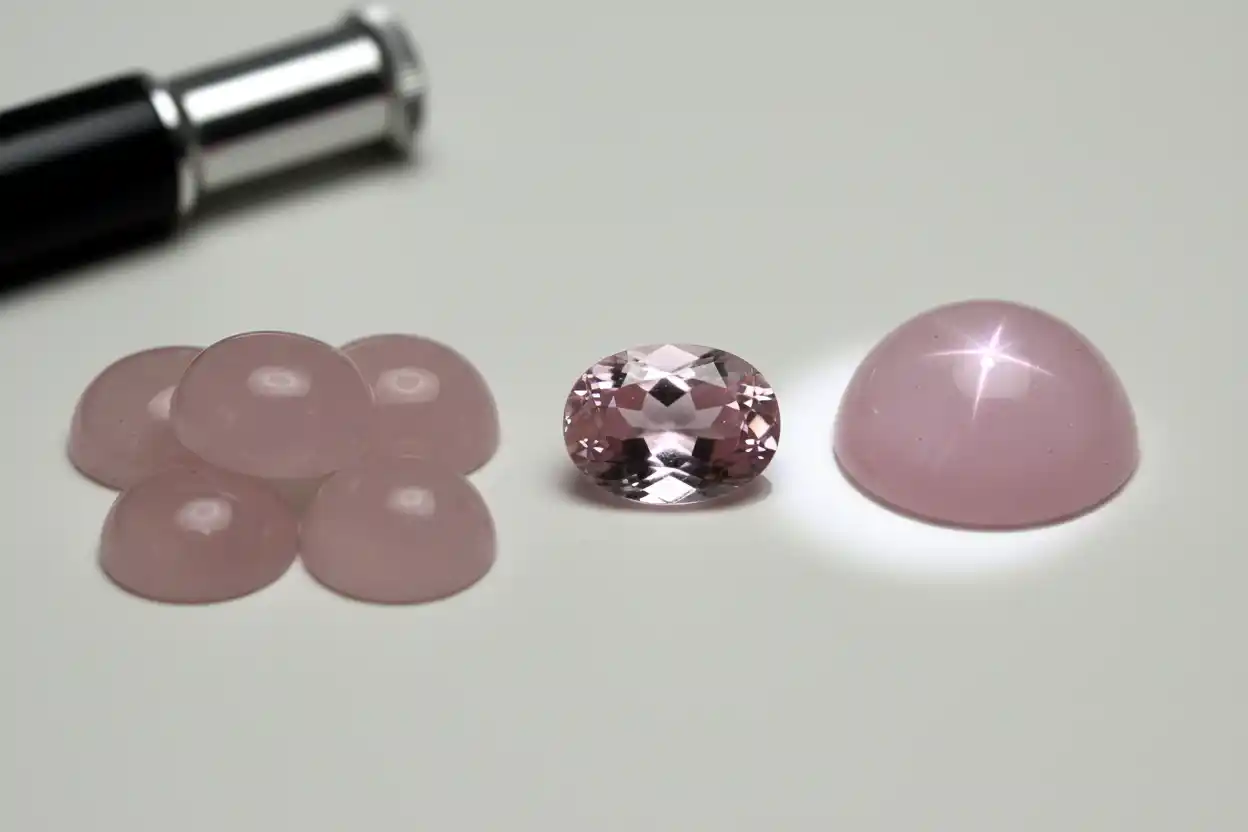
Buy Rose Quartz: Purchase Checklist, Color, Clarity & Value
To buy rose quartz intelligently, begin with color quality, transparency or translucency appropriate to the intended form, cutting, visible inclusions, size, treatment disclosure, and whether the material is ordinary massive rose quartz, phenomenal star rose quartz, or the rarer transparent crystalline pink-quartz material that can be confused with conventional rose quartz terminology. Rose quartz is a pink variety of quartz with a chemical composition of SiO₂ and Mohs hardness of about 7, and GIA describes its normal color range as very light pink, sometimes nearly white, through medium-dark pink. The classic material usually occurs in massive form rather than as well-formed transparent crystals, and microscopic fibrous inclusions contribute both to its characteristic pink coloration and to the cloudy translucence seen in much commercial material.
Rose quartz differs from many high-value transparent gemstones because large material is readily available and frequently shows better visible color than small pieces. GIA specifically notes that the most appealing pink often occurs in larger sizes and that small rose quartz with strong color can actually be scarcer than large material. Consequently, a buyer should not assume that a large cabochon, sphere, carving, or faceted stone is exceptionally rare merely because of its weight. Fine value comes from the combination of even pink color, pleasing saturation, transparency or attractive translucency, skilled cutting, condition, phenomenon where present, and honest disclosure rather than size alone.
Buy Rose Quartz At a Glance
| Buying Factor | What to Examine | Why It Matters |
|---|---|---|
| Color | Even light-to-medium or richer pink | Color is the most obvious quality factor |
| Saturation | Clear attractive pink without excessive gray or brown | Better saturation improves visual appeal |
| Color Distribution | Consistent color across the face | Heavy zoning can reduce uniform beauty |
| Transparency | Transparent material for faceting; translucent material for cabochons and carvings | Different qualities suit different cutting styles |
| Clarity | Clouds, fractures, veils, visible mineral inclusions | Excessive disruption can reduce brilliance and durability |
| Star Effect | Sharp, centered, mobile six-rayed star when present | Fine asterism can add value |
| Cut | Symmetry, polish, proportional depth, limited windowing | Good cutting strengthens pale pink color |
| Size | Compare dimensions with actual color quality | Large rose quartz is readily available |
| Treatment | Ask about irradiation | Radiation is occasionally used to intensify color |
| Material Type | Massive rose quartz versus transparent crystalline pink quartz | These materials can have different color mechanisms and rarity |
| Synthetic Origin | Independent testing for unusual high-value transparent material | Synthetic pink quartz can exist |
| Condition | Chips, scratches, fractures, worn polish | Quartz is durable but not immune to damage |
| Seller Grade | Actual characteristics behind AAA/AAAA | No universal GIA quality grade exists |
| Documentation | Useful for unusual, high-value, natural-crystal, or phenomenal material | Helps verify identity and treatment |
| Care | Warm soapy water; avoid steam and ultrasonic cleaning | GIA recommends conservative cleaning |
Color Should Be the First Quality Comparison
GIA describes rose quartz from almost colorless pale pink through medium-dark pink and identifies even color as particularly desirable. A fine stone should look unmistakably pink under ordinary neutral lighting rather than depend on a pink background, warm photographic filter, rose-gold reflection, or aggressive digital saturation. The most attractive hue is ultimately a matter of taste, but stronger clean pink generally attracts more demand than material that appears almost white, grayish, brownish, or unevenly colored.
This quality factor is especially important because commercial rose quartz is abundant enough that buyers do not need to accept poor color merely to obtain a large stone. When two pieces are similarly transparent and well polished, the one with more attractive and evenly distributed pink usually provides stronger visual value. Buyers familiar with the Gems Lore amethyst price guide or citrine price guide should recognize a similar principle across quartz varieties: once material identity is established, color quality often matters more than raw carat weight.
Strong Color Can Be Scarcer in Small Rose Quartz
Unlike many gems where size alone drives scarcity, rose quartz can develop its most noticeable pink in larger masses. GIA states that large fashioned gems frequently show more intense color and that small specimens with good color tend to be scarce. This means a richly pink five-millimeter stone can sometimes be harder to source than a much larger carving cut from a sizable piece of pastel rough.
The effect also explains why very large rose quartz spheres, decorative objects, and cabochons should not automatically receive extreme rarity premiums. Large material can be impressive, but a premium should correspond to unusually fine color, transparency, phenomenon, cutting, provenance, or workmanship rather than dimensions alone.
Even Color Is Preferable to Distracting Zoning
Rose quartz can display uneven pink concentration, including visibly stronger purple-pink or rose-colored patches. GIA illustrates color zoning as a naturally occurring quality characteristic in rose quartz. Mild variation can look attractive in carvings or collector specimens, but a faceted or polished jewelry stone generally benefits from reasonably consistent face-up color because abrupt pale and dark areas can make the gem appear patchy.
A seller should show the stone from more than one direction because an evenly pink face-up photograph can conceal pale zones on the reverse or edges. In a carved object, however, zoning can become part of the design rather than a defect if the lapidary artist uses it intentionally.
Classic Rose Quartz Is Commonly Translucent Because of Microscopic Inclusions
GIA explains that microscopic fibrous mineral inclusions are closely associated with the soft pink color of massive rose quartz and also contribute to its cloudy translucence. Advanced research indicates that these fibers are broadly similar to, although not identical with, dumortierite. The familiar misty appearance of rose quartz is therefore not automatically poor clarity in the same sense that cloudiness might be penalized in diamond or sapphire.
The buyer should judge whether the translucence looks smooth and attractive or whether large fractures, opaque zones, dark inclusions, or surface-reaching damage disrupt the stone. A glowing translucent cabochon can be excellent rose quartz even though it would never meet the clarity standard expected of a transparent faceted gem.
Transparent Material Belongs to a Higher Clarity Category
GIA states that the finest-quality rose quartz can be transparent and is generally faceted when suitable transparent rough is available. A transparent faceted stone can therefore attract a premium over ordinary cloudy cabochon material when its pink remains strong, its interior appears relatively clean, and the cutting produces attractive brilliance.
Transparency should not be pursued at the expense of color. A crystal-clear stone whose pink is so weak that it appears nearly colorless may be less desirable than a slightly hazier gem with visibly stronger rose coloration. Quality depends on the balance between clarity and color rather than on one characteristic in isolation.
Traditional Rose Quartz and Transparent Pink Quartz Need Careful Distinction
GIA describes an exceptionally rare transparent crystalline pink quartz that can occur as well-formed crystals and is sometimes called pink crystalline quartz, crystalline rose quartz, or simply pink quartz. It differs from the usual massive rose quartz in formation and color mechanism, and material from some deposits can lose color after exposure to natural light. This distinction becomes important when a seller markets a transparent crystal specimen as extraordinarily rare rose quartz and charges a collector premium.
The ordinary buyer seeking a polished rose quartz cabochon does not need to worry excessively about this nomenclature, but mineral collectors buying transparent euhedral pink crystals should ask what material they are actually purchasing, how the color behaves, what locality is claimed, and whether the specimen has undergone irradiation. A transparent crystal cluster and a traditional massive rose quartz cabochon should not be valued through the same criteria.
Star Rose Quartz Can Carry a Phenomenal Premium
Aligned microscopic inclusions can produce asterism when rose quartz is cut as a properly oriented cabochon or sphere. GIA notes that a well-defined six-rayed star can add value and illustrates star rose quartz as an important phenomenal variety. The best stars should be reasonably sharp, centered, and mobile across the curved surface as the stone or light source moves.
A weak diffuse cross or vague light patch should not receive the same premium simply because the seller uses the word star. The star should be evaluated together with pink bodycolor, translucency, surface quality, cut orientation, symmetry, and size. A large cabochon with a broad fuzzy star can be less compelling than a smaller gem with a bright, well-centered six-rayed phenomenon.
Star Quality Depends on Orientation and Internal Structure
Asterism is not merely painted onto the surface; it depends on the interaction between light and oriented microscopic structures within the quartz. Modern GIA research shows that high-quality star quartz involves complex fibrous or needle-like nanotextures and that star rose quartz can display especially interesting reflected or transmitted-light phenomena. Cutting orientation therefore determines whether the star becomes visible and where it sits on the dome.
A poorly oriented cabochon may contain the necessary inclusions yet fail to display the phenomenon effectively. This makes cutting quality particularly valuable in star rose quartz because lapidary skill unlocks an optical feature already present within the material.
Ordinary Clouds Should Be Distinguished From Structural Fractures
Cloudy translucence is normal in classic rose quartz, but large fractures are a separate issue. GIA notes that microscopic fractures can contribute to cloudy appearance, while larger damage can affect both beauty and durability. Buyers should examine polished stones under side lighting for reflective cracks, open fissures, chipped edges, and repaired areas rather than assuming every internal white feature is simply harmless rose-quartz haze.
Surface-reaching fractures become particularly important in rings or bracelets because repeated impact can expand existing weaknesses. A large carved decorative object has different durability demands from a daily-wear ring, so the acceptable level of structural imperfection depends partly on intended use.
Faceting Should Strengthen a Delicate Color
Because rose quartz is commonly pale, a good faceted design should return light efficiently while maintaining enough depth to preserve visible pink. An overly shallow pavilion can create a large transparent window that makes the center look washed out, while excessive depth can hide weight below the girdle without improving face-up size proportionately.
GIA notes that larger fashioned rose quartz often displays stronger color and that transparent material is typically faceted. A well-cut cushion, oval, round, pear, emerald cut, or designer form can therefore transform relatively subtle rough into a convincing pastel gemstone, while poor cutting can leave even clean material looking watery.
Cabochons Should Have Smooth Polish and Intentional Shape
Translucent rose quartz is well suited to cabochons because the curved surface emphasizes its soft internal glow and can reveal asterism where oriented inclusions are present. A high-quality cabochon should have a clean polished surface, balanced dome, attractive outline, and no accidental flat spots, pits, or deep scratches that interrupt the luster.
For star material, dome shape and orientation matter even more because the phenomenon should appear near the center rather than being displaced toward one edge. Large low domes can also be visually attractive when no star is expected, particularly in rings or pendants designed around the pastel color.
Beads and Carvings Follow Different Quality Priorities
Rose quartz is popular for beads, figurines, spheres, bowls, decorative carvings, and other lapidary objects because large masses of attractive pink material are available. GIA specifically identifies rose quartz as a favorite material for gem carvers. Carving value may depend heavily on artistic execution, polish, symmetry, subject, and use of color zoning rather than on conventional faceted-gem clarity.
A strand of rose quartz beads should be judged for color consistency, drilling quality, polish, roundness, matching, and whether obvious cracks compromise durability. A master carving can also cost far more than the raw rose quartz because workmanship becomes the primary value contributor.
Large Rose Quartz Is Not Automatically Rare
Rose quartz occurs in pieces large enough for major carvings and large faceted gems, and GIA specifically highlights substantial fashioned stones. Carat weight therefore does not follow the steep scarcity curve seen in gems such as alexandrite, benitoite, or Paraiba tourmaline.
Large size can still enhance color and visual presence, so the finished piece may cost more in total. The buyer simply should not equate a high carat number with exceptional geological rarity.
Irradiation Can Be Used to Intensify Pink
GIA states that rose quartz is occasionally treated with radiation to intensify its color. Treatment is therefore not the defining feature of the entire rose-quartz market, but sellers should disclose it when known because color is a central part of value.
A treated stone remains quartz, just as treated amethyst or citrine remains quartz. The relevant buying issue is accurate representation. A seller should not create an untreated rarity premium without evidence or represent irradiated material as guaranteed natural-color collector quartz.
Synthetic Pink Quartz Exists
GIA notes that synthetic pink quartz can be produced hydrothermally and can develop pink color through impurity-related color centers activated by irradiation. This issue is most relevant for unusual transparent crystal material and higher-value specimens rather than ordinary inexpensive cloudy rose quartz, where laboratory testing may cost more than the gemstone itself.
When a transparent euhedral crystal, rare-color specimen, or unusually expensive faceted stone carries a substantial natural-origin premium, independent identification can remove uncertainty. GIA’s Colored Stone Identification Report can identify whether submitted rose quartz material is natural or laboratory-grown and can name detectable treatments.
Brazil Is Important, but Origin Usually Ranks Below Quality
GIA identifies Brazil as an important source of fine rose quartz and also notes production from India, Madagascar, and Sri Lanka. Source can matter to mineral collectors, particularly when purchasing rare transparent crystal specimens or historically documented rough, but most jewelry-grade rose quartz is valued primarily through color, translucency, cut, size, and workmanship.
A generic “Brazilian rose quartz” label should therefore not create a large premium without corresponding quality. Fine Madagascar material can be superior to weak Brazilian material, and the visual stone should remain the central buying consideration unless locality itself is the collecting objective.
Madagascar Has Important Rose Quartz Material
GIA has documented rose quartz from Madagascar, including material containing unusual mineral inclusions and asterism-producing structures. Madagascar consequently has significance both as a commercial source and as a source of material interesting to inclusion collectors.
The same rule still applies: locality does not guarantee top quality. A premium should reflect actual color, phenomenon, transparency, specimen history, or documented unusual inclusions rather than the country name alone.
Rose Quartz Versus Morganite
Both rose quartz and morganite can show pale pink to peach-pink coloration, but their mineralogy, clarity expectations, cutting behavior, and market scarcity differ substantially. Gems Lore’s buy morganite guide and morganite price guide explain why eye-clean transparent morganite belongs to the beryl family and commonly commands a different price structure from abundant massive quartz.
Rose quartz typically offers much larger material at lower cost, while morganite provides greater transparency and brilliance in conventional faceted jewelry.
Rose Quartz Versus Rhodolite Garnet
The recently drafted Gems Lore buy rhodolite garnet guide covers a transparent raspberry-to-purplish-red garnet that generally displays stronger saturation and brilliance than rose quartz, while rhodolite garnet price follows a different size and clarity market.
Rose quartz is better suited to buyers seeking pastel softness, large cabochons, carvings, beads, or star effects rather than high-saturation red-purple brilliance.
Rose Quartz Versus Pink Tourmaline and Rubellite
Pink tourmaline can show much stronger brilliance and saturation than ordinary rose quartz, while rubellite occupies the deeper pink-to-red tourmaline market. These materials are substantially different from quartz in refractive properties, inclusion expectations, rarity, and price.
A buyer should not pay a tourmaline-level premium merely because a rose quartz listing uses phrases such as vivid raspberry, hot pink, or investment pink. Material identity remains fundamental.
Rose Quartz Is Durable Enough for Most Jewelry
Rose quartz has Mohs hardness 7, giving it practical scratch resistance for earrings, pendants, bracelets, and rings when worn sensibly. GIA describes it as durable enough for jewelry but advises avoiding rough handling. Quartz remains softer than sapphire, ruby, and diamond, so frequent contact with harder gemstones or abrasive surfaces can dull polish over time.
A protected setting is helpful for a large cabochon because the broad curved surface can collect scratches even though the material itself is reasonably hard.
Warm Soapy Water Is the Safest Cleaning Method
GIA recommends warm soapy water for rose quartz and advises against ultrasonic and steam cleaners. This conservative care rule is useful because large internal fractures can respond poorly to vibration or sudden heat, and a buyer may not always know whether the material has been irradiated or whether hidden structural weaknesses exist.
A soft cloth and gentle brush are sufficient for normal cleaning, while jewelry repair involving strong heat should be approached carefully.
AAA and AAAA Rose Quartz Are Seller Grades
GIA evaluates rose quartz but does not issue an overall commercial quality grade. Its identification service records gemological characteristics and can address natural versus laboratory-grown origin and detectable treatment. AAA, AAAA, premium rose, Madagascar grade, or collector pink are therefore private seller terms rather than universal standards.
Translate any grade into actual hue, saturation, color distribution, transparency, inclusions, cut, phenomenon, dimensions, treatment, provenance, and condition before comparing prices.
Common Red Flags When You Buy Rose Quartz
Warning signs include an inexpensive large stone marketed as extraordinarily rare purely because of carat weight, pink backgrounds or heavily edited photographs used to intensify weak color, seller claims that all cloudy material is poor clarity despite rose quartz’s normal fibrous inclusions, a vague star claim without video showing a centered moving phenomenon, transparent crystal material advertised as conventional rose quartz without explaining its distinct character, irradiation ignored despite an unusually intense color claim, synthetic quartz not disclosed in an expensive transparent specimen, Brazilian or Madagascar origin used as an automatic grade, and AAAA represented as an official laboratory standard. GIA’s rose-quartz guidance instead emphasizes color, clarity, cut, carat weight, phenomenon, and treatment.
How to Compare Rose Quartz Listings Fairly
Compare stones within the correct product category and align hue, tone, saturation, evenness, transparency or translucency, fractures, visible inclusions, star quality where present, cutting style, polish, face-up dimensions, weight, treatment disclosure, natural-versus-synthetic identity, provenance, condition, setting workmanship, and return rights. A cloudy bead strand, transparent faceted stone, six-rayed star cabochon, documented natural pink crystal specimen, irradiated commercial quartz, and carved decorative object should not be reduced to one generic rose quartz price-per-carat comparison.
Conclusion
To buy rose quartz well, judge the material according to what it is rather than according to the grading language surrounding it. Traditional rose quartz is quartz with delicate pink color, commonly cloudy or translucent because of microscopic fibrous inclusions, while the finest material can be transparent enough for faceting and properly oriented included material can show valuable six-rayed asterism.
Large size is readily available and can actually strengthen visible pink, so weight alone is not a strong rarity indicator. GIA notes that small deeply colored pieces can be more selective than large material, making color quality, cut, clarity, and phenomenon more important than simply purchasing the highest carat number. Treatment also deserves accurate disclosure because irradiation is occasionally used to intensify color, while transparent crystalline pink quartz and synthetic pink quartz introduce additional identification questions at the collector end of the market.
The strongest purchase therefore combines attractive even pink, the appropriate level of transparency for its cutting style, sound condition, good workmanship, realistic size expectations, and clear treatment or origin information whenever those characteristics affect the price.
Frequently Asked Questions
What is the best rose quartz color?
The strongest traditional quality generally shows an attractive even pink that is clearly visible without artificial background enhancement. GIA describes rose quartz from nearly white pink through medium-dark pink and notes that stronger appealing color often occurs in larger pieces.
Is dark pink rose quartz rarer?
Stronger pink can be more desirable, particularly when even and attractive, but large material can naturally display better color. GIA specifically notes that small rose quartz specimens with good color can be scarcer than large ones.
Should rose quartz be transparent?
Not necessarily. Classic rose quartz is commonly translucent because microscopic fibrous inclusions contribute to its cloudy appearance, while the finest transparent material can be faceted.
Is cloudy rose quartz low quality?
Cloudiness is normal in much traditional rose quartz and can create an attractive soft glow. Large fractures, opaque patches, or distracting defects are different and should be judged according to how much they affect beauty and durability.
What is star rose quartz?
Star rose quartz is included material cut and oriented as a cabochon or sphere so aligned microscopic structures create asterism. A well-defined six-rayed star can add value.
Does irradiation occur in rose quartz?
Yes. GIA states that rose quartz is occasionally irradiated to intensify its pink color.
Is irradiated rose quartz fake?
No. The host material remains quartz, but treatment should be disclosed because it changes the origin of the intensified color and may affect collector valuation.
Is synthetic rose quartz available?
Synthetic pink quartz can be produced, and GIA describes hydrothermal synthetic pink quartz whose color is created through impurity-related color centers and irradiation.
Is large rose quartz rare?
Large rose quartz is readily available, and GIA documents very large fashioned gems and carvings. Large size becomes valuable when exceptional color, transparency, star effect, cutting, provenance, or artistry accompanies it.
Is Brazilian rose quartz better?
Brazil is an important source of fine material, but origin alone does not establish quality. GIA also identifies India, Madagascar, and Sri Lanka as rose-quartz sources.
How hard is rose quartz?
Rose quartz is Mohs 7, making it durable enough for many jewelry applications while still requiring protection from harder gemstones and rough impacts.
How should rose quartz be cleaned?
GIA recommends warm soapy water and advises avoiding ultrasonic and steam cleaning.
Does GIA grade rose quartz AAA?
No. GIA evaluates and identifies rose quartz but does not assign an overall commercial grade.
Is rose quartz a guaranteed investment?
No. Fine color, star phenomena, important natural crystal specimens, and artistic carvings can be collectible, but ordinary rose quartz is widely available and future appreciation or resale liquidity is not guaranteed.