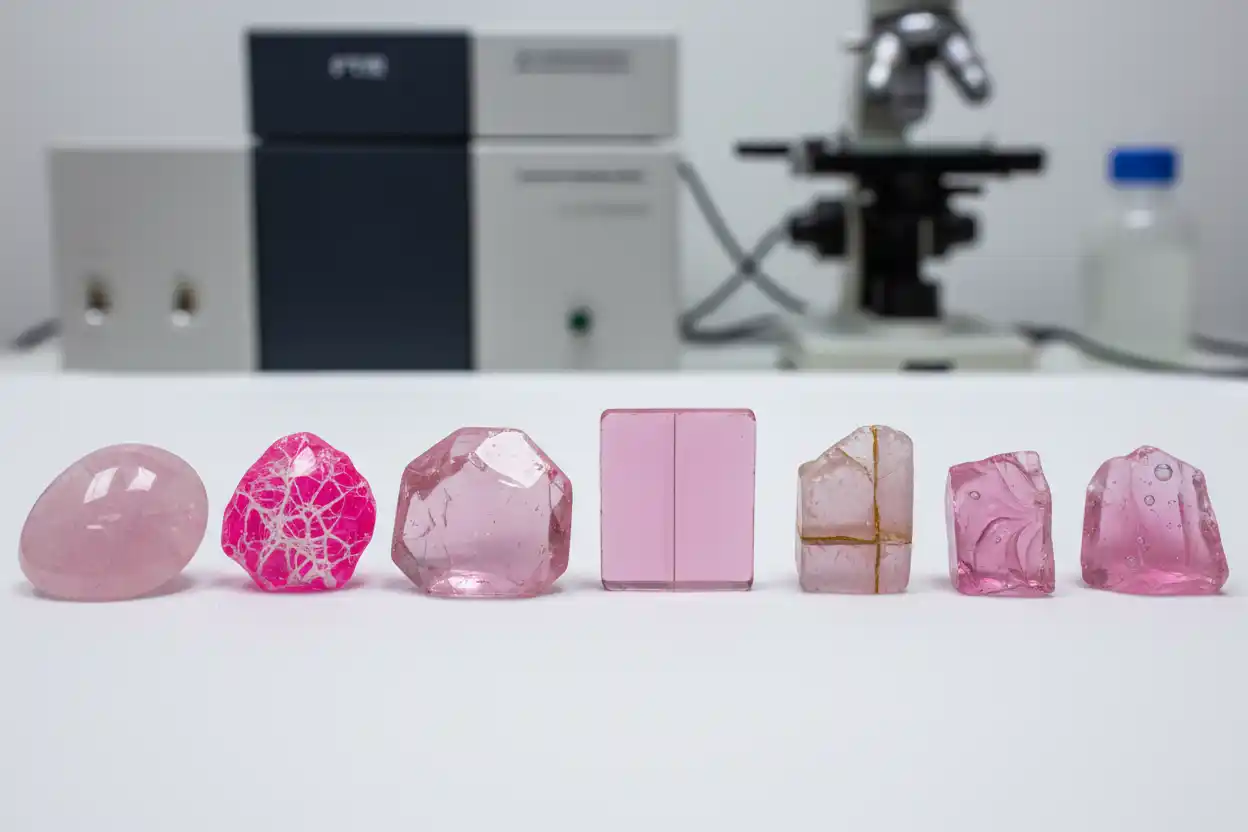
How to Spot Treated or Synthetic Rose Quartz
Rose Quartz is the massive translucent-to-cloudy pink variety of quartz. Its color commonly comes from microscopic aligned silicate fibers containing iron and titanium rather than from dye or a simple surface stain.
Most ordinary rough, beads, cabochons, spheres, and carvings are sold with natural bodycolor. Rose Quartz is abundant enough that sophisticated enhancement is not required for much of the market.
Treatment and substitution still occur. Pale or colorless quartz may be dyed pink, thermally crackled before dyeing, coated, filled with colored polymer, backed, reconstructed from mineral fragments, or replaced with glass, resin, ceramic, pink Calcite, or another material.
Laboratory-grown pink quartz adds a separate complication. Hydrothermal quartz can be grown on seed plates and later treated through irradiation and heat to produce pink color. Natural and synthetic quartz share basic hardness, density, refractive index, and crystal structure, so ordinary home tests cannot establish geological origin.
Rose Quartz treatment categories at a glance
| Product category | What it is | Common evidence | Correct description |
|---|---|---|---|
| Natural massive Rose Quartz | Naturally formed pink quartz containing microscopic color-producing inclusions | Cloudy massive texture, diffuse color, quartz properties | Natural Rose Quartz |
| Dyed Rose Quartz | Pale quartz or quartz-rich material with introduced pink color | Dye in fractures, pores, drill holes, and grain boundaries | Dyed quartz |
| Dyed crackle quartz | Quartz deliberately fractured and filled with pink or red dye | Sharp colored fracture network through pale quartz | Crackled and dyed quartz |
| Coated quartz | Pale quartz or another material covered with a pink film | Peeling, edge wear, surface-only color | Coated gemstone |
| Fracture-filled Rose Quartz | Cracks containing resin, wax, oil, glass, or colored polymer | Flash effects, bubbles, filler at surface openings | Filled Rose Quartz |
| Resin-stabilized Rose Quartz | Fractured aggregate impregnated with polymer | Resin between grains or fractures, FTIR absorption | Stabilized natural quartz |
| Reconstructed Rose Quartz | Quartz fragments or powder bonded with resin | Binder, bubbles, molded body, repeated texture | Composite containing quartz |
| Hydrothermal synthetic pink quartz | Laboratory-grown quartz whose pink color develops through growth and treatment | Seed plate, planar growth bands, synthetic inclusions, FTIR evidence | Synthetic pink quartz |
| Pink glass or resin | Manufactured imitation | Bubbles, mold seams, flow lines, polymer or glass spectrum | Rose Quartz simulant |
What natural Rose Quartz is
Natural Rose Quartz belongs to the quartz family and has the composition SiO₂.
Its broader identity, formation, and conventional uses appear in Rose Quartz: Meaning, Healing Properties & Uses.
Unlike Amethyst or rock crystal, traditional Rose Quartz generally occurs as massive material rather than well-formed transparent crystals with flat natural faces.
It commonly appears translucent, cloudy, milky, or semitransparent because its microscopic inclusions scatter light. The strongest pink can become more visible in larger pieces because light travels through more colored material.
Natural shades range from almost white through pale blush, cool pink, lavender-pink, peach-pink, and medium pink. Uneven color, milky areas, healed fractures, and pale zones are normal.
The host-family context appears in Quartz: Types, Properties & Meaning.
Rose Quartz and crystalline pink quartz are not identical categories
The name Rose Quartz is sometimes applied loosely to transparent pink quartz crystals.
Gemological research distinguishes common massive Rose Quartz from rare euhedral pink quartz. The massive material’s color is associated with microscopic fibrous inclusions and can be comparatively stable.
Transparent crystalline pink quartz can owe its color to irradiation-sensitive defects. Its color may fade under ultraviolet exposure or relatively low heat.
Synthetic transparent pink quartz has also been produced hydrothermally and treated after growth.
This distinction matters because a transparent faceted pink quartz crystal may not have the same color mechanism, stability, or inclusion structure as familiar massive Rose Quartz.
Natural color distribution
Natural massive Rose Quartz usually shows diffuse color distributed through a cloudy quartz body.
The color may vary gradually rather than collecting only within open cracks. Pale veils, milky patches, and fiber-related haze can run through the material.
Small pieces can look almost colorless because the delicate pink becomes visible only across greater thickness. This is why large carvings and spheres often show stronger color than tiny faceted gems.
Color concentrated only along sharp fractures, drill holes, pits, or the exterior suggests introduced dye or filler rather than the usual massive Rose Quartz color mechanism.
Dyeing
Pale Rose Quartz, clear quartz, Snow Quartz, quartzite, and other quartz-rich material can receive pink or red dye.
Introduced color commonly travels through surface-reaching fractures, grain boundaries, drill holes, cavities, and porous or weathered areas.
A bead may show a dark pink ring around its drill opening. Likewise, a chipped edge can expose pale quartz beneath a saturated exterior.
Natural iron staining or mineral inclusions can also follow cracks. The important question is whether the color behaves like a liquid introduced from the surface.
The practical inspection process appears in How to Spot Dyed Crystals.
Crackling before dyeing
Dense quartz does not absorb dye easily through an unbroken surface. Treaters can create access by heating the material and cooling it rapidly.
Thermal shock produces numerous surface-reaching fractures. Dye then enters those cracks and forms a vivid pink or red network.
The unfractured quartz between the lines may remain colorless, white, or only faintly pink.
This appearance differs from natural Rose Quartz, whose color is normally distributed through the body rather than limited to a dense angular fracture pattern.
Crackle treatment also reduces toughness. The stone retains Mohs hardness 7 but can break more readily because it contains many deliberate cracks.
Dye can imitate Strawberry Quartz
Some dyed quartz is marketed as Strawberry Quartz because of its stronger pink-red appearance.
Natural Strawberry Quartz: Meaning, Properties & Symbolism contains visible inclusions or color-producing particles rather than only dye-filled cracks.
Retail usage remains inconsistent, so a strawberry label should not replace mineral and treatment testing.
A product with bright color concentrated along induced fractures is better described as dyed crackle quartz.
Coatings
Pale natural quartz, synthetic quartz, glass, or another gemstone can receive a pink, metallic, transparent, or iridescent film.
Possible evidence includes scratches through the coating, peeling, color concentrated on pavilion facets, worn edges, and colorless chips beneath the surface.
A clear coating can also improve gloss, conceal small pits, or seal unstable dye and filler.
Metal-oxide coatings may create pink, blue, gold, or rainbow aura effects. These colors arise through thin-film interference rather than Rose Quartz’s natural bodycolor.
Coating is discussed more broadly in Gemstone Treatments Explained.
Fracture filling
Surface-reaching cracks may be filled with clear or pink resin, oil, wax, polymer, or glass-like material.
Filler reduces the optical contrast between a crack and the surrounding quartz, making the stone appear less fractured. Colored filler can improve apparent clarity and pink saturation simultaneously.
Under magnification, possible clues include bubbles, smooth transparent material across a rough fissure, partial filling, flow lines, or blue, orange, purple, and yellow flash effects.
The original fracture remains present. Filling does not restore the quartz lattice.
High heat, strong solvents, and ultrasonic vibration can damage the filler.
Resin stabilization
Highly fractured, grainy, or porous Rose Quartz may be impregnated with polymer before cutting.
The resin can strengthen carvings, improve polish, fill pits, and make a pale stone appear more translucent.
Possible evidence includes transparent binder between grains, bubbles, ultraviolet fluorescence, and an unusually plastic-like surface.
FTIR spectroscopy identifies organic polymer more reliably than touch or shine.
A stabilized object may still contain natural Rose Quartz, but its structure and appearance depend partly on resin and should be disclosed.
Reconstruction
Rose Quartz chips, cutting waste, powder, pigment, glass, and resin can be molded into spheres, beads, carvings, cabochons, or decorative slabs.
The finished object may contain substantial natural quartz but did not form as one continuous geological mass.
Under magnification, fragments may appear suspended in binder. Mold seams, round bubbles, repeated grain size, and a smooth polymer skin provide additional clues.
A correct description should use reconstructed, bonded, composite, or reconstituted Rose Quartz.
Heat stability of massive Rose Quartz
Massive Rose Quartz has a different color mechanism from irradiation-sensitive transparent pink quartz.
Its pink color can tolerate substantially more heat than the rare euhedral crystalline material, although uncontrolled high temperature can still fracture quartz, alter inclusions, or change color.
This does not make a torch test safe. Strong heating can create cracks, damage coatings or filler, and destroy the object.
Jewelry repair should keep Rose Quartz away from direct flame and sudden temperature change.
Light exposure
Many ordinary massive Rose Quartz pieces remain stable under normal indoor use. Nevertheless, prolonged intense sunlight can fade some specimens, particularly when their exact color mechanism or treatment history is unknown.
Transparent irradiation-related pink quartz is more likely to be light sensitive than massive fibrous Rose Quartz.
Dye and coatings can also fade independently of the quartz host.
The safest practice is to avoid placing valuable pink quartz permanently in a hot sunlit window.
Irradiation
Radiation-related treatment is more important for transparent synthetic pink quartz than for common massive Rose Quartz.
Hydrothermal synthetic quartz may be grown nearly colorless and later irradiated and heated to develop pink bands or zones.
Natural euhedral pink quartz can also owe its color to radiation-sensitive defects.
This makes the phrase irradiated Rose Quartz potentially ambiguous. A seller should state whether the material is massive natural Rose Quartz, natural crystalline pink quartz, or laboratory-grown pink quartz.
Hydrothermal synthetic pink quartz
Synthetic quartz grows in hot pressurized solutions on prepared seed plates.
Commercial transparent synthetic pink quartz has been produced with planar pink bands or zones. The crystals may be tabular and show large basal faces unlike ordinary massive Rose Quartz.
As-grown material can be nearly colorless. Irradiation and heating then create the pink appearance.
The finished gem has quartz hardness, density, refractive index, and birefringence. Standard physical tests therefore confirm quartz without proving natural origin.
The general distinction appears in Lab-Grown vs Natural Gemstones.
Synthetic growth clues
A rough synthetic crystal may retain a seed plate or seed boundary. Faceting can remove or conceal it.
Planar growth bands, breadcrumb-like particles, nail-head spicules, unusual fluid inclusions, and controlled color zoning can support hydrothermal origin.
Modern synthetic quartz may be extremely clean. High-resolution FTIR, polarized-light examination, twinning analysis, and comparison with known reference samples may be needed.
The related origin workflow for colorless quartz appears in How to Spot Treated or Synthetic Clear Quartz.
Natural inclusions and asterism
Massive Rose Quartz contains microscopic aligned silicate fibers. These inclusions cause cloudiness and, in suitably oriented cabochons or spheres, can produce a six-rayed star.
The optical effect can be strongest in transmitted light.
Asterism supports aligned internal inclusions but does not prove that no coating, filler, backing, or dye is present.
Likewise, a natural-looking star can be imitated through fiber-optic material or manufactured structures.
Pink glass and resin
Pink glass can reproduce transparency, color, and polish. It may contain round bubbles, curved flow lines, mold seams, and conchoidal chips.
Resin and plastic can imitate cloudy Rose Quartz by suspending pigment, white particles, and internal swirls in a translucent polymer.
Possible clues include low weight, seams, bubbles, repeated patterns, and a surface that scratches or dents more easily than quartz.
The broader comparison appears in Glass vs. Crystal.
The completed Real vs. Fake Rose Quartz page owns the full authenticity decision tree rather than this treatment-focused article.
Natural lookalikes
Morganite is transparent pink beryl with greater density and different optical properties. Its direct comparison appears in Morganite vs Rose Quartz.
Rhodonite commonly shows stronger opaque pink with black manganese-oxide veins. The direct distinction appears in Rose Quartz vs Rhodonite.
Pink Calcite, Kunzite, pink Opal, glass, and dyed white quartz can also overlap visually.
These materials are legitimate under their own identities. Misrepresentation occurs when the seller replaces the correct name with Rose Quartz.
Hardness does not reveal treatment
Natural and synthetic Rose Quartz have quartz hardness 7. Their position appears in the Gemstone Hardness Chart.
Dyed natural quartz may also retain hardness 7. Therefore, a scratch test cannot establish natural color or geological origin.
Crackle treatment and filling can reduce structural reliability without changing the quartz host’s Mohs number.
The difference between scratch resistance and breakage appears in Gemstone Toughness vs Hardness.
Professional testing
A laboratory first confirms quartz through refractive index, specific gravity, optical character, Raman spectroscopy, and X-ray diffraction.
Microscopy evaluates color distribution, fractures, dye, filler, coatings, seed boundaries, growth structures, and reconstructed binder.
High-resolution FTIR examines hydrogen-related features that help separate natural and hydrothermal synthetic quartz while also detecting polymer, wax, oil, and resin.
UV-visible spectroscopy studies the pink color mechanism. Surface chemical analysis identifies coatings and pigments.
Several methods may be required because one object can contain natural quartz, pink filler, coating, and adhesive together.
Buying, price, and reports
Purchase priorities appear in the Rose Quartz Buying Guide, while the Rose Quartz Price Guide separates common material from fine color, star stones, large carvings, treated objects, and exceptional transparent gems.
A major report is rarely economical for an ordinary inexpensive tumble. Testing becomes useful for transparent faceted pink quartz, strong synthetic claims, asteriated collector material, valuable carvings, or suspected coatings and reconstruction.
The completed Gemstone Certification Labs Compared explains laboratory scope. Use How to Read a Gem Lab Report to match the tested material, dimensions, photograph, treatment comments, and origin conclusion to the exact item.
Before buying from an unfamiliar seller, follow How to Buy Gemstones Online Without Getting Scammed.
Care
Warm water, mild soap, and a soft cloth or brush provide the safest routine cleaning method after treatment is known.
Avoid steam and sudden temperature change. Ultrasonic cleaning is inappropriate for crackled, filled, coated, glued, or heavily fractured material.
Solvents may remove coating, dissolve filler, or alter dye. Strong sunlight and heat may fade treatment-created color or irradiation-sensitive pink quartz.
The complete maintenance process appears in How to Clean Rose Quartz Jewelry Safely.
Frequently Asked Questions
1. Is most Rose Quartz treated?
Most ordinary commercial material has natural pink color, although dye, crackling, coating, filling, stabilization, and reconstruction can occur.
2. What gives natural Rose Quartz its pink color?
Microscopic aligned silicate fibers containing iron and titanium are associated with the pink color of massive Rose Quartz.
3. Can Rose Quartz be dyed?
Yes. Dye may enter fractures, grain boundaries, drill holes, pits, and porous areas in pale quartz.
4. What is dyed crackle quartz?
It is quartz deliberately fractured through thermal shock and then colored by introducing dye into the open crack network.
5. Can Rose Quartz be coated?
Yes. Pink or iridescent films can be applied to natural quartz, synthetic quartz, glass, or another material.
6. Can Rose Quartz be resin stabilized?
Yes. Polymer may strengthen fractured material, improve polish, and fill pits or grain boundaries.
7. Is synthetic Rose Quartz real quartz?
It is laboratory-grown crystalline quartz but did not form geologically.
8. How is synthetic pink quartz produced?
Commercial material can be grown hydrothermally on seed plates and later irradiated and heated to develop pink zones.
9. Can hardness separate natural from synthetic Rose Quartz?
No. Both have quartz hardness 7 and overlapping standard physical properties.
10. Does a star prove Rose Quartz is natural and untreated?
No. A natural star supports aligned inclusions, but additional treatment or manufactured imitation still needs to be excluded.
11. Can Rose Quartz fade?
Some specimens, dyes, coatings, and especially irradiation-sensitive transparent pink quartz can fade under intense light or heat.
12. When should Rose Quartz receive laboratory testing?
Testing is useful for transparent faceted pink quartz, unusual synthetic claims, valuable star stones, reconstructed carvings, and suspected dye or coating.
Conclusion
Most massive Rose Quartz reaches buyers with natural pink color created by microscopic fibrous inclusions. Treatment is more likely to intensify pale material, conceal fractures, create a high polish, or manufacture larger decorative objects.
Dye commonly follows open cracks and drill holes. Quench crackling creates an artificial fracture network that accepts vivid color, while coatings and filler alter only the surface or damaged areas.
Hydrothermal synthetic pink quartz is a separate product with genuine quartz composition but laboratory growth and post-growth color treatment. Distinguishing it from natural material requires growth analysis, spectroscopy, and careful use of the Rose Quartz versus crystalline pink quartz terminology.