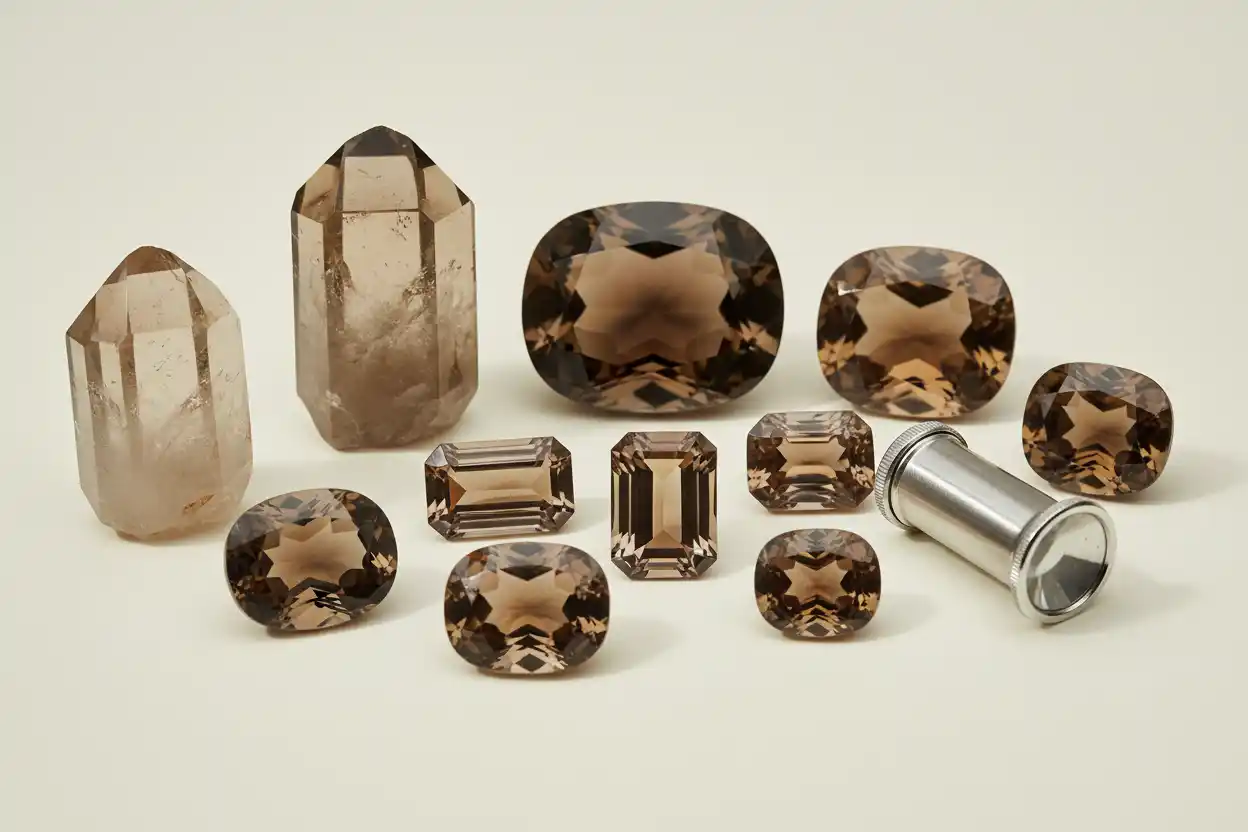
Buy Smoky Quartz: How to Evaluate Stones, Color, Clarity & Value
To buy smoky quartz intelligently, evaluate color, transparency, cut, natural crystal quality, treatment disclosure, condition, and seller terminology rather than assuming that the darkest or largest specimen is automatically the best. Smoky quartz is a gray, brown, to nearly black variety of quartz with the chemical composition SiO₂. Its characteristic color develops when irradiation interacts with aluminum-related defects in the quartz crystal lattice, and that irradiation can occur naturally over geological time or be applied artificially to suitable quartz. This distinction matters because natural smoky color and laboratory-induced smoky color can look similar, while ordinary commercial smoky quartz is abundant enough that a seller should not charge a large rarity premium merely because a crystal is very dark.
Smoky quartz is typically transparent to translucent and ranges through pale smoky gray, tea brown, cognac brown, deep brown, and almost black. Mindat reserves the traditional term morion for nearly black smoky quartz and notes that genuine smoky quartz differs from black quartz colored primarily by separate mineral or organic inclusions. A strong purchase therefore begins by deciding whether you want a transparent faceted gemstone, a natural crystal specimen, a dark morion-style collector piece, included quartz with visual character, or jewelry whose value depends partly on craftsmanship. Those forms follow different quality priorities and should not be compared only by carat weight.
Buy Smoky Quartz At a Glance
| Buying Factor | What to Examine | Why It Matters |
|---|---|---|
| Identity | Genuine smoky quartz rather than included black quartz or another brown gem | Color alone does not establish variety |
| Color | Smoky gray, warm brown, cognac, deep brown, near-black | Hue and tone strongly affect visual appeal |
| Tone | Enough transparency to show internal light | Very dark quartz can look opaque or lifeless |
| Color Distribution | Even color or attractive intentional zoning | Patchy zoning can distract in faceted gems |
| Transparency | Clean transparent material for faceting | Fine jewelry stones generally benefit from high transparency |
| Clarity | Fractures, veils, crystals, needles, cavities | Structural inclusions can affect brilliance and durability |
| Cut | Brilliance, symmetry, polish, limited windowing | Smoky quartz is abundant enough that poor cutting should not command a premium |
| Natural Crystal Form | Complete terminations, luster, undamaged faces | Mineral specimens are valued differently from faceted gems |
| Irradiation | Natural or artificial color origin where known | Artificial irradiation can produce smoky color |
| Heat Sensitivity | Avoid unnecessary high heat | Smoky color centers can bleach when heated |
| Size | Compare size with color and workmanship | Large quartz is readily available |
| Seller Terminology | Beware “smoky topaz” or invented rarity grades | Smoky quartz is quartz, not topaz |
| Condition | Chips, scratches, broken terminations, repolishing | Damage can lower both jewelry and collector value |
| Documentation | Useful for unusual provenance or high-value specimens | Helps support treatment or locality claims |
| Return Policy | Enough time for inspection | Particularly helpful when buying crystals or expensive jewelry online |
Smoky Quartz Is Quartz, Not Topaz
Smoky quartz belongs to the quartz species and has the formula SiO₂. Mindat lists names such as smoky topaz among historical or misleading synonyms, but the mineral itself is quartz rather than topaz. This distinction matters because topaz and quartz have different hardness, crystal structure, density, refractive properties, and market value, so a seller should not use the prestige of the topaz name to make ordinary smoky quartz sound rarer.
The same species relationship connects smoky quartz with amethyst, citrine, rose quartz, and prasiolite. These stones share a quartz framework but differ in color mechanisms, treatment histories, transparency, and commercial demand. Understanding that broader quartz family helps buyers evaluate smoky quartz realistically rather than treating it as an unrelated exotic mineral.
Smoky Color Comes From Irradiation and Aluminum-Related Defects
Mindat explains that smoky quartz owes its color to irradiation acting on aluminum incorporated into the quartz lattice, creating color centers responsible for gray, brown, and black appearance. GIA’s treatment literature similarly explains that irradiation is responsible for smoky coloration in quartz containing suitable aluminum-related defects and that natural geological radiation can create the same fundamental effect.
This mechanism has an important commercial consequence: smoky color does not prove that a quartz crystal emerged from the earth already dark. Natural rock crystal can be irradiated after mining to produce smoky color, and Gemdat notes that artificially irradiated rock crystal can become smoky quartz in a way that standard gemological tests may not always separate from naturally irradiated material. Buyers should therefore be cautious with expensive “100% naturally smoky” claims unless the premium is supported by credible provenance or specialized evidence.
Artificial Irradiation Does Not Turn Quartz Into an Imitation
A quartz crystal that has been artificially irradiated remains quartz. Treatment changes the origin or intensity of its visible color, not the mineral species itself. GIA’s broader treatment guidance treats irradiation as a color modification process rather than as a conversion into a simulant. The relevant buying issue is disclosure and pricing: treated smoky quartz can be attractive and durable, but it should not be represented as an exceptionally rare natural-color specimen when its color was produced commercially.
This is similar to treatment distinctions in prasiolite, where the gem remains quartz even when color has been created by heating or irradiation. Buyers who care primarily about jewelry appearance may be entirely comfortable with treated material, while mineral collectors may place much greater value on a documented naturally smoky crystal from a classic locality.
Pale to Medium Smoky Color Often Shows More Life Than Near-Black Material
The darkest smoky quartz is not automatically the finest. Very deep brown or black material can absorb so much light that faceted stones appear nearly opaque, reducing brilliance and making internal transparency difficult to appreciate. Pale smoky gray, champagne brown, cognac brown, and medium chocolate tones can show far more scintillation because enough light passes through the stone to return from the pavilion.
A buyer seeking a faceted gemstone should therefore prioritize attractive visible color rather than maximum darkness. Morion can be desirable as a crystal specimen or for a dramatic near-black jewelry look, but that aesthetic belongs to a different category from bright transparent smoky quartz. Paying a premium simply because a stone is almost black ignores the fact that intense irradiation can also create very dark quartz.
Morion Is the Traditional Name for Nearly Black Smoky Quartz
Mindat identifies morion as the German name commonly used for very dark or black smoky quartz. The term is legitimate when used descriptively, but it does not by itself establish rarity, locality, treatment status, or superior quality.
A large dark crystal labeled morion should still be examined for transparency at thin edges, crystal completeness, surface luster, internal fractures, repair, irradiation history where known, and provenance. The name is a color-term tradition rather than an independent mineral species or standardized premium grade.
True Smoky Quartz Should Not Be Confused With Inclusion-Colored Black Quartz
Mindat cautions that some black or brown quartz crystals owe their appearance to included minerals or organic matter rather than the smoky color center and are sometimes incorrectly called smoky quartz. Genuine smoky quartz can show characteristic dichroic behavior because the color is associated with the quartz lattice rather than separate dark inclusions.
This distinction matters particularly for natural crystal specimens, where dark included quartz may be attractive in its own right but should not be sold under a smoky-quartz rarity narrative without supporting identification. A buyer should ask whether the body itself is smoky or whether the apparent darkness comes primarily from hematite, chlorite, carbonaceous matter, or another included phase.
Even Color Is Usually Best for Faceted Smoky Quartz
Smoky quartz can occur with uniform coloration or with zoning, including phantom-like internal layers. Mindat notes that some geological environments produce relatively even smoky color, while others show multiple smoky zones or phantoms. In a faceted gem, relatively even face-up color usually supports greater brilliance and visual balance, although intentional zoning can be attractive in artistic cuts.
A stone should be viewed from the front and side because dark zoning may be hidden beneath the crown in photographs. Strongly uneven distribution can create patches that alternate between almost colorless and very dark, making the gem appear less coherent unless the cutter has used the pattern creatively.
Phantom Smoky Quartz Belongs to a Collector-Oriented Market
Phantoms occur when changes in growth conditions leave visible internal outlines of earlier crystal stages. Smoky coloration can outline those growth episodes, creating layered or ghost-like patterns. Such material may be more desirable as a mineral specimen, polished point, or intentionally cut collector stone than as a conventional faceted gem.
The value should therefore reflect the quality of the phantom architecture, crystal form, clarity, locality, and aesthetics rather than conventional faceting standards. A visually striking phantom can command more collector interest than a cleaner but ordinary crystal even though the included structure would be considered a clarity feature in mainstream gemstone cutting.
Faceted Smoky Quartz Should Usually Be Quite Clean
Quartz is abundant enough that buyers should generally expect transparent faceted smoky quartz to be eye-clean or close to it unless the stone is intentionally sold for unusual inclusions. Large obvious fractures, dense veils, cloudy areas, or dark inclusions deserve discounts because cleaner material is widely available.
The best clarity standard is practical rather than microscopic. Once the gem looks clean during normal viewing, paying heavily to remove tiny internal features visible only through magnification adds little visual benefit. Better color and better cutting usually make a larger difference.
Cut Quality Is More Important Than Carat Weight
Smoky quartz can be cut into ovals, cushions, emerald cuts, pears, rounds, fantasy cuts, concave cuts, and very large statement gems because quartz rough can occur in substantial sizes. Gemdat’s contributed examples include faceted smoky quartz exceeding several tens of carats, illustrating the broad size availability of the material.
A high carat number should therefore not persuade a buyer to accept a large central window, heavy extinction, poor symmetry, or excessive pavilion depth. A smaller precision-cut smoky quartz can look brighter, larger face-up, and more refined than a much heavier commercial stone that preserves rough inefficiently.
Windowing Can Make Smoky Quartz Look Weak and Washed Out
A shallow pavilion allows the observer to see through the central part of the stone rather than receiving reflected light, producing a visible window. In medium smoky quartz this can make the center look pale while the edges remain brown, creating an uneven appearance.
Because smoky quartz is not scarce enough to justify severe weight-retention compromises, buyers can afford to be selective about cutting. Compare length, width, and depth rather than carat weight alone, and favor stones whose color remains distributed across the face.
Excessive Depth Can Make Dark Quartz Look Nearly Black
The opposite cutting problem occurs when the pavilion is excessively deep. Light travels through more colored material, increasing absorption and potentially making a medium-brown crystal appear much darker after cutting. Extra depth also hides weight below the girdle rather than providing greater visible spread.
This effect means two smoky quartz gems cut from similar rough can display very different face-up color. The better purchase is the one whose proportions support the desired appearance rather than the heavier stone automatically.
Natural Crystal Specimens Need Different Quality Criteria
Collectors buying natural smoky quartz crystals should evaluate crystal habit, complete termination, transparency, surface luster, growth features, associated minerals, matrix aesthetics, damage, repair, and provenance. A fully terminated crystal with exceptional form may be more collectible than a larger broken specimen even when the larger piece has darker color.
Natural surface texture should not be confused with damage. Growth hillocks, skeletal development, etched faces, scepters, and other crystallographic features can add mineralogical interest, while fresh chips, glued repairs, polished broken tips, or heavily bruised edges generally reduce specimen value.
Locality Can Matter to Mineral Collectors More Than Jewelry Buyers
Smoky quartz occurs in thousands of documented localities and is characteristic of pegmatites, igneous-rock pockets, and alpine-type fissures. Mindat records smoky quartz from a very large global locality base. Jewelry buyers usually value color and cutting more than geographic origin, but mineral collectors may pay premiums for classic alpine specimens, aesthetic pegmatite associations, historically important localities, or unusually complete crystals.
A locality premium should be supported by reliable provenance. A newly written tag claiming a famous source is weaker than old collection documentation, credible dealer history, or an intact matrix association consistent with the locality.
Smoky Quartz Can Be Associated With Attractive Mineral Assemblages
Mindat’s association data show smoky quartz commonly occurring with feldspars such as microcline and albite, mica such as muscovite, schorl tourmaline, fluorite, and spessartine garnet. A natural smoky-quartz specimen with aesthetically arranged associated minerals can therefore be valued as a complete mineral composition rather than by the quartz alone.
This is especially important when comparing a simple loose crystal with a matrix specimen. A beautifully balanced smoky quartz–feldspar–mica association may command much more collector interest than a larger isolated quartz point.
Color Can Be Sensitive to Heat
Mindat states that smoky quartz color is heat sensitive and can pale when exposed to sufficiently high temperatures, while the color can also weaken over prolonged ultraviolet exposure. GIA’s irradiation guidance likewise notes that irradiated quartz colors tend to remain stable under ordinary conditions but can be affected by high temperatures.
This makes a jeweler’s torch a more important risk than ordinary daily wear. Smoky quartz should not be exposed unnecessarily to high heat during repair, and buyers should avoid any seller recommendation to heat the gem as a home test because that can permanently change the color.
Deliberate Heat Testing Is Destructive and Unnecessary
Heating smoky quartz to see whether it fades cannot establish whether the original irradiation was natural or artificial, because both natural and artificial smoky color involve irradiation-related color centers. The test can simply damage the appearance of the stone while answering the wrong question.
Likewise, scratch testing should be avoided because it can damage polish and does not distinguish treatment history. Treatment questions are better addressed through provenance, seller disclosure, and professional gemological evaluation where economically justified.
Smoky Quartz Is Durable but Not Indestructible
Gemdat places smoky quartz at Mohs hardness 7, with brittle tenacity, no cleavage, and conchoidal fracture. Quartz is sufficiently durable for rings, pendants, earrings, and bracelets, but facet edges can still abrade and a sharp impact can chip the stone because hardness measures scratch resistance rather than resistance to breakage.
The Gems Lore rose quartz guide covers the same quartz hardness family from a different color variety. Smoky quartz should be stored away from diamonds, sapphires, and other harder gems that can scratch it.
Warm Soapy Water Is the Conservative Cleaning Choice
GIA’s care guidance for quartz varieties places quartz around Mohs 7 and recommends warm soapy water as a safe cleaning method while cautioning against unnecessary heat and, in some quartz varieties, steam. Smoky quartz’s heat-sensitive color makes gentle cleaning especially sensible.
Ultrasonic cleaning may be tolerated by clean quartz, but included crystals, large fractures, filled material, or unknown treatments increase risk. Warm water, mild soap, and a soft brush provide sufficient cleaning for normal jewelry without introducing unnecessary thermal or vibration stress.
Smoky Quartz Versus Citrine
Smoky quartz and citrine are both quartz and can overlap visually in brownish-yellow, golden-brown, or cognac tones. The Gems Lore buy citrine guide and citrine price guide explain the yellow-to-orange quartz market, while smoky quartz is defined by gray-to-brown irradiation-related coloration.
Mixed smoky-citrine zoning can occur in quartz, so not every stone sits neatly at one visual boundary. Buyers should focus on the dominant face-up appearance and accurate description rather than paying a premium for creative hybrid naming.
Smoky Quartz Versus Prasiolite
Both smoky quartz and prasiolite can be affected by irradiation- and heat-related color mechanisms, but they occupy different visible color markets. Smoky quartz ranges gray to brown and black, while prasiolite is green quartz.
The comparison demonstrates why treatment does not automatically make quartz fake. Accurate disclosure establishes the correct commercial category while color, clarity, and cutting determine whether the individual stone is attractive.
Smoky Quartz Versus Rose Quartz
Rose quartz is usually valued for pink color, translucency, and sometimes asterism, while smoky quartz is typically valued for transparent gray-brown color or natural crystal aesthetics. Both are quartz, but their inclusion structures and preferred cutting styles often differ.
Large size is available in both varieties, which means buyers should avoid interpreting weight alone as a strong rarity signal.
Smoky Quartz Versus Brown Topaz
Brown or champagne topaz can resemble smoky quartz, but topaz is a different mineral with higher hardness, perfect cleavage, different density, and different refractive properties. A seller should identify the stone correctly rather than using “smoky topaz” for quartz.
If the material is valuable enough that the distinction matters, a gemologist can separate the two easily through standard gemological testing without damaging the stone.
AAA and AAAA Smoky Quartz Are Seller Grades
There is no universal laboratory AAA, AAAA, 5A, premium smoky, or collector-dark grading system for smoky quartz. Those terms can function as inventory shorthand within one seller’s catalog, but they should be translated into actual color, transparency, cut, treatment, dimensions, condition, and provenance before comparison.
A beautifully cut medium-brown stone with no extravagant grade can be a much stronger purchase than a dark windowed stone labeled AAAA.
Common Red Flags When You Buy Smoky Quartz
Warning signs include “smoky topaz” used as though quartz were topaz, extreme rarity claims based only on dark color, artificial irradiation omitted when it is known, near-black material marketed automatically as highest quality, large carat weight used to justify an exceptional premium despite quartz’s broad availability, natural-crystal specimens with repaired tips presented as undamaged, digitally enhanced brown color, obvious windows hidden by dark backgrounds, seller-created AAAA grades presented as laboratory standards, and claims that destructive heating or scratching is necessary to prove authenticity.
How to Compare Smoky Quartz Listings Fairly
Compare faceted stones by hue, tone, saturation, transparency, visible inclusions, cut, windowing, extinction, dimensions, carat weight, treatment disclosure, condition, and jewelry workmanship. Compare natural crystals separately by color, transparency, crystal form, completeness, luster, associated minerals, locality, repair, damage, and provenance. A 30 ct faceted irradiated smoky quartz, natural alpine crystal, near-black morion, included phantom specimen, and ordinary brown topaz should never be reduced to one generic smoky-quartz quality scale.
Conclusion
To buy smoky quartz well, prioritize accurate identity, attractive visible color, transparency, competent cutting or crystal form, condition, and treatment disclosure. Smoky quartz is a genuine quartz variety whose gray-to-brown-to-black color is produced by irradiation-related color centers involving aluminum defects in the crystal lattice. Natural geological radiation can produce that color, but suitable quartz can also be irradiated artificially, and standard testing may not always separate those histories conclusively.
That reality makes exaggerated “natural smoky” premiums difficult to justify without provenance. Large quartz is readily available, and extremely dark color is not automatically superior because near-black material can lose transparency and brilliance. The best faceted purchase usually balances smoky tone with enough light return to remain lively, while the best mineral specimen may derive value from complete crystal form, locality, associated minerals, or unusual growth features.
Color is also heat sensitive, so responsible ownership avoids unnecessary high temperatures. A buyer who judges smoky quartz on actual visual quality and documentation rather than darkness, size, or seller grades will usually obtain better value.
Frequently Asked Questions
What is smoky quartz?
Smoky quartz is a gray, brown, to nearly black variety of quartz with the chemical composition SiO₂. Its color is produced by irradiation-related color centers involving aluminum within the quartz lattice.
Is smoky quartz naturally irradiated?
Natural smoky quartz receives irradiation from its geological environment over long periods, but clear quartz can also be irradiated artificially to create smoky color.
Is irradiated smoky quartz fake?
No. If the host material is quartz, irradiation changes its color rather than turning it into an imitation. The treatment should be disclosed when known, particularly if natural color is being used to justify a premium.
Can a jeweler always tell natural irradiation from artificial irradiation?
Not necessarily. Gemdat notes that smoky quartz produced by irradiating rock crystal may not be distinguishable from naturally irradiated smoky quartz using standard tests.
What color smoky quartz is best?
There is no single best tone. Transparent pale-to-medium smoky gray and warm brown often show stronger brilliance, while near-black morion appeals to buyers seeking dramatic color or collector crystals.
What is morion?
Morion is a traditional name commonly reserved for very dark or nearly black smoky quartz.
Is the darkest smoky quartz the most valuable?
No. Very dark material can look almost opaque, and dark color can also be produced through strong irradiation. Transparency, cut, crystal quality, provenance, and condition matter more than darkness alone.
Is large smoky quartz rare?
Not generally. Quartz crystals can grow very large, so high carat weight by itself does not create an extreme rarity premium.
Can smoky quartz fade?
Mindat notes that smoky color can pale under sufficiently high heat and can also weaken after prolonged ultraviolet exposure.
How hard is smoky quartz?
Smoky quartz has Mohs hardness 7, no cleavage, and brittle tenacity typical of quartz.
Can smoky quartz be worn in rings?
Yes. Quartz is durable enough for jewelry, but it can still scratch, chip, or fracture under hard impact, so sensible protection is appropriate.
Is smoky topaz the same as smoky quartz?
Smoky topaz is a misleading name sometimes applied to smoky quartz. Smoky quartz is quartz, not topaz.
Does smoky quartz have an official AAA grade?
No universal AAA or AAAA smoky-quartz grading scale exists. Compare actual color, transparency, cut, treatment, condition, and provenance instead.
Is smoky quartz a guaranteed investment?
No. Fine collector crystals can be desirable, but ordinary smoky quartz is widely available and future appreciation or resale liquidity is not guaranteed.