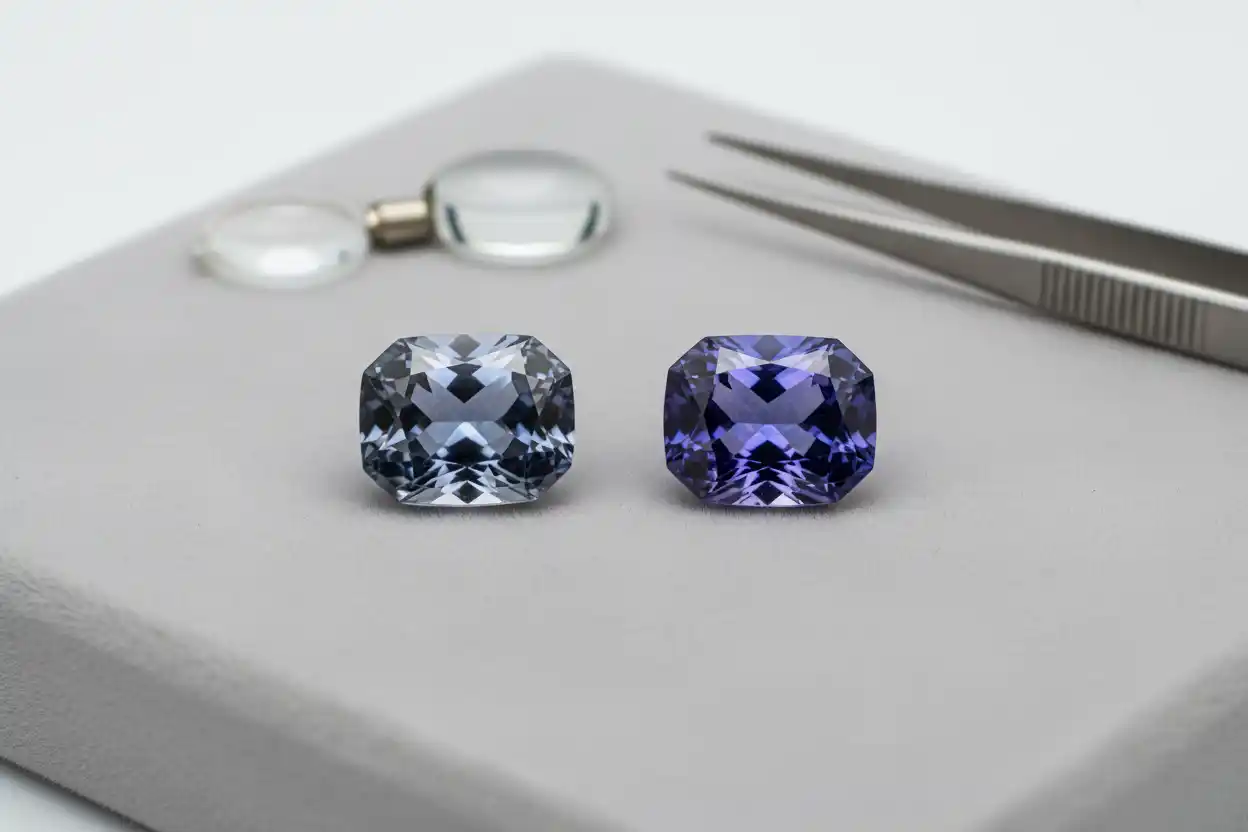
Iolite vs Tanzanite: Key Differences & How to Choose
Iolite and tanzanite can occupy remarkably similar visual territory. Both may appear violet-blue, bluish violet, or purple-blue, both are strongly pleochroic, and both can produce attractive transparent faceted gems. That resemblance is why an iolite vs tanzanite comparison based only on a seller photograph can be unreliable. They are not varieties of the same mineral, however, and their measurable properties, normal treatment histories, durability profiles, source distributions, and market positions differ enough that a structured comparison usually separates them clearly.
Iolite is gem-quality cordierite, an orthorhombic magnesium-aluminum silicate whose best gem colors are typically violetish blue to blue. Tanzanite is the blue-to-violet gem variety of zoisite, with a different chemistry, substantially higher refractive index and specific gravity, and a lower Mohs hardness range. GIA lists iolite at approximately 1.542–1.551 refractive index, 2.61 specific gravity, and 7–7.5 Mohs hardness, while tanzanite is listed at 1.691–1.700 refractive index, about 3.35 specific gravity, and 6–7 Mohs hardness.
The practical purpose of this guide is therefore not to declare one stone universally “better.” It is to decide which material better suits a particular combination of appearance, wear exposure, treatment preference, budget, documentation, and collector interest. For broader gemstone-comparison and verification topics, Gems Lore groups related material in the Identification category.
Iolite vs Tanzanite at a Glance
| Feature | Iolite | Tanzanite |
|---|---|---|
| Mineral identity | Cordierite | Zoisite |
| Typical gem color | Violetish blue to blue, with strong directional color changes | Violet blue, bluish violet, violet purple |
| Pleochroism | Strong; commonly blue/violet, paler yellowish or colorless directions | Strong; blue, violet, and other directional components |
| Refractive index | About 1.542–1.551 | About 1.691–1.700 |
| Specific gravity | About 2.61 | About 3.35 |
| Mohs hardness | 7–7.5 | 6–7 |
| Cleavage/toughness concern | Cleavage makes sharp blows important to avoid | Cleavage and fair-to-poor toughness require protection |
| Typical treatment context | Usually untreated | Most blue material is routinely heated |
| Source pattern | Found in multiple regions worldwide | Commercial gem production is associated with the Merelani area of northern Tanzania |
| Typical market positioning | Usually the more affordable violet-blue option | Usually commands stronger prices for fine saturated material |
| Best reason to choose | Violet-blue color, natural untreated norm, generally lower acquisition cost | Strong saturated color, distinctive provenance, established fine-gem market |
| Can appearance alone prove identity? | No | No |
The table is useful as a decision shortcut, but it should not be mistaken for a field identification certificate. Mounted stones, unusual compositions, poor lighting, weak pleochroism, treatments, and imitations can complicate visual judgment. When the financial stakes are meaningful, measurable properties or laboratory examination should take precedence over appearance.
Identity: These Are Two Different Minerals
The clearest iolite vs tanzanite distinction begins with mineral identity. Iolite is cordierite. GIA describes it as a magnesium-aluminum silicate and lists its characteristic gemological properties separately from zoisite. Tanzanite, by contrast, is a gem variety of zoisite with the composition Ca₂Al₃(SiO₄)₃(OH). Their blue-violet resemblance is therefore an optical coincidence rather than evidence of mineralogical kinship.
This matters because names used in commerce can create false equivalence. Iolite has historically been marketed under misleading terms such as “water sapphire,” while tanzanite’s name applies specifically to the blue-violet gem material associated with zoisite. A color name or trade nickname does not establish mineral identity. Identification should be based on physical and optical evidence, not on how strongly a stone resembles sapphire, tanzanite, or another blue gem.
The same principle applies throughout gemstone identification. A useful starting framework is to establish material identity before interpreting color or commercial labels, as discussed in how to identify crystals. Pages such as jadeite vs nephrite illustrate the same broader rule: similar appearance does not imply identical mineralogy.
Side-by-Side Optical Data
The optical difference between iolite and tanzanite is large enough that standard gemological instruments can be much more informative than visual inspection.
| Property | Iolite / cordierite | Tanzanite / zoisite | Identification significance |
|---|---|---|---|
| Refractive index | Approx. 1.542–1.551 for gem iolite | Approx. 1.691–1.700 | Strong separation between normal ranges |
| Specific gravity | Approx. 2.61 | Approx. 3.35 | Tanzanite is substantially denser |
| Optical character | Biaxial | Biaxial | Not sufficient alone |
| Pleochroism | Strong | Strong | Useful visually, but both possess it |
| Mohs hardness | 7–7.5 | 6–7 | Helpful for wear decisions, not recommended as a destructive ID test |
GIA’s published gem-reference data provide the narrower commercial-gem values shown above, while mineralogical data for cordierite and zoisite can span somewhat wider refractive-index ranges because natural mineral chemistry varies. Mindat lists cordierite as biaxial with a maximum birefringence range around 0.011–0.018 and confirms strong pleochroism; its zoisite data likewise identify a biaxial material with substantially higher refractive indices and density.
In practice, refractive index is one of the most useful non-destructive separations for suitable loose or accessible polished stones because the ranges do not sit close together. A properly obtained reading near the mid-1.54 range supports iolite far more strongly than tanzanite, while readings around 1.69–1.70 are consistent with tanzanite rather than iolite. Instrument technique, surface quality, mounting, contact fluid, and operator interpretation still matter, so one questionable reading should not be treated as absolute proof.
Visual Clues: What You Can See Without Instruments
Both gems are pleochroic, but the character of the color shift can provide a useful clue. Iolite is famous for very strong directional contrast. Depending on orientation, a stone can move from violet-blue or blue to pale yellowish, grayish, or nearly colorless appearances. Mindat describes cordierite pleochroism with pale yellow or greenish directions, violet or blue-violet directions, and lighter blue components, while GIA emphasizes that cutters must orient iolite carefully to show its most desirable blue-violet face-up color.
Tanzanite is also strongly pleochroic, commonly displaying blue and violet components as its viewing direction changes. GIA notes that the cut strongly affects which color dominates face-up and that predominantly blue examples are less common than those showing stronger violet influence because of crystallographic orientation and the choices cutters make when retaining weight.
A particularly revealing observation is therefore not “Does the stone change color?” because both can. Instead, rotate the stone slowly under one neutral light source and observe the degree and character of directional color change. Strong transitions toward pale yellowish or near-colorless directions are more characteristic of iolite, while the familiar blue-violet interplay of tanzanite generally stays within a richer blue-purple family after normal treatment.
Even that distinction has limits. Photography can suppress pleochroism, editing can intensify color, mounted settings can restrict viewing directions, and unusual specimens do not always behave like textbook examples. Readers dealing with suspicious listings should treat visual observations as screening evidence rather than final proof. The same caution applies when assessing other apparently unusual materials in guides such as is my moldavite real and how to spot fake crystals.
Original Side-by-Side Visual Comparison Protocol
A fair iolite vs tanzanite image comparison needs controlled conditions. Comparing one seller’s backlit studio photograph with another seller’s dim smartphone image introduces more photographic variation than gemological information. The following protocol creates a reproducible visual comparison without pretending that photography can replace laboratory testing.
| Control | Recommended setup | Why it matters |
|---|---|---|
| Light source | Same diffuse daylight-balanced source | Prevents different color temperatures from shifting blue and violet |
| Background | Neutral matte gray | Reduces reflected color contamination |
| Scale | Photograph both stones beside the same millimeter scale | Prevents apparent size from influencing perceived saturation |
| Camera | Same camera, lens, exposure, and white balance | Reduces processing differences |
| Orientation 1 | Table-up, camera perpendicular to table | Establishes normal face-up appearance |
| Orientation 2 | Tilt each stone approximately the same amount | Makes pleochroic change easier to compare |
| Orientation 3 | Rotate around the vertical axis | Reveals directional color behavior |
| Editing | No selective saturation or hue adjustment | Preserves comparison integrity |
| Reporting | Record weight, dimensions, shape, and known treatments separately | Prevents appearance from carrying claims it cannot prove |
This protocol is intentionally conservative. A side-by-side photograph taken under matched conditions can expose obvious differences in tone, saturation, extinction, windowing, and directional color, but it cannot establish species with the certainty of refractive-index, spectroscopy, or other laboratory evidence.
Which Stone Usually Looks More Saturated?
Fine tanzanite can reach highly saturated violet-blue to blue-violet colors. GIA identifies deep saturated violet-blue or blue-violet as the most valuable tanzanite range and notes that small stones often appear paler; deeply saturated fine color is more frequently associated with larger stones.
Fine iolite can also be strongly saturated and visually impressive. GIA describes vivid violet to blue as its preferred color and specifically notes that iolite can rival tanzanite in beauty while generally occupying a lower price position. Commercial iolite, however, commonly contains a grayish component, and poor cutting orientation can allow less desirable directional colors to dominate.
The result is not that all tanzanite looks richer than all iolite. A fine iolite can outperform a pale or poorly cut tanzanite visually. The better comparison is specimen against specimen under matched lighting, with color saturation, tone, brightness, and pleochroic behavior judged separately.
Treatment: One of the Most Important Differences
Treatment context is one of the clearest commercial differences in an iolite vs tanzanite decision. GIA states that iolite is not typically treated. Its attractive violet-blue color normally comes from the natural material, and routine heat treatment is not a defining feature of the iolite market.
Tanzanite has the opposite normal market context. Untreated tanzanite is commonly brownish, and GIA reports that most blue tanzanite sold in the trade owes its familiar blue-violet appearance to heating. The treatment is stable, widely expected, and generally has little pricing effect because heat treatment is regarded as routine for the material. Determining whether a particular tanzanite has been heated can also be difficult for gemological laboratories.
This does not make untreated iolite inherently “better” or heated tanzanite inferior. Treatment preference is a buyer criterion, not a universal quality hierarchy. A disclosed and stable treatment can coexist with a valuable gemstone. The important issue is whether the material has been accurately represented and whether any less typical treatments—such as coating or fracture filling—have been disclosed. GIA notes that coated or fracture-filled tanzanite has been encountered, although these treatments are less common than heating.
Color enhancement claims should therefore be examined in context rather than treated as interchangeable across species. The identification principles discussed in how to spot dyed crystals are useful for recognizing why a color claim needs evidence, although dye is not the normal explanation for the classic blue-violet appearance of either gem.
Durability: Iolite Has the Hardness Advantage, but Both Need Care
Iolite ranks approximately 7–7.5 on the Mohs scale, compared with approximately 6–7 for tanzanite. That gives iolite an advantage in resistance to scratching, but hardness is only one component of durability. Cleavage and toughness determine how readily a stone may chip or split when struck, and both materials require more care than their color and polish might suggest.
GIA describes iolite as having perfect cleavage in one direction and warns that a hard blow, extreme pressure, or sharp temperature change can cause breakage. It recommends protective mountings and lower-exposure jewelry formats when practical. Tanzanite likewise has cleavage and fair-to-poor toughness. GIA advises protection from rough wear and hard blows, particularly in rings.
For an everyday ring, neither material should be treated like sapphire. If the design leaves corners or girdle edges exposed, the risk rises. Iolite’s higher hardness makes it somewhat more resistant to surface abrasion, but a direct impact aligned with cleavage can still cause serious damage. Tanzanite’s combination of lower hardness and cleavage makes protective setting design especially important.
For pendants and earrings, where impacts are usually less frequent, both gems are easier to own. For a frequently worn ring, the choice should consider lifestyle and setting architecture rather than gem name alone.
Care: Their Safest Cleaning Method Is Surprisingly Similar
Warm, soapy water is the conservative cleaning choice for both iolite and tanzanite. GIA advises against steam and ultrasonic cleaning for iolite because sudden temperature changes and vibration can contribute to damage, and it likewise states that ultrasonic and steam cleaning are not recommended for tanzanite.
The reason differs from simple surface hardness. Both gems can be vulnerable to cleavage-related breakage, and tanzanite may occasionally contain fractures or fracture filling that makes aggressive cleaning especially undesirable. A gemstone surviving ordinary water contact does not mean every cleaning method is safe.
This is also why home “hardness tests,” scratch tests, deliberate heating, chemical exposure, hammer tests, or other destructive experiments have no place in an iolite vs tanzanite identification workflow. A gem can be permanently damaged before the test provides a useful answer.
Value: Why Tanzanite Usually Costs More
Value is one of the strongest practical reasons people compare iolite vs tanzanite. GIA explicitly describes iolite as capable of rivaling tanzanite visually at a fraction of the cost, which captures the broad market positioning without pretending there is one permanent price-per-carat ratio.
Part of that difference comes from market recognition and supply structure. Iolite occurs in multiple parts of the world, whereas commercial tanzanite is associated with a geographically restricted mining area in northern Tanzania. Tanzanite has also developed a strong luxury-jewelry identity, while iolite remains less widely recognized by mainstream consumers. GIA notes that some trade professionals attribute iolite’s lower profile partly to inconsistent supplies of fine-quality material for major jewelry programs.
That does not mean every tanzanite is worth more than every iolite. A pale, included, damaged, or badly cut tanzanite can be less desirable than an exceptional saturated, eye-clean, well-oriented iolite. Stone size also interacts differently with color. GIA reports that fine iolite above 5 carats is relatively rare, while tanzanite commonly needs larger size to develop the deep saturated color associated with its finest commercial appearance.
Price therefore belongs after quality assessment, not before it. Compare color, face-up performance, clarity, cut, durability condition, treatment disclosure, laboratory evidence, weight, and seller context before deciding whether a price difference is justified.
Iolite vs Tanzanite Decision Matrix
The following matrix turns the comparison into a practical decision rather than a list of properties.
| Your priority | Better starting choice | Reason | Important caveat |
|---|---|---|---|
| Lowest cost for violet-blue appearance | Iolite | Commonly positioned below tanzanite in price | Fine large iolite can still command a premium |
| Naturally colored material with little routine treatment | Iolite | Iolite is not typically treated | Identity and unusual treatments still require evidence |
| Deep blue-violet luxury-gem appearance | Tanzanite | Fine stones can show exceptional saturation | Smaller or lower-quality stones may be pale |
| Strong geographic provenance | Tanzanite | Commercial gem material is tied to a restricted Tanzanian source | Provenance does not make every stone high quality |
| Better scratch resistance | Iolite | Higher Mohs hardness | Cleavage still makes hard blows dangerous |
| Frequent ring wear | Neither without protection | Both have cleavage-related durability concerns | Iolite has somewhat better hardness, but setting matters greatly |
| Pendant or earrings | Either | Lower impact exposure suits both materials | Avoid rough handling and unsafe cleaners |
| Buyer dislikes routine heat treatment | Iolite | Routine heating is not normal for iolite | Heated tanzanite is standard and stable, not inherently defective |
| Buyer wants strong mainstream recognition | Tanzanite | Tanzanite is generally more commercially recognized | Brand recognition does not prove individual quality |
| Buyer wants maximum appearance per budget | Often iolite | Fine iolite can offer vivid violet-blue color at lower cost | Compare actual stones, not labels |
| Buyer wants an identity conclusion from a photograph | Neither | Appearance overlaps too much | Use measurable testing or a laboratory |
This matrix should be used as a starting filter. Personal preference can legitimately override it. Someone may prefer iolite’s sharper directional color shifts even with a larger budget, while another buyer may select tanzanite for its saturated appearance and provenance despite knowing that heat treatment is routine.
Decision Case 1: You Want a Violet-Blue Pendant Without Paying Mainly for Rarity
Iolite is often the logical starting point. Its best colors can be visually impressive, it is normally untreated, and a pendant reduces the impact exposure that makes cleavage more concerning. A well-cut iolite that displays saturated violet-blue face-up without a strong gray component can provide much of the visual appeal that motivates a tanzanite search.
The comparison still needs to focus on individual quality. Poorly oriented iolite can appear gray or washed out, and a large inexpensive stone is not automatically a bargain if its cut sacrifices color and brilliance. Compare face-up color under neutral light and rotate the gem before accepting a seller photograph as representative.
Decision Case 2: You Want the Richest Possible Blue-Violet Color
Fine tanzanite deserves close attention. GIA notes that its most valued colors are deeply saturated violet-blue to blue-violet, and larger stones can show stronger saturation than small material.
The tradeoff is that fine color can carry a stronger market premium, and routine heating should be expected rather than treated as an anomaly. The stone still needs good cutting: pleochroism means orientation affects whether it appears more blue or more violet, and poor proportions can reduce brightness regardless of color grade.
Decision Case 3: You Prefer a Gem That Is Usually Sold Untreated
Iolite is the clearer fit. GIA repeatedly characterizes iolite as a gemstone that is not typically treated, whereas heating is routine for blue tanzanite.
The distinction should not be converted into a moral judgment about gemstones. Stable, disclosed heat treatment is an accepted part of the tanzanite trade. A buyer who simply prefers minimal treatment has a rational reason to favor iolite; a buyer who values tanzanite’s appearance more strongly has an equally rational reason to accept routine heating.
Decision Case 4: You Are Choosing a Ring
This is the comparison where durability should outrank color. Iolite’s 7–7.5 hardness provides better scratch resistance than tanzanite’s 6–7 range, but iolite still has cleavage and limited toughness. Tanzanite is more vulnerable to abrasion and also has cleavage, so protective settings and cautious use become important for both.
If the ring will be worn during manual work, sports, gym sessions, gardening, or other impact-prone activities, neither gemstone is ideal for carefree continuous wear. If the piece is intended for occasional use and the setting shields vulnerable edges, either can work.
Decision Case 5: You Are Comparing Two Blue Stones From Online Photographs
Do not identify them from color alone. First normalize the photographs if possible: same lighting, same white balance, same scale, and more than one viewing angle. Look for iolite’s potentially stronger shift toward pale yellowish or near-colorless directions, but treat that clue as provisional.
Then move to measurable evidence. A refractive-index reading creates much stronger separation because normal iolite and tanzanite ranges are far apart. Specific gravity can also provide supporting evidence on suitable loose stones. When basic observations conflict, do not force a conclusion; obtain a laboratory report.
The same evidence-first discipline is useful in other visually confusing comparisons such as kyanite vs sapphire, kunzite vs morganite, heliodor vs citrine, and jade vs jadeite. The purpose of comparison is to narrow possibilities, not to turn color resemblance into certainty.
What a Gem Laboratory Can Establish
A professional colored-stone identification report can answer questions that a comparison article cannot. GIA states that its Colored Stone Identification Report identifies the gemstone material, determines whether it is natural or laboratory-grown, records characteristics such as weight, measurements, shape, cutting style and color, and lists detectable treatments. GIA evaluates both iolite and tanzanite but does not issue standardized quality grades for either.
That last point matters when a listing advertises “AAA iolite” or “AAA tanzanite.” Seller-created quality labels may be useful within one company’s inventory, but they are not universal laboratory grades. GIA specifically notes that no standardized quality-grading scale exists for commercial labels such as AAA in tanzanite.
A report should also be read for what it actually says rather than for what a seller implies it says. The practical framework in how to read a gem lab report is useful when checking whether a document establishes identity, treatment, measurements, or something more limited.
Laboratory Limits: What Testing Still Cannot Decide for You
Laboratory identification is powerful, but it does not determine which stone you personally should buy. It can establish that one specimen is iolite and another is tanzanite, and it may detect reportable treatments, but it cannot decide whether violet is more beautiful than blue, whether one cut style suits your taste, or whether the retail asking price represents good subjective value to you.
A laboratory report also should not be treated as an investment certificate. GIA does not grade either iolite or tanzanite under a universal colored-stone quality scale, and identification does not guarantee future resale value.
Geographic-origin reporting has another relevant limitation. GIA’s current Identification & Origin service is offered only for specified gemstone types, and neither iolite nor tanzanite appears on that eligibility list. A seller’s locality or country claim therefore should not automatically be interpreted as a GIA geographic-origin determination.
Can a Fake Be Confused With Either Gem?
Yes. Glass, synthetic materials, other natural blue stones, assembled products, coatings, and misleading trade names can all complicate online buying. Strong pleochroism is useful evidence because it is a characteristic property of both natural mineral species, but pleochroism by itself does not establish identity. Instrument data and microscopic or spectroscopic observations can be needed when the material is uncertain.
A suspiciously uniform appearance, implausible price, inaccurate physical-property claims, inconsistent photographs, or a certificate that cannot be verified should trigger additional scrutiny. Do not respond by scratching, heating, crushing, or chemically testing the stone. Those approaches risk destroying a genuine gem and may still fail to provide a reliable conclusion.
Which Is Better: Iolite or Tanzanite?
Iolite is generally the stronger choice for someone who wants violet-blue color at a more accessible price, prefers a gemstone that is normally untreated, or values slightly greater scratch resistance. Tanzanite is generally the stronger choice for someone prioritizing deeply saturated blue-violet appearance, geographically distinctive provenance, and the market identity associated with a well-established luxury colored gemstone.
Neither is universally superior. Iolite can be poorly oriented, gray, included, or damaged. Tanzanite can be pale, poorly cut, heavily included, or overpriced. A fine example of either material deserves to be judged against a weak example of neither.
The most reliable iolite vs tanzanite decision therefore follows this order: establish identity, compare color under the same lighting, inspect clarity and cut, account for treatment, evaluate wear exposure, review documentation, and only then compare value.
Frequently Asked Questions
Is iolite the same as tanzanite?
No. Iolite is gem-quality cordierite, while tanzanite is a blue-violet gem variety of zoisite. Their mineral chemistry and measurable gemological properties are different.
How can I visually tell iolite from tanzanite?
Rotate the stone under one neutral light source and watch its directional colors. Iolite can show dramatic violet-blue to pale yellowish or nearly colorless changes, while tanzanite typically displays strong blue-violet pleochroism. However, visual examination alone is not reliable enough for valuable or ambiguous stones.
Which is harder, iolite or tanzanite?
Iolite is harder. GIA lists iolite at 7–7.5 on the Mohs scale and tanzanite at 6–7. Hardness measures scratch resistance, however, not complete durability; both gems have cleavage and should be protected from hard blows.
Is iolite usually treated?
No. GIA states that iolite is not typically treated. That contrasts with tanzanite, for which heating is routine in the commercial market.
Is most tanzanite heat treated?
Yes. GIA reports that most blue tanzanite in the market owes its blue-violet appearance to heat treatment. The treatment is stable and normally has little effect on pricing because it is widely expected in the trade.
Which is more expensive, iolite or tanzanite?
Tanzanite generally occupies the higher price position, while GIA describes iolite as capable of offering comparable violet-blue beauty at a fraction of tanzanite’s cost. Individual quality still matters, so an exceptional iolite can be more desirable than a weak tanzanite.
Can a refractometer distinguish iolite from tanzanite?
In many properly testable polished stones, refractive index provides strong separation. Gem iolite is around 1.542–1.551, whereas tanzanite is around 1.691–1.700 according to GIA. Correct instrument use and interpretation are essential.
Which is better for rings?
Iolite has better scratch resistance, but both materials have cleavage and can be damaged by hard blows. Iolite may have a modest durability advantage for carefully worn rings, while tanzanite especially benefits from protective setting design. Neither should be treated as an impact-resistant everyday-work gemstone.
Can I use an ultrasonic cleaner on iolite or tanzanite?
The conservative answer is no. GIA recommends warm, soapy water for both and advises against ultrasonic and steam cleaning.
Does “AAA” prove that one stone is better?
No. GIA does not grade either iolite or tanzanite, and standardized universal AAA quality scales do not exist for these materials. Seller grades should be interpreted within the seller’s own system rather than treated as independent laboratory conclusions.
When is laboratory testing worth it?
Laboratory testing becomes more valuable when the purchase price is substantial, the material’s identity is uncertain, treatment disclosure matters, photographs and seller claims conflict, or a report is central to the transaction. Visual resemblance alone is not enough for a high-certainty conclusion.
For readers checking how Gems Lore handles gemological scope and site information, see About and the general Disclaimer. Factual corrections or documentation relevant to this comparison can be submitted through Contact, while data-handling information is available in the Privacy Policy.