Heliodor vs Citrine: Key Differences & How to Choose
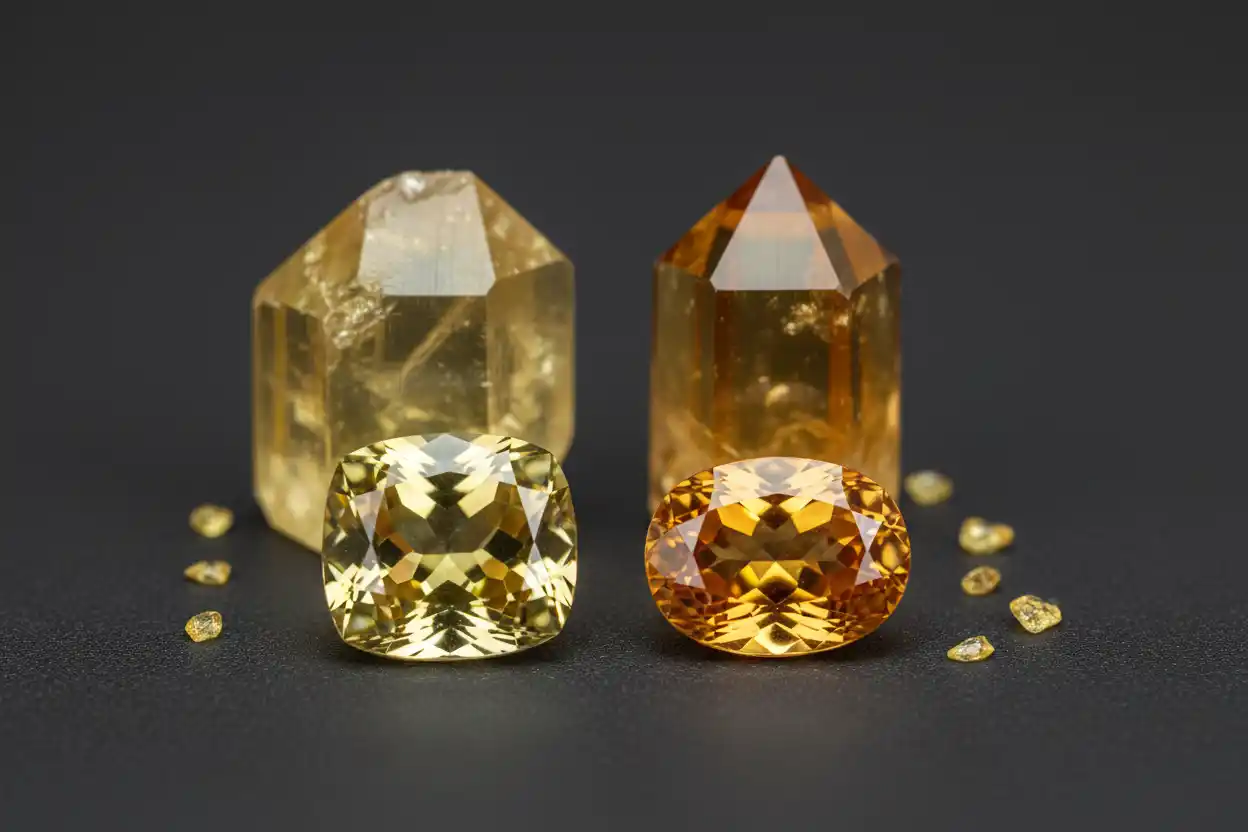
The heliodor vs citrine comparison becomes much easier once color is treated as the beginning of identification rather than the answer. Both stones can appear pale lemon yellow, bright yellow, golden, or slightly greenish, and a well-cut transparent example of either can look remarkably similar in photographs. Mineralogically, however, they are unrelated. Heliodor is yellow beryl, ideally Be₃Al₂Si₆O₁₈, while citrine is yellow-to-orange quartz, SiO₂. Their different crystal structures produce measurable differences in refractive index, optic sign, hardness, birefringence, crystal habit, inclusions, treatment history, and wear behavior. GIA identifies citrine as transparent yellow-to-brownish-orange quartz with RI 1.544–1.553, specific gravity about 2.66, and Mohs hardness 7, while yellow beryl research reports heliodor-compatible refractive indices broadly in the upper 1.56 to 1.58 range and the standard beryl hardness of approximately 7.5–8.
That difference means visual rules such as “heliodor is more golden,” “citrine is more orange,” or “greenish yellow always means heliodor” are unreliable. Heliodor can be lemon yellow or golden, and citrine can be yellow, orange-yellow, brownish orange, or yellow-green depending on the material. GIA’s work on blue-to-yellow beryl shows that heliodor itself spans multiple yellow and greenish-yellow tones as iron-related absorption changes, while GIA’s citrine reference documents a similarly broad yellow-to-orange range.
For readers working through gemstone identification more broadly, the Identification category provides the surrounding framework. The purpose of this page is narrower: decide between heliodor and citrine using properties, tests, treatment context, wear, value, and realistic buying tradeoffs without repeating the full reference guide for either stone.
Heliodor vs Citrine at a Glance
| Property | Heliodor | Citrine |
|---|---|---|
| Mineral species | Beryl | Quartz |
| Ideal formula | Be₃Al₂Si₆O₁₈ | SiO₂ |
| Crystal system | Hexagonal | Trigonal |
| Typical color | Lemon yellow, greenish yellow, golden yellow | Pale yellow, yellow, orangy yellow, brownish orange |
| Mohs hardness | About 7.5–8 | 7 |
| Typical RI | Commonly about 1.568–1.586 in yellow beryl | 1.544–1.553 |
| Birefringence | Low, commonly around 0.005–0.008 | About 0.009 |
| Optic sign | Uniaxial negative | Uniaxial positive |
| Specific gravity | Often around 2.66–2.75 for many gem beryls, but composition varies | About 2.66 |
| Pleochroism | Usually weak | Generally weak to absent visually in ordinary citrine |
| Cleavage | Imperfect basal cleavage | No true cleavage; conchoidal fracture |
| Common treatment issue | Heat and irradiation can modify beryl color | Most commercial citrine is heated amethyst; synthetic citrine also exists |
| Common natural inclusions | Two-phase inclusions, tubes, mineral crystals, healed fissures | Two-phase inclusions, growth features, mineral inclusions, color zoning |
| General jewelry suitability | Very good when sound | Good when properly protected |
| Best quick lab separator | Refractive index plus optic sign | Refractive index plus optic sign |
| Weak separator | Specific gravity alone | Specific gravity alone |
The most useful row is refractive index. A properly measured value around 1.544–1.553 is consistent with quartz and therefore citrine, while a yellow transparent gem giving values in the upper 1.56–1.58 region is much more consistent with beryl. This is a stronger distinction than body color and usually more useful than specific gravity, because clean heliodor can overlap quartz closely around the mid-2.6 density range.
The Core Difference: Beryl Versus Quartz
Heliodor belongs to the beryl species. Its structure contains rings of silica tetrahedra connected with beryllium and aluminum, creating channels parallel to the crystal’s c-axis. Iron-related centers within that structural system contribute to the yellow-to-green-to-blue continuum seen in heliodor and aquamarine. GIA’s spectroscopy of blue-to-yellow beryl found that yellow color is linked to absorption extending into the violet-blue region, with iron valence and structural occupancy influencing the visible result.
Citrine belongs to quartz. Quartz is SiO₂ with a trigonal structure and a completely different crystal chemistry. GIA describes citrine as transparent pale yellow to brownish-orange quartz and identifies iron as the broad color-related trace component. Natural citrine is comparatively uncommon, and much material sold in the commercial market begins as amethyst that is heated into yellow or orange coloration.
The shared yellow appearance therefore represents convergent color, not close mineral relationship.
Original Decision Matrix: Heliodor vs Citrine Without Guesswork
| Observation or test | More consistent with heliodor | More consistent with citrine | Reliability |
|---|---|---|---|
| RI around 1.57–1.58 | Strongly | No | High |
| RI around 1.544–1.553 | No | Strongly | High |
| Uniaxial negative optic sign | Strongly | No | High when properly measured |
| Uniaxial positive optic sign | No | Strongly | High when properly measured |
| Mohs hardness clearly above quartz | Supports | No | Moderate, but destructive testing discouraged |
| SG near 2.66 | Possible | Expected | Low as separator |
| Hexagonal prismatic rough | Supports beryl | Quartz can also look pseudo-hexagonal in some habits | Moderate |
| Yellow-to-orange color | Possible | Common | Low |
| Slight greenish modifier | Common in some heliodor | Also possible in citrine | Low |
| Strong reddish-orange commercial color | Less typical | Common commercial citrine appearance | Moderate visual clue only |
| Natural two-phase inclusions | Possible | Possible | Low without morphology/context |
| Long growth tubes parallel to c-axis | Beryl-compatible | Less characteristic | Moderate |
| Heat-treated amethyst history | No | Strongly supports commercial citrine | High if documented |
| Laboratory-grown quartz evidence | No | Synthetic citrine possible | High when tested |
| Beryl heat/irradiation evidence | Supports treated beryl | No | High when tested |
| “Golden beryl” label | Supports heliodor family | No | Moderate if seller terminology is correct |
| “Madeira citrine” label | No | Citrine trade color term | Moderate as trade context |
| Photograph only | Indeterminate | Indeterminate | Low |
The matrix demonstrates a recurring gemological principle: the strongest distinction is not visual. It is a measured property that comes directly from crystal structure.
Can You Tell Heliodor From Citrine by Color?
Sometimes a knowledgeable observer can form a useful hypothesis, but color is not sufficient for reliable identification.
Heliodor often appears lemon yellow, golden yellow, or greenish yellow. The green modifier can be subtle and may become more noticeable when the stone is compared directly with a warmer orange-yellow citrine. GIA’s beryl study recorded lemon and yellow heliodor with saturated color and weak dichroism, while the wider blue-to-yellow beryl series demonstrates continuous shifts caused by changing iron-related absorption.
Citrine can range from pale yellow through golden, orange-yellow, reddish orange, and brownish orange. GIA notes that saturated yellow-to-reddish-orange colors free of undesirable brown can be particularly attractive in the market.
Under warm indoor lighting, however, greenish-yellow heliodor can look more golden, while pale citrine can look lemon yellow. Camera white balance can push either stone toward orange or green. A color-based answer should therefore remain provisional.
Controlled Side-by-Side Photo Method
The workbook calls for same-lighting comparison whenever possible because online images are one of the biggest sources of identification error.
A valid side-by-side image should use the same neutral background, distance, exposure, lens, white balance, illumination angle, and approximate stone size. The stones should be photographed simultaneously rather than in two separate sessions.
The first image should use diffuse neutral white light. A second image can use transmitted light to show internal color distribution. A third can use oblique light to expose inclusions, facet polish, and surface features.
If one image comes from a warm jewelry light box and the other from cool daylight, apparent color differences are not reliable evidence.
Refractive Index Is the Best Practical Separator
For loose polished stones with suitable facets, refractive index is the most efficient conventional test.
GIA gives citrine’s RI as 1.544–1.553. Yellow beryl samples examined by GIA commonly fall around nε 1.568–1.579 and nω 1.573–1.586, with locality- and composition-related variation.
Those ranges do not overlap in normal material.
That means an accurately obtained reading near 1.55 strongly favors quartz, while a reading near 1.57 or 1.58 strongly favors beryl.
Someone learning the broader testing sequence can use How to Identify Crystals for the distinction between visual screening and actual diagnostic testing.
Why Specific Gravity Is Less Helpful
Specific gravity appears attractive because quartz has a textbook value near 2.66. Unfortunately, many clean beryls occur close enough to that value that the test is much weaker for this particular pair than RI.
GIA’s Volyn beryl study recorded eye-clean rough and faceted samples around SG 2.66–2.70. GIA gives citrine approximately 2.66, with a normal tolerance around that value.
A measured SG of 2.67 therefore does not confidently decide the question.
Density becomes more useful when combined with RI and optical behavior, not when interpreted by itself.
Optic Sign Provides a Second Strong Laboratory Difference
Both minerals are uniaxial, but their optic signs differ.
Beryl, including heliodor, is uniaxial negative. Quartz, including citrine, is uniaxial positive.
A trained gemologist using appropriate optical techniques can therefore use optic sign as an additional structural separator after confirming birefringent behavior.
This is a useful example of why two stones with similar color can still respond differently in optical instruments even when they look almost identical face-up.
Hardness: Useful on Paper, Poor as a Finished-Gem Test
Heliodor has the beryl hardness of approximately 7.5–8. Citrine is Mohs 7. GIA describes aquamarine, another beryl variety, at 7.5–8, while citrine is 7.
The difference matters for wear, but deliberately scratching a polished gem to distinguish them is poor practice.
A scratch test can permanently damage the object, and the result can be confused by facet coatings, surface contamination, incorrect test tools, or differences in test pressure.
Non-destructive RI testing is both cleaner and more informative.
Crystal Habit Helps More With Rough Than Faceted Stones
Natural beryl commonly forms elongated hexagonal prisms with longitudinal striations. Heliodor rough can therefore show six-sided prismatic morphology typical of beryl.
Quartz also produces six-sided-looking prisms, but quartz symmetry and terminations differ from true hexagonal beryl. A complete rough crystal can therefore provide useful structural clues to an experienced mineralogist.
Once the material is faceted, most of that morphology disappears.
A polished oval heliodor and polished oval citrine should not be identified from the original expected crystal form.
Pleochroism Is Usually a Supporting Clue
Heliodor can show weak dichroism, often involving slightly different yellow or greenish-yellow directions. GIA recorded weak dichroism in lemon and yellow heliodor samples.
Citrine’s ordinary face-up appearance generally does not provide an equally useful visual pleochroic clue, although quartz is anisotropic and its optical behavior can be studied instrumentally.
The difficulty is that heliodor’s pleochroism may be so weak that it is not visible enough to serve as a buyer’s test.
Failure to see obvious color change with a dichroscope does not prove citrine.
Inclusions: Helpful, but Rarely Decisive Alone
Both materials can contain natural inclusions, making simplistic inclusion rules unreliable.
GIA’s yellow beryl studies document two-phase inclusions as common, including elongated rod-like two-phase features and growth tubes oriented with the c-axis. Mineral inclusions including tourmaline, albite, muscovite, garnet, zircon, and other pegmatitic minerals have also been documented.
Natural citrine can contain two-phase inclusions, elongated tubules, mineral inclusions, and growth structures. GIA’s study of natural Zambian citrine documented planes of elongated tubules and two-phase inclusions, while also noting that separating natural from synthetic quartz can require inclusion study or trace-element analysis.
The correct question is therefore not “Does it have inclusions?” but “Are the inclusions diagnostic for the host material or origin?”
Natural Versus Synthetic Citrine Adds a Second Identification Problem
A yellow quartz can be genuine citrine as a mineral variety but still be laboratory-grown.
GIA confirms that laboratory-grown quartz is produced commercially and that some laboratory-grown material becomes synthetic citrine. GIA research also notes that faceted natural and synthetic quartz can be difficult to separate because hydrothermal laboratory growth can produce very clean material with physical and optical properties closely resembling natural quartz. Trace-element analysis and microscopic growth features may be needed in difficult cases.
So the full decision may involve two questions:
Is the yellow stone beryl or quartz?
If quartz, is it natural or laboratory-grown?
A simple color inspection answers neither conclusively.
Treatment Is Much More Commonly Discussed With Citrine
Natural yellow quartz is relatively uncommon. GIA states plainly that most citrine in the market is produced by heating amethyst.
Heating changes the purple iron-related color system of suitable amethyst to yellow, orange, or brownish-orange coloration. That treatment is accepted and extremely common, but it should not be confused with natural-color citrine when provenance or treatment status matters.
A darker reddish-orange stone with a heated-amethyst origin is still quartz and may legitimately be sold as citrine when properly represented.
The important issue is disclosure, not the assumption that treatment makes the gem “fake.”
Heliodor Has Its Own Treatment Questions
Beryl can also have its color altered.
GIA research notes that yellowish and greenish beryl can be heated to obtain bluer material by reducing the yellow component. The same experimental work showed changes in some two-phase inclusions as heating increased.
Irradiation is another relevant beryl treatment pathway. Some irradiated beryl colors can be unstable or have characteristic spectral behavior depending on the color center involved.
This means “heliodor is always untreated while citrine is treated” is false.
The treatment histories differ, but both materials deserve proper disclosure when treatment status affects value.
Readers needing the broader conceptual framework can use Gemstone Treatments Explained.
Heat-Treated Citrine Is Not Dyed Citrine
Heating and dyeing are different treatments.
Commercial citrine commonly receives its yellow-to-orange color by heating amethyst. Dye, in contrast, introduces coloring material into fractures, pores, coatings, or other accessible structures.
A yellow quartz whose color is caused by dye is therefore a different treatment case from ordinary heat-treated citrine.
The visual distinction can sometimes be suggested by unnatural color concentration around fractures or drill holes, but technical verification may be needed. The broader inspection principles are covered in How to Spot Dyed Crystals.
Composite Stones Are Another Source of Confusion
Neither heliodor nor citrine should automatically be assumed to be a single homogeneous natural stone simply because the face-up view looks convincing.
Composite gems can combine separate pieces using cement or other joining methods. Doublets and triplets can imitate color, size, or clarity characteristics while presenting a convincing top surface.
A girdle inspection, immersion, magnification, or laboratory test can reveal assembly planes that casual photography hides.
Readers working with unusual mounted or bargain-priced material can use Gemstone Doublets and Triplets for that separate construction problem.
Glass Imitations Can Resemble Both
Yellow glass can imitate both heliodor and citrine because glass manufacturers can create a wide range of yellow shades and transparency levels.
Gas bubbles, swirl marks, mold features, unusually low hardness, single refractive behavior, and different RI may expose some glass imitations, but no one clue works in every case.
The comparison with manufactured glass is handled more directly in Glass vs Crystal.
The key point for heliodor vs citrine is that a yellow object does not necessarily belong to either mineral family.
“Too Perfect” Does Not Automatically Mean Fake
A clean stone can be natural.
Beryl can form transparent crystals of considerable size, and quartz can also grow exceptionally clean. Conversely, both synthetic and imitation materials can contain deliberately introduced imperfections.
Clarity therefore cannot determine natural origin by itself.
A better approach is to combine measurable physical properties, internal growth features, spectroscopy where appropriate, and credible documentation. How to Spot Fake Crystals provides that broader evidence hierarchy.
Durability: Which Is Better for Jewelry?
Heliodor wins on scratch hardness. Beryl is approximately Mohs 7.5–8 compared with citrine at 7.
That does not automatically mean heliodor is tougher in every mechanical sense. Beryl is brittle and has imperfect basal cleavage, while quartz lacks a prominent true cleavage and is generally regarded as having good toughness for ordinary jewelry.
For rings worn frequently, both can work when the stone is sound and the setting protects vulnerable edges. Heliodor offers somewhat stronger resistance to scratching, whereas citrine’s quartz structure avoids the same cleavage consideration.
Actual durability also depends on fractures, cut shape, girdle thickness, setting style, and the wearer’s habits.
Which Is Better for an Everyday Ring?
For a carefully worn ring, either can be reasonable.
Heliodor is appealing when higher scratch resistance, a more unusual beryl identity, or a lighter lemon-to-golden appearance is desired. Citrine is appealing when affordability, broad availability, warm orange-yellow color, and established quartz durability matter more.
A large open fracture in either stone can outweigh the species-level difference.
The best ring choice is therefore the sounder, better-cut, better-protected individual gemstone—not simply the harder species.
Care: Warm Soapy Water Is the Conservative Choice
GIA recommends warm soapy water as a safe cleaning method for citrine. Ultrasonic cleaning is usually safe unless the stone has dye or fracture filling, while steam is not recommended because abrupt heat can damage quartz.
For beryl, GIA’s aquamarine care guidance provides a useful species-level reference: warm soapy water is always safe, while ultrasonic and steam cleaning are normally acceptable only when the stone lacks fractures or liquid inclusions.
For an unidentified yellow gem, warm soapy water is therefore the sensible default until identity, treatment, and inclusion condition are known.
Light and Heat Stability
Some citrine can fade after prolonged exposure to intense light, and sudden temperature changes can cause fracture. GIA specifically warns against steam cleaning and intense heat.
Beryl care depends partly on color variety and treatment history. Heat is relevant because it can intentionally alter yellow/greenish beryl toward blue, and liquid inclusions can create additional risk during strong heating.
Neither gemstone needs to be baked, torched, or exposed to extreme temperature as part of cleansing or identification.
Value: Heliodor and Citrine Occupy Different Market Positions
Citrine is generally abundant in large faceted sizes and remains relatively affordable. GIA specifically notes that even fine citrine has a modest price profile and that price per carat does not rise dramatically simply because the stone becomes large.
Heliodor is also capable of forming sizeable clean gems, but it is less ubiquitous in mainstream jewelry. Attractive saturated yellow beryl, precision cutting, documented locality, or unusual collector crystals may create a premium over ordinary commercial citrine.
That does not mean every heliodor is more valuable than every citrine. A pale, windowed heliodor can reasonably be worth less than an exceptional natural-color citrine with superior cutting and documentation.
Color Value Is Different for the Two Stones
In citrine, attractive saturated yellow-to-orange and reddish-orange colors are strongly marketable. Warm orange material may be desirable rather than considered a defect.
In heliodor, the market may favor bright lemon, golden, or desirable greenish-yellow beryl depending on the buyer and naming convention.
A warm reddish-orange color that strengthens citrine’s commercial appeal would be unusual for classic heliodor.
Color should therefore be evaluated within the correct species rather than through one universal yellow-gem scale.
Does Natural-Color Citrine Deserve a Premium?
Potentially, but only when natural color can be supported.
GIA describes natural citrine as rare relative to the amount of heated amethyst sold as citrine. That scarcity can create collector interest in convincingly documented natural-color material.
The difficulty is identification. Natural versus synthetic quartz and natural-color versus heat-derived yellow can be technically challenging in clean faceted stones. GIA notes that citrine may lack some infrared features used for natural/synthetic separation in amethyst, so inclusion evidence or trace-element analysis may become important.
A seller asking a large premium for “rare natural citrine” should therefore provide more than a marketing phrase.
Does Untreated Heliodor Deserve a Premium?
Again, potentially.
A well-documented natural yellow beryl with attractive color can carry collector or gemological interest, particularly when provenance is credible.
But a premium requires evidence. A yellow color alone cannot establish an untreated history, and beryl is known to respond to heat and irradiation.
For both stones, treatment claims should increase the demand for documentation rather than merely increase the price.
Original Buyer Decision Matrix
| Buyer priority | Better starting choice | Why |
|---|---|---|
| Lowest typical cost | Citrine | Broad supply and large commercial availability |
| Slightly higher scratch resistance | Heliodor | Beryl is about 7.5–8 versus quartz at 7 |
| Warm orange or reddish-orange color | Citrine | Common desirable citrine color range |
| Lemon or subtle greenish-yellow | Heliodor | Common heliodor appearance |
| Rare-natural-color collecting | Either, with documentation | Natural-color citrine and well-documented heliodor each have specialist interest |
| Easy replacement | Citrine | Generally much easier to source |
| Unusual beryl-family jewelry | Heliodor | Same species family as aquamarine and emerald |
| Large affordable yellow stone | Citrine | Large sizes commonly remain relatively accessible |
| Strong laboratory separation | Neither has an advantage | RI readily distinguishes the two |
| Lowest treatment ambiguity | Neither by default | Treatment disclosure matters for both |
| Everyday ring | Either sound stone | Species-level durability is acceptable; condition and setting decide |
| Collector crystal specimen | Heliodor often offers strong crystal appeal | Beryl prisms, locality and pegmatite associations can add specimen interest |
| Buyer without testing access | Choose documented seller material | Visual guessing is weak for both |
There is no universally better gemstone. The correct choice depends on why the buyer wants yellow color in the first place.
Decision Case: You Want a Warm Golden-Orange Stone on a Moderate Budget
Citrine is usually the more direct choice.
Its commercial color range naturally includes yellow, orangy yellow, brownish orange, and reddish-orange shades, and larger stones remain widely available.
There is little reason to pay a heliodor premium if the desired appearance is specifically warm orange and the buyer has no interest in beryl identity.
Decision Case: You Want a Lemon-Yellow Beryl
Choose heliodor, but verify species rather than relying on the label.
A properly identified heliodor provides the beryl crystal chemistry, higher hardness, and subtle optical behavior that distinguish it from quartz.
The purchase should ideally be supported by measurements or credible gemological documentation if the price is substantial.
Decision Case: You Want the Harder Stone
Heliodor has the edge in resistance to scratching.
Its Mohs hardness is about half to one full step above quartz, depending on the exact reference values used.
Do not interpret that difference as immunity from damage. Beryl remains brittle, and a poorly protected corner or surface-reaching fracture can still chip.
Decision Case: You Want the Stone With the Simplest Treatment Story
Neither deserves automatic selection.
Most market citrine is heated from amethyst, which makes treatment common but relatively straightforward. Heliodor can be natural yellow beryl, but beryl colors can also be modified through heat or irradiation.
The easier path is not choosing a species based on assumptions; it is choosing a seller whose disclosure is clear.
Decision Case: You Want Natural-Color Citrine
This is one of the situations where a laboratory may matter more than the intrinsic monetary value suggests.
GIA offers colored stone identification reporting for citrine, although it notes that such reports are not commonly requested because the laboratory fee can be significant relative to the value of ordinary citrine.
If a seller’s premium depends heavily on natural-color, natural-origin claims, the cost of independent verification can become rational despite citrine’s otherwise accessible market position.
What a Gem Laboratory Can Resolve
A professional identification report can establish the gemstone species and variety, whether the material is natural or laboratory-grown, and any detectable treatments within the laboratory’s service scope. GIA’s colored-stone reports also record shape, cutting style, weight, measurements, color, and a photograph.
For heliodor vs citrine, that means the basic species question should be straightforward for a qualified laboratory.
Treatment and natural-versus-synthetic questions can require more advanced analytical work, especially with quartz.
A report is evidence about the gemstone. It is not automatically an appraisal or guarantee of resale value.
Readers evaluating documentation can use How to Read a Gem Lab Report and the separate Gemstone Certification guide for terminology and report limits.
Why Geographic Origin Usually Matters Less Here
GIA’s current standard colored-stone Identification Report can identify heliodor or citrine and disclose detectable treatment, but geographic-origin services are restricted to selected gem types rather than every colored stone.
That means a report identifying yellow beryl does not automatically certify that it came from a seller-claimed pegmatite in a particular country.
Likewise, citrine origin can be difficult to prove from color alone.
For ordinary jewelry buyers, species, treatment, color, clarity, cutting, and seller reliability are usually more practical decision factors than ambitious locality claims.
Beware of Overconfident Home-Test Lists
Online guides sometimes promise that one can distinguish heliodor and citrine through temperature, “energy,” weight in the hand, sparkle, or one scratch test.
Those methods are unreliable.
The density difference may be negligible. Both can feel cool because thermal sensation depends on several factors. Facet design can dominate apparent sparkle. Color overlaps. Scratch testing can damage the gem.
A proper identification sequence prioritizes RI and optical measurements.
Why “More Sparkly” Is Not a Reliable Test
Heliodor has somewhat higher refractive index than citrine, but apparent brilliance depends heavily on cutting geometry.
A well-cut citrine can look much livelier than a windowed heliodor. A precision-cut stone can outperform a poorly proportioned gem even when its intrinsic RI is lower.
Brilliance is therefore useful in evaluating cut quality, not in making a confident species identification by eye.
Why Weight in the Hand Fails
Because the density ranges can overlap closely, two stones of similar external dimensions may feel almost identical.
Cut depth, pavilion bulge, girdle thickness, mounting metal, and exact beryl composition can create a larger apparent weight difference than species alone.
Hand heft is not a meaningful heliodor-vs-citrine diagnostic.
Why UV Reaction Is Not a Primary Separator
Neither gemstone has a simple, universal fluorescence response that should replace standard testing.
Beryl fluorescence can vary with composition and locality, while quartz may be inert or respond depending on inclusions, impurities, or treatments.
A UV lamp may contribute supporting information in a broader examination, but RI remains far more decisive for this pair.
What About Mounted Jewelry?
Mounted stones can make refractive-index access, specific-gravity testing, inclusion observation, and optic testing more difficult.
The mounting can also mask a doublet seam or prevent inspection of the pavilion.
A competent gemologist can often still identify mounted material through a combination of accessible measurements, microscopy, spectroscopy, and experience, but home identification becomes less reliable.
If a mounted yellow stone carries meaningful financial or sentimental value, testing it professionally is preferable to attempting destructive methods.
Treatment Disclosure Should Match the Claim
A listing saying “natural citrine” can mean natural quartz rather than natural yellow color. Those are not equivalent statements.
Similarly, “natural heliodor” may mean naturally mined beryl without explicitly ruling out color modification.
When treatment matters, ask directly whether the color is natural as mined, heat-treated, irradiated, dyed, coated, or otherwise enhanced.
A seller unable to explain the difference should not charge a premium based on treatment language.
Counterfeit and Misrepresentation Risks
The most realistic risks are not necessarily elaborate counterfeits.
A yellow quartz may simply be mislabeled as heliodor. A heat-treated citrine may be marketed as rare natural-color citrine. Laboratory-grown quartz may be sold without synthetic disclosure. Yellow glass may be passed off as either gemstone. A composite may be hidden by a setting. An origin claim may be invented.
The solution is not suspicion of every inexpensive stone. It is matching the strength of verification to the value of the transaction.
Comparison Pages Need the Same Evidence Discipline
The same principle applies to other look-alike comparisons. The mapped Iolite vs Tanzanite comparison relies on optical and physical differences rather than purple-blue color alone, while Fluorite vs Amethyst requires hardness, cleavage, crystal system, and optical behavior to replace superficial purple-color matching.
Heliodor vs citrine is easier than many comparisons because their refractive-index ranges are well separated.
That advantage should be used rather than ignored.
How to Choose Between Heliodor and Citrine
Choose heliodor when the appeal lies in beryl identity, slightly stronger scratch resistance, lemon-to-golden or greenish-yellow color, pegmatitic crystal history, or owning a less common mainstream jewelry gem.
Choose citrine when warm yellow-to-orange color, larger affordable sizes, widespread availability, and straightforward quartz jewelry performance are the higher priorities.
If the main goal is simply an attractive yellow stone, compare individual gems rather than species stereotypes.
Color quality, cut, transparency, inclusions, treatment disclosure, setting, and price may matter more than the name.
A Practical Pre-Purchase Sequence
Before purchasing a significant yellow gemstone, establish what the seller is actually claiming. Confirm whether the listing says beryl/heliodor or quartz/citrine, whether the material is natural or laboratory-grown, whether color treatment is disclosed, whether the weight applies to one stone or a parcel, and whether the photographs use realistic neutral lighting.
Then evaluate cut and condition. Look for large windows, dark extinction, chipped facet junctions, uneven girdles, surface-reaching fractures, and obvious composite seams.
Finally, decide whether the price is high enough to justify independent gemological testing.
Lab Limits and Evidence Boundaries
Even laboratories work within defined scopes.
A laboratory can identify beryl versus quartz readily, but some treatment questions and natural-versus-synthetic quartz determinations require advanced instrumentation. GIA explains that colored stones may be examined by multiple gemologists using microscopy and analytical testing, with additional research review when necessary.
Geographic origin is not automatically available for every gem variety, and a laboratory report should not be interpreted as a price guarantee.
The broader evidence approach used by Gems Lore is described on About Gems Lore.
Safety and Ownership
Neither heliodor nor citrine needs destructive testing at home.
Do not intentionally scratch a finished gemstone, strike it to examine fracture, heat it to see whether the color changes, expose it to aggressive chemicals, or grind material for identification.
Ordinary intact ownership is different from lapidary processing. Cutting quartz can create respirable crystalline-silica dust, while beryl processing introduces a different mineral-dust exposure profile. Proper workshop controls are required for both.
The site’s boundaries around gem testing, health claims, and non-professional use are stated in the Disclaimer.
Original Final Decision Scorecard
| Question | Choose heliodor when… | Choose citrine when… |
|---|---|---|
| Color | You prefer lemon, golden, or subtly greenish yellow | You prefer yellow, orange-yellow, or reddish-orange |
| Species interest | You specifically want beryl | You prefer quartz |
| Scratch resistance | Slightly higher hardness matters | Mohs 7 is sufficient |
| Cleavage concern | You accept beryl’s imperfect cleavage | You prefer quartz’s lack of prominent cleavage |
| Budget | You accept potentially higher specialist pricing | Affordability is a major priority |
| Large size | You want beryl and accept variable price | You want large size economically |
| Treatment | You have reliable beryl disclosure | You accept common heat-treated citrine |
| Natural-color collecting | Documented heliodor appeals | Verified natural-color citrine appeals |
| Replacement | Rarity is part of the appeal | Easy replacement matters |
| Testing | RI can verify your candidate | RI can verify your candidate |
| Best overall choice | The individual heliodor has better color, cut, documentation and price for your needs | The individual citrine has better color, cut, documentation and price for your needs |
The scorecard deliberately ends with the individual stone. Species-level averages cannot tell you whether one specific gem is better cut, more attractive, more honestly represented, or more reasonably priced.
Frequently Asked Questions About Heliodor vs Citrine
What is the main difference between heliodor and citrine?
Heliodor is yellow beryl, Be₃Al₂Si₆O₁₈, while citrine is yellow-to-orange quartz, SiO₂. Their chemistry and crystal structures are fundamentally different.
Can heliodor and citrine look the same?
Yes. Pale yellow, lemon, and golden stones can overlap strongly in appearance. Color alone cannot reliably separate them.
What is the easiest reliable test?
Refractive index. Citrine is approximately 1.544–1.553, while typical heliodor is broadly around the upper 1.56–1.58 range.
Does specific gravity separate heliodor and citrine?
Not reliably by itself. Citrine is near 2.66, and some gem-quality yellow beryl can also fall around 2.66–2.70.
Which is harder?
Heliodor. Beryl is approximately Mohs 7.5–8, while citrine is 7.
Which is tougher?
Citrine has good jewelry toughness and no prominent cleavage, while beryl is also durable but brittle with imperfect cleavage. Individual fractures and setting design can matter more than a simple species ranking.
Is heliodor more valuable than citrine?
Often, but not universally. Fine natural-color citrine, exceptional cutting, unusual provenance, or collector quality can alter the comparison, while ordinary pale heliodor need not command a major premium.
Is natural citrine rare?
Natural yellow citrine is relatively uncommon. GIA states that most citrine sold commercially results from heating amethyst.
Is heat-treated citrine fake?
No. It is natural quartz whose color has been modified by heat. The important issue is accurate treatment disclosure.
Is synthetic citrine real quartz?
Laboratory-grown citrine has essentially the quartz structure and properties but is manufactured rather than naturally crystallized. GIA confirms that synthetic citrine exists.
Can heliodor be treated?
Yes. Beryl color can be modified by heat or irradiation. Yellowish and greenish beryl can respond to heat by becoming bluer.
Is greenish-yellow always heliodor?
No. Citrine can also show yellow-green or greenish-yellow tones. Color modifiers are not sufficient identification.
Is orange-yellow always citrine?
It is more typical of citrine, particularly strongly warm material, but an identification should still rely on gemological properties rather than color alone.
Can inclusions identify the stone?
Sometimes they provide strong supporting evidence, but both beryl and quartz can contain fluid and mineral inclusions. Inclusion morphology must be interpreted carefully.
Can a phone photo distinguish heliodor from citrine?
Usually not conclusively. White balance, saturation, lighting, and cutting can make them look more similar or more different than they are.
Which is better for a ring?
Both can work. Heliodor offers slightly greater scratch resistance; citrine offers good toughness and broad affordability. Stone condition and setting protection are crucial.
How should I clean heliodor and citrine?
Warm soapy water is a conservative safe choice for both. More aggressive cleaning should depend on confirmed identity, fractures, inclusions, and treatment status.
Should I ask for a laboratory report?
For an expensive stone, unusual natural-color claim, synthetic concern, or unclear treatment history, independent identification can be worthwhile. GIA Colored Stone Identification Reports identify the material, natural or laboratory-grown status, and detectable treatments.
Does a certificate prove geographic origin?
Not necessarily. Geographic-origin services are restricted to specific gem categories and report types, so buyers should read exactly what the report states rather than infer information that is not listed.
How can I verify a seller’s unusual claim?
Request the original laboratory report, verify the report through the issuing laboratory where possible, compare the wording carefully with the listing, and ask what evidence supports treatment and origin statements. Questions or documented corrections about Gems Lore content can be submitted through Contact Gems Lore, with submitted information handled according to the Privacy Policy.
Final Perspective
The heliodor vs citrine choice is visually difficult but gemologically straightforward. Heliodor is beryl and citrine is quartz. Their yellow colors overlap enough that photographs, warmth, sparkle, weight in the hand, or seller adjectives are poor primary tests. Refractive index gives a far cleaner answer: quartz citrine lies around 1.544–1.553, while typical yellow beryl sits materially higher in the upper 1.56–1.58 range. Their optic signs differ as well, providing another structural confirmation.
Treatment context then becomes the second layer of the decision. Most commercial citrine is heated from amethyst, synthetic citrine exists, and separating natural from synthetic quartz can require more than routine visual inspection. Heliodor is not treatment-free by definition either; yellow and greenish beryl can respond to heat, and irradiation is relevant within the broader beryl treatment landscape.
For ownership, both stones are practical jewelry materials when sound. Heliodor provides somewhat greater scratch resistance, while citrine combines good toughness, availability, and affordability. For buying, the right answer depends on color preference, treatment disclosure, budget, cut, condition, documentation, and whether beryl or quartz identity carries personal value.
The key is not to guess from yellow color. Measure the properties, read the documentation, compare equivalent quality, and choose the individual gemstone whose evidence and appearance justify its name and price.