Kyanite vs Sapphire: Key Differences & How to Choose
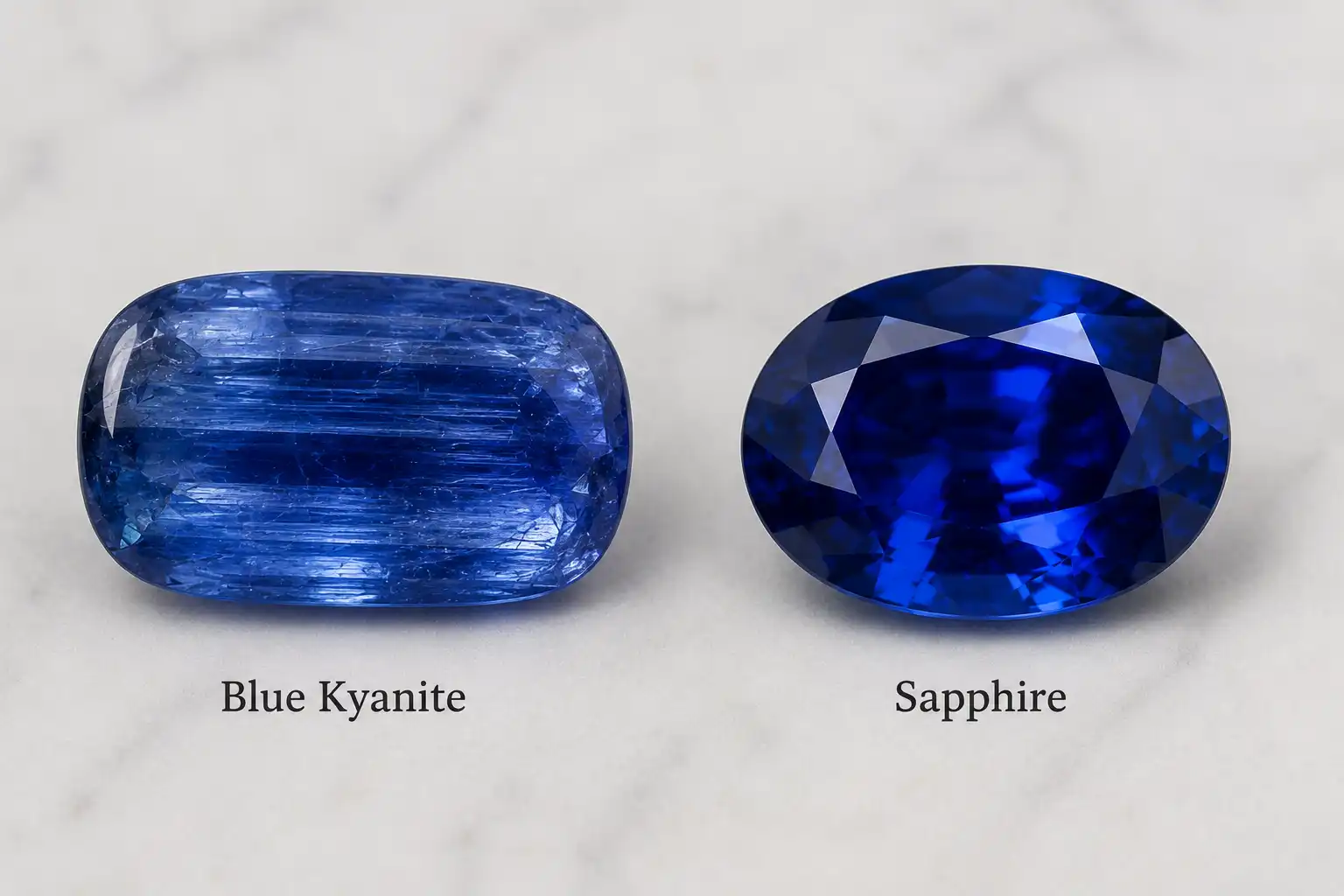
Kyanite and sapphire can overlap so closely in blue that a well-cut stone viewed in a photograph may not reveal which material it is. Mineralogically, however, they are very different. Kyanite is triclinic aluminum silicate, Al₂SiO₅, and belongs to the same polymorphic system as andalusite and sillimanite. Sapphire is corundum, Al₂O₃, and any gem-quality corundum that is not red ruby falls within the sapphire family. Their different structures create substantial differences in refractive index, density, hardness, cleavage, optical character, durability, treatment practices, value, and suitability for everyday jewelry. Mindat records kyanite at approximately Mohs 5.5–7 depending on crystallographic direction, density 3.53–3.67, perfect cleavage on one important plane, and good cleavage on another. GIA records sapphire at Mohs 9, RI 1.762–1.770, specific gravity around 4.00, excellent toughness, and no cleavage.
That difference is large enough to affect ownership more than the color resemblance suggests. Sapphire is one of the most practical traditional colored gemstones for rings and other jewelry exposed to daily wear. Kyanite can make an attractive collector gem, pendant, earrings, or carefully protected occasional-wear stone, but its directional hardness, brittleness, and cleavage demand considerably more care. GIA describes corundum as highly durable under ordinary wearing conditions, whereas kyanite’s mineral data show a crystal whose scratch resistance can shift dramatically according to direction.
The treatment and value markets are also very different. Heating is common and accepted for sapphire, lattice diffusion is widespread, and unheated fine sapphire can command a premium when supported by laboratory evidence. Kyanite does not have an equivalent globally standardized treatment-and-origin hierarchy, although impregnated or filled kyanite has been encountered in the gem trade and unusual material still deserves disclosure and testing.
This comparison therefore answers a practical question rather than declaring one gem universally superior. Choose sapphire when durability, an established fine-gem market, long-term ring wear, and high-value laboratory documentation matter most. Choose kyanite when you value its distinctive directional blue, metamorphic mineral identity, relative affordability, or collector character and are prepared to treat it as a more delicate stone. Related side-by-side material comparisons are organized under Identification.
Kyanite vs Sapphire at a Glance
| Property | Kyanite | Sapphire |
|---|---|---|
| Mineral species | Kyanite | Corundum |
| Formula | Al₂SiO₅ | Al₂O₃ |
| Crystal system | Triclinic | Trigonal |
| Typical blue | Medium blue to deep blue, often streaky or zoned | Pale to vivid blue, commonly more uniform but zoning can occur |
| Mohs hardness | Strongly directional, about 5.5–7 | 9 |
| Toughness | Brittle | Excellent for normal jewelry use |
| Cleavage | Perfect on one plane, good on another | None |
| Specific gravity | About 3.53–3.67 | About 4.00 |
| Refractive index | About 1.712–1.734 | About 1.762–1.770 |
| Birefringence | About 0.015–0.016 | About 0.008–0.010 |
| Optical character | Biaxial negative | Uniaxial negative |
| Pleochroism | Can be conspicuous blue to pale/colorless | Common in blue sapphire, generally blue/greenish-blue directional variation |
| Major blue-color context | Iron-related processes with Ti and other trace-element contributions | Iron and titanium interactions are central to much blue sapphire |
| Common treatment market | Less standardized; filling/impregnation has been encountered | Heat treatment common; lattice diffusion and some filling also encountered |
| Everyday ring use | Higher risk | Excellent relative choice |
| Gem-market hierarchy | Smaller specialist/collector market | Major international fine-gem market |
| Origin premium | Less standardized | Can be substantial for exceptional documented material |
| Best practical reason to choose | Distinctive mineral character and optical personality | Durability, established value framework, jewelry practicality |
The numbers provide an immediate route to separation. A polished blue gem with RI around 1.72 and SG in the mid-3.6 range is consistent with kyanite; a stone around RI 1.76–1.77 and SG near 4.00 strongly supports sapphire instead.
Identity: Aluminum Silicate Versus Corundum
Kyanite contains aluminum, silicon, and oxygen and has the formula Al₂SiO₅. Its structure is triclinic, and it is polymorphous with andalusite and sillimanite. The three minerals share overall chemistry but arrange their atoms differently, which produces different structures and physical properties. Kyanite is principally associated with metamorphic environments and can be an important indicator of the pressure-temperature history of aluminum-rich rocks.
Sapphire is corundum, Al₂O₃. Corundum contains aluminum and oxygen without the silicon framework that defines kyanite. Blue is only one sapphire color; GIA also recognizes yellow, green, violet, orange, pink, purple, black, gray, brown, and intermediate fancy sapphire colors. Red corundum is ruby rather than sapphire.
The difference illustrates why gemstone color cannot substitute for mineral identification. Similar reasoning applies when comparing Lapis Lazuli vs Sodalite: two materials may occupy nearly identical visual territory while differing in composition, structure, density, and practical behavior.
Original Side-by-Side Identity Table
| Test or observation | Kyanite expectation | Sapphire expectation | Separation strength |
|---|---|---|---|
| Chemistry | Al₂SiO₅ | Al₂O₃ | Definitive analytically |
| Crystal structure | Triclinic | Trigonal | Definitive structurally |
| RI near 1.72 | Expected | Too low | Strong |
| RI near 1.765 | Too high | Expected | Strong |
| SG around 3.6 | Expected | Too low | Strong |
| SG around 4.0 | Too high | Expected | Strong |
| Hardness 9 | No | Yes | Strong but destructive testing unnecessary |
| Major hardness change by direction | Characteristic | Not comparable | Strong conceptually |
| Cleavage | Strong | Absent | Strong |
| Biaxial optical response | Yes | No | Strong |
| Uniaxial optical response | No | Yes | Strong |
| Blue color | Common | Common | Very weak |
| Strong saturation | Possible | Possible | Very weak |
| Transparent faceted stone | Possible | Common | Weak |
| Color zoning | Possible | Possible | Weak |
| Seller says “natural blue gem” | Possible | Possible | No diagnostic value |
The safest identification method uses several independent properties rather than looking for one dramatic clue.
Visual Clues: What You Can Notice Before Testing
Kyanite often shows a slightly more directional, streaky, or uneven blue appearance than fine sapphire. Rough kyanite commonly grows as elongated blades, and cut stones may retain linear zoning, pale areas, cleavage-related features, or a noticeable change from deeper blue to grayish or nearly colorless as the gem is rotated. GIA reference specimens include blue kyanites with obvious colorless-to-blue or gray-to-blue pleochroism and parallel growth tubes.
Sapphire can also be zoned and pleochroic, so these observations are not proof. Natural blue sapphire can show angular color zoning, rutile silk, mineral crystals, healed fractures, and other internal structures. GIA’s inclusion work also demonstrates how microscopy can reveal both natural growth features and evidence of heating or other treatment.
Fine sapphire generally has a higher refractive index than kyanite, which can contribute to a crisper or more intense vitreous appearance when cut well. Cut quality, body color, transparency, stone depth, and lighting can easily overwhelm that difference in photographs, however. A badly cut sapphire may look duller than an excellent kyanite.
Color therefore narrows the possibilities; it does not settle the identity.
Original Same-Lighting Comparison Protocol
The workbook requires original comparison information rather than two unrelated seller photographs. A repeatable same-lighting protocol is more useful:
| Control | Method | Why it matters |
|---|---|---|
| Light source | One diffuse daylight-balanced lamp | Removes different color-temperature effects |
| Background | Neutral matte gray | Prevents warm or cool surrounding colors influencing blue |
| Face-up scale | Use similar visible dimensions | Stops a larger gem appearing more saturated simply because it occupies more image area |
| Camera settings | Fixed white balance, exposure, distance | Makes images comparable |
| Initial orientation | Table facing camera | Establishes normal jewelry view |
| Rotation | Rotate both gems through multiple angles | Reveals pleochroism and zoning |
| Side view | Photograph crown and pavilion | Shows depth and hidden weight |
| Macro view | Same magnification | Compares inclusions and zoning fairly |
| Reflected light | Same intensity and angle | Helps compare luster |
| Editing | No selective saturation or hue correction | Prevents manufactured visual separation |
If the stones still look identical after this exercise, that is not a failure. It demonstrates exactly why appearance is insufficient.
A similar controlled approach helps with Labradorite vs Moonstone, where viewing geometry can dramatically affect what a stone appears to show.
Refractive Index: One of the Cleanest Routine Tests
Kyanite’s refractive indices are approximately nα 1.712–1.718, nβ 1.720–1.725, and nγ 1.727–1.734, with birefringence around 0.015–0.016. Sapphire occupies a much higher and narrower range at approximately 1.762–1.770, with birefringence around 0.008–0.010.
Those ranges do not overlap under normal conditions. A competent refractometer measurement can therefore distinguish the two far more reliably than blue hue, saturation, or perceived sparkle.
Optical character provides another separation. Kyanite is biaxial negative, whereas sapphire is uniaxial. That distinction comes directly from their different crystal structures and can be resolved using appropriate gemological methods.
This is the same principle that makes measurements so useful in Iolite vs Tanzanite: visual color similarity is only the beginning of identification.
Specific Gravity: Sapphire Is Noticeably Denser
Sapphire has a typical specific gravity around 4.00. Kyanite commonly measures approximately 3.53–3.67.
If two loose gems have essentially the same external volume, sapphire should therefore weigh more. Hydrostatic SG testing can provide useful supporting evidence when the stones are loose and sufficiently large to measure accurately.
This test becomes less useful in mounted jewelry because metal, adhesives, cavities, and settings interfere with the measurement. Density should also not be estimated by simply holding two small gemstones in the hand; the weight difference may be too subtle for a reliable conclusion.
Hardness: Sapphire Wins Decisively
Sapphire is Mohs 9. Only diamond is conventionally placed above corundum among the standard Mohs reference minerals. GIA emphasizes that this high hardness contributes to sapphire’s excellent suitability for jewelry.
Kyanite is fundamentally different. Its hardness is strongly anisotropic—approximately 5.5 parallel to one crystallographic direction and about 7 along another.
That means a scratch approaching from one orientation encounters substantially less resistance than the same crystal tested in another direction. This is not a small variation; it is one of kyanite’s characteristic mineral properties.
A buyer should not perform scratch tests on a finished stone. The test is destructive, and refractive index or spectroscopy can separate kyanite from sapphire without deliberately damaging either one.
Cleavage and Toughness: An Even Bigger Practical Difference
Hardness describes scratch resistance. It does not describe how easily a gemstone can split.
Kyanite has perfect cleavage on one important plane and good cleavage on another and is brittle. A sharp impact, setting pressure, thin edge, internal fracture, or unfavorable orientation can exploit those structural weaknesses.
Sapphire has no cleavage and GIA characterizes corundum as having excellent toughness. That combination—Mohs 9 plus no cleavage—is why sapphire performs so well in rings and other jewelry exposed to repeated contact.
For ordinary ownership, this difference often matters more than any variation in blue color.
The same principle applies in Jadeite vs Nephrite, where mineral hardness alone does not tell the complete story of how a material survives impact.
Original Durability Decision Matrix
| Use case | Kyanite | Sapphire | Better default |
|---|---|---|---|
| Mineral specimen | Excellent | Excellent | Preference |
| Loose collector gem | Excellent | Excellent | Preference |
| Earrings | Reasonable with protection | Excellent | Sapphire for easier ownership |
| Pendant | Good with sensible protection | Excellent | Either, sapphire more forgiving |
| Brooch | Good | Excellent | Either |
| Occasional ring | Possible with protective mounting | Excellent | Sapphire |
| Everyday ring | Significant cleavage/abrasion concern | Excellent | Sapphire |
| Engagement ring | Higher maintenance and impact risk | One of the strongest colored-gem choices | Sapphire |
| Bracelet | High contact exposure | Much better suited | Sapphire |
| Jewelry for manual work | Poor choice | Still remove jewelry for heavy work | Sapphire |
| Collection focused on metamorphic minerals | Strong scientific interest | Different geological interest | Kyanite |
| Long-term heirloom wear | Possible with careful expectations | More practical | Sapphire |
The matrix does not mean every sapphire survives every accident or every kyanite will break. It describes the relative risk created by their physical structures.
Pleochroism and Color Behavior
Blue kyanite can show conspicuous directional changes between cobalt or medium blue, violet-blue, pale blue, gray, and near colorless depending on crystal thickness and orientation. Mindat’s optical summary describes blue directional absorption in thicker material, while GIA reference stones demonstrate obvious blue-to-paler pleochroism.
Blue sapphire is also pleochroic, typically displaying different blue or greenish-blue intensities according to direction. Cut orientation therefore matters in both stones.
The practical difference is that kyanite often adds strong streaky zoning and directional appearance to an already anisotropic material. Sapphire can display dramatic zoning too, but high-quality faceting frequently aims for an even, attractive face-up color.
A rotating video taken under fixed lighting can consequently be more informative than a single still image, yet even a video cannot replace measurements.
Color Cause: Similar Blue Does Not Mean Similar Chemistry
Kyanite’s blue is associated principally with iron-related processes, including Fe²⁺/Fe³⁺ interactions and contributions from titanium; chromium can also influence some material. Mindat summarizes recent analytical work showing iron as a dominant factor in hue and chroma, with titanium affecting lightness and chromium contributing in some samples.
Blue sapphire commonly owes its color to interactions involving iron and titanium within corundum. Heating can change the distribution and interaction of those elements and dissolve rutile-related titanium into the sapphire lattice, enhancing blue appearance in appropriate material. GIA microscopy literature documents this treatment-related internal diffusion of blue color around altered rutile silk.
Both can therefore involve iron and titanium without being the same mineral or producing identical optical behavior.
Treatment: Sapphire Has the More Complex Commercial Landscape
Sapphire buyers need to understand treatment because it can materially affect both appearance and value. Heating is accepted and widespread. GIA states that confirmation of no evidence of heat can add rarity and value to exceptional sapphire.
Lattice diffusion uses heat and chemical elements to alter color within the stone. GIA notes that diffusion-treated sapphires generally sell for less than comparable heat-only or untreated stones.
Fracture filling, cavity filling, and dyeing are less desirable treatment situations and can affect care. GIA warns that glass-filled or dyed sapphire may be vulnerable to chemicals that ordinary untreated sapphire tolerates.
Kyanite does not have an equivalently dominant global treatment hierarchy, but that does not justify assuming every blue kyanite is untreated. Gemological literature has documented impregnated kyanite among filled gemstones encountered in commerce.
The sensible rule for either material is disclosure first, testing when the price justifies it.
Can You Identify Treatment From a Photograph?
Usually not.
A photograph may reveal suspicious surface-reaching color concentrations, obvious filling, highly unnatural color, or treatment-related wear, but many treatments are subtle. Sapphire heat treatment, for example, can require microscopic and advanced laboratory evidence. GIA identifies microscopic alteration of inclusions as one important treatment clue and uses more advanced analytical methods when necessary.
A highly saturated blue sapphire should therefore not automatically be called heated, while a pale sapphire should not automatically be called untreated.
The same caution applies to kyanite. A glossy fracture or unusually clean-looking bead might justify further investigation, but photography alone cannot establish impregnation.
Care: Sapphire Is Far More Forgiving
For untreated and heat-treated sapphire, warm soapy water is always safe, and GIA says steam and ultrasonic cleaning are normally safe for untreated, heated, and lattice-diffusion-treated material. Filled, dyed, or otherwise specially treated stones need more conservative care.
Kyanite deserves gentler default handling because of its cleavage and brittleness. Lukewarm water, mild soap, limited pressure, and careful drying are more sensible than aggressive ultrasonic vibration or steam, especially when the stone’s fracture and treatment history is unknown.
Storage also differs. Sapphire can scratch many other gemstones because of its Mohs 9 hardness and should be kept from rubbing against softer stones. Kyanite needs protection from harder materials because it can scratch in its softer direction and fracture along cleavage planes.
The general principle—care according to the most vulnerable material in a piece—is also relevant to Jade vs Jadeite, where trade terminology can hide meaningful differences in physical behavior.
Value: Sapphire Has the Deeper High-End Market
Sapphire occupies one of the most developed international colored-gem markets. Color, treatment, size, clarity, cut, and—in exceptional material—geographic origin can materially change value. GIA specifically notes that fine Kashmir sapphire receives particularly strong origin premiums and that confirmation of no evidence of heat can add rarity and value to fine-quality stones.
Kyanite is better described as a specialist colored stone and collector gem. Fine transparent blue kyanite can be attractive and desirable, and GIA collections contain faceted specimens from multiple localities, but its market is not structured around the same globally recognized origin and treatment hierarchy as fine sapphire.
That difference means a visually similar pair can have dramatically different asking prices. The more expensive sapphire is not automatically overpriced simply because the kyanite appears equally blue. The price may reflect greater durability, established demand, rarity at a particular quality level, treatment status, origin evidence, and a much deeper resale and collector market.
Conversely, someone seeking beautiful blue color rather than prestige or heirloom durability may find kyanite visually rewarding for substantially less money.
Original Value Comparison Framework
| Value factor | Kyanite | Sapphire |
|---|---|---|
| Color importance | High | Extremely high |
| Clarity importance | Moderate to high | High but inclusion expectations vary by type |
| Cut importance | High because anisotropy and cleavage complicate cutting | High because color and brilliance depend on orientation/cut |
| Size premium | Can vary; specialist market | Can become very substantial in fine quality |
| Treatment premium | Less standardized | Major |
| Unheated premium | Not a broadly standardized category | Can be major in fine sapphire |
| Geographic-origin premium | Limited/specialist | Can be substantial |
| Durability premium | Lower practical durability | Strong jewelry advantage |
| Collector demand | Specialist | Broad international |
| Resale liquidity | Generally narrower | Greater for important documented stones, but never guaranteed |
| Laboratory-report importance | Useful when identity/treatment matters | Often important in high-value transactions |
No table can turn gemstone valuation into a formula. GIA notes more generally that colored-stone value depends on interacting factors such as rarity, size, durability, beauty, color, clarity, cut, and sometimes geographic origin.
Decision Case 1: Everyday Engagement Ring
Choose sapphire.
Its Mohs 9 hardness, excellent toughness, and absence of cleavage make it one of the most practical colored gemstones for a ring worn every day. GIA explicitly describes corundum as well suited to rings and other settings exposed to regular wear.
Kyanite can be mounted in a ring, but that does not eliminate cleavage or directional hardness. A protective bezel and careful wearer reduce risk; they do not make the material physically equivalent to sapphire.
If durability is the dominant requirement, this decision is unusually clear.
Decision Case 2: Large Blue Pendant on a Moderate Budget
Kyanite can become highly compelling.
A pendant receives fewer direct impacts than a ring, so kyanite’s cleavage becomes easier to manage. Transparent blue kyanite can provide saturated color and unusual pleochroism without requiring the budget of comparable high-quality natural sapphire.
Sapphire remains the easier material to own, but its durability advantage may matter less in a pendant than it does on a hand.
Decision Case 3: Collector Interested in Metamorphic Geology
Choose kyanite if the geology is the attraction.
Its Al₂SiO₅ polymorphism, strongly directional hardness, pressure-sensitive metamorphic significance, and bladed crystal habit make it unusually instructive as a mineral specimen.
Sapphire has its own rich geological story, but the two materials answer different collecting interests.
Decision Case 4: Heirloom Ring Intended for Generations of Wear
Sapphire is again the stronger default.
Durability does not guarantee survival, and badly damaged sapphire exists, but its combination of hardness, toughness, and lack of cleavage gives it a structural advantage that repeated careful behavior cannot fully reproduce in kyanite.
A high-value sapphire should still be removed during strenuous work, impact-heavy activity, or situations where jewelry itself creates a safety risk.
Decision Case 5: You Prefer a Slightly Streaky, Directional Blue
Kyanite may be more interesting.
Some gem kyanite displays vivid directional zoning and noticeable pleochroic shifts that make the stone change character during movement. For a buyer who appreciates this rather than demanding perfectly uniform color, it can be a feature.
Sapphire can also show zoning, but premium cutting and grading often favor an attractive, balanced face-up color.
Decision Case 6: You Want the Strongest Established Resale Market
Sapphire has the advantage, particularly when the stone is of significant quality and carries credible laboratory documentation.
That does not mean sapphire is a guaranteed investment. Retail markup, auction conditions, dealer margins, treatment, origin, fashion, and economic conditions all affect resale.
Kyanite’s market is narrower, making predictable resale even less appropriate as a primary buying rationale.
Decision Case 7: The Seller Says “It Looks Like Sapphire, So It Is Basically the Same”
Do not accept the comparison.
A blue kyanite may resemble sapphire aesthetically, but its lower refractive index, lower density, biaxial optical behavior, cleavage, directional hardness, and specialist market make it a fundamentally different ownership proposition.
A useful comparison page should preserve those differences rather than using sapphire resemblance as a marketing shortcut.
The same reasoning is important in Larimar vs Turquoise: visual resemblance should never erase physical identity.
Decision Case 8: You Cannot Tell Which Stone You Have
Do not start with a scratch test.
For a loose polished gem, refractive index is exceptionally useful because the kyanite and sapphire ranges are clearly separated. Specific gravity adds confirmation, and optical testing can distinguish biaxial kyanite from uniaxial corundum.
Microscopy then helps determine whether inclusions, zoning, filling, or heat-related features are present.
If the stone is valuable, spectroscopy and professional gemological testing are more appropriate than destructive home experiments.
The same escalation from observation to testing is useful in Malachite vs Azurite, even though that comparison involves an entirely different mineral system.
Laboratory Limits: What Testing Can Establish
A competent gemological laboratory can separate kyanite from sapphire confidently using physical, optical, microscopic, and spectroscopic evidence.
For sapphire, advanced testing can also investigate natural versus synthetic origin, heat treatment, diffusion treatment, filling, and—when the evidence permits—geographic origin. GIA’s colored-stone research emphasizes that increasingly advanced methods may be required to identify subtle treatments reliably.
For kyanite, Raman spectroscopy can confirm species identity where visual observations are ambiguous, while refractive index, birefringence, density, and microscopy provide strong routine evidence.
This is conceptually similar to Lab Diamond vs Moissanite: two convincing-looking gems can still be separated decisively because optical and physical properties differ.
Laboratory Limits: What Testing Cannot Establish
Testing cannot decide whether you prefer the more complex blue of kyanite or the prestige and durability of sapphire.
It cannot guarantee that a gemstone will never chip, predict future retail appreciation, or tell you whether a particular budget should be allocated to size, color, origin, or rarity.
It also cannot transform an asking price into an objective intrinsic value. A laboratory report describes gemological evidence; an appraisal or market valuation answers a different question.
This distinction is especially useful when assessing uncertain online claims such as those discussed in Is My Moldavite Real?: identification and value are related questions, not the same question.
Can Sapphire Be Synthetic While Kyanite Is Natural?
Synthetic sapphire is commercially important and can have essentially the same corundum composition and many of the same physical properties as natural sapphire. GIA notes that laboratory-grown sapphires exist alongside natural and treated material, and identifying natural versus synthetic origin is a separate laboratory question from confirming the stone is corundum.
Kyanite is much less associated with a mainstream synthetic jewelry market. That does not mean every stone sold as kyanite should automatically be accepted as natural; misidentification, imitation, filling, or incorrect seller descriptions remain possible.
The broader lesson matches Kunzite vs Morganite: first determine what the material is, then determine treatment or origin, then evaluate whether its properties suit the intended use.
Common Misunderstandings
The first misconception is that kyanite is “soft sapphire.” It is not. Kyanite and sapphire are different mineral species with different formulas and structures.
A second is that blue color provides identification. Both can be blue, and many other gemstones can occupy the same visual range.
A third misconception is that kyanite’s harder direction makes it nearly as durable as sapphire. It does not. Directional hardness, cleavage, brittleness, and lower overall scratch resistance make kyanite substantially more vulnerable.
A fourth is that every sapphire is untreated. Heat treatment is common, and diffusion and filling are also encountered.
A fifth is that treated sapphire is automatically poor quality. Heat treatment is widely accepted; what matters is disclosure and the relationship between treatment type, quality, rarity, and price.
A sixth assumes that inexpensive blue kyanite must be fake because it resembles a costly sapphire. Different supply, demand, durability, and market structures explain why visually similar gems can have different prices.
A seventh is that a laboratory origin report makes a sapphire valuable regardless of quality. Origin can add value to exceptional stones, but weak color or poor cutting still affects desirability.
Which Should You Choose?
Choose kyanite when you value its unusual metamorphic identity, directional hardness, characteristic bladed mineral habit, pronounced pleochroism, and potentially accessible route to an attractive blue collector gem. It works best when you are comfortable giving the stone more protection and when daily ring durability is not the central requirement.
Choose sapphire when you need a blue gemstone capable of much more demanding jewelry use. Its Mohs 9 hardness, excellent toughness, lack of cleavage, stable untreated or heat-treated structure under normal wear, mature laboratory infrastructure, and established international market make it the stronger practical choice for engagement rings, heirloom jewelry, and frequently worn pieces.
The best comparison therefore is not “Which blue looks prettier?” but “Which physical and market profile matches what I intend to do with the stone?”
Gems Lore’s broader material-first approach is described on About, while the limits of educational identification, care, health, and value information are defined in the Disclaimer. General website communication is available through Contact, and website data practices are explained in the Privacy Policy.
Frequently Asked Questions
Is kyanite the same as sapphire?
No. Kyanite is triclinic Al₂SiO₅, while sapphire is corundum, Al₂O₃. They are different mineral species with different structures and physical properties.
Which is harder, kyanite or sapphire?
Sapphire. Corundum is Mohs 9. Kyanite is strongly directional, measuring roughly 5.5 in one crystallographic direction and around 7 in another.
Which is tougher?
Sapphire. GIA describes corundum as having excellent toughness and no cleavage, while kyanite is brittle with strong cleavage.
Which is better for an engagement ring?
Sapphire is the much more practical default because it resists scratching and breakage substantially better during repeated wear.
Can kyanite look like sapphire?
Yes. Fine transparent blue kyanite can resemble sapphire closely enough that color alone is unreliable for identification.
Which has the higher refractive index?
Sapphire. Its RI is about 1.762–1.770 compared with approximately 1.712–1.734 for kyanite.
Which is denser?
Sapphire. Its specific gravity is around 4.00, while kyanite commonly falls around 3.53–3.67.
Does kyanite show pleochroism?
Yes. Transparent blue kyanite can show pronounced directional changes from deeper blue toward pale blue, gray, violet-blue, or nearly colorless appearances.
Does sapphire show pleochroism?
Yes. Blue sapphire is also pleochroic, although pleochroism by itself cannot identify sapphire.
Can refractive index distinguish them?
Yes. Their normal RI ranges are clearly separated, making refractometer testing one of the strongest routine distinctions for polished loose stones.
Is sapphire usually treated?
A significant amount of sapphire in the market is heat treated, and lattice diffusion is also encountered. Treatment should be disclosed and can materially affect value.
Is kyanite treated?
Kyanite does not have the same dominant treatment market as sapphire, but impregnated kyanite has been documented in gem commerce. An individual stone should not be assumed untreated merely because treatment is less commonly discussed.
Does heat-treated sapphire have stable color?
GIA describes untreated and heat-treated sapphire as stable and highly durable under normal wearing conditions.
Is unheated sapphire more valuable?
For fine-quality sapphire, independent confirmation that there is no evidence of heat can add rarity and value. It does not automatically make every unheated sapphire valuable; color, clarity, cut, size, and other factors still matter.
Is kyanite cheaper than sapphire?
Kyanite generally occupies a smaller specialist and collector market, while fine sapphire can command very high prices based on color, size, treatment, quality, and sometimes documented origin. Individual listings still need direct comparison rather than assuming every kyanite is cheaper than every sapphire.
Which is better for earrings?
Either can work, but sapphire is easier to own. Earrings expose gems to less impact than rings, making kyanite more realistic there than in heavy daily-wear jewelry.
Which is better for a pendant?
Both can be appropriate. Kyanite becomes more practical in pendants because impact risk is lower, while sapphire still offers greater durability.
Can I scratch-test a stone to tell the difference?
You should not deliberately scratch a valuable gemstone. Refractive index, specific gravity, optical examination, microscopy, and spectroscopy provide better evidence without damaging it.
Can a photograph prove whether a blue gem is kyanite or sapphire?
No. Photographs can document color, zoning, pleochroism, and inclusions, but they cannot reliably establish refractive index, density, optical character, treatment status, or mineral structure.
Does sapphire always sparkle more?
Its higher refractive index can contribute to a different optical appearance, but cut quality, transparency, color, depth, and lighting strongly affect brilliance. A photograph alone is not a reliable species test.
Which is better value?
Kyanite can offer attractive blue color and collector interest at a more accessible level, while sapphire offers much greater durability and a deeper international gem market. The better value depends on whether your priority is appearance, mineral collecting, daily wear, rarity, documentation, or long-term jewelry use.