How to Spot Dyed Crystals: A Practical Guide
Dyed crystals often reveal color concentrated in fractures, pores, drill holes, grain boundaries, surface pits, or areas protected from polishing. Those features provide useful clues, but no single visual sign proves that a gemstone has been dyed.
Natural minerals can show vivid colors, uneven zoning, iron staining, colored inclusions, and contrasting veins. Meanwhile, a skilled dye treatment can appear uniform and may require spectroscopy, microscopy, or chemical analysis to confirm.
The practical goal is not to reject every treated stone. Dyeing can create affordable, attractive jewelry when the seller discloses it accurately. The problem begins when dyed material is represented as naturally colored, unusually rare, or more valuable than it really is.
Dyed-crystal signs at a glance
| Possible sign | Why it may indicate dye | Important limitation |
|---|---|---|
| Color concentrated in fractures | Liquid dye follows open pathways | Natural iron or mineral staining can also follow fractures |
| Dark color inside drill holes | Porous or damaged surfaces absorb dye | Drilling residue and dirt can produce similar dark areas |
| Stronger color in pits and cavities | Recesses retain coloring agents | Natural matrix and oxidation may collect there |
| Color limited to the surface | Coating or shallow dye penetration may be present | Some natural weathering also affects the surface |
| Unnaturally intense hue | Dye can create neon pink, blue, purple, or green | Some natural gems genuinely have vivid color |
| Identical color across a large batch | Industrial treatment creates uniform products | Calibrated natural material can also look consistent |
| Color rubbed from worn areas | Surface-applied color may abrade | Dirt, wax, and coatings can also wear |
| Colored residue on string or packaging | Unstable dye may transfer | A stable dye may produce no residue |
| Spectral evidence | Organic dyes may produce characteristic absorption | Requires proper equipment and interpretation |
| Laboratory detection | Microscopy, FTIR, Raman, UV-visible, or chemical analysis may confirm treatment | Testing cost may exceed an inexpensive stone’s value |
What dyeing does
Dyeing introduces a coloring substance into a gem material or onto its surface.
A dye may penetrate:
- Natural pores
- Grain boundaries
- Surface-reaching fractures
- Quench-created cracks
- Drill holes
- Cavities
- Weathered areas
- Reconstructed powder or aggregate material
Some materials absorb dye readily because they are porous or microcrystalline. Others must be fractured, heated, chemically prepared, or surface treated before color can enter.
Dyeing differs from heat treatment, irradiation, diffusion, coating, filling, and stabilization. The complete distinction appears in Gemstone Treatments Explained.
Dyed does not always mean fake
A dyed agate bead can still consist of natural chalcedony. A dyed howlite cabochon remains natural howlite. The treatment changes the color but not necessarily the underlying mineral identity.
The seller must still distinguish among:
- Natural-color material
- Dyed natural material
- Dyed laboratory-grown material
- Dyed reconstructed material
- Artificial glass or resin
- A composite containing several materials
A dyed natural stone becomes deceptive when the seller implies that the color developed naturally or uses the name of a different, more valuable gem without qualification.
For example, dyed howlite should not be sold simply as turquoise.
Why some crystals accept dye more easily
Dye moves most readily through open spaces.
Porosity
Turquoise, magnesite, howlite, coral, some opal, and several aggregate materials may contain microscopic pores capable of absorbing coloring agents.
Microcrystalline texture
Agate and chalcedony consist of extremely fine quartz crystals. Certain structures and treatments allow colorants to enter or react within the material.
Surface-reaching fractures
Quartz, beryl, corundum, and other crystals can receive dye when cracks connect the interior to the surface.
Quench crackling
A heated stone may be placed into a cooler liquid, creating a network of fractures. Dye then penetrates the cracks and produces dramatic vein-like color.
This method is common in inexpensive crackle quartz and can also be applied to laboratory-grown or artificial materials.
The strongest visual clue: color in fractures
Use a 10× loupe and illuminate the stone from the side or behind.
Dye may appear as:
- Dark lines following cracks
- Bright color outlining a fracture network
- Colored pools where fractures intersect
- Stronger saturation near the surface
- Color fading toward unfractured areas
- Concentration around a cavity
The distribution often looks like liquid that entered an existing pathway.
Natural staining can produce a similar appearance. Iron oxides, copper minerals, manganese compounds, and other substances can coat fractures naturally. Laboratory confirmation may be necessary when the color carries a substantial price premium.
Examine drill holes closely
Beads frequently reveal dye around drilled areas because drilling exposes fresh surfaces and creates microfractures.
Look for:
- Stronger color inside the hole
- A dark ring around the opening
- Color concentrated along drill damage
- Pale material exposed where the hole has chipped
- Dye transferred to string
- Residue beneath bead caps
Use a flashlight from the opposite side and rotate the bead slowly. A pale interior with strongly colored drill-hole walls may suggest shallow treatment.
However, dirt, polishing compound, wax, or thread residue can accumulate in the same area. Clean only with a method known to be safe for the material.
Inspect pits, cavities, and unpolished backs
Dye often remains most visible where polishing cannot remove it.
Useful areas include:
- The back of a cabochon
- The underside of a carving
- Natural pits
- Recessed engraved lines
- Matrix boundaries
- Rough edges
- Broken corners
- Areas beneath prongs
A surface-dyed cabochon may show intense color on the polished face but pale material along a chipped edge.
A deeply impregnated dye may remain consistent throughout visible areas, so the absence of a pale chip does not prove natural color.
Watch for unnatural color combinations
Dye commonly creates hues rarely encountered in the claimed material.
Examples include:
- Electric blue agate
- Neon pink howlite
- Vivid purple crackle quartz
- Uniform turquoise-blue magnesite
- Bright green chalcedony
- Multicolored beads with identical vein patterns
- Deep blue “lapis” without natural texture
- Saturated red coral substitutes
Unusual color is a reason to investigate, not proof of treatment. Fine natural gems can be remarkably vivid, while marketing photographs can exaggerate ordinary material.
Compare the object with reliable examples of the exact species and variety rather than with generic search images.
Dyed agate and chalcedony
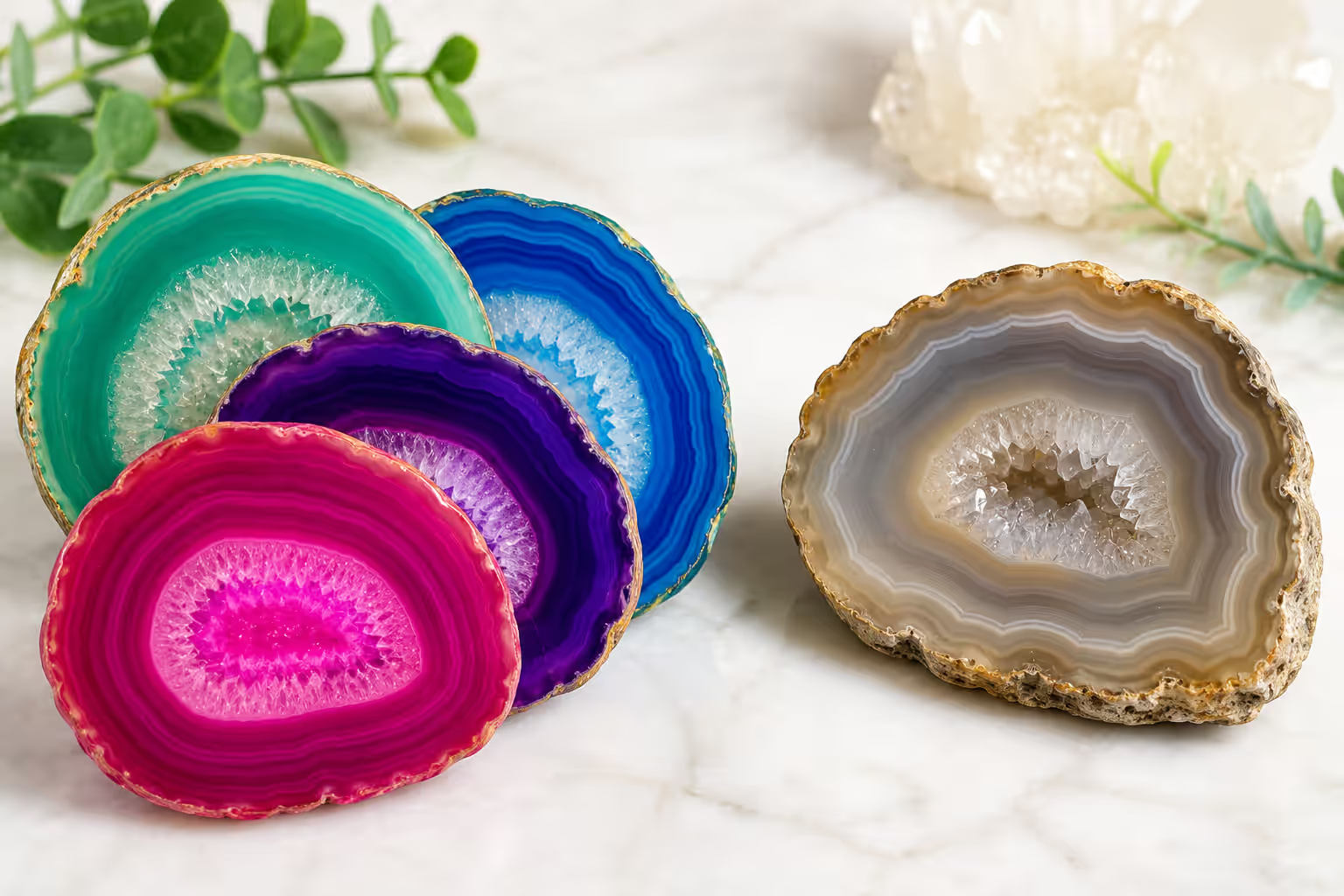
Agate is among the most frequently dyed gem materials. Its bands and microcrystalline texture allow manufacturers to produce intense blue, pink, purple, red, green, and black products.
Natural agate can already contain white, gray, brown, red, orange, yellow, blue, and other colors. The challenge is distinguishing natural distribution from introduced color.
Possible signs of dyed agate include:
- Strong color confined to porous bands
- Dye collecting between layers
- Saturation near the outer rind
- Artificially uniform neon hues
- Color inside drill holes
- Pale chips exposing the original material
- Several slabs with nearly identical artificial coloring
The family overview in Types of Agate explains natural patterns. The planned Real vs Fake Agate page owns agate-specific imitation and treatment comparisons, while How to Spot Treated or Synthetic Agate will cover the full treatment profile.
Dyed howlite and magnesite sold as turquoise
White howlite and magnesite are commonly dyed blue or green because their dark veining can resemble turquoise matrix.
Possible clues include:
- Blue color concentrated in veins or cracks
- White material inside a chip
- Low price for a large, uniformly colored piece
- Matrix that looks painted or overly regular
- Dye around drill holes
- A porous, chalky appearance
- Physical properties inconsistent with turquoise
Natural turquoise itself can also be dyed, impregnated, reconstructed, or imitated. Visual inspection is not always sufficient for valuable material.
The underlying white mineral is explained in Howlite: Meaning, Healing Properties & Uses. Turquoise-specific comparisons belong to Real vs Fake Turquoise and How to Spot Treated or Synthetic Turquoise.
Dyed and crackled quartz
Clear or pale quartz may be heated and rapidly cooled to create fractures. Dye enters the resulting network, producing bright internal veins.
The treatment can imitate:
- Emerald
- Ruby
- Sapphire
- Tourmaline
- Amethyst
- Citrine
- Multicolored fantasy gems
Under magnification, the color often remains almost entirely within the fracture network, while the unbroken quartz stays colorless.
Naturally included quartz can also contain colored minerals, coatings, iron staining, or fluids. Use the broader Quartz: Types, Properties & Meaning guide to understand the family, while How to Spot Treated or Synthetic Clear Quartz owns quartz-specific treatment detection.
Dyed rose quartz and pink imitations
Natural rose quartz normally shows soft pink color associated with microscopic inclusions or structural color mechanisms. The material is often cloudy or translucent rather than perfectly transparent and neon pink.
Possible dye indicators include:
- Color concentrated in cracks
- Saturated pink near the surface
- Pink residue
- A pale interior at chips
- Strongly colored transparent quartz with fracture networks
- Identical bright color across inexpensive batches
Real vs Fake Rose Quartz will compare dye, glass, synthetic materials, and natural rose quartz without duplicating the general dye workflow here.
Dyed jade, quartzite, and serpentine
Green dye may be used to improve jadeite, nephrite, quartzite, serpentine, and other materials.
In jadeite, dyed color may concentrate along grain boundaries or surface-reaching fractures. Some treatments combine dye with polymer impregnation, making identification more difficult.
A green cabochon sold as jade may instead be:
- Dyed jadeite
- Dyed quartzite
- Dyed serpentine
- Glass
- Polymer
- A reconstructed composite
- Another naturally green mineral
The dedicated Real vs Fake Jade page owns the distinction between jadeite, nephrite, treatments, and common substitutes.
Dyed lapis lazuli and sodalite
Low-grade lapis lazuli may receive dye to strengthen its blue color. Pale calcite areas, porous zones, cracks, and surface pits can absorb more color.
Sodalite and artificial materials may also be dyed or represented as lapis. Pyrite-like metallic particles can be added to reconstructed or artificial products.
Possible clues include:
- Blue residue
- Color concentrated around calcite
- Extremely even dark blue
- Dye inside fractures
- Artificial metallic glitter
- Weak mineral texture
- Pale material beneath scratches or chips
Because acids and solvents can damage lapis and its treatments, avoid home chemical testing.
Dyed pearls and organic gem materials
Pearls, coral, shell, and other organic materials can receive dye. These are not mineral crystals, but they commonly appear in gemstone and bead markets.
Dye may concentrate:
- Around drill holes
- Beneath surface blemishes
- Between nacre layers
- In cracks
- Near the string
- Along worn edges
Organic gems are chemically sensitive. Acetone, bleach, acids, heat, and ultrasonic cleaners may cause permanent damage.
Can you use acetone to test for dye?
A cotton swab with acetone is often recommended online. This test is unreliable and potentially damaging.
A positive color transfer may support the presence of an unstable surface dye. A negative result proves very little because:
- The dye may be colorfast.
- It may sit below the surface.
- A coating may prevent contact.
- The stone may have been sealed with resin or wax.
- The solvent may not dissolve the coloring agent.
- The tested area may not contain dye.
Acetone can also damage resin, adhesive, coatings, organic gems, filled stones, painted material, and jewelry finishes.
Do not use solvent tests on valuable, mounted, porous, organic, composite, or unknown material.
Does soaking reveal dye?
Water, alcohol, detergent, or other liquids may cause unstable dye to bleed. However, soaking can harm:
- Turquoise
- Opal
- Pearl
- Amber
- Selenite
- Calcite
- Filled gemstones
- Doublets and triplets
- Coated stones
- Dyed porous material
- Jewelry adhesive
A colorfast dye may not bleed at all. Therefore, soaking is neither safe nor conclusive.
UV fluorescence may expose uneven treatment
Under ultraviolet light, dyed areas may react differently from the host material. Resin, adhesive, filling, and surface coating may also fluoresce.
Possible observations include:
- Patchy fluorescence
- Bright lines along fractures
- Inert areas surrounded by reactive material
- Fluorescent adhesive
- An unexpected response for the claimed species
These reactions provide supporting evidence only. Natural minerals vary widely, and many dyes remain inert.
Spectroscopy and laboratory testing
A spectroscope or UV-visible instrument may reveal absorption associated with organic or inorganic coloring agents.
Laboratories may use:
- Microscopy
- FTIR spectroscopy
- Raman spectroscopy
- UV-visible spectroscopy
- X-ray fluorescence
- Chemical analysis
- Refractive index
- Specific gravity
- Fluorescence imaging
Testing becomes particularly important when the material is valuable, when dye is combined with impregnation, or when the visible color could plausibly be natural.
Gemstone Certification Labs Compared explains laboratory options, while How to Read a Gem Lab Report clarifies what the final document establishes.
Dye, coating, filling, and diffusion are different
A color that appears concentrated at the surface is not necessarily dye.
Dye
A coloring agent penetrates pores, fractures, or another receptive structure.
Coating
A thin colored layer sits on all or part of the surface.
Filling
Glass, resin, oil, wax, or another substance occupies fractures or cavities. The filler may also contain color.
Diffusion
Elements enter the gemstone under high heat and alter color near the surface or deeper within the stone.
These treatments can coexist. An object may be dyed and stabilized, fracture filled with colored glass, or coated after impregnation.
How dye affects care
The durability of dyed color depends on the dye, host material, penetration depth, sealing process, and exposure conditions.
Potential risks include:
- Fading in strong light
- Bleeding during cleaning
- Solvent damage
- Color loss during repolishing
- Abrasion of surface treatment
- Heat damage during repair
- Ultrasonic or steam-cleaning damage
- Uneven appearance after wear
A seller should provide special-care instructions whenever treatment affects normal use.
How sellers should disclose dyed material
A clear product description should identify both the material and the treatment.
Useful descriptions include:
- Dyed natural agate
- Blue-dyed howlite
- Dyed and stabilized turquoise
- Quench-crackled and dyed quartz
- Dyed cultured freshwater pearl
- Reconstructed and dyed lapis lazuli
Terms such as “color enhanced,” “natural stone,” or “genuine crystal” may be too vague when the color treatment materially affects value or care.
Buyer questions
Before purchasing a brightly colored stone, ask:
- Is the material natural, laboratory-grown, reconstructed, or artificial?
- Is the color natural?
- Has dye been used?
- Has the stone also been stabilized, filled, coated, or heated?
- Can the color fade or bleed?
- Which cleaners should be avoided?
- Do the photographs show the exact item?
- Is there a return and inspection period?
- Will the treatment appear on the invoice?
- Is a laboratory report available for a high-value item?
Use the broader transaction safeguards in How to Buy Gemstones Online Without Getting Scammed.
Practical dyed-crystal checklist
Before describing a crystal as naturally colored:
- Examine it in neutral lighting.
- Compare the hue with verified examples of the species.
- Use a 10× loupe.
- Look for color concentrated in fractures.
- Inspect drill holes and chipped edges.
- Check recessed and unpolished areas.
- Compare several pieces from the same batch.
- Watch for unnaturally uniform neon color.
- Identify whether the host is porous or fractured.
- Separate dye from coating, filling, and diffusion.
- Avoid solvent, flame, soaking, and uncontrolled scratch tests.
- Request written treatment disclosure.
- Review care instructions.
- Obtain laboratory testing when the price depends on natural color.
- Treat a negative home test as inconclusive.
Frequently Asked Questions
1. What is the easiest way to spot a dyed crystal?
Use a 10× loupe to look for color concentrated in surface-reaching fractures, drill holes, pits, grain boundaries, and chipped areas.
2. Does bright color always mean a crystal is dyed?
No. Some natural gemstones have vivid color. Brightness is a reason to investigate, not proof of treatment.
3. Can natural crystals have color in fractures?
Yes. Natural mineral staining and inclusions can follow fractures, which is why several observations or laboratory tests may be needed.
4. Is dyed agate real agate?
The underlying material can be natural agate even when its color was introduced. The treatment should be disclosed.
5. Is blue howlite turquoise?
No. Howlite is a different mineral that is often dyed blue to imitate turquoise.
6. Can dyed quartz be transparent?
Yes. Clear or pale quartz may be crackled and dyed, producing transparent areas crossed by brightly colored fractures.
7. Will dyed crystals always bleed in water?
No. Some dyes are stable or sealed below the surface. A lack of bleeding does not prove natural color.
8. Is acetone a safe dye test?
Not generally. It can damage resin, adhesive, coatings, organic gems, filled stones, and jewelry finishes, while a negative result remains inconclusive.
9. Can UV light reveal dye?
Sometimes. Dye, resin, or filling may fluoresce differently from the host, but reactions overlap and cannot confirm treatment alone.
10. Does dye reduce gemstone value?
It often places the stone in a different and usually lower-priced market than equivalent natural-color material. The effect depends on the species, quality, disclosure, and buyer demand.
11. Are dyed gemstones safe to wear?
Most properly manufactured dyed gems are wearable, but the seller should disclose care restrictions and any relevant material-safety concerns.
12. When should a dyed crystal be tested professionally?
Testing is advisable when natural color creates a significant premium, when several treatments may be present, or when the stone is intended for appraisal or resale.
Conclusion
The most useful dye clues are not unusual color by itself but the paths that color follows. Fractures, pores, drill holes, grain boundaries, recessed areas, and worn surfaces often reveal how coloring agents entered or coated the material.
A dyed crystal can still be attractive and consist of genuine natural stone. Honest identification depends on separating the host material from the source of its color—and ensuring that the buyer receives both pieces of information before purchase.