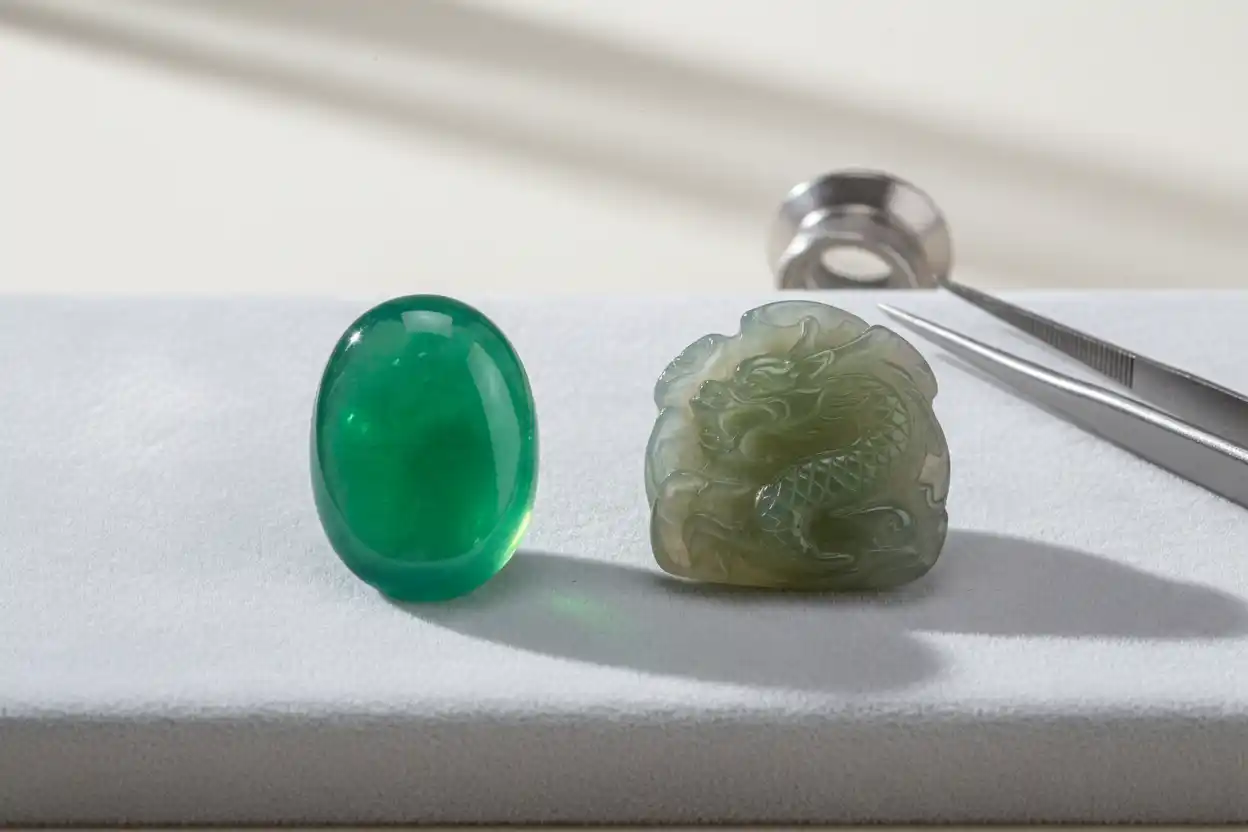
Jade vs Jadeite: Differences, Identification & Best Choice
The most important fact in a jade vs jadeite comparison is that jadeite is not a material separate from jade in the way sapphire is separate from emerald. Jade is an umbrella term. Modern gemology uses it principally for jadeite jade and nephrite jade, while certain green omphacite can also qualify as jade under defined conditions. Jadeite is therefore one specific type of jade. If a seller offers one object as “jade” and another as “jadeite,” the first description is incomplete rather than evidence that the objects belong to two mutually exclusive mineral categories. GIA explicitly defines jade as a generic term that includes jadeite, nephrite, and, under certain circumstances, green omphacite.
That terminology changes how the comparison should be approached. The useful question is not simply “Which is better, jade or jadeite?” but “What material does the generic jade object actually contain, and how does that identified material compare with confirmed jadeite?” If the generic jade proves to be nephrite, measurable differences in density, refractive index, mineral structure, hardness, texture, color range, treatment context, and market value become relevant. If it proves to be jadeite, then there is no mineralogical jade-versus-jadeite distinction at all; the comparison becomes one jadeite specimen versus another.
This page therefore owns the decision framework rather than duplicating full mineral references. Readers making other gemstone comparisons can browse the Identification category, while the narrower question of separating the two principal jade materials belongs in jadeite vs nephrite.
Jade vs Jadeite at a Glance
| Question | Jade | Jadeite |
|---|---|---|
| What is it? | An umbrella gem-material term | A specific pyroxene mineral and the principal component of jadeite jade |
| Can jade itself be jadeite? | Yes | Yes—jadeite jade is jade |
| Other materials included? | Nephrite and, under certain conditions, green omphacite | Jadeite specifically |
| One chemical formula? | No, because jade covers different materials | NaAlSi₂O₆ for ideal jadeite |
| One refractive index? | No | About 1.666–1.680 for jadeite jade |
| One specific gravity? | No | About 3.34 |
| Mohs hardness | Depends on jade type | About 6.5–7 |
| Typical appearance | Wide range because the term includes multiple materials | White, green, lavender, yellow, orange, brown, gray, black and related colors |
| Exceptional toughness? | Yes for the established jade materials | Yes |
| Treatment concerns | Depend on material | Bleaching/polymer impregnation, dyeing, waxing, coating and other enhancement require attention |
| Does “jade” mean nephrite? | Not automatically | No |
| Can appearance alone distinguish the terms? | No | No |
| Typical high-end market | Depends on material, quality and cultural market | Fine translucent green jadeite can reach exceptionally high values |
| Best first step | Determine what type of jade it is | Confirm jadeite identity and treatment status |
The table exposes the central problem with many online comparisons: the left-hand category contains the right-hand category. A seller who contrasts “jade” with “jadeite” without defining what “jade” means may actually be comparing nephrite with jadeite, natural jadeite with treated jadeite, or simply a generic product label with a precise mineralogical one.
Identity: Jade Is the Family Name, Jadeite Is a Member
GIA describes jadeite and nephrite as metamorphic materials composed of tightly interlocking microscopic crystals. Jadeite belongs to the pyroxene family, whereas nephrite consists primarily of tremolite-actinolite amphibole. Their structures help explain why both can be extraordinarily tough even though neither occupies the highest end of the Mohs hardness scale. Certain green omphacite materials can also fall within modern gemological use of the word jade, which makes generic labeling even less precise.
This means that “real jade” does not necessarily mean jadeite. Genuine nephrite is genuine jade. Conversely, “jadeite” is not a premium marketing synonym that should be applied to every valuable green jade object. The term identifies a particular mineralogical component. Color, transparency, treatment, workmanship, rarity, and provenance determine whether an individual jadeite object is ordinary or exceptional.
A useful analogy is a category nested inside a category. Asking whether jadeite is jade is straightforward: yes. Asking whether jade is jadeite cannot be answered without testing because the object might instead be nephrite or qualifying omphacite.
Identity Table: What the Terms Actually Commit You To
| Label | What the label supports | What remains unresolved |
|---|---|---|
| Jade | Material falls somewhere within accepted jade terminology if correctly identified | Whether it is jadeite, nephrite, or qualifying omphacite |
| Jadeite | Specific mineral identity | Whether the object is predominantly jadeite jade, its treatment status, quality, origin and value |
| Jadeite jade | Jade material dominated by jadeite or otherwise meeting accepted gemological jadeite-jade criteria | Quality, treatment and provenance still require evidence |
| Nephrite jade | Jade composed mainly of tightly interlocking tremolite-actinolite amphibole | Quality, origin and treatments remain separate questions |
| Green omphacite jade | Certain qualifying green omphacite material | Requires compositional testing because visual appearance can overlap jadeite |
| “Natural jade” | Potentially useful seller statement | Does not specify jade type or prove absence of treatments |
| “Grade A jade” | Ambiguous wording | May be confused with the treatment term A jade; does not automatically indicate top quality |
| A jade | In common jadeite terminology, untreated jadeite or material receiving only traditional waxing | Does not establish fine color, translucency or market value |
| B jade | Acid-bleached and polymer-impregnated jadeite | Still jadeite mineralogically, but materially treated |
| C jade | Dyed jadeite in the common classification | Does not indicate natural color |
GIA specifically defines the commonly used A/B/C system as a treatment classification for jadeite: A describes natural or traditionally wax-polished jadeite, B describes material bleached with acid and impregnated with polymer resin, and C refers to dyed material. Those letters should not be interpreted as a universal ranking from “excellent” to “poor.”
Optical Data: Why Testing Can Resolve an Ambiguous “Jade” Label
A generic jade object has no single refractive index or specific gravity because the term includes more than one mineralogical material. Jadeite and nephrite occupy different normal ranges, which means properly conducted gemological testing can often clarify what a seller’s vague jade label does not.
| Property | Jadeite jade | Nephrite jade | Practical significance |
|---|---|---|---|
| Refractive index | Approx. 1.666–1.680 | Approx. 1.606–1.632 | Distinct normal ranges can assist separation |
| Specific gravity | Approx. 3.34 | Approx. 2.95 | Jadeite is normally denser |
| Mohs hardness | Approx. 6.5–7 | Approx. 6–6.5 | Jadeite is somewhat more scratch resistant |
| Structure | Interlocking pyroxene grains | Fine interlocking amphibole fibers | Texture contributes to appearance and toughness |
| Toughness | Exceptional | Exceptional, with nephrite particularly renowned for toughness | Explains why both can survive demanding carving and wear |
| Birefringence | Usually not readily detectable in aggregate jade | Usually not readily detected as a simple faceted-stone reading | Aggregate structure limits simplistic optical testing |
GIA publishes the refractive-index, density and hardness values above and emphasizes that both jadeite and nephrite have exceptional toughness. The institute also notes that green omphacite can overlap jadeite so closely in ordinary gemological properties that Raman spectroscopy may be necessary for reliable separation.
The practical conclusion is that a single home observation is not enough when identity matters financially. A density estimate, refractive-index reading, microscopic texture and spectroscopic evidence can complement one another, but an ambiguous or high-value specimen should not be forced into an identification merely because one measurement seems convenient.
Visual Clues: Useful for Screening, Not Proof
Jadeite often offers a wider and potentially more vivid color range than nephrite. GIA documents jadeite in green, lavender, yellow, reddish orange, white, gray, black, brown and related shades, whereas nephrite commonly ranges through white, gray, brown, black, yellowish and muted light-to-dark greens. Fine jadeite can also develop a combination of strong color, translucency and fine texture that produces a distinctly luminous appearance.
Nephrite often shows a smoother, waxier or greasier visual impression and may exhibit a particularly homogeneous fibrous aggregate texture. Jadeite can appear more granular under magnification because its constituent pyroxene grains differ structurally from nephrite’s felted amphibole fibers. Yet these descriptions overlap in real material. Fine polishing, wax, lighting, surface condition, grain size, coatings and treatment can make visual separation difficult.
The safest visual conclusion is therefore probabilistic rather than absolute. A highly translucent vivid emerald-green cabochon may make jadeite more likely than typical nephrite, while a very tough, muted spinach-green material with a felted texture may suggest nephrite. Neither observation alone justifies replacing laboratory evidence when the transaction depends on identity.
The same evidence discipline applies in other visually deceptive gemstone comparisons. The iolite vs tanzanite comparison demonstrates why similar blue-violet appearance does not establish mineral identity, while kyanite vs sapphire shows why hardness and optical measurements can matter more than color resemblance.
Original Side-by-Side Observation Protocol
A reproducible visual comparison is more useful than comparing two unrelated seller photographs. If both pieces can be examined together, document them under the same conditions before drawing conclusions.
| Control | Recommended method | Why it matters |
|---|---|---|
| Lighting | One diffuse daylight-balanced source | Prevents different light temperatures from changing green, lavender or gray appearance |
| Background | Neutral matte gray | Reduces reflected color contamination |
| Scale | Same ruler or calibrated scale in every image | Prevents larger pieces from appearing more impressive simply because of framing |
| Camera | Same lens, exposure, white balance and distance | Makes transparency and saturation more comparable |
| Reflected-light view | Photograph both face-up | Records ordinary appearance |
| Transmitted-light view | Use the same backlight intensity where safe | Reveals differences in translucency and internal texture |
| Edge view | Photograph comparable edge thicknesses | Helps prevent thin material from appearing artificially more translucent |
| Magnification | Same magnification level | Allows texture and fissures to be compared |
| Surface state | Record wax, polish, coating or unknown status | Surface treatment can alter apparent luster |
| Color editing | None beyond global neutral correction | Prevents saturation changes from becoming false evidence |
| Documentation | Record weight, dimensions, seller description and laboratory report separately | Keeps visual observations from silently becoming identity claims |
The protocol does not identify jadeite by itself. Its purpose is to remove photographic variables so that visible differences become meaningful observations. If two specimens still look nearly identical after controlled photography, that is a reason to move toward instrumental testing rather than inventing stronger visual rules.
Treatments: Jadeite Needs Particular Attention
Treatment is one of the most commercially important differences between a generic jade label and a properly documented jadeite purchase. Jadeite can be acid bleached to remove undesirable coloration and then polymer impregnated because the bleaching process leaves open spaces and weakened areas that can be filled to improve appearance. Dyeing, waxing, coatings and other modifications are also encountered. GIA specifically documents bleaching followed by polymer impregnation as a common jadeite treatment process.
A seller describing an item simply as “natural jade” has therefore not answered enough questions. Which jade material is it? Has it been dyed? Is polymer present? Has surface wax been applied? Is the color natural? A laboratory report can materially reduce that uncertainty.
Color concentration can sometimes raise suspicions but should not be treated as proof. Dye may accumulate along fractures, grain boundaries or porous regions, while natural jade can itself have uneven color. The broader visual-warning framework in how to spot dyed crystals can help structure observations, but jade treatment identification can require infrared spectroscopy or other laboratory methods.
“A Jade” Does Not Mean “Best Jade”
This misunderstanding deserves separate treatment because it directly affects buying decisions. A jadeite object can qualify as A jade and still be pale, opaque, coarse textured, heavily fissured or aesthetically ordinary. A describes treatment status, not a universal quality grade. GIA’s own explanation distinguishes A, B and C by treatment rather than beauty or market rank.
Fine jadeite commands high value because several factors can coincide: desirable color, high translucency, fine texture, favorable size, good polish, appealing form, good condition and appropriate treatment status. GIA identifies color, transparency and texture as its dominant jadeite quality factors.
This is why “Grade A jadeite” on a product listing deserves careful reading. The seller may mean untreated A jade, or may simply be using “grade A” as an informal quality claim. Those are different statements.
Durability: Both Jadeite and Nephrite Are Exceptionally Tough
Jadeite has a modest hardness advantage, about 6.5–7 on the Mohs scale compared with roughly 6–6.5 for nephrite. That difference affects scratch resistance, but it does not tell the whole durability story. GIA describes both jade materials as exceptionally tough and highly resistant to breaking and chipping because their microscopic crystals interlock into cohesive aggregates.
Nephrite is particularly famous for toughness, which helps explain its ancient use for tools and weapons. Jadeite is also extraordinarily tough by gem standards. Consequently, a buyer should not assume that jadeite is automatically the better everyday material simply because its Mohs number is slightly higher.
Existing fractures, drilled holes, thin carving sections, repairs, polymer impregnation, mounting stress and workmanship can matter more than the small difference in hardness. A thick nephrite bangle can be mechanically more forgiving than a delicate jadeite carving even though the jadeite material is nominally harder.
Care: Identity Matters Less Than Treatment History
GIA recommends warm, soapy water as the consistently conservative cleaning method for jade. Untreated jade can tolerate more aggressive professional cleaning methods, but the possibility of dye, bleaching, impregnation, coatings or other treatment makes heat, steam, chemicals and ultrasonic cleaning less universally appropriate.
That makes treatment history more useful to care decisions than the generic label “jade.” A known untreated jadeite piece and an unknown treated jadeite piece should not automatically receive identical cleaning. Similarly, antique or repaired jade objects may contain adhesives, fillings or construction elements that create additional vulnerabilities.
This principle resembles the decision logic in labradorite vs moonstone: mineral identity matters, but practical ownership also depends on the specific condition and construction of the object in front of you.
Value: Jadeite Can Occupy the Highest End of the Jade Market
Fine jadeite is among the most valuable jade materials. GIA identifies the most prized jadeite as material combining desirable green color, strong translucency and fine texture, with exceptional green material traditionally described as Imperial jade. Size, craftsmanship, matching and the ability to carve forms such as hololith bangles can add further premiums.
That does not mean every jadeite is expensive or every nephrite inexpensive. Commercial jadeite can be opaque, grayish, coarse or heavily treated, while exceptional nephrite can have substantial cultural, artistic and collector value. Generic material labels are therefore poor substitutes for specimen-specific evaluation.
If a seller asks a major premium merely because the product title says “jadeite” while another item says “jade,” the buyer still needs to know what the generic jade actually is and whether the jadeite’s color, transparency, texture, treatment, size and documentation justify the price difference.
Original Decision Matrix: Jade or Jadeite?
Because jadeite is itself jade, the matrix below interprets “jade” as a generic or incompletely identified jade object rather than pretending the terms describe exclusive species.
| Your situation | Better decision | Why |
|---|---|---|
| Seller says only “jade” with no mineral identification | Do not choose based on the label alone | “Jade” does not tell you whether the material is jadeite, nephrite or qualifying omphacite |
| You specifically want jadeite mineralogy | Choose laboratory-confirmed jadeite | The material identity is explicit rather than inferred |
| You want vivid, highly translucent emerald-green material | Fine jadeite is the stronger starting point | This combination is characteristic of the highest jadeite market |
| You want traditional nephrite character | Generic “jade” is still too vague | Confirm nephrite specifically rather than assuming all non-jadeite jade is nephrite |
| You prioritize maximum toughness | Do not choose from the words jade/jadeite alone | Both main jade materials are exceptionally tough; form and condition matter |
| You prioritize scratch resistance | Jadeite has a modest advantage over nephrite | Jadeite is approximately 6.5–7 Mohs versus nephrite around 6–6.5 |
| You want untreated jadeite | Look for treatment evidence, not “Grade A” marketing | A/B/C terminology concerns jadeite treatment status |
| You are comparing high-value green pieces | Obtain appropriate laboratory documentation | Visual appearance cannot reliably resolve material and treatment in every case |
| You want lowest cost | Compare actual quality and treatment rather than material name | Commercial jadeite can be inexpensive, while exceptional nephrite can be costly |
| You are buying primarily for investment returns | Neither choice provides a guaranteed return | Gemstone resale value and liquidity cannot be promised |
| You are choosing an everyday wearable | Evaluate construction, fractures, thickness and treatment | Both jadeite and nephrite can be durable when appropriately made |
| Photographs look identical | Treat the comparison as unresolved | Controlled gemological or laboratory testing is stronger than visual guessing |
The matrix avoids the false conclusion that jadeite is always the “upgrade.” Sometimes the right decision is jadeite; sometimes nephrite better matches the desired appearance, heritage or object type; and sometimes the first task is simply to discover what the supposedly generic jade actually is.
Decision Case 1: One Seller Offers “Jade,” Another Offers “Jadeite”
Do not compare price until the generic jade has been identified more precisely. If it is nephrite, a real material comparison becomes possible. If it is jadeite, both products are jadeite and the relevant differences are quality, treatment, construction and price. If it is an imitation or a material carrying a misleading trade name, the comparison changes again.
The same logical mistake appears in many gemstone purchases: a broad visual or trade category is compared with a precise mineral identity as if the labels were equivalent. The verification approach used in how to spot fake crystals is useful here because a label should be treated as a claim until physical evidence supports it.
Decision Case 2: You Want the Brightest Fine Green Jade
Jadeite is usually the appropriate material to examine first. Fine jadeite can combine vivid saturated green with high translucency and fine texture, creating the luminous appearance associated with the upper jade market. GIA specifically identifies green as jadeite’s most valuable color and emphasizes transparency and texture alongside it.
Yet the word jadeite still does not guarantee fine green quality. Jadeite can be white, black, gray, lavender, yellow, orange or commercially modest green. A low-grade jadeite object does not become superior to fine nephrite merely because the mineral name sounds more prestigious.
Decision Case 3: You Want an Object for Frequent Wear
Both principal jade materials deserve consideration. Their interlocking structures provide exceptional toughness, which is one reason jade has a long history in objects subject to handling and wear. Jadeite has somewhat higher scratch resistance, whereas nephrite’s fibrous aggregate structure gives it a renowned reputation for toughness.
The object itself may matter more than the material distinction. A thick, well-made bangle without serious fractures is a different mechanical proposition from a thin openwork pendant or a ring containing vulnerable carved projections. Treatment, existing damage and repair history should be part of the decision.
Decision Case 4: You Are Worried About Treatments
Ask for material-specific disclosure. If the stone is jadeite, A/B/C terminology can be relevant, although the wording must be interpreted correctly. B jade indicates bleaching followed by polymer impregnation, while C relates to dyeing in the common classification.
Do not rely on color concentration, fluorescence, a phone flashlight, surface temperature or a viral home test as final proof. Some treated and untreated materials overlap visually, and advanced testing may be necessary. The logic is similar to lab diamond vs moissanite: reliable separation comes from properties and testing, not from how expensive or convincing an object looks.
Decision Case 5: Two Pieces Look Almost Identical
Matched lighting should be the first improvement. Examine them against the same background, at the same scale, with comparable thickness and the same transmitted-light geometry. Record rather than merely remember the differences. If one appears more translucent, determine whether the comparison is being distorted by thickness or backlighting.
If visual differences remain weak, move to physical data. Refractive-index and specific-gravity behavior can distinguish typical jadeite from typical nephrite, while some jadeite-versus-omphacite cases require Raman spectroscopy because ordinary properties overlap.
This evidence-first approach also underlies comparisons such as kunzite vs morganite, where visually similar colors do not remove the need for species-specific measurements.
Laboratory Testing: What It Can Establish
A professional jade report can identify the material and provide treatment information that cannot be established reliably from a seller photograph. GIA’s Jade Report includes jade type information when appropriate, and its reporting terminology can address material categories relevant to jadeite, omphacite and associated trade usage.
GIA also currently offers geographic-origin determination for eligible untreated jadeite jade and omphacite jade from Myanmar or Guatemala. That is a narrower service than simply identifying something as jade and should not be extrapolated to every nephrite or generic jade object.
When reviewing any certificate, concentrate on the exact result rather than the presence of the word “certificate.” The practical framework in how to read a gem lab report helps separate identity, treatment, origin and descriptive observations instead of assuming that one report statement proves them all.
Laboratory Limits: What Testing Does Not Decide
A laboratory can help determine whether the material is jadeite, nephrite, omphacite or another substance and can investigate important treatments. It cannot decide whether you personally prefer a translucent vivid-green jadeite cabochon to a creamy nephrite carving, whether a family heirloom has emotional value, or whether a retail asking price fits your budget.
Nor does an identification report automatically establish a universal quality grade or future resale value. Jadeite quality depends on multiple interacting factors, and market prices reflect scarcity, workmanship, fashion, culture, provenance and sales context in addition to mineral identity.
The same distinction between material identification and purchasing judgment appears in is my moldavite real: proving what a material is answers only one part of the commercial decision.
Common Jade vs Jadeite Misconceptions
The first misconception is that jade and jadeite are competing minerals. They are not; jadeite is one of the materials called jade. The second is that every non-jadeite jade is nephrite. Modern gemological usage can include certain green omphacite, so a generic jade label remains insufficient.
The third misconception is that jadeite is automatically higher quality. Mineral identity does not determine whether color, transparency, texture, condition or workmanship is fine. The fourth is that “A jade” means the finest grade. It primarily describes treatment status, not beauty. The fifth is that saturated green color proves jadeite. Other minerals, dyes, treatments and imitations can produce convincing green objects.
This broader problem—appearance being mistaken for identity—is why comparisons such as labradorite vs moonstone rely on optical behavior and mineral properties instead of one visual resemblance.
Safe Testing: What Not to Do
Do not scratch a polished jade object merely to decide whether it is jadeite. Jadeite and nephrite occupy overlapping enough hardness territory that destructive scratch testing provides poor discriminatory value while permanently damaging a real object. Do not heat it, burn it, soak it in aggressive chemicals, strike it to hear a supposed “jade sound,” or deliberately break an edge to inspect the interior.
Ordinary intact handling is different from lapidary processing. Cutting, drilling, grinding and sanding jade produce mineral dust and require appropriate professional dust-control practices. Chemical treatment testing should likewise be conducted through proper gemological methods rather than improvised exposure.
For online purchases, suspicion should lead to better evidence, not harsher home experiments.
A Practical Evidence Ladder
The lowest-confidence evidence is a seller’s product title. Above that come photographs taken under known lighting, measured dimensions, weight, documented provenance and treatment disclosure. Standard gemological measurements such as refractive index and specific gravity provide stronger material evidence when performed correctly. Microscopy can reveal aggregate texture and treatment clues. Spectroscopy and other laboratory methods can resolve cases that remain ambiguous.
A comparison becomes reliable when independent observations converge. A seller calling a translucent green object jadeite, an RI consistent with jadeite, a density consistent with jadeite, microscopy showing compatible aggregate texture and a reputable laboratory report all reinforce one another. A single green photograph does not.
The publication and evidence principles used for Gems Lore comparisons are described on the About page, while the site’s Disclaimer explains the limits of educational content relative to specimen-specific professional identification or valuation.
Questions about the interpretation of a Gems Lore comparison can be directed through Contact; readers considering submitting images or report details can review the Privacy Policy before including personal information.
Which Is Better: Jade or Jadeite?
The answer depends on what “jade” means in the comparison. If jade means an unidentified product carrying only the generic name, confirmed jadeite is the more informative choice because its material identity is known. If jade means nephrite, neither material is universally better: jadeite offers a somewhat higher hardness range and can achieve extraordinarily vivid translucent colors, while nephrite has its own exceptional toughness, distinctive texture, cultural significance and high-quality markets.
If the buyer wants vivid translucent green material associated with the highest end of the modern jadeite market, fine jadeite is usually the logical target. If the buyer wants nephrite specifically, especially for its characteristic texture, color, carving tradition or toughness, then purchasing jadeite simply because its market prestige can be higher would miss the buyer’s actual goal.
The technically correct conclusion is therefore simple: identify first, choose second. “Jade” is too broad a label to make a reliable side-by-side purchasing decision until the material behind the word is known.
Frequently Asked Questions
Is jade the same as jadeite?
Not exactly. Jade is the broader gem-material term, and jadeite is one type of jade. Nephrite and, under certain conditions, green omphacite can also be called jade.
Is all jadeite jade?
Yes. Jadeite used as jade material falls within jade terminology. The reverse is not true because not all jade is jadeite.
Is all jade that is not jadeite nephrite?
No. Although jadeite and nephrite are the two principal jade materials, modern gemological usage can include certain green omphacite. Some omphacite can require advanced Raman testing to distinguish it reliably from jadeite.
Which is harder, jade or jadeite?
“Jade” has no single hardness because it covers multiple materials. Jadeite is approximately Mohs 6.5–7, while nephrite is around 6–6.5. Both are exceptionally tough.
Is jadeite more valuable than jade?
The question compares a subtype with its broader category. Fine jadeite can occupy the highest end of the jade market, but some commercial jadeite is inexpensive and exceptional nephrite can be valuable. Value depends on the specific material and object.
Does bright green color prove jadeite?
No. Color alone cannot prove jadeite identity or natural color. Treatments, other minerals and imitations can produce convincing green appearances.
What does A jade mean?
A jade generally refers to jadeite that is natural or has received only traditional wax polishing. It describes treatment status rather than guaranteeing top visual quality.
What does B jade mean?
B jade is jadeite that has been acid bleached and subsequently impregnated with polymer resin. The treatment should be disclosed because it affects commercial interpretation and can influence care requirements.
Can I tell jadeite from other jade by touch?
Temperature, smoothness, weight in the hand and surface feel may provide impressions, but none is a reliable stand-alone identification method. Measurable gemological properties provide stronger evidence.
Is jadeite heavier than nephrite?
Typical jadeite has a higher specific gravity, approximately 3.34 compared with about 2.95 for nephrite. Proper density measurement on a suitable object can therefore contribute to identification.
Is jadeite tougher than nephrite?
Both are exceptionally tough, but nephrite is particularly renowned for fracture toughness. Jadeite has somewhat greater scratch hardness. The better material for a specific object still depends on construction, thickness, existing damage and treatment.
Can jadeite be dyed?
Yes. Dyeing occurs, and jadeite can also be bleached and polymer impregnated. Visual inspection may detect suspicious color distribution in some cases, but laboratory testing can be required.
Is a certificate enough to prove valuable jadeite?
A reputable laboratory report can provide important evidence about identity and treatment and, for eligible material, certain origin conclusions. It does not guarantee that the stone has fine color, transparency, texture, workmanship, market value or future resale performance.
Should I buy “jade” or jadeite online?
Do not make the decision from those two labels alone. Ask what mineralogical material the generic jade is, what treatments are disclosed, whether laboratory evidence is appropriate, and whether the object’s color, transparency, texture, construction, condition and price suit your purpose.
When is laboratory testing necessary?
Laboratory testing is most valuable when identity or treatment affects a significant purchase, when a seller charges a jadeite or origin premium, when the stone’s appearance is ambiguous, when ordinary gemological tests conflict, or when a report is central to the transaction. For low-value decorative material, the cost of testing may exceed the practical benefit.