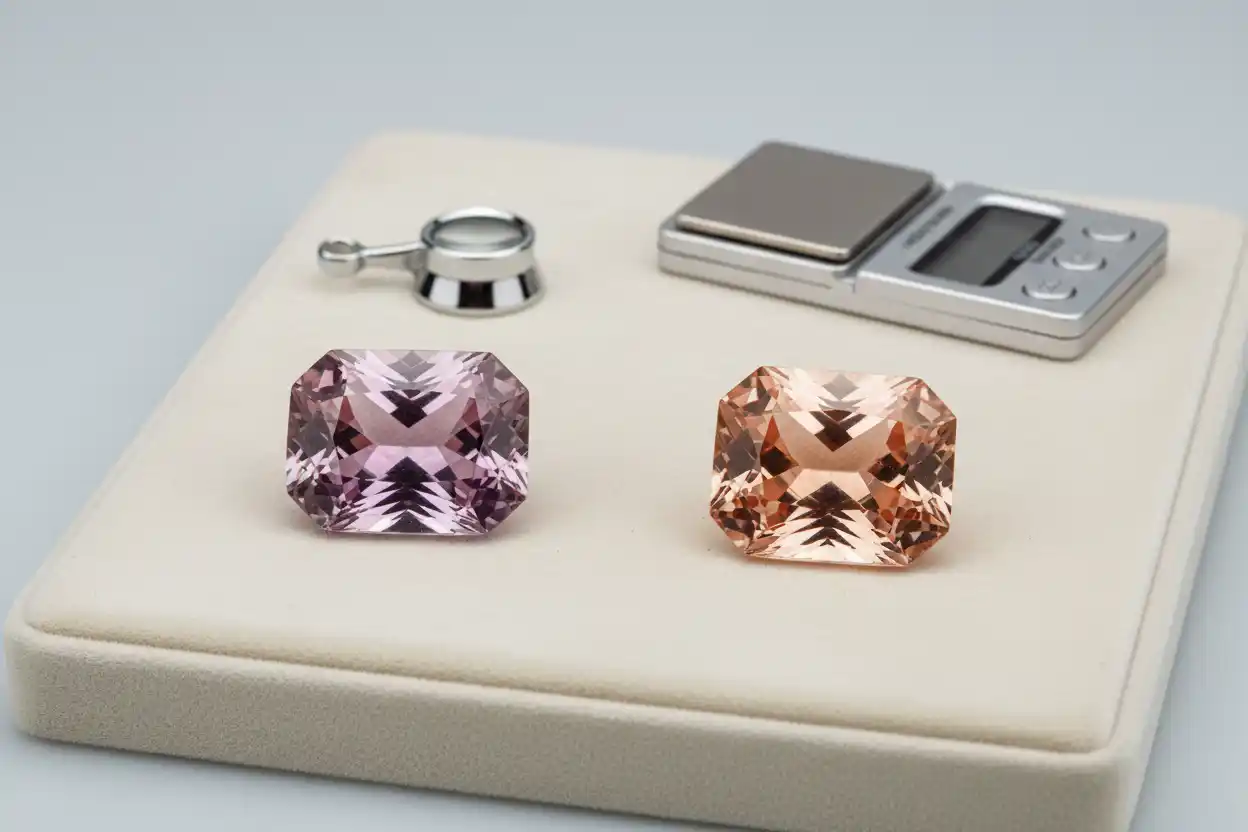
Kunzite vs Morganite: Key Differences & How to Choose
Kunzite and morganite can occupy almost the same pastel-pink visual territory, but they are fundamentally different gemstones. Kunzite is the pink-to-violet variety of spodumene, a lithium-aluminum silicate with the formula LiAlSi₂O₆. Morganite is the pink-to-orange-pink variety of beryl, whose formula is Be₃Al₂Si₆O₁₈. Their different crystal structures produce measurable differences in refractive index, density, hardness, cleavage, birefringence, color behavior, treatment context and practical durability. GIA lists kunzite at approximately RI 1.660–1.676, specific gravity 3.18 and Mohs 6.5–7, while morganite is approximately RI 1.583–1.590, SG 2.80–2.91 and Mohs 7.5–8.
The most important ownership difference is mechanical. Kunzite has two perfect cleavage directions and GIA rates its toughness as poor; a sharp impact, mounting pressure or abrupt temperature change can split it along those planes. Morganite is harder and is generally more forgiving for jewelry exposed to regular wear, although it can still scratch, fracture or chip like any gemstone. GIA specifically advises protective settings and lower-impact jewelry for valuable kunzite, whereas its morganite guidance considers the beryl suitable for most everyday activities when ordinary precautions are followed.
Color stability creates another major distinction. Kunzite can fade with prolonged intense light or heat whether the color is natural or enhanced. Morganite is routinely heat treated to reduce yellow or orange components and produce a purer pink; GIA describes that resulting color as stable and notes that the treatment is ordinarily not detectable.
Neither stone is therefore universally “better.” Kunzite is compelling when violet-pink color, conspicuous pleochroism, large transparent stones and collector character matter more than ruggedness. Morganite is usually the more practical option when higher hardness, better regular-wear suitability and stable pastel color are priorities. The comparison framework below separates these choices using observable properties rather than relying on photographs or marketing descriptions. Similar evidence-first comparisons are grouped under Identification.
Kunzite vs Morganite at a Glance
| Property | Kunzite | Morganite |
|---|---|---|
| Mineral species | Spodumene | Beryl |
| Formula | LiAlSi₂O₆ | Be₃Al₂Si₆O₁₈ |
| Crystal system | Monoclinic | Hexagonal |
| Typical color | Pink to violetish purple | Pink, rose, peach, salmon, orangy pink |
| Important color element | Manganese | Manganese |
| Refractive index | 1.660–1.676 | 1.583–1.590 |
| Birefringence | 0.014–0.016 | 0.007–0.008 |
| Specific gravity | About 3.18 | 2.80–2.91 |
| Mohs hardness | 6.5–7 | 7.5–8 |
| Major mechanical weakness | Two perfect cleavage directions | No comparable two-direction perfect-cleavage problem |
| Pleochroism | Often strong | Distinct but generally less dramatic |
| Large sizes | Common | Also common |
| Eye-clean stones | Common | Common |
| Color treatment | Irradiation followed by heat may be used | Heat treatment is routine |
| Color stability | Can fade with prolonged intense light or heat | Heat-treated pink color is considered stable |
| Everyday ring suitability | Requires greater protection | Generally the more practical choice |
| Conservative cleaning | Warm soapy water | Warm soapy water |
| Best reason to choose | Violet-pink character and strong directional color | Better durability and stable pastel pink |
The numerical differences are large enough to matter in gemological testing. A refractive-index reading around 1.67 is consistent with kunzite but far outside morganite’s normal range, while a reading around 1.585 strongly supports morganite over kunzite. Density differs substantially as well, with an equivalent volume of kunzite normally weighing more than morganite.
Identity: Spodumene Versus Beryl
Kunzite is spodumene. Its lithium-aluminum silicate chemistry places it in the pyroxene group, although its crystal habit can include long flattened or bladed crystals rather than the compact appearance many people imagine when they hear pyroxene. Pink-to-violet coloration defines the kunzite variety, while other spodumene colors receive different descriptive names. GIA identifies manganese as the trace element responsible for kunzite’s characteristic pink-violet appearance.
Morganite belongs to beryl, the same mineral species that also includes emerald and aquamarine. Its beryl framework contains beryllium, aluminum and silica, while trace manganese produces its pink-to-orange-pink color range. GIA describes morganite as pink, rose, peach, salmon, purplish pink or orangy pink and notes that strong color is considerably less common than the pastel tones normally encountered.
That species difference matters more than color resemblance. The same principle underlies Lapis Lazuli vs Sodalite: two stones can share a dominant visual color while differing fundamentally in composition and physical behavior.
Side-by-Side Identity Table
| Identification question | Kunzite | Morganite | Diagnostic strength |
|---|---|---|---|
| Spodumene species? | Yes | No | Strong |
| Beryl species? | No | Yes | Strong |
| Lithium-bearing structure? | Yes | No | Strong |
| Beryllium-bearing beryl structure? | No | Yes | Strong |
| Monoclinic? | Yes | No | Strong |
| Hexagonal? | No | Yes | Strong |
| RI around 1.67? | Expected | Too high | Strong |
| RI around 1.585? | Too low | Expected | Strong |
| SG near 3.18? | Expected | Usually too high for morganite | Strong |
| SG around 2.8–2.9? | Too low | Expected | Strong |
| Strong trichroic appearance? | Common | Less dramatic | Supporting |
| Pink alone? | Possible | Possible | Very weak |
| Large eye-clean gem? | Common | Common | Not diagnostic |
The lesson is straightforward: visual similarity does not create identification certainty. This is also why comparisons such as Jade vs Jadeite rely on material definitions and measurements rather than commercial naming alone.
Visual Clues: Violet-Pink Versus Peach-Pink Is Useful, but Not Proof
Kunzite commonly trends toward pink, lilac and violetish purple. The violet component can become conspicuous in stronger stones, particularly when the gem is oriented to show the richest pleochroic direction. GIA notes that the best kunzite color is generally visible looking down the length of the rough crystal, making orientation a major cutting consideration.
Morganite more often occupies pink, rose, salmon and peach territory. Untreated material can carry obvious yellow-orange or salmon components, while routine heat treatment reduces those warmer components and leaves a purer pink. Strong saturated morganite exists but is uncommon, and larger stones often display color more effectively because additional optical path length strengthens a normally light-toned body color.
These trends are helpful when comparing two stones side by side. A conspicuously violet-pink stone showing major color change during rotation is more suggestive of kunzite, while a stable-looking pastel peach or rose stone may suggest morganite. Neither observation is diagnostic. Lighting, cut, treatment, white balance and stone thickness can shift both gems into overlapping pink ranges.
The same visual limitation appears in Larimar vs Turquoise, where apparent color can guide the first observation but cannot substitute for actual material properties.
Original Same-Lighting Comparison Protocol
A fair kunzite vs morganite comparison should remove photographic variables before anyone tries to interpret color. The following protocol can be repeated by a jeweler, collector or buyer examining loose stones.
| Control | Method | What to record |
|---|---|---|
| Background | Neutral matte gray | Prevents pink color cast from skin, wood or fabric |
| Light | One diffuse daylight-balanced source | Keeps color temperature identical |
| Stone scale | Similar face-up dimensions where possible | Prevents large stones from appearing stronger simply because they occupy more image area |
| Camera | Same exposure, white balance and distance | Removes most photographic differences |
| Face-up image | Photograph both stones side by side | Records ordinary viewing color |
| Rotation | Rotate each stone through several orientations | Reveals pleochroism |
| Side profile | Photograph depth and pavilion | Shows hidden weight and color-enhancing depth |
| Transmitted light | Use identical backlight only if useful | Helps compare zoning and transparency |
| Neutral video | Rotate both under the same lamp | Often reveals kunzite pleochroism better than still images |
| Editing | No selective hue or saturation adjustment | Prevents one stone receiving stronger digital color |
The result should be treated as visual evidence, not species confirmation. If two stones remain visually ambiguous under controlled conditions, refractive index and other gemological tests should take priority.
The same principle is useful in Labradorite vs Moonstone, where lighting geometry can dramatically change what a gemstone appears to display.
Optical Data: The Cleanest Routine Separation
Refractive index is one of the most useful routine tests because the two ranges are comfortably separated. Kunzite is approximately 1.660–1.676, while morganite is approximately 1.583–1.590. Their birefringence is also different: kunzite is roughly 0.014–0.016 compared with about 0.007–0.008 for morganite.
A properly obtained refractometer reading therefore does far more than comparing pink saturation. If a polished stone gives values around the upper 1.66 range and shows the expected birefringence, morganite becomes highly unlikely. Conversely, readings near 1.58–1.59 strongly support beryl and exclude normal kunzite.
Specific gravity provides another independent separation. Kunzite’s typical SG is near 3.18; morganite lies around 2.80–2.91. A correctly performed hydrostatic measurement can therefore add useful confirmation, although mounted jewelry, attached components and cavities can make density testing unsuitable.
This measurement-first logic also drives Iolite vs Tanzanite: directional color can be informative, but optical constants are much harder for a look-alike to imitate accidentally.
Pleochroism: Kunzite Usually Makes the Stronger Show
Kunzite’s pleochroism is one of its signature traits. Rotation can reveal substantial differences in pink, violet, pale or nearly colorless appearance, and GIA describes the strongest color as visible along the length of the original crystal.
Morganite also displays pleochroism, typically between paler pink and deeper bluish pink. Cutters orient morganite carefully for this reason, but the phenomenon is usually less dramatic to the casual observer than it can be in strongly colored kunzite.
This gives kunzite a more visibly changeable personality under rotation. That can be a major aesthetic advantage for someone who enjoys optical character, but it can also create an online-shopping problem because the seller can choose whichever orientation produces the strongest color.
Hardness: Morganite Has the Clear Advantage
Morganite has a Mohs hardness of approximately 7.5–8, compared with 6.5–7 for kunzite. The difference means morganite normally resists scratching better during ordinary wear.
That does not make morganite immune to abrasion. Diamond, corundum and other harder materials can scratch it, and household environments can still damage a poorly protected gem. Yet when the two stones are being compared specifically for frequent jewelry wear, morganite begins with the stronger surface-durability profile.
Hardness alone, however, understates the much larger difference created by cleavage.
Cleavage and Toughness: The Most Important Wear Difference
Kunzite has two perfect cleavage directions. A force applied at the wrong angle can split the crystal, and GIA describes its toughness as poor. Cutting, polishing and setting all require unusual care because pressure that would be routine for another gem can exploit a cleavage plane.
Morganite does not carry the same two-direction perfect-cleavage problem. GIA describes morganite as suitable for most ordinary activities when basic gemstone precautions are observed, although strenuous activities should still be avoided while wearing it.
This distinction should dominate any engagement-ring or everyday-ring decision. If two equally attractive stones are being considered for a piece that will regularly hit desks, doorframes, gym equipment or household surfaces, morganite is generally the more forgiving choice.
The importance of combining hardness with fracture behavior is also apparent in Kyanite vs Sapphire, where similar colors hide a dramatic difference in practical durability.
Original Durability Comparison Matrix
| Wear situation | Kunzite | Morganite | Better default choice |
|---|---|---|---|
| Occasional pendant | Very suitable with sensible care | Very suitable | Either |
| Earrings | Good because impact exposure is low | Excellent | Either |
| Brooch | Good | Excellent | Either |
| Occasional dress ring | Possible with protective setting | Very suitable | Morganite |
| Daily ring | Higher cleavage and impact risk | More practical | Morganite |
| Engagement ring | Requires careful design and expectations | Commonly workable | Morganite |
| Bracelet | Higher risk from repeated impacts | Better, though still exposed | Morganite |
| Loose collector gem | Excellent | Excellent | Preference |
| Strong-light display | Fading concern | Much less concern after routine heat treatment | Morganite |
| Frequent resizing/repair environment | Heat and pressure demand caution | Still requires professional care | Morganite |
The matrix is a practical ownership tool rather than a guarantee. A poorly designed morganite ring can still fail, while a carefully protected kunzite pendant can remain attractive for decades.
Treatment: The Two Gems Have Very Different Commercial Contexts
Morganite is routinely heat treated. GIA explains that heating reduces yellow or orange components, converting peachier material toward a purer pink, and says the resulting color is stable. The treatment is also generally not detectable, which means buyers should not assume that an apparently untreated pink stone can be proven untreated through routine observation.
Kunzite can be irradiated and then heated to enhance its color. Unlike heat-treated morganite, enhanced kunzite can still fade with prolonged exposure to heat and light, just as naturally colored kunzite can.
This produces an interesting buying tradeoff. A buyer who dislikes routine treatment may find morganite’s market frustrating because heat treatment is widespread and can be undetectable. A buyer more concerned with long-term color stability may nevertheless prefer morganite because its treated pink is stable, whereas kunzite needs ongoing protection from intense light.
Can You Tell Treatment From Color?
Not reliably. A very pure pink morganite may have been heated, but its appearance does not establish the treatment history. GIA explicitly says routine heat treatment can be undetectable.
Likewise, vivid kunzite does not prove irradiation, and pale kunzite does not prove untreated status. Natural color varies widely, pleochroism changes visible saturation, and fading can alter an older stone.
This is one reason visual authenticity shortcuts should be treated cautiously. The broader screening principles in How to Spot Fake Crystals are useful for recognizing suspicious claims, but treatment determination for an individual gem may require specialist testing and honest disclosure rather than a home trick.
Care: Warm Soapy Water Is the Common Safe Denominator
For kunzite, GIA recommends warm, soapy water and advises against steam or ultrasonic cleaning because cleavage, pressure, heat and sudden temperature changes create unnecessary risk. Prolonged intense light should also be limited because color fading is possible.
For morganite, warm soapy water is likewise a conservative choice. GIA notes that steam and ultrasonics are often acceptable for sound material, but fractures, liquid inclusions or rare fracture filling can change that recommendation.
If one universal home-care method must be chosen for both gems, mild soap, lukewarm water and careful handling are simpler than trying to exploit the greater cleaning tolerance of morganite.
Size: Both Can Be Large
Neither kunzite nor morganite is a gemstone where ten or twenty carats automatically signals extraordinary rarity. Kunzite can form exceptionally large crystals and large faceted stones are well documented. Morganite crystals also grow large, and GIA notes that faceted examples can exceed very substantial weights.
This matters because size alone should not decide between them. A large pale gem can be less visually compelling than a smaller stone with stronger color and better cutting.
The shared availability of large rough also means that buyers should pay close attention to face-up dimensions. A deep stone can carry a surprising amount of hidden weight beneath the setting without looking much larger from above.
Clarity: Eye-Clean Material Is Common in Both
GIA notes that kunzite is commonly very clean, so inclusions that noticeably reduce transparency can hurt value. Morganite is similar: most faceted stones generally lack eye-visible inclusions.
That makes clarity a weaker discriminator between the species than consumers sometimes expect. A clean pink stone is not especially diagnostic for either one.
Inclusions become more useful when examined microscopically because growth tubes, fluid inclusions, multiphase inclusions, cleavage and other structures can help support an identification. They should still be interpreted together with optical measurements rather than being treated as one universal authenticity marker.
Value: Which Is Usually More Expensive?
There is no permanent rule that kunzite or morganite must always cost more. Both occur in large sizes, both commonly produce clean faceted stones, and both can range from pale commercial material to strongly colored stones carrying substantial premiums. Color and cut therefore matter more than species name alone in many retail comparisons.
Kunzite’s strongest violet-pink colors can be highly attractive, while very pale material is often accessible despite large carat weight. Morganite likewise becomes more valuable as pink color strengthens; GIA identifies strong pink as top-quality color and notes that larger stones are more likely to show attractive saturation.
Morganite can command additional jewelry demand because it is a practical pink center-stone option and belongs to the beryl family, while kunzite can appeal strongly to collectors because of its pleochroism and dramatic crystal habit. Retail brand, setting, treatment representation and sales channel can therefore outweigh a simple species-based price hierarchy.
A seller claiming that one is categorically “more valuable” should be asked to define the comparison: same dimensions, color, cut, transparency, treatment representation and transaction context—or merely two unrelated listings?
Original Decision Matrix: Kunzite or Morganite?
| Your priority | Better starting choice | Why |
|---|---|---|
| Violet-pink color | Kunzite | Violetish-purple tones are central to its identity |
| Peach or salmon pink | Morganite | Its normal range includes peach and salmon |
| Strong visible pleochroism | Kunzite | Directional color can be striking |
| Higher scratch resistance | Morganite | Mohs 7.5–8 versus 6.5–7 |
| Better daily-ring durability | Morganite | Avoids kunzite’s two perfect cleavage directions |
| Occasional pendant or earrings | Either | Both can work well with appropriate care |
| Long-term bright display | Morganite | Kunzite carries a documented fading concern |
| Stable routine heat-treated color | Morganite | Heat-treated pink is considered stable |
| Collector crystal character | Kunzite | Large bladed spodumene crystals can be visually dramatic |
| Pastel rose center stone | Morganite | Strong commercial fit and greater everyday practicality |
| Maximum size for visual impact | Either | Both occur in large sizes |
| High-confidence visual identification from photos | Neither | Physical testing is stronger |
| Guaranteed investment appreciation | Neither | No gemstone return should be guaranteed |
The best choice is therefore use-specific. The decision matrix deliberately avoids naming one universal winner.
Decision Case 1: An Everyday Engagement Ring
Morganite is the more practical default. Its higher hardness improves scratch resistance, while the absence of kunzite’s two perfect cleavage directions reduces the risk of catastrophic splitting from a sharp impact. GIA’s jewelry guidance treats morganite as suitable for most ordinary wear with normal caution.
Kunzite can still be used in a ring, but the setting should protect the girdle and corners, and the wearer needs realistic expectations about impact, repair, heat and strong-light exposure.
For a buyer who does not want to think about cleavage each time the ring is worn, morganite is the simpler choice.
Decision Case 2: A Large Statement Pendant
The comparison becomes much closer. Pendants receive less impact than rings, so kunzite’s cleavage is less restrictive. Its strong violet-pink pleochroism can become a major visual advantage, especially in a large transparent stone.
Morganite can offer softer rose, peach or salmon colors and greater long-term light stability. If the pendant will be worn primarily indoors and stored away from strong sunlight, kunzite may be especially appealing. If it will be displayed frequently in bright environments, morganite requires less color-stability management.
Decision Case 3: You Prefer Peach Rather Than Purple
Choose morganite. Peach, salmon and orangy-pink are established parts of morganite’s natural color range, whereas kunzite is principally associated with pink through violetish purple.
A peach morganite may also be untreated, although appearance cannot prove that. Some collectors specifically value attractive untreated peach material, while routine heating converts warmer morganite toward purer pink.
Decision Case 4: You Want the Most Interesting Directional Color
Kunzite generally provides the stronger experience. Its pleochroism can be conspicuous enough that a gem visibly shifts in color intensity while being turned. Morganite also shows pleochroism, but the effect is normally more restrained.
A buyer considering kunzite for this reason should ask for rotation video under one fixed light rather than relying exclusively on a face-up still photograph.
Decision Case 5: The Two Stones Look Identical Online
Treat the photographs as unresolved evidence. Request dimensions, depth, weight, neutral-light images and rotation video. If the stones are loose and identification materially affects the purchase, refractive index provides a straightforward route because their normal ranges are widely separated.
Do not use color saturation, perceived “sparkle,” skin temperature or vague descriptions such as “cooler pink” as species-level proof. Similar identification discipline is necessary in Jadeite vs Nephrite, where related-looking materials still require measurable separation.
Decision Case 6: You Want the Easier Stone to Own
Morganite usually wins. Its higher hardness, better routine-wear profile and stable heat-treated color reduce the number of special precautions.
Kunzite asks more of its owner: avoid sharp blows, setting pressure, sudden heat and unnecessarily intense prolonged light. Those limitations do not make it a poor gemstone; they simply mean its beauty comes with a different ownership profile.
Visual Identification Limits
Pink gemstones occupy one of the most crowded color families in gemology. Tourmaline, sapphire, spinel, topaz, rose quartz, synthetic materials, glass and several other gems can overlap with portions of the kunzite-morganite range.
A buyer should therefore resist “I know it when I see it” identification. Even dramatic pleochroism can only support a hypothesis until measurements agree.
The reasoning is comparable to Lab Diamond vs Moissanite: appearance can become extremely convincing while underlying physical properties remain decisively different.
Laboratory Testing: What Separates Them Reliably
Routine gemological tests can usually distinguish kunzite from morganite without unusual analytical complexity. Refractive index and density are particularly useful because their normal ranges are well separated. Optical character and birefringence provide additional confirmation.
Microscopy can then assess natural inclusions, fractures, cleavage, filling or unusual surface features. If ordinary observations conflict, Raman spectroscopy or other laboratory methods can provide species-level confirmation.
The correct conclusion is sometimes “visually consistent with kunzite” or “visually consistent with morganite” rather than an unsupported definitive identification. A similar evidence hierarchy is useful when asking Is My Moldavite Real?: a photograph can narrow possibilities, but laboratory-level certainty requires stronger evidence.
What Laboratory Testing Cannot Decide
A laboratory can identify a gemstone and investigate detectable treatment where the available methodology permits it. It cannot decide whether violet-pink is more beautiful to you than peach-pink, whether you prefer the cultural appeal of beryl, or whether maintaining kunzite’s light exposure feels inconvenient.
It also cannot guarantee future resale value or eliminate all ownership risk. Material identity is one component of a buying decision rather than the entire decision.
Are Either of These Good for Everyday Jewelry?
Morganite is generally better suited. Its Mohs 7.5–8 hardness provides stronger scratch resistance and GIA’s everyday-wear guidance is comparatively favorable.
Kunzite works better when the jewelry format reduces impact—pendants, earrings, brooches and carefully worn rings. The stone should also be protected from prolonged intense light if preserving color is important.
Neither stone should be treated as indestructible.
Cleaning Comparison
| Cleaning method | Kunzite | Morganite |
|---|---|---|
| Mild soap + lukewarm water | Recommended | Recommended |
| Soft brush | Use gently | Generally appropriate when stone is sound |
| Ultrasonic | Avoid | Often acceptable if unfractured and untreated appropriately |
| Steam | Avoid | Often acceptable for suitable sound material |
| Sudden temperature change | Avoid | Sensible to avoid |
| Strong acids/harsh chemicals | Avoid | Avoid |
| Extended intense light | Avoid because of fading | Much less problematic for stable pink color |
Warm soapy water is the simplest method that safely serves both materials.
Is One More Likely to Be Fake?
Neither species is inherently “more fake,” but popular pink gems can be imitated, misidentified or marketed with unclear treatment statements. Glass, synthetic materials and other natural pink gemstones can all enter the comparison depending on the seller and product.
An unusually low price by itself does not prove imitation because both kunzite and morganite can occur in substantial sizes. Instead, compare the seller’s material claim with physical evidence, return terms and documentation.
The broader warning applies to comparisons such as Lapis Lazuli vs Sodalite as well: an attractive trade label should never outrank mineral identity.
Value and Resale Expectations
Neither kunzite nor morganite should be purchased with a guaranteed-return narrative. Both can be beautiful collector or jewelry gems, but retail asking prices incorporate seller overhead, cutting, setting, inventory and branding. Resale can occur through an entirely different market with different margins.
Fine color, attractive cutting, transparency, size and documentation can improve desirability, but those factors do not create guaranteed liquidity.
The correct buying question is whether the actual stone justifies its price for your intended use, not whether a pink gemstone category is certain to appreciate.
Which Has the More Important Treatment Concern?
The answer depends on what concern you mean.
If treatment disclosure itself is the concern, morganite deserves attention because heat treatment is routine and may not be detectable.
If long-term color stability is the concern, kunzite deserves greater attention because natural and enhanced material can fade under prolonged intense light or heat.
These are different issues. “Untreated” and “stable” are not synonyms.
Choosing by Color Rather Than Gem Name
If your priority is an intense violetish pink, begin with kunzite. If you want peach, salmon, rose or warm pastel pink, begin with morganite. If you simply want “pink,” compare individual stones because both species can overlap strongly.
The most useful comparison is made under identical neutral lighting and similar face-up dimensions. Retail photographs taken under different conditions are poor evidence for subtle hue distinctions.
Other visually close gem pairs, such as Larimar vs Turquoise, demonstrate why same-lighting comparison is much more informative than putting unrelated seller photos next to each other.
Evidence and Site Context
Material comparisons on Gems Lore distinguish physical evidence from seller descriptions and personal preferences; the publication’s wider editorial scope is described on About, while educational and professional-advice limits are set out in the Disclaimer. General website communication is available through Contact, and website data handling is described in the Privacy Policy.
Which Should You Choose?
Choose kunzite when its violet-pink appearance, stronger pleochroism and distinctive spodumene character are the main attraction and you are comfortable providing extra protection from impact, setting pressure and intense prolonged light. It is especially compelling in earrings, pendants, collector gems and carefully worn jewelry where its cleavage is less exposed.
Choose morganite when you want pink, peach or rose color in a gemstone that is harder and generally more practical for regular jewelry wear. Its routine heat treatment should be understood, but its treated color is considered stable, and the gem is normally easier to own than kunzite from a durability perspective.
If the stones are being considered strictly as loose collector gems, neither wins automatically. Compare the actual hue, saturation, transparency, cutting, size, treatment representation, price and optical character. The best choice is the stone whose documented properties match your purpose.
Frequently Asked Questions
Is kunzite the same as morganite?
No. Kunzite is pink-to-violet spodumene, LiAlSi₂O₆. Morganite is pink-to-orange-pink beryl, Be₃Al₂Si₆O₁₈.
Which is harder, kunzite or morganite?
Morganite. It is approximately Mohs 7.5–8, while kunzite is about 6.5–7.
Which is tougher?
Morganite is generally the more forgiving jewelry material. Kunzite has two perfect cleavage directions and poor toughness, making it more vulnerable to splitting from sharp impacts or pressure.
Which is better for an engagement ring?
Morganite is normally the better default because of its greater hardness and more practical everyday-wear profile. Kunzite can be used in a protective setting but requires more careful ownership.
Which stone is more purple?
Kunzite more commonly reaches violet and violetish-purple tones. Morganite typically occupies pink, rose, peach, salmon and orangy-pink ranges.
Which stone is more peach?
Morganite. Peach and salmon are established morganite colors, particularly in material that has not been heated toward purer pink.
Does kunzite fade?
It can. GIA advises that prolonged exposure to intense light or heat can fade both natural and treated kunzite color.
Does morganite fade?
GIA describes the pink color produced through routine heating as stable. That is a major contrast with kunzite’s documented light sensitivity.
Is morganite usually treated?
Heat treatment is routine. It commonly removes yellow or orange components and leaves a purer pink color.
Is kunzite treated?
It can be irradiated and then heated to enhance color. Enhanced material can remain susceptible to fading.
Which stone is heavier?
Kunzite is denser. Its specific gravity is around 3.18 compared with approximately 2.80–2.91 for morganite.
Which has the higher refractive index?
Kunzite. Its RI is approximately 1.660–1.676 compared with morganite’s 1.583–1.590. This creates a strong routine gemological separation.
Which shows stronger pleochroism?
Kunzite usually produces the more conspicuous directional color change. Morganite is also pleochroic, but its pale-pink to deeper bluish-pink change is commonly subtler.
Are large kunzites rare?
Large faceted kunzites are not unusual. Spodumene can produce exceptionally large crystals.
Are large morganites rare?
Morganite can also form very large crystals and large faceted stones. Greater thickness can help normally pale material show stronger color.
Which stone is usually clearer?
Both can be very clean. GIA notes that eye-clean faceted material is common in both kunzite and morganite, so clarity alone normally provides little separation.
Can I distinguish them by color alone?
No. Their pink ranges overlap, and treatments, pleochroism, lighting and photography can make them appear even more similar. Refractive index provides much stronger evidence.
Can I use a scratch test?
A destructive scratch test is unnecessary. Routine gemological measurements such as refractive index and specific gravity distinguish the materials more cleanly without deliberately damaging the stone.
Which stone is easier to clean?
Morganite tolerates a wider range of cleaning methods when it is sound, but warm soapy water is the conservative method for both. Kunzite should not be steam- or ultrasonically cleaned.
Which is better value?
There is no universal answer. Compare actual color, cut, size, transparency, treatment representation, durability needs and price rather than assuming the species name determines value.
Can a photograph prove whether a pink stone is kunzite or morganite?
No. Photographs can suggest hue, pleochroism and cutting quality, but they cannot establish refractive index, density or mineral species. When identity affects the purchase materially, gemological testing is the stronger evidence.