Larimar vs Turquoise: Differences and Identification
Larimar and turquoise overlap in opaque blue, blue-green and sky-blue colors, yet they are unrelated gem materials with different compositions, geological origins, patterns, treatments and physical properties.
Larimar is the trade name for blue massive pectolite associated with the Dominican Republic. Turquoise is a hydrated copper-aluminum phosphate that forms in weathered copper-bearing environments across several regions of the world.
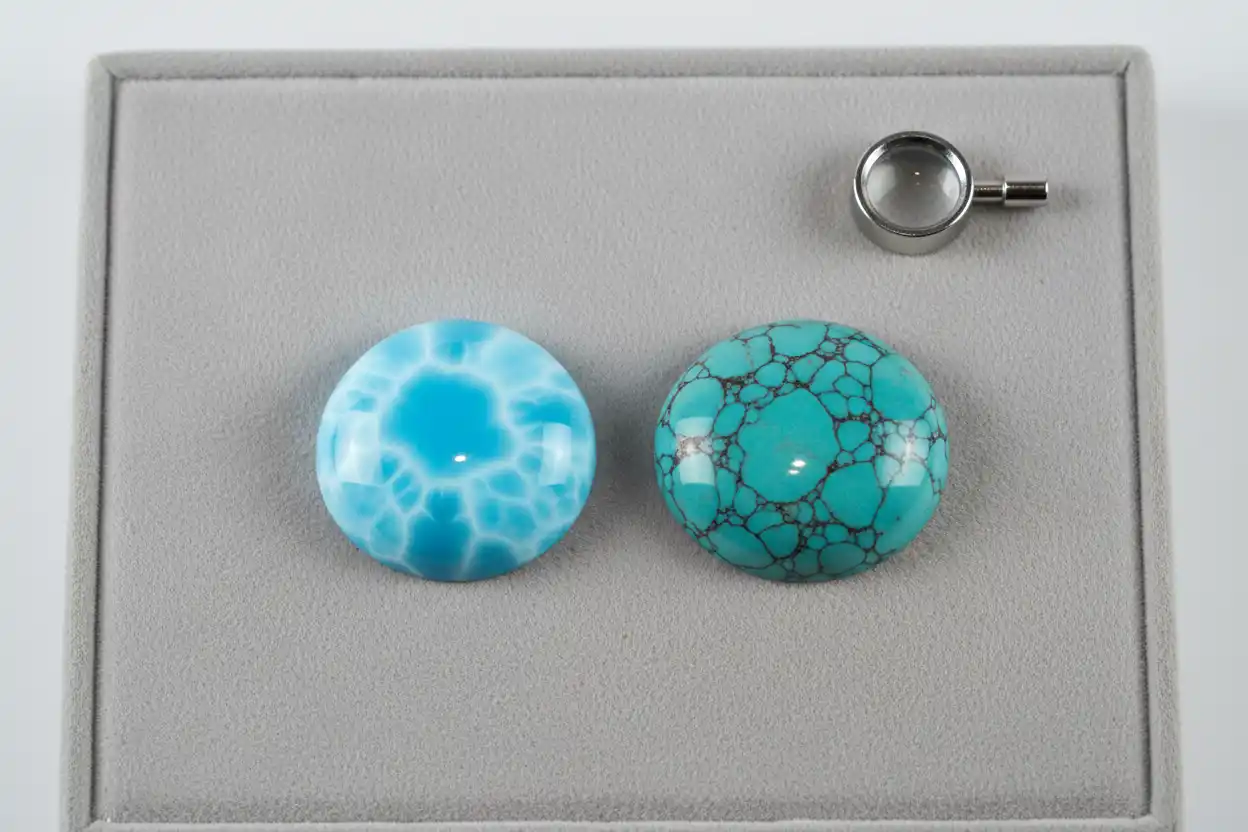
Their patterns often provide the first clue. Larimar commonly shows white cloudlike, fibrous, cellular or watery zones. Turquoise more often displays even blue color, brown or black host-rock matrix, and sometimes fine spiderweb veining.
Color and pattern cannot prove identity by themselves. Dyed stones, stabilized material, glass, resin and composites can imitate both.
The general Larimar guide and turquoise guide own each material’s complete history and symbolism. This page focuses strictly on identification and practical comparison.
Larimar vs Turquoise at a Glance
| Property | Larimar | Turquoise |
|---|---|---|
| Material identity | Blue massive pectolite | Hydrated copper-aluminum phosphate |
| General formula | NaCa₂Si₃O₈(OH) | CuAl₆(PO₄)₄(OH)₈·4H₂O |
| Crystal system | Triclinic | Triclinic |
| Main commercial source | Dominican Republic | Multiple sources in Asia and the Americas |
| Common color | White to pale, sky, turquoise, greenish or deeper blue | Light to medium blue, greenish blue and green |
| Typical pattern | White cloudlike, cellular or fibrous zones | Plain blue, mottling, dark matrix or spiderweb |
| Mohs hardness | Approximately 4.5–5; compact material may test somewhat higher | Approximately 5–6 |
| Toughness | Compact material can be cohesive, but cleavage and thin areas need care | Generally fair to good |
| Cleavage | Perfect in two directions | Usually described without Larimar’s pronounced pectolite cleavage concern |
| Refractive index | Approximately 1.59–1.63 for polished massive material | Commonly lower than Larimar |
| Specific gravity | Commonly near 2.84–2.90, with variation from inclusions | Commonly around the upper 2s, depending on composition and treatment |
| Common treatments | Resin, coating, dye, backing, wax, oil and filling | Stabilization, impregnation, dye, wax, coating and proprietary enhancement |
| Main jewelry concern | Scratching, cleavage and heat | Porosity, discoloration, treatment and chemicals |
| Main visual clue | White ocean-like pattern in Dominican blue pectolite | Even blue or host-rock matrix in phosphate material |
Mineral Identity
Larimar is pectolite, a chain silicate containing sodium and calcium.
Its compact fibrous texture distinguishes gem-quality massive material from the slender, brittle crystals commonly associated with ordinary pectolite specimens.
Turquoise belongs to the phosphate mineral class. Copper contributes to its blue color, while iron substitution can shift the appearance toward green.
The shared blue color therefore results from different structures and chemistries. A surface photograph cannot reveal whether the stone is silicate pectolite or phosphate turquoise.
Geological Formation
Larimar forms hydrothermally in cavities and veins within altered volcanic rock in the Dominican Republic. Heated mineral-rich fluids deposited generations of pectolite and associated minerals inside the host basalt.
Turquoise forms through secondary weathering processes in dry or semi-arid copper-bearing environments. Water moving through rock reacts with copper, aluminum and phosphorus sources, producing turquoise in seams, nodules and fracture fillings.
These distinct geological settings influence their typical matrix.
Larimar commonly contains white fibrous or calcite-rich zones and volcanic-associated inclusions. Turquoise commonly preserves remnants of its host rock as brown, black, tan or gray matrix.
Geographic Origin
Commercial Larimar is geographically restricted to the Dominican occurrence. Blue pectolite from elsewhere should not automatically receive the Larimar trade name.
Turquoise has numerous established sources. Iran, the United States, China, Egypt and other regions have produced important material.
Color cannot prove either locality. A uniform sky-blue turquoise is sometimes called Persian blue even when it was not mined in Iran.
Likewise, a blue-and-white imitation cannot become Larimar merely because a seller labels it Dominican.
Provenance and laboratory evidence matter when geographic origin creates a large premium.
Color Differences
Larimar ranges from white and pale blue through sky blue, turquoise blue, greenish blue and deeper blue. Its most characteristic appearance combines blue with white cloudlike or cellular patterning.
Turquoise commonly ranges from light blue to medium blue, greenish blue and green. Fine commercial material may show highly even color with little visible matrix.
The strongest Larimar often has substantial blue coverage but still retains a pattern that reflects the fibrous pectolite mass.
The most prized traditional turquoise color is an even intense medium blue, although attractive spiderweb and matrix patterns also have dedicated markets.
Neither color range is exclusive. Larimar can appear nearly uniform, while turquoise can contain pale or white-associated material. Treatment and photography increase the overlap.
White Pattern vs Host-Rock Matrix
Larimar’s white areas often look soft, cellular, fibrous, cloudlike or wave-like. They may consist of pale pectolite, calcite or related internal structures.
Turquoise matrix usually represents remnants of surrounding rock. It may appear brown, black, tan, gray or reddish and can form irregular veins or fine spiderweb patterns.
White calcite-like material can occur with turquoise, so a pale vein alone cannot prove Larimar.
Similarly, brown or red mineral inclusions can occur in Larimar. Pattern must be considered with the stone’s complete texture and measured properties.
A repeated artificial-looking white web over a perfectly uniform blue surface may indicate resin, dyed stone or manufactured imitation rather than either natural gem.
Surface Texture
Polished Larimar can show a fibrous or spheroidal internal texture beneath the surface. Some stones appear slightly silky, and different mineral zones may undercut during polishing.
Fine turquoise often has a more even, waxy appearance, particularly when the material is compact and matrix-free.
Porous turquoise may absorb oil, cosmetics and perspiration. Stabilization is commonly used to improve durability and polish in lower-quality material.
Larimar can also contain pores, cavities and filled fractures, but porosity is not the same identification pattern as turquoise’s treatment market.
Hardness and Durability
Turquoise is generally somewhat harder than book-value pectolite, although the ranges can overlap when compact fibrous Larimar behaves more cohesively.
Hardness testing should not be performed on polished jewelry. A scratch test damages the surface and cannot establish identity reliably.
Larimar’s cleavage remains an important distinction. Sharp impact and setting pressure can split or flake vulnerable areas, particularly when the stone is thin.
Turquoise usually presents a different practical concern: porous or treated material may discolor, absorb contaminants or respond badly to solvents and heat.
The gemstone hardness chart provides scale context, while Gemstone Toughness vs Hardness explains why one number does not define jewelry performance.
Refractive Index and Density
Larimar’s polished massive material commonly provides refractive-index readings around 1.59–1.63. Turquoise normally falls below that range.
This difference can help a gemologist separate the stones when a suitable polished surface is available.
Specific gravity may overlap, but composition and inclusions often create useful supporting evidence. Larimar specimens can vary because calcite, natrolite, chalcocite and other phases alter density.
Turquoise density also varies with porosity, matrix and impregnation.
One measurement should not be used alone. A mounted, backed or resin-filled stone may produce misleading results.
Transparency
Both materials are generally translucent to opaque in jewelry.
Larimar may show slight translucency around thin pale-blue edges, while compact turquoise usually remains opaque or semitranslucent.
Transparent blue material is unlikely to represent ordinary examples of either product and deserves separate testing.
Holding a mounted stone against light can reveal backing or thin construction but does not prove mineral identity.
Inclusions and Magnification
Under magnification, Larimar may show interlocking fibrous texture, white calcite, natrolite-related areas, hematite patterns, dark chalcocite particles, cavities or fracture filling.
Turquoise may show granular texture, porosity, host-rock matrix, dye concentration, polymer impregnation and natural or artificial web patterns.
The surface should be examined for color collected in cracks or cavities. Such concentration may indicate dye in either material.
A glass imitation may show bubbles, flow structures or a surface pattern that does not continue into the depth.
Resin products may show molding marks, swirls or inclusions suspended in a uniform polymer body.
Treatments
Larimar may receive resin, dye, coating, wax, oil, backing, glue or filling. The dedicated treated-Larimar guide owns those alterations.
Turquoise has a particularly extensive treatment market. Waxing, oiling, stabilization, polymer impregnation, dyeing, coating and proprietary processes can improve color or durability.
The treated-turquoise guide covers turquoise treatment and disclosure separately.
A treated stone is not automatically an imitation. Natural Larimar or turquoise may remain the host material.
However, treatment affects value, care and the reliability of some tests. A polymer-filled stone may display different weight, surface luster and chemical resistance from untreated material.
Common Imitations
Both stones may be imitated by dyed howlite, magnesite, marble, chalcedony, glass, ceramic, resin and composite products.
Larimar imitations often attempt to reproduce white ocean-like patterning. Turquoise imitations more commonly reproduce an even blue surface or dark spiderweb matrix.
The Real vs Fake Larimar guide and Real vs Fake Turquoise guide own the full authenticity workflows.
A label such as reconstituted, block, created or composite should be read carefully. These terms may describe powder or fragments bound with resin rather than one natural stone.
Safe At-Home Observations
A buyer can compare pattern, surface, weight, back construction and seller disclosure without damaging the jewelry.
Larimar is more likely to show white fibrous, cloudlike or cellular patterning. Turquoise is more likely to show even medium blue or natural host-rock matrix.
The reverse may reveal the answer when the face has been highly polished or treated. A Larimar cabochon may continue its blue-and-white pectolite texture through the back, while turquoise may show host rock or a differently colored natural rind.
However, backing can conceal both materials. A closed setting limits visual conclusions.
The broader How to Identify Crystals guide explains why several independent observations should converge.
Tests to Avoid
Do not perform scratch, acid, flame, hot-needle, acetone, alcohol or prolonged sunlight tests.
Pectolite can be damaged by scratching and concentrated heat. Turquoise can discolor through chemicals, cosmetics, perspiration and high heat, while solvents may damage treated surfaces.
A destructive test can ruin genuine jewelry without establishing whether the stone was Larimar, turquoise or an imitation.
Professional Identification
A gemologist can combine refractive index, density, microscopy, spectroscopy and mineralogical analysis.
Raman spectroscopy is especially useful because pectolite and turquoise have different molecular structures.
Infrared spectroscopy can help identify turquoise and detect some polymer treatments. X-ray diffraction can identify mineral phases directly.
The gemstone certification guide explains when laboratory testing is worthwhile.
Testing is particularly useful for valuable carvings, disputed treatment, unsupported origin, unusual color or high-priced vintage jewelry.
Jewelry Suitability
Larimar and turquoise both benefit from bezels, protected edges and conservative cleaning.
Larimar’s cleavage makes high-pressure prongs and thin tablets especially concerning. A Larimar ring should normally sit low.
Turquoise may perform somewhat better in a compact untreated or stabilized cabochon, although its color and treatment can be affected by oils and chemicals.
The turquoise ring guide owns turquoise-specific ring construction.
Pendants and earrings are safer for both materials. A Larimar necklace and turquoise necklace reduce hand-level impact but still require treatment-aware care.
Price and Market Position
Fine Larimar is valued for deeper blue, attractive pattern, blue coverage, sound structure and Dominican provenance. The Larimar price guide owns its valuation.
Turquoise value is influenced by color, texture, matrix, source, treatment and historical or cultural context. The turquoise price guide owns that separate market.
Neither material should be priced by color alone. A rare-source turquoise with documented provenance may exceed an ordinary Larimar cabochon, while fine deep-blue Larimar may cost more than heavily stabilized commercial turquoise.
Finished jewelry may derive substantial value from metal, maker, age and provenance.
Buying Either Stone
The Larimar Buying Guide and Turquoise Buying Guide own their complete purchase processes.
For either material, request a written identity, treatment disclosure, dimensions, weight, construction details and return period.
Product images should show the front, sides and reverse under neutral lighting.
The transaction safeguards in How to Buy Gemstones Online Without Getting Scammed apply to both.
The broader blue gemstones guide provides alternatives when greater hardness, transparency or treatment stability is required.
Cleaning Differences
Confirmed Larimar should be cleaned according to How to Clean Larimar Jewelry Safely.
Confirmed turquoise should follow How to Clean Turquoise Jewelry Safely.
Warm soapy water and gentle hand cleaning provide the safest general starting point for both, but prolonged soaking should be avoided when treatment, glue, backing or stringing is present.
Neither should receive steam or ultrasonic cleaning. Solvents and high heat can damage treated surfaces, discolor turquoise or alter Larimar and its fillers.
Frequently Asked Questions
1. Is Larimar a type of turquoise?
No. Larimar is blue pectolite, while turquoise is a hydrated copper-aluminum phosphate.
2. What is the easiest visual difference?
Larimar commonly shows white cloudlike or cellular patterns. Turquoise more often shows even blue or brown-to-black host-rock matrix.
3. Can Larimar be plain blue?
Yes. Some pieces show extensive blue with little white pattern, so a plain surface does not exclude Larimar.
4. Can turquoise contain white areas?
Yes. Associated minerals and matrix can produce pale areas, which is why white patterning alone cannot prove Larimar.
5. Which stone is harder?
Turquoise generally ranks around 5–6, while pectolite’s book hardness is approximately 4.5–5. Compact Larimar can sometimes test somewhat higher.
6. Which stone is more vulnerable to cleavage?
Larimar has pronounced pectolite cleavage and needs particular protection from sharp impact and setting pressure.
7. Are both stones commonly treated?
Yes. Larimar may be filled, coated or dyed, while turquoise commonly receives wax, stabilization, impregnation, dye and other enhancements.
8. Does spiderweb matrix indicate turquoise?
Fine dark spiderweb matrix strongly supports turquoise, but manufactured and dyed imitations can reproduce the pattern.
9. Can refractive index distinguish them?
Yes. Larimar generally provides higher refractive-index readings than turquoise when a reliable polished surface is available.
10. Which is better for a daily ring?
Neither is ideal for unrestricted wear. Compact stabilized turquoise may tolerate some designs better, while Larimar’s cleavage requires particularly protective construction.
11. Can I use an acid or scratch test?
No. Destructive testing can permanently damage either stone and may still provide an ambiguous result.
12. When should I obtain a laboratory report?
Testing is useful when identity, treatment, origin or high value materially affects the purchase or an insurance claim.
Larimar and turquoise share a blue palette but record entirely different geological processes. Larimar grew as fibrous pectolite within Dominican volcanic cavities and veins, while turquoise formed as a secondary phosphate in weathered copper-bearing rock. White ocean-like patterning and dark host-rock matrix may begin the visual comparison, but measured optical properties and mineral spectroscopy provide the reliable distinction.