Morganite Engagement Rings: A Complete Buyer’s Guide
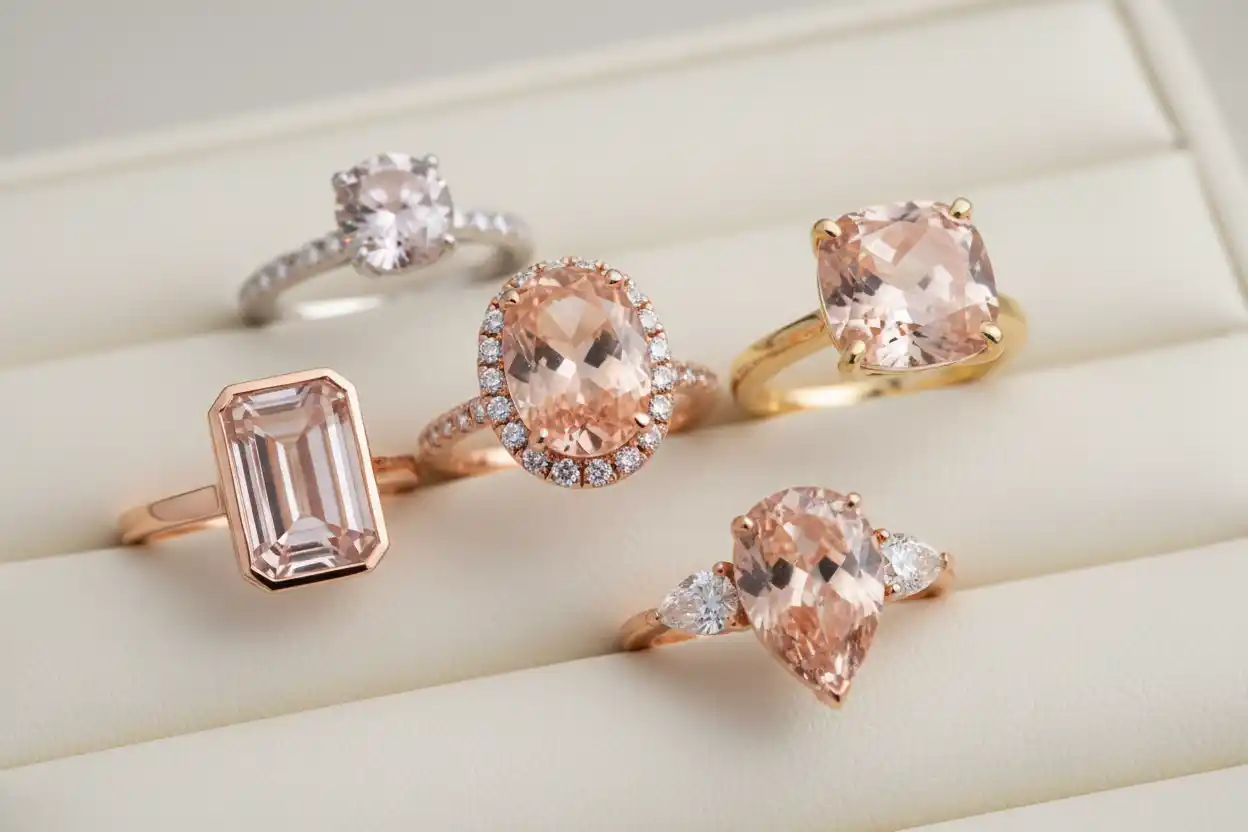
Morganite engagement rings offer pale pink, peach and salmon color in a gemstone that can be found in substantial sizes and worn regularly with appropriate care. The soft color works in classic solitaires, halos, three-stone designs, vintage settings and modern bezels without requiring the price associated with many pink Diamonds or fine Pink Sapphires.
Morganite is the pink-to-orange-pink variety of beryl. Its Mohs hardness of 7.5–8 makes it suitable for engagement jewelry, although it is more vulnerable to scratching and hard impact than Diamond, Ruby or Sapphire.
The purchase should therefore balance appearance and durability. A large center stone needs adequate metal, protected edges, a stable shank and realistic wearing habits. Color treatment, cut depth, clarity and wedding-band fit also deserve attention before the ring is ordered.
The broader Morganite gemstone guide owns the material’s geology, history and symbolism. This page focuses specifically on bridal selection and long-term ring performance.
Morganite Engagement Rings at a Glance
| Decision | What matters most |
|---|---|
| Gem identity | Natural or laboratory-grown pink-to-orange-pink beryl |
| Mohs hardness | 7.5–8 |
| Strongest value factor | Attractive pink color |
| Common treatment | Heat to reduce orange or yellow components |
| Most protective setting | Full or substantial partial bezel |
| Classic bridal setting | Four- or six-prong solitaire |
| High-spread cuts | Oval, pear, marquise and elongated cushion |
| Main durability concern | Scratching, edge impact and setting failure |
| Main color concern | Pale bodycolor in smaller stones |
| Main documentation concern | Origin and treatment disclosure |
| Main wedding-band concern | Gallery height and side clearance |
| Safest routine cleaning | Lukewarm water, mild soap and a soft brush |
Is Morganite Suitable for an Engagement Ring?
Morganite is durable enough for careful everyday ring wear.
Its hardness provides good scratch resistance compared with Moonstone, Opal, Pearl and Quartz. However, it remains below Sapphire and Diamond on the Gemstone Hardness Chart.
A Morganite ring should be removed before weight training, gardening, mechanical work, harsh cleaning and activities likely to strike or bend the setting.
The Gemstone Toughness vs Hardness guide explains why hardness does not protect the metal or prevent every chip.
The wider Best Gemstones for Engagement Rings comparison helps couples decide whether Morganite’s color and price outweigh the greater durability offered by Sapphire, Spinel or Diamond.
Why Morganite Has Become a Bridal Gem
Morganite combines several qualities that suit modern engagement jewelry.
It offers a recognizable pink-to-peach palette, good transparency and access to larger stones. The color also coordinates naturally with rose gold, which became prominent in contemporary jewelry.
Unlike many rare pink gemstones, Morganite can often be purchased in several-carat sizes without an extreme price.
The trade-off is subtle saturation. A large Morganite may be affordable because the material commonly forms in sizeable crystals and is often pale.
A successful ring should therefore be chosen for its specific color and construction rather than for carat weight alone.
Choosing Morganite Color
Morganite ranges from pale blush and peach through salmon, orangy pink, purplish pink and stronger pure pink.
Strong pink typically receives the greatest demand, while peach and salmon material can be attractive in warm-metal designs.
Color should remain visible under ordinary indoor light. A stone that looks pink only beneath warm spotlights may appear nearly colorless in daylight.
Large Morganites often display stronger color than small stones because light travels through more material.
The Pink Engagement Ring Stones guide compares Morganite with Pink Sapphire, Spinel, Tourmaline, Diamond and other options.
The broader Pink Gemstones guide provides additional non-bridal context.
Pink, Peach and Salmon Morganite
These color terms are descriptive rather than standardized grades.
Pink Morganite may range from soft blush to purplish pink. Peach material combines pink and orange, while salmon generally indicates a stronger orangy component.
Rose gold can make peach Morganite appear pinker because warm metal reflects into the stone. White gold or platinum shows the bodycolor more independently.
Yellow gold can strengthen yellow or orange components.
The couple should compare the loose stone against the intended metal before approving the final ring.
Pleochroism and Orientation
Morganite is pleochroic.
Different crystallographic directions may show pale pink and deeper bluish or purplish pink. A skilled cutter orients the rough to preserve the strongest face-up color.
Poor orientation can leave the gemstone nearly colorless from above while stronger color remains visible through the side.
Pleochroism can become more obvious in elongated cuts and larger stones.
Request video that rotates the exact stone through several angles. One optimized face-up photograph cannot show how stable the color remains.
Heat Treatment
Heat treatment is common and generally used to remove yellow or orange components, leaving a purer pink.
The treatment is considered stable during ordinary wear. Heated Morganite remains natural beryl.
Known treatment should be disclosed because it affects consumer understanding and comparison with untreated material.
The dedicated Treated Morganite guide owns treatment detection, laboratory-grown material and disclosure.
Rare fracture filling imposes additional cleaning restrictions and should be stated explicitly.
Morganite Clarity
Faceted Morganite is commonly expected to appear eye-clean.
Liquid inclusions, tubes, mineral crystals and fractures can occur. A small internal feature away from the girdle may have little practical significance.
A bright surface-reaching fracture near a prong, corner or pointed end deserves greater concern.
Larger stones may reveal inclusions more readily simply because there is more material to inspect.
Eye-clean does not mean internally flawless. It means inclusions do not distract under normal unaided viewing.
The Morganite Buying Guide owns the full color, clarity, cut and carat evaluation.
Round Morganite Engagement Rings
Round brilliant cuts offer balanced sparkle and familiar bridal styling.
They work in solitaires, halos, three-stone rings and pavé settings.
Round Morganite can appear smaller face-up than elongated cuts of a similar weight because more depth may be retained to strengthen pale color.
Four prongs show more of the stone. Six prongs provide greater redundancy around a large round center.
A bezel creates a smooth protected outline and may make the gemstone appear slightly larger through its metal frame.
Oval Morganite Engagement Rings
Oval Morganite is one of the most popular bridal choices.
The elongated outline provides generous finger coverage and works effectively with solitaires, halos and hidden halos.
Ovals vary in length-to-width ratio and bow-tie visibility. A modest central contrast can add scintillation, while a dark stationary bow tie reduces visual balance.
The stone should not have an excessively shallow window through its center.
A large oval may become top-heavy. A stable basket and adequate lower-shank width help prevent rotation.
Cushion and Radiant Morganite
Cushion cuts range from square to elongated and may have rounded or more defined corners.
Their broad facets can strengthen color and suit vintage, halo or solitaire settings.
Radiant cuts combine rectangular outlines with brilliant-style faceting. They can create lively sparkle but may also show a busy pattern that hides Morganite’s subtle color.
Two cushions with the same stated dimensions can look very different because facet arrangements vary.
Compare the exact stone rather than buying from a shape label alone.
Pear and Marquise Cuts
Pear and marquise Morganites provide substantial visual length.
Their points require protection. A V-shaped prong or bezel should cover the tip rather than leaving it exposed.
Both shapes can show bow-tie effects and noticeable outline asymmetry.
A pear should have balanced shoulders and a centered point. A marquise should not appear uneven or excessively narrow.
The wedding band may need to curve around the elongated footprint, depending on the setting.
Emerald-Cut Morganite
Emerald cuts create broad flashes and emphasize clarity.
Their long step facets can make pale color and windowing more obvious than brilliant cuts. A well-proportioned emerald cut should show pink throughout the center rather than behaving like transparent glass.
Trimmed corners reduce vulnerability compared with a sharp rectangle.
Emerald-cut Morganite works especially well in bezels, three-stone rings and clean architectural settings.
Side baguettes or trapezoids should remain separated from the center by enough metal to prevent girdle contact.
Solitaire Settings
A solitaire places all attention on the Morganite.
Four- and six-prong designs are familiar, while cathedral shoulders can provide support beneath a larger center.
A low setting reduces snagging but may prevent a straight wedding band from sitting flush.
A high basket creates more clearance but increases impact exposure and leverage.
The connection between the basket and shank should contain enough metal to resist twisting. A large center on an extremely thin neck is structurally weak even when it looks delicate.
Bezel Settings
A bezel surrounds the gemstone with metal and provides the strongest general protection.
It is a particularly practical choice for active wearers or large centers.
The metal covers a small part of the girdle but does not prevent Morganite from returning light through its face.
A full bezel can make future stone removal and replacement more labor-intensive. It should still include cleaning access beneath the pavilion.
A partial bezel leaves selected sides exposed while retaining some protective benefit.
Halo and Hidden-Halo Settings
A visible halo surrounds Morganite with smaller accent stones and increases apparent spread.
A hidden halo sits beneath the girdle and becomes visible mainly from the side.
Diamond accents create strong contrast around pale Morganite. Their greater hardness means the settings must keep the girdles separated.
Halos contain many small prongs and need more maintenance than solitaires.
The accent stones should be identified as natural Diamond, laboratory-grown Diamond, Moissanite, Cubic Zirconia or another material on the invoice.
Three-Stone Morganite Rings
A three-stone ring may use Morganite side stones or contrasting Diamond, Sapphire or Aquamarine accents.
Pear, trapezoid, oval and round sides create different proportions.
The side stones should support the center’s color. Very white Diamonds produce a sharp contrast, while warmer accents create a softer transition.
All gemstones must remain separated by metal.
An unusual side-stone shape can become difficult to replace, so couples should ask whether matched stones are available.
Rose Gold Settings
Rose gold is a natural visual partner for Morganite.
Its copper-containing alloy reflects warm pink into the gemstone and can make pale peach material appear more saturated.
However, metal reflection can also hide the stone’s independent bodycolor. A loose Morganite should be viewed against both white and rose backgrounds.
The alloy’s exact composition affects color, hardness and skin compatibility.
A person with copper or alloy sensitivity should not assume every rose-gold formula will behave identically.
White Gold and Platinum
White metals create a cooler, more contrasting setting.
They can make purplish-pink Morganite appear crisp, while peach or yellow components remain more visible.
White gold is commonly rhodium plated and may need periodic replating. Platinum is naturally white and develops a patina through wear.
White-metal prongs combined with a rose-gold shank can preserve a cool frame around the stone while retaining a warm overall design.
The Best Gemstones and Metals for Sensitive Skin guide explains alloy and nickel considerations.
Yellow Gold
Yellow gold emphasizes Morganite’s warm peach and salmon components.
The combination can create a vintage or richly colored appearance, especially with cushion and emerald cuts.
A very pale Morganite may blend into yellow gold rather than contrast strongly.
The stone should be viewed in the final metal color before approval.
Yellow gold also avoids the rhodium-plating maintenance associated with many white-gold rings.
Shank Width and Ring Strength
Large Morganites need adequate metal beneath them.
An extremely thin shank may bend, causing the center basket or pavé to loosen.
A tapered design can look delicate near the center while retaining more thickness beneath the finger.
The shank should remain substantial enough for future polishing and resizing.
Metal weight and dimensions provide more useful structural information than a photograph alone.
Pavé Bands
Pavé creates additional brilliance along the shoulders.
Fine pavé settings use small prongs or beads that can wear over time. A very thin pavé shank may bend, releasing accents.
Partial pavé leaves solid metal beneath the finger and usually permits more resizing than a full eternity design.
Morganite’s pale color can collect reflected brightness from the pavé, but it should remain the visual center.
A wearer who works extensively with their hands may prefer a plain shank or limited upper pavé.
Wedding-Band Fit
Wedding-band planning should happen before the engagement setting is finalized.
A straight band sits flush only when the basket, halo and decorative gallery leave adequate side clearance.
Low bezels and projecting halos may create a gap. A curved or contoured band can follow the engagement ring’s outline.
The two rings should not rub continuously against prongs or Morganite.
Try the complete set together whenever possible. Digital renderings do not always show where metal components meet.
Morganite vs Pink Sapphire
Pink Sapphire is harder and generally more resistant to scratching.
It can also display stronger saturation in smaller stones, but fine material may cost substantially more.
Morganite offers softer pastel color and larger visual size for the budget.
The Sapphire Engagement Ring guide owns Sapphire-specific bridal buying.
A couple prioritizing durability and vivid color may prefer Sapphire. Someone seeking blush, peach or large pastel scale may prefer Morganite.
Morganite vs Diamond
Diamond offers greater hardness, stronger conventional brilliance and a more developed resale market.
Morganite offers natural pink-to-peach color at a much lower purchase price than most pink Diamonds.
The Diamond Engagement Ring guide owns natural-Diamond bridal selection.
The comparison should not imply that Morganite is a pink Diamond substitute in material terms. It is a separate beryl gemstone with different optics and durability.
Morganite vs Lab Diamond and Moissanite
Laboratory-grown Diamond has the Diamond carbon structure and provides Diamond optical behavior at a lower price than many comparable mined stones.
The Lab Diamond Engagement Ring guide owns that choice.
Moissanite is silicon carbide and provides intense brilliance and rainbow fire. The Moissanite Engagement Ring guide explains its separate identity.
Morganite supplies natural pastel color rather than attempting to reproduce a colorless Diamond appearance.
The decision depends on whether color, Diamond identity, spectral fire, size or price matters most.
Morganite vs Aquamarine Engagement Rings
Morganite and Aquamarine are both beryl varieties with similar hardness.
Aquamarine offers blue-to-greenish-blue color, while Morganite offers pink-to-orange-pink.
The Aquamarine Engagement Ring guide owns the blue-beryl bridal workflow.
Both can occur in large, relatively clean stones and require protection from hard blows.
Metal choice affects them differently: rose gold strengthens Morganite’s warmth, while white metal often emphasizes Aquamarine’s cool blue.
Laboratory-Grown Morganite and Imitations
Laboratory-grown pink beryl can be a legitimate engagement-ring material when disclosed clearly.
It usually costs less than comparable natural Morganite and may offer strong clarity.
Imitations include pink glass, Cubic Zirconia, synthetic Spinel and other pink gems.
The complete identification workflow belongs to Real vs Fake Morganite.
The direct Kunzite vs Morganite and Morganite vs Rose Quartz comparisons address two common lookalikes.
Price and Long-Term Value
The Morganite Price Guide owns current valuation.
Price depends on color, clarity, cut, size, treatment, metal weight, accent stones, brand and workmanship.
Morganite can form large crystals, so substantial carat weight does not create rarity automatically.
A ring should not be purchased with a guaranteed appreciation claim. Secondhand value may depend more on gold, design, brand and market demand than on the Morganite alone.
A moderate stone in a durable setting may provide better long-term use than a very large center mounted in insufficient metal.
Reports, Appraisals and Disclosure
An independent report may confirm natural or laboratory-grown origin and identify detectable treatments.
It does not determine one universal retail value.
The Gemstone Certification guide explains the difference between identification and appraisal.
A finished-ring appraisal should identify the Morganite, accent stones, metal and known treatment accurately.
The seller should provide treatment and origin disclosure in writing rather than through verbal assurances alone.
Buying Online
Follow How to Buy Gemstones Online Without Getting Scammed.
Request continuous video of the exact stone under neutral and ordinary indoor light.
Confirm dimensions, ring size, metal weight, shank width, setting height, treatment, origin, accent identity, return period and resizing limits.
A stock photograph of a similar ring cannot establish the color of an individual Morganite.
The return period should allow the buyer to evaluate the stone away from jewelry-store lighting.
Cleaning and Maintenance
Follow How to Clean Morganite Jewelry Safely.
Use lukewarm water, mild dish soap and a soft brush. Clean beneath the center, where oil and residue can make Morganite look pale and cloudy.
Steam and ultrasonic cleaning may be acceptable for some sound untreated stones but should be avoided when fractures, liquid inclusions or filling are present.
Remove the ring before demanding hand activities and avoid repair heat around the gemstone.
Prongs, pavé and the shank should be inspected periodically. A moving stone or bent ring requires immediate attention.
Frequently Asked Questions
1. Is Morganite durable enough for an engagement ring?
Yes, with careful wear. Its hardness is 7.5–8, although Diamond and Sapphire offer greater scratch resistance.
2. What is the safest Morganite setting?
A full or substantial partial bezel provides the strongest edge protection and reduced snagging.
3. Is rose gold the best metal?
Rose gold strengthens the warm pink appearance, but white, yellow and mixed-metal settings can also work beautifully.
4. Why are many Morganites pale?
Strong color is uncommon, and larger stones usually show pink more effectively than small gems.
5. Is Morganite usually heat-treated?
Yes. Heating commonly removes orange or yellow components and produces a purer pink.
6. Is heated Morganite suitable for engagement jewelry?
Yes. The treated color is generally stable during ordinary wear.
7. Does Morganite scratch easily?
It has good scratch resistance but can be scratched by Diamond, Sapphire and other harder materials.
8. Is Morganite better than Pink Sapphire?
Morganite offers larger pastel stones for the budget. Pink Sapphire offers greater hardness and often stronger saturation.
9. Can a straight wedding band sit flush?
It depends on the basket and gallery. Low or projecting settings may require a curved band.
10. Does Morganite need a laboratory report?
A report is useful for valuable centers, laboratory-grown-origin questions or significant treatment disputes.
11. Can Morganite be cleaned ultrasonically?
Some sound stones may tolerate it, but warm soapy water is safer when fractures, liquid inclusions or filling may be present.
12. Does Morganite retain its value?
Resale is usually below retail and depends on color, setting, metal, brand and market demand. Appreciation is not guaranteed.
Morganite engagement rings work best when their softness of color is not confused with fragility of construction. The center may be pastel, but the basket, shank and wedding-band plan must be substantial. Choosing the ring around everyday habits—and not simply the largest affordable carat weight—allows the gemstone’s pink color to remain meaningful through long-term wear.