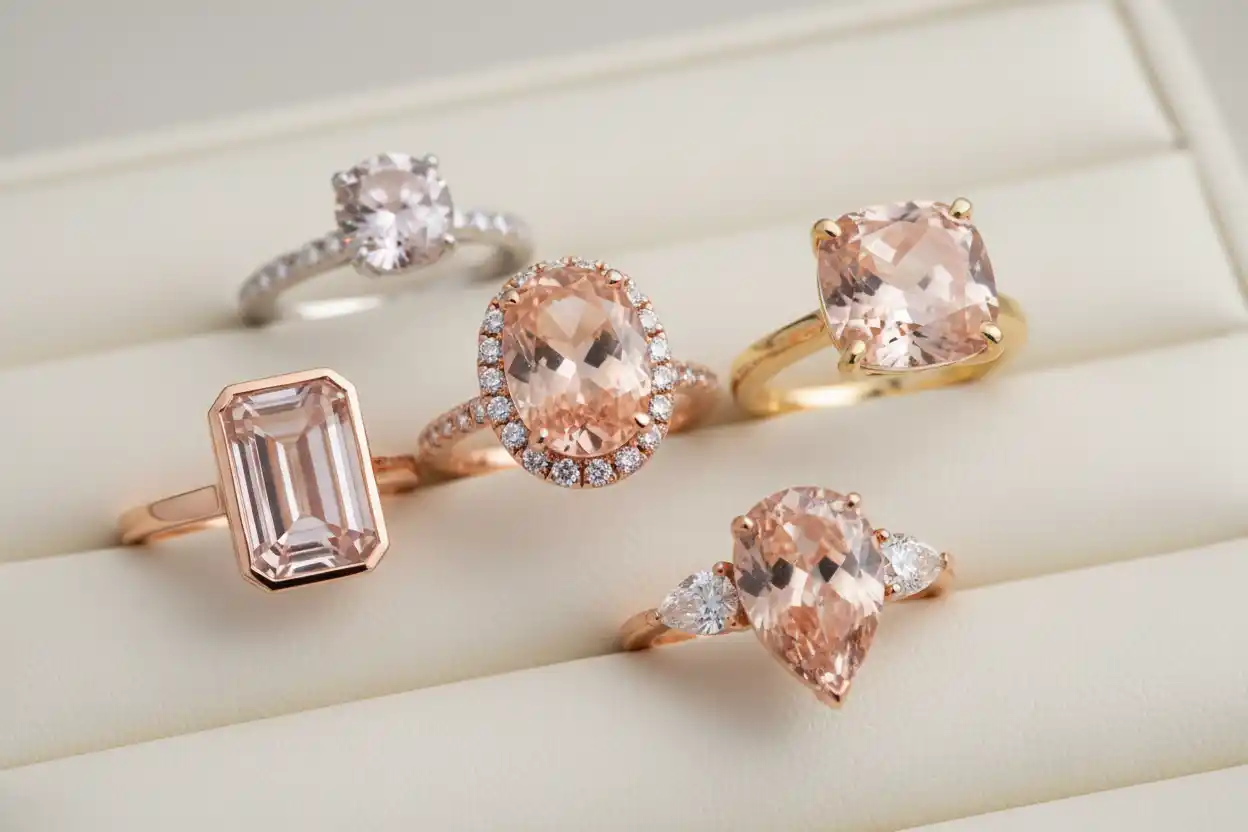
Morganite Engagement Ring: 10 Divine Meanings of Heart-Centered Love
A morganite engagement ring combines soft pink color, good jewelry durability and a romantic visual character that feels noticeably different from traditional diamond, ruby or sapphire. Morganite is the pink to orange-pink variety of beryl, the same mineral species that includes emerald and aquamarine. Its color comes mainly from traces of manganese, and fine stones can range from peach and salmon to pink, rose and purplish pink. GIA notes that strongly saturated pink morganite is relatively uncommon, while most examples display the gentle pastel tones for which the gemstone is known.
For engagement jewelry, morganite offers a practical balance between beauty and wearability. It ranks about 7.5 to 8 on the Mohs hardness scale and is considered durable enough for jewelry worn regularly, although rough handling should still be avoided. Its combination of high clarity and comparatively large crystal sizes also means buyers can often find substantial center stones without encountering the extreme price increases associated with large fine rubies or diamonds.
The spiritual language around a morganite engagement ring should be treated as symbolism rather than measurable gemstone energy. Modern crystal traditions often associate pink morganite with affection, emotional openness, compassion and heart-centered love. Those ideas can make the stone personally meaningful for an engagement, but they are not established medical or psychological effects.
10 Morganite Engagement Ring Meanings & Buying Priorities
- Pink can symbolize tenderness and affectionate love.
- Pastel color can represent gentle emotional openness.
- Heart-centered symbolism can reflect compassion between partners.
- Peach-pink tones can represent warmth and emotional renewal.
- High transparency can symbolize honesty and trust.
- Beryl durability makes morganite practical with sensible care.
- Stronger pink generally carries greater rarity and value.
- Eye-clean clarity is a realistic expectation for fine faceted stones.
- Heat treatment is common and usually used to improve pink color.
- A secure setting matters more than chasing the largest possible stone.
Morganite Naturally Fits Romantic Engagement-Ring Design
Morganite’s pink color gives it an immediate association with romance, but unlike strongly saturated red ruby or bright pink sapphire, its appearance is usually softer. That gentler color can work especially well for someone who wants an engagement ring that feels romantic without looking intensely traditional or formal.
Its pastel character changes significantly with metal choice. Rose gold can blend with pink or peach morganite and create a warm, unified look. Yellow gold adds richer contrast, while platinum or white gold can make the gemstone appear cooler and slightly more lavender or pink by comparison.
The gemstone also pairs easily with small diamonds because colorless accent stones provide brightness around the center without overwhelming its subtle color.
For symbolic interpretation, the combination of pink morganite and a circular engagement-ring design can represent affection, continuity and a commitment that is intentionally gentle rather than dramatic.
Pink Morganite Can Symbolize Tender Love
Pink has long been associated in modern Western jewelry with affection, softness and romance. Morganite brings those associations into a natural gemstone whose color is produced by trace chemistry rather than surface coating.
A morganite engagement ring can therefore symbolize a relationship built around tenderness, emotional respect and affection rather than intensity alone.
The symbolism becomes more personal when the wearer genuinely likes pink. Jewelry that reflects someone’s natural aesthetic preferences often carries more emotional value than a stone chosen simply because tradition expects it.
There is no scientific evidence that morganite makes someone more loving or compassionate. Its value as a symbol comes from the meaning a couple intentionally gives it.
Heart-Centered Symbolism Comes From Modern Crystal Traditions
Modern metaphysical traditions frequently associate morganite with the heart, emotional healing, compassion and openness. These ideas also appear in discussions of morganite benefits, where symbolic uses should remain clearly separated from evidence-based health claims.
For an engagement ring, the heart-centered interpretation can simply represent the wish to keep empathy, patience and communication at the center of a relationship.
That symbolic use does not require claims that morganite physically changes emotional states. A ring can function as a personal reminder of shared values without emitting measurable psychological energy.
This distinction preserves the meaning while keeping the gemological information accurate.
Morganite’s Transparency Can Represent Honesty
Fine faceted morganite is often highly transparent. GIA notes that faceted stones generally do not contain inclusions visible to the unaided eye, although larger examples can occasionally display more internal features.
That physical clarity lends itself naturally to symbolism involving honesty, openness and trust.
A couple may choose a morganite engagement ring because the transparent pink center visually represents a relationship in which important feelings are discussed openly.
The gemological feature is real, while the emotional interpretation remains symbolic. This makes transparency one of the more natural bridges between the stone’s physical beauty and its engagement-ring meaning.
Morganite Is Beryl, Like Emerald and Aquamarine
Morganite belongs to the beryl family, with the chemical composition Be₃Al₂Si₆O₁₈. Emerald and aquamarine belong to the same mineral species, although different trace elements and color mechanisms create their distinctive appearances.
This family relationship gives morganite respectable hardness and good suitability for jewelry. GIA describes it as durable enough for all types of jewelry and daily wear when rough handling is avoided.
| Property | Morganite |
|---|---|
| Mineral species | Beryl |
| Typical color | Pink, purplish pink, peach, salmon, orange-pink |
| Main color influence | Manganese |
| Mohs hardness | About 7.5–8 |
| Typical clarity | Often eye-clean when faceted |
| Common treatment | Heat treatment |
| Daily ring wear | Suitable with sensible protection |
| Best-known appeal | Soft pastel color and large clean stones |
The hardness makes a morganite engagement ring more practical than many softer decorative gems, but it should not be treated as indestructible.
Strong Pink Is Rarer Than Pale Pink
Color is the most important quality factor for morganite. GIA identifies strong pink to magenta as especially prized and notes that stronger saturation can significantly increase value. Most morganite, however, is naturally lighter and more pastel.
This matters because large size alone should not determine which center stone you choose. A very large but washed-out morganite may have less visual impact than a smaller stone with richer pink color.
When comparing stones, look at them against the wearer’s skin and under several lighting conditions. Pale morganite can appear almost colorless in bright lighting, while warmer indoor light can emphasize peach or salmon tones.
The factors behind morganite price therefore need to be judged together rather than through carat weight alone.
Heat Treatment Is Common in Morganite
Morganite is commonly heat treated to modify its color. GIA explains that heat can reduce yellow or orange components and leave a purer pink appearance. The treatment is routine, and the resulting color is considered stable under normal wear.
This means a heated morganite is not automatically a poor purchase.
Some collectors prefer untreated peach or salmon stones precisely because their original color remains unchanged. Other buyers prefer the cleaner pink created by heating.
Neither preference is inherently superior. The important point is disclosure, especially when a seller claims that an unusual pink stone is untreated and charges a premium on that basis.
Because GIA notes that the treatment may not be detectable after the fact, absolute untreated claims deserve particular caution unless reliable supporting information exists.
Morganite Usually Offers Excellent Clarity
Faceted morganite often looks very clean to the unaided eye. This gives the gemstone a bright, open appearance that works especially well in larger center stones.
GIA notes that eye-visible inclusions are uncommon in fine faceted morganite and that included rough may instead be cut into cabochons or carvings.
For an engagement ring, this means you usually do not need to accept heavy cloudiness or distracting inclusions merely because the stone is natural.
An internal feature that is invisible without magnification may have little effect on beauty. What matters more is whether the stone looks transparent and lively face-up and whether any fractures present a durability concern.
The principles behind morganite quality grading therefore place color, clarity and cutting together rather than treating clarity as the sole measure of quality.
Cut Is Especially Important in Pale Morganite
Because morganite is often light in color, cutting plays an important role in giving the stone visible presence.
A poorly proportioned stone may show a large transparent window through the center, making the gem look pale or empty. An attractive cut returns enough light to maintain brightness while preserving the pink bodycolor.
Morganite’s pleochroism also means cutting orientation affects visible color. GIA notes that the gemstone can show pale pink and deeper bluish-pink directional colors, so cutters must orient rough carefully.
Ovals and cushions are especially popular because they combine large face-up appearance with soft romantic shapes, but rounds, pears and emerald cuts can also be beautiful when well proportioned.
The strongest choice is the stone that looks balanced and lively from the top rather than the one with the largest carat number.
Large Morganite Is More Available Than Many Buyers Expect
Morganite crystals can grow to substantial sizes. GIA notes that very large crystals occur and that larger cut stones are more common than they are in many other gemstone species. Greater size can also help strengthen visible color in naturally pale morganite.
This creates one of the major attractions of a morganite engagement ring. A buyer can often obtain a visually substantial pink center stone without entering the extreme price ranges associated with equally large fine ruby or pink diamond.
Yet size needs proportion.
A very large stone sits higher, exposes more surface area to impacts and may feel impractical for everyday wear. Large morganite also requires a strong setting because the center’s physical dimensions place more leverage on prongs if the ring catches on clothing or objects.
Choosing the right size is therefore a lifestyle decision as much as a value decision.
The Setting Should Protect Morganite During Daily Wear
Morganite’s 7.5 to 8 hardness provides good resistance to scratching, but engagement rings experience more than scratches. They encounter knocks, pressure against hard surfaces and repeated contact with metal objects.
A bezel offers strong edge protection, while a halo can provide some buffering around the center. Properly constructed prongs are also suitable, especially when vulnerable tips on pear or marquise shapes are protected.
A lower-profile setting is particularly useful for someone who works frequently with their hands.
GIA considers morganite durable enough for daily wear but still advises avoiding rough handling.
That makes morganite a realistic engagement-ring stone, but one that benefits from thoughtful ownership rather than carefree treatment.
Rose Gold Is Popular, but Not Automatically Best
Rose gold and morganite became a popular pairing because the warm metal reinforces pink and peach tones. The effect can be soft and monochromatic.
However, a very pale morganite may blend so completely into rose gold that some contrast is lost. White gold or platinum can make pale pink more obvious, while yellow gold can emphasize peach and salmon tones.
The choice should depend on the actual stone.
Viewing an unset morganite over different metal-colored backgrounds is a useful way to predict the finished effect before committing to a mounting.
Morganite Can Represent a Relationship That Grows Gently
Many engagement gemstones symbolize dramatic passion, strength or permanence. Morganite offers a softer emotional language.
Its pale pink appearance can symbolize affection that grows steadily, compassion during disagreement and the ability to remain emotionally open as a relationship changes.
Modern metaphysical traditions extend these meanings into claims about heart chakras, emotional healing and energetic love. Those claims are not supported as medical effects.
The symbolic idea itself, however, can remain powerful. A couple may choose morganite because the color expresses the type of partnership they want to build.
Price Should Reflect Color and Cutting, Not Just Size
Because large morganite is relatively available, carat weight alone does not create value in the same way it can for rare large ruby.
Stronger pink saturation can command a premium. High transparency, attractive proportions and appealing overall color also matter.
A very large stone with weak color, poor cutting and obvious windowing should not automatically cost more than a smaller, more attractive gem.
When you buy morganite, compare several stones at the same time. Side-by-side comparison makes differences in saturation, cut and brightness much easier to see.
Conclusion
A morganite engagement ring combines soft pink beauty, eye-clean clarity, respectable hardness and a romantic personality that suits someone who wants something gentler than traditional diamond or intense red ruby. Morganite is a pink beryl colored mainly by manganese, and stronger pink stones generally command greater value. Heat treatment is routine and commonly used to reduce orange or yellow components, while larger stones are relatively available. Its heart-centered meanings of affection, compassion and emotional openness can make the ring deeply personal, but those meanings belong to symbolism rather than medical science. For long-term wear, prioritize attractive color, lively cutting, a secure setting and realistic care.
FAQs About Morganite Engagement Rings
Is morganite durable enough for an engagement ring?
Yes. Morganite ranks about 7.5 to 8 on the Mohs hardness scale and GIA considers it durable enough for daily jewelry wear. It should still be protected from hard impacts and rough handling.
Is morganite more durable than emerald?
Both are varieties of beryl and have similar hardness, but emerald commonly contains more fractures and inclusions. Fine morganite is usually cleaner, which can make it less vulnerable in practical ring wear.
What is the best morganite color?
Strong pink to purplish pink generally receives the highest market preference, while peach and salmon stones can appeal strongly to buyers who prefer warmer natural-looking color.
Is most morganite heat treated?
Heat treatment is common and often used to reduce orange or yellow components and create a purer pink. The resulting color is considered stable under normal wear.
Does heat treatment lower morganite value?
Routine heat treatment is widely accepted. Value still depends strongly on final color, transparency, cut and size. Untreated peach or salmon stones may appeal particularly to collectors who value original color.
Is morganite naturally pink?
Yes. Morganite is naturally pink to orange-pink beryl, with its color mainly linked to manganese. Heating can modify the exact balance of pink and orange.
Does morganite scratch easily?
It is relatively scratch resistant at Mohs 7.5 to 8, but sapphire, ruby, moissanite and diamond are harder. Normal care helps preserve the surface polish.
Why are large morganites affordable?
Morganite can form relatively large crystals, so large clean faceted stones are more available than large examples of many rarer gemstones. Color quality and cutting can matter more than size alone.
Is rose gold best for morganite?
Rose gold is popular because it harmonizes with pink tones, but white gold, platinum and yellow gold can be equally attractive. The best choice depends on the individual stone’s hue and the wearer’s preference.
Does morganite have healing or heart-chakra energy?
There is no established medical evidence that morganite heals emotional or physical conditions or changes chakra energy. Heart-centered meanings belong to modern spiritual traditions and personal symbolism.
Disclaimer:
Spiritual, heart-centered, healing, chakra and emotional interpretations associated with morganite reflect modern traditions and personal symbolism rather than established medical or psychological effects. A morganite engagement ring does not replace professional healthcare, and perceived energy does not determine gemstone quality or authenticity.