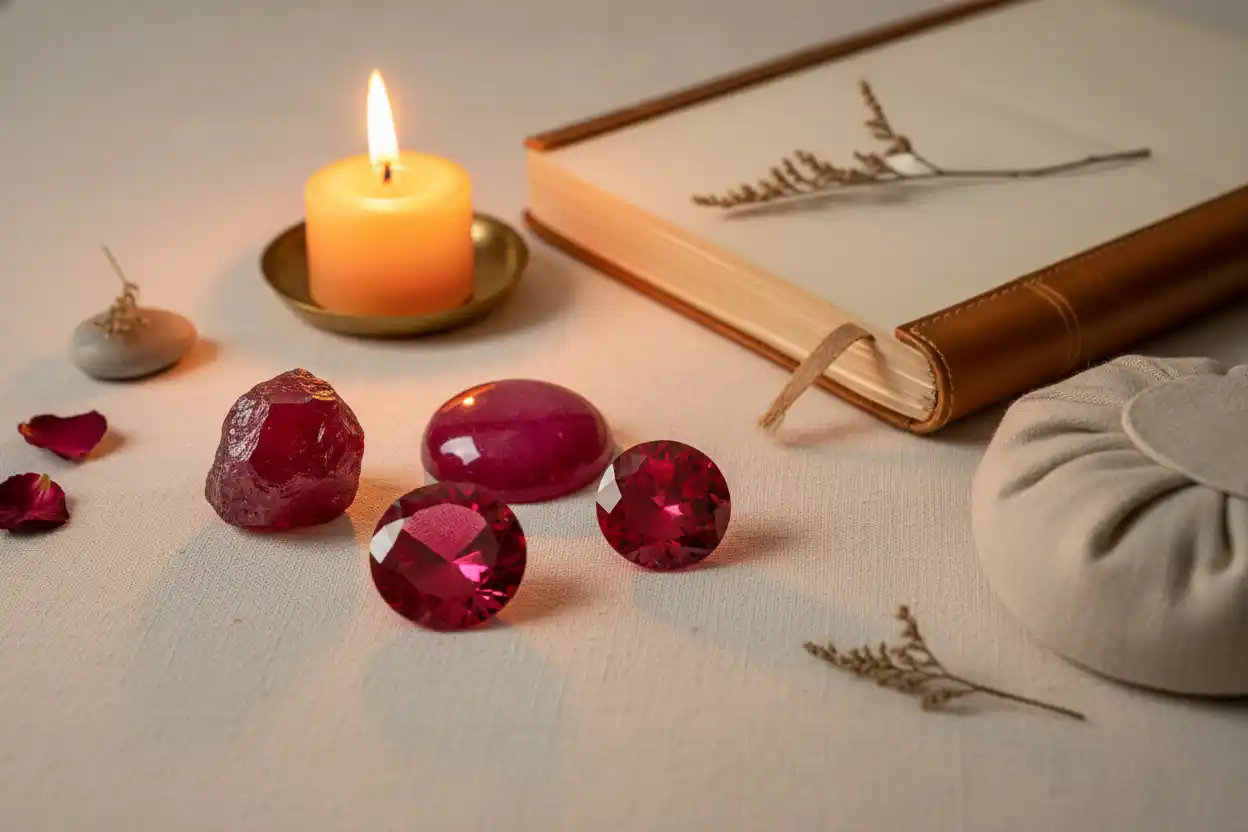
Ruby Healing Properties: Meaning, Benefits and Uses
Ruby is traditionally associated with vitality, courage, confidence, devotion and purposeful action. Its intense red color has connected it with life, power and protection in spiritual and cultural traditions for centuries.
Modern crystal practitioners often use ruby as a symbolic aid when they want to become more engaged with life, strengthen a commitment or approach a difficult goal with greater determination. Some also associate it with love, sensuality, leadership and the confidence to be visible.
These healing properties are spiritual interpretations rather than scientifically demonstrated medical effects. Ruby cannot treat blood disorders, heart disease, reproductive conditions, depression, fatigue or any other health problem. Its most responsible use is as a focus for reflection, intention and behavior rather than a substitute for healthcare.
For ruby’s mineral identity, geology, history and general symbolism, see Ruby: Meaning, Properties & Symbolism. The wider color traditions appear in Red Crystals and Red Gemstones.
Ruby Healing Properties at a Glance
| Traditional association | Responsible interpretation |
|---|---|
| Vitality | A symbolic reminder to participate actively and care for physical needs |
| Courage | Support for taking a defined action despite uncertainty |
| Confidence | Encouragement to prepare, communicate and accept visibility |
| Motivation | A visual cue to begin or continue meaningful work |
| Passion | Renewed engagement with relationships, creativity or purpose |
| Love | Devotion, affection and reciprocal commitment |
| Protection | A reminder to establish boundaries and take practical safety measures |
| Leadership | Acting decisively while remaining accountable |
| Grounding | Connecting ambition with physical reality and daily responsibilities |
| Emotional strength | Remaining present with intense feelings without acting impulsively |
| Prosperity | Symbolic focus on effort, stewardship and responsible opportunity |
| Chakra work | Commonly linked with root, heart and solar-plexus themes |
What Does Crystal Healing Mean?
Crystal healing is a spiritual or symbolic practice in which stones are used during meditation, intention-setting, ritual or personal reflection.
A crystal may help someone remember an intention because it is visible, tactile and emotionally meaningful. That kind of attentional effect does not require the mineral to emit a medically active force.
Ruby’s color, rarity and long history make it especially powerful as a symbol. A person who associates red with courage may feel more focused when holding or wearing it before a difficult task.
The helpful element comes from the relationship among the object, the intention and the person’s actions. It should not be described as proof that ruby changes organs, hormones or disease processes.
The broader foundations of responsible practice appear in Healing Crystals: A Complete Beginner’s Guide.
Ruby and Vitality
Vitality is the healing theme most strongly associated with ruby.
Its vivid red color recalls blood, heat, movement and physical life. Historically, those associations led people to treat ruby as a symbol of youthful energy and resilience.
In modern practice, vitality can be interpreted without making medical claims. Ruby may represent returning to daily participation after a period of apathy, fatigue or discouragement.
A person might place the stone beside a written routine that includes sleep, nutrition, movement and medical care. The ruby then serves as a reminder of the intention to engage with those supports.
It does not generate physical energy or correct the medical cause of tiredness. Persistent fatigue requires appropriate professional assessment.
Ruby for Courage
Ruby is commonly chosen when courage must become visible through action.
That action may involve speaking honestly, attending an appointment, submitting work, leaving an unsafe situation or accepting responsibility for a decision.
Courage does not mean the absence of fear. It means acting with sufficient care despite uncertainty.
A practical ruby ritual can pair the stone with one clearly written step. Instead of assigning it the intention “make me brave,” identify the exact behavior required.
The comparative Best Crystals for Strength and Courage guide places ruby alongside stones with gentler, steadier or more protective symbolism.
Ruby for Confidence
Ruby’s confidence symbolism is direct and visible.
It is frequently associated with leadership, public presence and the willingness to occupy space without apology.
Healthy confidence includes preparation and accountability. It does not require dominance or certainty about every decision.
Before a presentation or important conversation, a person might wear ruby jewelry while reviewing the information they need, practicing their opening words and identifying the outcome they can control.
The gemstone becomes a cue for readiness rather than a guarantee of success.
For other symbolic approaches, see Best Crystals for Confidence and Self-Esteem.
Ruby for Motivation
Ruby is often interpreted as an activating stone.
Its symbolism fits projects that require a deliberate beginning or renewed effort after momentum has been lost.
A ruby can be placed beside a notebook, training plan or unfinished task. Each time it is noticed, the person can return to one small defined action.
Motivation is easier to sustain when the goal is specific. “Work on the project” is vague; “revise the first two pages” creates an observable step.
Ruby’s intensity may feel more suitable for short periods of focused action than for relaxation. Red jasper or garnet may offer a steadier visual symbol for prolonged work.
The broader comparison appears in Best Crystals for Motivation.
Ruby for Passion and Purpose
Passion is not limited to romance.
Ruby can symbolize engagement with art, career, community, study or a personally meaningful cause.
When enthusiasm has become scattered, the stone may be used to ask which commitment deserves concentrated attention.
Passion without structure can lead to unfinished projects. Therefore, ruby is most useful symbolically when paired with scheduling, boundaries and realistic priorities.
A person might place the stone beside a written statement of purpose and review whether current actions reflect it.
The color’s intensity supports a question rather than providing the answer: What deserves my full participation now?
Ruby for Love and Devotion
Ruby has a long association with romantic love and devotion.
Its symbolism is more intense than the gentleness commonly attached to rose quartz. Ruby represents affection expressed through commitment, courage and active participation.
A ruby gift can mark an anniversary, engagement or decision to renew a relationship. However, the stone cannot force loyalty, attraction or reconciliation.
Healthy devotion remains reciprocal. It does not require tolerating manipulation, violence or repeated disregard for boundaries.
For a wider comparison of stones used in relationship traditions, see Best Crystals for Love and Romance.
Ruby for Emotional Strength
Ruby is traditionally linked with the ability to remain present during intense emotion.
Its symbolism can help someone acknowledge anger, desire, grief or fear without allowing the feeling to control every response.
Emotional strength is not emotional suppression. A strong response may include crying, asking for help, setting a limit or delaying a decision until the intensity has passed.
During journaling, ruby can serve as a visual reminder to distinguish the feeling from the action.
A useful question is: What is this emotion communicating, and which response protects both integrity and safety?
Ruby and Boundaries
Ruby’s protective symbolism can be interpreted through boundaries.
A boundary describes what behavior a person will accept and what action they will take when a limit is crossed.
The stone can be worn or carried before a conversation in which a clear answer is needed.
Protection should not be reduced to an invisible shield. Locks, safety plans, legal support, professional advice and distance from dangerous situations remain the practical measures that matter.
Ruby’s value is symbolic: it can represent the decision to take those measures seriously.
For a broader protection-focused list, see Best Crystals for Protection and Negative Energy.
Ruby and Positive Energy
Ruby is often described as bringing positive energy.
A responsible interpretation does not require dividing emotions or people into spiritually positive and negative categories.
Instead, the phrase can refer to increased engagement, hope, enthusiasm and willingness to act constructively.
Ruby may be used when a person wants to redirect attention from repetitive discouragement toward available choices.
The stone does not remove grief or hardship. It can represent choosing one helpful response within a difficult situation.
Other stones used in similar traditions appear in Best Crystals for Positive Energy.
Ruby and the Root Chakra
Ruby is commonly connected with the root chakra.
Within the modern seven-chakra framework, the root chakra represents safety, embodiment, resources, shelter and physical presence.
Ruby’s red color fits that symbolism, although its visual intensity differs from the earthy steadiness of red jasper.
Practitioners may choose ruby when grounding is connected with courage, leadership or active commitment rather than quiet stabilization.
A ruby can be held during meditation while identifying one practical need involving health, home, finances or boundaries.
The full root-centered stone list appears in Root Chakra Crystals.
Ruby and the Heart Chakra
Ruby is also associated with the heart chakra because of its connection with devotion and passionate love.
Green and pink stones dominate many modern heart-chakra lists, but red ruby introduces a more active and courageous form of affection.
It can represent expressing care clearly, accepting vulnerability or protecting a relationship through honest boundaries.
The heart association should never be interpreted as a claim that ruby changes cardiovascular function.
For a broader selection of symbolic love and compassion stones, see Heart Chakra Crystals.
Ruby and the Solar Plexus Chakra
Ruby’s themes of confidence and leadership also overlap with the solar plexus chakra.
This chakra is commonly linked with identity, choice, personal power and directed action.
Although yellow stones are the dominant modern association, ruby can be used when confidence requires courage and emotional intensity.
A practitioner might hold ruby while considering which decisions belong to them and which outcomes remain outside their control.
The complete confidence-centered list appears in Solar Plexus Chakra Crystals.
Ruby for Meditation
Ruby meditation is usually more activating than calming.
Choose a short session and one clear intention. Hold the stone, wear a pendant or place it where the color remains visible.
Notice its weight, temperature and red tone. Then bring attention to the action or commitment that needs greater focus.
Avoid trying to force heat, pulsing or another sensation. Physical sensations may result from posture, attention, circulation or expectation rather than a gemstone effect.
End the meditation by writing one next step.
For broader techniques and stone selection, see Best Crystals for Meditation.
A Simple Ruby Meditation
Sit in a supported position.
Take several natural breaths and notice where the body meets the floor or chair.
Look at the ruby or hold it comfortably.
Name one quality you want to express, such as courage, honesty or commitment.
Ask what that quality requires in the next twenty-four hours.
Choose one action small enough to complete.
After the meditation, perform or schedule that action before beginning another ritual.
Ruby Affirmations
Ruby affirmations should describe realistic choices rather than impossible guarantees.
Suitable examples include:
“I can act with courage while respecting risk.”
“My confidence grows through preparation and experience.”
“I can participate fully without abandoning my boundaries.”
“I direct my energy toward what matters most.”
“I can express devotion through consistent action.”
“I allow passion and responsibility to support one another.”
The general How to Program Crystals for Your Intentions guide explains how to connect an affirmation with a defined behavior.
How to Use Ruby for Intention-Setting
Begin by choosing one theme.
Clean the stone physically if necessary, then sit with it in a quiet setting.
Write the intention in practical language. “Ruby will bring success” gives control to the object. “I will complete the proposal by Friday” creates an action.
Decide where the stone will be placed or worn.
Choose a review point. At the end of the week, assess what happened and whether the intention needs revision.
The gemstone becomes part of a reflective system rather than an object expected to produce results independently.
Wearing Ruby for Symbolic Support
Jewelry keeps ruby present throughout the day.
A ruby necklace can carry heart-centered or commitment symbolism near the chest.
A ruby bracelet remains within sight and can serve as a frequent reminder of an intention.
Ruby earrings offer a protected and visible jewelry form, while a ruby ring creates a strong personal symbol but experiences more impact.
Jewelry symbolism remains personal. The position of the stone does not determine a guaranteed energetic effect.
Ruby in Fuchsite and Ruby in Zoisite
Ruby in fuchsite combines hard red corundum with soft green mica-rich material.
Its contrasting colors have inspired meanings involving courage, compassion and growth. The soft fuchsite matrix requires gentler handling than solid ruby.
Ruby in zoisite combines ruby with green zoisite and commonly black amphibole.
Its symbolism often emphasizes integrating passionate action with development and patience.
Neither mixed rock should be treated as though its entire surface has ruby’s hardness.
Combining Ruby With Other Crystals
Ruby can be paired symbolically with rose quartz for affection, red jasper for steadiness or black tourmaline for boundaries.
Clear quartz is often added when a practitioner wants a visually neutral companion.
A combination should have a clear purpose. Using many intense stones does not make a practice stronger.
Physical compatibility also matters. Ruby is harder than quartz, garnet, tourmaline, opal and many ornamental stones. Loose storage can cause scratches.
Use divided compartments or individual pouches.
The general Crystal Pairings guide explains symbolic and physical compatibility.
Cleansing Ruby
Physical cleaning and symbolic cleansing are different tasks.
For ordinary cleaning, use the treatment-aware instructions in How to Clean Ruby Jewelry Safely.
For a spiritual reset, a practitioner may use intention, sound at a comfortable distance or placement in a clean dedicated space.
Water, steam and ultrasonic cleaning depend on whether the ruby is untreated, heated, filled, dyed or mounted.
The broader How to Cleanse Crystals guide explains non-damaging symbolic methods.
Avoid salt, acid, extreme heat and prolonged sunlight experiments.
Scientific Evidence and Health Claims
There is no reliable scientific evidence that ruby cures disease, increases blood flow, changes fertility, detoxifies the body or balances hormones.
Corundum’s measurable properties include hardness, density, optical behavior and chemical composition. Those physical properties do not establish the medical claims attached to the stone.
A meaningful ritual can still influence attention, expectation and behavior. That is different from the mineral treating a medical condition.
Ruby should never delay emergency care, diagnostic testing or evidence-based treatment.
The Crystal Meanings Chart can be used as a symbolic reference rather than a medical guide.
Frequently Asked Questions
1. What are ruby’s main traditional healing properties?
Ruby is associated with vitality, courage, confidence, devotion, passion and active engagement with life.
2. Is ruby scientifically proven to heal the body?
No. Ruby has no established medical ability to treat organs, disease, hormones or circulation.
3. Which chakra is ruby associated with?
Ruby is commonly linked with the root chakra and is also used in heart- and solar-plexus-centered practices.
4. Is ruby a calming crystal?
Usually not. Its symbolism is more activating, intense and motivational than soothing.
5. Can ruby help with confidence?
It may serve as a symbolic reminder to prepare, communicate and act confidently, but it does not create confidence automatically.
6. Is ruby used for love?
Yes. Traditional symbolism links it with passionate affection, devotion and reciprocal commitment.
7. Can ruby attract a specific person?
No. A gemstone cannot override another person’s feelings, choices or consent.
8. Is ruby good for motivation?
Ruby is commonly used as a visual cue for beginning or renewing purposeful action.
9. Can ruby protect against danger?
No stone replaces locks, protective equipment, medical care, legal support or safety planning.
10. How should ruby be used during meditation?
Choose one practical intention, focus on the stone briefly and finish by identifying an observable next action.
11. Can ruby be combined with other stones?
Yes. Common symbolic pairings include rose quartz, red jasper, clear quartz and black tourmaline, but physical hardness must be considered during storage.
12. Is natural ruby spiritually stronger than lab ruby?
There is no objective evidence that geological origin determines spiritual effectiveness. Personal meaning and clear disclosure matter more.
Ruby’s healing reputation grew from its extraordinary color, durability and cultural history. Used responsibly, it can represent vitality, confidence and devotion while keeping the source of change where it belongs: in the person’s decisions, support systems and actions.
Ruby is also July’s traditional birthstone, with its wider calendar history explained in the July Birthstone guide.
Ruby healing properties, affirmations and chakra associations are spiritual and cultural beliefs, not medical or psychological treatment. Seek qualified professional care for health symptoms, persistent emotional distress or safety concerns.