Alexandrite Bracelet: Styles, Fit & Buying Guide
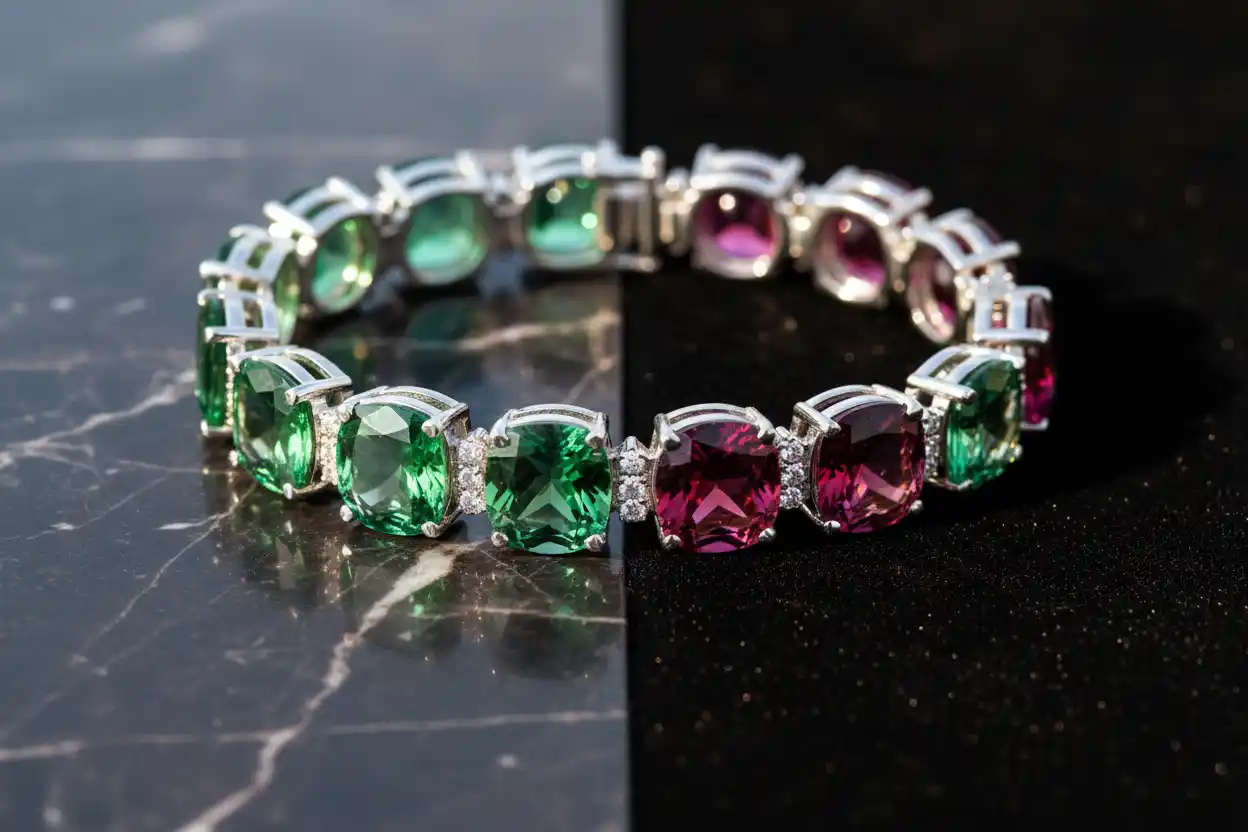
An alexandrite bracelet places one of the gem world’s most distinctive color-change effects on a piece of jewelry that is constantly moving through different lighting conditions. Fine alexandrite may appear green or bluish green in daylight-type illumination and shift toward red, purplish red or raspberry tones under warmer light.
That movement makes an alexandrite bracelet different from a pendant or stationary display gem. As your wrist moves between daylight, indoor lamps and shadow, the stones can reveal changing colors from moment to moment.
The bracelet format also creates unique buying challenges. A natural alexandrite bracelet may require several stones that coordinate not only in size and shape but also in daylight color, warm-light color, saturation and strength of change. The bracelet must then keep those expensive stones secure through flexible links, dependable settings and a clasp that survives repeated opening and closing.
The best alexandrite bracelet therefore balances five things:
gem quality, matching, construction, fit and authenticity.
Alexandrite Bracelet at a Glance
| Factor | What to Look For |
|---|---|
| Gem identity | Natural or clearly disclosed laboratory-grown alexandrite |
| Mineral | Color-change variety of chrysoberyl |
| Hardness | About 8.5 Mohs |
| Main optical feature | Light-dependent color change |
| Daylight-type color | Ideally attractive green to bluish green |
| Warm-light color | Ideally red to purplish red |
| Matching | Coordinated size, cut, tone and color-change behavior |
| Strong bracelet settings | Bezel or well-made prong settings |
| Best fit | Comfortable movement without excessive sliding or snagging |
| Clasp | Secure, durable and appropriate for bracelet weight |
| Best daily-wear concern | Repeated wrist impact and setting wear |
| Main buying risk | Synthetic or imitation material represented as fine natural alexandrite |
| Best documentation | Independent gemological report for significant natural pieces |
Why Alexandrite Works So Well in a Bracelet
Alexandrite is the color-change variety of chrysoberyl, a beryllium aluminum oxide mineral. Its remarkable optical behavior is the defining reason to choose an alexandrite bracelet rather than simply another green or red gemstone design.
The mineral itself is covered in more depth in the alexandrite meaning and properties guide, while its relationship with ordinary chrysoberyl is explained separately in the chrysoberyl guide.
For bracelet buyers, the important feature is movement.
A ring usually displays one principal gemstone. A pendant remains relatively stable against the chest. An alexandrite bracelet constantly changes orientation as the wrist turns.
That movement can make differences in lighting especially obvious.
A bracelet may look predominantly green beside a bright window, mixed green-purple while moving through indoor daylight, and noticeably redder under warm evening illumination.
This shifting appearance is part of its appeal.
Natural Alexandrite Bracelet vs. Lab-Grown Alexandrite Bracelet
One of the first decisions is whether you want natural or laboratory-grown stones.
Natural alexandrite formed geologically and is exceptionally scarce in fine quality.
Laboratory-grown alexandrite is manufactured under controlled conditions. Genuine synthetic alexandrite is still chrysoberyl and can reproduce the physical and optical behavior of natural alexandrite remarkably well.
Origin is the critical difference.
This becomes particularly important in a bracelet because multiple matched natural stones can be difficult to assemble.
A natural alexandrite bracelet containing seven, fifteen or even dozens of well-matched gems may require substantial sourcing effort and cost.
Laboratory-grown material makes it easier to create:
larger stones, stronger uniform color change, closely matched suites and full tennis-bracelet layouts.
That does not make laboratory-grown material undesirable.
It simply belongs to a different rarity and value category.
A seller should state the origin clearly.
For authentication issues, real vs. fake alexandrite explains the distinctions among natural alexandrite, synthetic chrysoberyl and color-changing imitation materials.
A Simulant Is Not Lab-Grown Alexandrite
This distinction deserves special attention.
A laboratory-grown alexandrite bracelet should contain synthetic color-change chrysoberyl if the stones are truly alexandrite.
A simulant is different.
Color-changing synthetic sapphire, glass or another material can imitate alexandrite’s appearance without being chrysoberyl.
Older jewelry creates a particular identification challenge because color-change synthetic corundum has historically appeared in pieces described casually as alexandrite.
Therefore:
Color change alone does not prove that a bracelet contains alexandrite.
This becomes increasingly important as the number and apparent quality of stones increase.
A large alexandrite bracelet containing numerous clean stones with spectacular green-to-red change at a surprisingly low price deserves careful verification.
Color Change Is the First Quality Factor
The defining feature of an alexandrite bracelet is not simply green color or rarity.
It is color change.
When evaluating a bracelet, examine both sides of the phenomenon.
First ask:
How attractive are the stones under daylight-type illumination?
Then ask:
How attractive are they under warm light?
Finally:
How different are those two appearances?
Fine alexandrite is traditionally prized when an attractive green or bluish-green color shifts toward an attractive red or purplish-red color.
Not every natural stone achieves that ideal.
Some stones shift from olive green to brownish red.
Others move from yellow-green to purple.
Some display only partial color change.
A technically genuine alexandrite bracelet can therefore be much less visually compelling than another bracelet containing smaller but better-color-changing stones.
Test the Entire Bracelet Under Two Lighting Conditions
Do not judge an alexandrite bracelet from one photograph.
Ideally, view the actual piece under at least two clearly different lighting conditions.
Use a daylight or daylight-equivalent source first.
Then use warmer illumination.
Rotate the bracelet slowly.
Pay attention to whether all stones respond similarly.
Modern lighting complicates evaluation because two LED lamps can have very different spectral characteristics even when both appear white to your eyes.
This is why the simplistic phrase “green by day, red by night” should not be interpreted literally.
Alexandrite responds to the spectral composition of the light source, not to the clock.
For an online purchase, continuous video under different lights is often more informative than dramatically edited side-by-side photographs.
Matching Matters More in an Alexandrite Bracelet
Matching is one of the most important features that separates an alexandrite bracelet from other alexandrite jewelry.
A bracelet containing one alexandrite only needs one stone to perform beautifully.
A tennis bracelet may need twenty or more.
Each gem can vary in:
- dimensions;
- shape;
- cutting;
- daylight color;
- warm-light color;
- saturation;
- tone;
- clarity;
- and degree of color change.
Imagine an alexandrite bracelet where most stones become purplish red under warm light but several remain brown or green.
Every stone could be natural.
The bracelet may still look poorly matched.
The goal is not perfect laboratory-like uniformity. Minor natural variation can be attractive.
The goal is visual harmony.
Why Matched Natural Alexandrite Can Be Expensive
Matching several rare stones is substantially harder than finding one acceptable gem.
Suppose a dealer has ten natural alexandrites of similar weight.
Three may be too yellow in daylight.
Two may become brown under warm light.
Another may be too dark.
One may have noticeably different dimensions.
One may be strongly included.
Only two might actually match.
A fine natural alexandrite bracelet therefore represents not only total carat weight but also the difficulty of assembling a coherent suite.
This is why buying several small matched natural stones can sometimes be more challenging than buying one larger stone of equivalent total weight.
Alexandrite Tennis Bracelet
A tennis-style alexandrite bracelet uses a continuous or nearly continuous row of individually set stones.
This design shows the color-change phenomenon especially well because the entire line can shift as lighting changes.
It is also the most demanding style to buy correctly.
A natural alexandrite tennis bracelet requires extensive matching, and every additional gemstone creates another setting that must remain secure.
Pay particular attention to articulation.
Each link should move smoothly without feeling loose.
The bracelet should curve naturally around the wrist rather than forming stiff angles.
Turn it over.
Inspect the underside.
The galleries and joints should look clean and consistent rather than thin, distorted or roughly repaired.
For a valuable natural bracelet, construction quality is just as important as gemstone quality.
Alexandrite Station Bracelet
A station alexandrite bracelet spaces individual stones along a chain or flexible metal structure.
This can be an excellent strategy when your budget prioritizes natural stones.
Instead of purchasing a long row of smaller commercial-quality gems, you can use fewer stones and allocate more of the budget to stronger color change.
A station design also creates visual separation between gemstones.
That makes each alexandrite easier to appreciate individually.
Bezel-set stations are particularly practical because the metal can protect the stone edges while reducing snagging.
Check that each station faces reasonably well when the bracelet is worn. Poorly balanced stations may repeatedly flip to show the metal back rather than the gemstone.
Bezel-Set Alexandrite Bracelet
A bezel surrounds most or all of a gemstone’s perimeter with metal.
For an alexandrite bracelet intended for frequent wear, this is one of the most practical setting choices.
Bracelets receive constant contact with desks, counters, bags, sleeves and other surfaces.
A bezel can shield exposed edges from some of those impacts.
It also eliminates projecting prong tips that may catch on knitted clothing.
The trade-off is visual.
A heavy bezel can make small alexandrites look even smaller.
Too much metal can also reduce the open appearance of a delicate bracelet.
Good design uses enough metal for security without visually burying the stones.
Prong-Set Alexandrite Bracelet
Prongs expose more of each gemstone.
This can make a row of small alexandrites look brighter and more open.
It also allows stones to sit relatively close together in a tennis-style alexandrite bracelet.
The main concern is maintenance.
A bracelet may contain dozens of individual prongs.
One bent, worn or lifted prong can eventually release an expensive stone.
Run a fingertip very gently over a pre-owned bracelet and look for obvious catches, but do not pull or bend the prongs yourself.
A jeweler can examine whether each stone remains properly seated.
Prong-set designs deserve regular inspection if worn often.
Chain and Centerpiece Alexandrite Bracelet
A fine chain with one central alexandrite can provide a much more accessible route into natural alexandrite jewelry.
The advantage is concentration.
Instead of dividing the budget across many stones, you can prioritize one gem with stronger color change.
The chain must still match the weight of the centerpiece.
An extremely thin chain attached to a substantial gemstone setting can create a weak point.
Check the soldered connections between the central element and chain.
The transition should be smooth and mechanically sensible rather than decorative only.
Alexandrite Charm Bracelet
An alexandrite charm bracelet creates more movement than most other designs.
That movement can showcase color change—but it also increases contact.
A gemstone charm may strike:
other charms, metal links, tables, door frames and hard surfaces.
For this reason, dangling alexandrite elements should ideally have protective mountings rather than exposed girdles.
Also examine how the charms interact with one another.
A diamond-set charm can potentially scratch neighboring materials.
Alexandrite is hard, but no precious bracelet should be designed so that its components repeatedly collide during normal wear.
How Durable Is an Alexandrite Bracelet?
Alexandrite has Mohs hardness around 8.5, which gives it strong resistance to everyday scratching compared with many colored gemstones.
That makes it a practical jewelry material.
However, hardness is not immunity from damage.
Chrysoberyl is still brittle and can chip or break under sufficiently strong impact. Crystal cleavage and existing fractures also matter when evaluating an individual stone.
Bracelets face a particular problem: the wrist regularly contacts hard objects without the wearer noticing.
Typing at a desk, reaching into a bag or resting your wrist on a counter can create repeated contact.
Therefore, the practical durability of an alexandrite bracelet depends on both the stones and the construction.
Secure links and settings are essential.
Bracelet Wear Is Different From Ring Wear
An alexandrite ring concentrates exposure on one finger and usually one principal gemstone.
A bracelet spreads risk differently.
It may contain many small stones and dozens of moving joints.
The gemstones themselves may experience fewer direct frontal impacts than a high-set ring, yet the bracelet has more mechanical components that can wear.
This changes maintenance priorities.
With a ring, prongs around the center stone may receive most attention.
With a bracelet, you must consider:
every setting, every hinge, every connecting link, the clasp and any safety mechanism.
A strong gemstone cannot compensate for a failing bracelet link.
Get the Alexandrite Bracelet Fit Right
Fit is not merely cosmetic.
An alexandrite bracelet that is too tight may pinch the wrist and place unnecessary tension on links and clasp components.
One that is too loose may rotate excessively, strike objects more frequently or even slide over the hand.
Measure the wrist where you normally want the bracelet to sit.
Then consider the bracelet’s construction.
A thin chain follows the wrist closely.
A wide tennis bracelet has more physical thickness and may need additional internal circumference.
A rigid or semi-rigid design behaves differently again.
There is no universal extra-length measurement that works perfectly for every construction.
Fit should be judged on the finished bracelet.
Close, Comfort or Loose Fit?
A close fit sits near the wrist without compressing the skin.
This can suit delicate chain or station bracelets and reduces excessive movement.
A comfort fit allows moderate movement and is usually practical for stone-set designs.
A loose fit creates more drape but also more motion.
For a valuable natural alexandrite bracelet, extreme looseness is rarely the most secure choice.
You want enough room to move naturally without allowing the bracelet to travel constantly across the hand or catch easily on objects.
Bracelet Width Changes the Fit
Do not choose length without considering width.
A narrow chain bracelet and a wide rigid line bracelet can both have the same nominal length yet feel very different.
A wide alexandrite bracelet occupies more space around the wrist.
The inner circumference becomes the measurement that matters.
If buying online, ask for both:
overall bracelet length and usable inner circumference when fastened.
This is particularly helpful for substantial tennis bracelets and vintage pieces.
The Clasp Deserves Serious Attention
A valuable alexandrite bracelet is only as secure as its clasp.
Common designs can include box clasps, lobster clasps and other jewelry-specific mechanisms.
The best choice depends on weight and construction.
What matters is that the clasp closes positively and does not release from a small accidental push.
For a high-value tennis bracelet, a secondary safety feature can provide additional reassurance.
Examples include a safety latch or appropriately designed safety chain.
However, a safety feature does not make a worn primary clasp acceptable.
It is backup protection, not a substitute for repair.
Inspect Bracelet Links and Hinges
Flexible gemstone bracelets depend on many small mechanical connections.
Look closely at the links.
They should move freely but not appear excessively stretched.
A stiff joint can place stress on neighboring components.
An overly loose joint can indicate wear.
On a pre-owned alexandrite bracelet, inspect areas nearest the clasp especially carefully because repeated fastening can concentrate wear there.
Any section that appears thinner than neighboring links deserves professional evaluation.
With expensive natural alexandrite, preventative maintenance can be far cheaper than replacing a lost matched stone later.
Choosing Metal for an Alexandrite Bracelet
Metal affects appearance, durability and total price.
White gold and platinum can emphasize cool daylight colors.
Yellow gold can create warmer contrast when the alexandrite shifts toward red or purple.
Rose gold can complement warm-light tones particularly well.
These are aesthetic effects rather than rules.
The gemstone should still look attractive in both lighting environments.
Construction matters more than color preference alone.
A well-made bracelet in a suitable alloy is preferable to an elaborate design built with fragile links.
If the bracelet contains large numbers of natural alexandrites, the metalwork should be appropriate for the value of the stones it is protecting.
Alexandrite With Diamond Accents
Diamonds can create strong contrast around alexandrite.
Their neutral appearance allows the color change to remain visually dominant.
Small diamond halos can also make modest natural alexandrites appear larger without requiring larger center stones.
But accents create another consideration.
Diamond is harder than alexandrite.
A properly constructed bracelet keeps stones from rubbing directly against one another during articulation.
Poor spacing can allow hard diamond edges to contact neighboring gems or settings.
Inspect how the bracelet behaves when bent naturally around the wrist.
Choosing Stone Shapes
Round stones are especially practical for a multi-stone alexandrite bracelet because matching symmetrical outlines is relatively straightforward.
Ovals can provide more face-up spread and work well in station designs.
Cushions create a softer geometric appearance.
Pear and marquise shapes can produce more distinctive patterns but introduce vulnerable points that need protective setting design.
The best shape is the one that preserves attractive color change while fitting the bracelet architecture securely.
Rare alexandrite rough is often cut to preserve weight, so individual stones may not follow standardized proportions perfectly.
Face-up appearance matters more than theoretical cutting perfection.
Natural Variation Is Acceptable
A fine natural alexandrite bracelet does not require every stone to look like a machine-made duplicate.
Small differences can be normal.
The question is whether those differences create character or visual disorder.
Slight variation in green tone may be acceptable if the stones still shift cohesively under warm light.
Minor differences in shape can work in intentionally graduated designs.
But one dark brown stone in an otherwise lively green row may distract noticeably.
Evaluate matching at normal viewing distance before studying individual differences under magnification.
The bracelet is a complete composition.
Alexandrite Bracelet Price
The price of an alexandrite bracelet can vary dramatically.
Natural alexandrite is scarce, and value increases quickly when attractive color change, transparency, good size and strong overall quality occur together.
A bracelet introduces another premium: matching.
A row of well-coordinated natural alexandrites can be more difficult to source than the same total weight represented by unrelated loose stones.
Other price factors include:
total alexandrite weight, individual stone size, strength of color change, color quality, clarity, cutting, documented origin, metal, accent stones, construction and maker.
The dedicated alexandrite price guide covers current market valuation separately.
For the bracelet itself, focus on whether the total price makes sense for the identity and quality of the stones plus the craftsmanship of the finished piece.
Smaller Stones Can Be the Better Choice
Natural alexandrite becomes increasingly scarce as individual gem size rises.
This creates an advantage for bracelets.
A design using several small stones can produce a substantial total visual effect without requiring one exceptionally large alexandrite.
Small stones may also offer lively color.
Do not assume a bracelet with tiny alexandrites is automatically low quality.
Evaluate:
color change, matching, clarity, brightness and construction.
A beautifully matched row of smaller natural stones can be far more attractive than a bracelet built around larger but muddy or poorly matched gems.
Laboratory Reports and Documentation
For a significant natural alexandrite bracelet, independent documentation is valuable.
A report can help establish whether tested stones are natural alexandrite rather than synthetic chrysoberyl or another color-changing material.
Multi-stone bracelets create a practical complication because testing every small stone individually may be expensive or technically inconvenient.
Ask exactly what the documentation covers.
Does it describe the entire bracelet?
One representative gemstone?
Several stones?
A detachable center stone?
Do not assume a report for one gem proves that every stone in a large bracelet has identical origin.
The broader alexandrite buying guide explains the purchase criteria for important loose and set stones.
Be Careful With Vintage Alexandrite Bracelets
Vintage jewelry can be appealing, but age does not authenticate alexandrite.
Some older color-change jewelry contains synthetic corundum or other materials historically marketed using alexandrite-related terminology.
The metal can be genuinely old.
The bracelet can be beautifully made.
The family history can be sincere.
The stones can still be something other than natural alexandrite.
Hallmarks establish information about metal, maker or period where interpretable.
They do not independently identify gemstones.
For a valuable vintage alexandrite bracelet, gemological examination is worthwhile before paying a substantial natural-alexandrite premium.
Alexandrite Bracelet as June Birthstone Jewelry
Alexandrite is one of the recognized June birthstones alongside pearl and moonstone.
That makes an alexandrite bracelet a distinctive birthday or anniversary gift.
It also offers a practical advantage over some alternative June birthstone materials because chrysoberyl is substantially harder than pearl and moonstone.
However, a mixed June-birthstone bracelet needs to be cared for according to the most delicate component.
A bracelet combining alexandrite with pearls, for example, should not be cleaned as though every component had alexandrite’s durability.
The broader June birthstone jewelry guide compares those material differences.
Alexandrite Bracelet vs. Earrings or Necklace
An alexandrite bracelet emphasizes movement.
An alexandrite earrings pair creates a different matching challenge: two stones should coordinate closely because the viewer naturally compares left and right.
An alexandrite necklace receives less repeated impact and allows a single fine gem to become the focal point.
The bracelet is mechanically more complex.
It requires attention to fit, links, clasp and repeated surface contact.
Choose the form based on how the jewelry will actually be worn rather than assuming one alexandrite design is universally better.
How to Clean an Alexandrite Bracelet
Routine cleaning should be gentle.
For a structurally sound piece, lukewarm water, mild soap and a soft brush can remove skin oil and everyday residue.
Pay particular attention to the underside of the stones, where lotion and debris can reduce brightness.
The bracelet format requires additional care around:
links, hinges, clasp cavities, galleries and safety mechanisms.
Rinse carefully and dry thoroughly with a soft cloth.
Avoid harsh chemical cleaners and abrasive compounds.
If the bracelet contains fracture-filled stones, delicate accent gems, pearls, antique components or uncertain treatments, use a more conservative method.
The dedicated guide to cleaning alexandrite jewelry safely covers the procedure in greater detail.
When to Have the Bracelet Professionally Checked
A frequently worn alexandrite bracelet should be inspected periodically.
You do not need to wait until a gemstone feels loose.
Look for:
- thinning prongs;
- lifted prong tips;
- loose links;
- distorted hinges;
- worn clasp components;
- rattling stones;
- cracks in solder joints;
- missing safety parts.
If the bracelet contains many matched natural alexandrites, losing one stone can create an additional problem: the replacement must visually match the remaining suite.
Preventative inspection is therefore especially valuable.
How to Store an Alexandrite Bracelet
Fasten the clasp before storage so the bracelet does not become tangled.
Lay flexible stone-set designs flat or in a gentle curve rather than forcing them into a tight fold.
Keep the bracelet separate from diamond and sapphire jewelry that could scratch it.
A fabric-lined compartment or soft individual pouch works well.
Avoid allowing chains to wrap around prongs.
Store laboratory reports, receipts and provenance documentation separately in a safe location rather than permanently inside the jewelry box where they can be lost with the bracelet.
Alexandrite Bracelet Buying Checklist
Before purchasing an alexandrite bracelet, confirm the following.
Identity: Is the material natural alexandrite, laboratory-grown alexandrite or a simulant?
Color change: Is the change clearly visible under genuinely different light sources?
Matching: Do multiple stones coordinate in both lighting conditions?
Cut: Are the stones lively rather than heavily windowed or dark?
Condition: Are chips, fractures and repairs disclosed?
Settings: Are every stone and every prong or bezel secure?
Links: Does the bracelet articulate smoothly without excessive looseness?
Clasp: Does it close positively and remain secure?
Fit: Is the bracelet comfortable without excessive movement?
Metal: Is the construction substantial enough for the stone weight and value?
Documentation: What exactly has been independently tested?
Price: Does the cost make sense for natural or laboratory-grown origin and the actual stone quality?
This checklist is far more useful than choosing an alexandrite bracelet because a listing simply describes it as “rare,” “Russian” or “100% color change.”
Frequently Asked Questions
Is an alexandrite bracelet good for everyday wear?
An alexandrite bracelet can be suitable for frequent wear because alexandrite has high hardness and generally strong jewelry durability. However, bracelets experience repeated contact and contain moving links, settings and clasps, so construction and maintenance remain essential.
What color should an alexandrite bracelet be?
Fine alexandrite is traditionally prized when it appears attractive green to bluish green under daylight-type illumination and shifts toward red or purplish red under warmer light. Natural stones can show other combinations, including olive, purple and brownish tones.
Does every alexandrite bracelet turn from green to red?
No. Natural alexandrite varies. Some stones show partial change or less desirable combinations such as olive-to-brown or yellow-green-to-purple.
Why are natural alexandrite bracelets expensive?
Natural alexandrite is rare, and bracelets often require several stones matched for size, color, cut, clarity and color-change behavior. Creating a coherent suite can be much harder than sourcing one stone.
Is a lab-grown alexandrite bracelet real alexandrite?
If the gemstones are genuine synthetic chrysoberyl with alexandrite color-change characteristics, they are laboratory-grown alexandrite. Their origin is manufactured rather than geological and must be disclosed clearly.
Is synthetic alexandrite the same as an imitation?
No. Synthetic alexandrite is laboratory-grown chrysoberyl. An imitation can be another material, such as color-change synthetic corundum or glass, used to resemble alexandrite.
What is the best setting for an alexandrite bracelet?
Bezel settings provide excellent protection and reduce snagging. Well-made prong settings expose more of the stones and work well in tennis bracelets but require periodic inspection.
Is an alexandrite tennis bracelet practical?
Yes, provided the settings, links and clasp are well constructed. Natural tennis bracelets can be expensive because assembling many visually matched alexandrites is difficult.
Should every stone in an alexandrite bracelet match perfectly?
Perfect duplication is unnecessary for natural gems. However, stones should coordinate reasonably in dimensions, daylight color, warm-light color, saturation and strength of change.
How should an alexandrite bracelet fit?
It should allow normal wrist movement without pinching while remaining secure enough that it does not constantly slide over the hand, snag or strike surrounding surfaces.
Should an alexandrite bracelet be loose?
A slightly relaxed fit can be comfortable, but excessive looseness increases movement and snagging. Stone-set bracelets generally benefit from a controlled comfort fit.
How do I measure for an alexandrite bracelet?
Measure around the wrist at the intended wearing position, then account for the width and construction of the bracelet. Wide tennis bracelets may require more internal room than thin chains.
What clasp is best for an expensive alexandrite bracelet?
The best clasp is one appropriately sized for the bracelet that closes securely and resists accidental opening. High-value pieces may also benefit from a properly designed secondary safety mechanism.
Can alexandrite bracelets get scratched?
Alexandrite is hard at about Mohs 8.5, so it resists scratching well. However, harder materials such as diamond can scratch it, and severe impact can still chip a gemstone.
Can I shower with an alexandrite bracelet?
Routine showering is unnecessary and can expose the jewelry to soap residue, shampoos and repeated moisture around settings and links. Removing valuable jewelry before bathing is the safer habit.
Can I swim wearing an alexandrite bracelet?
It is better to remove it. Swimming increases the risk of loss, while chlorine, saltwater and repeated movement can affect metals, settings and other components.
How do I clean an alexandrite bracelet at home?
For a sound piece with no delicate companion stones or problematic treatments, use lukewarm water, mild soap and a soft brush, then rinse and dry thoroughly. Pay attention to residue around the undersides of stones and clasp.
Should I use an ultrasonic cleaner?
Hand cleaning is the safer default when treatment history, fractures, repairs or mixed gemstones are present. Valuable antique or complicated bracelets should be evaluated before mechanical cleaning.
Does an alexandrite bracelet need a laboratory report?
For a significant natural-alexandrite purchase, independent gemological documentation can substantially reduce uncertainty about identity and natural versus laboratory-grown origin.
Does one laboratory report prove every stone in the bracelet is natural?
Not necessarily. Read what the document actually covers. A report for one representative stone does not automatically establish the origin of every gem in a large multi-stone bracelet.
Are vintage alexandrite bracelets always natural?
No. Some vintage color-change jewelry contains synthetic corundum or other substitutes. Age, hallmarks and family history do not independently authenticate the gemstones.
Is Russian alexandrite always more valuable?
Documented Russian origin can carry historical prestige, but gemstone quality still matters. A weak-color-change stone should not automatically outrank a better alexandrite from another source.
Is a larger alexandrite bracelet always better?
No. Strong matching, attractive color change, secure construction and good fit matter more than simply maximizing total carat weight.
Are small alexandrites valuable in bracelets?
They can be. Small natural alexandrites with attractive color change can be desirable, particularly when a bracelet contains a well-matched group.
Can an alexandrite bracelet be resized?
It depends on construction. Chain and some link bracelets may be easier to adjust than continuous stone-set tennis designs. Removing or adding links can also affect gemstone matching and design symmetry.
What should I inspect on a pre-owned alexandrite bracelet?
Check every setting, link, hinge and clasp. Look for chipped stones, replacement gems with mismatched color change, worn prongs, repaired links and documentation that actually applies to the piece.
Is an alexandrite bracelet a good June birthday gift?
Yes. Alexandrite is a June birthstone, and a bracelet can be a meaningful option for someone who appreciates color-changing gemstones. Verify wrist size or choose an adjustable design when the fit is uncertain.
What Makes a Good Alexandrite Bracelet?
A good alexandrite bracelet is not simply a collection of expensive stones.
The gemstones should work together.
Their daylight colors should look intentional.
Their warm-light colors should remain harmonious.
Their color-change behavior should be visible rather than exaggerated only in seller photographs.
The settings should protect the stones.
The links should move smoothly.
The clasp should remain secure.
The fit should allow comfortable wrist movement without unnecessary swinging or snagging.
And the description should tell you clearly whether the alexandrite is natural, laboratory-grown or another material entirely.
For a natural alexandrite bracelet, matching deserves particular attention because assembling several fine stones is one of the most difficult parts of creating the piece.
For a laboratory-grown alexandrite bracelet, the emphasis shifts toward craftsmanship, visual quality and accurate disclosure rather than geological rarity.
In both cases, the same principle applies:
buy the bracelet as a complete piece of jewelry, not simply as a carat total.
The color-changing stones create the attraction.
Matching makes the design coherent.
Fit makes it wearable.
And secure settings, links and clasp are what allow an alexandrite bracelet to remain enjoyable long after the first dramatic change from green to red has caught your attention.