Alexandrite Necklace: Styles, Lengths & Buying Tips
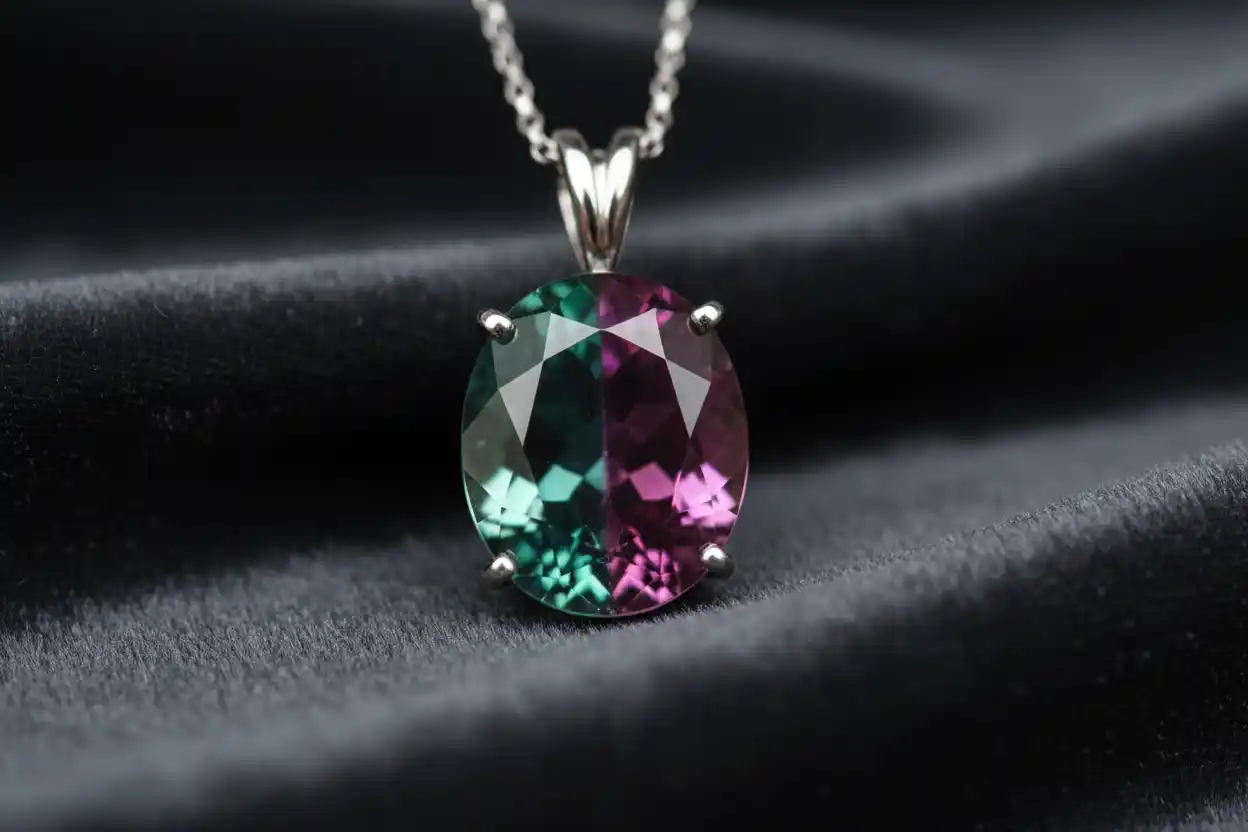
An alexandrite necklace places one of the gem world’s most distinctive color-change effects where it can move constantly between daylight, indoor illumination, shadow and reflected light from clothing. Fine alexandrite may appear green or bluish green under daylight-type illumination and shift toward red, purplish red or raspberry tones under warmer light.
That optical effect makes an alexandrite necklace visually unusual, but color change is only one part of choosing the piece well.
A necklace has its own practical requirements. Pendant weight must suit the chain. The bail needs enough strength to support the setting. The clasp must remain secure. Chain length determines where the stone sits and how often it rubs against clothing. Multi-stone designs introduce matching challenges that do not exist with a single pendant.
Natural versus laboratory-grown origin also changes the buying decision dramatically.
Fine natural alexandrite is rare, particularly in larger transparent sizes with attractive color on both sides of the change. Laboratory-grown alexandrite can provide larger, cleaner and more dramatic stones at a very different price level.
The best alexandrite necklace therefore balances:
color change + gemstone identity + pendant construction + chain strength + length + wearability.
Alexandrite Necklace at a Glance
| Factor | What to Look For |
|---|---|
| Gem material | Natural or clearly disclosed laboratory-grown alexandrite |
| Mineral species | Color-change chrysoberyl |
| Mohs hardness | About 8.5 |
| Toughness | Excellent |
| Cleavage | None |
| Defining optical feature | Change in apparent color under different light sources |
| Strong natural color change | Green/bluish green toward red/purplish red |
| Practical necklace styles | Solitaire, bezel, halo, drop, station and multi-stone |
| Main pendant concern | Secure setting and properly sized bail |
| Main chain concern | Strength appropriate for pendant weight |
| Main closure concern | Reliable clasp and sound connecting rings |
| Main fit consideration | Where the pendant sits relative to neckline and clothing |
| Main authenticity concern | Synthetic alexandrite or simulants sold as fine natural material |
| Best care method | Gentle soap, lukewarm water and careful drying |
| Main buying principle | Prioritize color change and construction over size alone |
Why Alexandrite Works Well in a Necklace
Alexandrite is the color-change variety of chrysoberyl. Its ideal chemical composition is BeAl₂O₄, and chromium is primarily responsible for the color behavior prized in fine stones.
With Mohs hardness around 8.5, excellent toughness and no cleavage, alexandrite is physically well suited to jewelry.
The broader alexandrite meaning and properties guide covers the mineral itself, while an alexandrite necklace creates a more specific practical situation.
A pendant normally experiences less impact than a ring.
It also avoids many of the repetitive knocks that affect a bracelet.
That makes an alexandrite necklace an attractive format for a valuable natural gemstone.
The necklace introduces different weak points instead.
A durable alexandrite can still be lost if:
the bail opens;
a jump ring separates;
the chain breaks;
a prong wears down;
or the clasp fails.
For an alexandrite necklace, the gemstone may be the most valuable component, but the smallest metal connection can determine whether you keep it.
Color Change Is the First Gemstone Quality to Evaluate
Do not begin by asking how many carats an alexandrite necklace contains.
Begin with the color change.
Fine alexandrite is traditionally prized when it looks attractive in both cooler daylight-type illumination and warmer light.
A desirable natural stone might appear:
green;
bluish green;
or teal-green
under one light, then move toward:
red;
purplish red;
raspberry;
or reddish purple
under another.
Natural alexandrite does not always produce a textbook emerald-green to ruby-red transformation.
Some stones change from olive green to brownish red.
Others move from yellow-green to purple.
A genuine alexandrite necklace can therefore contain a real natural stone while showing a less valuable color change.
Identity and quality are separate questions.
Strong Color Change vs. Attractive Color Change
A dramatic change is valuable only if both resulting colors are attractive.
Imagine two stones.
The first shifts strongly from muddy yellow-green to dark brown-red.
The second shifts somewhat less dramatically from lively bluish green to attractive raspberry purple.
The second alexandrite necklace may be visually preferable even if the numerical degree of change is lower.
This is why judging alexandrite by a percentage alone can be misleading.
Ask three questions:
How attractive is the stone under daylight-type light?
How attractive is it under warm light?
How clearly different are those two appearances?
The combination matters.
Test the Actual Alexandrite Necklace Under Different Lights
A single photograph is not enough.
Alexandrite responds to the spectral composition of illumination.
It does not literally change because the sun has set.
The familiar description “green by day, red by night” is shorthand.
Modern LED lighting makes evaluation more complicated because two bulbs that appear similarly white to your eyes can produce different gemstone responses.
When examining an alexandrite necklace in person, move the actual piece between noticeably different light sources.
Observe the pendant rather than relying only on a seller’s comparison photographs.
For online buying, ask for video of the exact gemstone or exact necklace.
A continuous recording is particularly useful because it makes dramatic editing or substitution more difficult.
Clothing Can Affect How the Color Looks
An alexandrite necklace sits against skin, fabric or both.
That makes background color more relevant than it is for some other jewelry forms.
A dark green shirt can reduce contrast with the daylight appearance of alexandrite.
A white or neutral neckline may make the color easier to judge.
Red, burgundy or purple fabric can visually reinforce the warmer side of the color change.
This does not mean the clothing changes alexandrite’s mineral properties.
It changes the visual environment around the stone.
Reflected light from nearby surfaces can also influence what your eyes perceive.
When deciding whether an alexandrite necklace looks good on you, evaluate it against clothing you actually expect to wear.
Alexandrite Solitaire Necklace
A solitaire alexandrite necklace uses one principal gemstone.
For natural alexandrite, this is often the most rational design.
Instead of dividing the budget across several stones, you can concentrate it on one better gem.
That may allow you to prioritize:
stronger color change;
more attractive daylight color;
better warm-light color;
greater transparency;
or better cutting.
A solitaire also makes the optical phenomenon easier to observe.
There is only one alexandrite to evaluate.
You do not need to determine whether neighboring stones match.
For many buyers seeking natural material, one excellent stone is more compelling than several weaker stones with a larger combined carat weight.
Small Natural Alexandrite Can Still Make a Strong Necklace
Fine alexandrite becomes considerably scarcer as size increases.
That creates an important design opportunity.
A small natural gemstone with strong color change can be visually enlarged through intelligent setting design rather than replacing it with a larger but less attractive stone.
A delicate frame, halo or contrasting metal can provide more presence.
The necklace itself also positions the gemstone where it can be noticed without requiring a large face-up size.
Do not dismiss an alexandrite necklace simply because the natural center stone is modest in carat weight.
For rare gemstones, quality frequently matters more than scale.
Bezel-Set Alexandrite Necklace
A bezel surrounds most or all of the gemstone’s perimeter with metal.
For an alexandrite necklace intended for regular wear, this is one of the most practical setting choices.
The metal protects the edges and produces a smooth outline that is less likely to catch on fabric.
A bezel can work particularly well with:
round stones;
ovals;
cushions;
and some cabochon forms.
The main risk is visual.
Too much metal can overwhelm a small alexandrite.
A refined bezel should frame the gemstone rather than make it disappear.
The back construction also matters.
An open back can simplify cleaning and inspection, but an alexandrite does not need a completely open setting in order to show color change.
The phenomenon depends principally on the gemstone and the spectrum of the light reaching it.
Prong-Set Alexandrite Necklace
Prongs expose more of the gemstone.
That can make an alexandrite necklace appear lighter and allow more of the stone’s outline to remain visible.
The number of prongs depends on gemstone shape, size and setting architecture.
More prongs do not automatically mean better construction.
Execution matters.
Each prong should contact the stone securely.
A prong should not:
sit visibly away from the gemstone;
catch easily on clothing;
look excessively thin;
or show obvious wear.
A pendant experiences less direct impact than a ring, but necklaces move continuously against clothes and skin.
A raised prong can catch on a sweater or scarf and gradually distort.
Periodic inspection remains worthwhile.
Alexandrite Halo Necklace
A halo surrounds the alexandrite with smaller accent stones, commonly diamonds.
This can create greater visual presence without requiring a larger natural center stone.
That makes the halo particularly effective for alexandrite.
Fine natural stones become much rarer as size increases, so spending more for a significantly larger center stone can become inefficient.
A smaller but excellent alexandrite surrounded by a proportionate halo may look more impressive than a larger center with weak color change.
However, evaluate the alexandrite independently.
Bright diamond accents can disguise how dark or dull the center stone looks.
Ask yourself whether you would still like the alexandrite if the halo were removed.
The surrounding sparkle should enhance the center.
It should not compensate for poor gemstone quality.
Alexandrite Drop Necklace
A drop alexandrite necklace suspends the gemstone below another decorative element or connecting section.
Movement becomes part of the design.
As the pendant changes angle, you may see:
different pleochroic colors;
changing reflections;
and different expressions of the color-change phenomenon.
The mechanical connection deserves close examination.
A small loop between the upper component and the alexandrite setting may carry the full pendant weight.
Look at:
jump rings;
soldered loops;
hinges;
decorative connectors;
and the point where the bail joins the pendant.
A gemstone with excellent durability can still be lost because one tiny metal component wears through.
Alexandrite Station Necklace
A station alexandrite necklace distributes several gemstones along a chain rather than concentrating them in one central pendant.
This creates a lighter, more continuous look.
It also changes the buying problem.
Multiple natural alexandrites need to coordinate.
They do not have to be perfectly identical, but substantial differences may become distracting.
Compare:
daylight color;
warm-light color;
degree of change;
face-up size;
shape;
tone;
and brightness.
Laboratory-grown alexandrite is particularly practical for station necklaces because closely matched stones are easier to obtain.
Natural stones may display more visible variation.
That variation can still look attractive when it appears deliberate and balanced.
Multi-Stone Alexandrite Necklace
A multi-stone alexandrite necklace can range from three gemstones around a pendant to an elaborate rivière-style row.
This is where natural alexandrite becomes especially demanding.
A ten-stone alexandrite necklace does not merely require ten natural stones.
It requires ten stones that look convincing together.
Every additional gem introduces another set of variables:
color change;
daylight hue;
warm-light hue;
tone;
saturation;
clarity;
cut;
dimensions;
and shape.
One stone that remains olive while all the others become raspberry-red can disrupt the entire composition.
A well-matched natural suite may therefore deserve significant value beyond simple total carat weight.
Alexandrite Necklace Matching Is Different From Earring Matching
Matching requirements depend on jewelry form.
With alexandrite earrings, the two stones are naturally compared because they sit symmetrically on either side of the face.
In a necklace, slight variation can be easier to accommodate.
A graduated design may intentionally place the strongest or largest gemstone at the center while smaller stones change progressively toward the sides.
That gives the designer more flexibility.
However, an apparently symmetrical alexandrite necklace should still look balanced.
If one side becomes dramatically redder or darker than the other, the inconsistency may be obvious.
Alexandrite Necklace Lengths
Length determines where an alexandrite necklace sits, how it interacts with clothing and how visible the gemstone remains.
Common necklace categories provide useful starting points:
| Necklace Style | Approximate Length | Typical Position |
|---|---|---|
| Choker | 14–16 in | High around neck |
| Princess | 17–19 in | Around collarbone |
| Matinee | 20–24 in | Upper chest |
| Opera | 28–36 in | Lower chest |
| Rope | 36+ in | Long, often styled in multiple ways |
These are conventions rather than rigid rules.
Body proportions matter.
Neck circumference matters.
Pendant size matters.
A two-inch pendant on an 18-inch chain will sit visually lower than a tiny gemstone on the same chain.
When purchasing an alexandrite necklace, consider both chain length and total pendant drop.
16-Inch Alexandrite Necklace
A 16-inch alexandrite necklace generally sits relatively high around the base of the neck for many adults.
It can work well with:
small solitaire pendants;
minimalist bezels;
short drops;
and open necklines.
Fit can vary considerably with neck circumference.
A 16-inch chain that sits comfortably on one person may feel almost choker-like on another.
If the alexandrite necklace is valuable, avoid choosing such a tight fit that the chain remains under continuous tension.
Comfort and mechanical stress should both be considered.
18-Inch Alexandrite Necklace
An 18-inch length is one of the most versatile options for many pendant designs.
It often places the gemstone around the collarbone or slightly below, depending on the wearer and pendant size.
This can give the alexandrite enough space to remain visible with many shirts and dresses.
A solitaire alexandrite necklace often works particularly well around this range because the center gemstone remains visually prominent without sitting too high.
Again, actual fit matters more than the number stamped on a product description.
Measure rather than assuming.
20- to 24-Inch Alexandrite Necklace
Longer princess-to-matinee lengths move the alexandrite farther down the chest.
This can work well with larger pendants and more substantial designs.
The gemstone may interact with clothing more frequently.
That creates two considerations.
First, fabric color can change the visual contrast around the alexandrite.
Second, repeated rubbing can deposit lint, skin oil or cosmetic residue on the pendant and chain.
A longer alexandrite necklace may therefore require slightly more attention to cleaning and fabric contact than a short pendant resting primarily against skin.
Long Alexandrite Necklaces
Opera and rope lengths can create dramatic jewelry, but they increase movement considerably.
A long alexandrite necklace can swing when walking, bending or turning.
That movement may make the color-change phenomenon visually interesting.
It can also increase the chance of impact.
Long necklaces can strike:
desk edges;
counters;
seat belts;
bags;
and other jewelry.
If natural alexandrite is mounted in a long design, consider whether the pendant or stations are adequately protected.
Long chains also require stronger attention to snagging and clasp construction.
Chain Length vs. Pendant Drop
One of the easiest online-buying mistakes is looking only at chain length.
Suppose two alexandrite necklaces both use 18-inch chains.
One has a tiny bezel center.
The other has a two-inch drop pendant.
They will not occupy the same visual position.
Ask for:
chain length;
pendant height;
and total drop.
This is especially important when layering an alexandrite necklace with other chains.
Two nominally different necklace lengths can still overlap if one pendant extends downward substantially.
Choosing a Chain for an Alexandrite Necklace
The chain should match the weight and value of the pendant.
A valuable natural alexandrite in a substantial gold setting should not depend on an extremely delicate chain chosen only because it looks unobtrusive.
The chain needs enough strength for:
the pendant;
normal movement;
occasional light snagging;
and repeated wear.
A delicate chain can be appropriate for a tiny solitaire.
A heavy halo or multi-component pendant requires more support.
The goal is balance.
An excessively heavy chain may visually overpower a small alexandrite necklace.
An excessively thin chain can create unnecessary loss risk.
Chain Construction Matters
Several chain styles can support pendant jewelry, but the style name alone does not determine strength.
Metal thickness, manufacturing quality, link integrity and wear matter more.
A cable-style chain can be excellent when adequately made.
Box and wheat chains can provide a more substantial appearance.
Fine chains may suit small pendants.
Regardless of style, inspect the actual construction.
Look for:
stretched links;
thin worn sections;
poorly closed connections;
and areas that have been repeatedly bent.
For an expensive alexandrite necklace, the chain should be treated as a structural component rather than an afterthought.
The Bail Is a Critical Component
The bail connects the pendant to the chain.
It may be one of the smallest visible components in an alexandrite necklace, yet it carries the entire pendant.
Inspect it closely.
The bail opening must be large enough for the chain and any end fittings to pass through when appropriate.
It should also be substantial enough that repeated movement does not quickly wear the metal thin.
Some pendants use fixed bails.
Others use articulated bails that allow more movement.
Both can work well.
Look especially closely at the point where the bail joins the gemstone setting.
A beautiful thick bail is of little value if the soldered connection below it is weak.
Jump Rings Should Not Be Ignored
A jump ring can connect:
the bail;
chain;
clasp;
or extension section.
For valuable jewelry, a poorly closed ring can be a serious weak point.
Look for whether the ends meet properly.
Where appropriate, soldered connections provide greater security than open rings that rely entirely on tension.
Not every part of an alexandrite necklace must be soldered; certain design elements need articulation.
The important point is understanding which component carries weight and how it is secured.
Choosing a Clasp
A clasp should suit the chain weight and necklace value.
Small spring-ring and lobster-style clasps are common.
More elaborate necklaces may use box clasps or decorative closures.
The specific mechanism matters less than how well it functions.
A good clasp should:
close positively;
remain closed during normal movement;
show no obvious distortion;
and connect securely to the chain.
Repeated opening eventually causes wear.
A valuable alexandrite necklace should have its clasp checked if the mechanism becomes easier to open than it used to be.
A clasp that “still works most of the time” is not good enough for an expensive natural gemstone.
Extension Chains and Adjustable Lengths
An adjustable alexandrite necklace can be useful because lighting and clothing affect how the gem looks.
A pendant that sits perfectly with one neckline may disappear under another.
An extension chain gives you flexibility.
However, the extension should be proportionate to the necklace.
A very light extender attached to a heavy pendant chain can become the new weakest point.
If the necklace frequently slides to its longest setting, examine whether the clasp and extension rings are showing concentrated wear.
Adjustability is useful only if the hardware remains secure.
Does an Open-Back Setting Improve Color Change?
An open-back setting can make cleaning and inspection easier.
It can also allow light from behind the stone under certain conditions.
However, alexandrite does not require a completely exposed back to change color.
The phenomenon originates from its absorption behavior under different spectral light sources.
Do not reject a secure bezel or partially enclosed setting because someone claims alexandrite must receive light from every direction.
A well-designed setting balances:
security;
appearance;
maintenance;
and the gemstone’s proportions.
Should the Pendant Flip?
A pendant that repeatedly turns backward can become frustrating.
Some alexandrite necklace designs are more prone to flipping because of:
top-heavy settings;
poor bail positioning;
a high center of gravity;
or an extremely light chain.
A double-bail or integrated-chain design can sometimes stabilize the pendant.
Before buying, wear or simulate the necklace for several minutes if possible.
Move naturally.
Turn your shoulders.
Look down.
A pendant that faces correctly only when perfectly still may not be satisfying in actual wear.
This is especially important for alexandrite because the visible face of the stone is the whole point of the design.
Natural Alexandrite Necklace
A natural alexandrite necklace contains chrysoberyl that formed geologically.
Fine natural material is scarce.
The combination of:
good transparency;
strong color change;
attractive colors;
useful size;
and good cutting
becomes increasingly difficult to find.
Natural origin can therefore account for a large part of value.
However, natural does not automatically mean excellent.
A natural alexandrite necklace with dark brownish colors and weak change may be less visually attractive than a laboratory-grown piece.
Natural origin describes where the crystal formed.
Quality describes how good the gemstone is.
Do not confuse the two.
Laboratory-Grown Alexandrite Necklace
A laboratory-grown alexandrite necklace can provide dramatic color change at a much more accessible price.
True synthetic alexandrite is laboratory-grown chrysoberyl.
It can have essentially the same fundamental composition and many of the same physical and optical characteristics as natural alexandrite.
Laboratory growth makes it easier to obtain:
larger stones;
cleaner stones;
closely matched stones;
and stronger apparent color change.
This can be especially useful for station or multi-stone necklaces.
The requirement is clear disclosure.
A laboratory-grown alexandrite necklace should not be represented in a way that suggests geological rarity.
Synthetic Alexandrite vs. Simulants
Synthetic alexandrite and an imitation are not the same thing.
Synthetic alexandrite is laboratory-grown chrysoberyl.
A simulant is another material used to resemble alexandrite.
Color-change synthetic sapphire is particularly important.
It can show dramatic shifts and has historically appeared in jewelry described using alexandrite-related terminology.
Glass and other manufactured materials can also imitate aspects of the color change.
The real vs. fake alexandrite guide covers these distinctions more deeply.
For an alexandrite necklace, do not accept “color-changing stone” as proof of material identity.
Vintage Alexandrite Necklaces Need Extra Verification
A vintage setting does not prove the alexandrite is natural.
This matters because older color-change synthetic corundum has often been called alexandrite informally.
A necklace may have:
genuine age;
real gold;
excellent craftsmanship;
and authentic family history
while containing a synthetic or imitation color-change stone.
None of those facts contradict each other.
If the price depends heavily on natural alexandrite, have the material examined appropriately.
A vintage simulant may still be attractive and collectible jewelry.
It simply belongs to a different value category.
Alexandrite Treatments
Natural alexandrite is not dominated by routine enhancement to the same degree as several other colored gemstone markets.
However, treatment can occur.
Fracture filling, coating and other modifications should be disclosed where present.
Treatment is different from laboratory growth.
A treated natural alexandrite formed in nature before modification.
A laboratory-grown alexandrite was created synthetically.
A simulant is a different material.
The treated alexandrite guide helps separate these categories.
This distinction matters for both value and care.
Should an Alexandrite Necklace Have a Laboratory Report?
For an inexpensive laboratory-grown piece, extensive gemological documentation may not be economically necessary.
For a significant natural alexandrite necklace, the equation changes.
Independent laboratory examination can provide valuable evidence concerning gemstone identity and natural versus laboratory-grown origin.
For mounted necklaces, read the document carefully.
A report may cover:
one center stone;
a group of stones;
or the complete mounted item, depending on the service.
Do not assume that a report describing one alexandrite proves the origin of every gemstone in a multi-stone necklace.
The scope of the document matters.
Geographic Origin
Historic Russian alexandrite carries significant prestige.
Alexandrite has also been produced from Brazil, Sri Lanka, East Africa and other sources.
Geographic origin can influence collector interest, but it should not replace quality assessment.
A mediocre natural stone does not become exceptional merely because it is Russian.
Likewise, an excellent alexandrite from another source can have superb color change.
Origin claims should be supported appropriately when they contribute a substantial premium.
Do not infer Russian origin solely because a stone has desirable green-to-red colors.
Alexandrite Necklace Price
The price of an alexandrite necklace can vary from accessible laboratory-grown jewelry to exceptionally expensive natural-gem pieces.
The main gemstone value factors include:
natural versus laboratory-grown origin;
strength of color change;
quality of both colors;
stone size;
clarity;
cut;
and documented origin where relevant.
The necklace adds another layer:
metal type;
chain quality;
setting;
accent gems;
craftsmanship;
and brand or designer value.
The dedicated alexandrite price guide focuses on gemstone valuation separately.
For the necklace itself, avoid judging value solely by total carat weight.
One Better Stone vs. Several Weaker Stones
Suppose the same budget buys either:
one smaller natural alexandrite with strong attractive color change;
or several larger combined stones with weak, brownish changes.
Which is better?
There is no universal answer, but buyers seeking the defining alexandrite experience often get more visual value from the single better stone.
That is why solitaire alexandrite necklace designs can be especially efficient.
Multi-stone designs make sense when the stones are intentionally matched and the distributed appearance is part of the goal.
Do not allow a larger total carat figure to replace quality evaluation.
Diamond Accents
Diamonds pair naturally with alexandrite because their neutral appearance does not compete with the center gem’s changing hue.
A diamond halo or small accent can increase visual presence.
However, diamond is harder than alexandrite.
Well-made jewelry prevents stones from rubbing directly against one another.
The construction should keep diamond edges from repeatedly contacting the alexandrite.
Also consider budget allocation.
If most of the cost is going into an elaborate diamond surround while the alexandrite itself has weak color change, the finished necklace may not deliver the effect you wanted.
Choose the center stone first.
Yellow Gold vs. White Gold
Metal color changes the visual frame around an alexandrite necklace.
White gold provides a relatively neutral appearance that works easily with both greenish and reddish colors.
Yellow gold adds warmer contrast.
Green alexandrite can stand out strongly against yellow gold, while the warm-light red side can appear visually integrated with the metal.
Neither is objectively better.
Judge the actual gemstone in the actual setting.
Do not assume one metal color will automatically improve a weak color change.
Rose Gold
Rose gold can complement raspberry, purple and reddish aspects of alexandrite particularly well.
The warmer metal may make the necklace feel softer or more romantic.
However, it can also reduce contrast with the warmer side of some stones.
This is a matter of design rather than quality.
If possible, view the actual alexandrite beside the intended metal before making an expensive custom setting.
Alexandrite’s shifting color means the relationship with metal is less predictable than with a gemstone that always appears the same hue.
Platinum
Platinum can be an appropriate choice for a high-value natural alexandrite necklace.
Its naturally white color provides a neutral frame, while its density can create substantial, durable settings.
The trade-offs are price and weight.
A heavy platinum pendant needs a chain appropriate for that weight.
Do not assume a delicate chain is sufficient simply because the center stone itself is small.
The total pendant mass determines the mechanical requirement.
Alexandrite Necklace as June Birthstone Jewelry
Alexandrite is one of June’s recognized birthstones, alongside pearl and moonstone.
An alexandrite necklace can therefore serve as a June birthday gift while providing greater resistance to scratching and impact than many softer birthstone alternatives.
The June birthstone jewelry guide compares the main options in greater depth.
For gifting, laboratory-grown alexandrite can provide the recognizable color-change effect without the high price of fine natural material.
If natural origin matters to the recipient, make that distinction before purchasing.
Alexandrite Necklace for Anniversaries and Milestones
Alexandrite’s color change gives it natural symbolic appeal for milestone jewelry.
The gemstone can represent adaptability, transition and continuity.
Those ideas are especially appropriate for anniversaries, career changes, graduations or other periods where circumstances have changed while important relationships or values remain.
The symbolism is personal rather than scientific.
You do not need a metaphysical claim for an alexandrite necklace to carry meaning.
Its real optical behavior already provides a strong metaphor.
Alexandrite Necklace vs. Ring
An alexandrite ring places the gemstone on the hand, where it encounters much more frequent impact and abrasion.
A necklace is generally more protected.
The trade-off is hardware complexity.
The ring depends heavily on its shank, setting and prongs.
The alexandrite necklace depends on:
setting;
bail;
chain;
connecting rings;
and clasp.
Choose the form according to how you wear jewelry rather than assuming one is inherently superior.
Alexandrite Necklace vs. Bracelet
An alexandrite bracelet experiences constant wrist movement and repeated contact with surrounding surfaces.
It also commonly contains several stones.
The alexandrite necklace normally experiences less direct impact and can concentrate the budget into one center gemstone.
For someone purchasing their first fine natural alexandrite, that can make a solitaire necklace especially practical.
Jewelry & DIY Context
Alexandrite necklaces belong to a broader group of jewelry decisions where the gemstone and construction must be evaluated together.
The Jewelry & DIY collection covers form-specific considerations across earrings, rings, bracelets, necklaces and other designs.
The key principle remains the same:
a beautiful gemstone cannot compensate for unsafe construction.
For an alexandrite necklace, the chain and bail deserve the same seriousness as the center setting.
Is an Alexandrite Necklace Good for Everyday Wear?
Yes, alexandrite has excellent physical properties for frequent jewelry use.
Its hardness of approximately 8.5 provides strong scratch resistance, and chrysoberyl has excellent toughness with no cleavage.
The necklace format also reduces direct impact compared with rings.
The main everyday risks are:
chain wear;
snagging;
clasp failure;
pendant impact;
cosmetic residue;
and setting wear.
A well-made alexandrite necklace can therefore be worn regularly, but it should not be treated as indestructible.
Should You Sleep in an Alexandrite Necklace?
Removing an alexandrite necklace before sleeping is the safer habit.
The gemstone itself may tolerate ordinary wear well, but the chain can:
tangle;
kink;
catch on bedding;
or place stress on the bail.
Prongs can also catch on fabric.
Sleeping in valuable jewelry creates wear without providing any practical advantage.
Remove the necklace and place it in an appropriate compartment.
Can You Shower With an Alexandrite Necklace?
Sound alexandrite can tolerate ordinary contact with clean water.
The complete necklace creates additional considerations.
Soap can build up beneath the gemstone.
Shampoo and conditioner may leave films.
Repeated exposure can accelerate grime accumulation around the chain and clasp.
Some treatments or companion stones may also require more conservative care.
Removing valuable jewelry before showering is generally easier than repeatedly cleaning residue from it.
Can You Swim With an Alexandrite Necklace?
Remove it before swimming.
Pool chlorine can affect some metals and jewelry components.
Saltwater can leave residue and create additional metal-care concerns.
More importantly, losing a necklace in water can turn a minor clasp problem into a permanent loss.
A natural alexandrite necklace may be difficult or expensive to replace.
The safest swimming jewelry is no valuable jewelry.
Perfume, Cosmetics and Skin Products
Necklaces sit in an area where perfume, sunscreen, foundation, hair products and skin care can contact both gemstone and metal.
These products may leave films that reduce brightness.
Apply perfume or cosmetics first.
Allow them to dry.
Then put on the alexandrite necklace.
This simple sequence reduces direct product buildup on the stone and setting.
It is especially useful for open-back pendants, where residue can collect beneath the gemstone.
How to Clean an Alexandrite Necklace
For a sound untreated alexandrite necklace, gentle hand cleaning is usually straightforward.
Use lukewarm water with a small amount of mild soap.
Clean carefully around the front and back of the gemstone.
A soft brush can help remove residue from accessible setting areas when the construction is secure.
Rinse thoroughly.
Dry with a soft lint-free cloth.
The more detailed alexandrite jewelry cleaning guide covers treatment and setting considerations separately.
For a necklace, inspect the chain and clasp while cleaning.
Cleaning time is a useful opportunity to notice wear before failure occurs.
Ultrasonic Cleaning
Sound untreated alexandrite itself can generally tolerate ultrasonic cleaning.
That does not mean every alexandrite necklace belongs in an ultrasonic machine.
Avoid mechanical cleaning when the piece contains:
fracture-filled material;
loose settings;
delicate companion gemstones;
antique components;
repairs;
or unknown treatments.
A chain with fragile links can also create complications.
Hand cleaning remains the conservative default when the complete construction is uncertain.
How to Store an Alexandrite Necklace
Fasten the clasp before storage to reduce tangling.
Lay the chain flat or in a gentle curve.
Do not wrap it tightly around the pendant.
Store the alexandrite necklace separately from diamond jewelry, which can scratch chrysoberyl.
Alexandrite itself can scratch softer gemstones, so individual compartments are useful.
For delicate chains, hanging storage can work if the necklace is supported safely and cannot strike surrounding objects.
Store laboratory reports, purchase receipts and important provenance separately from the necklace.
How Often Should the Necklace Be Inspected?
There is no fixed inspection schedule appropriate for every piece.
Frequency depends on:
how often you wear it;
how valuable it is;
whether the setting has prongs;
how delicate the chain is;
and whether the necklace has a history of repair.
Inspect it yourself periodically.
Look for:
raised prongs;
loose stones;
thinning bail surfaces;
open rings;
stretched chain links;
and a clasp that no longer closes firmly.
If anything feels different, have the piece evaluated before wearing it again.
Buying an Alexandrite Necklace Online
Online buying requires stronger documentation because you cannot control the lighting or inspect the construction directly.
Ask for images of the exact alexandrite necklace rather than stock photographs.
Request video under distinct light sources.
Confirm:
gemstone dimensions;
carat weight;
natural or laboratory-grown origin;
treatment disclosure;
metal purity;
chain length;
pendant measurements;
clasp type;
and return policy.
For a valuable natural piece, ask what independent documentation accompanies the gemstone.
A vague statement such as “100% real alexandrite” is not enough.
Natural alexandrite, synthetic alexandrite and alexandrite simulants can all be “real stones” in ordinary conversational language.
Gemological terminology needs to be more precise.
Red Flags When Buying an Alexandrite Necklace
Be cautious when a listing combines:
a large center stone;
exceptional clarity;
strong emerald-green to ruby-red change;
claimed natural origin;
rare geographic provenance;
and an unusually low price.
Each of those features adds desirability.
All of them together in a fine natural alexandrite should not be priced like ordinary commercial jewelry.
A low price does not automatically prove fraud.
It does mean the claim deserves stronger verification.
Also be cautious with terms such as:
“alexandrite sapphire”;
“Russian-style alexandrite”;
“created alexandrite” without identifying the material;
or “natural color-change crystal” without a gemological species.
Specific disclosure is more useful than impressive adjectives.
Alexandrite Necklace Buying Checklist
Before buying an alexandrite necklace, confirm the gemstone identity first.
Then evaluate the color change under genuinely different lighting.
Look at whether both colors are attractive rather than concentrating only on how dramatic the transformation appears.
Check the stone’s face-up size, clarity and cutting.
Determine whether the gemstone is natural, laboratory-grown or another color-changing material.
Review any disclosed treatment.
Then inspect the necklace itself.
Make sure the setting is secure.
Examine the bail.
Check chain thickness and condition.
Test the clasp.
Confirm the chain length and pendant drop.
For multi-stone designs, evaluate matching.
For expensive natural material, understand exactly what laboratory documentation covers.
Finally, compare price with genuinely similar pieces.
A well-chosen alexandrite necklace should make sense gemologically, mechanically and financially.
Frequently Asked Questions
Is an alexandrite necklace good for everyday wear?
Yes. Alexandrite has Mohs hardness around 8.5, excellent toughness and no cleavage, making it suitable for frequent jewelry wear. The chain, bail, clasp and setting still need appropriate construction and maintenance.
What is the best alexandrite necklace style?
There is no universal best style. A solitaire concentrates the budget into one stone, a bezel offers strong protection, a halo increases visual presence, and station or multi-stone designs emphasize multiple color-changing gems.
What length is best for an alexandrite necklace?
Around 17–19 inches is versatile for many pendant styles, but the best length depends on neck circumference, body proportions, pendant size and the necklines you wear.
Is an 18-inch alexandrite necklace a good choice?
An 18-inch alexandrite necklace is versatile for many adults and often positions the pendant around the collarbone area. Actual fit varies, so measurement is more reliable than assuming.
Should an alexandrite necklace sit on skin or clothing?
Either can work. Skin provides a relatively neutral background, while clothing can change contrast and reflected light around the gemstone. Choose the length according to how you prefer the pendant to appear.
Does clothing change the color of alexandrite?
Clothing does not change alexandrite’s chemistry, but nearby colors and reflected light can influence how its colors appear to your eyes.
What color should a natural alexandrite necklace be?
Fine alexandrite is traditionally prized for green to bluish-green daylight-type color changing toward red or purplish red under warmer light. Natural stones can show several less textbook combinations.
Does alexandrite always change from green to red?
No. Some natural stones change from olive to brownish red, green to purple or other related combinations. The quality and strength of change vary.
Is a natural alexandrite necklace expensive?
Fine natural alexandrite can be very expensive, especially as individual gemstone size and color-change quality increase. Finished necklace cost also includes metal, chain, setting and craftsmanship.
Is lab-grown alexandrite good for a necklace?
Yes. Genuine laboratory-grown alexandrite can provide strong color change, larger sizes and good durability at a substantially different price from fine natural material.
Is lab-grown alexandrite the same as fake alexandrite?
No. True synthetic alexandrite is laboratory-grown chrysoberyl. A simulant is another material used to imitate alexandrite.
Can synthetic sapphire be sold as alexandrite?
Color-change synthetic sapphire has historically been used as an alexandrite imitation. It is corundum rather than chrysoberyl and should not be represented as natural alexandrite.
Should a natural alexandrite necklace have a certificate?
For a significant purchase, independent gemological documentation is valuable. Read the report carefully to determine exactly which gemstone or gemstones were examined.
Does one report prove every stone in a multi-stone necklace is natural?
Not necessarily. A document covering one center stone does not automatically establish the origin of every stone in the necklace.
Is Russian alexandrite more valuable?
Documented historic Russian origin can carry a premium, but gemstone quality still matters. Origin should be supported rather than inferred from color alone.
What setting is best for an alexandrite pendant?
Bezels offer excellent edge protection and reduced snagging. Well-made prong settings expose more of the gemstone. Both can work when properly constructed.
Does alexandrite need an open-back setting?
No. An open back can aid cleaning and inspection, but the gemstone does not require a completely exposed back in order to show color change.
What chain should I use for an alexandrite necklace?
The chain should be strong enough for the complete pendant weight while remaining visually proportionate. Very heavy settings should not be placed on extremely delicate chains.
Why is the bail important?
The bail carries the pendant and connects it to the chain. Wear, weak soldering or poor proportions can create a loss risk even when the gemstone setting itself is secure.
Can an alexandrite pendant flip over?
Yes. Pendant weight distribution, bail position and chain design can cause flipping. Check how the actual necklace behaves during normal movement before buying when possible.
Are multi-stone alexandrite necklaces difficult to match?
Natural ones can be. Each stone must coordinate not only in size and cut but also in daylight color, warm-light color and strength of color change.
Is one large alexandrite better than several small stones?
Not automatically. One smaller natural stone with excellent color change may be more desirable than several larger but weakly changing stones.
Can I wear an alexandrite necklace in the shower?
The gemstone itself can tolerate ordinary water exposure, but repeated showering creates unnecessary soap and cosmetic buildup on the setting and chain. Removing valuable jewelry first is the better habit.
Can I swim in an alexandrite necklace?
It is safer to remove it. Swimming creates additional loss risk and exposes the metal and clasp to chlorine or saltwater.
Can I sleep in an alexandrite necklace?
Removing it before sleep reduces chain tangling, snagging, prong wear and unnecessary stress on the bail and clasp.
How do I clean an alexandrite necklace?
Use lukewarm water, mild soap and gentle cleaning for sound untreated jewelry. Rinse thoroughly and dry with a soft cloth. Use more conservative methods when treatments or delicate companion materials are present.
Can an alexandrite necklace go in an ultrasonic cleaner?
Sound untreated alexandrite may tolerate ultrasonic cleaning, but the complete necklace may contain fragile settings, repairs, treatments or companion stones. Hand cleaning is the safer default when construction is uncertain.
How should I store an alexandrite necklace?
Fasten the clasp and store the necklace separately in a lined compartment or pouch. Keep it away from diamond jewelry and prevent the chain from tangling around the pendant.
Is an alexandrite necklace a June birthstone gift?
Yes. Alexandrite is one of June’s birthstones and makes a distinctive gift because of its color-change phenomenon.
What should I look for in a vintage alexandrite necklace?
Verify gemstone identity, inspect chain and clasp wear, check the setting and look for repairs. Do not assume an old setting proves the stone is natural alexandrite.
What most affects alexandrite necklace value?
Natural or laboratory-grown origin, color-change quality, size, clarity, cut, treatment, documentation, metal, setting quality and craftsmanship all affect value.
What Makes a Good Alexandrite Necklace?
A good alexandrite necklace begins with a gemstone worth looking at under more than one light.
The daylight-type color should be attractive.
The warm-light color should also be attractive.
The change between them should be meaningful enough to give alexandrite its distinctive visual identity.
Then the necklace itself must support that stone properly.
The setting should be secure.
The bail should be substantial enough for the pendant.
The chain should suit the weight.
The connecting rings should be sound.
The clasp should close reliably.
The length should place the gemstone where you actually want to wear it.
For natural alexandrite, documentation becomes increasingly important as value rises.
For laboratory-grown alexandrite, accurate disclosure allows you to judge the piece for what it is: durable, visually dramatic color-change jewelry without natural alexandrite’s geological rarity.
A necklace also has one design advantage that should not be overlooked.
It allows a single fine stone to carry the entire piece.
You do not need an enormous alexandrite or a long row of mediocre gemstones.
One smaller stone with convincing color change, mounted securely on a well-proportioned chain, can make a much stronger alexandrite necklace than a larger design built around size alone.
The defining buying question is therefore not:
How big is the stone?
It is:
Does this alexandrite change beautifully, and has the necklace been built well enough to let me wear it confidently?
When the answer to both is yes, an alexandrite necklace delivers what makes the gemstone special without allowing rarity, carat weight or decorative complexity to distract from the qualities that matter most.