Alexandrite Earrings: Styles, Settings & Buying Tips
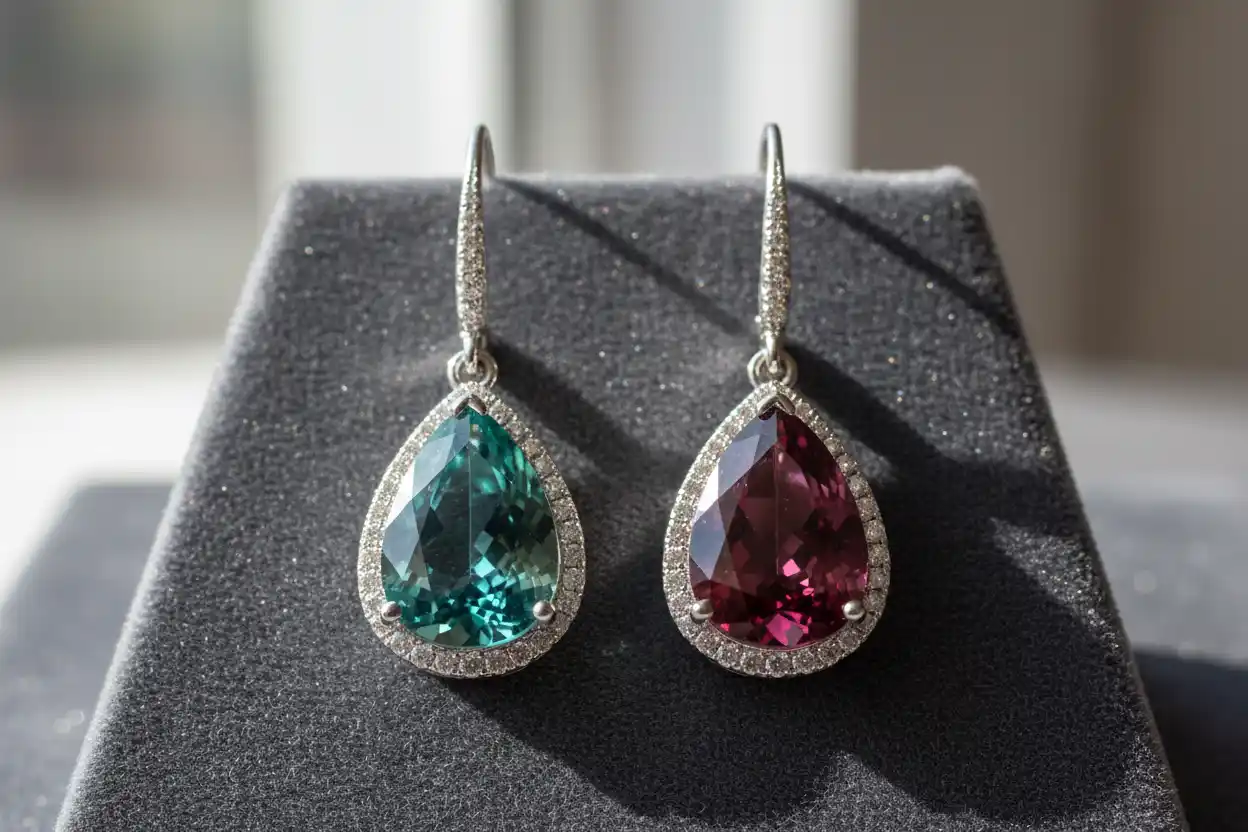
Alexandrite earrings showcase one of the most unusual optical effects in colored gemstones: a visible shift in color as the lighting changes. Fine stones can appear green or bluish green under daylight-type illumination and move toward red, purplish red or raspberry tones under warmer light.
For earrings, however, finding one attractive alexandrite is only half the challenge.
A pair must look harmonious twice—once in cooler light and again in warmer light. Two stones can have nearly identical weights yet differ noticeably in face-up dimensions, daylight color, warm-light color, darkness, clarity or strength of color change.
That makes matching the defining quality issue for alexandrite earrings.
The best pair balances:
color change + matching + secure settings + comfortable weight + reliable backs.
Natural origin can add considerable rarity and value, while laboratory-grown alexandrite can provide larger, cleaner and more closely coordinated stones at a much lower cost. Both can make beautiful earrings when their origin is disclosed correctly.
Alexandrite Earrings at a Glance
| Buying Factor | What Matters |
|---|---|
| Gem material | Color-change chrysoberyl |
| Mohs hardness | About 8.5 |
| Toughness | Excellent |
| Cleavage | None |
| Defining feature | Change between cooler and warmer lighting |
| Pair requirement | Match both sides of the color change |
| Good everyday styles | Studs and protected small drops |
| Protective setting | Bezel |
| Open setting | Well-made prongs |
| Main hardware concern | Secure posts, backs, hooks or hinges |
| Natural vs. lab-grown | Must be clearly disclosed |
| Main imitation concern | Color-change synthetic sapphire and other simulants |
| Best documentation | Independent identification for significant natural pairs |
| Primary care method | Warm water, mild soap and gentle cleaning |
Why Alexandrite Works Especially Well in Earrings
Alexandrite is the color-change variety of chrysoberyl, with a chemical composition based on BeAl₂O₄. Chromium is primarily responsible for the distinctive color behavior associated with fine alexandrite.
The mineral itself is covered more broadly in the alexandrite meaning and properties guide, but earrings create a very different practical decision.
Compared with rings and bracelets, earrings usually experience much less impact.
Your hands regularly contact desks, doors and tools. Your ears generally do not.
That makes alexandrite earrings particularly well suited to preserving fine natural gemstones while still allowing frequent wear.
Alexandrite is also physically suitable for jewelry. At approximately Mohs 8.5, it has strong scratch resistance. It has excellent toughness and lacks cleavage, reducing the tendency to split along a predictable crystallographic plane.
That does not make alexandrite indestructible.
A gemstone can still chip if dropped onto a hard floor or struck forcefully, and the earring setting can fail even when the stone remains intact.
For alexandrite earrings, the hardware often deserves as much attention as the gemstone.
Matching Is the Most Important Earring-Specific Quality
A single alexandrite ring can contain one excellent stone.
Alexandrite earrings need two.
This creates a scarcity problem that is easy to underestimate.
Two natural alexandrites may have the same carat weight while looking noticeably different when worn side by side.
One may be deeper and therefore face up smaller.
One may appear bluish green while the other is olive.
One may become rich purplish red under warm light while its partner turns brownish purple.
One may show a strong color change while the other remains partially green.
For quality alexandrite earrings, evaluate the pair together rather than examining each gem independently.
What Should Match in Alexandrite Earrings?
A good natural pair does not need to be microscopically identical.
Natural variation is expected.
Instead, look for visual coordination in seven areas:
Face-up size: Both stones should appear approximately equal when viewed from the front.
Outline: Rounds should look similarly round; ovals should have comparable length-to-width proportions.
Daylight color: One stone should not look bright green while the other looks muddy brown-green.
Warm-light color: The pair should move toward compatible red, purple or raspberry hues.
Strength of change: One stone should not transform dramatically while the other barely changes.
Brightness: Excessive darkness in one stone can make the pair appear mismatched.
Clarity: The two gemstones should look reasonably similar at ordinary viewing distance.
Matching becomes even more demanding in alexandrite earrings containing multiple alexandrites per ear.
Color Change Comes Before Carat Weight
The defining quality of alexandrite earrings is color change.
A larger stone is not automatically a better alexandrite.
Fine material should look attractive on both sides of the change.
Traditionally desirable stones move from green or bluish green under daylight-equivalent illumination toward red or purplish red under warmer light.
Natural alexandrite can also show less textbook combinations.
You may encounter:
olive green to brownish red;
gray-green to purple;
green-blue to raspberry;
yellowish green to reddish purple.
These combinations do not automatically indicate imitation material.
However, stronger and more attractive color change generally creates greater desirability.
A pair of smaller lively alexandrite earrings can therefore outperform a much larger pair whose stones remain dark or brown under most lighting.
View Alexandrite Earrings Under Two Different Lights
Never evaluate alexandrite earrings from one photograph.
Alexandrite responds to the spectral composition of the light source.
The stone does not change because it is “day” or “night.”
Use a daylight or daylight-equivalent source first.
Observe both earrings together.
Then move them under distinctly warmer illumination.
Compare them again.
Look for whether the pair changes together rather than simply asking whether some change exists.
Modern LEDs complicate this test because two bulbs that both appear white can have very different spectral output.
When purchasing alexandrite earrings online, ask for a continuous video showing the actual pair moving between documented lighting conditions.
A split-screen photograph can be informative, but heavily processed images can exaggerate saturation or make weak stones appear more dramatic.
Alexandrite Stud Earrings
Studs are among the most practical alexandrite earrings.
They place each stone close to the earlobe with relatively little movement, reducing mechanical stress and making them easy to wear frequently.
Studs also allow the budget to remain concentrated in two principal gems.
For natural alexandrite, that can be a major advantage.
Instead of purchasing several stones for elaborate drops, you can choose a smaller pair with stronger color change.
Round and oval cuts work especially well because the symmetrical outlines make matching easier.
For everyday alexandrite earrings, studs with secure backs and carefully finished settings are difficult to beat.
Bezel-Set Alexandrite Earrings
A bezel wraps metal around most or all of the gemstone perimeter.
This gives alexandrite earrings strong edge protection and creates a smooth profile that is unlikely to catch on clothing.
Bezel studs are especially useful for people who:
wear earrings frequently;
put on sweaters or scarves often;
prefer minimalist jewelry;
or want to minimize exposed prongs.
The main trade-off is visual.
A thick bezel can make a small natural alexandrite look smaller.
The best setting uses enough metal to provide security without overwhelming the stone.
An open or partially open back can make inspection and cleaning easier.
Prong-Set Alexandrite Earrings
Prongs expose more of the gemstone outline.
They can make alexandrite earrings look lighter and allow more of the crown and side profile to remain visible.
Four-prong settings are common for round and oval stones.
Six-prong designs provide additional points of contact but use more metal around the gem.
Neither number is automatically superior.
Execution matters more.
Inspect whether every prong:
contacts the gemstone securely;
is evenly positioned;
has a smooth finished tip;
and does not stand away from the stone.
Thin or worn prongs should be repaired before they release an expensive natural alexandrite.
Halo Alexandrite Earrings
Halo alexandrite earrings surround each center gem with smaller accent stones, commonly diamonds.
This can be an efficient design for natural alexandrite because the halo increases the overall visual footprint without requiring a much larger center stone.
A well-proportioned halo should support the center rather than overpower it.
Very bright diamonds around a dark or weakly changing alexandrite can make the center look dull by comparison.
Look at the complete earring from normal viewing distance.
If the halo is the only part you notice, the design may not be making the best use of the alexandrite.
A modest natural alexandrite with good color change can look excellent in a carefully scaled halo.
Alexandrite Drop Earrings
Drop alexandrite earrings suspend the gemstones below the earlobes.
Movement becomes part of the design.
As the wearer turns their head, the stones change angle relative to the light, which can make transitional colors more visible.
The connection between the upper earring and the gemstone setting becomes especially important.
Inspect:
small loops;
hinges;
jump rings;
soldered connections;
and decorative links.
A beautiful gemstone cannot compensate for a thin connector that is close to wearing through.
Drop alexandrite earrings should also hang evenly.
If one side tilts differently, check whether the stone depths, settings or connecting components differ.
Alexandrite Dangle Earrings
Dangle alexandrite earrings typically introduce more length and articulation than simple drops.
They can be visually dramatic, particularly when several moving components interact with different light sources.
However, movement creates mechanical complexity.
Every joint becomes another point that can wear.
Long alexandrite earrings should be checked for:
balanced weight;
secure hinges;
closed connecting rings;
smooth articulation;
and adequate clearance between gemstones.
Components should not repeatedly strike one another when the earrings move.
For high-value natural stones, avoid designs where exposed alexandrites collide with diamond edges or hard metal projections.
Three-Stone and Multi-Stone Alexandrite Earrings
Multi-stone alexandrite earrings create the greatest matching challenge.
A design containing three alexandrites per ear requires six gems that work together.
Matching does not mean every stone needs identical inclusions or laboratory measurements.
It means the group should appear intentional.
A graduated design can use progressively different sizes.
Color change should still remain coherent.
A practical alternative is to use one alexandrite per ear with diamond or other neutral accents.
That preserves the visual complexity of multi-stone earrings without requiring six rare matched alexandrites.
Round Alexandrite Earrings
Round brilliant-style stones are particularly practical for matched alexandrite earrings.
Symmetry makes face-up size easier to compare.
Commercial settings are also widely available.
Round cuts can show attractive brilliance, although the cutter still has to balance light return, color and weight retention.
Because natural alexandrite rough is valuable, perfectly standardized proportions should not be expected in every fine natural pair.
Judge the visible result.
A slightly unconventional cut that produces strong color and brightness may be preferable to theoretically ideal proportions that waste rare rough.
Oval Alexandrite Earrings
Oval stones can offer greater apparent length and face-up spread than rounds of similar weight.
They work well in studs, halos and drops.
For matched alexandrite earrings, compare the outlines carefully.
Two stones can both be described as oval while having noticeably different proportions.
Check:
length-to-width ratio;
shoulder shape;
depth;
outline symmetry;
and how centered each stone appears in its mounting.
Color matching remains more important than achieving mathematically identical dimensions.
Pear and Marquise Alexandrite Earrings
Pear and marquise cuts create elegant elongated alexandrite earrings, particularly in drop designs.
Their pointed ends create an additional setting consideration.
Tips should be protected appropriately.
For pears, matching direction matters too. The pair should be set symmetrically unless deliberate asymmetry is part of the design.
Marquise stones deserve similar attention to outline and tip protection.
These shapes may be harder to match naturally because cutters frequently adapt the shape to rare rough rather than forcing every crystal into a standardized outline.
Cushion and Step-Cut Alexandrite Earrings
Cushion-cut alexandrite combines softened corners with a square or rectangular outline.
It can work beautifully for vintage-inspired studs and halos.
Step cuts produce a more architectural look.
Rather than emphasizing rapid scintillation, they create broader flashes and expose clarity more readily.
Matching step-cut alexandrite earrings can be difficult because differences in length, width, depth and facet arrangement are immediately noticeable when the stones sit next to one another.
These cuts are particularly appealing when the natural material already has good transparency and attractive body color.
Natural Alexandrite Earrings
Natural alexandrite formed through geological processes and is scarce in fine quality.
Creating a matched natural pair compounds that scarcity.
The price premium is not simply for owning two stones.
It reflects the difficulty of finding two gemstones with compatible:
color;
color change;
size;
cut;
clarity;
and brightness.
A significant natural pair should therefore be evaluated as a matched suite.
If natural geological origin matters to you, insist on unambiguous seller language and appropriate documentation.
The real vs. fake alexandrite guide explains why color change alone cannot establish natural origin.
Laboratory-Grown Alexandrite Earrings
Laboratory-grown alexandrite earrings can be an excellent choice when appearance matters more than geological rarity.
Genuine synthetic alexandrite is laboratory-grown chrysoberyl.
It is not merely colored glass pretending to be a gemstone.
Synthetic material can reproduce alexandrite’s important chemical, physical and optical characteristics, including strong color change.
Laboratory growth makes close pair matching considerably easier.
Stones can also be:
larger;
cleaner;
more saturated;
and substantially less expensive than comparable fine natural material.
The important requirement is disclosure.
Laboratory-grown alexandrite earrings should never be represented in a way that implies the gemstones formed naturally.
Synthetic Alexandrite Is Different From a Simulant
The language around alexandrite earrings can be confusing.
There are three broad categories:
Natural alexandrite: naturally formed color-change chrysoberyl.
Synthetic alexandrite: laboratory-grown color-change chrysoberyl.
Alexandrite simulant: another material used to imitate alexandrite.
Color-change synthetic sapphire is a particularly important simulant.
It can show a dramatic change and may occur in older jewelry.
But it is corundum, not chrysoberyl.
Color-change glass and other materials can also imitate aspects of alexandrite.
Therefore, “lab alexandrite” should not be accepted as precise wording if an important purchase depends on material identity.
Ask whether the stone is actually synthetic chrysoberyl.
Vintage Alexandrite Earrings Need Verification
Vintage alexandrite earrings deserve extra caution because historical trade descriptions were not always mineralogically precise.
A pair can be genuinely old and still contain synthetic color-change sapphire.
An antique gold setting proves information about the setting.
It does not prove the gemstones are natural alexandrite.
Likewise, family history can be sincere without being gemologically correct.
If significant value depends on natural origin, independent testing is far safer than relying on:
age;
metal hallmarks;
family stories;
or dramatic color change.
A genuine vintage simulant can still be attractive jewelry.
It simply should not command the price of fine natural alexandrite.
Alexandrite Treatments
Natural alexandrite is not defined by one dominant routine enhancement process in the way some other gem markets are.
Treatment is nevertheless possible.
Fracture filling, coating and other modifications can occur.
Treatment should also be separated from synthetic origin.
A treated natural stone formed geologically before being modified.
A synthetic alexandrite formed in a laboratory.
A simulant is another material.
Those are three different disclosures.
The treated alexandrite guide explores these distinctions in greater detail.
Treatment matters for alexandrite earrings because filled fractures may require more conservative cleaning than untreated sound chrysoberyl.
Earring Backs Matter More Than Most Buyers Think
A valuable pair of alexandrite earrings can be lost because of a component costing only a fraction of the gemstones.
The backs deserve serious attention.
Friction Backs
Friction backs are common on stud alexandrite earrings.
They are fast and convenient.
A properly fitted backing should slide onto the post with clear resistance and remain secure during wear.
Replace backs that have become loose.
Screw Backs
Screw backs physically thread onto compatible posts.
They can provide additional security but take longer to put on and remove.
They must be aligned properly to avoid damaging the threads.
Locking Backs
Mechanical locking backs can work particularly well for valuable natural alexandrite earrings.
The mechanism should engage positively and release intentionally rather than accidentally.
Lever Backs
Lever-back closures suit many drop and dangle designs.
Check the hinge and latch periodically.
A worn hinge can become a weak point even when the gemstone setting remains perfect.
Post Length and Comfort
Stud alexandrite earrings should not be evaluated only from the front.
Post length matters.
A post that is too short may not accommodate the earlobe and backing comfortably.
An unnecessarily long post can press against the skin behind the ear or catch during sleep.
The post should also sit straight relative to the setting.
Bent posts are not merely cosmetic.
Repeated bending can work-harden or weaken metal and eventually cause failure.
For valuable alexandrite earrings, have badly distorted posts professionally repaired rather than repeatedly bending them back by hand.
Weight Matters in Larger Alexandrite Earrings
Earrings are worn differently from rings and necklaces because their entire weight is supported by the earlobe or piercing.
A large drop can be beautiful yet uncomfortable after several hours.
Total weight includes more than alexandrite.
Metal, diamonds, decorative links and backs all contribute.
Before buying substantial alexandrite earrings, consider:
overall gram weight;
how far the design hangs below the ear;
whether the weight is concentrated at the bottom;
and whether the backing provides adequate support.
A visually dramatic pair that becomes uncomfortable after twenty minutes is unlikely to be worn often.
Metal Choice
Metal changes the visual environment around alexandrite earrings.
White gold provides a relatively neutral frame and works with both cool and warm sides of the color change.
Yellow gold creates warmer contrast against green daylight colors and can complement red or purple transitional tones.
Rose gold emphasizes warmth even further.
Platinum provides a naturally white, durable mounting appropriate for valuable stones, although it increases weight and price.
Sterling silver can be suitable for more affordable designs, especially laboratory-grown alexandrite earrings.
Do not use setting metal as evidence of gemstone identity.
Natural alexandrite can be mounted in modest metal, and imitation stones can be mounted in gold or platinum.
Alexandrite Earrings With Diamonds
Diamond accents can make small natural alexandrite center stones appear more substantial.
They also remain visually consistent while the center gems change color.
This creates an attractive contrast.
The craftsmanship still matters.
Diamond melee should be securely set, and the metal should prevent diamond edges from rubbing directly against alexandrite.
When comparing halo alexandrite earrings, focus on the center stones first.
An elaborate diamond surround should not distract you from weak color change or poor pair matching.
How Much Do Alexandrite Earrings Cost?
Alexandrite earrings occupy an enormous price range because the same product name can describe very different materials.
A laboratory-grown pair in a simple mounting belongs to an entirely different market from matched fine natural alexandrites surrounded by diamonds in platinum.
For natural stones, important value factors include:
strength of color change;
quality of both colors;
tone;
saturation;
individual stone size;
clarity;
cut;
treatment status;
and matching.
The finished earrings add the cost of metal, accent stones, labor and design.
Current gemstone valuation is covered separately in the alexandrite price guide.
Do not compare alexandrite earrings by total carat weight alone.
A smaller, better-matched pair with strong color change may deserve a higher price than larger dark stones with weak transformation.
When a Laboratory Report Is Worthwhile
For inexpensive laboratory-grown alexandrite earrings, extensive independent documentation may cost more than it adds in practical value.
The calculation changes for significant natural pairs.
A reputable colored-stone laboratory can help determine whether gemstones are natural or laboratory-grown and identify detectable treatments.
For mounted earrings, clarify exactly what was examined.
A report should not be interpreted more broadly than its stated scope.
If only one stone has been tested, do not automatically assume the laboratory certified both.
Likewise, a seller’s appraisal is not identical to an independent gemological identification report.
Alexandrite Earrings as June Birthstone Jewelry
Alexandrite is one of June’s recognized birthstones, alongside pearl and moonstone.
That makes alexandrite earrings a particularly distinctive June birthday gift.
From a durability perspective, alexandrite is substantially better suited to frequent wear than pearl or moonstone.
That does not make one birthstone inherently better.
They simply create different jewelry experiences.
The June birthstone jewelry guide compares these options for rings, necklaces, earrings and gifts.
For someone who values changing color and unusual gemological behavior, alexandrite is especially distinctive.
Alexandrite Earrings vs. Other Alexandrite Jewelry
Earrings have one major advantage: reduced impact exposure.
An alexandrite bracelet must survive wrist contact, flexible links and clasp wear.
An alexandrite necklace introduces chain length, pendant movement and neckline considerations.
An alexandrite ring faces much more repeated impact because hands continually contact hard surfaces.
Alexandrite earrings avoid many of those problems.
Their unique challenge is pair matching and secure attachment to the ear.
That is what makes this jewelry form genuinely distinct.
How to Clean Alexandrite Earrings
Alexandrite itself is durable and can generally be cleaned with warm water, mild soap and a soft brush.
For earrings, concentrate on areas where skin oils accumulate.
The back of the gemstone and the gallery beneath it can become coated with residue that reduces brightness.
Posts and backs also collect cosmetic products and skin oils.
Clean them gently and rinse thoroughly.
Dry the earrings with a soft lint-free cloth.
The detailed alexandrite jewelry cleaning guide covers different settings and treatment considerations.
Ultrasonic and steam cleaning can be acceptable for sound untreated alexandrite, but hand cleaning remains the conservative choice when treatments, fractures, antique construction or delicate companion gems are uncertain.
When Not to Use an Ultrasonic Cleaner
Avoid assuming that the strength of alexandrite automatically makes the entire earring safe for ultrasonic cleaning.
The gemstone may be durable while another component is not.
Use extra caution with:
fracture-filled stones;
antique settings;
pearls or other delicate accent gems;
loose stones;
repaired metalwork;
and uncertain treatments.
A gemstone earring should be cleaned according to its most vulnerable component.
How to Store Alexandrite Earrings
Store the pair together but prevent the gemstones from rubbing directly against each other.
A divided jewelry box or soft individual compartments work well.
Secure the backs to the posts before storage so small components are not lost.
Long dangle alexandrite earrings should be laid flat or suspended appropriately so chains and articulated sections do not knot.
Keep them away from diamond jewelry, which can scratch alexandrite.
For important natural pairs, store laboratory documents and receipts separately from the jewelry itself.
Buying Alexandrite Earrings Online
Online buying places greater importance on documentation and realistic imagery.
Ask for photographs of the exact pair.
Avoid listings that use only generic stock images.
Request video under at least two noticeably different light sources.
Compare both stones simultaneously.
Confirm:
natural or laboratory-grown origin;
stone dimensions;
individual or total carat weight;
metal purity;
treatment disclosure;
back type;
return policy;
and what any laboratory documentation actually covers.
A seller who provides only the phrase “100% genuine alexandrite” has not answered the most important origin question.
Red Flags When Buying Alexandrite Earrings
Price should make sense relative to the claims.
Be cautious when a listing combines all of the following:
very large stones;
exceptional clarity;
dramatic emerald-green to ruby-red color change;
natural origin;
and an unusually low price.
Fine natural alexandrite is scarce.
A spectacular inexpensive pair may contain laboratory-grown alexandrite or a simulant.
That does not necessarily make the earrings bad jewelry.
The problem is inaccurate disclosure.
Also watch for listings that use terms such as:
“alexandrite sapphire”;
“created alexandrite” without identifying the material;
or “Russian alexandrite” without evidence supporting origin.
Identity should be clear before rarity claims affect the price.
Alexandrite Earrings Buying Checklist
Before purchasing alexandrite earrings, confirm:
Material: Is each stone natural alexandrite, laboratory-grown chrysoberyl or a simulant?
Matching: Do both stones look harmonious under the same light?
Color change: Is the change attractive in both directions?
Dimensions: Do they appear equal face-up?
Cut: Are obvious windows or dead areas distracting?
Clarity: Do the pair look reasonably coordinated?
Setting: Are the bezels or prongs secure?
Hardware: Are posts, hooks, hinges and backs appropriate for the design?
Comfort: Is the weight realistic for prolonged wear?
Treatment: Has any detectable enhancement been disclosed?
Documentation: Does independent testing support important natural-origin claims?
Price: Does the cost reflect the actual material and matching quality rather than only total carat weight?
Frequently Asked Questions
Are alexandrite earrings good for everyday wear?
Yes. Alexandrite has Mohs hardness around 8.5, excellent toughness and no cleavage, while earrings generally experience less impact than rings or bracelets. Secure settings and reliable backs remain essential.
What makes high-quality alexandrite earrings?
Strong color change, attractive colors under both lighting conditions, good pair matching, lively cutting, secure settings and comfortable construction are the main quality factors.
Do alexandrite earrings really change color?
Genuine alexandrite can show noticeable color change under light sources with different spectral characteristics. The strength and exact colors vary from stone to stone.
Should both alexandrites change exactly the same way?
Perfect duplication is unnecessary, particularly for natural stones. However, the pair should look harmonious in daylight-type and warmer illumination.
Why are natural alexandrite earrings expensive?
Natural alexandrite is rare, and earrings require two stones matched for size, shape, color and color-change behavior. Matching adds another layer of scarcity.
Are lab-grown alexandrite earrings real alexandrite?
Laboratory-grown alexandrite made from synthetic chrysoberyl has essentially the same mineral identity as natural alexandrite but is manufactured rather than geologically formed. Its origin must be disclosed.
Is color-change synthetic sapphire alexandrite?
No. It can imitate alexandrite’s color change, but synthetic sapphire is corundum rather than chrysoberyl.
Can vintage alexandrite earrings contain synthetic stones?
Yes. Older jewelry may contain color-change synthetic corundum or other substitutes historically described using alexandrite-related terminology.
What is the best setting for alexandrite stud earrings?
Bezels provide excellent edge protection and a smooth profile. Well-made prong settings expose more of the gemstone and can also be secure when maintained properly.
Are screw backs better for expensive alexandrite earrings?
Screw backs can provide strong mechanical security, but well-fitted friction or locking backs can also work. The best system is one that fits the post correctly and remains secure during wear.
Which alexandrite cut is easiest to match?
Rounds are generally straightforward to coordinate because their symmetrical outline makes differences easier to evaluate. Ovals are also common and practical.
Are halo alexandrite earrings good value?
They can be. A halo can create greater visual presence around smaller natural alexandrites without requiring much larger center stones.
Can alexandrite earrings be cleaned with soap and water?
Yes. Warm water, mild soap and gentle cleaning are appropriate for sound alexandrite jewelry. Treatment, antique construction and delicate accent stones may require more conservative care.
Can alexandrite earrings go in an ultrasonic cleaner?
Sound untreated alexandrite can generally tolerate ultrasonic cleaning, but hand cleaning is safer when fractures, fillers, loose settings, antique construction or delicate companion stones are present.
Can I sleep in alexandrite earrings?
Small secure studs may be physically durable enough, but routinely sleeping in valuable earrings can bend posts, loosen backs, catch on bedding and place unnecessary stress on settings. Removing them before sleep is the safer habit.
Can I shower in alexandrite earrings?
Occasional clean-water contact is unlikely to harm sound alexandrite, but repeated showering can leave soap residue on stones and settings. Removing valuable jewelry before bathing reduces unnecessary wear.
Are alexandrite earrings suitable for sensitive ears?
Sensitivity depends mainly on the metal touching the skin rather than alexandrite itself. Buyers with known metal sensitivities should choose an appropriate alloy and confirm its composition.
What metal looks best with alexandrite?
White metals provide a relatively neutral background, yellow gold creates warm contrast and rose gold emphasizes red and purple tones. The best choice is personal and should be judged under both sides of the color change.
Should natural alexandrite earrings have laboratory reports?
For significant purchases, independent gemological documentation is valuable because natural-versus-laboratory-grown origin can have a major effect on price.
Can one report cover both earrings?
Possibly, depending on the laboratory service and how the mounted pair is submitted. Always read the report to confirm exactly which stones or item were examined.
Are small alexandrite earrings valuable?
They can be. Small natural stones with strong color change and excellent matching can be desirable because matched natural alexandrite is difficult to assemble.
Is total carat weight important?
It matters, but it should not outrank color-change quality and matching. Two larger weak stones may be less desirable than a smaller coordinated pair with vivid change.
How should alexandrite earrings be stored?
Store them in a lined compartment where the two gemstones cannot scratch one another. Keep diamond jewelry separate and secure removable backs before storage.
Are alexandrite earrings a June birthstone gift?
Yes. Alexandrite is one of June’s birthstones and is particularly suitable for earrings because of its durability and unusual color-change effect.
What should I inspect in pre-owned alexandrite earrings?
Check stone identity, matching, chips, worn prongs, repaired settings, bent posts, loose hinges, worn backs and whether any documentation actually applies to the pair being sold.
What Makes Alexandrite Earrings Worth Buying?
Alexandrite earrings are fundamentally about a matched optical experience.
One attractive alexandrite is impressive.
Two stones changing together are much harder to achieve.
That is why the most important question is not simply:
How many carats are these earrings?
Ask instead:
Do these two alexandrites behave like a convincing pair?
Look at them simultaneously in daylight-type illumination.
Move them together into warm light.
Compare their face-up size, color, brightness and degree of change.
Then inspect everything that keeps them on your ears.
The settings should be secure.
The posts should be straight.
The backs or closures should engage properly.
Drop and dangle connections should move smoothly without looking worn.
The earrings should be light enough to wear comfortably.
For natural alexandrite earrings, documentation becomes increasingly important as price rises because synthetic chrysoberyl and color-changing simulants can be convincing.
For laboratory-grown alexandrite earrings, clear disclosure matters more than geological rarity, allowing the focus to remain on matching, cutting and craftsmanship.
Alexandrite already has excellent jewelry durability and an exceptional optical identity.
A well-chosen pair does not need exaggerated claims.
What makes alexandrite earrings special is simpler: two rare-looking gemstones that remain visually connected even while both colors change with the light.