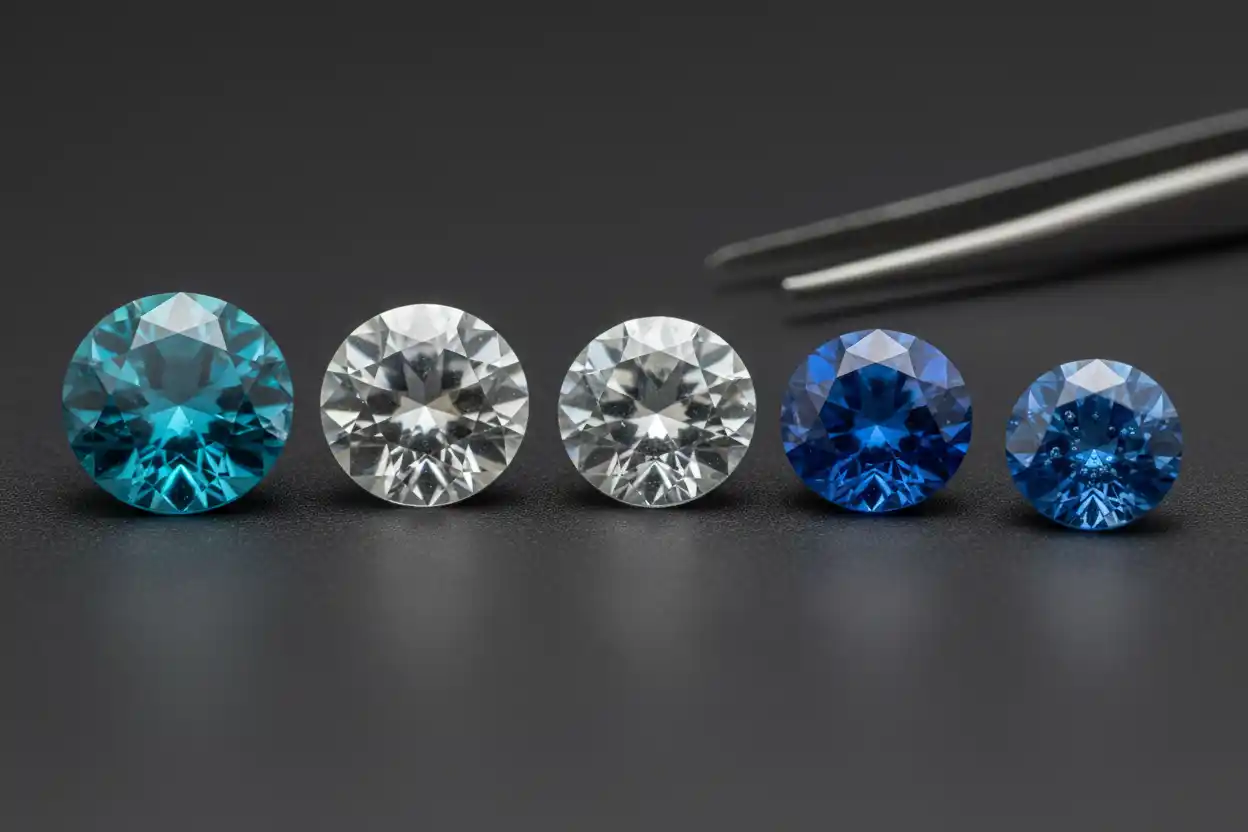
Real vs Fake Zircon: How to Tell the Difference
Real zircon is a natural zirconium silicate gemstone with the formula ZrSiO₄. Fake zircon, by contrast, is not one specific material. The label can describe cubic zirconia, synthetic spinel, glass, or another gem being represented incorrectly as natural zircon.
The biggest source of confusion is cubic zirconia. Despite their similar names, zircon and cubic zirconia are completely different gemstones. Genuine zircon is a natural mineral with strong double refraction, high brilliance, and a long geological history, whereas the CZ used in jewelry is a manufactured zirconium-oxide material.
Fortunately, a combination of weight, facet doubling, refractive behavior, inclusions, spectroscopy, and professional testing can distinguish genuine zircon from its common imitations.
Real vs Fake Zircon at a Glance
| Feature | Natural Zircon | Cubic Zirconia | Synthetic Spinel | Glass |
|---|---|---|---|---|
| Material type | Natural mineral | Manufactured simulant | Laboratory-grown gem | Manufactured glass |
| Main composition | ZrSiO₄ | Stabilized ZrO₂ | MgAl₂O₄ | Variable silicate glass |
| Crystal system | Tetragonal | Cubic | Cubic | Amorphous |
| Typical colors | Brown, blue, colorless, yellow, orange, red, green | Nearly any color | Nearly any color | Nearly any color |
| Refractive index | Roughly 1.81–1.98 depending on zircon type | About 2.15–2.18 | About 1.718 | Usually substantially lower than zircon |
| Double refraction | Often strong in high zircon | None | None | None |
| Specific gravity | About 3.90–4.73 | About 5.6–6.0 | About 3.60 | Usually lower |
| Mohs hardness | About 6–7.5 | About 8–8.5 | About 8 | Commonly around 5–6 |
| Typical inclusions | Natural inclusions, zoning or healed features may occur | Usually extremely clean | Often very clean; synthetic growth features possible | Bubbles or flow features may occur |
| Facet-edge doubling | Often visible in high zircon | No | No | No |
| Common retail confusion | Mistaken for CZ or diamond | Incorrectly called zircon | Used to imitate colored gems | Used as inexpensive imitation |
| Reliable final test | Gemological examination | Gemological examination | Gemological examination | Gemological examination |
The Zircon meaning guide covers zircon’s mineralogy and general properties. This page focuses specifically on determining whether a stone sold as zircon is actually natural zircon.
What Is Real Zircon?
Real zircon is a naturally occurring mineral composed primarily of zirconium silicate, ZrSiO₄.
It forms in many types of igneous, metamorphic, and sedimentary rocks. Some zircon crystals are extraordinarily ancient, which makes the mineral important not only as a gemstone but also as a geological record of Earth’s early history.
Gem-quality zircon occurs in several colors, including brown, yellow, orange, red, green, blue, and colorless.
Many consumers know only blue zircon, but natural zircon is often brownish before treatment. Heating suitable material can produce the vivid blue associated with much of the modern jewelry market.
That treatment does not make zircon fake.
Treated Zircon Is Still Real Zircon
One of the most important distinctions in zircon identification is the difference between treatment and imitation.
A natural zircon that has been heated to change its color remains natural zircon. Its crystal formed geologically; treatment occurred afterward.
Blue zircon is particularly important because much commercial blue material has been heat treated.
Therefore:
Natural untreated zircon = real zircon.
Natural heat-treated zircon = also real zircon.
Cubic zirconia, glass, synthetic spinel or another substitute sold as zircon = imitation or misrepresented material.
Treatment disclosure deserves a separate evaluation, which is why How to Spot Treated or Synthetic Zircon should remain distinct from this authenticity guide.
Zircon Is Not Cubic Zirconia
This is the single most important fact for buyers.
Zircon and cubic zirconia are not natural and synthetic versions of the same gem.
Zircon is ZrSiO₄, zirconium silicate.
Cubic zirconia is based on ZrO₂, zirconium dioxide, and commercial jewelry CZ is manufactured.
Their crystal structures, densities, hardness, optical properties, and geological origins are different.
The similarity exists mainly in their names.
Consequently, jewelry described simply as “zirconia,” “CZ,” or “cubic zirconia” should never be interpreted as natural zircon.
The separate Cubic Zirconia guide covers that material in its own right.
Why Zircon Can Look Like Other Gems
Zircon has unusually strong optical properties for a natural gemstone.
Fine transparent zircon can show high brilliance and strong dispersion, creating flashes of spectral color. Colorless zircon was historically used as a diamond simulant because of this lively appearance.
That history sometimes creates a second misconception: people assume zircon itself must be a fake gemstone because it was once used to imitate diamond.
It is not.
A natural gem can be used as a simulant for another gem while remaining completely natural. Colorless sapphire, quartz, topaz and zircon have all been used historically as substitutes for diamond.
Therefore, genuine zircon can simultaneously be a real natural gemstone and, in certain jewelry, have been used to imitate something else.
The Facet-Doubling Test
Strong double refraction is one of the most recognizable features of many natural zircons.
Look through a faceted zircon with a 10× loupe from an appropriate angle, particularly through the crown toward the pavilion facets.
In high-type zircon, the edges of pavilion facets may appear doubled.
Instead of seeing one sharp facet junction through the stone, you may see two slightly separated images.
This happens because zircon is doubly refractive: incoming light can split into two rays traveling through the crystal at different velocities.
Cubic zirconia and synthetic spinel are cubic materials and therefore singly refractive. Ordinary glass is also singly refractive.
Consequently, clear facet doubling can provide useful evidence that a stone is zircon rather than CZ.
However, this test has an important limitation.
Not Every Zircon Shows Strong Doubling
Natural zircon varies structurally.
Trace radioactive elements such as uranium and thorium can damage its crystal lattice gradually over geological time. This process is called metamictization.
Gemologists traditionally describe zircon along a spectrum that includes high, intermediate, and low zircon.
High zircon retains a relatively intact crystal structure and usually shows the strongest classic gemological properties, including strong birefringence.
Low zircon has suffered greater structural alteration and can show lower refractive index, lower density, and much weaker birefringence.
Therefore, the absence of obvious doubling does not automatically prove that a stone is fake.
This variability is one reason professional gem identification relies on a combination of tests.
Check the Stone’s Weight
Density provides another powerful clue.
Natural zircon has a relatively high specific gravity, generally around 3.90–4.73, depending partly on its structural condition.
Cubic zirconia is even denser, commonly around 5.6–6.0.
Therefore, when two loose stones have the same physical dimensions and similar cutting proportions, the CZ should be substantially heavier.
This can help when a suspicious stone is being compared directly with a known zircon.
However, carat weight cannot be interpreted without dimensions.
A deeply cut zircon may weigh more than a shallow CZ with a similar face-up appearance. Likewise, different shapes and pavilion depths distort casual comparisons.
For serious identification, specific gravity should be measured properly rather than estimated in the hand.
Refractive Index Is Highly Diagnostic
Natural zircon has a very high refractive index.
High-type zircon commonly falls around 1.925–1.984, while intermediate and low zircon can show progressively lower values.
Cubic zirconia is higher still, around 2.15–2.18.
Synthetic spinel is much lower, approximately 1.718.
These differences make refractive-index testing extremely useful.
Many high zircons and CZ stones are above the measurement range of a conventional gem refractometer, but the result still contributes valuable information when combined with other tests.
A gemologist may also use reflectivity measurements or specialized instrumentation when ordinary refractometer readings reach their limits.
Does Real Zircon Sparkle More?
Real zircon can be exceptionally brilliant.
Its combination of high refractive index and dispersion creates considerable fire, particularly in colorless and lightly colored material.
However, sparkle should not be used as an authenticity test.
CZ also has high refractive properties and can produce strong fire. Other manufactured materials can be highly brilliant as well.
Cut quality matters enormously. A well-cut imitation may sparkle far more than a poorly cut natural zircon.
Lighting also changes the result.
Therefore, statements such as “real zircon sparkles more” or “fake zircon looks too shiny” are unreliable generalizations.
Natural Zircon Usually Shows Doubling; CZ Does Not
When conditions are favorable, facet doubling is more informative than total sparkle.
High zircon can show obvious doubled pavilion facet edges through the crown.
CZ does not display this optical doubling because it is singly refractive.
Synthetic spinel is also singly refractive.
Nevertheless, several practical factors can make doubling difficult to see. The orientation of the cut, stone size, facet angles, zircon type, observation direction, and visual experience all influence the result.
A loupe test should therefore support—not replace—formal identification.
Look for Natural Inclusions
Microscopic examination may reveal evidence consistent with natural growth.
Natural zircon can contain mineral inclusions, tiny particles, healed fractures, color zoning, growth structures, or other internal features.
Some stones are remarkably clean, though.
Therefore, inclusions can provide positive evidence when diagnostic features are present, but an eye-clean zircon is not automatically fake.
This point is particularly important because many gem-quality zircons are sold precisely because they have high clarity.
Meanwhile, synthetic and imitation materials can sometimes contain their own internal features.
An inclusion should be identified rather than simply categorized as “something inside the stone.”
Glass Imitations
Colored glass can imitate almost any transparent gemstone, including zircon.
Possible clues include rounded gas bubbles, curved flow lines, swirls, lower luster, softer surfaces, molded facet characteristics, and different optical properties.
Older glass jewelry may also show significant facet-edge wear.
However, none of these features should be assumed to occur in every glass imitation.
Modern glass can be clean and well cut, while genuine zircon can become abraded because its facet edges are not exceptionally tough.
Refractive index, specific gravity, optical character, and magnification provide a stronger combined identification.
Synthetic Spinel Imitations
Synthetic spinel has historically been used to imitate many colored gemstones.
It can be manufactured in blue and numerous other colors, so a blue synthetic spinel may occasionally be represented incorrectly as zircon.
The two materials are straightforward to separate gemologically.
Synthetic spinel is singly refractive, with refractive index around 1.718 and specific gravity around 3.60.
High zircon generally has a much higher refractive index and specific gravity and can show strong double refraction.
Synthetic spinel is also harder, at approximately Mohs 8.
Those differences provide multiple independent tests rather than relying on color.
Is Synthetic Zircon Real Zircon?
The terminology requires care.
A true synthetic zircon would be laboratory-grown ZrSiO₄ with essentially the same fundamental composition and crystal structure as natural zircon.
Zircon has indeed been synthesized for scientific and technical purposes.
However, true laboratory-grown zircon is not the common inexpensive jewelry material most consumers encounter under terms such as “synthetic zircon.”
In retail jewelry, that wording is sometimes confused with cubic zirconia.
CZ is not synthetic zircon.
The distinction mirrors a basic gemological rule: a synthetic gem reproduces a natural gem material, whereas an imitation merely looks similar.
For ordinary shoppers, natural zircon, heat-treated natural zircon and CZ are far more commercially relevant categories than true laboratory-grown zircon.
Can Color Tell You Whether Zircon Is Real?
No.
Natural zircon comes in a surprisingly broad range of colors.
Brown is common in untreated rough. Yellow, orange, red, green and colorless stones also occur.
Blue is commercially important, although intense blue is commonly produced by heating suitable natural material.
CZ, synthetic spinel and glass can all be manufactured in colors that resemble zircon.
Therefore, neither bright blue nor colorless appearance proves authenticity.
Color can suggest which tests should come next, but it does not establish mineral identity.
Is Very Bright Blue Zircon Fake?
Not necessarily.
Vivid blue zircon is one of the most commercially popular zircon varieties, and heat treatment commonly produces that appearance from suitable brown natural material.
A bright electric or greenish-blue color should therefore prompt a treatment question, not an automatic accusation of fakery.
If the material itself tests as natural zircon, heating does not change its identity.
For buyers who care about natural versus treated color, treatment disclosure should be evaluated separately from authenticity.
Is Colorless Zircon Fake?
No.
Natural zircon can be colorless.
In fact, colorless zircon has historically attracted attention because its brilliance and dispersion can resemble diamond.
Some colorless zircon on the market may have been heat treated, while naturally colorless examples also occur.
Neither situation makes the stone cubic zirconia.
A colorless gem therefore needs actual material identification rather than an assumption based on appearance.
Can a Diamond Tester Identify Zircon?
Not reliably as a complete authenticity test.
Basic diamond testers commonly measure thermal conductivity. Their purpose is primarily to distinguish diamond from many non-diamond materials.
Getting a “not diamond” result tells you very little about whether the stone is zircon, CZ, topaz, sapphire, glass, or another gemstone.
Advanced multi-test instruments may provide more information, but consumers should not assume that every device marketed as a diamond tester can identify zircon specifically.
A gemologist can combine refractive behavior, specific gravity, microscopy and spectroscopy for a much more reliable result.
Does a UV Light Prove Zircon Is Real?
No.
Ultraviolet response is not a universal zircon authenticity test.
Different zircons can respond differently because of composition, treatment history, structural state, and color.
Furthermore, research has documented reversible photochromic behavior in some blue zircons exposed to long-wave UV.
That means deliberate UV exposure can actually alter the apparent color of particular stones temporarily.
For that reason, videos claiming that “real zircon must glow a certain color under UV” oversimplify the mineral’s behavior.
UV fluorescence may contribute evidence in a gemological examination, but it should never serve as the only authenticity criterion.
Can You Use a Scratch Test?
Do not use one.
Zircon varies from approximately 6 to 7.5 on the Mohs scale, depending partly on its structural condition.
A scratch test can therefore permanently damage the stone while providing an ambiguous result.
CZ and synthetic spinel are harder than zircon, but intentionally scratching jewelry simply to exploit that difference is poor gemological practice.
Surface coatings, weathering, facet orientation, pressure, and the hardness of the testing object can all complicate an improvised test.
Non-destructive techniques provide much better evidence.
Real Zircon vs Cubic Zirconia
The most common name confusion deserves a direct comparison.
| Property | Natural Zircon | Cubic Zirconia |
|---|---|---|
| Composition | ZrSiO₄ | Stabilized ZrO₂ |
| Origin | Natural | Manufactured for commercial jewelry |
| Crystal system | Tetragonal | Cubic |
| Refraction | Doubly refractive | Singly refractive |
| Facet doubling | Often visible in high zircon | Absent |
| RI | About 1.81–1.98 depending on type | About 2.15–2.18 |
| SG | About 3.90–4.73 | About 5.6–6.0 |
| Mohs hardness | About 6–7.5 | About 8–8.5 |
| Typical market value | Natural-gem market | Low-cost manufactured-gem market |
The difference is large enough that a trained gemologist should normally have little difficulty separating them.
Real Zircon vs Diamond
Colorless zircon has been confused with diamond for centuries because both can show considerable brilliance and fire.
However, their physical properties are very different.
Diamond ranks 10 on the Mohs scale, while zircon is considerably softer. Diamond is singly refractive, whereas high zircon displays strong double refraction.
Zircon’s characteristic doubling can actually help distinguish it from diamond when viewed appropriately through a loupe.
The important terminology point is that a natural zircon used as a diamond substitute is still a real zircon, even though it is acting as a diamond simulant.
Real Zircon vs Blue Topaz
Blue topaz and blue zircon frequently occupy similar areas of the colored-gem market.
Their appearance can overlap, particularly in photographs.
Yet topaz has lower refractive properties, less dispersion, a different density, and different optical behavior. Zircon usually looks more fiery and may show facet doubling.
Blue topaz also belongs to an entirely separate mineral species.
Consequently, a seller should never use the names interchangeably.
The Topaz Buying Guide and Zircon Buying Guide preserve their separate buying intents.
Check for Suspicious Terminology
Misleading naming often reveals problems before physical testing begins.
Be cautious with listings that use phrases such as:
“natural cubic zircon”
“natural CZ zircon”
“diamond zirconia”
“synthetic natural zircon”
“zircon crystal CZ”
These terms mix different materials or commercial categories.
A properly described natural stone should simply identify the material as zircon, followed by relevant color, weight, treatment disclosure, origin claim if supported, and laboratory information when appropriate.
If the seller cannot explain whether the stone is zircon or cubic zirconia, avoid treating the listing as authoritative.
Check the Price—but Don’t Use Price as Proof
Price can reveal obvious inconsistencies, but it cannot authenticate a gemstone.
Natural zircon generally occupies a higher material-value category than mass-produced CZ or glass.
Fine blue, red, green, large clean, unusually colored, or collectible zircon may command meaningful prices.
However, affordable zircon is also widely available.
Conversely, an expensive piece of jewelry can contain inexpensive CZ because the price may reflect gold, platinum, craftsmanship, branding or accent stones.
Therefore, neither “too cheap” nor “very expensive” is a conclusive test.
For market-specific evaluation, use the site’s zircon price information separately from authenticity testing rather than merging the two intents.
How to Check a Zircon at Home Without Damaging It
Home examination can help determine whether professional testing is warranted.
First, clean the gemstone gently so oil and dirt do not interfere with observations.
Next, examine it with a 10× loupe under good neutral lighting. Look through the crown toward the back facets and check for facet doubling.
Then observe inclusions and zoning without assuming that a clean stone is fake.
Compare dimensions and carat weight when reliable measurements are available. An exceptionally heavy stone for its size may suggest CZ, although proper specific-gravity measurement is better.
Finally, review the seller’s documentation and terminology.
These steps can identify inconsistencies, but they cannot replace professional testing in every case.
What a Gemologist Tests
A gemologist can use several independent observations to identify zircon.
Refractive behavior helps separate zircon from lower-RI materials.
Birefringence and optical character can establish whether the stone behaves like tetragonal zircon or a singly refractive simulant.
Specific gravity narrows the possible materials significantly.
Microscopy can reveal natural inclusions, zoning, fractures and characteristic internal structures.
Spectroscopy may detect absorption features consistent with zircon.
Raman spectroscopy can identify the material’s molecular or crystal-structure signature directly.
When multiple tests agree, identification becomes much stronger than any single home observation.
When Should You Get a Laboratory Report?
Independent laboratory identification makes sense when the stone is expensive, unusually large, represented as untreated, accompanied by a significant origin claim, or being purchased as a collectible gem.
A laboratory report can establish whether the material is natural or laboratory-grown and can report detectable treatments.
This is particularly valuable when a seller charges a premium for an unusual natural color or unheated status.
For ordinary inexpensive jewelry, a qualified local gemologist may be sufficient.
However, high-value stones deserve documentation proportionate to the purchase.
Does a Certificate Automatically Prove Zircon Is Real?
Only if the document itself is legitimate and clearly identifies the same stone.
A generic card printed by a seller is not equivalent to an independent gemological report.
Check whether the laboratory actually exists, whether the report number can be verified when the lab provides verification, and whether the measurements and weight correspond to the gemstone being sold.
The site’s gemstone certification guide explains why laboratory reputation and report scope matter.
A report may establish material identity without assigning quality grades or geographic origin.
How Fake Zircon Listings Usually Happen
Not every mislabeling case involves sophisticated fraud.
Some sellers simply confuse zircon and cubic zirconia because of their similar names.
Mass-market marketplaces may also inherit incorrect product terminology from wholesalers.
In other cases, generic terms such as “zircon stone” are used loosely for CZ jewelry.
That usage is inaccurate.
A buyer searching specifically for natural zircon should require the word zircon to refer to ZrSiO₄ rather than assuming that “zirconia” means the same thing.
Is Zircon Radioactivity an Authenticity Test?
No.
Natural zircon can contain trace uranium and thorium, and internal radiation over geological time contributes to metamictization.
However, this does not make a radiation detector a sensible consumer authentication method.
Trace-element concentrations vary widely, many gem zircons are not meaningfully distinguishable with ordinary consumer equipment, and jewelry-level zircon is not identified professionally by simply checking whether a detector responds.
GIA notes that trace radioactivity in zircon used in jewelry is not considered a health risk.
Gemological optical and spectroscopic techniques provide much more useful identification evidence.
Why High, Intermediate and Low Zircon Matter
Zircon is unusual because natural radiation damage can alter some of its standard physical properties.
High zircon retains a relatively ordered structure and typically shows high refractive index, high specific gravity and strong birefringence.
Low zircon is more metamict and may show significantly reduced values.
Intermediate material falls between these states.
This variation explains why internet identification charts sometimes appear contradictory.
One chart may list zircon’s RI near 1.98, while another specimen measures much lower. Both can potentially represent real zircon.
A reliable identification workflow therefore uses the appropriate zircon range rather than expecting every natural stone to match one number exactly.
Does Heat Treatment Restore Zircon Properties?
Heating suitable zircon can affect both color and structural characteristics.
In some material, heating can partially restore crystallinity that geological radiation damage had disrupted.
This is another reason treatment history and authenticity should be considered separately.
A heat-treated zircon may show different properties from untreated metamict material while still being natural zircon.
Treatment-specific questions remain better placed on the dedicated treated zircon guide.
How to Buy Real Zircon Safely
Choose a seller who identifies the gemstone clearly and uses correct terminology.
For blue zircon, expect treatment disclosure rather than promises that vivid color automatically means an untreated stone.
Ask for the exact carat weight and millimeter dimensions.
Inspect photographs from more than one angle and lighting condition.
For significant purchases, request an independent identification report rather than relying solely on an in-house certificate.
Most importantly, make sure the invoice says natural zircon when natural zircon is what you are buying.
The broader Zircon Buying Guide covers color, clarity, cut, size, seller selection, and purchasing priorities without duplicating this authenticity workflow.
How to Care for a Confirmed Natural Zircon
Once a zircon is authenticated, gentle cleaning is important because the gem is more brittle than its brilliance might suggest.
Use warm water, mild soap, and a soft brush.
Avoid steam cleaners and ultrasonic machines.
Zircon can abrade along facet edges, and sudden temperature changes or mechanical impact should be avoided.
Store it away from harder gemstones so surfaces do not rub together.
For the material-specific routine, follow How to Clean Zircon Jewelry Safely.
Frequently Asked Questions
How can I tell if zircon is real?
Look for a combination of zircon’s high brilliance, possible facet-edge doubling, appropriate weight, refractive behavior, and natural internal features. Professional RI, specific-gravity, microscopy and spectroscopy testing provides much stronger confirmation than visual inspection alone.
Is cubic zirconia fake zircon?
Cubic zirconia is not zircon at all. It is a different manufactured material. It becomes an imitation only when it is presented as natural zircon or another gemstone.
Is blue zircon usually real?
Commercial blue zircon can absolutely be genuine natural zircon. Much blue zircon has been heat treated from brownish natural material, but treatment does not make it fake.
Is heat-treated zircon fake?
No. Heat-treated natural zircon remains natural zircon. Treatment status and material authenticity are separate questions.
Does real zircon show double facets?
High-type zircon commonly shows noticeable doubling of pavilion facet junctions because of strong birefringence. Low or intermediate zircon may show weaker doubling, so its absence does not automatically mean the stone is fake.
Is natural zircon heavier than cubic zirconia?
No. Both are relatively dense, but CZ is generally substantially denser. For two stones of similar dimensions and cut, CZ should usually weigh more.
Can glass imitate zircon?
Yes. Colored or colorless glass can imitate many gemstones. Bubbles, flow features, lower RI, lower density and softer surfaces can provide clues, but proper testing is preferable.
Is synthetic spinel sold as zircon?
Synthetic spinel has historically been used to imitate many colored gemstones, including zircon-like colors. It can be separated readily through refractive index, density and optical character.
Does real zircon scratch glass?
Many zircons can scratch ordinary glass, but this is not a recommended authentication method. Hardness varies among zircon types, and deliberate scratching can damage the gemstone.
Can a diamond tester test zircon?
A basic diamond tester may indicate that zircon is not diamond, but that does not establish that the stone is zircon. It cannot substitute for gemological identification.
Does UV light identify real zircon?
No. UV reactions vary, and some blue zircons show reversible photochromic effects under long-wave UV. Fluorescence is supporting information rather than a universal authenticity test.
Is colorless zircon the same as CZ?
No. Colorless zircon is natural ZrSiO₄. CZ is manufactured zirconium oxide. Their names, chemistry and gemological properties are different.
Can true synthetic zircon exist?
Yes, zircon has been synthesized in laboratories for scientific and technical purposes. However, genuine lab-grown ZrSiO₄ is not the common mass-market material consumers usually encounter when listings say “CZ” or “zirconia.”
What is the safest way to authenticate an expensive zircon?
Use a reputable independent gemological laboratory or qualified gemologist. For valuable material, standard optical tests combined with spectroscopy provide much more reliable evidence than home tests.
Final Takeaway
The most common mistake in zircon identification is confusing zircon with cubic zirconia.
Natural zircon is zirconium silicate, ZrSiO₄. It is a genuine geological gemstone with unusually high brilliance, significant density, and—in high-type material—strong double refraction that can make pavilion facets appear doubled.
Cubic zirconia is a different manufactured material. Synthetic spinel, glass and other stones can also imitate zircon, but their refractive indices, densities, optical characters, and internal features differ enough for proper gemological testing to separate them.
At the same time, a treated zircon should not be labeled fake simply because its color has been modified. Much blue zircon is heat treated while remaining completely natural in origin.
For inexpensive stones, careful seller terminology, loupe examination and weight comparisons may identify obvious problems. For valuable zircon, however, an independent gemological examination remains the most reliable way to confirm whether the stone is natural, laboratory-grown, treated, or an imitation.