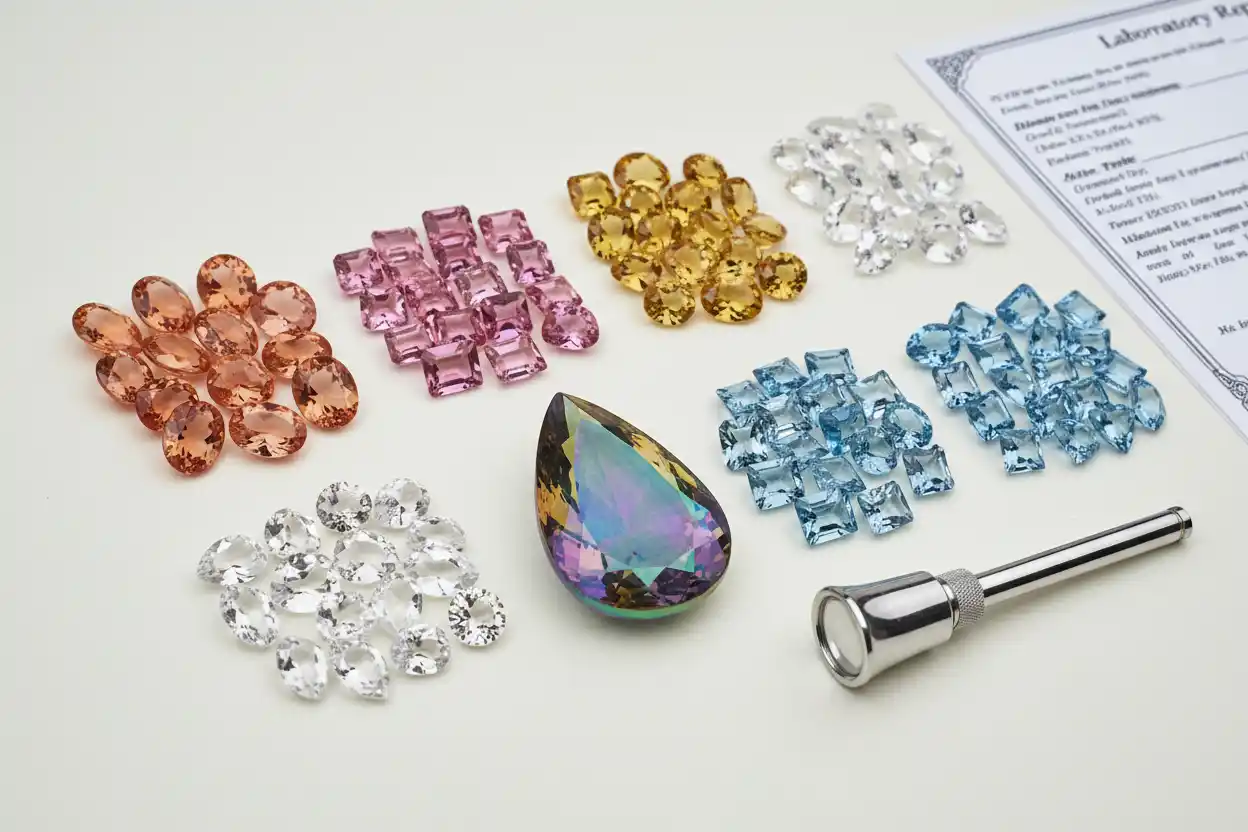
Buy Topaz: Smart Buying Tips & Red Flags
When you buy topaz, the first decision is not simply which color looks best. Topaz spans a remarkably broad market that includes abundant colorless stones, mass-market treated blue gems, natural yellow and brown material, valuable pink and red colors, highly prized Imperial-style orange-to-red stones, coated rainbow-colored products, collector crystals, and precision-cut gems. These categories can share the same mineral species while differing dramatically in rarity, treatment history, price, and resale potential.
That diversity makes it easy to buy topaz for the wrong reason. A huge flawless Swiss Blue or London Blue gem can be beautiful, yet its size and saturated color do not indicate the rarity associated with fine red, pink, or Imperial-color material. Conversely, a smaller orangy-red stone can command substantially more because desirable natural color, transparency, and size occur together much less frequently.
Treatment is equally important when you buy topaz. Strong blue topaz in mainstream jewelry is generally produced by irradiating suitable natural colorless material and then heating it to achieve or stabilize the desired blue. Mystic and similar rainbow topaz usually obtain their appearance from a thin surface coating. Some pink colors can result from heating suitable starting material. These products remain topaz when the underlying gemstone is topaz, but their color origin and durability considerations differ.
The strongest way to buy topaz is therefore to identify the exact color and treatment category first, then judge hue, tone, saturation, clarity, cut, face-up dimensions, structural condition, documentation, setting quality, and price within that category. Large weight, seller-created grades, and glamorous trade names should come later.
What Should You Evaluate First When You Buy Topaz?
A practical buy topaz hierarchy starts with mineral identity, followed immediately by color category and treatment. Once those are understood, evaluate transparency, clarity, cut, dimensions, structural condition, documentation, provenance when relevant, and intended jewelry use.
Topaz is an aluminum fluorosilicate mineral commonly represented as Al₂SiO₄(F,OH)₂. It crystallizes in the orthorhombic system, has a refractive index generally around 1.619–1.627, a specific gravity near 3.53, and Mohs hardness 8. Its broader geology, properties, color range, and mineral background are covered in topaz meaning.
Topaz also has perfect basal cleavage. That structural weakness is crucial because the mineral’s high hardness can create a false impression that it is exceptionally difficult to break. A topaz can resist scratches well and still split after an unfavorable impact or concentrated setting pressure.
| Priority | What to evaluate | Stronger choice | Main red flag |
|---|---|---|---|
| 1 | Identity | Topaz confirmed appropriately | Color or trade name used as proof |
| 2 | Color category | Exact color judged within its own market | Blue, Imperial, pink, or Mystic terms treated as universal grades |
| 3 | Treatment | Irradiation, heat, coating, or filling disclosed where relevant | “Natural” used as though it means untreated |
| 4 | Transparency | Clear transparent faceting material | Cloudiness priced as fine transparent quality |
| 5 | Clarity | Eye-clean or minimally distracting inclusions | Large surface-reaching fractures |
| 6 | Cut | Strong light return and useful spread | Windowing, extinction, unnecessary depth |
| 7 | Dimensions | Visible size appropriate to weight | Hidden pavilion weight |
| 8 | Condition | Crisp facets and sound girdle | Cleavage chip, worn coating, open crack |
| 9 | Documentation | Evidence matched to value and claim | Generic seller certificate |
| 10 | Setting | Protection suitable for perfect cleavage | High exposed mounting promoted as impact-proof |
When you buy topaz using this sequence, the color name becomes useful information rather than a substitute for quality analysis.
Understand the Topaz Category Before Comparing Prices
One of the biggest mistakes when people buy topaz is comparing completely different varieties by carat weight.
A large colorless topaz, a treated blue topaz, a vivid pink gem, and a fine orangy-red Imperial-style stone may all be natural topaz crystals originally formed in the earth, yet their market positions differ sharply.
Before you buy topaz, separate the major categories described in types of topaz:
- Colorless or white topaz.
- Sky Blue topaz.
- Swiss Blue topaz.
- London Blue topaz.
- Natural pale blue topaz.
- Yellow and golden topaz.
- Brown and sherry-colored topaz.
- Pink topaz.
- Red and purplish-red topaz.
- Imperial-style orange, pinkish-orange, and reddish material.
- Mystic and other coated topaz.
- Bicolor or unusually zoned material.
- Natural crystals and collector specimens.
The correct buy topaz comparison always stays within the relevant category unless you are deliberately deciding between categories.
Color Is the Most Important Quality Factor
After identity and treatment category, color usually has the greatest effect on value when you buy topaz.
Fine red is among the rarest and most valuable topaz colors. Highly prized Imperial-style stones can show orange, pinkish orange, reddish orange, orange-red, pink, red, or related combinations depending on how the trade term is being used.
Blue sits at the opposite end of the supply structure. Naturally strong blue topaz is uncommon, but treatment makes intense blue stones widely available. As a result, a spectacular large blue gemstone can cost considerably less than a much smaller fine red or Imperial-color stone.
When you buy topaz, therefore, ask two separate questions:
How beautiful is the color?
How difficult is that color to obtain in this particular treatment category?
Both affect price.
Do Not Judge Every Topaz Color With the Same Standard
Each color category has its own value hierarchy.
When you buy topaz in blue, uniform attractive color, clean transparency, precision cutting, size, and craftsmanship can matter strongly because the rough and treatment supply are relatively abundant.
When you buy topaz in Imperial-style colors, subtle differences in hue, reddish modifiers, saturation, transparency, treatment, and size can change value much more dramatically.
When you buy topaz in colorless form, clarity and cutting become especially visible because there is no body color to disguise a broad window or weak light return.
A universal AAA checklist cannot capture these differences.
Blue Topaz Is Usually Treated
This is one of the most important facts to understand before you buy topaz.
Naturally occurring blue topaz exists, but naturally strong blue is uncommon. Most vivid blue topaz in ordinary jewelry begins as colorless or lightly colored natural topaz that receives irradiation, generally followed by controlled heating.
The treatment changes the color centers responsible for the final appearance. The mineral remains topaz.
When you buy topaz in a strong blue shade, treatment should therefore be expected unless credible evidence indicates otherwise.
That expectation should influence price. An attractive treated blue gem can provide excellent value, but it should not receive the rarity premium attached to naturally rare topaz colors.
Irradiated Blue Topaz Is Not Fake Topaz
A common misunderstanding is that treatment somehow converts topaz into an imitation.
It does not.
When you buy topaz that began as natural colorless rough and received irradiation plus heat, you are still buying natural topaz with treated color.
The distinction matters commercially:
- Natural topaz refers to geological formation.
- Irradiated topaz describes post-growth color modification.
- Synthetic topaz would mean laboratory-grown topaz.
- An imitation may be glass, quartz, synthetic spinel, cubic zirconia, or another material merely resembling topaz.
Keeping these categories separate prevents unnecessary confusion.
Sky Blue, Swiss Blue, and London Blue Are Trade Categories
When you buy topaz in blue, you will frequently encounter Sky Blue, Swiss Blue, and London Blue descriptions.
Sky Blue generally refers to lighter blue.
Swiss Blue commonly describes a brighter, more saturated medium-to-strong blue.
London Blue usually refers to a darker, grayer or greenish blue.
These are useful retail descriptions, but they are not globally standardized color grades. Different sellers can apply the boundaries differently.
When you buy topaz labeled Swiss Blue or London Blue, compare the exact gemstone rather than paying extra solely because of the trade name.
Darker Blue Is Not Automatically Better
London Blue can be visually sophisticated, but excessive darkness may cause large areas to look gray or nearly black.
When you buy topaz in a dark blue shade, rotate the gemstone under ordinary lighting and examine whether the internal color remains visible.
A slightly lighter Swiss-style blue can show much stronger brilliance than a deep stone with widespread extinction.
The best buy topaz decision depends on the balance between color depth and light return rather than maximum darkness.
Strong Blue Color Does Not Prove Natural Rarity
A large, flawless, intensely blue gemstone can look as though it must be exceptionally rare.
In topaz, that assumption fails.
Treatment and the availability of large clean colorless crystals allow the market to produce substantial blue gemstones efficiently. This is one reason you can buy topaz in impressive blue sizes without entering the pricing territory associated with rare fine ruby, sapphire, or Imperial topaz.
Do not interpret affordability as proof that the gemstone is fake.
Instead, understand why the category is abundant.
Properly Processed Irradiated Topaz Is a Commercial Jewelry Product
Buyers sometimes worry that irradiated blue topaz must remain dangerously radioactive.
Commercial irradiation processes are subject to controls before treated material enters regulated jewelry markets. Properly processed stones are released only after applicable requirements have been satisfied.
When you buy topaz in blue, the practical consumer concerns are transparent treatment disclosure, legitimate supply channels, color quality, cut, and value rather than assuming that the word irradiation automatically means an unsafe gemstone.
A consumer should not attempt to evaluate radiation safety through improvised home methods.
Imperial Topaz Is Valuable but Poorly Standardized
Imperial is one of the most important terms to understand when you buy topaz.
There is no single universally enforced definition. Some dealers apply Imperial to orange, pinkish-orange, reddish-orange, orange-red, pink, or red topaz of desirable saturation. Others use narrower boundaries or associate the name strongly with material from Brazil.
Some specialists emphasize a reddish pleochroic component as part of the traditional Imperial character.
The practical rule is simple: buy topaz for the actual color, transparency, treatment status, and quality rather than for the word Imperial alone.
Imperial Topaz Should Not Simply Mean Yellow Topaz
One common marketplace problem occurs when ordinary golden-yellow or brownish-yellow material receives an Imperial label.
When you buy topaz sold as Imperial, inspect whether the stone actually exhibits the attractive orange, pinkish, reddish, or red-related characteristics typically associated with the premium category.
A pale yellow or brown stone does not become scarce simply because Imperial appears in the product title.
If the term creates a substantial price increase, ask exactly how the seller defines it.
Undefined rarity terminology deserves less weight.
Red Is an Exceptionally Rare Topaz Color
Fine red topaz represents a very small portion of facetable material and can command substantial collector demand.
When you buy topaz in red, evaluate whether red is truly the dominant body color rather than a tiny reflection seen only in one direction.
Pleochroism can cause reddish components to appear at certain orientations, especially near the ends of elongated stones. Those flashes can be desirable, but they should not automatically turn an orange gemstone into a predominantly red stone.
A high red-color premium deserves strong neutral-light video and appropriate documentation.
Pink Topaz Can Be Natural or Treatment-Modified
Pink topaz can occur naturally, and some suitable yellowish-pink or warm-colored starting material can also be heated to intensify the pink appearance by reducing unwanted yellow components.
When you buy topaz in pink, ask whether the seller has treatment information rather than assuming that all pink is either natural-color or treated.
Fine natural pink and purplish-pink material can be valuable.
Treatment does not necessarily make a pink stone unattractive, but disclosure influences how you should compare the price.
Yellow Topaz Is Not Citrine
Yellow, golden, honey, and orange-yellow topaz can look remarkably similar to citrine.
When you buy topaz in this range, do not rely on color to separate the two. Citrine is quartz, while topaz is a different mineral with substantially greater density and higher refractive index.
Topaz also has perfect basal cleavage, while quartz lacks equivalent cleavage.
The detailed identification differences appear in citrine vs yellow topaz.
This distinction matters because historical trade names have repeatedly attached the word topaz to yellow quartz even though the material is not topaz.
“Smoky Topaz” Is Usually a Misleading Name
Brown smoky quartz has sometimes been sold under topaz-like terminology.
When you buy topaz, be cautious with the phrase smoky topaz unless the seller has actually identified the material as topaz.
Smoky quartz and topaz are different minerals.
Quartz has different density, refractive properties, crystal structure, hardness, and cleavage.
A brown stone does not become topaz because a more prestigious trade term is attached to it.
Sherry Topaz Is a Color Description, Not a Species
Sherry is used commercially for yellowish-brown, brownish-yellow, and orange-brown topaz.
When you buy topaz with this description, judge the stone for actual color quality.
Some warm brown-orange material can be beautiful, particularly when transparency and cutting are strong. However, the sherry label does not create one universal value tier.
A vividly saturated orangy-red stone and a dark brown-yellow gem should not be priced identically merely because both fall beneath a broad sherry description.
White Topaz Is Colorless Topaz
White topaz generally means colorless or nearly colorless material.
When you buy topaz in this category, clarity and cutting become especially important because there is no body color to distract from optical weaknesses.
Large, eye-clean white topaz is available because the mineral can form substantial transparent crystals.
Do not pay a rarity premium simply because a colorless stone is large and flawless-looking.
Its value can still rise through exceptional precision cutting, designer authorship, antique provenance, or fine jewelry craftsmanship, but the raw material itself is usually relatively accessible.
White Topaz Is Not a Diamond Equivalent
White topaz can provide an attractive colorless gemstone at lower cost, yet its brilliance, dispersion, refractive index, toughness, and long-term surface performance differ from diamond.
When you buy topaz as a colorless center stone, choose it because you like the appearance and value proposition rather than because a seller describes it as indistinguishable from diamond.
Topaz also has perfect cleavage, which makes direct impact a more important risk.
A lower price does not make it inferior for every purpose, but the physical differences should be understood.
Mystic Topaz Is a Coated Product
Mystic topaz usually begins as colorless natural topaz and receives a very thin surface coating that creates rainbow, purple, green, pink, blue, or multicolored interference effects.
When you buy topaz in Mystic form, remember that the dramatic visible color is treatment-dependent.
The coating is much less durable than the underlying Mohs 8 topaz.
Scratching, polishing, abrasive cleaners, repeated rubbing, and jewelry repair can damage or remove the surface layer.
A Mystic stone should therefore be priced and cared for as coated topaz rather than as a naturally multicolored rare gem.
Coating Wear Is a Major Mystic Topaz Red Flag
Before you buy topaz with a coated finish, inspect the facet junctions, girdle, table, chipped areas, and regions beneath prongs.
Uneven color, scratches exposing a different underlying appearance, peeling, or dull patches can indicate coating damage.
Do not intentionally scratch the gemstone to test it.
A close inspection under magnification can reveal enough to determine whether professional examination is warranted.
When you buy topaz secondhand in Mystic form, coating condition is part of the value.
Bicolor Topaz Should Show a Meaningful Color Pattern
Natural or treatment-related color zoning can create gemstones displaying more than one visible color.
When you buy topaz represented as bicolor, inspect whether both colors remain distinct in the face-up view.
A tiny yellow corner on an otherwise colorless stone should not automatically receive the same premium as a beautifully balanced two-color design.
Cutting orientation matters because the cutter can either showcase or obscure the zoning.
Video is particularly useful for understanding whether the bicolor effect remains visible through movement.
Clarity Standards Should Usually Be High
Topaz frequently forms large transparent crystals, and faceted blue, colorless, and yellow material is commonly eye-clean.
When you buy topaz in those categories, obvious central inclusions, dense clouds, or large reflective fissures should generally reduce the price.
Rare red, pink, and fine Imperial-color stones deserve more tolerance because desirable color is much scarcer. A small inclusion can be a reasonable compromise when the color is exceptional.
The important question is whether the inclusion affects appearance or structure.
Do Not Assume a Flawless-Looking Topaz Is Fake
Because natural topaz can form in large clean crystals, extreme clarity does not prove glass or laboratory manufacture.
When you buy topaz, avoid the common rule that a natural gemstone must contain obvious inclusions.
Some natural stones are extremely clean.
Likewise, glass and manufactured substitutes can also be clean.
Clarity alone cannot identify the material.
Natural Topaz Can Contain Useful Identification Features
Natural topaz may contain liquid-filled cavities, two-phase inclusions, mineral crystals, tubes, healed fissures, and other internal features.
When you buy topaz, these characteristics can contribute to gemological identification but should not be treated as a checklist where one feature proves authenticity.
Different deposits produce different inclusions.
A clean stone can still be natural.
Professional identification combines microscopy with optical and physical measurements.
Surface-Reaching Fractures Require Extra Caution
Topaz already has perfect basal cleavage, so an open fracture deserves serious attention.
When you buy topaz, inspect any fissure reaching the table, crown, girdle, pavilion, pointed end, or future prong position.
A surface-reaching fracture can:
- Reduce transparency.
- Trap dirt.
- Contain filler.
- Create a breakage path.
- Complicate setting.
- Affect repolishing.
- Reduce resale appeal.
A heavily fractured topaz can still be usable when accurately disclosed and priced accordingly, but it should not be represented as fine clean material.
Fracture Filling Should Be Disclosed
A resin, oil, polymer, glass-like material, or other filler can reduce the visibility of a surface-reaching fissure.
When you buy topaz with obvious fractures, ask whether clarity enhancement is known.
Filler affects both value and care.
Heat, chemicals, ultrasonic vibration, and repair procedures can affect filler differently from the topaz host.
A filled gemstone remains topaz if the host material is topaz, but its condition and treatment category are different from an untreated intact stone.
Cut Quality Matters Even When Rough Is Abundant
Topaz can occur in very large crystals, so buyers generally have little reason to accept severely poor cutting in common blue or colorless material.
When you buy topaz, look for balanced symmetry, good polish, strong light return, useful face-up size, and proportions suited to the color.
Rare Imperial, pink, and red rough may justify greater weight retention and unusual shapes, but even then the finished gem should remain attractive.
A cutting compromise should preserve something valuable.
If it simply creates a broad window or dark dead center, the extra weight may not be worth paying for.
Windowing Is Especially Obvious in Pale Topaz
A window occurs when light passes through the pavilion rather than reflecting efficiently back toward the viewer.
When you buy topaz in colorless, pale blue, or yellow material, place the gemstone over neutral text or a gray background.
If you can see through a broad central area clearly, the pavilion may be too shallow.
A small amount of leakage at steep viewing angles is normal.
A large stationary window weakens brilliance and can make an otherwise attractive stone appear hollow.
Extinction Can Hurt Dark London Blue and Warm Topaz
Extinction creates dark areas where little useful light returns.
When you buy topaz in a dark London-style blue, deep brown, reddish-orange, or strongly saturated warm color, rotate the stone slowly and examine whether dark facets move.
A dynamic pattern of light and dark is normal.
Large areas that remain nearly black can make the stone look less lively and suppress the color you are paying for.
Do not let “deep saturation” become an excuse for poor light return.
Bow Ties Can Affect Ovals and Pears
Oval, pear, marquise, and elongated cushion topaz can develop a bow-tie-shaped dark area across the center.
When you buy topaz in an elongated shape, request continuous video to evaluate the bow tie through movement.
A moderate central contrast can be visually acceptable.
A broad, persistent black band should reduce the price because it divides the gemstone and limits brilliance.
One carefully selected photograph may hide the problem.
Emerald Cuts Can Be Excellent for Strongly Colored Topaz
Step cuts can work particularly well when you buy topaz with strong body color because broad facets create flashes of color while preserving significant rough.
However, the same open facet pattern makes inclusions and windowing easier to see.
When you buy topaz in an emerald, octagonal, or other step cut, inspect the center carefully.
A clean transparent interior and precise polish become especially important.
Fantasy and Precision Cuts Can Add Genuine Value
Topaz is popular among artistic cutters because the material occurs in large clean crystals and can support elaborate shapes.
When you buy topaz with a precision, concave, fantasy, or designer cut, the cutting labor can legitimately contribute a large portion of the final value.
Judge:
- Symmetry.
- Polish.
- Facet alignment.
- Light return.
- Color distribution.
- Face-up spread.
- Originality.
- Cutter attribution.
A precision-cut blue topaz may cost far more than mass-produced blue material despite identical treatment because craftsmanship is the premium.
Compare Carat Weight With Millimeter Dimensions
Topaz is relatively dense, and stones can also be cut very deeply.
When you buy topaz, always compare length, width, and depth with carat weight.
A large carat number can sound impressive while much of the weight remains hidden beneath the girdle.
This issue becomes particularly important when you buy topaz in expensive Imperial, pink, or red colors because per-carat prices can increase substantially with fine size.
A deep stone can be rational when it preserves rare color, but you should understand what the added mass contributes.
Large Blue Topaz Should Not Receive a Rarity Premium From Size Alone
Topaz is famous for producing exceptionally large crystals.
When you buy topaz in treated blue, substantial sizes can therefore remain comparatively affordable.
A very large clean blue gemstone should be evaluated for cut, uniformity, polish, face-up dimensions, and craftsmanship rather than assumed to be rare because of its weight.
The market behaves differently from rare ruby or alexandrite, where large fine material is dramatically more difficult to obtain.
Large Imperial Topaz Is Different
The size equation changes when you buy topaz in rare fine color.
A larger transparent Imperial-style stone with strong orange-red, pinkish-orange, or reddish characteristics can command a much stronger premium because desirable natural-color rough is scarcer.
Size therefore has no universal effect across topaz.
Always ask which color category the size belongs to.
Natural Blue Topaz Needs Evidence if It Carries a Premium
Pale natural blue topaz exists, but strongly saturated untreated natural blue is unusual.
When you buy topaz marketed as rare natural blue, do not infer color origin from appearance.
A seller asking a large premium should provide evidence proportionate to that claim.
Ordinary vivid blue topaz should generally be assumed treated because treatment dominates that market category.
Synthetic Topaz Exists but Is Not the Main Consumer Problem
Laboratory-grown topaz has been produced, but it is not a major mass-market synthetic gemstone because natural colorless topaz is abundant.
When you buy topaz, more realistic misrepresentation risks often include glass, quartz, cubic zirconia, synthetic spinel, synthetic sapphire, and other natural or manufactured stones sold under topaz terminology.
That distinction matters.
A low-cost item labeled synthetic topaz may not necessarily be laboratory-grown topaz at all.
Ask what the material actually is.
Glass Can Imitate Every Topaz Color
Glass can reproduce blue, yellow, pink, brown, red, green, and colorless topaz appearances.
Possible clues include round gas bubbles, curved flow structures, mold marks, comparatively soft facet wear, or unusual luster.
However, high-quality glass may lack obvious bubbles.
When you buy topaz at meaningful value, objective gemological measurements provide stronger evidence than searching only for one visual clue.
Cubic Zirconia Can Imitate Colorless and Colored Topaz
Cubic zirconia is much denser and has substantially stronger dispersion than topaz.
When you buy topaz that produces unusually broad rainbow flashes, CZ becomes one possible comparison, although cutting and lighting also influence dispersion.
A same-size loose CZ usually weighs considerably more because of its much higher density.
Professional refractive and optical testing separates the materials readily.
Do not rely solely on hand feel because pavilion depth changes weight.
Synthetic Spinel Is Another Common Topaz-Like Material
Synthetic spinel can be manufactured in many blue, yellow, pink, and colorless appearances.
When you buy topaz, particularly vintage or inexpensive jewelry, a stone described vaguely as created topaz may actually be synthetic spinel rather than laboratory-grown topaz.
Synthetic spinel has different chemistry, optical properties, and refractive behavior.
The invoice should name the actual material rather than using a color-based substitute term.
Blue Topaz Versus Aquamarine Is a Common Buying Decision
Pale Sky Blue topaz can resemble aquamarine closely, while stronger treated blues can overlap with more saturated beryl in photographs.
The detailed mineral and buying differences appear in aquamarine vs blue topaz.
When you buy topaz instead of aquamarine, the strongest advantages are usually accessible saturated blue color, large clean stones, and excellent size for the budget.
Aquamarine can offer a naturally blue-to-greenish-blue beryl identity and lacks topaz’s pronounced perfect basal cleavage.
Neither is universally better.
Broader Topaz Versus Aquamarine Identification Requires Instruments
When the exact topaz color is uncertain, the broader aquamarine vs topaz comparison helps separate the minerals through refractive index, density, crystal structure, and treatment context.
When you buy topaz, remember that aquamarine is considerably less dense.
An equal-volume topaz would weigh noticeably more.
However, hand comparison is not precise enough for a valuable stone because cut depth changes physical volume.
Proper testing remains preferable.
Do Not Use Scratch Tests
Topaz defines Mohs hardness 8, which makes it harder than quartz.
That may tempt buyers to scratch a suspected citrine or piece of glass.
Do not do this.
When you buy topaz, a scratch test can damage a polished surface, chip an edge, or create misleading results without determining natural versus treated origin.
The test is especially inappropriate because topaz has perfect cleavage. Applying force merely to prove hardness introduces needless risk.
Use nondestructive identification.
Perfect Basal Cleavage Is Topaz’s Biggest Durability Weakness
This is the physical property every jewelry buyer should understand before they buy topaz.
Topaz is hard but has poor toughness because of perfect basal cleavage. A sharp impact or concentrated force in an unfavorable direction can split the gemstone.
The distinction between surface hardness and breakage resistance is explained in gemstone toughness vs hardness.
This is why a topaz can resist ordinary scratches quite well while still needing more impact protection than its Mohs 8 rating might suggest.
Cutting Orientation Helps Reduce Cleavage Risk
Experienced cutters orient topaz carefully so the cleavage direction does not sit in the most vulnerable relationship to the table.
That reduces risk during faceting, polishing, setting, and wear.
When you buy topaz, you normally cannot determine the complete internal orientation from an ordinary product photograph, which is another reason skilled cutting and professional setting matter.
A high-value stone should not be recut casually by someone unfamiliar with topaz.
Rings Need More Protection Than Earrings or Pendants
When you buy topaz for jewelry, intended use should influence the setting.
Rings and bracelets experience frequent impacts from desks, door frames, countertops, tools, and other hard objects.
Earrings and pendants generally encounter much less direct impact.
Topaz can still be used successfully in rings, particularly with protective settings and sensible wear. The goal is not to avoid topaz rings entirely but to respect the cleavage.
Pointed Shapes Need Extra Care
Pear, marquise, trillion, kite, and other pointed cuts can concentrate impact and setting pressure.
When you buy topaz in a pointed shape, inspect each corner or tip for chips, fractures, and thin areas.
Protective V-prongs or partial bezels can reduce direct impact, although the jeweler must avoid excessive force against the stone.
A large valuable Imperial topaz deserves particularly thoughtful setting work.
A Protective Bezel Is Helpful but Not Automatically Risk-Free
A bezel surrounds more of the girdle and can provide excellent impact protection.
However, installing a bezel requires moving metal against the gemstone.
When you buy topaz for a bezel setting, the setter should understand its cleavage and inspect existing fractures before applying pressure.
Protective design and skilled execution must work together.
Avoid Tension Settings
A tension setting deliberately uses significant metal pressure to hold the gemstone.
That is poorly matched with topaz’s perfect cleavage.
When you buy topaz for a ring, choose a setting that secures the stone without making sustained high pressure part of the design.
The issue is structural physics, not whether the topaz has a high quality grade.
Warm Soapy Water Is the Safer Cleaning Method
Topaz does not need aggressive cleaning equipment.
When you buy topaz, plan on lukewarm water, mild soap, a soft brush, and gentle drying for ordinary sound jewelry.
The detailed procedure for blue, Imperial, white, yellow, Mystic, and fractured pieces appears in how to clean topaz jewelry.
Cleaning should always follow the most vulnerable treatment or setting component.
Avoid Ultrasonic Cleaning
Ultrasonic vibration can stress fractures and cleavage-related weaknesses.
When you buy topaz, especially a valuable Imperial stone, coated Mystic gem, fractured stone, or antique setting, manual cleaning is the more conservative choice.
The benefit of an ultrasonic cleaner is small compared with the possible consequence of splitting or damaging the stone.
Avoid Steam and Abrupt Temperature Change
Steam combines heat and rapid thermal change, both of which are poor choices for a cleavage-sensitive gemstone.
When you buy topaz jewelry, inform the jeweler about the center stone before soldering, retipping, resizing, or another repair that generates concentrated heat.
Some yellow, brown, or related colors can also be affected by prolonged heat or strong exposure.
Mystic coatings introduce an additional surface-treatment vulnerability.
Mystic Topaz Requires the Gentlest Cleaning
The topaz underneath the coating may be Mohs 8, but the coating does not inherit the same abrasion resistance.
When you buy topaz with a Mystic or similar coated finish, avoid polishing compounds, abrasive cloths, strong chemicals, steam, ultrasonic cleaning, and aggressive brushing.
A worn coating may not be economically restorable in the same way that an ordinary polished topaz surface can be repolished.
The treatment should therefore be considered part of long-term ownership cost.
Brazilian Origin Matters Most for Certain Premium Colors
Brazil is an important source of topaz and is particularly famous for Imperial-color material from Minas Gerais.
When you buy topaz represented as Brazilian, remember that Brazil produces a range of qualities and colors.
A country name is not a grade.
Fine reddish-orange or pinkish material with strong provenance may attract collector interest, but an ordinary yellow or colorless Brazilian stone should still be judged according to its actual quality category.
Ouro Preto Provenance Can Add Collector Interest
Ouro Preto is strongly associated with Imperial topaz in the gem trade.
When you buy topaz carrying a specific Ouro Preto premium, ask what connects the gemstone to that provenance.
Dealer records, rough history, old labels, collection documentation, and credible supply-chain records can be useful.
Color alone does not prove exact mine origin.
A stone can look Imperial without allowing precise geographic attribution from appearance.
Pakistan Is Important for Pink and Other Topaz
Pakistan has produced notable topaz, including valued pink material and collector crystals.
When you buy topaz represented as Pakistani, quality should still come before origin.
A pale, heavily included stone does not become top quality merely because the provenance is fashionable.
When exact mine or valley origin creates a substantial premium, require stronger traceability than seller assertion alone.
Origin Should Usually Rank Below Color
For most jewelry buyers, color affects enjoyment every time the gemstone is viewed.
When you buy topaz, a beautifully saturated stone with excellent cutting can be more satisfying than a weaker gemstone from a prestigious locality.
Collectors focused on mineral provenance may reasonably choose differently.
The important step is knowing whether you are paying for a gemstone, a locality collectible, or both.
Seller Grades Are Not Universal
AAA, AAAA, premium, investment, royal, museum, heirloom, or collector grade are not standardized topaz grades.
When you buy topaz, ask what the seller’s grade means.
Does it evaluate:
- Color?
- Clarity?
- Cut?
- Treatment?
- Origin?
- Size?
- Coating condition?
- Symmetry?
- All of these?
If the answer is vague, ignore the grade and evaluate the stone directly.
Imperial Is Not a Laboratory Grade Either
A laboratory can identify topaz and describe its observable color, but the word Imperial does not correspond to one universally enforced laboratory quality grade.
When you buy topaz sold as Imperial, the exact body color matters more than the label.
This is particularly important because different dealers use the term across different boundaries.
When Does a Laboratory Report Make Sense?
Most ordinary blue or white topaz does not need an expensive individual laboratory report.
When you buy topaz in those categories, the testing cost may be disproportionate to the stone’s raw material value.
A report becomes more useful when:
- Fine Imperial color creates a large premium.
- Natural pink or red color is claimed.
- Untreated natural blue is claimed.
- The stone may be citrine, aquamarine, zircon, or another gem.
- A coating or filling is suspected.
- Natural versus laboratory-grown origin materially affects value.
- The gemstone is unusually expensive.
- Important provenance is part of the transaction.
The threshold should follow the cost of being wrong.
GIA Evaluates Topaz but Does Not Apply a Universal Quality Grade
A colored-stone identification report can establish whether a submitted gemstone is topaz, document measurements and appearance, determine natural or laboratory-grown origin, and name detectable treatments within the service.
That is different from assigning a universal AAA or Imperial quality score.
When you buy topaz with a report, use the laboratory document for identification and treatment evidence.
Judge commercial quality separately.
A Report Is Not an Appraisal
A laboratory report and an appraisal perform different functions.
When you buy topaz, an identification report addresses what the gemstone is and supported characteristics.
An appraisal estimates monetary value for a stated purpose.
A high insurance figure does not prove that an orange topaz is untreated Imperial material.
Likewise, a laboratory identification does not establish that the asking price is competitive.
Match Documentation to the Exact Stone
Before you buy topaz with a laboratory report, compare:
- Carat weight.
- Length.
- Width.
- Depth.
- Shape.
- Cutting style.
- Color description.
- Report number.
- Photograph where available.
A report for another stone from the same parcel does not authenticate yours.
If the gemstone has been recut or repolished, dimensional discrepancies should be explained.
Actual-Stone Photography Is Essential for Premium Topaz
A generic stock image may be acceptable for inexpensive standardized blue studs, but it is inadequate for individually priced Imperial, pink, red, bicolor, precision-cut, or collector topaz.
When you buy topaz at a meaningful premium, request actual-stone photographs.
A complete visual set should include:
- Face-up view.
- Side profile.
- Pavilion view where practical.
- Neutral background.
- Inclusion close-up.
- Girdle and corner details.
- Continuous rotating video.
The stronger the rarity claim, the stronger the visual documentation should become.
Ask for Neutral-Light Images
Color photography can materially influence topaz.
Warm lighting can intensify orange, pink, red, and yellow. Cool lighting can strengthen blue. Dark backgrounds can deepen saturation.
When you buy topaz, request images where the surrounding environment looks neutral.
A white card should look white.
If the entire scene appears orange or blue, the gemstone is probably being affected as well.
Side Views Reveal Hidden Weight
A straight face-up photograph cannot tell you how deep the pavilion is.
When you buy topaz, particularly expensive warm-color material, ask for a side view.
A deep pavilion may preserve valuable color and rough, but it can also create a high carat figure without equivalent visible spread.
Determine whether the depth provides something useful.
Pavilion Views Can Reveal Chips and Coating Wear
Rear photographs can expose:
- Cleavage damage.
- Chipped culets.
- Poor polish.
- Surface-reaching fractures.
- Coating irregularities.
- Hidden inclusions.
- Excessive depth.
When you buy topaz online, these views reduce uncertainty without requiring destructive inspection.
Return Rights Matter
Color and cut can look different once the stone reaches your own lighting environment.
When you buy topaz remotely, verify the return policy before purchasing rather than after discovering a problem.
Check whether:
- The exact stone can be returned.
- Laboratory testing is permitted.
- Tags must remain attached.
- Setting a loose stone ends return rights.
- Resizing jewelry makes it final sale.
- Restocking fees apply.
- Return shipping must be insured.
- Treatment misdescription receives a remedy.
A high-value purchase deserves a realistic inspection opportunity.
Put Material and Treatment Claims in Writing
When you buy topaz, the invoice should identify the material clearly.
For a significant purchase, preserve relevant wording such as:
Natural topaz.
Irradiated and heated blue topaz.
Coated Mystic topaz.
Natural pink topaz.
Imperial-color topaz.
Known filling.
Carat weight.
Dimensions.
Laboratory report number.
Claimed provenance.
Written disclosure does not replace testing, but it establishes what the seller represented.
Value Trade-Off: Fine Color Versus Larger Size
Suppose your budget allows either a large pale yellow stone or a smaller vivid reddish-orange topaz.
If your priority is fine color, the smaller stone may be the better way to buy topaz.
Topaz can occur in large crystals, so size without rare color is often less significant than buyers expect.
Fine color and size together create the stronger rarity.
Value Trade-Off: Blue Saturation Versus Brilliance
A dark London-style blue gemstone can show rich color but reduced brightness.
A somewhat lighter Swiss-style stone can show more scintillation.
When you buy topaz, compare both under ordinary lighting.
If the darker stone looks black through much of the center, greater saturation may not produce greater beauty.
Value Trade-Off: Treated Blue Versus Natural Rare Color
A large treated blue topaz can provide exceptional visible size and color for the budget.
A small natural pink or Imperial-color gem may provide greater geological and collector rarity.
When you buy topaz, choose according to your goal.
For dramatic jewelry, treated blue can be outstanding value.
For rare-gem collecting, the naturally scarce warm colors may be more compelling.
Value Trade-Off: Better Cut Versus More Weight
Topaz can produce enormous finished stones, making extra carats easy to overvalue.
When you buy topaz, a smaller precision-cut gemstone can look substantially more impressive than a heavier commercial stone with windowing and excessive depth.
Pay for visible optical performance.
Hidden weight does not sparkle.
Value Trade-Off: Untreated Claim Versus Visible Quality
An untreated claim can be meaningful in rare color categories, but it should not override the actual gemstone.
When you buy topaz, a weak untreated stone does not automatically outperform a beautiful gem with a disclosed acceptable treatment.
The value difference depends on color category, treatment type, rarity, and collector demand.
Value Trade-Off: Provenance Versus Better Gemstone
An Ouro Preto or Pakistani provenance can interest collectors.
However, if another topaz has visibly better color, transparency, cutting, and condition at the same budget, a jewelry buyer may obtain greater satisfaction from the better gemstone.
When you buy topaz, decide whether provenance is central to your objective before paying for it.
Value Trade-Off: Loose Stone Versus Finished Jewelry
When you buy topaz loose, you can evaluate dimensions, pavilion quality, treatment, and inclusions more easily.
Finished jewelry provides convenience and allows you to judge the complete design, but the setting can hide chips, fractures, coating damage, or excessive depth.
Rare Imperial and pink stones deserve particularly careful inspection before mounting.
Practical Buy Topaz Decision Matrix
| Factor | Strong candidate | Reasonable compromise | Serious concern |
|---|---|---|---|
| Identity | Topaz appropriately confirmed | Straightforward commercial purchase with clear disclosure | Trade name used as identification |
| Color | Attractive within the relevant topaz category | Pale or darker shade priced appropriately | Muddy or edited color sold as elite quality |
| Blue treatment | Irradiation and heat understood | Routine treated blue bought deliberately | Strong blue sold as naturally rare without evidence |
| Imperial term | Fine orange-to-red/pink-related color supports label | Seller defines term clearly | Ordinary yellow/brown stone called Imperial |
| Pink/red | Strong color with credible treatment context | Minor inclusion with rare color | Rare-color premium with weak documentation |
| Clarity | Eye-clean where category normally allows | Small inclusion compensated by rare color | Large central/open fracture |
| Cut | Bright, balanced, useful spread | Minor asymmetry preserving rare rough | Broad window, severe extinction |
| Dimensions | Good face-up size for weight | Additional depth supporting color | Major hidden weight |
| Coating | None or clearly disclosed | Mystic product deliberately chosen | Coating concealed or badly worn |
| Filling | None or disclosed | Minor filling reflected in price | Fracture enhancement hidden |
| Condition | Crisp facets and sound girdle | Minor wear priced appropriately | Cleavage chip or open crack |
| Origin | Provenance supported when premium matters | Country not central to decision | Famous locality inferred from color |
| Documentation | Appropriate to value and claims | No report for ordinary blue topaz | Seller certificate used as proof of rare natural color |
| Returns | Meaningful inspection opportunity | Reasonable limitations | Expensive final sale with no verification path |
| Setting | Cleavage-aware protective design | Carefully worn ordinary setting | High-pressure or highly exposed design |
Use this matrix when you buy topaz to make each premium explicit rather than letting one label control the entire transaction.
Stone-Specific Red Flags When You Buy Topaz
One major warning is a large vivid blue topaz sold as extraordinarily rare because of its color and weight. Strong blue is generally treatment-created, and large clean material is widely available.
Another red flag is ordinary yellow or brown topaz carrying a major Imperial premium without the orange, pinkish, reddish, or red-related characteristics usually associated with the prized category.
Be cautious with “smoky topaz,” “quartz topaz,” and similar terminology that may disguise quartz as topaz.
Mystic topaz should raise a different question: is the surface coating clearly disclosed, and is it in good condition?
Other red flags include:
- A supposedly natural intense blue stone with no treatment discussion.
- Rare pink or red color shown only under heavily biased lighting.
- AAAA grades with no definition.
- Huge weight without dimensions.
- Broad windowing hidden by a dark background.
- Severe extinction called deep saturation.
- Surface-reaching fractures with no filling disclosure.
- Mystic coating wear hidden beneath prongs.
- An appraisal presented as proof of natural color.
- A report that does not match the stone.
- Famous origin claimed from appearance.
- Jewelry marketed as impact-proof because topaz is Mohs 8.
- A tension setting promoted for an expensive cleavage-sensitive stone.
A Better Way to Buy Topaz
Start your buy topaz comparison by deciding which category you actually want.
If your goal is blue jewelry, compare treated blue stones against other treated blue stones. Focus on exact shade, brightness, cut, face-up spread, setting, and craftsmanship rather than searching for rarity where treatment has created abundant supply.
If you want Imperial, pink, or red topaz, raise your evidence standard. Compare body color under neutral light, treatment disclosure, transparency, size, cut, and documentation before accepting a premium.
For yellow material, verify that you are buying topaz rather than citrine or another yellow gemstone when the price makes the distinction important.
For Mystic topaz, treat coating condition and care requirements as central quality factors.
Once the correct category is established, inspect clarity and fractures. Then evaluate cutting, windowing, extinction, dimensions, and structural condition.
After those fundamentals, assess provenance, reports, actual-stone photography, invoice wording, return rights, and jewelry suitability.
The wider Buying & Value collection uses the same evidence-first principle across gemstones, but the best way to buy topaz is specifically to separate natural rarity from treatment-created abundance and to balance high scratch resistance against perfect cleavage.
Frequently Asked Questions
What should I check first when I buy topaz?
When you buy topaz, first confirm the mineral identity and exact color category, then establish relevant treatment before judging clarity, cut, size, condition, documentation, and price.
What topaz color is most valuable?
Fine red and highly prized Imperial-style orange-to-red or pink-related colors occupy the strongest value tiers. When you buy topaz, blue should not be assumed rare because strong commercial blue is commonly treatment-created.
Is blue topaz natural?
The underlying gemstone is usually natural topaz, but most strongly blue commercial stones receive irradiation followed by heating to produce the final color.
Is irradiated topaz fake?
No. When you buy topaz that was naturally formed and later irradiated, you are buying treated natural topaz rather than an imitation.
Is blue topaz normally heat treated too?
Yes. Irradiation and heat are commonly used together to create commercial blue shades.
What is Sky Blue topaz?
Sky Blue generally describes a lighter commercial blue. When you buy topaz under this label, compare the exact stone because the term does not have one universal color boundary.
What is Swiss Blue topaz?
Swiss Blue generally refers to brighter, more saturated blue topaz. When you buy topaz labeled Swiss Blue, the actual hue, tone, saturation, and cut are more important than the name.
What is London Blue topaz?
London Blue usually describes darker, grayer, or slightly greenish blue material. When you buy topaz in this shade, check for excessive extinction because very dark stones can lose brilliance.
Is natural blue topaz rare?
Strong naturally blue material is uncommon. When you buy topaz sold as intensely blue and untreated, a substantial rarity premium should be supported with appropriate evidence.
What is Imperial topaz?
Imperial topaz is a valuable trade category generally associated with desirable orange, pinkish-orange, reddish-orange, pink, red, or related colors. There is no single universally enforced boundary.
Is every orange topaz Imperial?
No. When you buy topaz marketed as Imperial, judge the actual hue, saturation, pleochroism, transparency, treatment, and seller definition rather than relying on orange color alone.
Is yellow topaz Imperial topaz?
Not automatically. Ordinary yellow or brownish-yellow material should not receive an Imperial premium merely because the seller uses the name.
Is red topaz rare?
Yes. Fine predominantly red material is extremely scarce among facet-grade topaz and can command substantial collector demand.
Is pink topaz natural?
Natural pink topaz exists, while some suitable material can also be heated to intensify pink by reducing yellowish components. When you buy topaz in pink, treatment context matters.
Is Mystic topaz natural?
The base stone is usually natural colorless topaz, but the rainbow-like appearance comes from an artificial surface coating.
Does Mystic topaz coating wear off?
It can be scratched, abraded, polished away, or damaged by inappropriate cleaning. When you buy topaz in Mystic form, inspect the coating condition carefully.
Is white topaz natural?
White topaz generally refers to natural colorless topaz unless a seller states otherwise. Large clean colorless stones are relatively available.
Is white topaz the same as diamond?
No. Topaz and diamond differ in chemistry, refractive index, dispersion, hardness, toughness, cleavage, and value.
Is smoky topaz real topaz?
The phrase is frequently used misleadingly for smoky quartz. When you buy topaz in brown, require actual mineral identification rather than relying on the smoky topaz name.
Is yellow topaz the same as citrine?
No. Citrine is quartz. Topaz is a different mineral with higher density, different refractive properties, and perfect basal cleavage.
What gemstones can imitate topaz?
Depending on color, topaz can be imitated or confused with glass, cubic zirconia, quartz, citrine, aquamarine, zircon, synthetic spinel, synthetic sapphire, and other transparent gems.
Does synthetic topaz exist?
Laboratory-grown topaz has been produced, but it is not a major mainstream jewelry product. When you buy topaz labeled synthetic, determine what the material actually is because many inexpensive substitutes are different substances.
Should topaz be eye-clean?
Blue, colorless, and yellow faceted topaz is commonly expected to look eye-clean. Rare pink, red, and Imperial-color stones may justify somewhat greater inclusion tolerance.
Are inclusions proof that topaz is natural?
No. Natural topaz can be extremely clean, while imitations and manufactured materials can contain inclusions. When you buy topaz, use complete gemological evidence rather than one inclusion rule.
What is windowing in topaz?
Windowing is a pale or transparent central area where light escapes through the pavilion. When you buy topaz, a large window should generally reduce the price.
What is extinction in topaz?
Extinction appears as dark or black areas where little useful light returns. It can be particularly distracting in dark blue or strongly saturated warm-color topaz.
Is bigger topaz more valuable?
Not automatically. Topaz can form very large crystals. When you buy topaz, size commands the strongest premium when rare color, transparency, clarity, and cutting survive into the larger gemstone.
Why is large blue topaz affordable?
Colorless topaz can occur in large clean crystals, and scalable irradiation-plus-heat treatment creates strong blue color. This allows substantial blue gems to remain accessible.
Is large Imperial topaz expensive?
Fine larger Imperial-color stones can become substantially more valuable because desirable natural warm colors are much scarcer than treated blue.
Is topaz hard enough for rings?
Topaz has Mohs hardness 8, giving it strong scratch resistance. However, perfect basal cleavage means sharp impacts can split it. When you buy topaz for a ring, protective design matters.
Is topaz good for an engagement ring?
It can be used in a carefully designed engagement ring, but its perfect cleavage makes it less forgiving of impact than sapphire or spinel.
What setting is best when I buy topaz?
Protective bezels, partial bezels, halos, and secure prong settings can work well when the setter understands topaz cleavage. Avoid designs that place excessive pressure on the gemstone.
Should topaz go in a tension setting?
A tension setting is generally a poor choice because sustained pressure conflicts with topaz’s perfect cleavage.
Can topaz go in an ultrasonic cleaner?
It is safer to avoid ultrasonic cleaning because vibration can aggravate fractures and cleavage-related weaknesses.
Can topaz be steam cleaned?
Steam should be avoided because heat and rapid temperature change can cause damage, while coated topaz requires additional caution.
How should I clean topaz?
Use lukewarm water, mild soap, and gentle manual cleaning. When you buy topaz with a coating, filler, open fracture, or delicate setting, use even more conservative care.
Does topaz need a laboratory report?
Most ordinary blue or white material does not. When you buy topaz with valuable Imperial, pink, red, untreated-blue, treatment-sensitive, or important provenance claims, a report can become much more useful.
Does a laboratory grade topaz as AAA?
There is no universal laboratory AAA quality grade for topaz. When you buy topaz with AAA or AAAA terminology, treat it as seller-specific unless the criteria are clearly defined.
Does a report prove Imperial topaz?
A laboratory can identify topaz and describe its characteristics, but Imperial is not one universally enforced quality boundary. When you buy topaz under that trade term, evaluate the actual color.
Is an appraisal proof of natural topaz?
No. An appraisal estimates monetary value. Gemological identification and treatment analysis require appropriate testing.
What photographs should I request before I buy topaz online?
Request exact-stone face-up photographs, side and pavilion views, neutral-light images, inclusion close-ups, and rotating video. Coated, Imperial, pink, and red material deserves particularly complete imagery.
Does topaz hold its value?
Fine rare-color topaz can attract collector demand, but ordinary blue and colorless stones are relatively abundant. When you buy topaz, do not assume that retail price guarantees future resale value.
What is the biggest red flag when I buy topaz?
The biggest warning is a premium based on a misunderstood category: vivid treated blue presented as naturally rare, ordinary yellow called Imperial, quartz sold as smoky topaz, coated Mystic material represented as naturally multicolored, or large carat weight used to distract from weak cutting.
Final Buy Topaz Checklist
Before you buy topaz, identify the exact product category. Colorless topaz, treated blue topaz, natural yellow material, fine pink or red topaz, Imperial-style warm colors, Mystic coated gems, and collector crystals should not be compared through one universal price-per-carat formula.
Judge color according to that category. When you buy topaz in blue, understand that strong commercial color normally results from irradiation and heat, so saturation and size alone do not indicate rarity. When you buy topaz in pink, red, or Imperial-style colors, raise your standards for treatment disclosure, neutral-light photography, and documentation because naturally scarce color can create a substantial premium.
Examine transparency and clarity next. Eye-clean material is common in blue, white, and yellow categories, while rare warm colors can justify some inclusions. Large surface-reaching fractures deserve much greater scrutiny because topaz already possesses perfect basal cleavage.
Study the cut carefully. Look for strong light return, limited windowing, manageable extinction, acceptable bow ties in elongated shapes, good polish, and face-up dimensions appropriate to the carat weight. Topaz can occur in huge crystals, so hidden weight should not be confused with visible rarity.
Ask specific treatment questions rather than accepting the vague word enhanced. Irradiation plus heat, ordinary heating, surface coating, and fracture filling affect value in different ways. Mystic coating condition deserves particularly close inspection.
Verify identity when the price makes a mistake costly. Yellow topaz can be confused with citrine, blue topaz with aquamarine, and colorless material with glass, cubic zirconia, synthetic spinel, and other substitutes. Large clean size does not prove imitation because natural topaz can be exceptionally large and transparent.
Use laboratory documentation proportionately. A modest blue stone may not justify extensive testing, whereas valuable red, pink, Imperial, untreated-blue, or provenance-dependent material deserves stronger evidence. Match every report to the exact gemstone and remember that an appraisal does not replace gemological identification.
When you buy topaz online, insist on actual-stone photography for individually priced premium material, including neutral-light video, side and pavilion views, exact dimensions, treatment disclosure, condition details, and reasonable return rights.
Finally, plan for the mineral’s durability rather than judging it from Mohs hardness alone. Topaz is strongly scratch resistant at Mohs 8 but has perfect cleavage and poor toughness, making sharp impact, concentrated setting pressure, ultrasonic cleaning, steam, and sudden thermal changes important risks.
The strongest way to buy topaz is to pay first for correctly represented mineral identity, an accurately understood color and treatment category, attractive face-up color, suitable transparency, intelligent cutting, sound condition, and clear disclosure. Huge carat weight, intense blue terminology, Imperial labels, famous provenance, proprietary grades, and rarity stories should increase the price only after the individual gemstone has demonstrated that it genuinely deserves the premium.