Cubic Zirconia Meaning: Facts, Uses & Cultural Lore
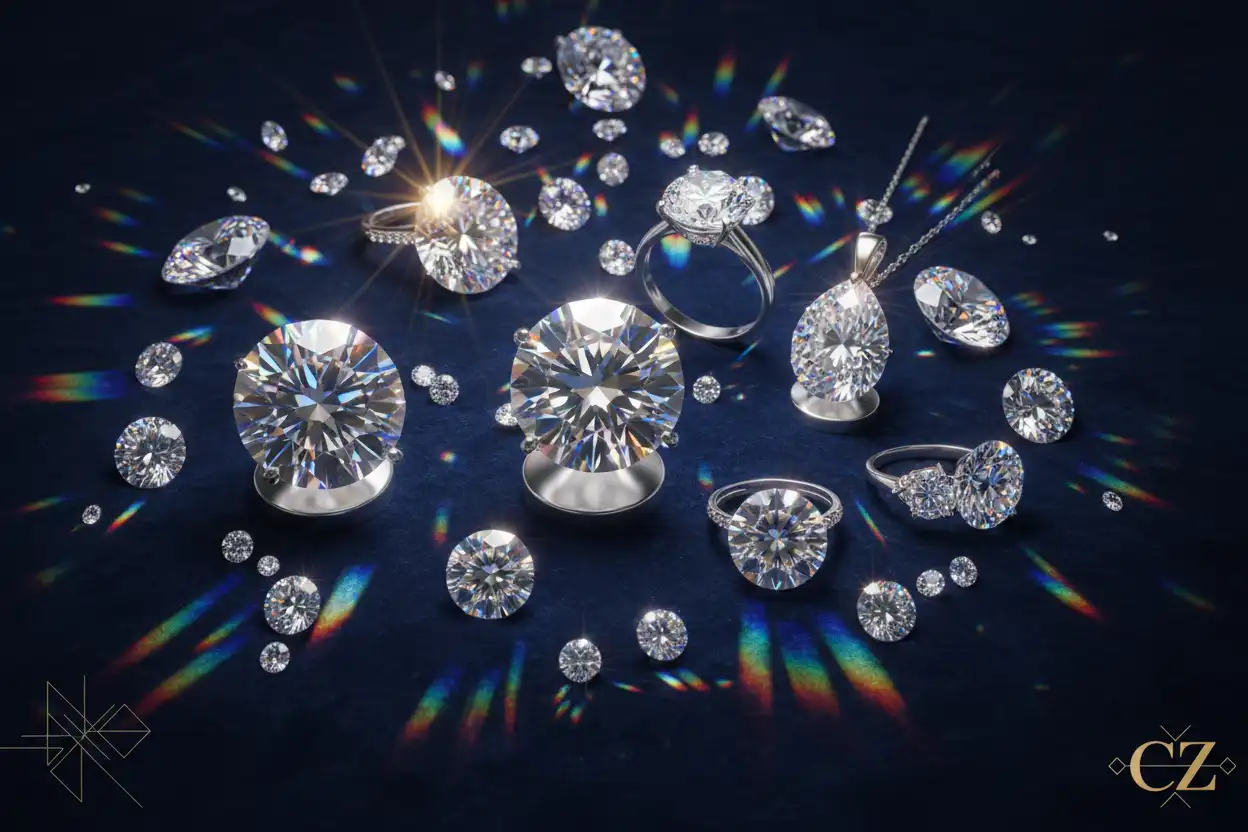
Cubic zirconia meaning is easiest to understand when cubic zirconia is identified correctly before symbolism is added. Cubic zirconia, usually abbreviated CZ, is a laboratory-produced crystalline form of zirconium dioxide stabilized in the cubic crystal structure. It is not diamond, not zircon, not ordinary zirconium metal, and not merely “glass that looks like diamond.” Commercial cubic zirconia is an engineered crystalline gem material valued because it can be transparent, highly refractive, strongly dispersive, comparatively hard, available in many colors, and manufactured with consistent quality. Those properties explain why it became one of the most familiar diamond simulants and decorative synthetic gems.
The scientific identity matters because cubic zirconia meaning is often distorted in two opposite directions. One description dismisses CZ as worthless fake diamond, while another gives it invented natural-mineral histories or metaphysical powers simply because it looks brilliant. Neither approach does the material justice. Cubic zirconia has legitimate gemological properties, demanding manufacturing requirements, useful jewelry applications, and an established cultural identity as an accessible brilliant stone. Within Gems Lore’s Gemstone Guides collection, those facts remain separate from symbolic associations involving clarity, confidence, accessibility, individuality, or conscious choice.
A second distinction is equally important: synthetic does not mean imaginary. Cubic zirconia exists as a real crystalline substance with measurable hardness, density, refractive index, dispersion, structure, and thermal behavior. The word synthetic describes controlled manufacture rather than geological origin. Cubic zirconia meaning becomes much more useful once synthetic origin is treated as information instead of a defect that needs to be hidden.
Cubic Zirconia at a Glance
| Property | Practical reference |
|---|---|
| Material identity | Laboratory-produced stabilized cubic zirconium dioxide |
| Simplified composition | ZrO₂ with stabilizing oxides |
| Common abbreviation | CZ |
| Crystal structure | Cubic when appropriately stabilized |
| Natural or synthetic in ordinary gem trade? | Commercial gem-quality cubic zirconia is laboratory manufactured |
| Typical color | Colorless, with many intentionally produced colors also available |
| Mohs hardness | Commonly about 8–8.5 |
| Refractive index | Approximately 2.15–2.18 |
| Dispersion | High, helping produce noticeable spectral fire |
| Specific gravity | Commonly around 5.6–6.0 |
| Optical character | Isotropic/singly refractive in the cubic phase |
| Common use | Diamond simulant, fashion jewelry, colored synthetic gem, decorative cutting |
| Major identification issue | Can resemble diamond visually but differs significantly in density, thermal behavior, hardness, inclusions, and other testable properties |
| Symbolic status | Cultural and personal interpretations rather than scientifically demonstrated metaphysical effects |
These characteristics immediately show why cubic zirconia meaning should not begin with the word fake. CZ is a genuine synthetic gem material even when it is being used to imitate diamond’s appearance. The correct disclosure is that the material is cubic zirconia, while the quality question concerns how well it is produced, cut, polished, set, disclosed, and maintained.
What Cubic Zirconia Actually Is
Cubic zirconia is zirconium dioxide that has been stabilized so the cubic crystal structure remains suitable for gem use. Pure zirconium dioxide can exist in different structural forms depending on conditions, and stabilizing oxides are introduced during manufacture to maintain the desired cubic phase. The resulting material can form transparent crystals large enough to be cut into gemstones.
This structural detail explains the name. “Cubic” refers to crystal structure, while “zirconia” refers to zirconium dioxide. Neither word means zircon. Zircon is a naturally occurring zirconium silicate mineral, ZrSiO₄, with different chemistry, crystal structure, density, optical properties, natural inclusions, geological origin, and gemological behavior.
The distinction also prevents confusion with zirconium metal. Zirconium is a chemical element. Zirconia is an oxide compound containing zirconium and oxygen. Cubic zirconia is one stabilized crystalline form of that oxide. Cubic zirconia meaning should therefore be built on chemical identity rather than on similarity among names.
Cubic Zirconia Is Synthetic, but Synthetic Does Not Mean Fake
The word synthetic has a specific gemological role. A synthetic material is produced through human-controlled processes rather than natural geological formation. In some gem categories, synthetic material closely duplicates a natural mineral that also occurs in gem quality. Cubic zirconia is slightly different because the stabilized transparent cubic zirconia familiar in jewelry is overwhelmingly a manufactured gem material rather than a routinely mined natural gemstone.
Calling CZ fake therefore hides useful information. It is more precise to say that cubic zirconia is often used as a diamond simulant. A simulant resembles another gem visually while having a different composition and structure. Cubic zirconia can simulate diamond without being synthetic diamond.
This distinction matters commercially. A seller who openly describes a stone as cubic zirconia is selling a legitimate product category. A seller who represents cubic zirconia as natural diamond is misrepresenting material identity. The ethical problem lies in false disclosure, not in the existence of synthetic gem materials.
How Cubic Zirconia Is Made
Commercial cubic zirconia is created under controlled high-temperature conditions rather than mined from a gem deposit. Zirconium dioxide and stabilizing compounds are melted or processed so that crystalline cubic material can grow as the system cools and solidifies. Specialized growth techniques are required because zirconia melts at extremely high temperatures, making conventional container-based crystal growth difficult.
Manufacturers can control chemistry, color additives, crystal quality, and growth conditions far more closely than nature controls a geological deposit. This is one reason clean, transparent cubic zirconia can be produced consistently. Internal stress, inclusions, growth features, color variation, and other imperfections can still occur, but the manufacturing environment is fundamentally different from the hydrothermal veins, pegmatites, metamorphic rocks, or sedimentary settings that produce many natural gems.
The deeper technical distinction between laboratory growth and geological occurrence belongs in cubic zirconia formation and deposit geology. For cubic zirconia meaning, the central fact is simpler: the material’s origin is engineered, while its crystal structure and optical properties are physically real.
Cubic Zirconia Meaning and the Myth of a Natural Crystal Tradition
Cubic zirconia meaning sometimes appears in crystal-lore descriptions as if CZ had been collected, worn, or spiritually interpreted through a long natural-mineral tradition. That framing is misleading. The gem material belongs primarily to laboratory crystal growth, jewelry, materials science, and the cultural history of diamond alternatives.
That does not prevent newer symbolism from developing. People routinely assign meaning to manufactured objects, synthetic gems, jewelry designs, colors, heirlooms, and personal gifts. A cubic zirconia engagement ring can acquire profound personal significance through the relationship it represents even though its center stone was not mined from the Earth.
The responsible boundary is therefore not “synthetic materials have no meaning.” It is that personal and cultural meaning should not be rewritten as ancient geological or spiritual history.
Why Colorless Cubic Zirconia Looks So Brilliant
Cubic zirconia has a high refractive index, meaning light changes direction strongly as it enters and exits a properly cut stone. Good facet design can therefore return substantial light toward the observer and create strong brightness. Its dispersion is also high, allowing white light to separate visibly into spectral colors and producing the colorful flashes commonly described as fire.
This combination helps explain why a well-cut CZ can look highly brilliant in ordinary jewelry. In some lighting it may show more obvious spectral fire than diamond, although brilliance and fire depend on cut, proportions, polish, lighting, stone size, cleanliness, and viewing conditions.
The optical behavior is explored more fully in cubic zirconia optical properties and color behavior. The important point for cubic zirconia meaning is that sparkle has a physical explanation. It does not require claims that the gem is emitting spiritual light or amplifying invisible energy.
What Causes Colored Cubic Zirconia?
Colorless CZ is only one part of the market. Manufacturers can produce yellow, orange, red, pink, purple, green, blue, brown, and other colors by controlling chemistry and introducing selected coloring agents during production. Because the material is manufactured, colors can be designed with far greater repeatability than many naturally occurring gem colors.
This makes color terminology especially important. A blue cubic zirconia is still cubic zirconia rather than blue diamond, sapphire, topaz, or zircon. Visual resemblance does not change composition. Likewise, a red CZ can imitate the appearance of ruby without becoming synthetic ruby.
Cubic zirconia meaning may change symbolically with color because people associate blue with calm, pink with affection, green with growth, or red with vitality. Those associations come from cultural color symbolism rather than a new mineral species created by each hue.
Diagnostic Traits of Cubic Zirconia
Cubic zirconia can resemble diamond strongly enough that appearance alone is unreliable, especially in small mounted stones. However, its physical properties provide multiple ways to distinguish the materials. CZ is denser than diamond, so two similarly sized loose stones can differ noticeably in weight. It is also softer than diamond, has different thermal behavior, and displays different microscopic and optical features.
CZ’s high dispersion can sometimes make larger stones look unusually fiery, but fire should not be treated as a definitive test. A well-cut diamond can also show strong spectral colors, while poor lighting can suppress the fire of either material. Surface condition matters as well because scratches, oily residue, poor polish, and abrasion can alter brilliance significantly.
Magnification adds another layer of evidence. The specialized cubic zirconia microscope and inclusion notebook focuses on what internal growth features, polish, wear, abrasions, bubbles, inclusions, facet junctions, and manufacturing clues can contribute to identification. Even then, a valuable or ambiguous mounted stone may justify instrumental confirmation rather than visual confidence.
An Original Cubic Zirconia Specimen and Photo Checklist
Begin with disclosure rather than appearance. Record exactly what the seller calls the object: cubic zirconia, CZ, simulated diamond, synthetic gemstone, diamond alternative, or another phrase. If the listing describes the stone only as “diamond-like crystal” without material identity, the first problem is incomplete disclosure rather than visual quality.
Next, photograph the stone under neutral diffused light and direct point-source light. Diffused illumination helps evaluate body color, transparency, polish, and general brightness, while point lighting makes dispersion easier to observe. Use the same camera settings when comparing stones because saturation and highlight processing can make one simulant look artificially superior.
Then examine facet condition. New cubic zirconia can have crisp, well-polished junctions, but worn material may show abrasions and small scratches more readily than diamond. Surface wear should be interpreted according to age, use, setting exposure, and maintenance rather than treated as immediate proof of identity.
For loose stones, record actual weight and dimensions together. Cubic zirconia’s comparatively high density means a stone can weigh substantially more than a diamond of similar diameter. Weight without dimensions is not useful, and dimensions without weight miss one of the strongest practical contrasts.
After that, examine the stone under magnification. Look for polish marks, abrasions, inclusions, internal growth evidence, chipped facet junctions, girdle characteristics, and possible coatings or surface contamination. Absence of inclusions does not prove CZ because some diamonds are exceptionally clean, while inclusions alone do not prove diamond.
Finally, separate observable evidence from conclusions requiring instruments. Photographs may show cut, color, apparent fire, surface condition, dimensions, and visible inclusions. They cannot reliably establish chemical composition, thermal conductivity, exact stabilizer chemistry, or whether an ambiguous mounted stone is CZ, diamond, moissanite, glass, sapphire, or another simulant.
A Source-Reconciliation Table for Common Cubic Zirconia Claims
| Common claim | What is defensible | What should be corrected |
|---|---|---|
| “Cubic zirconia is fake diamond.” | CZ is widely used as a diamond simulant | CZ is a real synthetic crystalline material, not imaginary diamond |
| “CZ is synthetic diamond.” | Both can be laboratory-produced gemstones | Their compositions and structures are different |
| “Cubic zirconia is zircon.” | The names sound similar and both involve zirconium chemistry | Zircon is ZrSiO₄; CZ is stabilized cubic ZrO₂ |
| “CZ is glass.” | Both can imitate diamond visually | Cubic zirconia is crystalline zirconium dioxide, not ordinary glass |
| “Natural cubic zirconia is commonly mined.” | Zirconium dioxide occurs naturally in other structural contexts | Commercial gem-quality CZ is manufactured |
| “CZ has more fire than every diamond.” | CZ has high dispersion and can show strong fire | Actual visual fire depends on cut, size, lighting, and comparison conditions |
| “CZ always looks fake.” | Poorly cut or worn CZ can be obvious | High-quality stones can be visually convincing without instruments |
| “CZ is worthless.” | It generally lacks the scarcity economics of fine natural diamond | Cutting, jewelry design, craftsmanship, setting, and sentimental value can still matter |
| “Cubic zirconia heals the crown chakra.” | Some modern practices assign clear stones symbolic meanings | No established scientific evidence demonstrates chakra activation |
| “CZ carries ancient crystal lore.” | Modern symbolism can develop around any material | A laboratory gem should not be given an invented ancient mining history |
| “CZ cannot last in jewelry.” | It is softer than diamond and can abrade with wear | Its hardness is still high enough for many jewelry applications when appropriately set |
This table captures the core of cubic zirconia meaning: most confusion comes not from the material itself but from collapsing several categories into one. Synthetic origin, diamond simulation, optical beauty, jewelry value, symbolism, and durability are separate questions.
Cubic Zirconia Versus Diamond
The most common cubic zirconia comparison is diamond because CZ was designed and adopted primarily as a highly convincing diamond simulant. Diamond is crystalline carbon with exceptional hardness, different density, different refractive properties, distinct thermal conductivity, different growth features, and very different natural and laboratory production histories.
CZ is substantially denser. A cubic zirconia and diamond with similar dimensions will not normally have the same weight. Diamond is also much harder, which affects long-term abrasion resistance. CZ’s high dispersion can create strong colored fire, sometimes producing a visually different balance between white brilliance and rainbow flashes.
These differences do not make one material morally or aesthetically superior. They mean the two materials should be disclosed correctly and valued according to different markets.
Cubic Zirconia Versus Zircon
Zircon and cubic zirconia are among the most frequently confused gem names. Zircon is a natural zirconium silicate mineral and can occur in colorless, blue, brown, yellow, red, green, and other varieties. Cubic zirconia is stabilized zirconium dioxide produced for commercial gem use.
The confusion is understandable because both names contain “zircon,” but chemistry resolves it immediately. Zircon is ZrSiO₄; cubic zirconia is ZrO₂ with stabilizers. Their crystal structures, densities, optical behavior, geology, inclusions, durability characteristics, and value systems differ.
A seller should never shorten cubic zirconia to “zircon” because doing so changes the material identity.
Cubic Zirconia Versus Moissanite
Moissanite is another prominent diamond simulant, but it is silicon carbide rather than zirconium dioxide. Modern gem moissanite is generally laboratory produced and differs from CZ in hardness, refractive behavior, dispersion, density, optical character, and thermal properties.
Moissanite usually resists abrasion better than CZ and can show extremely strong fire. Certain optical effects can also help trained observers distinguish it from both diamond and cubic zirconia, although improvements in cutting and material quality make visual identification less reliable than simplistic online tests suggest.
The practical lesson is the same: “diamond alternative” is a use category, not a material identity.
Cubic Zirconia Meaning in Jewelry Culture
Cubic zirconia meaning has developed partly through its role as an accessible alternative to more expensive transparent gems. For some wearers, that accessibility symbolizes practicality: the appearance they enjoy can be achieved without tying the jewelry’s meaning to scarcity or resale value.
For others, CZ represents freedom from prestige hierarchies. A person may prefer design, size, color, or craftsmanship over the social symbolism traditionally attached to natural diamond. A cubic zirconia ring can therefore represent conscious spending, fashion flexibility, celebration, commitment, or simply an appreciation of sparkle.
These meanings are social and personal rather than properties contained in the crystal lattice. They become meaningful because of how people choose and use the object.
Cubic Zirconia Meaning in Modern Spiritual Symbolism
Modern metaphysical descriptions commonly associate colorless cubic zirconia meaning with clarity, focus, confidence, intention, mental organization, and amplification. Colored CZ may acquire additional symbolism according to hue, while its brilliance sometimes inspires descriptions involving inner light, spiritual clarity, or manifestation.
These interpretations can function as personal symbolism, but they are not experimentally demonstrated effects of stabilized zirconium dioxide. Cubic zirconia does not scientifically open chakras, improve memory, cure anxiety, attract wealth, amplify another gemstone’s healing power, or transmit spiritual messages.
A grounded use can retain the metaphor. A clear CZ ring might remind someone to communicate plainly, a colored stone might commemorate a personal goal, or an affordable piece might symbolize choosing usefulness over status. The practical effect comes from intention and behavior rather than a medically active field produced by the gem.
“Clarity” Is a Symbolic Metaphor, Not a Neurological Effect
Transparency naturally encourages symbolic associations with clarity because people regularly use visual language to describe thinking: clear ideas, cloudy judgment, seeing through confusion. Cubic zirconia meaning often adopts the same metaphor.
That symbolic connection is understandable, but physical transparency does not prove cognitive enhancement. A transparent CZ does not improve concentration by altering neural activity simply because light passes through it.
Someone can still use the stone as an attentional cue. Seeing or touching a ring before an important conversation might serve as a reminder to speak precisely or verify assumptions. The useful mechanism is memory and behavior.
Does Cubic Zirconia Have Healing Properties?
There is no established scientific evidence that cubic zirconia treats medical conditions through ordinary wear or handling. It should not be described as curing disease, changing hormones, detoxifying the body, repairing organs, relieving clinical anxiety, improving circulation, or delivering therapeutic minerals through the skin.
The material’s zirconium and oxygen chemistry does not change that conclusion. Element names inside a formula are not a treatment plan. Biological effects depend on chemical form, exposure route, dose, concentration, and medical context.
Cubic zirconia meaning can include personal ritual or emotional symbolism without implying healthcare outcomes.
Safe Ownership
Finished cubic zirconia jewelry is generally suitable for ordinary handling and wear when the complete item has been properly manufactured. The material is comparatively hard, chemically stable under normal conditions, and widely used in jewelry. Everyday safety issues therefore relate more to physical damage, jewelry construction, metal allergies, loose settings, or unsuitable cleaning methods than to dramatic toxicity from touching the stone.
The exposure context changes during cutting, grinding, drilling, or industrial processing because fine particulate dust should not be inhaled casually regardless of how benign a finished polished gem appears. Appropriate wet processing, ventilation, eye protection, and dust control are prudent when working any hard lapidary material.
Cubic zirconia meaning should never be used to justify grinding the stone into powder, ingesting it, or adding fragments to beverages. Symbolic use does not require consumption.
Cutting Quality Matters More Than Many Buyers Realize
A cubic zirconia’s visual performance depends heavily on cutting. Poor proportions can allow light to leak through the stone or create dull central areas, while precise facet alignment and polish can produce strong brightness and fire. Large CZ stones make cutting quality particularly easy to notice because asymmetry, scratched facets, thick girdles, and poorly aligned junctions become visually obvious.
The technical decisions behind facet orientation, polishing, and manufactured rough belong in cubic zirconia cutting, orientation, and polish. For cubic zirconia meaning, the useful point is that visual beauty is not solely a property of chemistry. Craftsmanship determines how effectively the material’s optical properties are displayed.
A modestly priced stone can therefore be beautifully cut, while an expensive finished piece can contain mediocre CZ if most of the retail premium lies elsewhere.
Jewelry Durability and Wear
CZ’s hardness around the upper part of the Mohs scale makes it suitable for many forms of jewelry, but it does not match diamond’s resistance to scratching and abrasion. Rings and bracelets experience more surface contact than earrings or pendants, so facet edges and table surfaces can gradually show wear depending on how the piece is used.
Setting design also matters. A large exposed stone can receive direct impact, while a protective bezel or well-designed prong system can reduce certain risks. The specialist cubic zirconia setting and wear engineering reference addresses those mechanical details without turning this meaning page into a jewelry-construction guide.
A symbolic description such as “stone of strength” does not alter hardness. Physical durability remains a property of the material and design.
Cleaning Cubic Zirconia Jewelry
CZ can lose apparent brilliance when oils, soap residue, cosmetics, dust, or skin products coat the pavilion and facets. This is often a cleanliness problem rather than permanent optical deterioration. Once the surface is clean, brightness may return dramatically.
The correct method depends on the entire piece rather than the CZ alone. Plated metals, glued components, fragile settings, pearls, soft neighboring stones, treated materials, and antique construction can impose limits. The dedicated guide on how to clean cubic zirconia jewelry covers that task directly.
For cubic zirconia meaning, the relevant observation is that loss of sparkle should not be interpreted metaphysically as the stone becoming energetically “drained.” Dirt and surface films have straightforward optical consequences.
Cubic Zirconia Value
Cubic zirconia generally lacks the natural scarcity component that drives part of the market for many mined gems. Large clean stones can be manufactured relatively efficiently, so size alone does not create the same rarity premium seen in certain natural gemstones.
That does not make every CZ object economically equivalent. Precision cutting, unusual colors, custom shapes, jewelry design, precious metal, workmanship, brand, craftsmanship, and setting complexity can all contribute to finished value. A beautifully designed CZ jewel can cost far more than the loose stone itself.
The dedicated cubic zirconia price guide handles valuation separately. Cubic zirconia meaning should avoid turning price into a moral judgment: inexpensive raw material can still support excellent design.
Buying Cubic Zirconia
A strong purchase begins with transparent material disclosure. The seller should identify the stone as cubic zirconia rather than hiding it behind phrases such as “diamond crystal,” “created diamond look,” or other ambiguous descriptions that could cause confusion about composition.
After identity, examine cut, dimensions, color, clarity, polish, setting, metal, return conditions, and overall workmanship. For colored CZ, consider whether the appearance is consistent across the stone and whether any coating or special surface treatment has been disclosed when relevant.
The detailed buyer framework belongs in buy cubic zirconia. The simplest rule is that an accurately disclosed CZ does not need to pretend to be another gemstone to be worth buying.
Provenance Means Something Different for a Synthetic Gem
Traditional gemstone provenance often asks which mine, district, region, or country produced a natural gem. Cubic zirconia requires a different framework because commercial material is manufactured. Useful provenance may therefore involve producer, manufacturing batch, cutting workshop, jewelry maker, brand, treatment history, purchase record, or chain of ownership rather than a geological mine.
The cubic zirconia provenance disclosure checklist is particularly relevant because a claim such as “Russian CZ,” “premium laboratory CZ,” or “designer CZ” can refer to manufacturing or commercial history rather than mineral deposit origin.
This difference is not a weakness. It simply means provenance should match the way the material actually enters the market.
Conservation of Important Cubic Zirconia Objects
Most ordinary CZ jewelry is maintained for wear rather than curated as a mineral specimen, but conservation can still matter for designer pieces, historic costume jewelry, unusual cuts, prototypes, sentimental objects, or documented manufactured crystals. Scratches, coatings, repairs, loose stones, metal deterioration, and cleaning history can affect both appearance and future restoration choices.
The cubic zirconia specimen conservation record provides a structured place for those details when an object has enough historical, technical, or personal significance to justify documentation.
This illustrates another useful aspect of cubic zirconia meaning: value does not have to arise from natural rarity. Cultural, technical, artistic, and personal significance can all make an object worth preserving.
How to Read Claims About Cubic Zirconia
The strongest cubic zirconia information separates statements according to what could actually support them. Chemistry and crystal structure belong to materials science and gemology. Optical performance belongs to measurable physical properties and cutting. Manufacturing claims require production evidence. Jewelry quality requires inspection of the finished object. Symbolism belongs to cultural or personal interpretation.
Gems Lore’s About framework is particularly useful for cubic zirconia because synthetic gems are often judged through assumptions rather than evidence. Calling CZ worthless because it is manufactured is no more scientifically useful than claiming it possesses healing powers because it sparkles.
Health and safety claims require similar discipline. The Disclaimer defines the boundary between educational gem information and medical or individualized professional advice, which matters whenever cubic zirconia meaning is presented in wellness language.
Frequently Asked Questions About Cubic Zirconia Meaning
What is cubic zirconia?
Cubic zirconia is a laboratory-produced crystalline form of zirconium dioxide stabilized in the cubic structure. It is commonly used as a transparent synthetic gemstone and diamond simulant.
What does cubic zirconia mean spiritually?
Modern cubic zirconia meaning commonly includes clarity, confidence, intention, accessibility, individuality, and personal choice. These are symbolic interpretations rather than scientifically demonstrated effects of the material.
Is cubic zirconia a real gemstone?
Yes, cubic zirconia is a real manufactured gem material. It is not natural diamond, but it possesses measurable crystalline, optical, and physical properties and is widely used in jewelry.
Is cubic zirconia a fake diamond?
CZ is more accurately described as a diamond simulant when it is used to imitate diamond’s appearance. It is a different material rather than defective diamond.
Is cubic zirconia the same as synthetic diamond?
No. Synthetic diamond is crystalline carbon with the essential structure and composition of diamond. Cubic zirconia is stabilized zirconium dioxide.
Is cubic zirconia the same as zircon?
No. Zircon is the natural zirconium silicate mineral ZrSiO₄. Cubic zirconia is stabilized ZrO₂ and has different chemistry, structure, optics, origin, and durability.
Is cubic zirconia glass?
No. Ordinary glass is amorphous, while cubic zirconia is crystalline. Both can be used as diamond simulants, but they are materially different.
Does cubic zirconia occur naturally?
Commercial gem-quality cubic zirconia is manufactured. Natural zirconium dioxide occurs in other mineralogical contexts, but the transparent stabilized cubic zirconia familiar in jewelry should be treated as a laboratory-produced material.
Why does cubic zirconia sparkle so much?
Its high refractive index and strong dispersion allow a well-cut stone to return bright light and produce noticeable spectral fire. Cut quality, polish, cleanliness, lighting, and stone size all affect the result.
Is cubic zirconia durable?
CZ is comparatively hard at about 8–8.5 on the Mohs scale and is suitable for many jewelry applications. It can still scratch, chip, or abrade with wear and does not equal diamond’s hardness.
Does cubic zirconia become cloudy?
The material itself does not simply turn into a cloudy substance through ordinary ownership, but surface scratches, abrasions, oils, soap residue, cosmetics, or dirt can reduce apparent brilliance. Cleaning or repolishing may restore appearance depending on the cause.
Does cubic zirconia have healing properties?
There is no established scientific evidence that cubic zirconia prevents, diagnoses, treats, or cures medical or psychological conditions.
Is cubic zirconia associated with the crown chakra?
Some modern crystal traditions associate colorless brilliant stones with clarity or crown-chakra symbolism. This is a metaphysical or symbolic association rather than a scientifically demonstrated effect.
Is cubic zirconia valuable?
Loose CZ is generally affordable because it can be manufactured without the geological scarcity of many natural gems. Finished value can still reflect cutting, color, design, precious metal, craftsmanship, brand, and sentimental significance.
Is cubic zirconia good for an engagement ring?
It can be appropriate for someone who values appearance, affordability, design flexibility, or symbolic meaning more than natural rarity or long-term abrasion resistance. Expectations about wear and future replacement should simply match the material.
What Cubic Zirconia Meaning Can Responsibly Include
Cubic zirconia meaning becomes more interesting once the material stops being treated as merely an imitation. CZ is a deliberate achievement in crystal growth and materials engineering: stabilized zirconium dioxide that can be produced in transparent crystals, cut precisely, colored intentionally, and used across a wide range of jewelry designs. Its high refractive index and dispersion create real visual brilliance, while its synthetic origin allows consistency and accessibility that many natural gemstones cannot offer.
Its cultural meaning can grow from those same characteristics without pretending that laboratory manufacture is ancient crystal lore. Cubic zirconia can symbolize conscious spending, accessibility, choosing design over scarcity, celebrating without status pressure, or finding personal significance in a material whose value is not determined primarily by rarity. Clear stones can also serve as metaphors for clarity or focus when those ideas are kept in the realm of symbolism.
The most useful cubic zirconia meaning is therefore one that respects the object for what it is. It is not diamond, zircon, glass, or a naturally mined mystical crystal, yet none of those distinctions diminishes its legitimacy as a gem material. A well-cut cubic zirconia can be visually beautiful, mechanically practical for many uses, culturally meaningful, and personally important without requiring a false origin story.
When a listing appears to confuse CZ with zircon, synthetic diamond, glass, or another material, the exact wording and supporting documentation can be submitted through Contact for a material-specific correction rather than repeating the same terminology across unrelated pages. Information shared through that route is handled according to the site’s Privacy Policy, keeping the correction path relevant to the specific claim instead of turning every article ending into the same generic site boilerplate.