10 Azurite Healing Properties: Wellness Claims, Proven Facts & Safe Use
Azurite healing properties are traditionally associated with intuition, mental clarity, communication, creativity, self-reflection, confidence, emotional awareness, spiritual insight, changing perspective, and releasing unhelpful thought patterns. These ideas come from crystal traditions rather than established medical evidence. Azurite does not improve eyesight, treat neurological conditions, relieve pain, remove toxins, alter brain chemistry, regulate hormones, or cure anxiety or depression through ordinary handling. Its vivid blue color and dramatic crystal forms can make it a powerful personal symbol, but its most responsible use remains reflective rather than therapeutic.
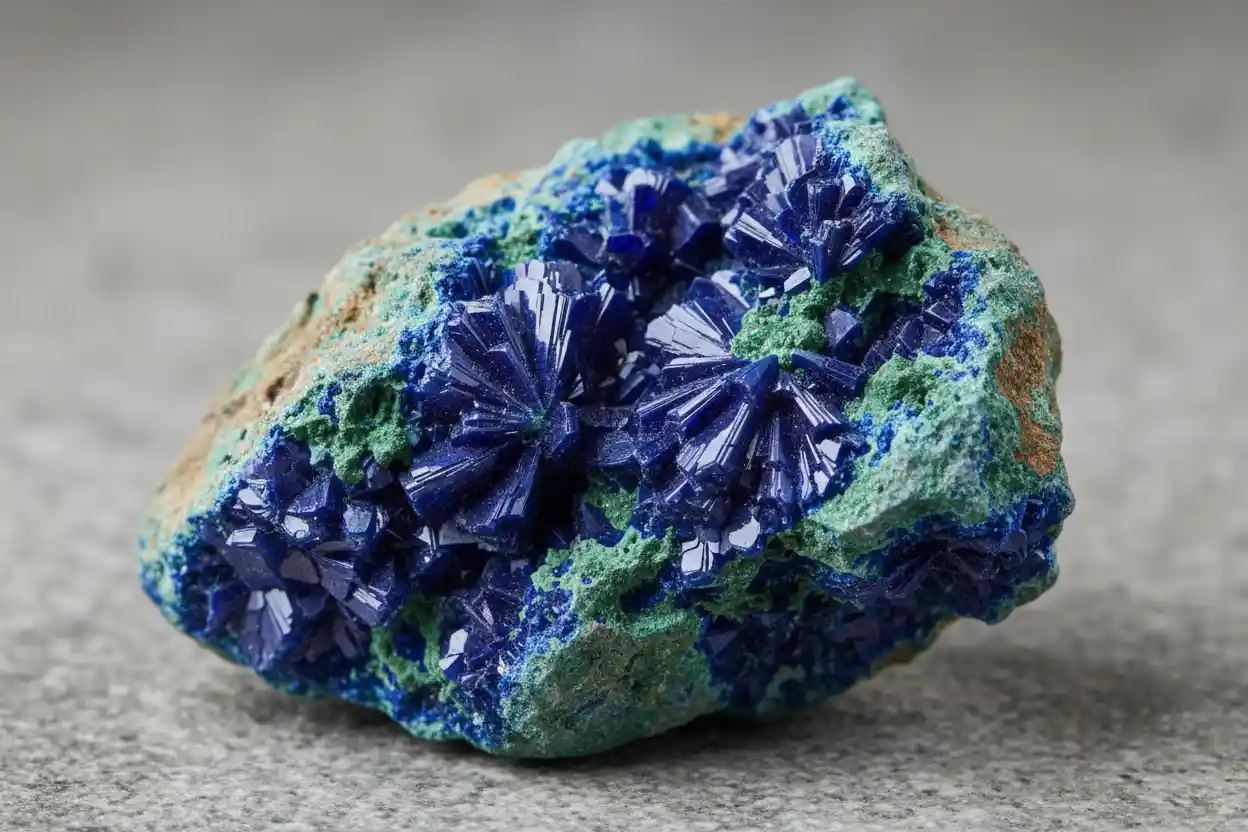
Azurite is a basic copper carbonate mineral with the chemical formula Cu3(CO3)2(OH)2. It typically forms in oxidized copper deposits and may occur alongside green malachite, creating some of the most visually striking blue-and-green mineral specimens. Azurite is relatively soft, usually around 3.5 to 4 on the Mohs scale, and its copper chemistry deserves practical respect. The mineral should not be ground, ingested, added to drinking water, or used in homemade wellness preparations. Appreciating azurite as a specimen, jewelry stone, or symbolic object provides all of its visual and personal value without introducing unnecessary exposure.
Azurite Intuition Claims Work Best as Careful Reflection Rather Than Supernatural Certainty
Intuition is one of the strongest metaphysical themes associated with azurite. Its intense blue color has encouraged traditions linking the stone with inner vision, spiritual awareness, and the ability to recognize information that is not immediately obvious. These associations can be meaningful in a reflective practice, but azurite does not provide verified access to hidden facts, predict future events, identify another person’s motives, or guarantee that an instinctive impression is correct.
A more useful approach is to let the stone represent a pause before accepting the first interpretation of a situation. Someone might hold an azurite specimen while writing down what they know, what they assume, and which part of a decision still lacks evidence. The crystals for intuition tradition becomes more responsible when intuition is treated as one source of personal information that can be checked against facts rather than as unquestionable guidance.
This distinction matters especially in medical, financial, legal, and relationship decisions. A feeling can be important without being complete. Azurite can encourage someone to notice that feeling and examine it, but evidence and appropriate expertise should still guide high-stakes choices.
Azurite Mental-Clarity Claims Support Better Questions, Not Enhanced Brain Function
Azurite is often described as a stone for mental clarity, insight, concentration, and understanding complicated problems. There is no established evidence that the mineral improves memory, intelligence, executive function, or concentration through physical contact. Its symbolism becomes more useful when clarity means organizing information and asking a more precise question.
Someone facing a difficult decision might place azurite beside a notebook and separate facts, uncertainties, consequences, and personal preferences. The crystals for clarity approach works especially well here because mental clarity often improves when vague concerns are converted into specific questions. If the problem is financial, identify the actual numbers. If it concerns a relationship, focus on observable behavior rather than assumed intentions. If it concerns work, define the expected outcome rather than simply describing the situation as overwhelming.
Azurite’s deep color can also make it an effective desk or meditation object because it gives attention a clear visual focus. The act of slowing down and examining one issue at a time can support clearer reasoning, while the stone remains a cue rather than the mechanism producing the result.
Azurite Communication Claims Should Encourage Precise Language and Better Listening
Modern crystal traditions often associate blue stones with communication, and azurite is no exception. It is commonly described as helping people express difficult truths, speak with confidence, or recognize what needs to be said. These ideas should remain symbolic because there is no evidence that azurite changes speech centers, language ability, or social anxiety.
A responsible communication routine can connect azurite with precision. Before an important conversation, identify the central issue, prepare one or two concrete examples, and decide what response would be useful. This prevents broad accusations from replacing a specific concern. Someone may also use the stone as a reminder to listen long enough to understand what the other person actually said before preparing a reply.
Communication does not always mean speaking more. Sometimes the clearest response is asking for time, declining an unreasonable request, or setting a boundary. Azurite symbolism is strongest when it supports thoughtful communication rather than promising that every conversation will become harmonious.
Azurite Creativity and Perspective Claims Reflect Flexible Thinking Rather Than Instant Inspiration
The saturated blue of azurite and its unusual crystal habits have made it popular with artists, collectors, and people who associate color with imagination. Crystal traditions frequently connect azurite with creativity, expanded perspective, and new ideas. The stone does not directly increase creative ability, but it can be used as a visual cue to change the way a problem is approached.
A writer or designer who feels stuck might use azurite to signal the beginning of a brainstorming period in which several possible directions are generated before any are judged. A person solving a practical problem may ask what assumption has remained unchallenged or what the situation would look like from another person’s point of view. Creativity often develops through experimentation, observation, and revision, not through waiting for a burst of inspiration.
Azurite can therefore represent intellectual flexibility. Its value lies in reminding someone that the first answer may not be the only answer, while the actual creative work still depends on experience, effort, and willingness to revise.
Azurite Emotional-Awareness Claims Should Support Naming Feelings Rather Than Treating Them
Azurite is sometimes described as helping people recognize hidden emotions or release emotional blocks. These phrases can sound therapeutic, but the mineral does not diagnose psychological conditions or directly alter emotional states. A more grounded interpretation is that azurite can become part of a journaling practice where recurring reactions are examined with greater specificity.
Someone might ask what happened immediately before a strong reaction, what interpretation they made, and whether another explanation is possible. The crystals for emotional healing tradition becomes more useful when emotional healing means processing experience rather than assuming a crystal removes distress.
Emotional awareness can reveal practical needs. Anger may point to a violated boundary, sadness may reflect loss, and anxiety may highlight uncertainty. Recognizing that information can help someone decide what to do next. Persistent depression, panic, trauma symptoms, or other serious concerns still require appropriate professional support.
Azurite Confidence and Personal-Growth Traditions Should Lead to Evidence-Based Action
Azurite is often associated with confidence, self-knowledge, and personal growth because its clarity and insight symbolism naturally extends into decision-making. No crystal can create self-esteem through contact with the body, yet an object with strong personal meaning can symbolize the decision to act after adequate preparation.
A person might use azurite before a presentation as a reminder to review the main point rather than rehearse every possible mistake. Someone considering a major change may use it while listing what they know, what they still need to learn, and which first step is reasonable. Confidence becomes more durable when it grows from preparation and experience rather than from a belief that the stone guarantees success.
The traditional azurite benefits are most constructive when they support that kind of behavior. Personal growth often means becoming more accurate about strengths, limitations, priorities, and consequences rather than trying to feel certain all the time.
Azurite Spiritual-Insight Claims Are Personal Beliefs, Not Verified Information
Azurite has a long-standing place in spiritual and symbolic traditions because its color is visually unusual and historically significant. Modern metaphysical practices may describe it as a stone of higher awareness, spiritual vision, meditation, or expanded consciousness. These beliefs can be personally meaningful, but they are not scientifically established properties of copper carbonate.
A meditation practice with azurite can be simple and safe when the stone remains external. Its color and crystal form can provide a point of visual focus while attention repeatedly returns to the chosen practice. Any insight that emerges can then be considered alongside ordinary evidence rather than being accepted automatically as supernatural truth.
The traditional azurite meaning can therefore be appreciated as symbolism without confusing spiritual interpretation with factual knowledge. Personal belief does not need to become a claim about what the mineral objectively does.
Azurite and Malachite Share Copper-Rich Geological Environments but Remain Different Minerals
Azurite frequently occurs with malachite because both can develop in oxidized copper deposits. Their contrasting blue and green colors make combination specimens especially attractive, and azurite may gradually alter to malachite under some natural conditions. Despite this relationship, the two minerals have different structures and should not be treated as interchangeable.
Traditional malachite healing properties often emphasize transformation, protection symbolism, and emotional change, while azurite traditions emphasize insight and clarity. Those distinctions come from crystal culture rather than different established therapeutic effects. Gemologically, the important differences concern structure, appearance, stability, and identification.
Azurite-malachite specimens also deserve careful handling because both are copper-bearing minerals. Their visual appeal does not make them suitable for ingestion, powders, or drinking-water rituals.
Azurite Copper Content Does Not Provide a Safe Therapeutic Copper Dose
One of the most important safety distinctions with azurite concerns its chemistry. The mineral contains copper, but that does not mean the body benefits from touching, licking, soaking, or consuming the stone. A mineral’s chemical composition should never be converted automatically into a nutritional or medicinal claim.
Copper is an essential trace element in human biology, but appropriate intake comes from diet and, when medically necessary, properly formulated supplements under suitable guidance. Azurite is not a nutritional supplement. Grinding it can create dust, and consuming it can create unnecessary exposure to copper compounds.
Crystal water is therefore inappropriate. Even if a polished piece appears smooth and clean, there is no established health benefit from soaking azurite in water and drinking that water. External display provides the symbolic experience without turning a collector mineral into an improvised health product.
Azurite Hardness, Cleavage, Heat Sensitivity, and Acids Affect Safe Care
Azurite’s hardness of around 3.5 to 4 makes it much softer than quartz, topaz, sapphire, and many common jewelry stones. Specimens can scratch easily when stored against harder objects, while crystals may chip or break under impact. Pendants and protected display pieces are generally more practical than heavily exposed rings or bracelets.
Heat and acids also deserve caution. Azurite can be altered by heating and reacts poorly with acidic cleaners because it is a carbonate mineral. Household vinegar, acidic solutions, strong cleaning chemicals, steam, and aggressive ultrasonic cleaning are poor choices for valuable or delicate specimens. A soft dry brush or gentle cleaning with minimal moisture is usually more appropriate for collector pieces.
Prolonged harsh conditions are unnecessary for crystal rituals. Azurite does not need salt, chemical solutions, direct flame, or repeated soaking to retain symbolic meaning. Gentle handling protects the crystal and avoids unnecessary exposure to copper-bearing residue.
Azurite Healing Claims Cannot Treat Eyesight, Pain, Neurological Conditions, or Mental Illness
Some wellness descriptions claim that azurite benefits eyesight, the brain, headaches, joint pain, detoxification, circulation, or neurological health. These claims are not established therapeutic effects of the mineral. Its blue color, copper content, and historical symbolism do not make it a medicine.
Mental health claims require the same limit. Azurite may be a personally meaningful object during reflection, counseling, or meditation, but it does not treat depression, anxiety disorders, trauma, psychosis, or another mental health condition. Serious or persistent symptoms deserve appropriate professional evaluation.
Azurite does not need healing power to be fascinating. Its intense blue color, copper carbonate chemistry, relationship with malachite, and striking crystal forms already make it one of the most recognizable collector minerals.
Conclusion: Azurite Healing Properties Are Symbolic While Copper Carbonate Chemistry Explains Its Real Behavior
Azurite healing properties are best understood as traditional themes of intuition, clarity, communication, creativity, emotional awareness, confidence, self-reflection, spiritual insight, perspective, and personal growth. Azurite itself is a soft blue copper carbonate mineral that commonly forms with malachite and requires careful handling around acids, heat, scratches, and ingestion risks. It can support reflective routines and personal symbolism, but it does not treat disease, provide hidden knowledge, or deliver therapeutic copper through ordinary use.
FAQs About Azurite Healing Properties, Copper Safety, and Mineral Care
What are the main traditional azurite healing properties?
Azurite is commonly associated with intuition, clarity, communication, creativity, confidence, emotional awareness, self-reflection, spiritual insight, and changing perspective.
Is azurite scientifically proven to heal?
No. There is no established evidence that azurite treats physical or mental health conditions through ordinary handling.
What is azurite made of?
Azurite is a basic copper carbonate mineral with the formula Cu3(CO3)2(OH)2.
Why is azurite often found with malachite?
Both minerals can form in oxidized copper deposits, and azurite can alter toward malachite under certain natural conditions.
Can azurite improve intuition?
It can serve as a reflection cue, but it does not provide verified hidden information or supernatural knowledge.
Can azurite improve eyesight or brain function?
No established evidence shows that azurite improves vision, cognition, neurological function, or brain health.
Is azurite safe to put in drinking water?
No health benefit is established, and azurite is a copper-bearing mineral. External use is the safer choice.
How hard is azurite?
Azurite is relatively soft at about 3.5 to 4 on the Mohs scale.
Can azurite be cleaned with vinegar?
Acidic cleaners should be avoided because azurite is a carbonate mineral and can be damaged by acids.
Is azurite suitable for everyday rings?
Its softness and vulnerability to impact make protected jewelry or display use more practical than demanding daily rings.
Azurite healing meanings are traditional or personal practices, not established treatments for physical or mental health conditions.