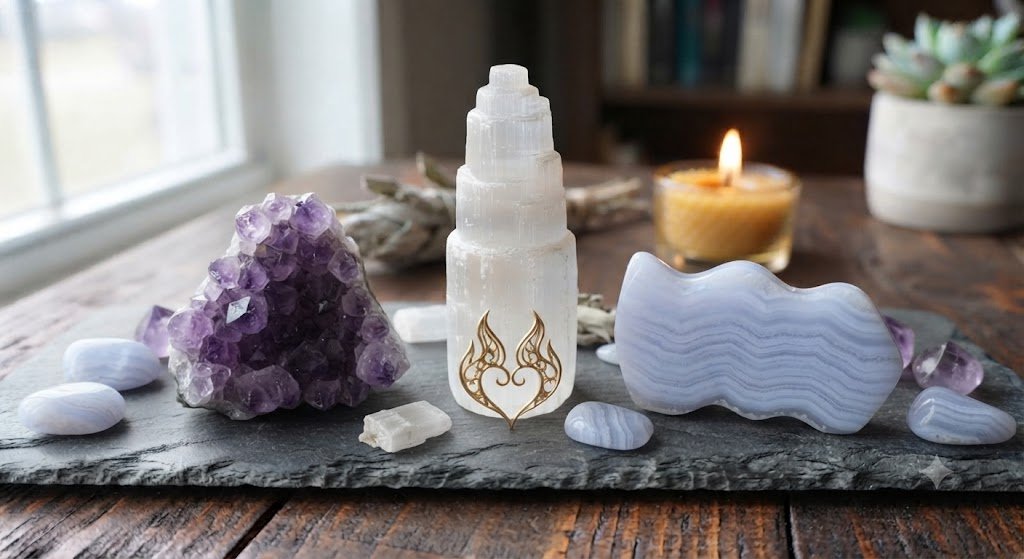
9 Inspiring Crystals for Inner Peace: Positive Meanings & Smart Everyday Uses
Crystals for inner peace can serve as quiet reminders to pause, reduce unnecessary stimulation, communicate more deliberately, accept what cannot be controlled, and create routines that make everyday life feel less reactive. They do not directly treat anxiety, depression, trauma, insomnia, or another mental health condition. Their most useful role is symbolic and behavioral: connect a stone with an action such as putting the phone away, breathing slowly for a few minutes, journaling, taking a short walk, setting a boundary, or returning attention to the present.
Amethyst, howlite, blue lace agate, lepidolite, moonstone, smoky quartz, rose quartz, amazonite, and selenite offer nine different traditional themes for inner peace. Some focus on reflection, others patience, communication, transition, self-compassion, or simplicity. Peace does not have to mean feeling calm every moment. A more realistic goal is creating enough internal and external space to respond thoughtfully when life becomes demanding.
Amethyst and Howlite for Pausing Before Stress Controls the Next Decision
Amethyst is purple quartz with Mohs hardness 7 and is traditionally associated with reflection, restraint, perspective, and calm routines. Its durability makes polished stones practical for desks, jewelry, and frequent handling.
Traditional amethyst healing properties can be connected with a pause habit. When stress rises, an amethyst ring or palm stone can represent delaying the next reaction long enough to decide whether it is actually useful.
That might mean waiting before replying to an irritating message, taking several minutes before making a purchase, or postponing an argument until both people can speak more clearly.
Inner peace does not come from avoiding every difficult situation. It often comes from reducing the number of difficulties made worse by impulsive reactions.
Howlite is commonly white or pale gray with darker veining and is traditionally associated with patience and slowing down. The symbolism within howlite healing properties fits times when irritation has accumulated gradually.
A howlite stone can symbolize checking ordinary causes of stress before assuming something larger is wrong. Poor sleep, hunger, overstimulation, constant notifications, and lack of breaks can all make the mind feel less settled.
Howlite is softer than quartz, so polished pieces should be protected from harder stones and rough abrasion.
Blue Lace Agate and Amazonite for Peace Through Clearer Communication
Blue lace agate is pale blue chalcedony with delicate bands and is traditionally associated with calm speech, listening, reassurance, and patient communication.
The traditions around blue lace agate healing properties can support a useful form of inner peace: reducing the number of unresolved conversations occupying your attention.
Avoiding every uncomfortable discussion can create temporary quiet while leaving the underlying issue active. A blue lace agate stone can represent speaking gently but clearly enough to address what needs attention.
Amazonite carries a related theme of honest expression and balanced communication. The symbolism surrounding amazonite healing properties can fit situations where peace requires a boundary rather than continued accommodation.
A boundary might involve ending work at a planned time, declining an unreasonable request, reducing contact with someone who repeatedly becomes disrespectful, or explaining what you need in a relationship.
Peace is not always created by saying yes. Sometimes it comes from saying no clearly enough that the issue stops consuming attention.
Lepidolite and Moonstone for Accepting Change Without Demanding Immediate Certainty
Lepidolite is a lithium-bearing mica commonly found in lavender, lilac, pink-purple, and gray-violet shades. Traditional symbolism often connects it with patience, transition, and gradual adaptation.
The themes within lepidolite healing properties can fit periods when uncertainty itself becomes exhausting. A job may be changing, a move may be approaching, a relationship may feel unsettled, or an important outcome may still be unknown.
A lepidolite stone can symbolize separating what needs action from what currently requires waiting.
The lithium within lepidolite does not provide medical lithium therapy through ordinary handling. It should never replace medication or professional mental health care.
Moonstone is a feldspar gem known for its moving sheen, called adularescence. Traditional moonstone healing properties commonly emphasize cycles, transition, reflection, and recognizing that circumstances change over time.
That symbolism can support a simple reminder: the way a situation feels today does not necessarily describe how it will feel permanently.
Moonstone is softer than quartz and has cleavage, so protected jewelry and careful handling are preferable to rough daily wear.
Smoky Quartz for Returning Attention to the Present
Smoky quartz ranges from pale gray-brown to nearly black and is traditionally associated with grounding and practical thinking. These themes work particularly well when inner peace is disrupted by constant prediction.
The traditions around smoky quartz healing properties can support the habit of asking what needs attention now instead of trying to solve every possible future problem at once.
A smoky quartz stone on a desk might represent narrowing the time horizon. Complete the next task. Make the necessary call. Eat the next meal. Prepare for tomorrow. Leave future problems for the point when more information exists.
This is not the same as ignoring long-term planning. It is a way of preventing planning from turning into endless rehearsal of situations that may never happen.
Smoky quartz belongs to the quartz family and offers good durability for jewelry and regular handling.
Rose Quartz for Self-Compassion Without Excusing Avoidable Problems
Rose quartz is traditionally associated with affection, kindness, compassion, and emotional warmth. Those themes can support inner peace when the main source of conflict comes from relentless self-criticism.
Traditional rose quartz healing properties can symbolize speaking to yourself with the same fairness you would offer someone you care about.
Self-compassion is not the same as saying every choice was correct. A peaceful response to a mistake can involve acknowledging what happened, repairing what can be repaired, and deciding what to do differently without repeating the same self-attack for weeks.
A rose quartz stone beside a journal can mark this distinction.
Inner peace becomes difficult when every mistake is treated as proof of personal failure. Learning from an event usually requires enough emotional distance to examine it accurately.
Selenite for Simplicity, Quiet Spaces, and Reduced Stimulation
Selenite is a crystalline form of gypsum, although many retail pieces labeled selenite are fibrous satin spar. White selenite can appear transparent, pearly, or silky, and its simple pale appearance has contributed to traditional symbolism around clarity and peaceful spaces.
The traditions connected with selenite healing properties can be used without assuming that the stone literally cleanses a room. A selenite piece on a desk or shelf can instead symbolize reducing unnecessary stimulation.
A calmer environment may mean putting the phone in another room, clearing one crowded surface, lowering background noise, closing unused browser tabs, or creating a short period without notifications.
Selenite is extremely soft, around 2 on the Mohs scale, and scratches easily. It also has strong cleavage, so rough handling and exposed jewelry are poor choices.
Protected display is usually the simplest use.
Inner Peace Often Depends on Reducing Unnecessary Conflict With Reality
Some stress comes from problems that can be changed. Other stress comes from repeatedly demanding that an unchangeable fact be different.
Acceptance does not mean liking the situation. It means recognizing which part is already true so that attention can move toward what remains possible.
The traditions around crystals for letting go fit this idea when letting go means releasing an argument with reality rather than becoming indifferent.
A delayed flight is already delayed. A past decision has already happened. Another person’s personality may not change because you want it to. Peace can begin when energy shifts toward the response that is still available.
That response may involve patience, a boundary, a new plan, or simply acknowledging disappointment without adding another layer of resistance.
A Peaceful Routine Needs Quiet Habits More Than Complicated Rituals
A crystal routine does not need several stones, grids, cleansing schedules, or strict placement rules. One stone connected with one habit is usually enough.
Amethyst can mean pause. Howlite can mean check whether basic needs have been ignored. Amazonite can mean communicate the issue. Smoky quartz can mean return to the present. Selenite can mean reduce stimulation.
The traditions around crystals for clarity can support this simplicity because inner peace often improves when problems are made more specific.
Instead of saying everything feels overwhelming, identify the three things creating the most pressure. Some may require action, while others may simply need to wait.
Clarity reduces the mental cost of treating every concern as equally urgent.
Inner Peace Is Compatible With Anger, Sadness, and Other Difficult Emotions
Being peaceful does not mean never feeling anger, grief, fear, frustration, or disappointment. Trying to eliminate every uncomfortable emotion can create a new source of tension.
The traditions around crystals for anger fit a healthier approach in which strong feelings are acknowledged while behavior remains deliberate.
You can be angry and still avoid an impulsive message. You can feel grief and still complete one necessary task. You can feel anxious and still ask for help.
Inner peace is often less about emotional silence and more about having enough stability to choose what happens next.
When a Search for Peace Needs Professional Support
Persistent anxiety, severe sleep disruption, panic, depression, trauma symptoms, substance misuse, or distress that repeatedly interferes with daily functioning deserves more than a crystal routine.
Professional care can include counseling, medical assessment, medication when appropriate, or other support based on the actual problem.
A crystal may remain part of a personally meaningful reflective practice as long as it does not delay effective help.
Avoid claims that distress continues because a stone needs cleansing, energy is blocked, or someone is not spiritually disciplined enough. Mental health difficulties can have many causes and deserve respectful, evidence-based attention.
Conclusion
Crystals for inner peace can symbolize reflection, patience, communication, transition, grounding, compassion, and simplicity. Amethyst, howlite, blue lace agate, lepidolite, moonstone, smoky quartz, rose quartz, amazonite, and selenite each provide a different traditional theme that can be connected with practical habits. Their usefulness comes from reminding you to pause, reduce unnecessary stimulation, communicate clearly, accept uncertainty, and return attention to actions that remain within your control.
FAQs
Which crystals are traditionally associated with inner peace?
Amethyst, howlite, blue lace agate, lepidolite, moonstone, smoky quartz, rose quartz, amazonite, and selenite are commonly associated with peaceful and reflective traditions.
Which crystal is commonly linked with calm?
Amethyst and howlite are frequently associated with calm routines, patience, and thoughtful responses.
Which crystal can symbolize peaceful communication?
Blue lace agate and amazonite are commonly connected with gentle speech, listening, honesty, and balanced communication.
Can crystals directly reduce anxiety?
There is no established evidence that crystals directly treat anxiety. They can serve as symbolic cues within calming routines.
Is lepidolite the same as lithium medicine?
No. Lepidolite contains lithium within its mineral structure, but ordinary handling does not provide a therapeutic medical dose.
Which crystal can symbolize living in the present?
Smoky quartz is commonly associated with grounding and practical focus, making it a fitting symbolic choice.
Is selenite durable enough to carry every day?
Selenite is very soft and scratches easily, so protected display is generally safer than rough daily carrying.
Does inner peace mean avoiding negative emotions?
No. Inner peace can coexist with anger, sadness, fear, and disappointment. The goal is often to respond deliberately rather than eliminate every difficult feeling.
Can crystals replace therapy or mental health treatment?
No. Persistent or severe emotional distress may require appropriate professional care.
Crystal meanings and inner-peace associations are traditional or personal practices, not established medical or psychological treatments.