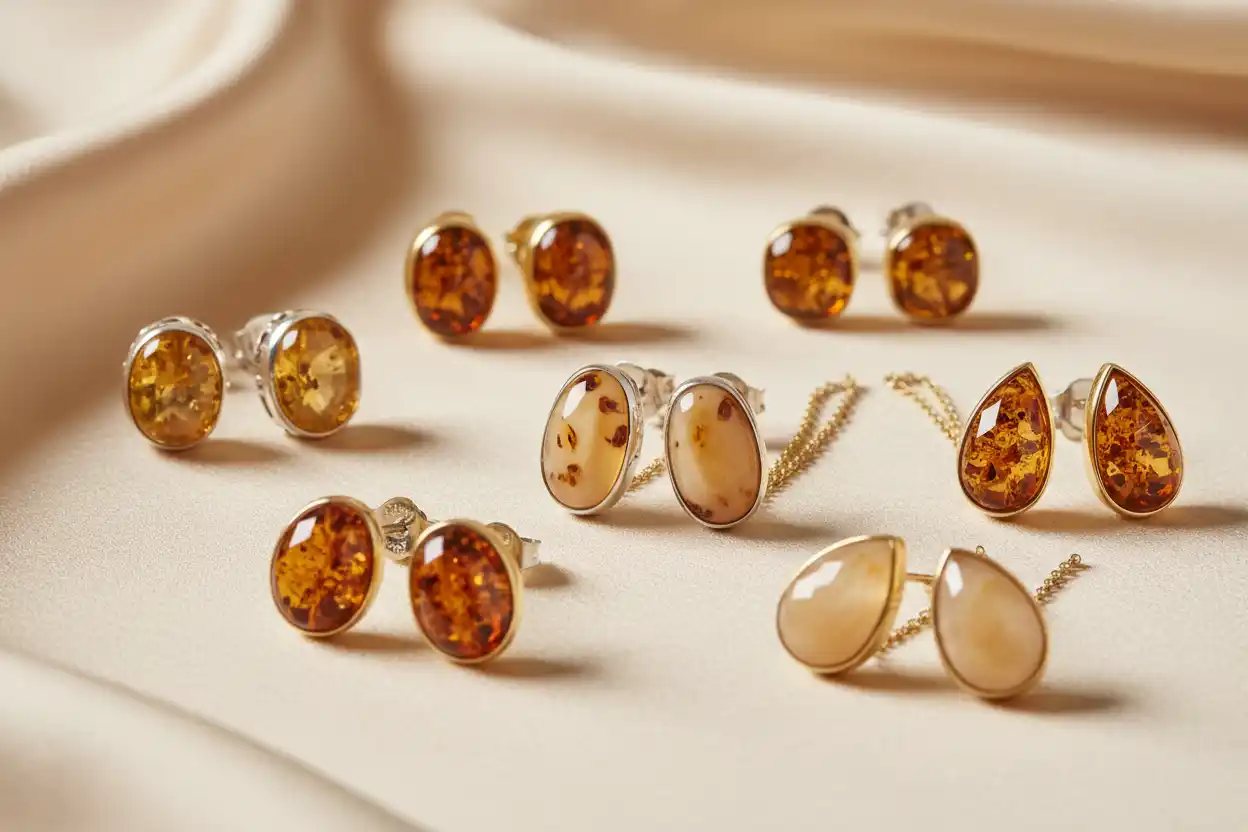
Amber Earrings: Styles, Quality & Buying Guide
Amber earrings combine warm organic color with an unusual physical advantage that becomes especially important when jewelry hangs from the earlobe: amber is remarkably lightweight compared with most mineral gemstones, allowing designers to use large drops, beads, cabochons and carvings without creating the substantial weight that similarly sized garnet, quartz or sapphire pieces would produce. That low density makes amber earrings particularly suitable for statement designs, although the same organic origin that keeps amber light also makes it softer, less tough and more sensitive to heat, chemicals and abrasion than conventional gem minerals.
Amber is fossilized plant resin rather than a mineral crystal, with natural material commonly appearing yellow, honey, orange, cognac, reddish brown, cream or brown while unusual material can show greenish, bluish or other distinctive optical appearances. With a Mohs hardness of only about 2–2.5 and poor toughness, amber earrings need more protection from scratches and accidental impact than their large size might suggest, even though earrings generally encounter fewer hard surfaces than rings and bracelets.
The most important buying questions are therefore not simply whether the pair looks attractive in a product photograph, but whether both pieces match appropriately, whether the amber is natural or modified as disclosed, whether drilled or mounted areas remain structurally sound, and whether the posts, hooks, hinges, jump rings and backs are reliable enough to keep a lightweight earring from disappearing unnoticed.
The best amber earrings balance:
material identity + pair matching + comfortable scale + secure hardware + realistic durability + clear treatment disclosure.
Amber Earrings at a Glance
| Factor | What Matters |
|---|---|
| Material | Fossilized plant resin; organic gem material |
| Mineral status | Not a mineral |
| Mohs hardness | About 2–2.5 |
| Toughness | Poor |
| Specific gravity | Around 1.08 for typical amber |
| Cleavage | Not applicable as mineral cleavage; amber is amorphous |
| Common colors | Yellow, honey, orange, cognac, red-brown, cream and brown |
| Important optical features | Transparency, cloudiness, fluorescence and inclusions |
| Major earring advantage | Extremely low weight |
| Best everyday forms | Compact studs and modest protected drops |
| Main material risk | Scratching, chipping, heat and chemicals |
| Main hardware risk | Loose backs, hooks, jump rings, posts and adhesive joints |
| Pair-matching factors | Color, transparency, pattern, inclusions, dimensions and visual weight |
| Common modifications | Heating, clarification, dyeing, pressing and reconstruction |
| Important lookalikes | Copal, plastic, synthetic resin, glass and reconstructed products |
| safest routine cleaning | Lukewarm water, mild soap and a soft cloth |
| Cosmetics rule | Apply perfume and hairspray before putting earrings on |
Why Amber Works Especially Well in Earrings
The strongest practical argument for amber earrings is density, because amber is so light that a visually substantial piece can remain comfortable enough for prolonged wear while a mineral gemstone of equivalent dimensions might pull noticeably on the earlobe. This allows designers to create long drops, oversized beads and sculptural forms that would become uncomfortable if made from a much denser gem.
That advantage is particularly noticeable in statement amber earrings, where visual size matters more than carat weight.
Amber’s softness is also easier to manage in earrings than in many other jewelry forms because the ears normally avoid countertops, door handles, desks, gym equipment and other hard surfaces that repeatedly strike rings and bracelets. The reduced impact exposure does not eliminate risk, but it makes earrings one of the more sensible ways to wear a delicate piece of fossilized resin.
The underlying material, formation and symbolism are covered more broadly in the amber meaning guide, while this page focuses specifically on how amber behaves when used as a matched pair worn at the ears.
Amber Is Not a Mineral Gemstone
Understanding what amber actually is prevents several buying and care mistakes, because amber formed from ancient plant resin that hardened and changed over geological time rather than crystallizing from a conventional mineral-forming process. Its organic origin explains several characteristics that are unusual when compared with mineral gems, including very low density, low hardness, sensitivity to heat and a tendency to darken gradually through aging and prolonged environmental exposure.
That distinction also changes the way durability should be discussed.
A mineral such as quartz can resist scratching much better.
Amber can acquire fine surface marks from comparatively ordinary contact.
A gemstone such as sapphire tolerates substantially more heat.
Amber can be damaged at temperatures that would present little concern for many mineral gems.
For amber earrings, the safest approach is therefore to appreciate their lightness without assuming that lightweight material is mechanically carefree.
How Lightweight Are Amber Earrings?
Typical amber has a specific gravity around 1.08, placing its density remarkably close to that of water and far below most familiar jewelry gemstones. Garnet, for example, is several times denser, while sapphire and many other conventional gems also carry far more weight at equivalent physical dimensions.
This creates a major design advantage.
A large amber drop can look visually substantial while remaining surprisingly light.
That can reduce downward pressure on the piercing and make longer styles more comfortable during extended wear, particularly for someone who dislikes heavy earrings but still wants noticeable scale.
The weight of finished amber earrings still depends on the metal.
Large silver hoops, heavy gold frames, multiple chains and substantial backs can erase part of amber’s natural weight advantage, so the complete pair should be evaluated rather than assuming every large amber design will automatically feel light.
Pair Matching Matters More Than Carat Weight
Amber earrings require two pieces that work visually as a pair, which creates a different buying problem from choosing one amber pendant because natural resin can vary dramatically in color, clarity, internal texture, oxidation, inclusions and surface appearance. Two pieces cut from different portions of rough amber may share the same general color name while looking noticeably different once they sit on opposite sides of the face.
Good matching does not require perfect duplication.
Natural inclusions and flowing internal structures can make slight differences attractive.
The goal is visual balance.
Compare both amber earrings together rather than evaluating each one separately, and look at whether their color depth, transparency, dimensions and overall visual weight appear coordinated at normal viewing distance.
What Should Match in Amber Earrings?
Color should generally coordinate unless deliberate contrast is part of the design, because a pale lemon-yellow piece beside a deep opaque cognac piece will create a very different visual effect from a pair chosen from similar material. Transparency also matters, particularly when one earring allows light to pass through clearly while the other is densely cloudy or opaque.
Size should be judged face-on rather than only by listed weight.
Because amber is very light and natural pieces can contain internal voids or varying structures, gram weight alone is not a useful substitute for dimensions.
Look at:
outline and dimensions, so one side does not appear conspicuously larger;
color and tone, particularly under the same neutral lighting;
transparency, so the pair behaves similarly when light passes through it;
internal pattern, including bubbles, plant debris and natural cloudiness;
surface polish, because one highly polished piece beside a visibly worn one can appear mismatched;
and hanging length, because even small differences become obvious when drops sit beside the face.
Matching should look intentional.
Natural Asymmetry Can Be Beautiful
Natural-form amber earrings do not need identical outlines, particularly when a designer intentionally preserves irregular pieces of fossil resin rather than forcing them into standardized calibrated shapes. A pair can use two different natural forms successfully when their color, scale and visual mass remain balanced enough that the asymmetry looks deliberate.
This works particularly well with organic drops and minimally polished pieces.
The important distinction is between complementary asymmetry and accidental mismatch.
If one earring is twice as thick, markedly darker and hangs substantially lower than the other without an obvious design reason, the pair may simply have been assembled from unrelated material.
Natural does not mean unconsidered.
Amber Stud Earrings
Amber stud earrings are among the safest and most convenient choices for frequent wear because the material stays close to the earlobe, movement is limited and the risk of the amber repeatedly striking clothing or other jewelry is reduced. Small cabochons, rounded polished pieces and compact carved forms work particularly well, while the low weight can make larger-than-average studs comfortable when the design remains balanced.
Construction deserves close inspection because amber cannot simply be treated like a hard faceted gemstone held under substantial metal pressure.
Some studs use a setting around the amber.
Others use a post attached to the back.
Adhesive-mounted pieces can perform well when properly made, but an aging or degraded adhesive joint can become a hidden failure point.
Look at the back as carefully as the front.
The post should sit securely and squarely rather than appearing partially detached, heavily bent or surrounded by cracked resin.
Friction Backs for Amber Studs
Friction backs are common because they are quick to use and work well with lightweight stud amber earrings, but the backing should grip the post firmly enough that ordinary head movement, hair contact and clothing changes do not loosen it. An amber stud may be so light that a wearer does not immediately notice when one side has fallen out, making a weak backing more consequential than the earring’s low weight suggests.
Test the fit before regular wear.
A backing that slides on with almost no resistance should be replaced.
The solution is inexpensive compared with replacing a matched natural amber earring that may be impossible to duplicate later.
Screw Backs and Locking Backs
Screw backs can provide additional mechanical security when the post and backing are designed correctly, although they take longer to put on and should never be forced if the threads become misaligned. Locking backs can also be useful for valuable amber earrings because they reduce dependence on friction alone while remaining relatively convenient.
The best closure is not automatically the most complicated one.
It is the system that fits the post correctly, engages consistently and remains comfortable behind the ear.
If an antique pair uses original hardware, security should take priority over preserving a worn backing that no longer performs its function reliably.
Amber Drop Earrings
Drop amber earrings make particularly effective use of the material’s low density because substantial cabochons, teardrops and irregular polished pieces can hang below the earlobe without the uncomfortable pull associated with equally large dense gemstones. Movement also changes how light passes through translucent amber, allowing honey, cognac and reddish tones to appear lighter or deeper as the earring turns.
The weak points shift from the gemstone surface to the connecting hardware.
Inspect the bail, cap, jump ring, hook and every joint between the amber and the ear wire.
A delicate loop holding an expensive piece of amber should not be almost worn through.
Where the amber is drilled, inspect the hole for cracks and enlargement.
The earrings should move freely without allowing the resin to strike hard metal repeatedly.
Amber Dangle Earrings
Long dangle amber earrings create more movement than simple drops, which can make transparent material especially attractive but also increases the chance of contact with shoulders, necklaces, zippers, scarves and hair accessories. The longer the design becomes, the more important it is to determine whether the amber pieces collide with one another or with metal components during normal movement.
Constant amber-on-metal contact is undesirable.
The metal may gradually scratch the soft resin.
Multiple amber pieces should therefore have enough spacing that ordinary movement does not turn the design into a series of repeated impacts.
Length should also suit the wearer’s body proportions.
A long pair that continually strikes the shoulders may look elegant while standing still but become frustrating during actual wear.
Amber Bead Earrings
Amber bead earrings range from small single beads to elaborate graduated arrangements, and their light weight makes even multi-bead designs easier to wear than similar earrings made from dense stones. The critical inspection area is the drill hole because wire, pins and other metal components can wear against the comparatively soft resin over time.
Look for cracks extending outward from the hole.
Check whether the opening has become elongated.
Inspect vintage earrings for abrasion where wire contacts the amber.
A drilled bead can remain visually beautiful while becoming structurally vulnerable at the exact point carrying its weight.
If the hole is already splitting, continued wear may enlarge the damage until the bead detaches.
Amber Cabochon Earrings
Cabochons suit amber particularly well because a smooth domed surface displays color, cloudiness, bubbles and inclusions without requiring the sharp facet junctions that are difficult to preserve indefinitely in such a soft material. Cabochon amber earrings may be surrounded by metal, held with carefully designed prongs or incorporated into frames using adhesive or mechanical support.
A bezel-style frame can protect the perimeter effectively.
The setting should still avoid excessive force.
Amber has poor toughness, so tightening metal aggressively around the material can create cracks rather than increasing security.
Protective does not mean compressed.
Carved Amber Earrings
Amber’s softness makes carving relatively easy compared with many mineral gems, allowing earrings to take the form of leaves, flowers, animals, geometric shapes, relief carvings or abstract organic forms. These pieces can be visually distinctive and remain surprisingly light despite substantial dimensions.
Thin projections create the main risk.
A delicate flower petal or narrow carved tip can break much more easily than a compact rounded cabochon.
Inspect the carving at:
thin edges;
drilled suspension points;
deep grooves;
sharp corners;
and narrow transitions between thicker sections.
A thicker, intelligently designed carving will generally tolerate wear better than an extremely delicate form whose visual complexity depends on fragile projections.
Amber Hoop Earrings
Hoop designs can use amber as beads, removable charms, inlays or suspended drops, creating a contemporary alternative to traditional cabochon earrings while preserving the resin’s warm organic appearance. The metal hoop can nevertheless become the dominant source of both weight and abrasion, particularly when an amber charm swings far enough to strike the hoop repeatedly.
Watch how the design moves before buying.
If the amber clicks against metal with every head movement, the surface can accumulate fine scratches.
A good hoop design allows enough movement to look lively without subjecting the resin to constant hard contact.
The hoop closure should also remain secure because a lightweight amber charm may not provide enough sensation for the wearer to notice immediately when the hoop has opened.
Leverback Amber Earrings
Leverbacks work particularly well for drop amber earrings because the hinged closure can provide greater security than an open hook while keeping the design easy to put on and remove. The hinge and closing wire should align properly, with enough positive tension that the mechanism stays shut during ordinary wear.
Vintage leverbacks deserve particular inspection.
Years of opening and closing can wear the hinge.
If the closure feels loose or inconsistent, repair it before trusting the earrings with valuable natural amber.
The amber itself may survive for geological ages.
A small metal hinge does not.
French Hooks and Ear Wires
Open hooks create an elegant lightweight look and suit the naturally low mass of amber, although an unsecured hook can work its way out of a piercing when hair, collars or scarves move around it. Small silicone or metal stoppers can add useful security without materially changing the appearance.
Check the wire where the amber drop connects.
A jump ring should close fully.
The wire should not be so thin that normal bending quickly distorts it.
For large natural amber earrings, upgrading a weak hook can be a far less expensive decision than trying to replace one lost member of the pair.
Earring Weight and Lobe Comfort
One of amber’s strongest advantages is that large visual size does not necessarily translate into heavy earrings, making the material especially appealing to people who enjoy statement jewelry but find dense gemstone earrings uncomfortable. Still, metal can change the calculation dramatically, and a large silver frame or gold mounting may weigh more than the amber it surrounds.
Ask for total pair or individual earring weight when buying substantial designs online.
Weight distribution matters too.
A long earring that places most of its mass at the bottom creates more leverage on the piercing than a compact stud of similar total weight.
Comfort is part of quality.
An impressive pair that becomes painful after twenty minutes will rarely become everyday jewelry.
Color Quality in Amber Earrings
Amber comes in far more visual varieties than one golden-yellow stereotype, with natural material ranging through pale lemon, honey, orange, cognac, reddish brown, cream, butterscotch and darker brown while fluorescence and internal structure can produce additional visual effects. Color preference is partly personal, so deeper material is not automatically superior to pale transparent amber.
Pair harmony matters more than selecting one supposedly ideal shade.
Transparent golden amber can look especially luminous in drops because light passes through it.
Opaque cream or butterscotch material can create softer sculptural earrings.
Deep cognac amber often produces a more traditional appearance.
The pair should be judged for consistency and beauty rather than for conformity to one color label.
Transparent vs. Cloudy Amber Earrings
Transparent amber can reveal internal bubbles, flow structures, plant debris or other inclusions, making the earrings especially interesting when the pair contains complementary internal features. Cloudy or opaque amber produces a different aesthetic and may show cream, butterscotch or honey-colored textures that rely more heavily on body color than internal transparency.
Transparency can influence market value, but inclusions complicate the simple rule that clearer material is always more desirable.
A transparent piece containing a compelling natural inclusion may attract more interest than a completely clean one.
For earrings, pair matching again becomes important.
One very transparent piece combined with one dense opaque piece needs to look intentionally contrasted rather than accidentally mismatched.
Amber With Inclusions
Plant fragments, insects and other natural inclusions contribute heavily to amber’s fascination because the fossilized resin can preserve evidence of ancient ecosystems with extraordinary three-dimensional detail. Earrings containing visible inclusions can therefore be far more interesting than plain material, particularly when both pieces show complementary rather than identical internal scenes.
Authenticity deserves caution.
A perfectly positioned, pristine insect inside unusually cheap, crystal-clear material should not automatically be accepted as a rare natural inclusion.
Modern insects and other objects can be embedded in resin imitations or manipulated material.
For significant purchases, the real vs fake amber guide explains why inclusion appearance, resin identity and professional testing need to be considered together.
A fascinating insect is not proof that the surrounding material is ancient amber.
Natural Amber vs. Pressed Amber
Natural amber can occur as individual pieces suitable for cutting, while smaller fragments can also be consolidated under heat and pressure to create larger material commonly described as pressed, reconstructed or consolidated amber. Pressed amber still contains amber material, but it does not have the same uninterrupted natural structure as a single piece.
That distinction can affect both market value and collecting interest.
Pressed amber earrings can be attractive and affordable.
They should simply be disclosed accurately.
Look for unusual flow structures, repeated internal patterns or visual boundaries that may suggest reconstruction, although appearance alone is not always sufficient for confident identification.
Seller terminology matters.
“Genuine amber” does not necessarily answer whether the material is one natural piece or reconstructed from multiple fragments.
Amber vs. Copal
Copal is younger resin material that has undergone less extensive geological maturation than amber, and its appearance can overlap so strongly with amber that color and transparency alone are not reliable ways to separate the two. Copal can be beautiful and naturally derived, but it occupies a different material category and may respond differently to heat, solvents and aging.
This matters when earrings are priced as old natural amber.
A seller should not use the attraction of fossilized ancient resin to justify an amber-level price for material that is actually younger copal without disclosure.
Home tests involving hot needles, flames or solvents can permanently damage earrings and should not be treated as harmless authenticity checks.
When the distinction materially affects value, professional testing is a better solution.
Plastic and Resin Imitations
Amber’s low density and warm translucency can be reproduced convincingly with plastics and manufactured resins, particularly in earrings where the material is already expected to feel unusually lightweight. Surface appearance may be highly polished, and artificial inclusions can make inexpensive pieces look superficially extraordinary.
Price can provide context but not proof.
An inexpensive pair may contain genuine commercial amber.
An expensive pair may still be misrepresented.
Look instead for coherent disclosure, appropriate material features, workmanship and evidence proportionate to the seller’s claims.
Avoid destructive household tests on finished jewelry.
Burning or melting a questionable earring proves very little once the object has been ruined.
Treated Amber Earrings
Amber can be altered through heat, pressure, clarification, dyeing and other processes that change color, transparency or internal appearance, while some treatments are widely accepted when they are described accurately. Heating can produce characteristic internal features, and commercial processing may make cloudy material clearer or modify the visible color.
Treatment does not automatically make amber earrings poor quality.
It changes what the buyer is purchasing.
An attractive treated pair can be excellent jewelry when the price and description reflect its condition honestly.
Problems arise when heavily modified material is presented as an exceptionally rare untreated natural color.
Green Amber Earrings
Green amber deserves particularly careful questions because vivid bright-green commercial material can result from treatment rather than representing an untreated natural body color. Some pieces may also appear green because of backing, reflected light or fluorescence-related effects rather than because the resin itself has a uniformly green natural color.
Ask exactly what created the appearance.
A seller should distinguish natural amber, treated amber, copal and imitation resin rather than using “green amber” as if the phrase alone explains the material.
For earrings, examine the piece from the front and back because colored backing beneath translucent amber can strongly influence the visible result.
Red Amber Earrings
Natural amber can occur in reddish and reddish-brown colors, while commercial pieces may also be heated, dyed or otherwise modified to intensify red appearance. An unusually uniform cherry-red pair deserves treatment questions, particularly when the color appears substantially stronger than the surrounding market at a very low price.
Again, treatment is not automatically a defect.
Disclosure determines whether the buyer can compare value fairly.
A treated red pair may be visually striking.
It should not acquire an untreated rarity premium merely because the color is dramatic.
Baltic Amber Earrings
Baltic amber has enormous historical and commercial importance and is strongly associated with the succinite variety of amber from the Baltic region. Genuine Baltic amber earrings can range from transparent golden material to opaque cream, butterscotch, cognac and other commercial appearances, while treatment and reconstruction remain possible regardless of geographic label.
“Baltic” should not be treated as a quality grade.
Material from the region can vary widely.
A beautiful pair should still be evaluated for color, condition, treatment disclosure, matching and craftsmanship.
For higher-value pieces, provenance becomes more useful when the seller’s geographic claim contributes significantly to the price.
Dominican Amber Earrings
Dominican amber is particularly well known for transparent material, biological inclusions and distinctive fluorescence in certain examples, while some pieces can show unusual blue or greenish optical effects under appropriate lighting. These characteristics can make earrings visually striking, especially when transparent drops allow changing light to interact with the resin.
Do not assume every intensely blue photograph represents how the earrings will look in ordinary room lighting.
Fluorescence and directional effects can appear dramatically different depending on illumination and background.
Ask for photographs under neutral daylight-type light as well as whatever lighting produces the unusual effect.
Buy the appearance you will actually see, not only the most dramatic photograph a seller can produce.
Burmese Amber Earrings
Amber from Myanmar, historically associated with Burmese deposits, can occur in a range of colors including yellow, orange, red and deep brown while also carrying substantial geological and paleontological interest. Provenance can influence collector value, particularly when inclusions are important.
For jewelry buyers, origin should remain secondary to accurate material identification and condition unless the locality itself forms a meaningful part of the purchase.
A damaged pair does not become better jewelry because its origin is prestigious.
Quality and provenance answer different questions.
Metal Choice for Amber Earrings
Amber’s warm color works naturally with yellow gold, rose gold, silver and other jewelry metals, while the best choice depends on visual preference, budget, skin sensitivity and the construction needed to support the resin safely. Yellow gold tends to reinforce honey and cognac tones, whereas silver or white metals can create stronger contrast around orange and warm brown material.
Metal should not press unnecessarily against amber.
A protective frame is useful when properly engineered.
A tight metal edge that places constant stress on a thin piece can eventually create damage.
The setting should support rather than squeeze the resin.
Metal Sensitivity and Earring Posts
For anyone with known sensitivity to certain metals, the composition of the post and backing matters more than the amber itself because those components remain in prolonged contact with the piercing and surrounding skin. A product described only as “amber earrings” may provide no useful information about whether the posts are gold, silver, plated base metal or another alloy.
Ask before purchasing when metal sensitivity matters.
Do not assume the visible decorative metal and the post are identical materials.
A silver-toned setting can still use a different post alloy.
Comfort depends on the component actually touching the ear.
Amber Earrings With Silver
Silver provides a cool-toned contrast that can make golden and cognac amber appear particularly warm, while its relatively accessible price makes it common in both modern and traditional amber jewelry. Sterling silver settings should be smooth around the amber, particularly where claws, caps or frames contact the resin.
Silver tarnish should be handled carefully.
Aggressive polishing compounds intended for metal can abrade soft amber if rubbed across the gemstone surface.
When cleaning mixed-material amber earrings, treat the amber as the more vulnerable component.
Amber Earrings With Gold
Gold can complement amber’s warm color exceptionally well and is often used in higher-value pieces, particularly when the earrings contain fine natural material or important inclusions. The mechanical design matters more than metal prestige because a poorly attached gold cap or thin worn jump ring can still fail.
Check hallmarks where relevant, but remember that a gold mounting does not authenticate the amber.
A genuine gold setting can contain treated amber, pressed material or imitation resin.
Metal identity and gem identity must be established separately.
Amber Earrings With Diamonds or Hard Gems
Designers occasionally combine amber with diamond, sapphire or other harder stones, creating attractive contrast while introducing a material compatibility issue because those gems can easily scratch amber if they make repeated direct contact. The setting should keep hard facet edges away from the resin during normal movement.
This matters especially in dangle designs.
A diamond charm swinging against amber is not harmless decoration.
Over time, the harder material can mark the softer surface.
Mixed-gem earrings should therefore be evaluated as moving mechanical systems rather than static photographs.
How Much Do Amber Earrings Cost?
Amber earrings occupy a wide price range because ordinary commercial pieces can be inexpensive while large natural amber, exceptional inclusions, desirable provenance, fine carving, historic craftsmanship and precious-metal settings can increase value substantially. Treatment and reconstruction also change the comparison, which means two similar-looking golden pairs can belong to different price categories.
The amber price guide covers material-level valuation separately.
For earrings, evaluate both the amber and the finished construction.
A high price can reflect:
rare inclusion quality;
large natural pieces;
desirable source;
precious metal;
antique or designer craftsmanship;
or unusually fine matching.
Carat weight is rarely the most useful starting point because amber is extremely light.
Large Amber Earrings Are Not Necessarily Expensive
Amber’s low density allows pieces to become visually large without becoming heavy, while commercially available material can occur in dimensions that would be exceptional for many mineral gemstones. A large pair therefore should not automatically receive a rarity premium simply because the pieces measure several centimeters across.
Quality determines whether size matters.
Large transparent amber containing an important natural inclusion is different from a large ordinary pressed or treated piece.
Large carved natural amber is different from molded synthetic resin.
Dimensions create visual impact.
They do not establish value by themselves.
Buying Vintage Amber Earrings
Vintage amber earrings require inspection of both material and hardware because decades of wear can leave the resin scratched while posts, wires, adhesives and jump rings may become even more vulnerable. Surface patina can be consistent with age, but it should not be confused automatically with evidence of authenticity because old plastics and reconstructed products also exist.
Inspect the back.
Look at how the post is attached.
Check drill holes.
Examine hinges and hooks.
Determine whether old adhesive has become brittle.
If the amber has important sentimental or market value, avoid unnecessary polishing that could remove original surface character or make later examination more difficult.
How to Evaluate Amber Earrings Online
Online buying removes the ability to feel the earrings’ weight, inspect their backs and view their transparency under changing angles, so clear photographs and precise disclosure become much more important. Ask for front, back and side views of the exact pair rather than relying only on a staged model photograph.
Confirm:
whether the material is natural amber;
whether it is pressed or reconstructed;
whether known heat, clarification, dye or other treatment is present;
the dimensions of each amber piece;
the total drop length;
the metal and post material;
the closure type;
and the return policy.
For inclusion pieces, request close photographs that show the object from several angles rather than one dramatic image.
For valuable natural material, seller confidence should be supported by evidence rather than adjectives.
Seller Terms That Need Clarification
Certain phrases sound reassuring without providing enough information, which makes them worth questioning before purchasing amber earrings.
“Genuine amber” may still leave treatment and reconstruction unanswered.
“Natural resin” may refer to material that is not geologically mature amber.
“Baltic style” does not establish Baltic origin.
“Pressed amber” indicates reconstructed material rather than one continuous natural piece.
“Created amber” is too vague to identify what substance was actually used.
“Green amber” does not establish whether the color is natural, treated or produced through backing.
Precise terminology allows meaningful comparison.
Vague terminology transfers uncertainty to the buyer.
Amber Earrings vs. Amber Necklace
An amber necklace can use very large beads and pendants because amber’s light weight remains comfortable around the neck, while earrings must balance visual scale with lobe comfort, pair matching and closure security. Necklaces also receive more direct contact with perfume, skin products and clothing across a larger surface area.
Earrings create a different risk profile.
Hair products and cosmetics become more important.
Pair matching becomes essential.
Backs and hooks become critical loss points.
The two jewelry forms should therefore not be evaluated through interchangeable style advice.
Perfume and Amber Earrings
Perfume is one of the most avoidable risks because fragrance products can contain alcohol and other compounds that should not be repeatedly sprayed onto delicate organic gem material. Amber can be damaged by chemicals, while residue also reduces surface appearance over time.
Apply fragrance first.
Allow it to dry.
Then put on the amber earrings.
This sequence is particularly important with large drops because they may hang near areas of the neck where perfume is commonly applied.
Putting jewelry on last is a simple habit with real protective value.
Hairspray and Hair Products
Amber earrings sit directly beside hair, making hairspray, styling mist, oils, dye products and other cosmetics more relevant than they are for many rings or bracelets. Aerosol sprays can settle across the polished surface and gradually create a film, while chemical ingredients may be inappropriate for prolonged contact with amber.
Style the hair first.
Use sprays before the earrings are in place.
Allow products to settle or dry.
Then add the jewelry.
This is more effective than repeatedly attempting to remove cosmetic residue from a soft organic surface.
Heat Is a Serious Care Concern
Amber is far more heat-sensitive than common mineral gemstones and can burn or undergo irreversible change at temperatures that many conventional gems would tolerate, making steam cleaning, open flames and high-temperature jewelry repair particularly inappropriate. Even sustained strong environmental heat should be avoided when there is no practical reason to expose the earrings.
Do not leave amber earrings on a hot dashboard.
Do not place them directly beside heating equipment.
Do not use a hot needle as an authenticity test.
Do not assume a jeweler can solder close to amber without first protecting or removing the material.
Tell anyone repairing the earrings exactly what the gem is.
Strong Light and Long-Term Aging
Amber naturally changes with age, and prolonged exposure to strong light can accelerate darkening or other surface changes over time. This does not mean the earrings must remain in permanent darkness, because normal wearing is part of owning jewelry, but leaving them for months in intense direct sunlight is unnecessary.
Display and storage are different activities.
Wear the amber earrings normally.
Store them away from prolonged strong light and heat when they are not being used.
This protects both color and surface condition more effectively than elaborate cleansing rituals.
How to Clean Amber Earrings
The safest routine for amber earrings is deliberately simple because soft organic material does not benefit from aggressive mechanical cleaning. Use lukewarm water with a small amount of mild soap, wipe gently with a soft cloth and avoid prolonged soaking when the construction includes adhesive joints, old repairs or uncertain treatments.
Rinse carefully where appropriate and dry promptly with a clean soft cloth.
Do not scrub with abrasive powders.
Do not use jewelry dips intended for harder stones.
Do not use strong solvents.
Do not assume a silver-cleaning solution is safe for the amber simply because it is appropriate for the metal.
The detailed how to clean amber jewelry guide covers the cleaning process and common mistakes more fully.
Can Amber Earrings Go in an Ultrasonic Cleaner?
Amber earrings should not be treated as routine ultrasonic-cleaner jewelry because the combination of soft organic material, poor toughness, possible treatments, adhesive joints and vintage construction creates unnecessary risk. An ultrasonic machine can also affect components around the amber even when the resin initially appears intact.
Hand cleaning is safer.
The same principle applies to steam.
High-temperature steam offers no advantage worth the additional risk to amber.
Can You Shower in Amber Earrings?
Removing amber earrings before showering is preferable because shampoo, conditioner, soap and hair products can accumulate on the surface while repeated water exposure may also affect adhesives, stringing elements or other components used in the jewelry. The earrings are easy to remove, and there is little benefit in keeping delicate organic material exposed during bathing.
Ordinary brief water contact during controlled cleaning is different from habitual exposure to a mixture of hot water and cosmetic products.
Care should be proportionate.
Can You Sleep in Amber Earrings?
Sleeping in amber earrings is best avoided, particularly with drops, carvings and large studs because bedding can catch the jewelry, bend posts, loosen backs and place sideways pressure on fragile resin components. Even small amber studs can develop unnecessary surface abrasion if repeatedly pressed against pillows.
Remove them before sleep.
The risk reduction costs nothing and avoids hours of pressure the jewelry was never intended to experience.
How to Store Amber Earrings
Amber earrings should be stored in a soft separate compartment where harder jewelry cannot scratch them, because quartz, garnet, sapphire, diamond and many ordinary mineral gemstones are substantially harder than amber. Even metal edges from other jewelry can gradually mark the polished surface if pieces move against one another inside a box.
Store the pair together but separated enough that they do not rub aggressively against each other.
Secure removable backs to the posts when practical.
Lay long dangles so chains and hooks do not tangle.
Keep important documentation elsewhere so losing or damaging the jewelry does not also destroy its provenance.
A soft pouch or lined compartment is usually sufficient.
How to Prevent Losing One Amber Earring
Matched amber earrings can be frustrating to replace because natural material varies enough that an identical second piece may not exist, especially when the pair contains distinctive inclusions, carving or unusual color. Hardware maintenance therefore protects more than the monetary value of one earring; it protects the integrity of the pair.
Check the backs periodically.
Inspect jump rings.
Test leverbacks.
Look for bent posts.
Examine hook connections.
Stop wearing the pair when a closure feels noticeably different.
Amber’s low weight creates one additional problem: losing an earring may produce so little physical sensation that the wearer notices only much later.
Secure hardware matters.
Are Amber Earrings Good for Everyday Wear?
Amber earrings can work well for frequent wear because the ear provides a comparatively protected location and amber’s low weight makes even larger pieces comfortable, but everyday use requires more care around cosmetics, hair products, heat and storage than harder gemstone earrings would need. Compact studs and moderate drops are generally easier to manage than highly articulated or extremely delicate carvings.
The wearer’s habits matter.
Someone who routinely applies hairspray after dressing should change the sequence.
Someone who removes earrings before exercising, bathing and sleeping will expose the resin to much less unnecessary stress.
Amber earrings are wearable.
They are not carefree.
Are Amber Earrings Suitable for Sensitive Ears?
Amber itself does not determine whether the piercing tolerates a pair comfortably because the post, hook or wire is the component contacting the ear for prolonged periods. People with known metal sensitivities should therefore confirm the composition of the hardware rather than relying on the fact that the decorative material is natural amber.
Weight also matters for comfort.
Amber reduces that concern substantially, but a heavy metal mounting can still pull on the lobe.
Sensitive ears need appropriate hardware and manageable construction.
The gemstone name alone cannot guarantee comfort.
Amber Earrings Buying Checklist
A strong purchase begins with the amber itself, establishing whether the material is natural amber, pressed or reconstructed amber, younger resin such as copal, or an imitation, because those categories should not be priced or described as though they were interchangeable. Then examine treatment disclosure, particularly when color is unusually vivid, clarity looks highly modified or the seller emphasizes an exceptional appearance.
Compare both earrings together.
Check color, transparency, size, pattern and surface condition.
Inspect inclusion claims carefully.
Look at every drill hole.
Examine posts and backs.
Test hooks and leverbacks.
Check whether hanging pieces collide with metal.
Confirm total length and, for large designs, total weight.
Consider whether the metal touching the ear suits the wearer.
Finally, decide whether the construction respects amber’s softness and poor toughness rather than merely making the pieces look dramatic in photographs.
The best amber earrings are not necessarily the largest, clearest or most heavily included pair.
They are the pair whose material, craftsmanship and disclosure make sense together.
Frequently Asked Questions
What are amber earrings made from?
Authentic amber earrings contain fossilized plant resin, an organic gem material rather than a mineral crystal, although commercial products can also contain pressed amber, treated amber, copal or imitation resins.
Are amber earrings lightweight?
Yes. Amber has very low density compared with most mineral gemstones, making relatively large amber earrings surprisingly comfortable when the metal construction is also lightweight.
Why is amber good for statement earrings?
Its low density allows designers to use large drops, beads or carvings without creating the weight that similarly sized dense mineral gemstones would produce.
Are amber earrings durable?
Amber earrings can provide good service with careful wear, but amber itself is soft at about Mohs 2–2.5 and has poor toughness, so scratches, chips, heat and chemical exposure are real concerns.
Does amber have cleavage?
Amber is amorphous organic material rather than a crystalline mineral with conventional cleavage planes, so mineral-style cleavage is not the principal durability issue. Poor toughness, softness and impact damage matter more.
Are amber earrings good for everyday wear?
They can be, particularly as compact studs or protected drops, provided they are kept away from hard impacts, perfume, hairspray, high heat and abrasive storage.
Are amber stud earrings practical?
Yes. Studs limit movement and keep the amber close to the ear, reducing many of the impact and snagging risks associated with long dangles.
Are amber drop earrings heavy?
Usually not compared with mineral gemstones of similar dimensions, although metal frames, chains and other components can add meaningful weight.
How should a pair of amber earrings match?
Look for reasonable harmony in color, dimensions, transparency, pattern, polish and visual weight, while allowing natural inclusions and irregular forms to differ when the asymmetry appears intentional.
Do natural amber earrings need to be identical?
No. Natural amber often contains unique patterns and inclusions, so a good pair needs visual balance rather than microscopic duplication.
Is clear amber better than cloudy amber?
Not automatically. Transparency can be desirable, but attractive cloudy material, cream amber and pieces containing interesting natural inclusions can also have substantial appeal.
Are insects in amber earrings valuable?
Authentic natural biological inclusions can increase interest and sometimes value, but exceptionally perfect insects in suspiciously inexpensive material deserve careful authenticity scrutiny.
Can fake amber contain insects?
Yes. Modern insects and other objects can be embedded in manufactured resin, so the presence of an insect does not prove that the surrounding material is ancient amber.
What is pressed amber?
Pressed or reconstructed amber is made by consolidating smaller amber fragments under heat and pressure into larger material. It can be genuine amber-based material but should be disclosed separately from a single natural piece.
Is pressed amber fake?
Not necessarily. It can contain real amber, but its reconstructed structure and market value differ from an intact natural piece and should be described accurately.
What is the difference between amber and copal?
Both originate from plant resin, but copal is geologically younger and less mature than amber. Their appearance can overlap enough that professional testing may be appropriate when value depends on the distinction.
Are green amber earrings natural?
Some amber can show unusual greenish appearances, but vivid commercial green amber frequently involves treatment or optical effects, so sellers should disclose how the color was produced.
Are red amber earrings natural?
Natural reddish amber exists, although heating, dyeing or other modification can intensify commercial red colors. Unusually uniform vivid red material deserves treatment questions.
Are Baltic amber earrings valuable?
They can be, but Baltic origin is not a quality grade by itself. Color, condition, natural versus reconstructed structure, treatment, craftsmanship and documentation still matter.
Are Dominican amber earrings different?
Dominican amber is known for transparent material, inclusions and distinctive fluorescence in some specimens, including unusual blue optical effects under suitable conditions.
Can amber earrings be set in gold?
Yes. Gold works well visually with amber, although the setting must support the soft resin without applying excessive pressure.
Is silver safe for amber earrings?
Yes, when the setting is well designed, but silver-polishing products should not be rubbed indiscriminately over amber because abrasive or chemical cleaners can damage the soft organic gem.
Can amber earrings contain diamonds?
They can, although harder diamond edges should not repeatedly strike or rub the amber because diamond can scratch it easily.
Are screw backs better for valuable amber earrings?
Screw or locking backs can provide additional security, although a well-fitted friction back can also work. The closure should fit the post correctly and remain comfortable.
Why do lightweight amber earrings still need secure backs?
Because a lost amber earring may be so light that the wearer does not immediately notice it falling, while replacing one member of a naturally matched pair can be difficult.
Can amber earrings be cleaned with soap and water?
Yes. Lukewarm water, mild soap and a soft cloth are appropriate for routine cleaning of suitable amber jewelry, with prolonged soaking avoided when adhesives, repairs or treatments are uncertain.
Can amber earrings go in an ultrasonic cleaner?
No ultrasonic cleaner should be considered routine for amber earrings because the material is soft, has poor toughness and may contain treatments or adhesive-mounted components.
Can amber earrings be steam cleaned?
Steam cleaning should be avoided because amber is heat sensitive and does not require high-temperature cleaning.
Can I shower while wearing amber earrings?
Removing them first is preferable because hot water, shampoo, conditioner and other products create unnecessary exposure and residue.
Can I sleep in amber earrings?
It is better to remove them because sleeping can bend posts, loosen backs, snag dangles and place prolonged pressure on soft amber surfaces.
Can perfume damage amber earrings?
Repeated direct exposure to perfume and other chemical products should be avoided. Apply fragrance first, let it dry and put the earrings on afterward.
Can hairspray damage amber earrings?
Hairspray and other styling products can coat the surface and expose amber to unnecessary chemicals, so hair products should be applied before putting the earrings on.
Does sunlight damage amber?
Prolonged strong light can contribute to darkening and aging changes over time, so amber should not be stored indefinitely in intense direct sunlight.
How should amber earrings be stored?
Keep them in a lined compartment or soft pouch away from harder gemstones and sharp metal edges, with the pair protected from rubbing and long dangles arranged to prevent tangling.
Are vintage amber earrings worth buying?
They can be, but the amber, posts, hooks, adhesives, jump rings and drill holes should all be inspected because older hardware may become the weakest part of otherwise attractive jewelry.
How can I tell whether amber earrings are real?
Visual features can provide clues, but pressed amber, copal, plastic and manufactured resin can imitate natural material effectively. Important purchases are better evaluated through non-destructive gemological methods than hot-needle, flame or solvent tests.
Should I use a hot needle to test amber earrings?
No. A hot needle can permanently damage the earring and produce fumes while still failing to establish all the information needed about treatment, reconstruction or material identity.
What most affects amber earring value?
Natural versus reconstructed material, treatment, color, transparency, inclusions, size, provenance, matching, carving, condition, metal and overall craftsmanship can all affect value.
What Makes a Good Pair of Amber Earrings?
A good pair of amber earrings takes advantage of the material’s greatest jewelry strength without ignoring the characteristics that make fossilized resin unusually vulnerable, which means the design should use amber’s low density to create comfortable visual presence while protecting the surface from unnecessary impact, abrasion, heat and chemical exposure. Large size can be an advantage because amber remains light, but scale should still work with the earlobe, the metal components and the amount of movement created by the design.
The pair should also look intentionally matched.
Color can vary naturally.
Inclusions can differ.
Irregular forms can be asymmetric.
What matters is whether the two earrings create visual balance when worn together rather than whether every internal feature has been duplicated.
Material identity comes next because natural amber, treated amber, pressed material, copal and manufactured imitations can all produce attractive earrings while belonging to different categories of rarity and value. A seller does not need to pretend every attractive amber product is untreated and exceptionally rare; accurate disclosure allows each piece to be judged for what it actually is.
Then inspect the components that are easiest to overlook.
A drilled hole should not be splitting.
A post should not wobble.
A friction back should grip properly.
A leverback should close positively.
A jump ring should not stand open.
A dangling amber piece should not strike hard metal every time it moves.
Those small mechanical details determine whether the earrings remain a pair.
Finally, consider how amber earrings will interact with daily habits, because the most realistic threats often come from hairspray, perfume, cosmetics, hard storage surfaces and careless cleaning rather than from ordinary wear on the ears. Putting the earrings on after hair and fragrance products, removing them before bathing or sleeping, cleaning them gently and storing them away from harder gems can prevent much of the avoidable damage.
The most useful buying question is therefore not:
“How large are these amber earrings?”
It is:
“Is the amber represented honestly, does the pair look balanced, and has every part of the earring been designed to respect how soft and lightweight this organic gem really is?”
When those conditions are met, amber earrings can deliver something few conventional gemstones provide: substantial visual scale, natural warmth and millions of years of geological history in a pair light enough to wear comfortably.