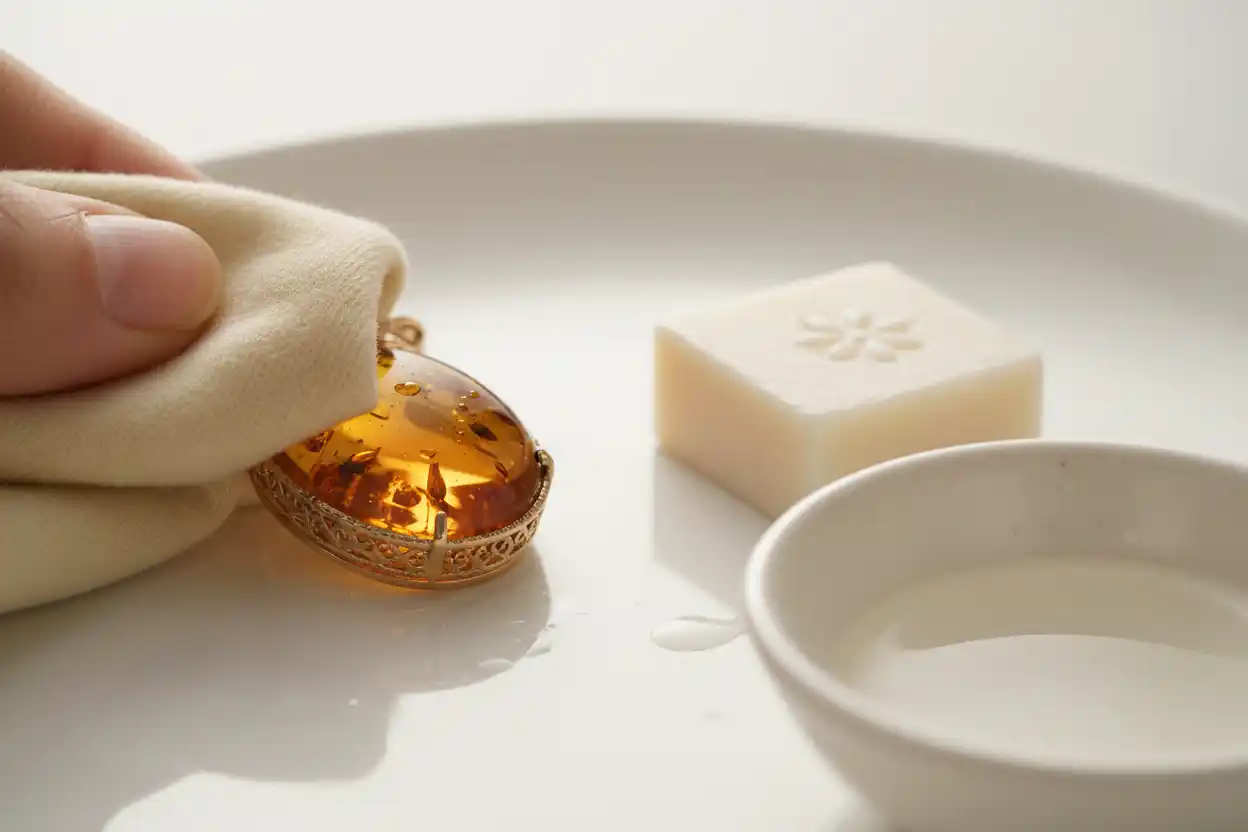
How to Clean Amber Jewelry Safely
Amber needs gentler care than most mineral gemstones. The safest method uses lukewarm water, mild soap, minimal soaking, and a very soft cloth. Steam, ultrasonic vibration, alcohol, abrasive powders, and strong jewelry chemicals can permanently alter its surface.
This caution is necessary because amber is fossilized resin rather than a crystalline mineral. It is lightweight, relatively soft, sensitive to heat and chemicals, and often fashioned as beads, carvings, cabochons, or polished free-form pieces with large exposed surfaces.
Why Amber Requires a Different Cleaning Routine
The material background appears in the Amber meaning and properties guide. Amber belongs among organic gem materials rather than conventional minerals, a distinction discussed in the guide to types of gemstones.
Amber normally ranks only 2 to 2.5 on the Mohs scale and has poor toughness. It can scratch against ordinary dust, harder gemstones, metal tools, rough cloth, and abrasive cleaners. The difference between scratch resistance and breakage resistance is covered in the gemstone hardness chart and gemstone toughness guide.
| Amber characteristic | Care consequence |
|---|---|
| Material type | Organic fossilized resin |
| Mohs hardness | About 2 to 2.5 |
| Toughness | Poor |
| Heat response | Can soften, darken, or burn |
| Chemical sensitivity | Alcohol, solvents, perfume, and cleaners may damage the surface |
| Safest cleaning method | Lukewarm water with mild soap |
| Main handling concern | Scratching, surface clouding, and damage to treated material |
Amber’s softness does not mean it cannot last. Well-preserved pieces survive for generations when owners prevent abrasion, chemical exposure, and excessive heat.
Prepare a Low-Risk Cleaning Area
Use a shallow bowl or a clean surface covered with a folded towel. Keep the amber away from a hard sink, stone countertop, or tiled floor because a dropped bead can chip or crack.
Prepare lukewarm water with a very small amount of mild liquid soap. The water should never be hot. Choose a soft, lint-free cloth and, only when necessary, an exceptionally soft brush with no stiff or protruding bristles.
Avoid paper towels. Some paper products feel smooth but contain fibers capable of producing fine surface abrasion over repeated use.
Inspect the Amber Before Cleaning
Look for cracks, chips, loose beads, open drill holes, damaged string, lifting coatings, cloudy patches, or areas where several pieces have been bonded together. Check the clasps and metal fittings without pulling on the amber.
Treatment and construction can change the safe method. Amber may be dyed, heated, clarified, pressed from smaller fragments, coated, assembled, or imitated by plastic and resin. The guide to treated or synthetic amber addresses those alterations, while real versus fake amber owns the identification comparison.
Do not test authenticity during cleaning. Saltwater flotation, hot needles, solvents, scratching, acetone, and burning can damage jewelry and do not belong in routine care.
Wash Solid Amber Jewelry Briefly
Dampen the soft cloth with lukewarm soapy water and wipe the amber gently. Use light, straight movements rather than aggressive circular polishing. Pay attention to recesses around bezels, bails, and carving details, but do not force a brush into cracks.
When the piece is structurally sound and not strung on a vulnerable cord, a brief wash in the bowl is acceptable. Do not leave amber soaking. Prolonged immersion offers little advantage and may affect string, adhesive, filler, surface treatments, or porous areas.
Rinse with a second cloth dampened in clean lukewarm water. Blot the amber dry immediately and allow any moisture around the setting to evaporate at room temperature.
How to Clean an Amber Necklace
An amber necklace often combines many drilled beads with thread, silk, wire, knots, metal spacers, or adhesive. That construction usually creates more risk than the resin itself.
Instead of immersing the necklace, support it on a clean towel and wipe each bead with a barely damp cloth. Keep the cord as dry as practical. Work from one section to the next without pulling at the knots or rubbing bead edges together.
Dry the necklace flat. Hanging it while wet can stretch stringing material and concentrate weight at the clasp.
If the thread has darkened, frayed, loosened, or absorbed cosmetics, restringing is safer than repeatedly washing it.
How to Clean Amber Earrings
With amber earrings, clean the amber separately from the posts, hooks, hinges, and backs. A damp soapy cloth works for the amber surface, while the metal fitting can be wiped carefully according to its alloy and finish.
Do not dip the entire earring in silver cleaner or another metal-cleaning solution. Chemical dips capable of removing tarnish rapidly may cloud, dry, discolor, or otherwise alter amber.
Make sure the fittings are fully dry before wearing the earrings again.
Methods That Should Not Be Used on Amber
| Method or product | Why to avoid it |
|---|---|
| Ultrasonic cleaner | Vibration and cleaning solution can damage soft or assembled amber |
| Steam cleaner | Heat can soften, darken, craze, or deform the resin |
| Alcohol or sanitizer | Can cloud or damage the surface |
| Acetone and solvents | May dissolve or alter amber, coatings, adhesives, or imitations |
| Toothpaste or baking soda | Abrasive enough to scratch the polish |
| Silver dip or metal polish | Chemicals or abrasive particles may damage adjacent amber |
| Boiling or very hot water | Creates heat damage and rapid expansion |
| Stiff toothbrush | Produces fine scratches |
| Motorized polishing cloth | Heat and abrasion can remove material quickly |
The broad treatment categories relevant to cleaning are explained in Gemstone Treatments Explained. Amber should always be treated according to its most vulnerable alteration, not according to the durability of the surrounding metal.
Perfume, Cosmetics, and Household Chemicals
Perfume, hairspray, sunscreen, lotion, makeup, and cleaning sprays can accumulate on amber or react with its surface. Put amber jewelry on after cosmetics have dried and remove it before using household cleaners.
Hand sanitizer deserves particular caution because many formulas contain a high proportion of alcohol. Remove amber rings or bracelets before applying sanitizer and wait until the hands are dry before replacing them.
Chlorinated pool water, hot tubs, and saltwater also create unnecessary exposure for string, metal, adhesives, and treated surfaces. The broader water-safety distinctions appear in Which Crystals Can and Can’t Go in Water, but amber jewelry should receive only controlled, brief cleaning rather than recreational soaking.
Light, Heat, and Amber Color
Prolonged light exposure can darken some amber, while dyed red or green material may fade or change. Heat from a sunny windowsill, vehicle dashboard, radiator, hair dryer, or jewelry-repair torch can cause more immediate damage.
Store amber away from direct sunlight and high-temperature display lights. The separate guide to crystals that fade in sunlight covers the wider light-stability topic without replacing amber-specific care.
Do not attempt to “warm” amber to restore color or luster. Surface changes caused by oxidation, treatment instability, or wear require professional assessment.
Cleaning Treated, Pressed, or Reconstructed Amber
Pressed amber is made by consolidating smaller pieces under heat and pressure. Other material may be clarified by heating, dyed, coated, or assembled with adhesive. These products can still be legitimate when disclosed, but their response to cleaning may differ from untreated natural amber.
Use only a barely damp cloth when treatment is unknown. Avoid soaking, solvents, heat, ultrasound, and steam.
A change in color, patchy surface gloss, unusual bubbles, visible flow boundaries, or softened adhesive should be evaluated through the dedicated identification content rather than scrubbed more aggressively.
Maintaining Amber’s Polish
Clean amber should have a smooth resinous luster, but routine washing cannot correct scratches or an oxidized surface. Household polishing compounds are risky because they remove material and can leave an uneven finish.
A specialist can repolish valuable amber with controlled abrasives and low heat. Professional work is especially appropriate for carved pieces, historic jewelry, prominent inclusions, or an amber surface that has become extensively crazed or opaque.
Condition directly affects appearance and marketability. The Amber price guide covers value factors, while the Amber buying guide addresses selection and disclosure.
Safe Storage
Wrap each amber piece in a soft clean cloth or place it in its own lined compartment. Do not store it loose beside diamond, sapphire, quartz, metal chains, or other harder objects.
Keep necklaces flat or loosely coiled so beads do not rub together. Avoid tightly sealed storage in a hot environment, and inspect stringing periodically.
When buying another piece, confirm construction and treatment before relying on a seller’s care instructions. The guides to buying gemstones online safely, spotting fake crystals, and ethically sourced gemstones cover those separate purchasing questions.
Frequently Asked Questions
1. Can amber get wet?
A brief wash with lukewarm water is acceptable for sound amber. Avoid prolonged soaking, particularly when the piece is strung, glued, coated, cracked, or of unknown treatment.
2. Is dish soap safe for amber?
A very small amount of mild liquid dish soap is suitable. Avoid strong degreasers, bleach, moisturizers, abrasive additives, and heavily fragranced formulas.
3. Can amber go in an ultrasonic cleaner?
No. Amber is too soft, chemically sensitive, and potentially assembled or treated for ultrasonic cleaning to be a prudent routine method.
4. Can amber be steam cleaned?
No. Steam introduces heat and pressure that can soften, darken, craze, or damage amber and its treatments.
5. Will alcohol damage amber?
Alcohol can cloud or damage amber’s surface. Keep perfume, sanitizer, rubbing alcohol, and alcohol-based cleaners away from the jewelry.
6. Can toothpaste clean amber?
No. Toothpaste contains abrasives that can produce fine scratches and reduce the polish.
7. How should I clean a strung amber necklace?
Wipe each bead with a barely damp soapy cloth, remove soap with a second damp cloth, and dry the necklace flat. Avoid saturating the cord.
8. Can I use silver polish on amber set in silver?
Do not allow silver polish or tarnish-removing dip to touch the amber. Clean the metal locally or ask a jeweler to handle the mixed-material piece.
9. Why did my amber turn cloudy after cleaning?
Possible causes include alcohol, solvent exposure, abrasive damage, heat, unstable treatment, soap residue, or deterioration of a coating. Stop cleaning and obtain professional advice.
10. Can scratched amber be made shiny again?
Light surface wear may be professionally repolished. Home polishing risks removing too much material, rounding details, or creating heat damage.
11. Does sunlight damage amber?
Prolonged exposure can darken natural amber or alter unstable dyes. Store it away from direct sunlight, hot windows, and intense display lighting.
12. How often should amber jewelry be cleaned?
Wipe it after wear and wash only when visible residue remains. Gentle preventive care is safer than frequent deep cleaning.
Conclusion
Amber survives through restraint rather than aggressive maintenance. Lukewarm water, mild soap, a soft cloth, prompt drying, and separate storage preserve its polish without exposing the resin to methods designed for harder mineral gems. When an amber piece remains cloudy or changes color after gentle cleaning, the next question should be whether it is dyed, pressed, coated, assembled, or chemically damaged—not which stronger cleaner to try.