Ametrine Healing Properties: 11 Important Claims, Positive Traditions & Safe Limits
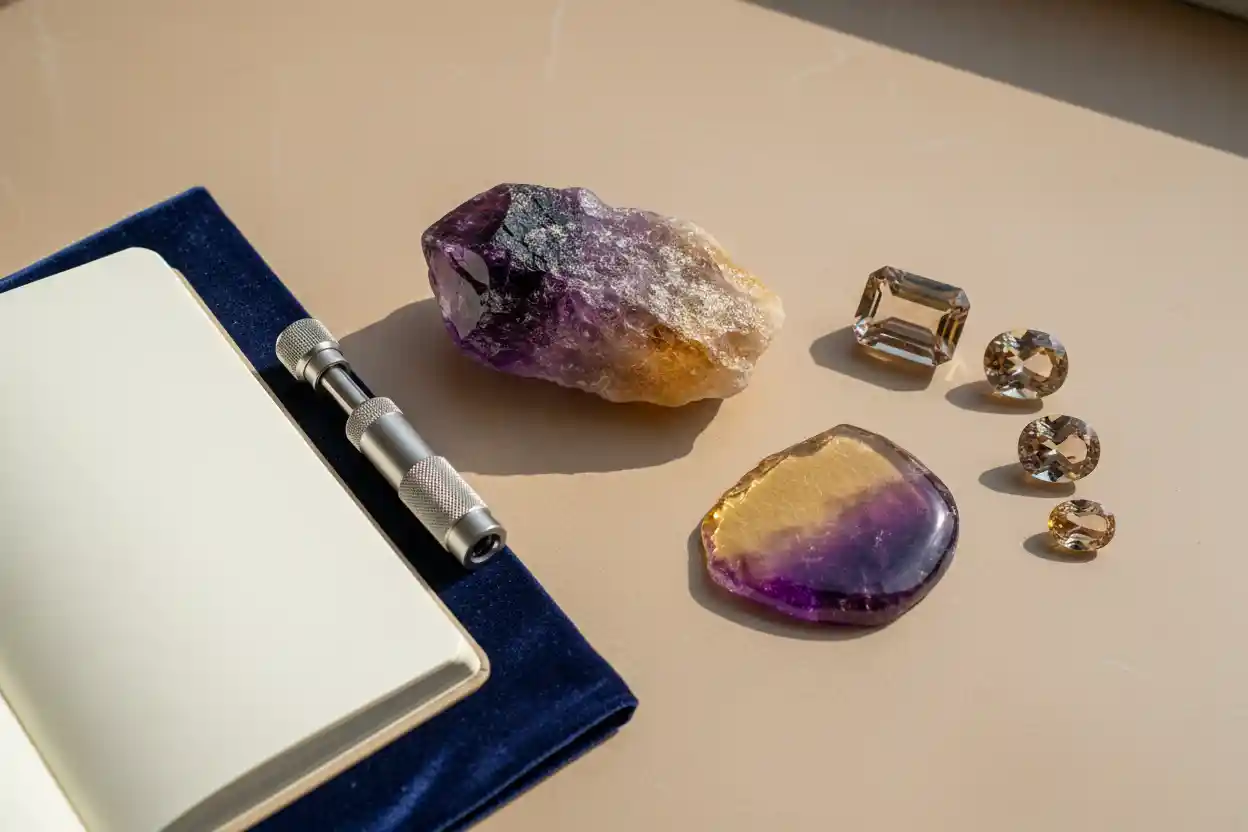
Ametrine healing properties are traditionally associated with balance, clarity, motivation, calm reflection, confidence, creativity, decision-making, adaptability, optimism, personal boundaries, and spiritual insight. These meanings draw heavily from ametrine’s most distinctive physical feature: natural purple amethyst and yellow to orange citrine color zones occurring within the same quartz crystal. The visual combination makes ametrine an intuitive symbol for integrating apparently different qualities, but the gemstone does not balance brain chemistry, regulate hormones, improve metabolism, treat anxiety or depression, increase physical energy, or cure illness.
Ametrine is a variety of quartz, so it has a Mohs hardness of 7 and a basic silicon dioxide chemistry. Its purple and yellow zones form because different regions within the crystal contain iron in states that produce different colors under geological conditions. Fine stones often show a clear boundary or attractive transition between violet and warm yellow-orange areas. Natural commercially significant ametrine is strongly associated with deposits in Bolivia, although synthetic and treated quartz capable of imitating the appearance also exists. These gemological features provide ametrine with a genuine identity that is far more useful for understanding the stone than claims about invisible healing forces.
Ametrine Balance Claims Reflect Its Purple and Yellow Color Zoning
Balance is the defining theme in most ametrine crystal traditions. Because one quartz crystal visibly contains colors associated with both amethyst and citrine, the stone is often described as combining calm reflection with motivation, restraint with action, or intuition with practical thinking. These ideas are symbolic rather than physiological. Ametrine does not balance the nervous system, hormones, emotions, or internal organs through contact with the body.
The metaphor can still be useful. Many decisions require holding two legitimate needs at the same time. Someone may need rest while also meeting an important deadline, confidence while remaining open to correction, or optimism while acknowledging genuine risk. Ametrine can represent the question, “Which qualities need to work together here?” rather than encouraging an all-or-nothing response.
This differs subtly from the traditional amethyst healing properties focus on reflection and restraint or citrine healing properties themes of optimism and constructive momentum. Ametrine’s appeal comes from visually joining both color families in one crystal, making it a particularly clear symbol for integration rather than choosing one quality at the expense of another.
Ametrine Clarity and Decision-Making Claims Work Best With Structured Questions
Ametrine is frequently marketed as a stone for mental clarity and better decisions. There is no established evidence that wearing it improves cognition, memory, executive function, or judgment. A more responsible interpretation is to use the gem as a reminder to slow down and define what the decision actually requires.
A decision journal can make this symbolism practical. Write down the available facts, the important unknowns, the consequences of each option, and the values that matter most. If an assumption cannot be supported, identify what information would test it. The crystals for clarity tradition becomes useful when clarity is treated as reducing confusion through questions and evidence rather than receiving an answer from the stone.
Ametrine’s two-color appearance can also symbolize examining two competing explanations before settling on one. This is especially useful when the first interpretation feels emotionally convincing. High-stakes medical, legal, financial, or relationship decisions should still rely on appropriate expertise and real-world evidence. The gemstone can accompany reflection, but it cannot verify which choice is correct.
Ametrine Motivation and Productivity Traditions Do Not Create Physical Energy
Ametrine is often associated with motivation because the golden citrine-colored zones are culturally linked with warmth, confidence, and action, while the purple zones are linked with reflection. This combination can make the gemstone a useful symbol for moving from planning into execution. A stone on a desk might represent beginning the next defined task once enough preparation has been completed.
That does not mean ametrine increases cellular energy, metabolism, stamina, or physical endurance. Fatigue has many possible causes, and persistent or severe tiredness should not be interpreted simply as low crystal energy. The crystals for energy tradition is safest when “energy” refers to motivation and routine rather than a measurable biological effect transmitted by a stone.
Ametrine can also help symbolically with overplanning. Some people spend so much time refining a plan that action never begins. The purple side of the stone can represent thinking carefully, while the yellow side represents taking the reasonable next step. The value lies in the reminder that reflection and action both matter.
Ametrine Calm and Stress Claims Should Remain Separate From Anxiety Treatment
The amethyst-colored portion of ametrine contributes strongly to claims that the stone calms stress, reduces tension, or settles emotional overwhelm. These effects are not medically established. Ametrine does not regulate stress hormones, prevent panic, or treat anxiety disorders, but it can become part of a personally calming routine when the practice itself is useful.
For example, someone may keep ametrine beside a notebook and use it as a cue to write down the actual problem before reacting. Another person may associate the stone with taking a short break after completing an intense work period. These are understandable behavioral routines, and the gemstone provides a consistent visual signal rather than a physiological treatment.
This distinction becomes especially important when stress is severe or persistent. Repeated panic, significant sleep disruption, avoidance, depression, or anxiety that interferes with ordinary life deserves appropriate professional support. Crystal symbolism can coexist with care, but it should not become a reason to delay it.
Ametrine Confidence and Optimism Claims Support Realistic Forward Movement
Ametrine’s yellow zones contribute to traditional confidence and optimism symbolism. The stone is sometimes described as increasing personal power or helping people believe in themselves, yet confidence does not transfer from quartz into the wearer. It develops through preparation, practice, feedback, successful experiences, and learning from setbacks.
Ametrine can represent realistic confidence rather than certainty. Someone preparing for an interview may acknowledge nervousness while still reviewing examples, practicing answers, and attending the meeting. The gem can symbolize the willingness to move forward without needing a guarantee that everything will go perfectly.
Optimism also works best when it remains evidence-aware. Positive thinking should not require denying risk, ignoring financial problems, minimizing illness, or pretending a difficult relationship is healthy. The crystals for positivity tradition is most constructive when positivity means recognizing options and useful next steps rather than insisting on a favorable outcome.
Ametrine Creativity Claims Reflect Flexible Thinking Rather Than Enhanced Brain Function
The sharp or gradual division between purple and golden zones makes ametrine visually unusual, which naturally supports symbolism around creativity and combining ideas. A writer, designer, artist, or entrepreneur might use the stone as a reminder to connect concepts that initially seem unrelated or to consider more than one solution to a problem.
There is no established evidence that ametrine directly increases creativity. Creative skill develops through observation, practice, experimentation, exposure to different ideas, and willingness to revise. The stone can mark the beginning of that process or remind someone to change perspective when the first approach stops working.
The combination of reflective purple and active yellow also suits creative revision. One stage produces possibilities, while another evaluates and develops them. Trying to judge every idea while it is being generated can restrict output, while generating endlessly without evaluation can leave work unfinished. Ametrine’s symbolism fits the movement between those two mental jobs.
Ametrine Adaptability and Personal Growth Claims Come From Its Dual-Color Identity
Ametrine is often described as a transformation or adaptability stone because its two colors occupy one continuous crystal. Symbolically, this can represent changing roles without losing a sense of identity. A person can be both ambitious and tired, confident and uncertain, independent and connected to others. Human experience often contains apparently opposite states at the same time.
The stone does not cause personal growth. It can, however, represent the willingness to revise an approach when circumstances change. The same plan may not work after a job change, move, relationship transition, health issue, or new responsibility. Adaptability means updating behavior rather than interpreting every change as failure.
This makes ametrine particularly suitable as a milestone gem. Someone may choose it to mark a transition because the color zoning visually represents continuity through change. The meaning comes from the person and the event, not from an objectively measurable healing field.
Ametrine Spiritual Insight Claims Should Not Be Treated as Hidden Knowledge
Ametrine inherits much of amethyst’s spiritual symbolism and is frequently associated with meditation, intuition, awareness, and higher insight. These traditions can be personally meaningful, but they do not prove that the stone opens access to hidden facts, predicts future events, reveals another person’s motives, or provides medically or financially reliable guidance.
Ametrine can instead be used as a meditation focus because the two-color structure gives attention something visually distinctive to return to. If an insight occurs during reflection, it can be written down and evaluated later rather than accepted automatically as truth.
This is particularly important when intuition concerns a serious decision. Personal impressions can contain useful experience, but they can also be influenced by fear, wishful thinking, incomplete information, or cognitive bias. Spiritual practice can remain meaningful while factual claims are checked independently.
Natural Ametrine Forms When Quartz Develops Purple and Yellow Zones
Ametrine’s physical origin helps explain why the gem is distinctive. Both amethyst and citrine are quartz, and their colors are linked with iron-related processes inside the crystal. In ametrine, different zones develop conditions that produce purple and yellow to orange appearances within a single crystal.
The color boundary may be relatively sharp or more blended. Skilled cutting often positions the zones so both colors remain visible face-up, because a weak division can make the stone look primarily like amethyst or citrine rather than obvious ametrine. This is one reason cut orientation is important for appearance and value.
Natural ametrine is strongly associated with Bolivia, particularly the famous Anahí deposit. Synthetic quartz and treated stones can also imitate ametrine colors, so a dramatic purple-yellow appearance alone does not establish natural origin. Buyers interested in authenticity should rely on seller disclosure and, for significant purchases, appropriate gemological evaluation rather than metaphysical claims.
Ametrine Buying and Value Depend on Color Separation, Cut, and Transparency
Ametrine is usually valued for the attractiveness of both color zones and how effectively the cut displays them. Balanced visible purple and yellow areas can be especially appealing, although personal preference varies. Strong saturation, good transparency, attractive cutting, size, and overall presentation influence value more directly than claims about healing strength.
When someone wants to buy ametrine, the important questions concern whether the stone is natural or synthetic, whether treatments are disclosed, whether both colors remain attractive under normal viewing conditions, and whether the cut wastes or enhances the zoning. A gem advertised as spiritually powerful but poorly identified still leaves the buyer with an identification problem.
The ametrine price reflects gem-market factors rather than metaphysical potency. A larger, well-cut stone with attractive color contrast may cost more because it is visually desirable, not because it is more effective for balance or intuition. Keeping these concepts separate protects both the buyer and the integrity of crystal symbolism.
Ametrine Jewelry Care Follows Quartz Durability With Sensible Heat Precautions
Ametrine has the quartz-family hardness of 7, so it offers good scratch resistance for pendants, earrings, bracelets, and many rings. It can still chip when struck sharply, particularly around vulnerable facet edges. Routine jewelry care should therefore focus on avoiding hard impacts and unnecessary exposure to harsh chemicals.
Lukewarm water, mild soap, and a soft brush are generally sufficient for ordinary cleaning. High heat deserves caution because quartz color can be altered under some heating conditions, and the purple-yellow zoning is central to ametrine’s appearance. Aggressive treatment at home is unnecessary.
Long periods of intense light and heat are also best avoided when storing valuable colored quartz. Ametrine does not need sunlight exposure to be spiritually usable, and crystal rituals do not require taking unnecessary risks with the gem’s appearance.
Ametrine Cannot Treat Physical or Mental Health Conditions
Ametrine healing claims sometimes extend into digestion, metabolism, immune function, circulation, pain, headaches, fatigue, hormonal balance, anxiety, depression, and other health concerns. These claims are not established medical effects of quartz. Wearing a stone does not deliver a therapeutic substance into the body or provide a clinically demonstrated treatment.
The same limit applies to claims that combining amethyst and citrine within one crystal somehow combines two sets of medical effects. Since the individual healing claims are not established, putting the two colors together does not create a proven therapy.
Ametrine can still be used responsibly as jewelry, a meditation object, a visual cue for balance, or a personally meaningful symbol. Its value does not depend on treating illness. When physical or mental health symptoms are persistent, severe, or concerning, appropriate professional care should guide decisions.
Conclusion
Ametrine healing properties are best understood as traditional themes of balance, clarity, motivation, calm reflection, confidence, creativity, decision-making, adaptability, optimism, boundaries, and spiritual insight. Its real fascination comes from natural purple amethyst and yellow citrine zoning within one quartz crystal, a hardness of 7, and cutting that can display both colors dramatically. Ametrine can support personal reflection and meaningful routines, but it does not balance body systems, treat disease, or provide hidden knowledge.
FAQs
What are the main traditional ametrine healing properties?
Ametrine is commonly associated with balance, clarity, motivation, calm reflection, confidence, creativity, adaptability, optimism, boundaries, and spiritual insight.
Is ametrine scientifically proven to heal?
No. There is no established evidence that ametrine treats physical or mental health conditions through ordinary contact.
Is ametrine a combination of amethyst and citrine?
Ametrine is a single quartz crystal containing purple amethyst and yellow to orange citrine color zones.
What causes ametrine’s two colors?
Iron-related processes within different areas of the quartz crystal produce the purple and yellow zones.
Can ametrine improve mental clarity?
It can serve as a reflection cue, but it does not directly improve cognition, memory, or decision-making ability.
Does ametrine increase physical energy?
No. Ametrine does not increase metabolism, stamina, or cellular energy.
Can ametrine reduce anxiety?
It may be personally comforting, but it is not an established treatment for anxiety disorders.
Is natural ametrine rare?
Natural ametrine is far less common than ordinary amethyst or citrine, with important commercial production strongly associated with Bolivia.
Can synthetic ametrine exist?
Yes. Synthetic and treated quartz can imitate the purple-yellow appearance, so color alone does not establish natural origin.
How hard is ametrine?
Ametrine has a Mohs hardness of 7 because it is quartz.
Does stronger color mean stronger healing power?
No. Color quality can affect visual appeal and market value, but it does not establish stronger healing effects.
Ametrine healing meanings are traditional or personal practices, not established treatments for physical or mental health conditions.