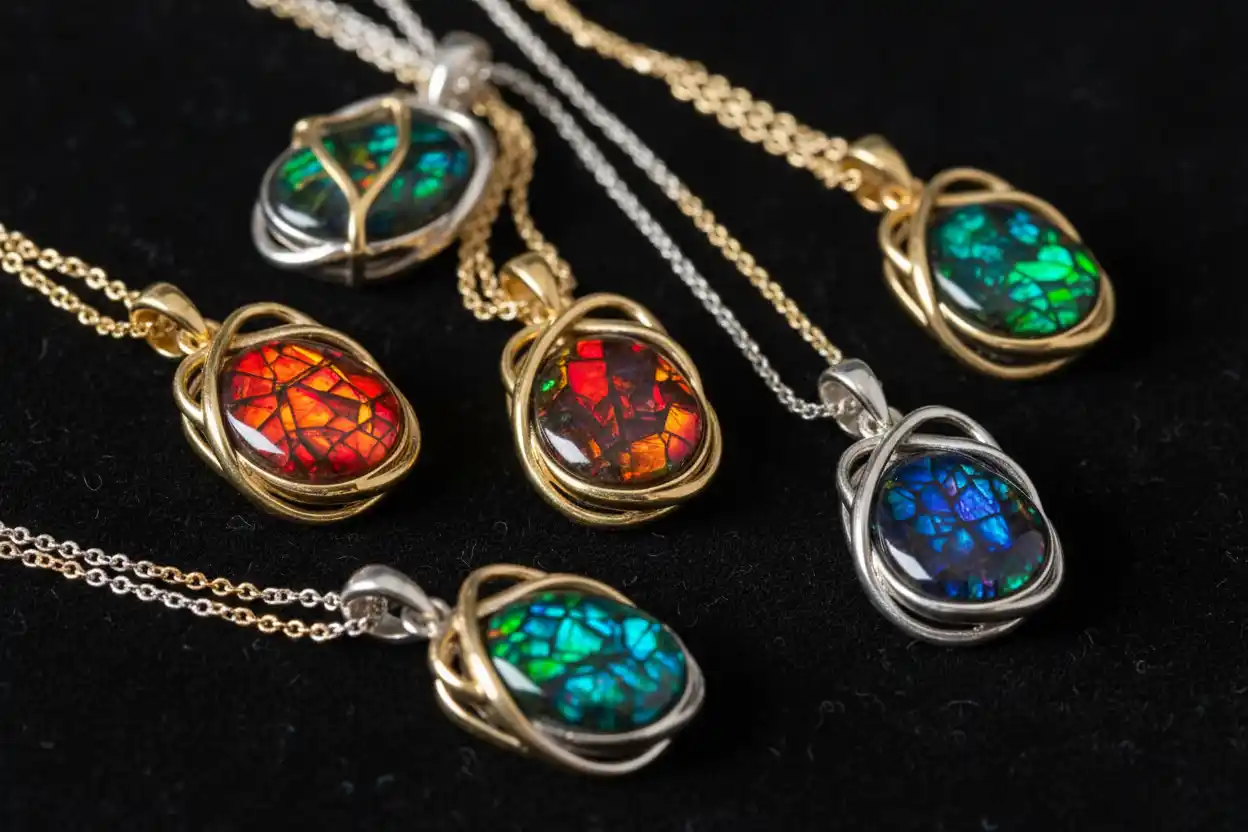
Ammolite Necklace: Styles, Settings & Buying Guide
An ammolite necklace places one of the most visually dynamic fossil-derived gemstones in a jewelry position that suits its delicate structure particularly well, because the upper chest receives far less repeated impact and abrasion than the hands or wrists while normal body movement continuously changes the angle between the gem and the light. That movement matters because ammolite does not display fixed surface color like paint; its microscopic aragonite layers create directional iridescence, allowing red, orange, yellow, green, blue, and violet flashes to appear, disappear, or shift as the pendant moves.
Choosing an ammolite necklace therefore involves considerably more than finding the specimen with the longest list of colors. Ammolite itself is soft, with an exposed surface around 3.5 on the Mohs scale, while the valuable iridescent shell layer can be extremely thin, which is why stabilization, supportive backing, transparent protective caps, recessed bezels, secure bails, appropriate chains, and careful clasp construction can be as important as color quality.
The complete pendant also needs to be evaluated honestly as either solid material, stabilized material, a doublet, a triplet, an inlay, or another disclosed construction. A well-made assembled ammolite necklace can be an excellent jewelry choice and may actually provide more practical surface protection than an exposed solid piece, but buyers should know exactly what they are purchasing rather than assuming every thick-looking cabochon consists entirely of natural fossil shell.
Readers looking for the material’s wider fossil origin, aragonitic structure, patterns, properties, and symbolism can keep that information separate in the ammolite meaning guide. This page focuses specifically on necklace construction, pendant balance, chain length, bails, settings, clasp security, layering, clothing contact, seller disclosure, and the practical decisions that determine whether an ammolite necklace performs well when worn.
Ammolite Necklace at a Glance
| Feature | What necklace buyers should know |
|---|---|
| Material | Iridescent fossil ammonite shell |
| Principal mineral | Aragonite |
| Composition | Primarily calcium carbonate, CaCO₃ |
| Typical colors | Red, orange, yellow, green, blue, and violet |
| Optical effect | Directional structural iridescence |
| Exposed hardness | About 3.5 Mohs |
| Common necklace form | Pendant, drop, halo, inlay, reversible, or station design |
| Common gem construction | Stabilized solid, doublet, or triplet |
| Best protective setting | Smooth, well-fitted bezel or recessed frame |
| Main pendant concern | Edge protection, balance, flipping, and construction disclosure |
| Main bail concern | Strength, opening size, orientation, and secure attachment |
| Main chain concern | Gauge, clasp, end fittings, and compatibility with pendant weight |
| Main wear concern | Scratching, snagging, layer separation, chemicals, and hard impacts |
| Best cleaning approach | Gentle wiping with a soft, barely damp cloth |
| Main buying priority | Bright color plus sound, clearly disclosed construction |
Why Ammolite Works So Well in a Necklace
An ammolite necklace takes advantage of two characteristics that are unusually important for this material: a protected wearing position and continuous changes in viewing angle. Ammolite is much softer than quartz, sapphire, spinel, or many other familiar jewelry gemstones, so moving it away from the hand immediately reduces exposure to desks, tools, door handles, countertops, and other hard surfaces.
The chest is not completely risk-free, because an ammolite necklace can still strike a zipper, metal button, another pendant, desk edge, or hard decorative clothing element, but the overall impact environment is substantially gentler than the one faced by a ring or bracelet.
Movement also improves the gem’s visual performance. Ammolite color is highly directional, so a stationary photograph captures only one part of what the pendant can display. As an ammolite necklace shifts naturally against the body, a section that appears mainly red and green from one angle may reveal orange, yellow, blue, or violet from another.
This is one reason necklace design should account for the natural resting angle of the pendant. A spectacular color flash that appears only when the stone is held horizontally under a lamp has limited value if the pendant hangs vertically and looks dark during ordinary wear.
Ammolite Necklace Construction Matters as Much as Color
Ammolite is not normally cut like a thick transparent gemstone because its iridescent shell structure can be very thin. Cutting deeply into the material would remove rather than enhance the valuable optical layer, so an ammolite necklace frequently uses reinforcement or assembled construction.
The three categories buyers encounter most often are stabilized solid material, doublets, and triplets. These should not be treated as vague quality grades because each describes a different physical construction.
A stabilized solid ammolite necklace can preserve a natural shell section while using polymer impregnation to strengthen vulnerable areas. A doublet places natural ammolite on a supportive backing, while a triplet usually adds both a backing and a transparent protective upper layer.
The broader mechanics of assembled gems are explained in gemstone doublets and triplets, but necklace buyers mainly need to understand how each construction changes scratch resistance, thickness, edge vulnerability, care, repair, and price.
Solid Ammolite Necklaces
A solid ammolite necklace generally uses a piece where the color-bearing shell and supporting natural material remain physically connected rather than being bonded onto an added backing.
“Solid” should not automatically be interpreted as untreated. Polymer stabilization may still be used to reinforce the shell, and natural matrix may remain attached behind the color layer.
Solid material can be highly attractive to collectors because more of the physical fossil structure remains intact, yet it can also expose more delicate ammolite at the surface than a capped triplet.
For a frequently worn ammolite necklace, a solid stone deserves a protective setting that surrounds vulnerable edges without crushing the material. Broad bezels and recessed frames usually make more sense than minimal prongs that leave thin shell edges exposed.
Stabilized Ammolite Necklaces
Stabilization can improve the structural integrity of an ammolite necklace by allowing a transparent polymer to penetrate or reinforce fragile areas. This process can reduce flaking and help natural material survive cutting, setting, and normal decorative wear.
Stabilized material remains fundamentally different from a triplet because there may be no separate transparent cap protecting the exposed upper surface.
That distinction matters in actual use. A stabilized ammolite necklace can still scratch relatively easily if the natural iridescent layer remains exposed, so the pendant should not be allowed to rub continuously against metal chains, harder gemstones, or rough clothing decorations.
The treatment should be disclosed clearly because it affects the gem’s construction and care even when the resulting necklace is attractive and entirely legitimate.
Ammolite Doublet Necklaces
A doublet ammolite necklace usually combines a thin natural ammolite layer with a supportive backing. The backing adds mechanical support, provides a stable platform for setting, and may improve visual contrast behind the bright fossil surface.
A doublet should not be called fake merely because it is assembled. Genuine natural ammolite can still create the visible color.
The important commercial distinction is that the finished gemstone is not one thick solid piece of fossil shell. Buyers should know that before comparing it with solid material or deciding whether the asking price makes sense.
Because a conventional doublet does not necessarily have a hard protective cap over the ammolite, its exposed face can still be scratched. A recessed bezel therefore works particularly well for an ammolite necklace using doublet construction.
Ammolite Triplet Necklaces
A triplet adds a transparent cap above the ammolite layer and backing, giving the fossil material additional protection from direct abrasion. Depending on the manufacturer, the upper layer may be made from quartz, synthetic spinel, glass, or another transparent material.
For a frequently worn ammolite necklace, triplet construction can be highly practical because the cap receives much of the surface contact that would otherwise reach the soft ammolite.
That does not make the complete pendant as uncomplicated as a solid quartz gemstone. Edge impacts can still damage the assembly, adhesives can deteriorate under unsuitable conditions, and gaps between layers may allow moisture or contamination to enter.
Inspect a triplet ammolite necklace from the side whenever possible. The layers should appear neat and stable, without obvious lifting, cloudy adhesive areas, large trapped bubbles, or widening gaps.
Solitaire Ammolite Pendants
A solitaire ammolite necklace concentrates attention on one color-bearing piece and is often the easiest format to evaluate. Oval, rectangular, pear, shield, and freeform shapes are common because cutters frequently follow the strongest section of surviving shell instead of sacrificing valuable color to force standardized proportions.
Freeform does not mean careless. The outline should still look balanced, the polish should be controlled, and the setting should follow the stone without leaving vulnerable unsupported sections.
A good solitaire ammolite necklace should also look convincing while hanging naturally. Examine whether the brightest color faces forward or whether the pendant continually rotates toward a weaker angle.
For a highly directional gemstone, orientation is part of cutting quality.
Bezel-Set Ammolite Necklaces
A bezel is one of the most practical settings for an ammolite necklace because it surrounds the perimeter and protects the thin edges that would otherwise remain exposed.
The metal should sit smoothly around the gemstone without obvious gaps or sharp sections. Excessive pressure is undesirable because ammolite can contain thin layers, backing materials, and adhesive joins that should not be compressed carelessly.
A deeply recessed bezel can provide additional scratch protection by keeping the exposed surface slightly below the surrounding metal.
The trade-off is visibility. Ammolite value is strongly connected to visible surface area, so a very heavy frame that hides a significant portion of the iridescent layer may reduce the visual impact of the ammolite necklace.
The best setting protects the perimeter while leaving enough color exposed to justify the design.
Are Prongs Suitable for Ammolite?
Prongs can hold an ammolite necklace securely when the construction has enough edge strength, but they expose more of the gemstone perimeter than a full bezel.
This exposure matters most with thin solids and doublets, where the color-bearing layer may sit close to an unprotected edge. A forceful side impact can damage shell or assembled layers even if the prongs themselves remain intact.
Triplets with stronger caps may tolerate appropriately engineered prongs more readily, although the underlying assembly still requires consideration.
For an ammolite necklace intended for regular use, a bezel or substantial frame is generally the more forgiving choice.
Halo Ammolite Necklaces
A halo can surround an ammolite with diamonds or other bright accent stones, increasing contrast and apparent size while creating a more formal piece of jewelry.
The design works particularly well when the ammolite has strong multicolor display because small colorless accents provide brightness without adding another dominant hue.
Durability requires careful engineering. Diamond is dramatically harder than exposed ammolite, so the accent settings should prevent the diamond girdles or metal edges from physically contacting the fossil surface.
A halo also increases pendant weight and thickness. When evaluating an ammolite necklace in this style, check whether the bail, chain, and clasp are substantial enough for the complete mounting rather than judging support requirements from the ammolite dimensions alone.
Inlay Ammolite Necklaces
Inlay construction allows cutters to fit thin sections of ammolite into channels or metal recesses, sometimes combining several pieces into geometric, pictorial, or abstract designs.
This format can use smaller areas of high-quality shell that might not support independent cabochons, while the surrounding structure offers useful edge protection.
The weakness is the number of interfaces. More segments mean more seams, adhesive boundaries, and places where poor workmanship can become visible.
A high-quality inlay ammolite necklace should have pieces sitting evenly within the design, with clean boundaries and no lifting corners, obvious excess adhesive, or large uneven gaps.
Because the inlay depends on a rigid foundation, avoid bending, twisting, or dropping the pendant even when the metal backing itself appears substantial.
Reversible Ammolite Necklaces
A reversible ammolite necklace can display ammolite on one side and another gemstone, fossil surface, metal design, or decorative element on the reverse.
The concept can provide excellent versatility, but it changes pendant engineering considerably. A reversible piece needs a bail or swivel mechanism that allows both sides to hang correctly without constantly flipping unintentionally.
It may also become thicker and heavier than a conventional pendant.
If both sides contain delicate materials, neither surface should repeatedly rub against a chain or hard clothing element. The design should provide enough separation to protect whichever face is turned inward.
Station Ammolite Necklaces
A station ammolite necklace distributes several small pieces along a chain instead of using one central pendant. This format can create repeated flashes of color across the neckline and may use small high-quality pieces efficiently.
The major challenge is orientation.
Each station should face forward naturally rather than twisting so that backing layers or metal undersides dominate the view. Fixed stations need balanced attachment points, while articulated stations require enough movement to settle properly.
If several pieces are used, color matching becomes another quality consideration. They do not need to be identical, but the overall distribution should look intentional.
A coordinated transition from red-green to blue-green can be beautiful, while random differences in brightness may make the ammolite necklace look inconsistent.
Color Range in an Ammolite Necklace
Ammolite can display red, orange, yellow, green, blue, and violet, but more colors do not automatically make a better ammolite necklace.
Brightness is fundamental. A vivid red-green piece can outperform a dull multicolor stone whose additional hues are visible only under ideal lighting.
Blue and violet are less common and can increase desirability when they appear strongly across a useful area, yet rarity should not be separated from visibility. A tiny dark blue corner is not necessarily more appealing than a large bright green field.
When choosing an ammolite necklace, rotate the pendant slowly through the angle it will actually move while worn. Notice how long the strongest colors remain visible and how rapidly the surface goes dark.
Viewing Angle Is a Necklace-Specific Quality Factor
Directional color matters particularly in an ammolite necklace because the pendant has a predictable resting orientation against the body.
A loose stone might display spectacular color when held almost flat beneath a light source, but that orientation may never occur once the gem is mounted vertically.
The strongest ammolite necklace designs account for this during cutting and setting. The pendant’s best optical display should appear near its natural face-forward position.
When shopping remotely, a rotating video of the actual necklace provides far more information than one highly controlled still image.
Look for whether the colors remain bright while the pendant passes through realistic angles rather than judging only the most dramatic frame.
Ammolite Patterns in Necklaces
Ammolite patterns range from broad uninterrupted sheet color to fractured mosaics separated by darker boundaries. Trade descriptions may compare these structures with stained glass, dragon skin, cobblestones, brush strokes, ribbons, or other familiar patterns.
These names are descriptive rather than standardized mineral grades.
Sheet material can create an elegant ammolite necklace because the pendant presents one broad field of strong color without visual interruption. Fractured material creates a more graphic surface where individual color sections form a mosaic.
Neither is universally superior.
A high-quality pattern should complement the pendant shape and remain bright enough that structural interest does not overwhelm the actual iridescence.
The types of ammolite guide provides a deeper comparison of these pattern and color categories.
Pendant Size: Use Millimeters, Not Just Carats
Carat weight can be misleading when evaluating an ammolite necklace because assembled stones contain material other than natural ammolite.
A thick backing or transparent cap adds mass without increasing the visible fossil-shell area. Two triplets with similar face-up dimensions can therefore have noticeably different weights.
Ask for the visible stone width and height, total pendant dimensions, thickness, and complete jewelry weight.
A close-up photograph can make a small ammolite necklace look enormous, particularly when there is no neck, hand, ruler, or other reference for scale.
Millimeter dimensions tell you far more about how the pendant will actually appear when worn.
Choosing Ammolite Necklace Length
Chain length determines where an ammolite necklace rests, how much light reaches the gemstone, whether the pendant contacts clothing hardware, and how easily it layers with other jewelry.
| Approximate chain length | Typical position | Often suits |
|---|---|---|
| 14–16 inches | High neck or collarbone | Small protected pendants |
| 18 inches | Around the collarbone | Versatile solitaire styles |
| 20 inches | Upper chest | Medium pendants and halos |
| 22–24 inches | Lower on the chest | Larger freeforms and statement pieces |
| Adjustable | Variable | Gifting and neckline flexibility |
Actual placement varies with neck circumference, body proportions, pendant height, and clothing, so measurements are more reliable than style names alone.
A large ammolite necklace often benefits from enough chain length to hang freely rather than pressing tightly against the throat, while a smaller bright pendant may remain most visible near the collarbone.
Pendant Drop and Overall Proportion
Chain length and pendant drop are different measurements. A 20-inch chain carrying a 50 mm pendant finishes much lower on the body than a 20-inch chain carrying a small 15 mm stone.
This matters because longer ammolite necklace designs can begin interacting with zippers, desk edges, buttons, belts, or layered jewelry.
Check the entire pendant from the top of the bail to its lowest point rather than relying only on the stone dimensions.
Proportion also influences stability. A long narrow pendant can swing or twist more readily than a broad flat design, while a thick triplet in a heavy frame may remain stable but place more load on the chain.
Bail Construction
The bail is one of the smallest parts of an ammolite necklace but one of the most important because it carries the entire pendant.
A fixed bail should connect securely to the frame without visible distortion, while an articulated bail should move smoothly without excessive side play.
The opening also needs enough clearance for the chain and its end fitting. A chain may physically fit through the bail while its clasp does not, leaving the pendant permanently attached unless the chain is disassembled.
Large pendants deserve proportionally substantial bails. A tiny decorative loop may look delicate but can become a mechanical weak point beneath a heavy bezel, triplet cap, backing, or halo.
Chain Strength and Gauge
The correct chain for an ammolite necklace depends on the complete finished pendant weight, not on the thin fossil layer alone.
Cable, box, wheat, curb, and similar chain constructions can all work when their gauge and metal quality suit the design. A very fine chain may be visually elegant with a small pendant but look structurally inadequate beneath a large framed piece.
The chain should also move smoothly through an articulated bail without sawing repeatedly against one narrow edge.
For expensive ammolite necklace designs, inspect the links closest to the clasp and bail because these connections often experience the most concentrated movement.
Clasps and End Connections
A strong chain can still fail as a necklace system if the clasp or connecting rings are weak.
Lobster clasps provide a positive mechanical closure and suit many fine ammolite necklace designs. Spring rings can work well on lighter chains, while more substantial box-style clasps may suit larger or more elaborate pieces.
Magnetic clasps are convenient but can release under sudden pulling force, which deserves consideration when the pendant is valuable or difficult to replace.
Inspect jump rings as carefully as the clasp itself. An open connecting ring can spread when snagged even when the main clasp continues functioning perfectly.
Metal Choices
Yellow gold can complement ammolite dominated by red, orange, yellow, and green, while white gold, platinum, and silver create cooler contrast that may emphasize blue or violet sections.
Rose-toned metal works particularly well with red-dominant material, although it can visually merge with some orange areas instead of separating them.
The metal does not create or increase ammolite’s spectral colors. It simply changes the visual frame surrounding them.
For buyers with metal sensitivity, verify the chain, clasp, bail, and setting alloy rather than checking only the decorative frame. Different parts of an ammolite necklace may use different alloys or plating.
Layering an Ammolite Necklace
Layering can be attractive, but ammolite requires more separation than many harder gemstones because direct contact with another pendant or textured chain can scratch exposed material.
Choose different chain lengths so the pieces occupy separate vertical zones rather than repeatedly colliding.
Avoid placing diamond-edged pendants, rough metal charms, faceted quartz, sapphire, or other hard materials directly against uncapped ammolite.
A triplet cap improves surface resistance, but the perimeter, backing, metal setting, and assembled joins can still be damaged by repeated impact.
For an expensive ammolite necklace, wearing the piece alone is often the simplest way to preserve both the gemstone and its visual prominence.
Clothing Contact
Clothing can create more abrasion than necklace buyers expect.
A smooth shirt or dress provides a relatively gentle background, whereas zippers, sequins, metallic embroidery, beads, hard buttons, heavily textured fabric, and rough decorative stitching can repeatedly strike an ammolite necklace as the wearer moves.
Long pendants face greater exposure because they travel across a wider portion of the torso.
Before choosing a chain length, consider what clothing the ammolite necklace will normally accompany. A large pendant intended for smooth formal clothing may perform differently from the same piece worn over a heavily embellished garment.
Buying an Ammolite Necklace Online
Remote buying requires more than one saturated front-facing image. Request photographs of the actual pendant from the front, back, and side, plus a rotating video showing how the color changes in neutral lighting.
The side view can reveal doublet or triplet construction, setting depth, cap thickness, backing, bail orientation, and potential gaps between components.
The back view helps reveal whether the setting is open, whether natural matrix remains attached, and whether the seller has hidden the construction behind a completely closed plate.
The broader guide to buying gemstones online explains seller identity, return terms, documentation, and photography checks that become particularly important when an ammolite necklace is expensive.
What the Seller Should Disclose
Before purchasing an ammolite necklace, obtain clear information about whether the gemstone is solid, stabilized, a doublet, a triplet, or an inlay.
If it is assembled, ask what materials form the backing and transparent cap when known. Repairs, stabilization, coatings, or other relevant treatment should also be disclosed.
Then check the jewelry details: metal composition, pendant dimensions, complete necklace length, chain gauge, clasp type, finished weight, and whether the pendant can be removed from the chain.
The broader ammolite buying guide covers gemstone quality in greater depth, but necklace-specific construction should never be treated as secondary.
Ammolite Necklace Price and Value
An ammolite necklace cannot be valued accurately through carat weight alone because the visible gem may be assembled and the finished piece includes metal, setting labor, chain, clasp, accent stones, craftsmanship, and retailer margin.
Brightness, color range, useful viewing angle, blue or violet content, pattern quality, visible surface area, construction, condition, and workmanship all affect value.
Solid material can attract a collector premium, while a high-quality triplet may provide a better practical choice for someone who intends to wear the ammolite necklace regularly.
The dedicated ammolite price guide separates material value from the costs built into finished jewelry.
Do not pay a premium merely because a seller uses vague terms such as “museum grade,” “investment grade,” or “healing grade.” Those phrases do not replace clear information about color, construction, condition, origin, and workmanship.
Does an Ammolite Necklace Need a Laboratory Report?
Most modestly priced ammolite necklace purchases do not require expensive laboratory documentation, particularly when the construction is obvious, the seller provides clear disclosure, and the return policy is strong.
Independent identification becomes more useful when an expensive piece is represented as unusual solid material, when natural construction is difficult to inspect because of a closed setting, when significant repairs are disputed, or when provenance contributes materially to the price.
A report should also be distinguished from an appraisal. The gemstone certification guide explains why identifying construction and treatment is different from assigning a monetary value.
Comparing Ammolite Necklaces and Earrings
Necklaces and earrings are both comparatively low-impact formats for ammolite, but their construction priorities differ substantially.
An ammolite earrings pair requires close matching across two stones, suitable total weight, dependable posts or hooks, secure backs, and consideration of hair and cosmetics.
An ammolite necklace instead requires chain length, pendant drop, bail strength, clasp security, resistance to flipping, appropriate chain gauge, clothing compatibility, and careful layering.
This is why jewelry advice should remain form-specific. An excellent matched pair of studs provides no evidence that a large pendant has a secure bail, and a perfectly built necklace clasp says nothing about earring-back reliability.
How Durable Is an Ammolite Necklace?
An ammolite necklace is more practical than an ammolite ring for many wearers because the chest provides lower impact exposure, but the material remains soft and layered.
The gemstone hardness chart helps place its approximately 3.5 Mohs surface hardness in context. Many common jewelry materials can scratch exposed ammolite.
Hardness still does not describe every failure mechanism. Layer separation, edge chipping, fractures, cap damage, adhesive deterioration, and metal-setting failure may occur even when the color-bearing surface has not been scratched.
The distinction between abrasion and structural damage is explored more broadly in gemstone toughness versus hardness.
Perfume, Cosmetics, and Personal-Care Products
An ammolite necklace sits near areas where perfume, sunscreen, lotion, body sprays, cosmetics, and hair products may be applied, so the order of dressing matters.
Apply these products first and allow them to dry before putting on the necklace. This reduces repeated exposure to the fossil surface, polymer stabilization, adhesives, cap boundaries, and metal components.
Residue can also dull the visible iridescence without permanently changing the structural color, which may tempt an owner to clean too aggressively.
Avoid alcohol, acetone, household solvents, jewelry dips, acids, and harsh chemical cleaners.
How to Clean an Ammolite Necklace
Routine cleaning should be conservative. Use a clean, soft, non-abrasive cloth that is dry or only slightly damp, wipe the surface gently, and dry the ammolite necklace promptly.
Do not soak the pendant.
Prolonged moisture can reach vulnerable edges, adhesive layers, backing materials, stabilization, or metal components, particularly when an older assembly already contains a tiny gap.
Ultrasonic and steam cleaners are unsuitable because vibration, heat, and liquid exposure create unnecessary risk for layered or assembled construction.
The complete procedure is covered in how to clean ammolite jewelry.
Storing an Ammolite Necklace
Store an ammolite necklace separately in a soft pouch or padded compartment, with the chain arranged so it cannot rub across the visible gemstone surface.
Do not place harder gemstones or sharp metal components directly against the pendant. Quartz, topaz, sapphire, ruby, diamond, and many other materials can scratch uncapped ammolite.
Even a triplet should be protected from careless storage because its perimeter, transparent cap, metal frame, and assembled interfaces can still be damaged.
Long chains should be laid loosely rather than compressed into a tight tangle around the pendant.
Can an Ammolite Necklace Be Worn Regularly?
Yes, particularly when the ammolite necklace uses a protective bezel and a sound triplet or other durable construction. The necklace position itself reduces much of the impact that would make the same material difficult in hand jewelry.
Regular wear still requires selective removal.
Take the necklace off before swimming, showering, strenuous exercise, household cleaning, salon procedures, or activities involving significant chemicals, heat, abrasion, or impact.
Ammolite should be treated as a beautiful but relatively delicate gem material rather than as something that becomes invulnerable merely because it has been stabilized or capped.
Ammolite Necklace Meaning and Symbolism
Some people choose an ammolite necklace for symbolism as well as appearance, particularly because fossil preservation and shifting colors lend themselves naturally to themes of transformation, continuity, adaptation, perspective, and renewal.
A pendant can serve as a visible reminder of a transition, a change in perspective, or the idea of preserving what remains valuable while adapting to new circumstances.
These interpretations belong to symbolic and spiritual traditions rather than medical science. An ammolite necklace has not been established as a treatment for disease, pain, anxiety, circulation problems, or another health condition, and wearing the gemstone does not guarantee financial prosperity or another external result.
The fossil’s natural history and optical behavior already provide enough distinctive meaning without unsupported therapeutic claims.
FAQs About Ammolite Necklaces
Is an ammolite necklace suitable for regular wear?
Yes. The necklace position exposes ammolite to less impact and abrasion than rings or bracelets, making it one of the more practical jewelry forms for the material when the stone is protected appropriately.
What is the best construction for an ammolite necklace?
A well-made triplet is particularly practical for frequent wear because its transparent upper cap protects the soft ammolite surface. Stabilized solids and doublets can also make excellent pendants when their edges are protected.
Is an ammolite triplet fake?
No. A triplet can contain genuine natural ammolite between a supporting backing and a transparent protective cap. It is an assembled gemstone and should be disclosed as such.
Is an ammolite doublet real?
A doublet can contain genuine natural ammolite attached to a supporting backing. The natural color layer is real, but the complete gem is assembled rather than one solid piece.
What setting is safest for an ammolite necklace?
A smooth bezel or recessed frame usually provides strong edge protection while reducing snagging. The setting should secure the gem without hiding an excessive amount of the iridescent surface.
Which ammolite colors are most valuable?
Blue and violet are generally less common than red and green, but brightness, visible area, viewing angle, pattern, and construction also matter. A vivid red-green ammolite necklace can be more desirable than a dull stone containing a small blue patch.
Why does an ammolite necklace change color?
The gem’s microscopic aragonite layers produce structural iridescence, so the wavelengths reflected toward the viewer change as the angle between the surface, light, and observer changes.
What chain length works best?
There is no universal best length. A smaller pendant often works well near the collarbone, while larger ammolite necklace designs may hang more naturally farther down the chest. Neck circumference and complete pendant drop should guide the choice.
Why does my ammolite pendant flip over?
Flipping can result from an off-center bail, excessive setting depth, uneven weight distribution, chain interaction, or the pendant’s center of gravity sitting too far from the body.
Can ammolite be worn on a thin chain?
A small lightweight ammolite necklace can use a fine chain, but the chain must support the complete pendant, including metal frame, backing, cap, halo, and other components rather than the fossil layer alone.
Can I layer an ammolite necklace?
Yes, but separate the necklace from harder gemstones and rough metal pendants. Different chain lengths help prevent direct contact and repeated scratching.
Can an ammolite necklace get wet?
Brief contact with a slightly damp cleaning cloth is preferable to soaking. Prolonged moisture may affect adhesives, stabilization, backing, cap interfaces, and jewelry components.
Can I shower with an ammolite necklace?
Removing it is safer. Showering exposes the necklace unnecessarily to water, soap, shampoo, heat, and repeated handling around slippery surfaces.
Can an ammolite necklace go in an ultrasonic cleaner?
No. Ultrasonic vibration is inappropriate for delicate layered or assembled ammolite and can threaten adhesive joins or structural integrity.
Can perfume damage ammolite?
Repeated chemical exposure can affect exposed ammolite, stabilizers, adhesives, caps, or metal. Apply perfume and cosmetics before putting on the necklace and allow them to dry.
Does carat weight determine ammolite necklace value?
Not reliably. Doublets and triplets include backing and cap materials, so visible surface dimensions, brightness, color, pattern, construction, and workmanship are more useful than weight alone.
What should I ask before buying an ammolite necklace?
Ask whether the gem is solid, stabilized, a doublet, or a triplet; request complete pendant and chain dimensions; verify metal and clasp construction; inspect rotating video of the actual stone; and obtain clear disclosure of treatment, repairs, and assembled components.
How should I store an ammolite necklace?
Place it separately in a soft padded compartment or pouch, keeping the chain and harder jewelry away from the visible ammolite surface and vulnerable edges.
Choosing an Ammolite Necklace That Protects the Color
A strong ammolite necklace succeeds by treating the fossil material according to what it actually is: a thin, soft, structurally colored shell layer whose visual impact comes from light interacting with microscopic aragonite structures. That makes brightness and color important, but it also makes stabilization, backing, protective caps, edge support, bail strength, chain gauge, clasp reliability, pendant orientation, and care central to the quality of the finished jewelry.
Begin with the construction, then judge the visible color while the pendant moves through realistic angles. After that, inspect the setting, bail, chain, clasp, dimensions, complete pendant drop, and seller disclosure rather than allowing one dramatic photograph to make the decision.
When those elements work together, an ammolite necklace can display the gemstone in one of its most practical and visually effective forms. The chest protects the material from much of the abrasion encountered by hand jewelry, while natural movement keeps the directional reds, greens, blues, yellows, oranges, and violets alive, allowing the fossil shell’s optical behavior—not generic jewelry styling—to remain the defining feature of the piece.