Ammolite Earrings: Styles, Quality & Buying Guide
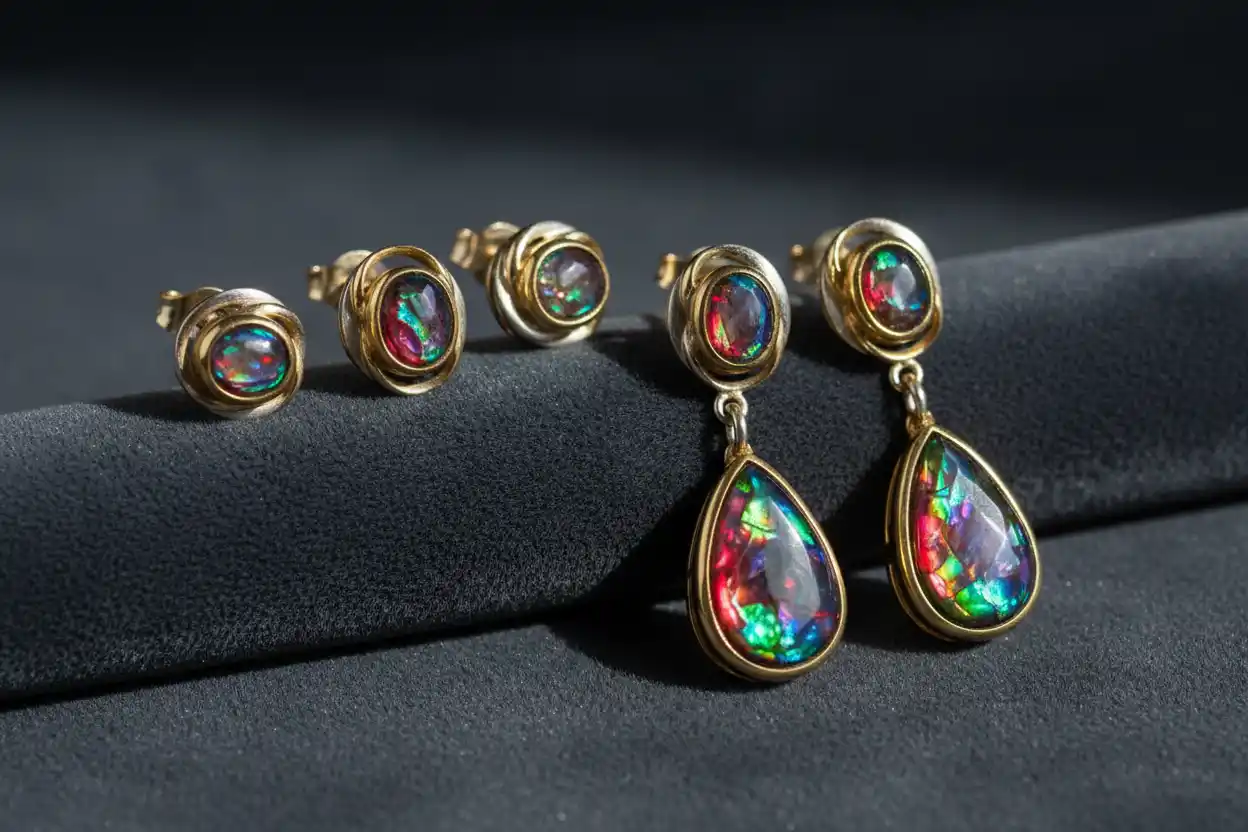
Ammolite earrings place one of the most visually dynamic organic gemstones in a jewelry position that suits its delicate structure unusually well, because the ears encounter much less repeated impact and abrasion than the hands or wrists while still allowing the material to move through changing angles of light. Fine ammolite can flash red, orange, yellow, green, blue, and violet across very thin fossil-shell layers, so even compact studs or modest drops can create stronger visual presence than their dimensions suggest.
The same structure that produces that color also makes ammolite earrings different from ordinary quartz, sapphire, or garnet earrings. Ammolite is fashioned from iridescent fossil ammonite shell composed principally of aragonite, its color-bearing layers can be extremely thin, and the exposed material is only about 3.5 on the Mohs scale; consequently, stabilization, backing layers, transparent caps, protective bezels, secure findings, and accurate seller disclosure matter far more than they would for a hard solid gemstone.
Choosing ammolite earrings therefore requires evaluating the pair as complete pieces of jewelry rather than judging only the brightest photograph. Color must match across two stones and across useful viewing angles, assembled construction needs to be disclosed, posts and backs must support the complete earring, drops require secure hinges and connecting rings, and every component should protect the iridescent surface from scratching, chemicals, heat, and accidental separation.
Readers who want the fossil material’s broader geology, formation, symbolism, and identification can keep that background separate in the ammolite meaning guide, while this page concentrates specifically on ammolite earrings, pair matching, construction, wearability, hardware, buying decisions, and care.
Ammolite Earrings at a Glance
| Feature | What buyers should know |
|---|---|
| Material | Iridescent fossil ammonite shell |
| Principal mineral | Aragonite |
| Composition | Primarily calcium carbonate, CaCO₃ |
| Typical appearance | Directional iridescent red, orange, yellow, green, blue, and violet |
| Mohs hardness | About 3.5 for exposed ammolite |
| Main jewelry advantage | Ear placement reduces abrasion and impact |
| Common forms | Studs, bezel studs, drops, dangles, halos, inlays, and clusters |
| Common construction | Stabilized solid, doublet, or triplet |
| Pair-matching priority | Color, brightness, pattern, orientation, dimensions, and viewing angle |
| Stud concern | Post strength, back size, edge protection, and forward tilt |
| Drop concern | Weight, hinges, jump rings, hooks, and movement |
| Main care risks | Scratching, heat, chemicals, moisture, adhesive failure, and layer separation |
| Best cleaning approach | Soft, barely damp non-abrasive cloth |
| Seller-disclosure priority | Solid vs stabilized vs doublet vs triplet construction |
What Makes Ammolite Different in Earrings?
Ammolite earrings are unusual because the visible gemstone surface is not a thick transparent crystal. The valuable color exists in very thin layers of fossil shell, and light interacting with those microscopic aragonite structures creates the shifting iridescence for which ammolite is known.
That distinction changes almost every jewelry decision.
A thick quartz cabochon can tolerate moderate repolishing if its surface becomes worn, whereas polishing too aggressively through a thin ammolite layer can permanently remove the very structure producing the color. An ordinary gemstone setting may simply hold a solid crystal, while many ammolite earrings contain a backing, stabilizing polymer, transparent protective cap, or combination of these elements.
The complete range of natural and assembled constructions is explained in types of ammolite. When buying ammolite earrings, however, the most important question is not which construction sounds most prestigious; it is whether the seller tells you exactly what the earrings contain and whether that construction suits the intended wear.
Why Earrings Are One of the Best Formats for Ammolite
Ammolite earrings keep the gemstone away from most desks, door handles, countertops, tools, and other hard surfaces that repeatedly threaten rings and bracelets. This reduced exposure makes earrings one of the more practical ways to wear a material whose unprotected surface scratches relatively easily.
Movement also benefits the optics. Ammolite color is directional, which means a slight change in viewing angle can alter the visible mix of red, green, blue, yellow, or violet. Drops and dangles naturally rotate as the wearer moves, while studs shift slightly with the head, allowing ammolite earrings to reveal different colors without requiring the wearer to manipulate them deliberately.
That combination—lower impact plus continuous angular movement—is particularly well suited to ammolite.
Earrings still have characteristic risks. Hair can catch settings, perfume and hairspray can contact the surface, dropped earrings can strike hard floors, and poor posts, hooks, backs, or jump rings can cause loss even when the ammolite itself remains intact.
Ammolite Stud Earrings
Studs are among the most protective ammolite earrings because they remain close to the lobe and move relatively little. A low bezel can surround vulnerable edges, support a doublet or triplet securely, and reduce the chance that hair or clothing catches the gemstone.
Round and oval studs create a conventional matched appearance, while freeform studs can preserve particularly attractive sections of natural color. Symmetrical shapes make differences between the pair easier to notice, so matching becomes especially important when the design is intended to look formal or balanced.
Large ammolite earrings need more than a thin post and tiny butterfly back simply because the visible fossil layer itself is lightweight. The mounting, backing, protective cap, bezel, halo, and accent stones may add enough total weight to pull the stud forward.
A wider friction back or other stabilizing back can distribute that weight across more of the lobe and keep the color-bearing face positioned properly.
Bezel vs Prong Settings
Bezel settings are particularly useful for ammolite earrings because the metal surrounds most of the gemstone perimeter, protecting thin edges and supporting assembled constructions. A well-fitted bezel should secure the piece without creating concentrated pressure or covering an excessive portion of the visible color.
Prongs expose more of the edge and may make the gemstone appear slightly larger, but the trade-off is increased vulnerability. A thin solid or doublet with exposed sides can be chipped, scratched, or separated more easily than the same material protected by a smooth frame.
For ammolite earrings intended for frequent wear, protection generally deserves more weight than maximum edge visibility.
This is especially true when blue or violet color appears near a thin outer area. Those shorter-wavelength color structures can occur in particularly delicate layers, so exposing a beautiful blue edge purely for visual effect may create unnecessary risk.
Ammolite Drop Earrings
Drop ammolite earrings make excellent use of directional iridescence because every step, turn, and movement can change the angle at which light meets the fossil surface. A pair that appears mostly red and green from the front may flash yellow or blue as the drops swing.
Mechanical construction becomes more important as movement increases. Inspect the ring or hinge joining the drop to the upper finding, then check whether the connection has enough strength for the complete earring rather than merely the ammolite insert.
A thin open jump ring beneath a heavy gold or silver frame can become the weakest point in otherwise excellent jewelry.
Leverbacks are particularly practical for valuable drop ammolite earrings because the wire closes behind the lobe, reducing the risk of the earring slipping out during movement. Open hooks can still be appropriate, although small stoppers add useful security.
Dangle Length and Total Weight
Long ammolite earrings can remain visually light because the color-bearing material itself is thin, but total finished weight may be dominated by metal frames, protective caps, diamonds, chains, beads, or other components.
Ask for complete earring weight when considering substantial drops. Gemstone dimensions alone do not reveal whether the pair will remain comfortable for several hours.
Length changes leverage as well. A long dangle moves through a wider arc and can catch hair, scarves, high collars, or embellished clothing more readily than a compact drop.
For regular wear, ammolite earrings should move enough to display iridescence without swinging so widely that they repeatedly hit the neck, jawline, clothing hardware, or one another.
Doublet Ammolite Earrings
A doublet generally combines a thin natural ammolite layer with a supportive backing. The backing reinforces the delicate shell, may make the piece easier to set, and can strengthen visual contrast behind the iridescent surface.
A doublet is not automatically fake ammolite.
The natural color layer can be genuine fossil material while the finished gemstone remains an assembled product. What matters is disclosure: ammolite earrings containing doublets should be described clearly as doublets rather than presented in a way that implies each visible stone is one thick solid piece of natural shell.
The broader terminology is explained in the guide to gemstone doublets and triplets.
For earrings, doublets can be highly practical because the ear position reduces surface abrasion while the backing strengthens the thin gem layer.
Triplet Ammolite Earrings
A triplet adds a transparent protective cap above the natural ammolite layer and supporting backing. The cap can be made from a clear durable material, providing significantly more scratch protection than an exposed ammolite surface.
This makes triplets especially useful in ammolite earrings intended for frequent wear, although the complete stone is still assembled and should be sold as such.
The cap does not make ammolite indestructible. Edge impacts can chip the upper layer, adhesives can deteriorate under unsuitable heat or chemicals, and moisture can become problematic if an existing gap allows it to reach the interfaces between components.
Inspect triplets from the side whenever possible. Clear layer boundaries are not necessarily defects; they may simply reveal the construction that the seller should already have disclosed.
Stabilized Solid Ammolite
Some ammolite is reinforced through polymer impregnation without adding a separate backing or transparent upper cap. This type of material may still be sold as a stabilized solid because the stone is not built as a multi-layer doublet or triplet.
Stabilization can improve structural integrity, but the exposed ammolite surface remains much softer than a hard protective triplet cap.
For stabilized solid ammolite earrings, smooth bezels and low profiles make particular sense. Avoid settings where the fossil layer projects beyond the metal or where a sharp prong contacts a very thin edge.
Treatment disclosure matters because stabilization changes the material’s construction, care requirements, and commercial category even when the visible ammolite itself remains natural.
Pair Matching Is More Complicated Than Matching Color Names
Pair matching is one of the most important quality factors in ammolite earrings because the colors are directional rather than fixed like paint.
Two stones may both contain red, green, and blue yet look poorly matched when worn. One may display its blue face-on while the other reveals blue only at a steep side angle; one may be intensely bright while the other looks dark; one may have broad sheet color while the other has a fine fractured mosaic.
For symmetrical ammolite earrings, evaluate both stones together while rotating them through the same angles. Their strongest displays should occur within a reasonably similar range rather than requiring one earring to be tilted differently from the other.
Perfect duplication is rarely necessary. Natural fossil shell varies, and slight differences often emphasize authenticity and individuality.
The goal is coordination rather than photographic cloning.
Brightness Matters More Than Maximum Color Count
Ammolite earrings showing many spectral colors often attract attention, but the number of colors should not be evaluated independently from brightness.
A brilliant red-and-green pair can be more impressive than a dull pair technically containing red, orange, yellow, green, and blue. Weak colors that appear only under intense light or at extreme angles should not automatically justify a large premium.
Rotate ammolite earrings slowly under neutral lighting and notice whether the color remains visible through a practical range.
The best pair generally displays strong color while facing forward and continues to reveal useful flashes as the head moves. If the color disappears almost completely whenever the earrings are viewed normally, the pair may be less satisfying in actual wear than the seller’s close-up photography suggests.
Red, Green, Blue, and Violet Ammolite
Red and green are among the more frequently encountered strong colors in ammolite, while blue and violet areas are generally less common. A pair containing bright blue or violet can therefore attract stronger collector or jewelry interest, particularly when those colors appear at useful viewing angles.
Rarity alone should not override visual quality.
A tiny dull blue patch does not automatically make ammolite earrings superior to a vivid red-green pair with broad brightness, attractive pattern, and stronger matching.
Color should be evaluated as a combination of range, saturation, brightness, area, and directional behavior. The dedicated ammolite price guide addresses how those characteristics affect commercial value without reducing the decision to one rare-color label.
Pattern Types in Ammolite Earrings
Ammolite can show broad uninterrupted sheet color or fractured patterns divided by darker boundaries, and both can make excellent earrings when the pair is coordinated thoughtfully.
Sheet material can create large smooth flashes that look particularly elegant in minimalist bezel studs or elongated drops. Fractured material may resemble stained glass, scales, mosaic tiles, or irregular networks, adding more visible texture within a small surface area.
Pattern names used in the trade often describe appearance rather than separate gem varieties.
When buying ammolite earrings, judge whether both stones belong to the same visual language. A finely fractured mosaic paired with a nearly uninterrupted sheet may look mismatched unless the asymmetry is clearly intentional.
Round, Oval, Rectangular, and Freeform Shapes
Round and oval ammolite earrings are easy to coordinate and work particularly well as studs because their outlines do not create fragile points. Rectangular pieces can showcase sheet material effectively and produce a modern geometric look, especially when mounted in narrow bezels.
Pear shapes and elongated freeforms can create excellent drops because movement emphasizes the length and changing color, although narrow tips deserve good metal protection.
Freeform ammolite earrings make sense when the cutter has preserved a particularly strong patch of color rather than sacrificing valuable shell simply to force both stones into standard calibrated shapes.
For asymmetrical designs, repeated metal details, similar total scale, or related color can provide enough unity even when the fossil pieces are not identical.
Why Carat Weight Is Misleading
Carat weight is less useful for ammolite earrings than it is for many solid transparent gemstones because assembled stones may contain backing material, transparent caps, adhesive, and other components.
Two ammolite triplets with identical visible face-up dimensions can weigh differently because their caps or backing layers differ in thickness.
Millimeter dimensions therefore communicate visible size more effectively.
Ask for the width and height of each stone, the complete earring dimensions, and the total finished weight. This makes it much easier to understand how large ammolite earrings will look and how comfortable they may feel.
Close-up photography without scale can make a modest stud appear enormous.
Posts and Backs
The post should emerge from the mounting in a position that allows the ammolite face to sit squarely rather than drooping downward. On larger studs, centrally balanced post placement is especially important because the metal frame and assembled gemstone may carry more weight than the fossil layer suggests.
Friction backs work well for many small ammolite earrings when they grip the post properly. Wider stabilizing backs can help support larger studs and reduce forward tilt.
Screw backs provide additional mechanical security but require more time to put on and remove. Locking backs can also work well for valuable earrings when their release mechanism remains clean and functional.
Whatever style is used, check the actual posts and backs rather than assuming a premium gemstone automatically comes with premium hardware.
Hooks, Leverbacks, and Hinges
Open hooks offer a light, simple appearance for ammolite earrings, although the absence of a closed mechanism increases dependence on gravity. Small stoppers can reduce the chance of accidental loss.
Leverbacks are a strong choice for drops because the finding closes behind the ear and usually keeps the gemstone secure even when the earring swings.
The hinge should move smoothly without large side-to-side looseness, and the closing wire should align cleanly with the latch.
A clasp that requires force to close may be misaligned. Repeated bending can fatigue the metal and eventually create a failure point.
Metal Choices
Yellow gold complements red, orange, yellow, and green ammolite especially well, producing a warm appearance that can echo the gemstone’s fire-like colors. White gold, silver, or platinum can create stronger contrast and may emphasize blue or violet sections.
Rose-toned metal can work beautifully with red-dominant ammolite earrings, although strong orange areas may blend more closely with the metal than they would against white gold or silver.
Metal choice does not change the actual structural colors inside ammolite. Reflections from the mounting can influence the way small areas appear, but metal cannot create blue or green where those wavelengths are absent from the shell.
If metal sensitivity is relevant, verify the composition of the post and back specifically because those parts maintain direct contact with the piercing.
Halo Ammolite Earrings
Halo designs surround ammolite with smaller accent stones, often increasing apparent size and creating strong contrast. A bright colorless halo can emphasize ammolite’s spectral appearance, but the additional metal and stones increase total earring weight.
Setting height becomes another consideration. A tall halo may catch hair or clothing more readily than a low-profile bezel stud.
Cleaning access also becomes more complicated because cosmetic residue can collect around the numerous small settings.
A halo should enhance ammolite earrings without making the delicate center difficult to protect. If the design exposes the fossil edges substantially simply to create a lighter-looking setting, the trade-off may not be worthwhile for frequent wear.
Inlay Ammolite Earrings
Inlay designs fit thin pieces of ammolite into channels or metal recesses, creating smooth geometric surfaces that can display several color patches while keeping the fossil material relatively low.
This construction can protect exposed edges effectively when the pieces are fitted precisely.
The primary concern is the number of seams. Multiple inlaid sections mean more interfaces between ammolite, adhesive, backing, and metal, so prolonged moisture, heat, or chemical exposure should be avoided.
Inspect inlay ammolite earrings for gaps, lifting corners, cloudy adhesive boundaries, or pieces that no longer sit flush with the surrounding metal.
Matching Ammolite Earrings With a Necklace
An ammolite necklace does not need to duplicate the earrings exactly. Coordinating through one dominant color, pattern family, or metal usually creates a more natural combination than attempting to reproduce every iridescent flash.
If the earrings are highly multicolored, a pendant dominated by one of their stronger colors can provide visual continuity without looking overly matched.
The dedicated ammolite necklace guide addresses chain length, pendant drop, bails, flipping, layering, and other necklace-specific issues separately.
When both pieces are worn together, make sure a high collar, hard decorative bead, or metal embellishment does not repeatedly strike the ammolite earrings as the wearer moves.
Durability of Ammolite Earrings
Exposed ammolite is soft, approximately Mohs 3.5, and can be scratched by many common jewelry materials and abrasive particles. That low hardness is one reason earrings are preferable to more impact-prone jewelry forms.
The gemstone hardness chart provides useful context, but hardness alone does not explain every durability issue. Thin shell layers can separate, assembled stones can suffer adhesive failure, and a triplet cap may remain intact even while an edge impact damages the structure beneath it.
Store ammolite earrings separately from harder jewelry. Quartz, topaz, sapphire, ruby, diamond, and many other gemstones can scratch exposed ammolite if the pieces rub together.
The same principle applies to the metal hardware of the opposite earring. Do not allow posts or sharp backs to scrape directly across an uncapped ammolite surface during storage.
Perfume, Hairspray, and Cosmetics
Personal-care products are particularly relevant to ammolite earrings because they sit directly beside hair and facial products.
Apply hairspray, perfume, setting spray, sunscreen, makeup, and styling products before putting the earrings on, then allow the products to dry. This reduces repeated chemical contact with ammolite, stabilizing polymer, adhesive interfaces, metal, and protective caps.
Residue can also dull the surface temporarily, making good ammolite earrings appear less bright even when the actual color structure remains unchanged.
Do not try to restore brightness with alcohol, acetone, jewelry dips, or aggressive solvents. The problem may involve surface residue, but harsh chemicals can create far more serious damage than the original dirt.
How to Clean Ammolite Earrings
Routine cleaning should be deliberately conservative. Use a soft, clean cloth that is dry or only slightly damp, wipe the visible surface gently, and dry the earrings immediately.
Avoid prolonged soaking.
Water itself may not instantly destroy every ammolite construction, but soaking introduces unnecessary risk around stabilizing polymers, adhesives, backing layers, cap interfaces, porous edges, and metal components.
Ultrasonic and steam cleaning are inappropriate choices for ammolite earrings. Vibration, heat, and extended liquid exposure can damage delicate or assembled structures even when a protective cap appears hard.
The detailed procedure in how to clean ammolite jewelry covers solid, stabilized, doublet, and triplet constructions separately.
What to Look for When Buying Ammolite Earrings
Start with construction. Ask whether each stone is a natural solid, stabilized solid, doublet, or triplet, then make sure the description is specific enough to explain what backing or cap is present when applicable.
Next, evaluate both ammolite earrings together rather than reviewing isolated close-ups. Compare dominant colors, brightness, pattern, visible surface dimensions, and the angle at which their strongest color appears.
Then inspect the jewelry hardware. Check posts, backs, leverbacks, hooks, hinges, jump rings, bezels, caps, and connections. The gem can be excellent while the finished pair remains unreliable because of weak findings.
Finally, verify metal composition, complete dimensions, finished weight, return terms, and whether photographs or videos show the actual earrings.
The broader ammolite buying guide covers material quality in more depth, but pair-specific evaluation remains essential because even two excellent individual stones can make mediocre earrings when their optical directions do not coordinate.
Buying Ammolite Earrings Online
Online shopping creates a particular problem for ammolite because a static image captures only one viewing angle.
Request a short video showing both ammolite earrings together while they are slowly rotated under neutral light. This reveals whether the pair remains bright, whether blue or violet appears only at an extreme angle, and whether both stones respond similarly as they move.
Do not rely entirely on black-background photographs. Dark surroundings can make spectral color look dramatically stronger than it may appear against skin or ordinary clothing.
The guide to buying gemstones online safely covers seller identity, return policies, documentation, photography, and payment precautions that become increasingly important as the purchase value rises.
Seller Disclosure Matters
Ammolite earrings frequently contain legitimate treatments or assembled construction, so accurate terminology is more useful than vague claims of purity.
A seller should clearly disclose whether the gemstone is stabilized, backed, capped, doubled, tripled, repaired, or otherwise assembled. The words “natural ammolite” should not be used in a way that conceals the fact that the finished stone includes additional manufactured components.
A triplet can still contain genuine natural ammolite and can be an excellent practical jewelry choice.
Honest disclosure does not make the piece inferior. It tells the buyer how the jewelry was constructed, how durable it is likely to be, and how it should be maintained.
For expensive or ambiguous material, the gemstone certification guide explains when independent identification can add useful confidence.
Ammolite Earrings Price and Value
Ammolite value is influenced strongly by brightness, color range, blue or violet content, pattern, surface area, directional color stability, construction, and workmanship. Earrings add another value factor that loose stones do not face: matching.
Finding two pieces with coordinated size, brightness, pattern, and optical response can require sacrificing material or sorting through numerous sections of fossil shell. A well-matched pair may therefore command a premium over two unrelated stones of comparable individual quality.
Metal, accent stones, brand, hand fabrication, and finding quality also contribute to finished ammolite earrings price.
Avoid evaluating assembled earrings through carat weight alone. Surface dimensions and visible quality matter much more, especially when doublets and triplets contain substantial non-ammolite components.
Does a Doublet or Triplet Reduce Value?
Construction influences value, but there is no simple rule that a solid is always the best purchase.
A high-quality solid ammolite piece may attract collectors who value natural structure, while a well-made triplet may be more practical for ammolite earrings because the transparent cap protects the vulnerable surface.
The correct comparison depends on intended use.
If two earrings have similar visible quality, a buyer may reasonably pay more for rare high-quality solid material, yet the triplet could remain the better everyday jewelry choice.
What matters is that the price reflects construction and that the seller does not blur the distinction.
Ammolite Earrings vs Other Iridescent Earrings
Ammolite shares visual territory with other colorful organic or fossil materials, but its optical behavior and construction remain distinctive.
Amber earrings are also lightweight and organic in classification, yet amber is fossilized plant resin rather than iridescent ammonite shell and does not produce ammolite’s thin-layer spectral display.
Pearl earrings use nacre and orient, creating a soft luster rather than the mosaic or sheet-like rainbow colors associated with ammolite.
These differences matter because care instructions should follow the actual material rather than the general idea that all organic gemstones can be treated identically.
Are Ammolite Earrings Suitable for Everyday Wear?
Ammolite earrings can be worn regularly when the construction is protective and the wearer accepts that the gem requires more care than harder materials.
Low bezel studs made from triplets are among the more forgiving choices. They keep the earrings close to the lobe, protect the edges, reduce movement, and add a harder upper surface over the delicate ammolite.
Exposed solids, long free-swinging drops, and highly intricate inlays deserve more cautious wear.
Remove ammolite earrings before sleeping, strenuous exercise, swimming, showering, salon treatments, or situations where they can encounter heavy cosmetics, chemicals, heat, or repeated impact.
How to Store Ammolite Earrings
Store each earring separately in a padded compartment or soft pouch so the pair cannot scratch one another.
Do not allow posts, butterfly backs, hooks, or harder accent stones to sit directly against exposed ammolite surfaces. A triplet cap may resist scratches better than a solid, but edges and assembly boundaries still need protection.
Keep the earrings away from strong heat and environments where adhesives or polymer stabilization may deteriorate.
For drop earrings, arrange the components naturally rather than bending articulated joints sharply into a small compartment. Chains and jump rings should remain untangled so they do not pull against the ammolite setting during removal.
What If One Ammolite Earring Is Lost?
Replacing one ammolite earring can be particularly difficult because matching involves more than dimensions and dominant color.
The replacement must ideally coordinate in pattern, brightness, number of visible colors, direction of color change, construction, thickness, and setting. A stone that looks like an excellent match in one photograph can behave very differently when rotated.
For valuable ammolite earrings, secure findings therefore protect more than the cost of one gemstone. They protect a matched pair that may be difficult to recreate.
Inspect friction backs, leverback hinges, jump rings, and hooks periodically rather than waiting until one component becomes obviously loose.
Ammolite Symbolism in Earrings
Some people choose ammolite earrings partly because the fossil material is associated symbolically with transformation, continuity, adaptation, cycles, and change. Those interpretations fit naturally with a gem derived from ancient ammonite shell and displaying constantly shifting color.
Symbolism should remain separate from medical or financial claims.
Wearing ammolite earrings has not been established as a treatment for disease, anxiety, pain, circulation problems, or other health conditions, and the gemstone does not guarantee prosperity or another external outcome.
The jewelry can still carry personal meaning as a reminder of resilience, change, natural history, or Canadian geological heritage without assigning the fossil shell effects that have not been scientifically demonstrated.
FAQs About Ammolite Earrings
Are ammolite earrings durable enough to wear?
Yes, with appropriate care. Ammolite earrings are one of the more practical formats for the gemstone because the ear receives less abrasion than the hand or wrist, although the material remains soft and layered.
Are ammolite earrings usually solid?
Not necessarily. Many ammolite earrings use stabilized solids, doublets, or triplets because the natural iridescent layer is thin and fragile. The exact construction should be disclosed.
What is an ammolite doublet?
An ammolite doublet combines a thin natural ammolite layer with a supportive backing. The backing can improve structural support and visual contrast.
What is an ammolite triplet?
A triplet adds a transparent protective cap above the ammolite and backing. The cap improves surface protection, making triplets particularly practical for jewelry.
Does a triplet mean ammolite earrings are fake?
No. A triplet can contain genuine natural ammolite, but it is an assembled gemstone rather than one solid piece. Accurate disclosure is essential.
Are blue ammolite earrings more valuable?
Bright blue and violet ammolite is generally less common than red and green, which can increase value. However, brightness, viewing angle, pattern, matching, and overall visual quality still matter more than a tiny patch of rare color.
Should ammolite earrings match perfectly?
They should coordinate when the design is symmetrical, but exact duplication is not necessary. Natural fossil shell varies, so small differences can look attractive as long as color, brightness, scale, and directional response remain balanced.
Why do my ammolite earrings change color when I move?
Ammolite produces structural iridescence. The wavelengths reflected toward the viewer change with angle, causing different colors to become visible as the earrings or observer move.
What setting is safest for ammolite earrings?
A low protective bezel is one of the safest choices because it supports the edges and reduces snagging. Triplets add additional surface protection through their transparent caps.
Are prong-set ammolite earrings safe?
They can be suitable when the stone is well supported, but prongs expose more of the edge than a bezel. Thin solid material deserves particularly careful setting.
Which earring backs are best?
Small studs can use properly fitted friction backs, while larger ammolite earrings may benefit from wider stabilizing, screw, or locking backs. The best choice depends on total finished weight and design.
Are leverbacks good for ammolite earrings?
Yes. Leverbacks are particularly useful for drop earrings because they close behind the ear and allow movement while providing more security than a completely open hook.
Can ammolite earrings get wet?
Brief wiping with a slightly damp cloth is generally preferable to soaking. Prolonged moisture can create risks for adhesives, stabilization, backing layers, and assembled construction.
Can I use an ultrasonic cleaner on ammolite earrings?
No. Ultrasonic vibration and liquid exposure are inappropriate for a delicate layered or assembled gemstone such as ammolite.
Can ammolite earrings be cleaned with alcohol?
Avoid alcohol and strong solvents. They may damage polymer stabilization, adhesives, surface finishes, or other components of the assembled gemstone.
Why do ammolite earrings look less colorful in some lighting?
Color is directional and depends on viewing angle and illumination. A stone photographed under ideal lighting may display fewer colors when worn, which is why videos and multiple viewing angles are valuable before purchase.
Does carat weight matter for ammolite earrings?
It is less useful than face-up dimensions because doublets and triplets include backing, caps, and adhesive. Millimeter size and visible color area provide a clearer sense of what the wearer will actually see.
Can I wear ammolite earrings with hairspray?
Apply hairspray before putting on the earrings and allow it to dry. Repeated direct exposure can affect the surface, polymer, adhesives, or metal and can leave dulling residue.
How should ammolite earrings be stored?
Keep each earring separately in a soft padded compartment, away from harder jewelry, heat, chemicals, and sharp metal components that could scratch the ammolite.
What should I ask a seller before buying ammolite earrings?
Ask whether the stones are solid, stabilized, doublets, or triplets; request the dimensions and complete earring weight; verify metal composition and back or hook type; inspect both earrings rotating together; and confirm return terms and any treatment or repair disclosure.
Choosing Ammolite Earrings That Balance Color and Construction
The strongest ammolite earrings succeed because they respect the gemstone’s physical structure rather than treating fossil shell like an ordinary hard crystal. Spectral color is important, but pair matching, viewing direction, edge protection, assembled construction, post placement, back security, total weight, hinge quality, and chemical-safe care determine whether that color remains enjoyable in actual wear.
Start by deciding whether solid, stabilized, doublet, or triplet construction best suits your priorities, then evaluate both earrings together for brightness, color range, pattern, dimensions, and directional response. After that, inspect every component keeping the pair on the ears, from bezels and caps to posts, backs, hooks, leverbacks, and jump rings.
When those details work together, ammolite earrings make unusually effective use of an unusually delicate gemstone. The ear position reduces much of the abrasion ammolite would face on the hand, while normal movement continuously changes the viewing angle, allowing the fossil shell’s red, green, blue, yellow, and violet flashes to remain the defining feature of the jewelry rather than forcing the material to behave like a much harder solid gem.