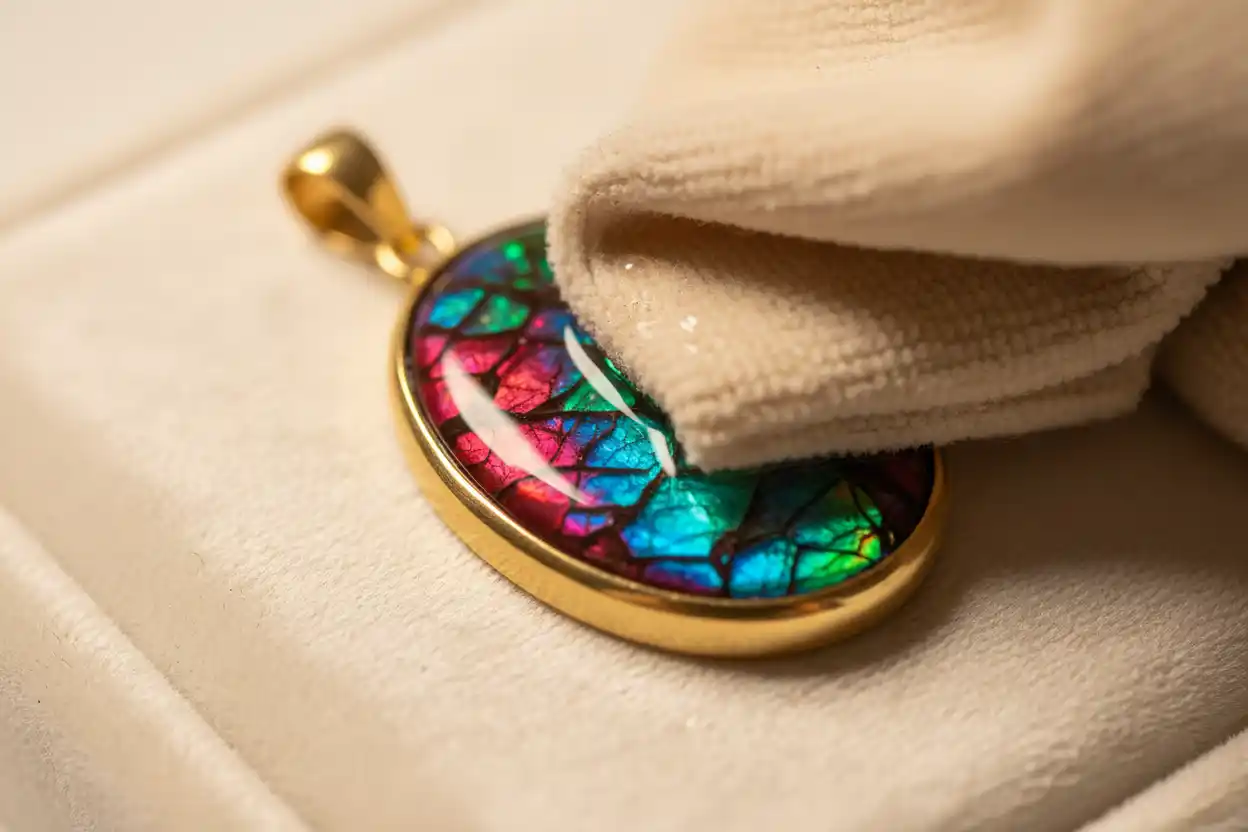
How to Clean Ammolite Jewelry Safely
Ammolite jewelry should normally be cleaned with a soft, slightly damp, non-abrasive cloth. Avoid soaking, hard brushing, steam, ultrasonic cleaners, acids, solvents, alcohol, and commercial chemical dips because the colorful layer is thin, relatively soft, and frequently stabilized or assembled as a doublet or triplet.
That conservative method differs from the warm-soapy-water routine used for many crystalline gemstones. Ammolite comes from the iridescent shell material of fossil ammonites, and its construction often matters as much as the gem layer itself. The wider material background appears in the Ammolite meaning and properties guide.
Why Ammolite Is Unusually Delicate
Ammolite’s visible color comes from thin aragonite-based shell layers. Rather than absorbing light like many colored stones, the microscopic structure produces shifting iridescent colors.
The material ranks around 3.5 on the Mohs scale before protective assembly. Therefore, exposed ammolite can scratch much more easily than quartz, sapphire, or aquamarine. The gemstone hardness chart explains the practical meaning of that rating.
Low hardness is only part of the concern. Thin layers, natural fractures, stabilization, backing materials, protective caps, and adhesives all influence durability. Readers can compare scratching and breakage resistance in Gemstone Toughness vs Hardness.
| Ammolite form | Typical construction | Cleaning approach |
|---|---|---|
| Natural solid ammolite | Iridescent shell material with matrix | Soft, barely damp cloth |
| Stabilized solid | Polymer-treated material | Soft damp cloth; avoid solvents and heat |
| Doublet | Ammolite layer bonded to a backing | Do not soak; wipe gently |
| Triplet | Ammolite between backing and a clear protective cap | Clean the cap gently; protect adhesive boundaries |
| Fossil specimen | Larger shell section, sometimes stabilized | Dust carefully; obtain specialist advice before washing |
The tracker’s guide to types of Ammolite owns the variety and pattern discussion. This page is limited to safe physical maintenance.
Understand Doublets, Triplets, and Stabilization
Ammolite is commonly backed with another material to support its thin color layer. A doublet generally combines ammolite with a backing, while a triplet adds a transparent protective cap.
The cap may be harder than the underlying gem layer, but the assembled jewel remains vulnerable at its edges and adhesive boundaries. A scratch-resistant top does not make the full construction resistant to heat, solvent, soaking, or impact.
The separate guide to gemstone doublets and triplets explains composite construction and disclosure in more detail.
Polymer impregnation may also stabilize the ammolite surface. Because solvents and heat can affect polymers and adhesives, the entire piece must be treated as an assembled or treated object unless documentation clearly proves otherwise.
The broader enhancement categories appear in Gemstone Treatments Explained.
Supplies for Safe Cleaning
Use a clean, padded work surface and gather two soft lint-free cloths. Lightly dampen one cloth with room-temperature or lukewarm water. Keep the second cloth dry.
For visible oily residue, a single drop of very mild soap may be diluted in a small amount of water and applied to the cloth rather than directly to the jewelry. However, many pieces need only a damp wipe.
Do not prepare a soaking bowl as the default method. Ammolite’s assembly, edge seals, backing, adhesives, and treatment history may not tolerate immersion.
A clean makeup brush with exceptionally soft bristles can remove dry dust from recessed metalwork, but it should not be scrubbed across an exposed ammolite surface.
Inspect the Piece Before Cleaning
Examine the jewelry under bright, indirect light. Look for lifting layers, gaps around a protective cap, cloudy adhesive, loose bezels, chipped edges, surface scratches, separation between layers, or cracks extending through the color plate.
Also inspect the backing and surrounding metal. Ammolite jewelry often uses bezel-style protection, but a bent bezel or sharp edge can press against the assembled gem.
Do not clean a delaminating, loose, or cracked piece at home. Added moisture may enter an existing gap, while pressure from wiping can enlarge the damage.
The gemstone cleavage guide provides broader context on directional breakage, but ammolite’s primary care problem is its layered fossil structure and frequent assembly rather than conventional cleavage alone.
Wipe the Surface Gently
Support the piece in one hand or place it on a padded surface. Use the damp cloth to wipe the surface with light, straight strokes.
Do not press into natural fractures or rub repeatedly at one spot. If the jewel is a triplet, the cloth is mainly cleaning the transparent cap rather than the ammolite layer beneath it.
For residue near the bezel, fold a clean part of the cloth into a soft point and work around the edge without pushing moisture into seams.
Follow immediately with the dry cloth. Allow the jewelry to rest flat at room temperature until all remaining moisture has evaporated.
Should Soap Be Used on Ammolite?
Plain water is usually sufficient for dust and light fingerprints. Mild soap may help with oily film, but it should be highly diluted and applied sparingly to a cloth.
Never pour soap directly over the gem. Avoid formulas containing alcohol, citrus solvents, ammonia, bleach, abrasives, moisturizers, or strong fragrance oils.
After using diluted soap, wipe the surface once with a second cloth dampened only with clean water, then dry it promptly.
When the construction is unknown, a dry or barely damp cloth is safer than any liquid cleaner.
Never Use an Ultrasonic Cleaner
Ammolite should not go into an ultrasonic cleaner. Vibration, liquid, and possible heat can affect the fragile color layer, polymer stabilization, adhesives, backing, protective cap, or surrounding setting.
Ultrasonic equipment may also encourage existing layers to separate. Even if a quartz or synthetic-spinel cap appears undamaged, the interface beneath it may not be.
The planned guide to which gemstones can go in an ultrasonic cleaner covers the broader equipment issue. Ammolite belongs on the avoid list.
Never Steam Clean Ammolite
Steam exposes the jewel to concentrated heat, moisture, and pressure. Those conditions can affect polymer, adhesive, natural fractures, edge seals, and the thin iridescent layer.
Rapid temperature change may also stress the assembly. Consequently, steam cleaning is unsuitable even when a triplet has a hard transparent cap.
A professional jeweler familiar with ammolite should use a low-risk manual method rather than assuming that equipment safe for diamond or sapphire is safe for a fossil-derived composite.
Avoid Soaking and Water Immersion
A brief damp wipe is different from immersion. Soaking can allow water and detergent to move toward the junction between the gem layer, backing, cap, and adhesive.
That risk is especially important when the piece is older, repaired, chipped, or poorly sealed. Cloudiness beneath a cap after immersion may indicate moisture or adhesive damage that cannot be wiped away.
The general crystal and gemstone water-safety guide covers broader material differences. Ammolite jewelry should not be treated as a water-soaking stone.
Chemicals, Cosmetics, and Products to Avoid
Perfume, hairspray, sunscreen, lotion, and cosmetics can dull or damage an exposed ammolite surface. Apply those products before putting on the jewelry and allow them to dry.
Remove ammolite before using hand sanitizer. Alcohol and other solvents may affect polymer, adhesive, coatings, or the exposed shell material.
Do not use silver dip, gold cleaner, tarnish remover, ammonia, acetone, vinegar, bleach, toothpaste, baking soda, or polishing paste on the gem.
A metal cleaner suitable for an unmounted chain may still be unsuitable for a pendant containing ammolite. Clean according to the most vulnerable component rather than the surrounding precious metal.
Cleaning Ammolite Earrings
Ammolite earrings often experience less impact than rings, but perfume, hair products, and skin oils can collect on their surfaces and fittings.
Hold the ammolite component while wiping the post, hook, hinge, and backing separately. Do not pull against the gem or immerse the entire earring.
Keep alcohol-based earring disinfectant away from the ammolite. Clean the metal fitting locally with a compatible method and prevent liquid from running onto the stone.
Cleaning an Ammolite Necklace or Pendant
An Ammolite necklace or pendant is often protected by a bezel and may use a doublet or triplet for additional durability.
Wipe the face gently, then clean the bail and back without forcing moisture around the cap edges. Check that the pendant cannot strike the chain or another pendant during storage.
Perfume should be applied before the necklace. Repeated direct spraying can affect the surface and leave residue around the setting.
What About Ammolite Rings and Bracelets?
Ammolite rings and bracelets face more impact, abrasion, and chemical contact than pendants or earrings. Protective caps and secure bezels help, but they do not make the jewelry suitable for heavy work.
Remove the piece before washing dishes, cleaning, exercising, gardening, showering, swimming, or applying sanitizer.
Inspect a ring regularly for edge chips and lifting layers. A small opening near the cap or backing should be repaired before moisture enters the assembly.
Scratches, Cloudiness, and Loss of Luster
A damp cloth removes surface residue but cannot repair scratches, delamination, worn polymer, chipped caps, or damaged adhesive.
Do not attempt to repolish ammolite with a household compound. Polishing can remove the thin color layer quickly or change the optical effect.
Cloudiness beneath a clear cap may come from adhesive deterioration, moisture intrusion, or separation between layers. Stronger cleaning will not solve those structural problems.
Professional repair may involve resealing, replacing a cap, resetting the gem, or working with a specialist cutter familiar with ammolite composites.
Natural Ammolite, Imitations, and Disclosure
Not every iridescent fossil, coated surface, assembled material, or imitation has the same care requirements. Cleaning behavior should not be used as an identification test.
The broader types of gemstones guide explains how organic, mineral, and assembled materials differ. The guide to spotting fake crystals and stones addresses general warning signs without recommending destructive tests.
Documentation should state whether a jewel is solid, stabilized, a doublet, or a triplet. The Ammolite buying guide covers construction and selection, while the Ammolite price guide explains how color, pattern, condition, size, and assembly affect value.
For higher-value pieces, the guides to gemstone certification and reading a gem laboratory report explain how material descriptions and detectable treatments may be presented.
Storage and Preventive Care
Store ammolite separately in a padded box or soft pouch. Harder gemstones, loose chains, metal clasps, and even gritty dust can scratch an exposed surface or protective cap.
Keep the jewelry away from high heat, prolonged direct sunlight, acidic environments, and rapid temperature changes.
Do not stack ammolite pieces together. Their metal settings can scratch one another even when the gems do not touch directly.
Retain invoices, treatment disclosures, and repair records. When purchasing online, the principles in How to Buy Gemstones Online Without Getting Scammed can help confirm construction before the piece requires care.
Sourcing and origin claims should also be supported rather than assumed. The tracker’s guide to ethically sourced gemstones covers questions to ask sellers.
Frequently Asked Questions
1. What is the safest way to clean ammolite?
Wipe it gently with a soft, slightly damp, non-abrasive cloth, then dry it promptly with a second clean cloth.
2. Can ammolite get wet?
A light damp wipe is usually acceptable, but soaking or immersion should be avoided because water may affect stabilization, adhesives, backing, or layered construction.
3. Can I use soap on ammolite?
Use only a trace of highly diluted mild soap when plain water does not remove oily residue. Apply it to the cloth, not directly to the stone.
4. Can ammolite go in an ultrasonic cleaner?
No. Vibration and liquid can damage the fragile surface, polymer treatment, adhesive, backing, cap, or setting.
5. Can ammolite be steam cleaned?
No. Heat, moisture, and pressure can damage the material and its assembled construction.
6. Can I clean a triplet more aggressively because it has a hard cap?
No. The cap may resist scratching better than exposed ammolite, but the adhesive and interfaces beneath it remain vulnerable.
7. Will alcohol or hand sanitizer damage ammolite?
Alcohol and other solvents may affect polymer, adhesive, coatings, or the exposed material. Remove the jewelry before applying sanitizer.
8. Can toothpaste polish scratched ammolite?
No. Toothpaste is abrasive and can worsen scratching, damage a cap, or remove delicate surface material.
9. Why is my ammolite cloudy under the surface?
Cloudiness may indicate moisture intrusion, adhesive deterioration, delamination, or damage beneath a protective cap. Surface cleaning will not remove it.
10. How should I clean ammolite set in silver?
Wipe the ammolite separately and clean only the exposed metal with a method that cannot touch the gem. Do not immerse the piece in silver dip.
11. How often should ammolite jewelry be cleaned?
Wipe it after wear and clean only when fingerprints or residue remain. Preventive care is safer than frequent washing.
12. When does ammolite need professional care?
Seek specialist help for lifting layers, edge chips, loose settings, cloudy adhesive, delamination, deep scratches, or an unknown composite construction.
Conclusion
Ammolite should be maintained as a delicate layered jewel rather than treated like a conventional hard crystal. A soft damp cloth, minimal pressure, immediate drying, and careful storage protect both its iridescent surface and the assembly supporting it. When cloudiness or separation appears beneath the surface, the next step is structural assessment—not stronger soap, longer soaking, or machine cleaning.