Carnelian vs Red Jasper: Tests, Wear & Buying Guide
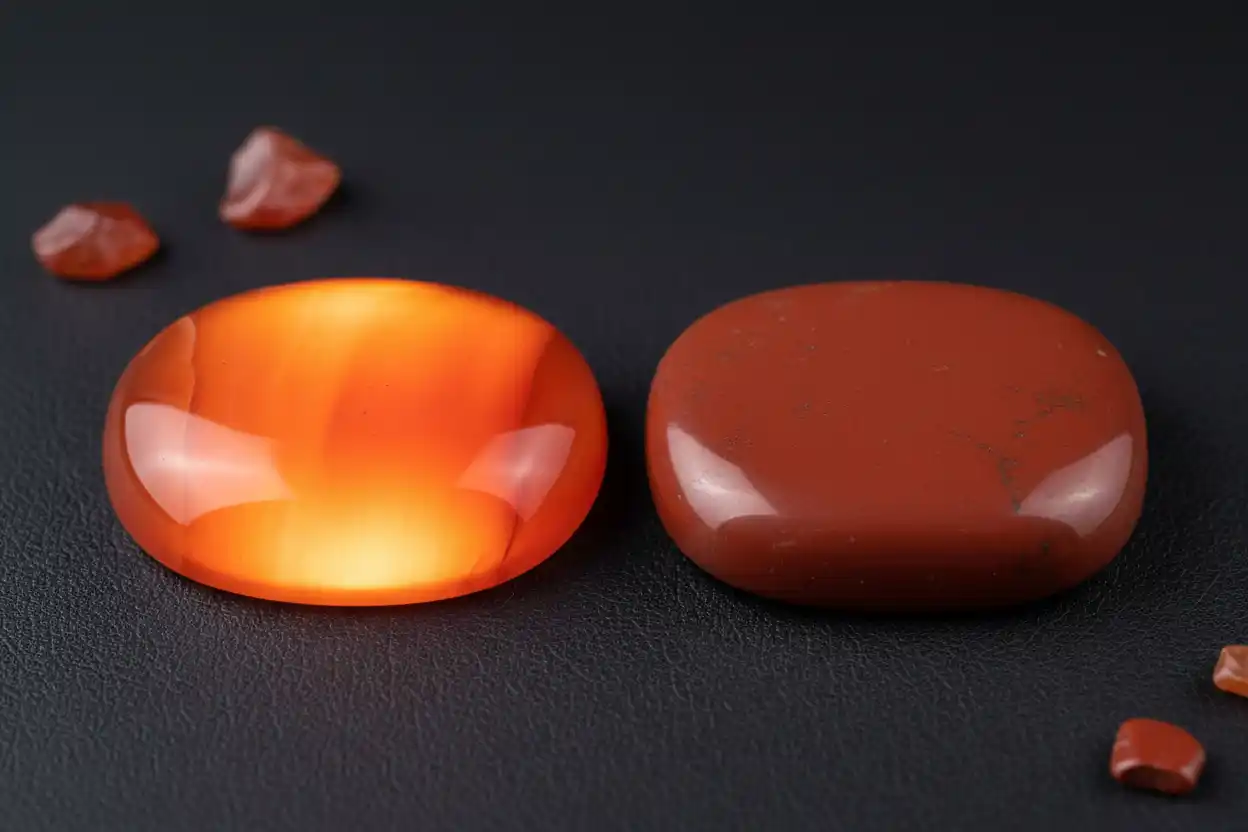
Carnelian vs red jasper can be surprisingly difficult to judge from a polished photograph because both materials belong broadly to the microcrystalline quartz family, commonly derive their warm red coloration from iron-bearing compounds, fall near the same hardness range, and take an excellent polish. The most useful distinction is usually not hardness or color alone. It is the way the material handles light: carnelian is characteristically translucent orange to reddish-brown chalcedony, whereas red jasper is normally opaque or nearly opaque because its silica contains enough finely dispersed mineral matter to block transmitted light.
That difference makes translucency the best first screening test for most ordinary specimens, but it is not an absolute shortcut. Very dark or thick carnelian may appear opaque until examined at a thin edge, while unusually thin red jasper can transmit a small amount of light. Borderline material may also sit between traditional trade categories such as carnelian, sard, agate, chalcedony, and jasper. A reliable carnelian vs red jasper comparison therefore combines transparency, texture, color distribution, microscopy, density context, treatment clues, and practical use rather than forcing an identification from a single characteristic.
For more side-by-side gemstone identification references, browse the Identification section.
Carnelian vs Red Jasper at a Glance
Both stones are silica-rich, durable, and widely used for beads, cabochons, carvings, pendants, rings, decorative objects, and tumbled stones. Their shared quartz-family properties explain why basic scratch testing often fails to separate them.
| Property | Carnelian | Red Jasper |
|---|---|---|
| General material | Chalcedony | Jasper, an opaque microcrystalline silica material |
| Main composition | Predominantly SiO₂ | Predominantly SiO₂ with abundant mineral impurities |
| Typical transparency | Translucent | Opaque to nearly opaque |
| Typical color | Orange, reddish orange, red, brownish red | Brick red, rusty red, deep red, burgundy, reddish brown |
| Main color influence | Iron-bearing compounds, especially ferric iron oxides | Iron oxides and other finely dispersed mineral matter |
| Texture | Usually comparatively even and chalcedony-like | Commonly more granular, spotted, veined, mottled, or inclusion-rich |
| Mohs hardness | About 6.5–7 | About 6.5–7 |
| Cleavage | None prominent | None prominent |
| Fracture | Conchoidal to uneven | Conchoidal to uneven |
| Typical luster when polished | Waxy to vitreous | Waxy to vitreous |
| Best first distinction | Transmitted light | Persistent opacity |
| Heat treatment | Commonly relevant | Less central, though enhancement is possible |
| Dyeing | Possible | Possible |
| Everyday wear | Generally good | Generally good |
| Major diagnostic problem | Dark carnelian may appear opaque | Thin jasper can sometimes transmit slight light |
The central carnelian vs red jasper distinction is therefore textural and optical rather than chemical. Their chemistry can be too similar for a simple elemental test to provide the trade name automatically.
The Simplest Difference: Translucent vs Opaque
If a polished red-orange stone glows noticeably when a strong white light is placed behind a thin section, carnelian becomes a strong possibility. Natural carnelian often transmits orange, reddish-orange, or warm red light because its chalcedony body contains fewer light-blocking impurities than jasper.
Red jasper usually remains opaque because abundant microscopic iron oxides, clay minerals, other silicates, or mineral particles scatter and absorb light throughout the stone. Even when polished to a high gloss, the internal body typically looks solid rather than luminous.
This makes a flashlight one of the most useful non-destructive tools for carnelian vs red jasper screening.
The correct procedure is to compare the thinnest accessible edge rather than the thickest center. A 15 mm-thick carnelian cabochon can appear opaque through its center even though a 2 mm edge clearly transmits light.
A Practical Flashlight Test
Use a cool or neutral white flashlight rather than an intensely colored LED.
Darken the immediate surroundings slightly and place the light behind the thinnest portion of the stone.
Strong orange-red transmission
This strongly favors carnelian or another translucent chalcedony.
Weak transmission only at an extremely thin edge
The result is ambiguous. Dark carnelian, sard, jasper, or another iron-rich chalcedony material may need consideration.
No visible transmission through a thin clean edge
Red jasper becomes more plausible, especially if the stone also shows mottled mineral texture.
Light visible mainly through fractures
Do not count this as body translucency. Light traveling through an open crack says little about the surrounding material.
A flashlight test narrows the possibilities; it does not replace mineral identification when the stone is valuable or represented with unusual claims.
Why Color Alone Is a Weak Test
A common carnelian vs red jasper mistake is to assume that bright orange means carnelian and deep red means jasper.
There is some practical truth behind that impression, but nature does not create such a simple boundary.
Carnelian can range from pale yellow-orange through strong red to dark brownish red. Red jasper can range from orange-red to brick red, burgundy, dark rust, and brownish red.
A rich opaque orange-red stone can be jasper.
A dark reddish-brown translucent stone can be carnelian or sard.
Lighting makes the problem worse. Warm photography can shift rusty red jasper toward orange, while strong backlighting can make brown carnelian appear bright scarlet.
The best carnelian vs red jasper identification starts by asking how the color is distributed and whether light travels through the material.
Why Both Stones Are Red
Iron is central to the appearance of both carnelian and red jasper.
In carnelian, finely dispersed ferric iron compounds within chalcedony are responsible for much of the orange-to-red coloration. Heating can sometimes intensify these colors by altering iron-bearing phases or oxidation conditions.
Red jasper also receives much of its color from iron oxides, particularly hematite-related material, but it usually contains a greater abundance of dispersed mineral matter. Those particles contribute not only color but also opacity and visible texture.
That distinction is useful:
Carnelian commonly looks like translucent silica colored by iron.
Red jasper commonly looks like opaque silica heavily loaded with iron-rich and other mineral material.
The boundary remains descriptive rather than a simple concentration threshold that can be read by eye.
Texture Is the Second Major Clue
Carnelian generally has a comparatively smooth internal appearance. Cloudy areas, color zoning, faint banding, fractures, and small inclusions are common, but many polished pieces look visually homogeneous at ordinary viewing distance.
Red jasper more often displays obvious mineral texture.
Possible features include:
dark spots;
black veins;
brown areas;
pale quartz patches;
iron-rich streaks;
brecciated fragments;
mottling;
small contrasting grains;
and uneven opaque coloration.
None of those features is mandatory, but their presence strengthens a red jasper interpretation when combined with opacity.
Original Carnelian vs Red Jasper Decision Matrix
Use the matrix below before relying on a seller’s label.
| Observation | Carnelian more likely | Red jasper more likely | Confidence |
|---|---|---|---|
| Strong orange glow through a thin edge | ✓ | High | |
| Completely opaque through a clean thin edge | ✓ | Moderate to high | |
| Smooth translucent orange body | ✓ | High | |
| Opaque brick-red body with mineral speckling | ✓ | High | |
| Dark reddish-brown but translucent | ✓ | Moderate | |
| Strong visible banding | Possible agate/carnelian overlap | Possible jasper/agate overlap | Low without further testing |
| Black or brown matrix-like patches throughout | ✓ | Moderate | |
| Color concentrated heavily in fractures | Possible treatment | Possible treatment | Low |
| Uniform neon-red color | Possible treatment | Possible treatment | Low |
| Hardness around 7 | ✓ | ✓ | Not useful for separation |
| Conchoidal fracture | ✓ | ✓ | Not useful for separation |
| Waxy polish | ✓ | ✓ | Not useful for separation |
| RI around chalcedony range | ✓ | ✓ | Confirms silica family, not trade category |
| Similar SG near quartz-family range | ✓ | ✓ | Limited separation value |
| Microscopy shows abundant opaque grains | ✓ | Moderate to high | |
| Microscopy shows relatively clean fibrous chalcedony texture | ✓ | Moderate to high |
The matrix shows why carnelian vs red jasper is not a one-test problem. Hardness, fracture, density, and refractive behavior overlap strongly because both materials are quartz-rich.
An Original Three-Step Identification Workflow
For most consumer specimens, use the tests in this order.
Step 1: Test light transmission
This provides the strongest low-cost distinction.
Step 2: Examine internal texture
Use a 10× loupe if available. Look for abundant opaque mineral particles, patches, veins, or brecciation.
Step 3: Investigate treatment if the color looks unusual
Inspect fractures, drill holes, surface pits, and porous regions for concentrated dye.
Only after those steps should more specialized testing be considered.
This workflow minimizes unnecessary destructive testing while answering the questions most likely to separate carnelian vs red jasper in ordinary jewelry and specimen material.
Hardness Will Usually Not Separate Them
Both carnelian and red jasper belong to the microcrystalline quartz family and generally fall around Mohs 6.5–7.
A scratch test therefore produces little useful separation.
If one stone scratches glass and another does too, the result merely indicates that both are relatively hard.
More importantly, destructive scratch testing can permanently mark a polished cabochon, carving, bead, or historic object.
For carnelian vs red jasper, translucency and texture provide far more information at much lower risk.
Specific Gravity Overlaps
Carnelian and red jasper usually fall close to the density expected for quartz-rich materials.
Carnelian commonly lies around the low-to-mid 2.6 range. Jasper can vary somewhat more because the amount and type of included mineral matter differ, but substantial overlap remains.
That means a hydrostatic specific-gravity measurement can support a quartz-family identification without reliably telling you which commercial chalcedony category applies.
If a supposed carnelian or jasper has a dramatically incompatible density, another material deserves investigation.
If the measurement is normal, carnelian vs red jasper still requires optical and textural evidence.
Refractive Index Is Also Similar
Chalcedony typically produces refractive readings around the mid-1.53 range.
Because carnelian is chalcedony and jasper is also dominated by microcrystalline silica, their refractive behavior can overlap closely.
A refractometer can therefore help distinguish these stones from unrelated materials such as glass of different optical properties, calcite, some feldspars, or higher-index gems.
It generally cannot provide a clean carnelian vs red jasper boundary by itself.
This is a useful example of why an instrument can correctly identify the mineral family without deciding the trade variety.
Carnelian vs Red Jasper Under Magnification
Microscopy can reveal the reason one stone transmits light while another does not.
Carnelian may show:
fine chalcedony texture;
cloudy color zones;
iron-rich particles;
healed fractures;
faint banding;
small inclusions;
and relatively open translucent regions.
Red jasper may show:
much denser opaque particles;
iron-oxide grains;
mineral fragments;
veins;
patches of quartz;
grain boundaries;
brecciated structures;
and heterogeneous coloration.
The distinction becomes easier when the two materials are viewed at the same magnification and lighting.
Microscopy still has limits. Extremely fine particles may not be identifiable to mineral species without spectroscopy or chemical analysis.
The Agate Problem
Some material sits between familiar trade categories.
Agate is defined primarily by visible chalcedony banding, while carnelian is identified primarily by orange-red chalcedony color. Jasper is distinguished mainly by opacity and inclusion-rich microcrystalline silica.
A red-orange specimen can therefore be both agate-like in structure and carnelian-like in color.
Commercial labels such as:
carnelian agate;
red agate;
sard;
sardonyx;
and jasper
may overlap at visual boundaries.
The most useful description records what the stone actually shows rather than forcing one word to carry all the information.
For example:
Translucent reddish-orange banded chalcedony
is more descriptive than arguing over whether only “carnelian” or only “agate” is permissible.
Carnelian vs Red Jasper Treatments
Treatment is one of the most important buying differences because carnelian color has a particularly long association with heat enhancement.
Iron-bearing chalcedony can become redder or more strongly orange when heated under suitable conditions. Heating changes the appearance without changing the basic silica identity.
Red jasper is commonly naturally red because of abundant iron oxides, but commercial material can still be dyed, coated, impregnated, stabilized, or otherwise altered.
Neither material should be assumed treated solely because its color is attractive.
Neither should be assumed untreated merely because it is sold as natural.
How to Look for Dye
Examine the stone under magnification, paying particular attention to:
fractures;
drill holes;
pits;
porous areas;
pale matrix;
and contacts between contrasting zones.
Artificial color may concentrate where liquid dye penetrated most easily.
A suspicious pattern includes very strong red color inside fractures while intact dense areas remain much paler.
However, natural iron staining can also concentrate in fractures.
Visual evidence should therefore be described as a treatment clue rather than absolute proof.
Heat-Treated Carnelian Is Still Natural Chalcedony
A common misunderstanding is that heating makes carnelian synthetic.
It does not.
If naturally formed chalcedony is heated to modify its color, the resulting stone remains natural chalcedony with a treatment history.
That distinction matters in disclosure and value.
Some buyers prefer untreated color and may pay more for well-documented natural appearance. Other buyers care primarily about beauty and durability.
Neither preference changes the mineral identity.
Red Jasper Can Be Dyed Too
Opaque silica is sometimes treated with dyes or surface colorants, particularly in inexpensive beads, carvings, or decorative material.
Strong opacity can make treatment harder to recognize visually because transmitted-light examination is less useful.
Drill holes become especially informative on bead strands. If a bright red surface becomes noticeably pale inside the hole, the possibility of applied color deserves attention.
The same caution applies to carvings whose chipped edges reveal a different interior color.
Carnelian vs Red Jasper Durability
For ordinary jewelry use, the two stones are more similar than different.
Both have quartz-family hardness near 7, no strong easy cleavage, and reasonably good resistance to everyday abrasion.
That makes them substantially more practical for frequent wear than softer materials such as calcite or fluorite.
Both can still chip at sharp edges.
Both can fracture if struck hard enough.
Both may contain pre-existing cracks that reduce local durability.
And both can be affected by aggressive treatment, coatings, adhesives, or poor-quality drilling.
The practical winner in carnelian vs red jasper durability is therefore usually whichever individual stone has fewer structural weaknesses and better workmanship.
Which Is Better for Rings?
Either can work well in rings when cut and set appropriately.
Carnelian’s translucency can make thin or open-backed settings visually attractive because light can enter the stone. Red jasper does not need transmitted light to display its body color, so closed or partially closed settings have less effect on its basic appearance.
For either material, evaluate:
girdle thickness;
exposed corners;
existing fractures;
stone thickness;
bezel or prong protection;
and the quality of the polish.
A solid red jasper cabochon may tolerate visually opaque backing better than a carnelian cabochon whose appeal depends on light transmission.
Which Is Better for Beads?
Both are excellent bead materials.
Carnelian beads often benefit from matched translucency and color saturation. A strand can show significant visual variation if some beads are pale orange while others are nearly opaque brown.
Red jasper strands are usually evaluated more by consistency of opaque red color, attractive natural pattern, surface polish, and freedom from excessive cracks.
Drill-hole inspection is useful for both materials because it can reveal treatment clues and structural weakness.
Sharp chips around the hole indicate lower finishing quality and may cut stringing material over time.
Which Looks Better in Carvings?
The answer depends on the design.
Carnelian can produce attractive depth because light enters the edges and thinner carved areas differently. This makes relief carving, intaglio, and engraved work visually interesting.
Red jasper provides a more solid graphic color field. Strong opaque red can make shapes, engraved lines, and contrasting mineral patterns visually bold.
Historically, both silica materials have been attractive to lapidaries because they accept fine polish and retain carved detail well.
The distinction is therefore aesthetic rather than a simple quality ranking.
Carnelian vs Red Jasper Value
Neither name alone determines price.
Value can depend on:
color;
translucency or pattern;
treatment;
size;
workmanship;
historical importance;
provenance;
carving quality;
rarity of a particular pattern;
condition;
and seller context.
Ordinary red jasper and common carnelian are generally accessible materials, but exceptional carved objects, documented antiquities, fine untreated material, important provenance, unusual patterns, or master lapidary work can move far beyond ordinary rough-material value.
Do not compare two finished pieces only by price per gram.
Workmanship can easily matter more than raw material weight.
Which Stone Should You Choose?
A practical carnelian vs red jasper choice starts with how you want the stone to look.
Choose carnelian when you prefer:
translucency;
orange-to-reddish light transmission;
a glowing appearance;
relatively even chalcedony color;
or lapidary work that uses changing thickness to create visual depth.
Choose red jasper when you prefer:
opacity;
brick-red or rusty-red body color;
stronger mineral texture;
mottling or veins;
or a solid visual presence unaffected by backlighting.
For jewelry durability, there is little reason to choose one automatically over the other.
Individual quality matters more.
Carnelian vs Red Jasper for Identification Beginners
Carnelian vs red jasper is a useful training comparison because it teaches a broader principle: begin with the property that differs most strongly between the materials.
That same approach improves other comparisons. For yellow transparent gems, citrine vs yellow sapphire depends heavily on hardness, refractive behavior, density, and corundum-versus-quartz identity rather than yellow color alone. In citrine vs yellow topaz, cleavage and optical measurements matter because both gems can appear similarly warm and transparent.
The strongest test changes with the pair being examined.
Color Similarity Is Often Misleading
A green stone can create the same problem. Aventurine vs jade cannot be settled from green coloration because quartz-rich aventurine and jade materials differ fundamentally in mineralogy and structure.
Blue comparisons are equally deceptive. Aquamarine vs topaz and aquamarine vs blue topaz require physical and optical evidence because hue alone provides little certainty.
Carnelian vs red jasper happens to offer an unusually accessible first clue—translucency—but that principle should not be generalized blindly to every gem pair.
Texture Sometimes Matters More Than Color
The comparison between clear quartz vs selenite demonstrates how cleavage, hardness, and crystal structure can resolve two superficially pale or transparent materials.
Similarly, fluorite vs amethyst becomes much easier once hardness, cleavage, density, and crystal habit are considered.
Carnelian vs red jasper follows the same evidence-first logic. The useful difference is not simply “orange versus red”; it is translucent chalcedony versus opaque inclusion-rich silica.
Similar Looking Gems Can Need Instrumental Testing
Some comparisons are much harder than carnelian vs red jasper.
Apatite vs aquamarine can require careful refractive-index, density, hardness, and optical examination when transparent stones lack their natural crystal form.
Amethyst vs charoite involves materials with entirely different structures and typical textures despite overlapping purple coloration.
The broader lesson is that a visual clue should be used only as strongly as the materials permit.
When a Laboratory Report Is Worthwhile
Most ordinary carnelian and red jasper beads do not justify expensive laboratory testing.
The situation changes when:
a high price depends on untreated status;
a historic object requires identification;
archaeological attribution matters;
the material is represented as unusually rare;
the stone appears inconsistent with its label;
or treatment has major value implications.
The gemstone certification guide explains what laboratory reports can and cannot establish.
For carnelian vs red jasper, a laboratory may first identify the material as chalcedony or microcrystalline quartz and then assess transparency, inclusions, treatment evidence, and other features relevant to the trade description.
Laboratory Limits Matter
Even laboratory evidence should be interpreted precisely.
Because carnelian and red jasper occupy closely related microcrystalline silica territory, instruments may establish quartz-family identity more objectively than a strict trade-name boundary.
A report can document:
mineral composition;
optical behavior;
microscopic features;
treatment indicators;
and sometimes color-related evidence.
It may not convert a gradual natural transition into an absolute universal line.
That is not a failure of testing. It reflects the way the commercial names themselves are defined.
Carnelian vs Red Jasper and Symbolism
Carnelian is commonly associated in modern crystal traditions with confidence, motivation, creativity, courage, and action.
Red jasper is often associated with endurance, stability, grounding, resilience, and persistence.
Those symbolic themes overlap considerably.
They cannot be used to identify the physical stone.
A seller’s description of a specimen as “energizing carnelian” or “grounding red jasper” provides no diagnostic evidence. A mislabeled red jasper does not become carnelian because its owner experiences motivation while holding it.
Material identity and personal symbolism are separate questions.
Choosing Between Them for Symbolic Use
If symbolism matters to you, the most grounded approach is to choose the interpretation after the material has been identified rather than using symbolism to decide what the material must be.
Carnelian can represent initiating action.
Red jasper can represent continuing action.
That creates a practical distinction without claiming that either mineral biologically changes motivation or endurance.
For example, someone might associate carnelian with beginning a difficult project and red jasper with maintaining consistency once the project is underway.
The usefulness lies in the chosen reminder.
The silica does not control the behavior.
Cleaning and Care
Both stones usually tolerate straightforward conservative cleaning when they are solid, untreated, and securely mounted.
Mild soap, lukewarm water, and a soft cloth are generally appropriate starting points.
However, avoid assuming that every commercial stone is simply untreated silica.
Dyed material, glued beads, fracture-filled stones, coated surfaces, antique objects, and jewelry with vulnerable settings may require different handling.
Avoid harsh chemicals when treatment status is uncertain.
Abrasive powders are unnecessary and can dull polish over time.
Heat Exposure Deserves More Caution With Carnelian
Because heat can alter iron-related color in chalcedony, extreme thermal exposure is particularly relevant to carnelian.
This does not mean ordinary warm water will transform the stone.
It means deliberate high-temperature exposure, torch heat during jewelry repair, or uncontrolled thermal treatment can alter appearance or damage a finished piece.
Red jasper is also not immune to heat-related damage, especially when fractures, dyes, coatings, or matrix materials are present.
For both stones, jewelry repair should account for the entire object rather than the ideal silica composition alone.
Buying Checklist: Carnelian
Before purchasing carnelian, check:
whether the body is genuinely translucent;
how it looks without backlighting;
whether color appears concentrated in fractures;
whether heat or dye is disclosed;
whether drill holes are clean;
whether the stone has major fractures;
whether photographs are heavily saturated;
and whether provenance claims are supported.
A beautiful carnelian does not need to be perfectly uniform.
Natural variation can improve visual character.
Buying Checklist: Red Jasper
Before purchasing red jasper, check:
whether the material remains opaque;
whether the red color is natural-looking rather than artificially neon;
whether pattern and veining are attractive;
whether cracks compromise durability;
whether drill holes reveal a different interior color;
whether the polish is even;
whether composites or coatings are disclosed;
and whether specific locality claims are documented.
Natural jasper can contain significant mineral variation.
Uniformity is not automatically a sign of better quality.
A Same-Lighting Comparison Protocol
If you have both materials physically available, compare them under identical conditions.
Clean both surfaces gently.
Place them on the same neutral background.
Photograph them under the same diffused white light.
Photograph the thinnest edges with the same flashlight behind them.
Examine both at the same loupe magnification.
Record visible bands, veins, inclusions, fractures, and drill-hole color.
Compare weight only after accounting for dimensions.
Do not adjust saturation separately between images.
This same-lighting protocol provides much better visual evidence than comparing two unrelated online product photographs.
It also satisfies the most important practical requirement of carnelian vs red jasper comparison: the variables should be controlled before appearance is interpreted.
Common Mistakes
“Carnelian is orange and jasper is red”
Too simple. Their color ranges overlap.
“If it is dark, it must be jasper”
Dark carnelian can look nearly opaque in thick sections.
“If it glows under a flashlight, it is definitely carnelian”
Strong translucency supports carnelian, but other chalcedonies can behave similarly.
“Hardness will settle it”
Usually not. Both are quartz-rich materials.
“Red jasper is always spotted”
No. Some material is relatively uniform.
“Bright carnelian must be dyed”
Natural vivid carnelian exists.
“All carnelian is untreated”
Also incorrect. Heat enhancement and dyeing can occur.
“Jasper is a completely unrelated mineral”
No. It is also a microcrystalline silica material, though typically much more inclusion-rich and opaque.
A Practical Buying Decision
If two similarly priced stones are being considered, compare them according to the job they need to perform.
For a luminous pendant, carnelian may provide more visual depth.
For an opaque carved signet or bold bead strand, red jasper may provide stronger solid color.
For a ring, compare actual fractures, polish, cut, and setting before worrying about which material is nominally more durable.
For collecting, examine provenance, natural pattern, treatment status, and specimen context.
For symbolic practice, choose the stone whose appearance and personally assigned meaning fit your purpose after verifying what the material actually is.
Safe Ownership
Both carnelian and red jasper are quartz-rich materials and are generally straightforward to handle as intact stones.
The important exposure distinction appears during lapidary work.
Cutting, drilling, grinding, or sanding quartz-family material can create respirable crystalline-silica dust. Appropriate wet methods, local extraction, eye protection, and suitable respiratory controls should be used rather than uncontrolled dry grinding.
Do not deliberately pulverize either stone for inhalation or ingestion.
A natural specimen may also contain mineral inclusions, dyes, coatings, adhesives, or matrix phases not represented by the simplified SiO₂ description.
Normal handling and generating fine mineral dust are different scenarios.
Carnelian vs Red Jasper: Final Decision Matrix
For quick reference:
| If your priority is… | Better fit |
|---|---|
| Translucent orange-red glow | Carnelian |
| Opaque brick-red appearance | Red jasper |
| Relatively uniform chalcedony body | Carnelian |
| Visible mineral pattern or mottling | Red jasper |
| Light-responsive carving | Carnelian |
| Solid-color opaque carving | Red jasper |
| Everyday jewelry durability | Essentially comparable; inspect the individual stone |
| Simple scratch-test separation | Neither; hardness overlaps |
| Best first identification test | Compare translucency |
| Highest treatment concern | Carnelian: heat and dye; red jasper: dye/coating can also occur |
| Determining a borderline trade name | Gemological context plus transparent disclosure |
| Proving locality | Documentation required for either |
| Symbolic “action” theme | Commonly carnelian |
| Symbolic “endurance” theme | Commonly red jasper |
The decision matrix is deliberately practical. Neither stone is universally better.
What Carnelian vs Red Jasper Can Reliably Tell You
The strongest carnelian vs red jasper distinction is that carnelian is characteristically translucent orange-to-red chalcedony, while red jasper is generally opaque microcrystalline silica whose abundant iron-rich and other mineral particles block light and often create greater textural variation.
Both stones share enough quartz-family properties that hardness, fracture, polish, refractive behavior, and general density overlap substantially. Those similarities explain why a scratch test or one instrument reading rarely settles the trade-name distinction.
For ordinary identification, begin with transmitted light. Then examine texture under magnification. Finally, investigate treatment if color concentration, drill holes, fractures, or surface appearance raise questions.
When the stakes are higher, laboratory analysis can establish silica-family identity and investigate treatment or inclusions, but the natural transition between chalcedony trade categories should not be forced into false precision.
Gems Lore’s approach to evidence, terminology, and mineral-versus-symbolism boundaries is explained on the About page. Important limitations around identification, purchasing, metaphysical claims, and informational use are set out in the Disclaimer. Supporting evidence or corrections can be submitted through Contact, while data-handling practices are described in the Privacy Policy.
Carnelian vs red jasper is ultimately a comparison of two closely related silica materials whose appearance diverges mainly because of transparency, impurity content, texture, and iron distribution. If the stone glows through a clean thin edge and shows a comparatively smooth orange-red chalcedony body, carnelian is the stronger interpretation. If it remains opaque and shows a dense, iron-rich, mineral-textured red body, red jasper is more likely. Everything beyond that should be supported by evidence proportionate to the claim.