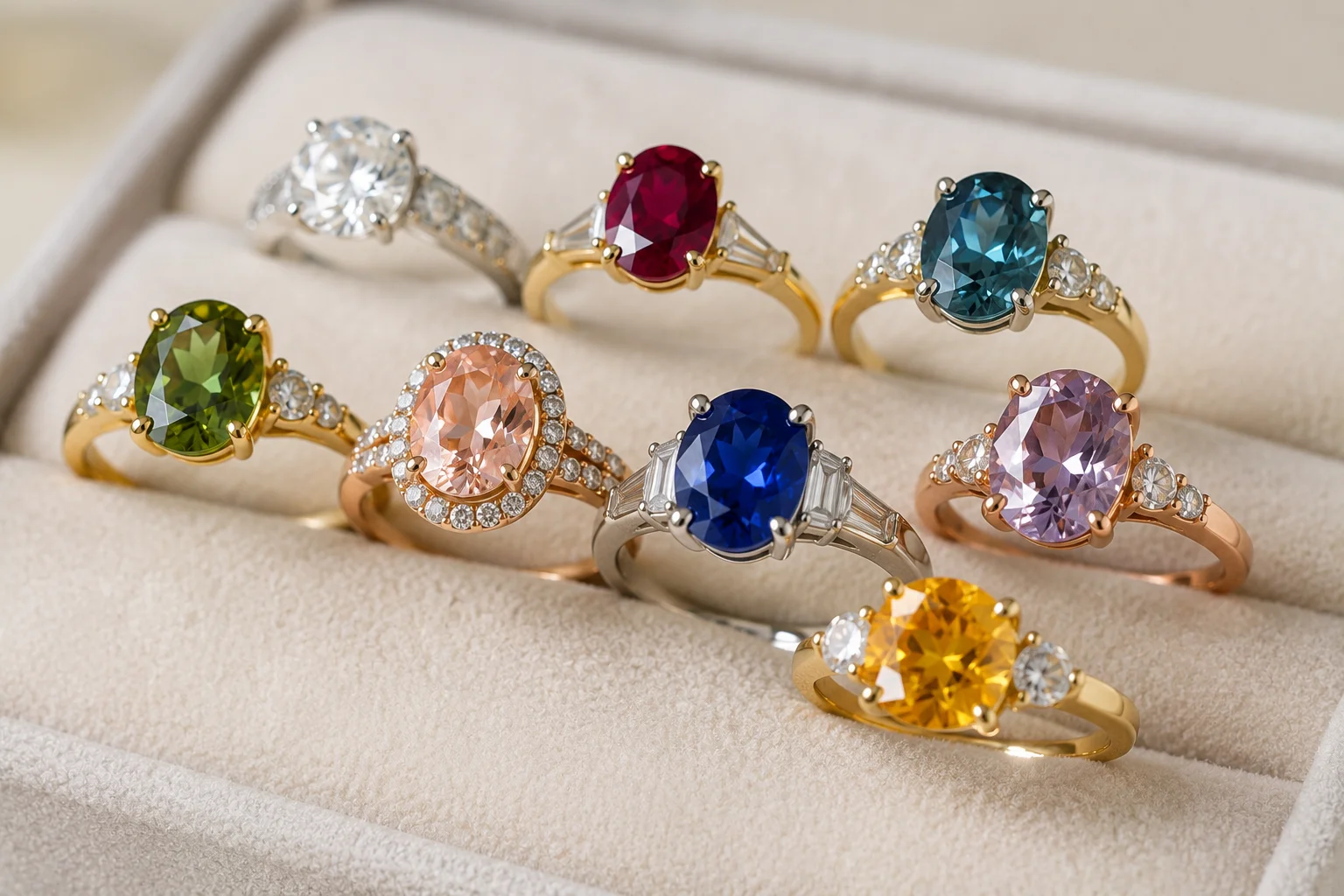
Best Gemstones for Engagement Rings: Value & Buying Guide
The best gemstones for engagement rings need to do something more demanding than look beautiful in a jewelry-store spotlight. A center stone worn regularly encounters countertop edges, door frames, clothing, soap, hand lotion, dust, accidental knocks, resizing work and repeated contact with harder materials, so durability has to be considered alongside color, rarity, treatment, price and personal preference.
Diamond, sapphire, ruby, moissanite, spinel and alexandrite provide the strongest overall combinations for frequent wear. Aquamarine, morganite, selected garnets and tourmaline can also make excellent engagement rings when the wearer accepts somewhat greater care and the setting protects vulnerable edges. Emerald remains an iconic luxury choice, but its common fissures and clarity enhancement make it substantially more maintenance-sensitive than sapphire or spinel despite a respectable hardness number.
The best gemstones for engagement rings are therefore not simply the stones at the top of the Mohs scale. Hardness measures scratch resistance; toughness describes resistance to breaking and chipping; cleavage can create structurally weaker directions; inclusions and treatments can introduce additional vulnerabilities. A sound engagement-ring choice considers all of these properties together.
Best Gemstones for Engagement Rings at a Glance
| Gemstone | Mohs hardness | Practical durability | Color options | Strongest reason to choose it | Main consideration |
|---|---|---|---|---|---|
| Diamond | 10 | Excellent for frequent wear | Colorless plus many fancy colors | Maximum scratch resistance and classic brilliance | Cleavage means it can still chip |
| Sapphire | 9 | Excellent | Blue, pink, yellow, green, teal, white, purple and more | Strongest natural colored-gem all-rounder | Treatment and dark zoning require attention |
| Ruby | 9 | Excellent | Red to purplish red | Outstanding durability with saturated red color | Fine untreated material can become expensive |
| Moissanite | About 9.25 | Excellent | Mainly colorless to near-colorless; some colored material | Brilliance, durability and larger visual size for the budget | More rainbow fire than diamond |
| Alexandrite | 8.5 | Excellent | Greenish to reddish color change | Rarity, color change and strong durability | Fine natural stones are scarce and costly |
| Spinel | 8 | Very good to excellent | Red, pink, blue, purple, gray, black and more | Durable natural gem with wide color range | Fine saturated colors can be rare |
| Aquamarine | 7.5–8 | Very good with sensible wear | Greenish blue to blue | Large, clean stones and elegant color | Hard knocks and fractures require care |
| Morganite | 7.5–8 | Very good with sensible wear | Pink, peach, salmon | Large pastel stones and accessible visual size | Shows dirt readily; more vulnerable than sapphire |
| Garnet | About 6.5–7.5 depending on type | Good for many varieties | Red, orange, green, purple, pink and more | Broad color and value range | Species and inclusions affect durability |
| Tourmaline | 7–7.5 | Good with protection | Extremely broad color range | Exceptional color choice and individuality | More vulnerable to impact than corundum |
| Emerald | 7.5–8 | Conditional for frequent wear | Green to bluish green | Iconic color and prestige | Fissures and fillers require careful wear |
| Topaz | 8 | Conditional | Blue, colorless, yellow, pink and more | Large stones can be accessible | Perfect cleavage |
| Tanzanite | 6–7 | Better for careful wear | Violet-blue to blue-violet | Distinctive color | Cleavage and lower abrasion resistance |
| Opal | About 5–6.5 | Higher-care | White, black and many play-of-color patterns | Unique optical appearance | Scratching, impact and stability concerns |
The strongest best gemstones for engagement rings are those whose real durability profile matches how the ring will actually be worn.
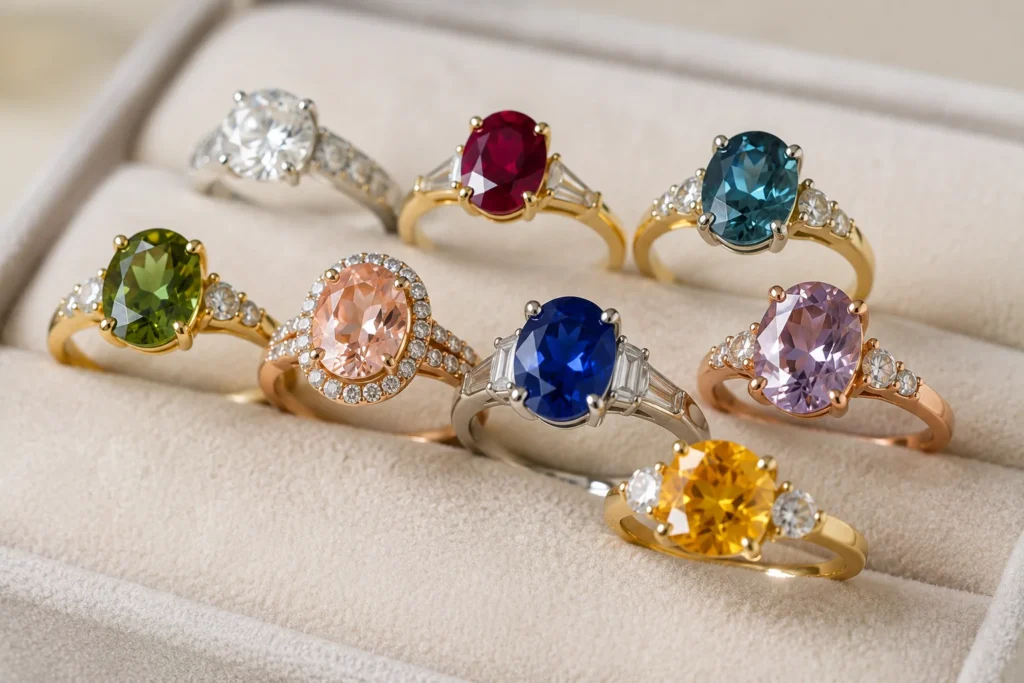
1. Sapphire: Best Overall Natural Colored Gemstone
For someone who wants color rather than a conventional colorless center stone, sapphire is one of the best gemstones for engagement rings.
Sapphire is corundum, Al₂O₃, with Mohs hardness 9, excellent toughness and no easy cleavage. That combination gives it outstanding resistance to the abrasion and minor impacts associated with frequent ring wear.
Blue sapphire remains the classic choice, but the color range is much broader. Pink, yellow, green, teal, purple, orange, colorless, gray, parti-colored and color-changing sapphires allow the ring to look highly personal without sacrificing the material’s strong durability.
The blue engagement-ring gemstones comparison shows why blue sapphire remains the strongest all-around natural blue option for demanding everyday wear.
What to Look for in Sapphire
Color should remain attractive in normal room lighting rather than only beneath intense jewelry-store spotlights.
Very dark blue stones can appear almost black indoors. Strong color zoning may also create obvious pale and dark patches when the gem moves.
Cut should distribute color while still returning enough light through the crown.
Treatment is another major issue. Conventional heat treatment is widespread and accepted in the sapphire market, but diffusion treatment, fracture filling, coatings and laboratory-grown origin should be disclosed accurately because they belong to different value categories.
A fine untreated sapphire may receive a substantial rarity premium. That does not mean treatment automatically makes a stone unsuitable for an engagement ring; it means price should correspond to what the stone actually is.
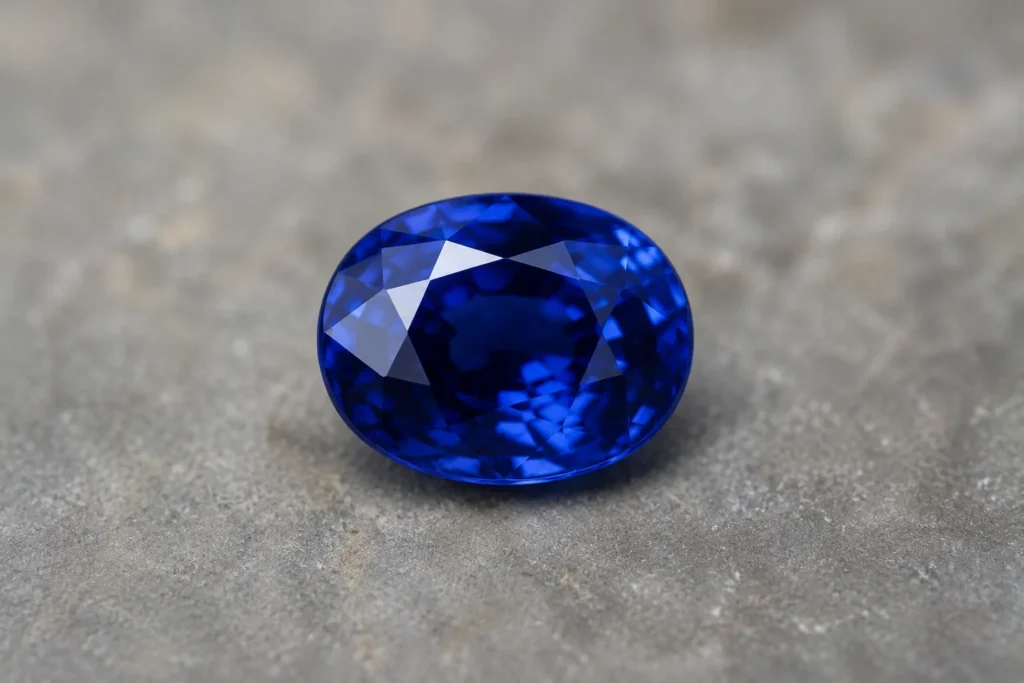
2. Ruby: Best for a Durable Red Engagement Ring
Ruby shares sapphire’s corundum structure and therefore combines Mohs hardness 9 with excellent practical toughness.
For someone who wants saturated red, ruby is among the best gemstones for engagement rings mechanically as well as visually.
Color is the main value driver. Fine material generally ranges from strong red to slightly purplish red while retaining enough brightness to avoid looking blackish or dull.
Natural inclusions are expected. A completely flawless appearance should not automatically be considered superior because synthetic ruby and heavily treated material can also look unusually clean.
Treatment deserves close attention.
Conventional heating is common, whereas lead-glass-filled ruby belongs to a different durability and value category because the filling material is substantially less resistant than corundum itself.
The dedicated ruby engagement ring guide covers how treatment, color, setting design and laboratory documentation affect this specific purchase.
Among the best gemstones for engagement rings, ruby makes particular sense when the wearer wants intense color without accepting the structural vulnerabilities of emerald or tanzanite.
3. Diamond: Best for Maximum Scratch Resistance
Diamond remains one of the best gemstones for engagement rings because no commonly worn natural gemstone matches its scratch resistance.
It ranks Mohs 10.
That does not mean diamond is unbreakable.
Diamond has cleavage directions, and a sufficiently concentrated impact can chip a girdle, point or facet junction. Pears, marquises and princess cuts therefore benefit from metal protection at their sharpest points.
A practical diamond choice also depends heavily on cut.
A well-proportioned stone can display stronger brightness, fire and scintillation than a larger diamond with poor optical performance. For that reason, carat weight should not automatically receive priority over cut quality.
Natural and laboratory-grown diamonds share diamond’s fundamental crystalline carbon structure and physical properties but differ in origin and market behavior.
If the decision is broader than diamond alone, diamond alternatives compares moissanite, sapphire, zircon, topaz and other colorless options by durability and appearance.
4. Moissanite: Best Non-Diamond Colorless Choice
Moissanite combines exceptional hardness, good practical toughness and unusually strong brilliance, making it one of the best gemstones for engagement rings when diamond identity is not essential.
Modern jewelry moissanite is laboratory-grown silicon carbide.
It has greater dispersion than diamond, meaning it can display stronger rainbow-colored flashes. Larger brilliant-cut stones may make that difference particularly obvious.
Some buyers love the additional fire.
Others prefer diamond’s more restrained balance of white brilliance and spectral flashes.
Neither preference is more correct.
The relevant question is whether you genuinely like moissanite’s visual character rather than expecting it to imitate diamond perfectly.
The moissanite engagement ring guide covers cut style, face-up dimensions, wedding-band fit, setting structure and disclosure in more depth.
Moissanite is particularly strong for someone who wants a visually substantial center stone, frequent-wear durability and a lower stone cost than many comparable diamond choices.
5. Spinel: Best Underused Natural Engagement Gem
Spinel deserves a much higher position in most discussions of the best gemstones for engagement rings.
Natural spinel ranks Mohs 8, generally has good toughness and lacks an easy cleavage direction. Those characteristics make it a strong ring stone.
Its color range is also remarkable.
Red and hot-pink spinels can compete visually with ruby. Lavender, purple, gray and blue material offers subtler alternatives. Black spinel works particularly well in high-contrast contemporary designs.
Historically, red spinel was sometimes mistaken for ruby because the two occur in similar geological environments and can overlap visually.
Modern gemological testing separates them readily.
The broad comparison of sapphire, emerald and ruby provides context for traditional high-value colored gems, while spinel can offer a less conventional option with impressive everyday durability.
The primary buying concern is disclosure.
Synthetic spinel has existed for a long time, so natural origin should not be assumed simply because a stone is attractive and inexpensive.
6. Alexandrite: Best Rare Color-Change Choice
Alexandrite is the color-changing variety of chrysoberyl and is one of the best gemstones for engagement rings when rarity, optical phenomenon and durability all matter.
It ranks Mohs 8.5, has excellent toughness and no cleavage.
Those characteristics are unusually favorable for a rare colored gemstone.
The difficult part is quality.
Fine natural alexandrite should show an obvious and attractive change between different lighting environments. A stone that merely shifts from muddy greenish gray to dull brownish red should not receive the same premium as a gem displaying vivid, distinct colors.
Size also affects value sharply because fine natural alexandrite becomes increasingly scarce as weight rises.
Laboratory-grown alexandrite exists and can show beautiful color change. It can be an excellent engagement-ring material when laboratory-grown origin is disclosed clearly.
Among the best gemstones for engagement rings, alexandrite is especially suitable for someone who values an unusual optical phenomenon more than conventional color.
7. Aquamarine: Best for Pale Blue and Larger Sizes
Aquamarine is blue to greenish-blue beryl and ranks approximately 7.5–8 on the Mohs scale.
GIA considers it durable enough for jewelry when protected from hard knocks, making it one of the stronger moderate-durability options among the best gemstones for engagement rings.
Its major advantage is size.
Aquamarine can form as relatively large, clean crystals, allowing cutters to produce visually substantial gemstones without the extreme size premiums associated with ruby, alexandrite or fine sapphire.
Color ranges from very pale icy blue to stronger blue and greenish blue.
Extremely pale stones can look almost colorless in small sizes, so judge the actual ring appearance rather than relying on the word aquamarine.
Heat treatment is common and can reduce greenish components to create a bluer appearance.
A low-profile setting is helpful for a large aquamarine because the stone’s dimensions themselves increase the chance of impact.
8. Morganite: Best Pastel Pink Choice for Size
Morganite is pink to orange-pink beryl with Mohs hardness around 7.5–8.
Like aquamarine, it can occur in large, relatively clean crystals, which makes it possible to obtain a substantial center stone without entering the pricing territory of fine pink sapphire or pink diamond.
The morganite engagement ring guide explains the setting and wear considerations specific to these larger pastel stones.
Morganite performs best for someone who understands its compromises.
It is durable enough for jewelry with proper care, but it scratches more readily than sapphire and can be damaged by hard knocks. Large stones also show lotion, soap film and fingerprints readily because pale transparent material loses brilliance quickly when dirty.
Heat treatment may alter orange-pink material toward a purer pink.
A buyer should evaluate color in neutral lighting because pale morganite can look significantly stronger in warm or heavily edited photographs.
Among pink best gemstones for engagement rings, sapphire and spinel provide greater durability, while morganite provides larger pastel visual presence for the budget.
9. Garnet: Best for Variety Across Different Budgets
“Garnet” does not describe one identical red gemstone.
It is a mineral group containing several species and varieties with different compositions, colors and value levels.
Almandine and pyrope can provide classic red at accessible prices. Rhodolite offers raspberry to purplish red. Spessartine can show brilliant orange. Tsavorite and demantoid provide important green options, while some garnets show color change.
Many garnets lack cleavage and perform well in rings, though hardness and toughness vary somewhat by type.
For someone seeking green without choosing emerald, tsavorite can offer an attractive combination of saturated color and comparatively straightforward care.
Garnet becomes one of the best gemstones for engagement rings when the specific variety—not merely the group name—is evaluated for inclusions, durability, cut and price.
10. Tourmaline: Best for Unusual Color
Few gemstone families offer as much color variety as tourmaline.
Pink, red, green, blue, teal, yellow, orange, brown, black and multicolored crystals are all available. Parti-color and watermelon tourmalines can also create engagement rings that look completely unlike conventional diamond jewelry.
Tourmaline usually ranks around Mohs 7–7.5.
It can work in engagement rings, particularly when the individual stone is sound and the setting protects exposed edges, but it is less forgiving of repeated hard impacts than sapphire or spinel.
Fine Paraíba-type colors, vivid rubellite and certain saturated green or blue stones can become expensive, so “tourmaline” should not automatically be interpreted as a budget choice.
Among the best gemstones for engagement rings, tourmaline is strongest for someone who prioritizes distinctive color and accepts moderately more deliberate wear.
11. Emerald: Best Iconic Green Choice, but Not Low-Maintenance
Emerald is one of the world’s most recognizable gemstones and can certainly serve as an engagement-ring center.
However, it should not be chosen using hardness alone.
Emerald is green beryl and ranks approximately 7.5–8 on the Mohs scale, yet natural emerald commonly contains numerous fissures. Many fashioned stones also receive oil, resin or polymer clarity enhancement within surface-reaching fractures.
Those features make emerald more vulnerable to impact and aggressive cleaning than ruby or sapphire.
The emerald engagement ring guide covers protected settings, treatment disclosure and maintenance in greater detail.
For someone committed to emerald, design matters enormously.
A low setting, bezel, halo or substantial corner protection can reduce accidental contact. Thin exposed corners on emerald cuts deserve particular attention.
Warm soapy water and gentle cleaning are safer than assuming ultrasonic or steam cleaning is appropriate.
Emerald remains one of the best gemstones for engagement rings for a careful wearer who values its distinctive green enough to accept the additional maintenance.
Engagement-Ring Gemstones That Need More Caution
Several attractive stones can be worn in rings, but they should not be presented as equally forgiving alternatives to sapphire or diamond.
Tanzanite
Tanzanite has extraordinary violet-blue color, but its moderate hardness and cleavage make it more vulnerable to abrasion and hard impact.
It is more suitable for careful wear or heavily protected settings.
Topaz
Topaz ranks Mohs 8, which can create a false impression of unrestricted durability.
The mineral has perfect cleavage.
A protected topaz ring can work, but it is not as mechanically forgiving as sapphire despite the respectable hardness number.
Iolite
Iolite ranks around Mohs 7–7.5 and has perfect cleavage in one direction.
Its blue-violet pleochroism can be beautiful, but a hard blow can split the stone. GIA specifically recommends protective mountings or lower-impact jewelry when practical.
Opal
Opal can create a spectacular engagement ring, yet it requires substantially more care because of lower hardness, possible porosity, impact sensitivity and variety-specific stability concerns.
Moonstone
Moonstone’s adularescence is distinctive, but feldspar cleavage and modest hardness make an exposed daily ring more vulnerable than corundum, spinel or chrysoberyl.
None of these materials is “bad.”
They simply require the wearer to accept a different maintenance profile.
Hardness Alone Does Not Tell You Which Gemstone Will Last
One of the most important principles when choosing the best gemstones for engagement rings is that Mohs hardness measures scratch resistance—not complete durability.
Diamond is Mohs 10 yet can cleave.
Topaz is Mohs 8 yet has perfect cleavage.
Emerald is approximately 7.5–8 but commonly contains fissures.
Alexandrite is 8.5 with excellent toughness and no cleavage, giving it a particularly favorable combination.
Sapphire and ruby rank 9 and pair that hardness with excellent toughness.
The practical equation is closer to:
everyday durability = scratch resistance + toughness + cleavage behavior + inclusions + treatment + setting protection
No single number replaces that assessment.
Best Gemstones for Engagement Rings by Color
Color can be a more useful starting point than gem name.
Blue
For blue, sapphire provides the strongest overall combination of durability, range and availability.
Spinel is an excellent less-common alternative, while aquamarine offers a paler, cleaner visual style.
Tanzanite, blue zircon and blue topaz work better when the wearer accepts specific durability compromises.
Green
Green sapphire and spinel are particularly strong for frequent wear.
Tsavorite garnet offers vivid color with good practical performance.
Emerald provides the iconic luxury green but requires more maintenance.
The green engagement-ring gemstone comparison separates these choices by durability, hue and care.
Pink
Pink sapphire and spinel provide the strongest natural colored-gem combinations for frequent wear.
Morganite offers much larger pastel stones for many budgets, while pink tourmaline provides a wide range from pale blush to saturated red-pink.
The pink engagement-ring gemstones guide compares those color-specific options without forcing every pink gem into the same durability category.
Red
Ruby provides the strongest classic red center stone.
Red spinel can offer outstanding color and durability with a different market profile, while rhodolite and other garnets can produce accessible red-to-purple alternatives.
Colorless
Diamond, moissanite and white sapphire are the primary durable choices.
Diamond provides maximum hardness and traditional diamond optics.
Moissanite provides intense brilliance and fire.
White sapphire offers natural corundum identity with more restrained sparkle.
Natural, Laboratory-Grown and Simulated Are Different Categories
The best gemstones for engagement rings can be natural, laboratory grown or manufactured simulants.
These terms should not be mixed together.
A laboratory-grown diamond is diamond produced through manufacturing rather than geological growth.
A laboratory-grown sapphire or ruby has corundum’s essential structure and composition but forms in a laboratory.
Moissanite is silicon carbide and is a different gem material from diamond.
Cubic zirconia is another separate manufactured material.
The real vs fake diamond guide explains why laboratory-grown diamond, diamond simulants and outright misrepresentation should not be treated as the same issue.
Disclosure should answer two independent questions:
What is the material?
How did it originate?
A ring can be excellent regardless of natural or laboratory-grown origin when the description and price accurately reflect those facts.
Treatment Matters More Than Many Buyers Realize
Treatment can influence color, apparent clarity, value, care and sometimes durability.
Sapphire and ruby are often heated.
Emerald frequently receives oil or resin in fractures.
Morganite may be heated to modify color.
Aquamarine is commonly heated to reduce greenish components.
Some diamonds are fracture-filled or color treated.
Glass-filled ruby requires much more cautious repair and cleaning than ordinary heated ruby.
Diffusion-treated sapphire occupies a different market category from conventionally heated material.
A seller should provide treatment information in writing for a meaningful purchase.
The strongest best gemstones for engagement rings are not necessarily untreated stones; they are stones whose treatment, condition and price are understood before purchase.
Choose the Setting Together With the Gemstone
A center stone should not be selected independently of its setting.
Prong Settings
Prongs expose more of the gemstone to light and can create a visually open design.
They also leave more of the girdle exposed.
Pointed shapes such as pear, marquise and princess cuts need protection at vulnerable tips, often through V-prongs or substantial corner prongs.
Bezel Settings
A bezel surrounds much or all of the girdle with metal.
That makes it particularly useful for someone who works with their hands or chooses a gemstone that benefits from additional edge protection.
The trade-off is a heavier metal appearance and, depending on design, potentially less visible side profile.
Halo Settings
A halo can visually enlarge the center and provide some impact buffering around the perimeter.
However, the many small stones and prongs create additional maintenance points.
Low-Profile Settings
A lower center stone is less likely to catch on clothing or strike external surfaces.
This can be especially useful for larger aquamarine or morganite.
Tension Settings
True tension settings place substantial controlled pressure on the gemstone.
They require a material and individual stone capable of handling that engineering, making them inappropriate for many fractured or cleavage-sensitive gems.
The crystal rings guide provides a broader comparison of ring structures, wear and gemstone compatibility.
Ring Height Matters More Than Photographs Suggest
A dramatic high-set center can look elegant in side-profile photographs while becoming inconvenient during everyday use.
High settings:
catch on clothing more readily, strike hard surfaces more easily and can require a specially shaped wedding band.
Low settings usually provide greater practicality.
However, some very low baskets prevent a straight wedding band from sitting flush against the engagement ring.
This is why wedding-band fit should be checked before buying, not discovered afterward.
Ask to see the ring from the side and underneath.
A top-down photograph does not reveal how high the center sits above the finger.
Wedding-Band Fit Should Be Planned Early
An engagement ring does not exist alone once a wedding band is added.
Straight bands fit flush against some solitaire settings but leave gaps beside others.
Low baskets, large halos and protruding galleries can require a curved or contoured wedding band.
There is nothing inherently wrong with that design, but the buyer should know it in advance.
If you want a simple straight band later, confirm that the engagement-ring basket leaves enough clearance.
This practical issue can matter more to long-term satisfaction than a small difference in center-stone carat weight.
Metal Choice Affects Setting Durability
The center gem may receive most of the attention, but the metal holds everything together.
Platinum provides dense, durable prongs and develops a characteristic surface patina rather than losing metal in exactly the same way as some gold alloys.
Gold remains the dominant choice for engagement rings and can be selected in yellow, rose or white alloys.
Higher gold purity does not automatically mean the strongest ring architecture. Alloy composition, shank thickness, prong dimensions and craftsmanship all matter.
Extremely thin bands may look delicate in photographs but leave less metal available for future wear, polishing and repair.
For an engagement ring expected to last decades, sufficient structure is more important than making every visible component as thin as possible.
Stone Size Should Be Compared in Millimeters
Carat is a unit of weight, not face-up size.
Different gemstones have different densities, and different cuts distribute weight differently.
Two one-carat stones can therefore look noticeably different when viewed from above.
A deep stone may hide substantial weight below the setting.
A shallower but well-proportioned stone can appear larger while weighing less.
For the best gemstones for engagement rings, compare:
length × width × depth + carat weight
Millimeter dimensions tell you how much finger coverage the gem provides.
Carat weight tells you how much it weighs.
Both matter.
Large Stones Need Stronger Ring Architecture
A large center gem places more mechanical demand on the ring.
It creates greater leverage when the stone strikes an object and may require larger prongs, a wider basket and a more substantial shank.
This is particularly relevant with aquamarine, morganite and other gemstones available in large sizes at comparatively accessible prices.
Buying a larger stone because it is affordable does not mean an ultra-thin setting is appropriate.
The center and mounting should be designed as one structure.
Cut Quality Matters Across Every Gemstone
Cut affects beauty even when there is no standardized cut grade comparable with the grading systems commonly used for round brilliant diamonds.
Look for:
- Attractive face-up color
- Strong brightness
- Limited windowing
- Limited excessive extinction
- Reasonable symmetry
- A sound girdle
- Protected points
- No unnecessary pavilion depth
A window appears as a transparent or washed-out area through which the setting or finger can be seen easily.
Extinction creates dark areas where little useful light returns.
Some extinction is normal in many colored stones, but a large lifeless center reduces appearance.
The best gemstones for engagement rings should be judged from normal viewing distance as well as under magnification.
Color Usually Matters More Than Microscopic Perfection
Colored gemstones do not follow diamond clarity expectations.
Emerald can contain obvious inclusions and still be valuable.
Ruby and sapphire frequently contain silk, crystals, healed fractures and other natural features.
Spinel, tourmaline, garnet and aquamarine have their own typical inclusion patterns.
The relevant question is not whether the stone contains any inclusion.
Ask whether the inclusions:
damage transparency, distract from color, reach the surface, threaten durability or provide evidence relevant to origin or treatment.
Paying a large premium for microscopic cleanliness can be a poor use of budget when color is the feature you actually see.
Origin Claims Should Not Replace Quality
“Ceylon sapphire,” “Burmese ruby,” “Colombian emerald” and similar locality names can influence market perception.
Origin can matter.
However, famous geography does not make every stone from that location beautiful.
A dark sapphire from a prestigious origin remains dark.
A weakly colored ruby remains weakly colored.
An unattractive emerald does not become better simply because a famous country name appears on the report.
Buy quality first.
Treat origin as an additional value factor when the stone itself justifies the premium.
For important stones where geographic origin materially affects price, an independent laboratory opinion is more meaningful than seller assertion alone.
Budget Should Include the Setting
One common mistake when shopping for the best gemstones for engagement rings is spending almost the entire budget on the center stone.
The ring still requires:
metal, setting labor, side stones, sizing, finishing and future maintenance.
A less expensive center stone may permit a stronger or more sophisticated setting.
This is particularly relevant to moissanite, aquamarine, morganite, garnet and laboratory-grown sapphire, where substantial visual size can leave more of the budget available for metal and construction.
The affordable gemstones guide explains why lower gemstone cost does not automatically mean low quality.
A strong setting with a beautiful moderate-priced gem can be a better long-term ring than an expensive stone held by underbuilt jewelry.
Sizing and Resizing Should Be Considered Before Purchase
Not every engagement-ring design is equally easy to resize.
A simple solitaire shank may offer considerable adjustment flexibility.
Full eternity bands, continuous pavé, elaborate engraving and certain tension-style constructions can be difficult or impossible to resize significantly.
Very large size changes can also alter stone spacing, prong geometry and ring shape.
If finger size may change or the ring is being purchased as a surprise, ask the jeweler how much resizing the actual design can tolerate.
The answer should be specific to that ring.
Replacement Risk Is Part of Gemstone Value
Replacement difficulty is an overlooked part of choosing the best gemstones for engagement rings.
Replacing a common calibrated diamond or sapphire may be relatively straightforward.
Replacing a rare alexandrite with the same color-change behavior, an unusual parti sapphire, a matched precision-cut tourmaline or an uncommon old-mine gemstone can be much more difficult.
This does not mean rare stones should be avoided.
It means insurance, documentation and careful measurement become more important.
Keep the laboratory report, sales invoice, exact dimensions and detailed photographs.
Which Gemstones Are Best for Active Lifestyles?
Someone who works frequently with tools, machinery, gym equipment, gardening or manual tasks should prioritize durability and low-profile settings.
Sapphire, ruby, diamond, moissanite, spinel and alexandrite are the strongest general options.
Even then, no engagement ring should be expected to survive every activity.
Removing a ring during high-impact work protects not only the gemstone but also the mounting and the wearer’s hand.
The strongest stone cannot compensate for repeatedly bending prongs or crushing a setting.
Which Gemstones Need a Protective Setting?
Emerald, topaz, tanzanite, iolite and many tourmalines benefit substantially from thoughtful protection.
Aquamarine and morganite also benefit when the stones are large or contain fractures.
Bezel edges, halos, substantial prongs and lower profiles can all reduce risk.
A protective setting cannot transform a fragile gem into sapphire, but it can change the probability and type of contact the stone experiences.
Cleaning an Engagement Ring Safely
Warm water, mild soap and a soft brush provide the safest general cleaning starting point for many engagement-ring gemstones.
Do not assume steam or ultrasonic cleaning is appropriate simply because the center stone is hard.
Emerald fillers can be affected.
Fractures can create problems in otherwise durable gems.
Side stones, adhesives, coatings and settings may have different limitations from the center stone.
Diamond and sapphire can be highly durable, but ultrasonic vibration can still expose a loose mounting problem.
Inspect the ring periodically and have worn prongs repaired before the stone begins moving.
Best Gemstones for Engagement Rings by Priority
If maximum scratch resistance matters most, choose diamond.
If colored-gem durability and broad color choice matter most, choose sapphire.
If red color with outstanding everyday performance matters most, choose ruby.
If brilliance and value in a non-diamond colorless stone matter most, choose moissanite.
If rarity plus excellent durability matters most, consider alexandrite.
If uncommon natural color and good durability matter most, choose spinel.
If large pale-blue size at a manageable budget matters most, choose aquamarine.
If large pastel pink presence matters most, choose morganite.
If green luxury and iconic character outweigh easy maintenance, choose emerald.
If individual color is more important than maximum ruggedness, explore garnet and tourmaline.
The best gemstones for engagement rings are the ones whose strengths match the buyer’s real priorities rather than whichever material currently receives the most marketing.
Frequently Asked Questions
What are the best gemstones for engagement rings overall?
The best gemstones for engagement rings for frequent wear include diamond, sapphire, ruby, moissanite, spinel and alexandrite. Aquamarine, morganite, garnet and tourmaline can also work well with sensible settings and care.
What is the best colored gemstone for an engagement ring?
Sapphire is one of the strongest overall choices because it combines Mohs hardness 9, excellent toughness, no cleavage and a very broad color range.
Which gemstone is most durable for an engagement ring?
Diamond provides the greatest scratch resistance at Mohs 10, although it has cleavage and can still chip. Sapphire and ruby combine Mohs 9 hardness with excellent toughness and are exceptionally strong colored-gem choices.
Is moissanite good for an engagement ring?
Yes. Laboratory-grown moissanite combines high hardness, good practical toughness and exceptional brilliance. Its strong rainbow dispersion gives it a different appearance from diamond, so buyers should choose it because they enjoy that optical character.
Is spinel durable enough for an engagement ring?
Yes. Spinel ranks Mohs 8, generally has good toughness and lacks easy cleavage, making it one of the better natural colored stones for regular ring wear.
Is alexandrite suitable for daily wear?
Yes. Alexandrite ranks Mohs 8.5, has excellent toughness and no cleavage, making it highly suitable for rings. Fine natural alexandrite is scarce, so replacement and price may be larger concerns than durability.
Is aquamarine strong enough for an engagement ring?
Aquamarine ranks Mohs 7.5–8 and can be durable enough for regular jewelry when protected from scratches and hard knocks. A lower or more protective setting is particularly useful for large stones.
Is morganite a good everyday engagement stone?
Morganite can be worn regularly with care and ranks Mohs 7.5–8. It is more vulnerable to abrasion and impact than sapphire or diamond, so setting protection and realistic wear habits become more important.
Is emerald too fragile for an engagement ring?
Not necessarily, but emerald requires more care than sapphire or ruby. Natural stones commonly contain fissures and may be clarity-enhanced, so protected settings and gentle cleaning are particularly important.
Is topaz suitable for an engagement ring?
Topaz can be used, but its Mohs hardness of 8 does not tell the entire story. Perfect cleavage makes it vulnerable to splitting from a concentrated impact, so a protected setting and careful wear are important.
Is tanzanite a good engagement-ring stone?
Tanzanite can make a beautiful engagement ring for a careful wearer, but its moderate hardness and cleavage make it less suitable for unrestricted daily wear than sapphire, spinel or alexandrite.
What is the best green gemstone for an engagement ring?
Green sapphire, green spinel and tsavorite garnet provide strong combinations of color and durability. Emerald remains the iconic green choice but requires more careful maintenance.
What is the best pink gemstone for an engagement ring?
Pink sapphire and pink spinel are among the strongest natural choices for frequent wear. Morganite offers larger pastel-pink stones but requires somewhat more protection.
Are lab-grown gemstones good for engagement rings?
Yes, when accurately disclosed. Laboratory-grown diamond, sapphire, ruby and alexandrite can have the essential physical properties of their natural counterparts. Their origin and market value are different, but laboratory growth does not inherently make them unsuitable for jewelry.
Should an engagement-ring gemstone have a laboratory report?
A report becomes increasingly useful when natural versus laboratory-grown origin, treatment, geographic origin or rare identity materially affects price. Very inexpensive or straightforward stones may not justify the cost of extensive documentation.
Does a higher Mohs number always mean a better engagement-ring gemstone?
No. Hardness measures scratch resistance. Toughness, cleavage, fractures, treatment and setting design also influence durability. Topaz, emerald and diamond demonstrate why the full structural picture matters.
Should I choose a bezel or prong setting?
A bezel provides greater edge protection and can suit active wearers or more vulnerable gems. Prongs expose more of the gemstone and create a lighter appearance but require periodic inspection. The best choice depends on the stone, shape and lifestyle.
What gemstone shape is safest for an engagement ring?
Rounded shapes such as round and oval eliminate pointed tips that can chip. Pear, marquise and princess cuts can still perform well when their vulnerable points or corners receive adequate metal protection.
How important is wedding-band fit?
Very important. Low baskets and large halos can prevent a straight wedding band from sitting flush. Check the engagement ring from the side and decide whether you want a straight, curved or custom-fitted wedding band before purchase.
Should I prioritize carat weight or millimeter size?
Use both, but millimeter dimensions tell you more about visible finger coverage. Carat measures weight, and two stones of equal weight can look very different because of density and cutting depth.
What are the best gemstones for engagement rings if I want something unusual?
Spinel, alexandrite, parti sapphire, tsavorite garnet, unusual tourmaline and color-changing garnet can all create distinctive rings without sacrificing gemstone identity. Choose the specific stone only after checking durability, treatment and replacement difficulty.
What matters most when choosing among the best gemstones for engagement rings?
Start with everyday wearability, then evaluate color, cut, treatment, origin, setting design, visible size, maintenance and total budget. The strongest engagement-ring gemstone is not merely the rarest or hardest stone—it is the one that fits the wearer and the way the ring will actually be used.