Barite Meaning: Mineral Identity, History & Symbolism
Barite meaning begins with one of the most physically distinctive common collector minerals: barium sulfate, BaSO₄. Barite crystallizes in the orthorhombic system and is best known for its unusually high density relative to its generally pale appearance. A clear or white specimen can look similar to calcite, gypsum, or quartz at first glance, yet it feels unexpectedly heavy because barium is a high-mass element incorporated directly into the crystal structure. This unusual density is so characteristic that the mineral’s name derives from a Greek root associated with heaviness.
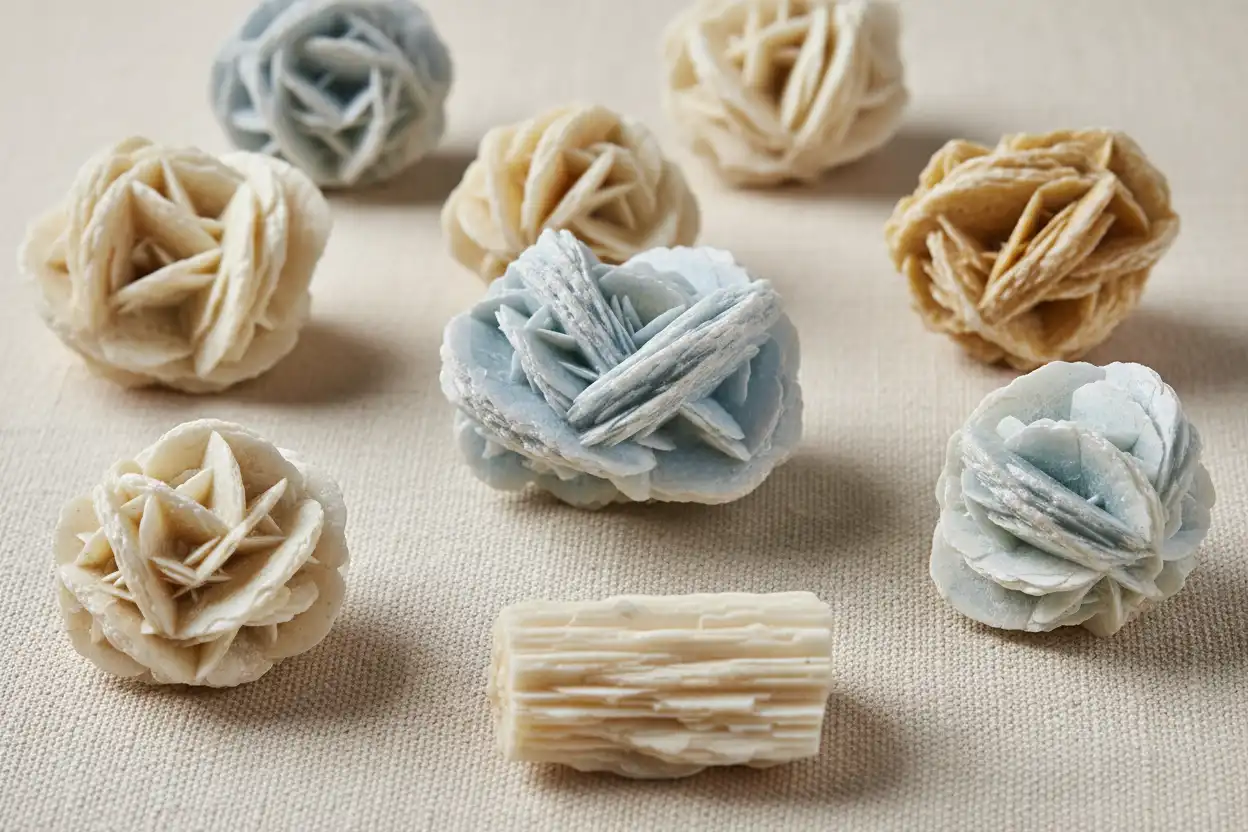
Natural barite occurs in colorless, white, gray, pale yellow, honey, brown, blue, greenish, reddish, and occasionally darker material. Crystals may be tabular, bladed, prismatic, fibrous, massive, nodular, rosette-like, or arranged in cockscomb aggregates. Many specimens show vitreous luster on intact faces and pearly reflections along cleavage surfaces, while iron staining or inclusions can modify the body color substantially.
Modern barite meaning often emphasizes grounding, stability, clarity, protection, focus, or emotional balance. These associations can be personally meaningful as symbolism, but they are not measurable effects of barium sulfate. Barite has not been demonstrated to neutralize negative energy, alter nervous-system function, remove toxins, balance emotions, improve psychic perception, or produce medical healing through contact with the mineral.
Readers exploring other evidence-led mineral references can browse the broader Gemstone Guides.
Barite Identity at a Glance
| Property | Barite |
|---|---|
| Mineral species | Barite |
| Chemical formula | BaSO₄ |
| Mineral class | Sulfate |
| Crystal system | Orthorhombic |
| Common colors | Colorless, white, gray, yellow, honey, brown, pale blue, greenish, reddish |
| Transparency | Transparent to translucent; massive material can be opaque |
| Luster | Vitreous to pearly |
| Mohs hardness | Approximately 3–3.5 |
| Specific gravity | Approximately 4.3–4.6 |
| Cleavage | Perfect in one direction and good in others |
| Tenacity | Brittle |
| Streak | White |
| Common habits | Tabular, bladed, prismatic, cockscomb, rosette, fibrous, massive |
| Typical geological settings | Hydrothermal veins, sedimentary deposits, evaporitic settings, replacement zones, cavities and ore deposits |
| Common associations | Calcite, fluorite, galena, sphalerite, quartz and other hydrothermal or sedimentary minerals |
| Main identification clue | High density combined with sulfate mineral properties |
| Main ownership concerns | Softness, cleavage, brittleness and fragile crystal edges |
Barite’s high density is the property that most often surprises new collectors. A crystal that looks visually light can feel nearly twice as heavy as a similarly sized quartz specimen.
Why Barite Feels So Heavy
Barite’s density comes from barium, an element with a relatively high atomic mass. Because barium occupies an essential structural position in BaSO₄, the resulting mineral packs much more mass into a given volume than quartz, calcite, feldspar, or many other pale minerals.
Typical barite specific gravity is around 4.3–4.6. Quartz is roughly 2.65, calcite around 2.71, and fluorite around 3.18. This means a compact barite crystal of the same external volume can feel dramatically heavier than many visually similar materials.
The weight difference is useful diagnostically, but hand-heft should still be treated as an initial clue rather than a precise measurement. A hollow, porous, thin, or matrix-rich specimen may feel lighter than expected, while a small dense sulfide attached to another mineral can create the opposite impression.
Measured specific gravity is stronger evidence than subjective weight.
Barite Is a Sulfate, Not a Sulfide
The word sulfate is easy to confuse with sulfide, but the mineral classes are chemically different.
Barite contains sulfate groups, SO₄, bonded with barium. Sulfide minerals such as galena, sphalerite, pyrite, and chalcopyrite contain sulfur combined directly with metals without the same oxygen-rich sulfate structure.
This distinction matters because barite commonly occurs beside sulfide ores. A heavy pale barite crystal may sit directly next to metallic gray galena, creating a specimen with two dense but chemically different minerals.
The association can be geologically informative because hydrothermal fluids may deposit both sulfate and sulfide minerals as temperature, pressure, oxidation state, and fluid chemistry change.
Barite meaning should therefore begin with its sulfate identity rather than treating it as a generic “heavy stone.”
How Barite Forms
Barite forms in several geological environments because barium-bearing fluids can react with sulfate-bearing waters or rocks under a range of conditions. Hydrothermal veins are especially important. Hot mineralized fluids moving through fractures can transport dissolved barium until changing chemistry causes BaSO₄ to precipitate alongside quartz, fluorite, calcite, galena, sphalerite, or other ore minerals.
Barite also occurs in sedimentary systems, including bedded or nodular deposits where barium-rich fluids interact with sulfate in marine or pore-water environments. Some deposits form through replacement of earlier minerals or sedimentary material, while others develop around biological or geochemical interfaces where local conditions favor sulfate precipitation.
Evaporitic and low-temperature settings can produce additional barite occurrences, and crystals may grow in cavities where open space allows tabular or bladed forms to develop.
The mineral’s detailed host-rock relationships, fluid sources, ore associations, replacement textures, and sedimentary pathways are explored in Barite formation and deposit geology.
Why Barite Can Be Blue, Yellow, Brown, or Nearly Colorless
Ideal barite can be colorless. Most natural color therefore reflects trace impurities, lattice defects, inclusions, staining, radiation-related color centers, or combinations of these factors.
Pale blue barite is especially attractive to collectors, but blue color should not automatically be assigned to one specific impurity without evidence. Yellow and honey tones may arise from trace chemistry or included material, while brown and reddish colors can reflect iron-rich staining or mineral inclusions.
Massive barite can look very different from transparent crystals because grain boundaries, inclusions, and surface texture scatter light. A polished massive piece may therefore appear more opaque and muted than a clear crystal from the same general locality.
The safest description begins with observed color rather than assuming the cause.
More detailed optical behavior, refractive properties, birefringence, color centers, and transmitted-light characteristics belong in Barite optical properties and color behavior.
Barite Crystal Habits Can Be Highly Variable
Barite frequently forms broad tabular crystals with flat faces and sharp edges. Bladed crystals may cluster into fan-like groups, while cockscomb aggregates develop when numerous blades project outward in repeated patterns.
Rosette-like forms can also occur when flat crystals arrange around a center. Some barite roses resemble the famous gypsum desert rose habit, although the two minerals differ substantially in density, hardness, and chemistry.
Fibrous, nodular, massive, and concretionary barite can look almost unrelated to the classic transparent crystal form. This variability makes habit useful but not definitive.
A mineral should not be identified from one memorized shape alone.
Barite Roses Are Not Always “Desert Roses”
Rosette-shaped barite can develop in sedimentary or evaporitic environments where flat crystals grow around a central region and may incorporate sand or other sediment.
The resulting specimen can resemble gypsum desert roses.
Density is one of the easiest ways to distinguish them. Barite is much heavier than gypsum, while gypsum is also significantly softer. Crystal details and cleavage can provide further evidence.
The trade term “desert rose” is often applied broadly to rosette-shaped gypsum or barite, so material identity should be stated separately from the decorative name.
A rosette shape describes morphology.
It does not determine chemistry.
Barite’s Cleavage Makes It More Fragile Than Its Weight Suggests
A dense crystal can feel mechanically substantial, yet barite is relatively soft and brittle. Its Mohs hardness is only around 3–3.5, meaning quartz and ordinary environmental grit can scratch it readily.
Barite also has prominent cleavage. A hard blow can exploit those structural planes and split a crystal even when the specimen looks thick and solid.
This is why large barite blades should be handled from the matrix rather than by projecting crystal edges. A heavy specimen dropped only a short distance can generate substantial impact energy because of its mass.
Density increases weight.
It does not increase toughness.
Diagnostic Traits of Barite
Barite is often identified through a combination of high specific gravity, modest hardness, white streak, orthorhombic crystal habit, cleavage, luster, and geological association.
Specific gravity is particularly valuable because relatively few pale nonmetallic minerals feel as heavy as barite. Celestine can overlap in crystal habit and appearance but is somewhat less dense, while anglesite can also be extremely dense but differs in chemistry and optical behavior.
Calcite is much lighter and reacts readily with dilute acids.
Quartz is harder and much lighter.
Fluorite is softer than quartz but still lighter than barite and has very different cleavage.
Precise identification can be strengthened with refractive data, microscopy, Raman spectroscopy, X-ray diffraction, or chemical analysis when visual and physical clues are insufficient.
Microscopic inclusions, growth zoning, fractures, cleavage, secondary minerals, repairs, and coatings are examined more closely in the Barite microscope inclusion notebook.
Original Barite Specimen and Photo Checklist
| Observation | What it may reasonably support | What it cannot prove alone |
|---|---|---|
| Broad tabular pale crystal | Common barite morphology | Species identity |
| Unexpectedly heavy specimen | Strong barite clue | Exact chemical composition |
| White streak | Compatible with barite | Species identity by itself |
| Pale blue transparent crystal | Known barite appearance | Cause of blue color |
| Honey-yellow blade | Common natural appearance | Geographic origin |
| Cockscomb aggregate | Characteristic habit | Barite without other tests |
| Rosette form | Compatible with barite | Difference from gypsum automatically |
| Perfect cleavage surface | Useful physical clue | Reason to break a good crystal |
| Galena association | Plausible hydrothermal context | Specific mine |
| Fluorite or calcite association | Common geological context | Exact paragenetic sequence |
| SG near 4.5 | Strong barite evidence | Treatment status |
| Raman or XRD match | Strong mineral identification | Provenance |
| Original mine label | Valuable locality evidence | Independent species confirmation |
| Old repaired matrix | Condition evidence | Whether repair was disclosed originally |
The strongest visual clue is often not color but the contradiction between appearance and weight. A pale transparent crystal that feels unusually heavy deserves a closer look.
Barite Claims That Need Qualification
| Claim | More accurate interpretation |
|---|---|
| “Barite is a metallic mineral” | False; barite is a nonmetallic sulfate despite high density |
| “Barite contains lead” | Barite is barium sulfate; lead-bearing minerals are separate species |
| “All heavy white stones are barite” | False; several dense minerals can look pale |
| “Every blue barite has the same color cause” | Unsupported without specimen-specific evidence |
| “Barite roses are always gypsum” | False; both barite and gypsum can form rosette habits |
| “High density means barite is tough” | False; barite is soft, brittle, and cleavable |
| “Barite releases useful barium into the body” | Wearing barite does not provide a controlled biological dose |
| “Barite grounds electricity from the body” | Grounding symbolism is not the same as electrical grounding |
| “Barite protects from radiation” | No general protective effect should be assumed from density |
| “Barite removes toxins” | No established medical mechanism supports this claim |
| “Every old barite specimen is safe to ingest or dissolve” | Mineral specimens are not food or medicine |
| “Rare color automatically means high value” | Condition, crystal form, locality, size, aesthetics, and demand also matter |
Barite meaning becomes clearer when physical heaviness is not translated automatically into metaphysical power.
The Name Barite Means Heavy
Barite’s name derives from a Greek-rooted term associated with heaviness. The naming is directly connected with the mineral’s high specific gravity.
Older spellings and names have varied, and “barytes” remains familiar in industrial contexts. The same root appears in other barium-related mineral names.
This etymology provides a straightforward historical basis for modern grounding symbolism. A stone literally distinguished by unusual weight can easily become associated metaphorically with stability, seriousness, or staying anchored.
The mineral was not named because it was believed to possess supernatural grounding energy.
It was named because it is physically heavy.
Barite Has Major Industrial Importance
Barite is much more than a collector mineral. Its high density, chemical stability, relative abundance, and low solubility make it valuable in industrial applications.
One of its best-known uses is as a weighting material in drilling fluids. Ground barite can increase fluid density, helping drilling operations manage subsurface pressure.
Barite is also used as a source of barium compounds and in various fillers, coatings, radiation-related engineered applications, and other industrial materials depending on processing specifications.
Industrial barite is evaluated differently from collector crystals. Purity, density, particle size, contamination, and processing performance can matter more than crystal beauty.
A transparent blue collector crystal and several tonnes of drilling-grade barite belong to the same mineral species but serve completely different markets.
High Density Does Not Mean General Radiation Protection
Because barium is heavy and barium-containing materials are used in some radiation-related applications, barite is occasionally marketed as a crystal that supposedly protects the wearer from radiation.
That conclusion is too broad.
Radiation shielding is an engineering problem involving radiation type, energy, material density, thickness, geometry, exposure time, and verified attenuation properties. A small pocket stone or pendant cannot be assumed to provide useful protection simply because it contains barium.
Barite can be incorporated into engineered high-density materials designed for specific shielding purposes.
That is very different from claiming that a mineral specimen creates a protective field around a person.
Barium in Barite Is Not the Same as Soluble Barium
The word barium can sound alarming because some soluble barium compounds are toxic. Barite behaves differently because barium sulfate is extremely insoluble under ordinary conditions.
This low solubility is one reason highly purified barium sulfate has been used in specialized medical imaging applications as a contrast material under controlled conditions.
A natural mineral specimen should not be equated with pharmaceutical-grade barium sulfate. Rough barite can contain other minerals, surface contaminants, processing residues, matrix material, or impurities.
The correct practical conclusion is balanced: intact barite is not the same exposure situation as a soluble barium salt, but natural specimens should still not be eaten, ground into remedies, or treated as pharmaceutical material.
Do Not Use Barite as a Crystal Elixir
Barite should not be placed into drinking water for medicinal purposes, ground into powder for ingestion, or dissolved intentionally as part of a wellness practice.
Natural specimens are geological materials rather than food-grade preparations. Associated minerals may differ substantially from the ideal BaSO₄ formula, and contamination or treatment history may be unknown.
Symbolic use can be entirely external.
A mineral does not need to enter the body to function as a personal object or decorative specimen.
Normal Handling and Dust Exposure Are Different
Handling a solid barite specimen in a collection is different from cutting, crushing, drilling, or grinding large quantities of material.
Mechanical processing creates fine mineral dust. Standard lapidary and workshop precautions—wet methods where appropriate, local extraction, eye protection, suitable respiratory controls, and careful cleanup—reduce unnecessary exposure.
Matrix material should also be considered. A barite specimen from an ore deposit can contain galena, sulfides, silica-bearing minerals, or other associated materials with their own handling implications.
The headline mineral name does not describe every particle in the rock.
Barite Is Usually Better as a Collector Stone Than a Daily-Wear Gem
Transparent barite can be faceted, and attractive cabochons or ornamental pieces can be produced from compact material. However, softness and cleavage make barite a collector gem rather than a practical everyday jewelry choice.
Facet edges can abrade relatively quickly, exposed corners can chip, and ring use places the stone in frequent contact with harder objects.
Pendants, earrings, brooches, display pieces, and protected collector jewelry are more forgiving. Large transparent faceted stones are often valued for rarity and display rather than durability.
Technical decisions involving cleavage orientation, facet placement, polish, yield, and preserving unusually clear rough belong in Barite cutting, orientation and polish.
Jewelry design, backing, setting pressure, protective mounting, and wear exposure are covered in Barite setting and wear engineering.
Safe Cleaning Should Be Gentle
Barite’s low hardness means abrasive cleaners should be avoided. A soft brush, gentle cloth, and conservative water-based cleaning can be appropriate for sound untreated specimens, but matrix, fractures, repairs, coatings, and associated minerals must be considered.
Aggressive ultrasonic or steam cleaning is unnecessary for a soft cleavable collector mineral.
A transparent crystal with repaired edges or delicate cockscomb blades should be treated more cautiously than a compact polished specimen.
Avoid acidic or strongly reactive cleaners when the matrix contains carbonates or other sensitive minerals even if the barite itself appears unaffected.
The individual specimen determines the safest method.
Collector Specimens Benefit From Stable Support
Barite’s combination of density and brittleness creates a specific storage problem: a heavy specimen can damage itself if it shifts or falls.
Support the matrix from underneath rather than allowing crystal blades to carry the object’s weight. Heavy pieces displayed on narrow shelves should be secured against vibration or accidental movement.
Keep crystals away from harder minerals that can scratch them, and protect delicate blades from contact with specimen boxes, labels, or neighboring stones.
Original labels, repairs, matrix stabilization, and storage history are addressed in the Barite specimen conservation record.
Provenance Can Add More Value Than Color Alone
Barite occurs worldwide, and attractive crystals from different deposits can overlap strongly in color and habit. A pale blue crystal cannot be assigned to a famous locality simply because similar photographs exist online.
Collector interest may depend on locality because certain mines or districts are known for distinctive crystal habits, exceptional transparency, rare associations, or historical importance.
Original labels, collection records, dealer history, field documentation, and matrix associations therefore matter.
A structured approach to locality claims, repairs, seller wording, and specimen disclosure is provided in the Barite provenance and disclosure checklist.
Barite and Barytocalcite Are Different Minerals
Barytocalcite meaning concerns a barium-calcium carbonate rather than barium sulfate. Both minerals contain barium and can be relatively dense, but their anion chemistry, crystal structures, hardness, acid behavior, and geological settings differ.
This is an important distinction because similar names do not imply interchangeable mineral properties.
Barite is BaSO₄.
Barytocalcite contains carbonate.
That difference changes how the minerals behave chemically and how they are identified.
Barite and Azurite Are Chemically Unrelated
Azurite meaning concerns a deep-blue copper carbonate, while barite is a barium sulfate. Pale blue examples of both can occur in mineral collections, but color is the only superficial overlap.
Azurite is much more strongly tied to oxidized copper deposits and can alter toward malachite. Barite is associated with hydrothermal, sedimentary, evaporitic, and ore-related systems and is distinguished by high density rather than intense copper-driven color.
The comparison demonstrates why “blue mineral” is never a useful scientific category.
Barite and Bastnasite Occupy Different Chemical Worlds
Bastnasite meaning concerns a rare-earth fluorocarbonate mineral rather than a sulfate. Bastnasite may occur in yellow, brown, reddish, or pale crystals and can also be relatively dense, but its rare-earth chemistry, optical behavior, and deposit settings differ substantially from barite.
Density alone therefore cannot identify a mineral.
Several chemically unrelated species can feel heavy for different reasons.
Barite and Axinite Can Both Occur in Collector Assemblages
Axinite meaning concerns a group of borosilicate minerals typically forming wedge-shaped crystals with stronger hardness and different optical behavior than barite.
Brown or honey-colored crystals can overlap visually in some specimens, especially in photographs without scale or matrix context.
Specific gravity, hardness, crystal habit, cleavage, and optical properties quickly separate them.
Modern Barite Meaning and Grounding
Grounding is the most intuitive modern barite meaning because the mineral is literally heavy for its size. A dense crystal in the hand can provide a strong tactile impression of physical weight and solidity.
Someone may use that experience symbolically during reflection, meditation, or periods of distraction. A heavy object can serve as a reminder to focus on immediate responsibilities, physical surroundings, routines, or facts rather than becoming overwhelmed by speculation.
The weight is real.
The metaphysical grounding field is not established.
Barite does not electrically ground the human body simply by being held, nor has it been shown to remove invisible negative energy into the Earth.
Barite Meaning and Stability
Stability is another reasonable metaphor. Barite is chemically resistant under many ordinary conditions, relatively dense, and often forms broad stable-looking blades or masses.
A person may associate the mineral with consistency, patience, or maintaining structure during a demanding period.
This symbolism does not mean the stone stabilizes blood pressure, mood disorders, hormones, or neurological function.
Physical stability in a mineral structure and biological stability in a human body are unrelated concepts.
Barite Meaning and Clarity
Transparent colorless or pale barite can inspire associations with mental clarity or clear perception. Visually, clean crystals can transmit light attractively and show sharply defined orthorhombic faces.
Someone may use a clear barite crystal as a reminder to separate assumptions from facts before making a decision.
The mineral itself has not been demonstrated to improve cognition, memory, attention, or reasoning.
Clarity can be a useful metaphor without becoming a neurological claim.
Barite Meaning and Protection
Some metaphysical descriptions assign barite protective qualities because of its physical weight or its use in engineered high-density materials.
Those two ideas should not be conflated.
Barite incorporated into a designed industrial material can contribute to physical properties such as density or radiation attenuation when thickness and engineering specifications are controlled. A small mineral specimen does not create a generalized protective shield around its owner.
A symbolic protection practice can instead use the stone as a reminder to assess risks, establish boundaries, or take concrete safety measures.
The action provides the practical protection.
Barite Does Not Have Established Healing Properties
There is no established scientific evidence that wearing or holding barite treats illness, pain, anxiety, neurological conditions, inflammation, bone problems, circulation disorders, or other health conditions.
Its barium content does not provide a therapeutic dose through skin contact.
Its density does not regulate bodily energy.
Its crystal structure does not detoxify organs.
A mineral can still have personal emotional significance without being presented as medicine.
The broader boundary between symbolic use and health claims is explained in the Gems Lore Disclaimer.
The Real History of Barite Is Already Substantial
Barite has a long scientific and industrial history because its density and barium chemistry made it useful far beyond decorative collecting. Mineral classification, ore geology, drilling technology, chemical processing, sedimentary geology, and high-density industrial applications all give barite documented importance.
That history does not require invented ancient healing traditions.
Claims that every ancient culture used barite for grounding, protection, spirit contact, or energy work should be treated cautiously unless specific archaeological or documentary evidence exists.
A historic heavy mineral specimen is not automatically a ritual object.
Documented use should be distinguished from modern reinterpretation.
Original Evidence Ladder for Barite Claims
Direct observation can establish color, transparency, luster, crystal habit, matrix, fractures, cleavage, staining, visible repairs, and apparent condition.
Physical examination can add specific gravity, hardness context, streak, cleavage relationships, and conventional optical measurements.
Microscopy can document inclusions, growth zoning, coatings, fracture fillings, polish, alteration, associated minerals, and repair materials.
Mineral identification can be confirmed through Raman spectroscopy, X-ray diffraction, or another suitable structural method.
Color interpretation may require spectroscopy or chemistry when a specific trace element or defect mechanism is proposed.
Geological interpretation requires host-rock context, mineral associations, fluid relationships, sedimentary textures, or ore-deposit evidence.
Provenance requires labels, collection history, supplier records, or reliable field documentation.
Historical-use claims require archaeological, documentary, artistic, industrial, or scientific evidence.
Metaphysical claims remain belief-based even when culturally documented. Evidence that people assigned a symbolic meaning to barite does not prove that the corresponding physical effect occurs.
This hierarchy lets barite meaning include geology, industry, history, and symbolism without giving all of those claims the same evidentiary weight.
What Barite Meaning Can Responsibly Represent
Barite’s actual properties provide several natural metaphors. Its unusual density can represent weight, seriousness, or staying grounded. Its broad bladed crystals can symbolize structure. Its occurrence in mineralized veins can represent concentration from moving fluids, while its industrial role can symbolize practical usefulness beyond outward beauty.
A person may choose barite as a reminder to slow down, concentrate on concrete information, or remain consistent with a long-term task.
The mineral does not need to control emotions, repel radiation, or remove invisible energies for those meanings to be useful.
The evidence-led approach used across Gems Lore is described on About Gems Lore. Questions about a particular specimen can be submitted through Contact Gems Lore.
Frequently Asked Questions
What is barite?
Barite is a barium sulfate mineral with the formula BaSO₄. It is best known for being unusually heavy for a generally pale nonmetallic mineral.
What is barite meaning?
Barite meaning can refer to its physical mineral identity and documented history or to modern symbolic associations such as grounding, stability, focus, and protection.
Why is barite so heavy?
Barium has a high atomic mass, giving BaSO₄ a specific gravity commonly around 4.3–4.6.
How hard is barite?
Barite is approximately 3–3.5 on the Mohs hardness scale.
Is barite fragile?
Yes. It is relatively soft, brittle, and cleavable despite its dense, solid appearance.
What colors can barite be?
Barite can be colorless, white, gray, yellow, honey, brown, pale blue, greenish, reddish, or combinations of these colors.
Is blue barite natural?
Natural pale blue barite occurs. Exact color mechanisms can vary and should not be assumed from appearance alone.
Is barite metallic?
No. Barite is a nonmetallic sulfate mineral, although it is unusually dense.
Is barite a sulfide?
No. Barite is a sulfate, BaSO₄. Sulfides such as galena have different chemistry.
Is barite radioactive?
Ordinary barite is not generally classified as a radioactive mineral merely because it contains heavy barium.
Does barite protect against radiation?
Engineered barite-containing materials can contribute to radiation attenuation under specific design conditions. A small mineral specimen should not be assumed to provide meaningful personal shielding.
Is the barium in barite dangerous?
Barium sulfate is very poorly soluble and behaves differently from soluble barium compounds. Natural specimens should still not be eaten or used as pharmaceutical material.
Can barite go in drinking water?
Barite specimens should not be used to prepare ingestible crystal remedies. Natural mineral material is not food-grade or medically prepared barium sulfate.
Where does barite form?
Barite occurs in hydrothermal veins, sedimentary deposits, evaporitic environments, replacement zones, ore deposits, and other barium-rich geological systems.
What minerals occur with barite?
Common associations can include calcite, fluorite, quartz, galena, sphalerite, and other hydrothermal or sedimentary minerals.
Why does barite form cockscomb crystals?
Bladed crystals can grow together in repeated radiating aggregates, creating the cockscomb appearance.
What is a barite rose?
A barite rose is a rosette-shaped aggregate of tabular barite crystals, sometimes incorporating sediment or sand.
Is a barite rose the same as a gypsum desert rose?
No. They can look similar, but barite is much denser and chemically different from gypsum.
How can barite be identified?
High density, modest hardness, crystal habit, white streak, cleavage, optical properties, microscopy, Raman spectroscopy, and X-ray diffraction can all contribute to identification.
Can you identify barite by weight alone?
Unusual heaviness is a strong clue but not definitive. Specific gravity and additional tests provide stronger evidence.
Can barite be faceted?
Transparent crystals can be faceted as collector gems, but softness, cleavage, and specimen rarity make faceted barite unsuitable for hard daily wear.
Is barite good for rings?
It is generally a poor choice for exposed everyday rings because the surface scratches readily and the stone can cleave or chip.
How should barite be cleaned?
Use gentle cleaning appropriate to the specimen’s condition and matrix. Avoid abrasive methods and unnecessary aggressive ultrasonic or steam cleaning.
What does barite symbolize?
Modern symbolism commonly connects barite with grounding, stability, clarity, focus, protection, and emotional balance.
Is barite a grounding stone?
It is commonly described that way in metaphysical practice. The association is symbolically understandable because of the mineral’s unusual physical weight, but no measurable grounding energy has been established.
Does barite remove negative energy?
There is no established evidence that barite removes an invisible form of negative energy.
Does barite have healing properties?
There is no established scientific evidence that barite treats medical or psychological conditions.
Does barite detoxify the body?
No established mechanism shows that holding or wearing barite removes toxins from the body.
Is barite valuable?
Value varies widely. Common massive industrial barite is inexpensive, while sharp transparent crystals, unusual colors, important localities, attractive matrix specimens, and large undamaged crystals can have collector value.
Why is provenance important?
Barite occurs in many localities with overlapping appearances. Original labels and collection records can preserve locality information that cannot be reconstructed from color alone.
Where can I ask about a barite specimen?
Clear photographs, dimensions, weight, crystal habit, matrix, locality labels, and seller information can be submitted through Contact Gems Lore.
Barite meaning becomes much clearer once its famous physical heaviness is understood. Barite is barium sulfate, a soft but dense orthorhombic mineral whose high specific gravity, varied crystal habits, hydrothermal and sedimentary formation, and broad industrial importance distinguish it from superficially similar pale minerals.
Its density also explains why grounding and stability became intuitive modern symbolic themes. A heavy stone can function as a tangible reminder to focus on practical matters, remain consistent, or give appropriate weight to a decision. Those interpretations do not require the mineral to alter electrical grounding, protect against radiation as a pocket stone, or create medical effects.
Barite’s real identity already provides enough significance: unusual density, barium-sulfate chemistry, distinctive crystal forms, ore-deposit associations, industrial usefulness, and a collector history that extends far beyond its appearance.