10 Black Kyanite Benefits: Fan Crystals, Metamorphic Geology & Practical Value
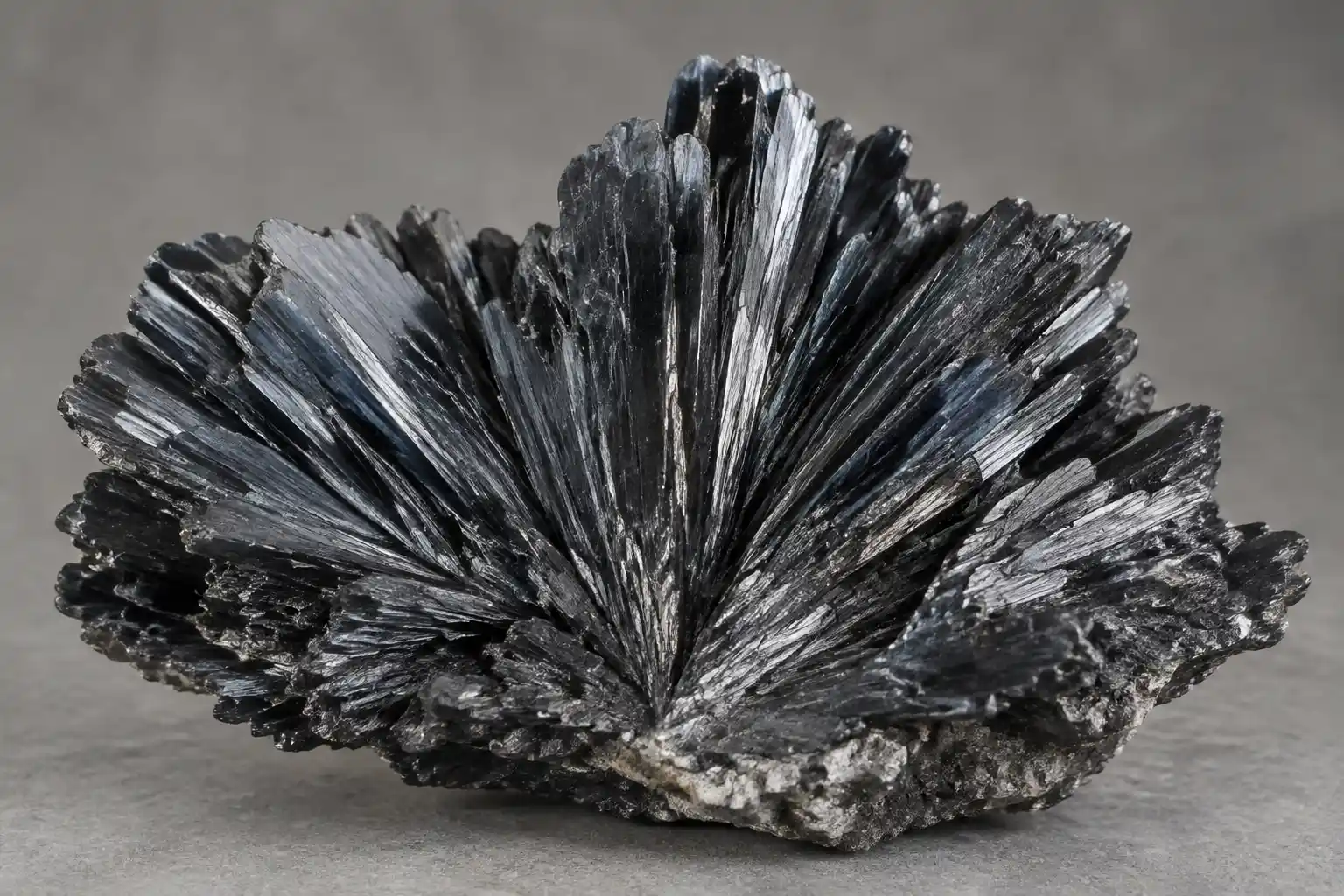
Black kyanite benefits begin with an unusual combination of fan-shaped crystal growth, deep black to silvery-gray appearance, strong directional physical properties, and valuable clues about metamorphic geology. Black kyanite is not a separate mineral species. It is dark-colored kyanite, Al₂SiO₅, whose black or gray appearance can result from fine graphite and, in some occurrences, other dark inclusions distributed through the crystal.
Kyanite is especially interesting because hardness changes dramatically with crystallographic direction. A blade can be much easier to scratch parallel to its length than across it, producing reported hardness values that span roughly 4 to 7 depending on direction and specimen. The mineral also has strong cleavage and brittle tenacity, making fan-shaped black specimens better suited to careful display and collecting than exposed everyday jewelry.
The strongest black kyanite benefits are therefore mineralogical, geological, collectible, educational, decorative, and symbolic. Its natural blade arrangements, metamorphic origin, directional hardness, dark inclusions, and relationship with other Al₂SiO₅ minerals provide more verifiable value than unsupported claims about energy clearing or medical healing.
10 Black Kyanite Benefits at a Glance
- Fan-shaped blade clusters create distinctive natural display specimens.
- Black coloration can reveal the influence of graphite and other dark inclusions.
- Directional hardness provides one of mineralogy’s clearest examples of anisotropic physical behavior.
- Metamorphic occurrence helps geologists interpret pressure-temperature conditions in altered rocks.
- Kyanite’s relationship with andalusite and sillimanite demonstrates mineral polymorphism.
- Natural cleavage and blade structure provide valuable mineral-identification lessons.
- Dark fans and silvery cleavage reflections offer strong decorative and collector appeal without polishing.
- Relative affordability of many specimens makes black kyanite accessible for educational collections.
- Accurate identification helps distinguish true kyanite from superficially similar dark bladed minerals.
- Modern grounding and protection symbolism can add personal value without becoming a medical or supernatural guarantee.
Fan-Shaped Crystals Lead the Most Visible Black Kyanite Benefits
The most recognizable black kyanite benefits come from its form. Commercial specimens frequently appear as dense fans, sprays, or broom-like arrangements of flattened blades radiating from a central region.
These formations can look sculptural without any cutting or polishing. Thin ridges may reflect silvery or gray light while recessed areas remain nearly black, emphasizing the layered character of the specimen.
Fan form is not a separate crystal species. The individual blades retain kyanite’s triclinic structure even when several crystals grow together into an arrangement that looks radial.
Collectors often prefer complete fans with minimal broken blades, attractive symmetry, strong dark color, and natural surface sheen. A specimen does not need gem transparency to be visually successful.
This makes black kyanite especially useful for people who appreciate natural crystal architecture rather than conventional faceted gemstones.
Black Color Can Come From Graphite-Rich Inclusions
Color is another important part of black kyanite benefits. Kyanite is best known in blue, yet the mineral can also occur in white, gray, green, black, and other appearances.
Some recognized black or black-gray kyanite contains very fine graphite inclusions that darken the blades. Other dark kyanites may contain magnetite, ilmenite, dark mica, or combinations of inclusions depending on locality.
These inclusions demonstrate how a mineral’s visual appearance can change without its fundamental identity changing. The host crystal remains kyanite even though tiny foreign components alter color and luster.
For collectors, this makes black kyanite educational rather than merely decorative. The stone provides a clear example of how inclusions influence a mineral’s appearance while leaving its underlying Al₂SiO₅ structure intact.
Directional Hardness Is One of the Most Remarkable Black Kyanite Benefits
Few common collector minerals demonstrate directional hardness as dramatically as kyanite. The mineral can show substantially lower hardness when tested along the length of a blade and considerably greater resistance across it.
This directional difference explains why a single hardness number does not describe kyanite particularly well. Depending on testing orientation, values can range from around 4 to roughly 7.
The crystal hardness chart is therefore especially interesting when applied to kyanite because Mohs hardness is not perfectly uniform in every direction.
This property is one of the strongest educational black kyanite benefits. It shows that physical properties can depend on crystal structure and orientation rather than behaving identically through an entire specimen.
Collectors should not repeatedly scratch valuable fans to demonstrate the effect. Existing mineralogical data provide the lesson without damaging the crystal.
Metamorphic Geology Gives Black Kyanite Scientific Value
Kyanite commonly forms in metamorphic rocks derived from aluminum-rich sediments. Elevated pressure and temperature reorganize existing minerals and allow new assemblages to develop as rocks adjust to changing conditions.
Kyanite is especially important because it belongs to the Al₂SiO₅ polymorph system with andalusite and sillimanite. All three minerals share the same overall chemical formula but possess different crystal structures stable under different pressure-temperature conditions.
Kyanite is generally favored by higher-pressure conditions relative to andalusite. Its presence alongside other minerals can therefore contribute to reconstructing metamorphic history.
These geological black kyanite benefits make a dark fan more than a decorative object. It represents conditions deep within Earth’s crust where sedimentary components were transformed into new minerals.
Kyanite, Andalusite & Sillimanite Demonstrate Polymorphism
Polymorphism is one of the most useful concepts illustrated by kyanite. Kyanite, andalusite, and sillimanite all have the formula Al₂SiO₅ but arrange their atoms differently.
Different structures produce different crystal habits, physical properties, and stability ranges. This means chemical formula alone cannot fully define how a mineral looks or behaves.
Black kyanite becomes particularly interesting when compared with the andalusite benefits seen in another member of the same chemical system. Andalusite can produce strongly pleochroic transparent gems, while kyanite commonly develops bladed crystals and dramatic directional hardness.
The comparison shows how dramatically crystal structure can influence the visible and physical character of substances with identical overall chemistry.
Cleavage Explains Why Black Kyanite Fans Need Gentle Handling
Black kyanite may look rugged, but fan-shaped clusters are relatively fragile. Kyanite has perfect cleavage in one direction and additional weaker cleavage, while the mineral itself is brittle.
Thin projecting blades can therefore split or snap if the specimen is dropped, squeezed, or packed loosely against harder rocks. Damage can occur along internal structural planes rather than only at exposed tips.
This makes careful handling one of the practical black kyanite benefits to learn from. Hardness should never be confused with toughness.
A specimen might resist scratching in one direction yet still break relatively easily along cleavage. This is the same reason gemologists evaluate hardness, toughness, cleavage, and fracture separately rather than combining them into one durability score.
Natural Black Kyanite Is Better Suited to Display Than High-Wear Jewelry
Black kyanite appears in pendants and wire-wrapped jewelry, but intact fans and blades generally perform better as collector specimens than as exposed everyday jewelry.
The combination of strong cleavage, brittle blades, and variable hardness makes rings especially vulnerable. A projecting fan can catch clothing, strike furniture, or lose individual blades after repeated wear.
Pendants can work when the specimen is supported securely and not allowed to swing into hard surfaces. Protective wire wrapping or backing may help, provided the setting does not put excessive pressure on cleavage planes.
For many buyers, the natural fan is already more impressive than a heavily modified piece. Preserving its original growth pattern allows the black kyanite benefits of structure and geology to remain visible.
Black Kyanite Offers Strong Identification Lessons
Dark bladed minerals can resemble one another, especially when sold as rough specimens. Some black Brazilian kyanite has historically been confused or marketed under incorrect mineral names.
True identification should consider crystal form, cleavage, directional hardness, density, associated minerals, locality, and analytical testing when necessary.
Color alone is particularly unreliable. A black blade is not automatically kyanite, just as every blue crystal is not sapphire.
When deciding where to buy black kyanite, credible mineral identification and locality information are more useful than claims about unusually strong energy. Sellers who provide dimensions, origin, natural photographs, and clear condition descriptions make specimens easier to evaluate.
This buyer-awareness role is one of the practical black kyanite benefits for beginning collectors.
Black Kyanite Can Be an Accessible Metamorphic Mineral Specimen
Many attractive black kyanite fans remain comparatively accessible, allowing beginners to own a visually distinctive metamorphic mineral without the cost attached to rare transparent gemstones.
This accessibility is useful educationally. A collector can study blade habit, cleavage, graphite-related coloration, directional hardness, and metamorphic context in one specimen.
Larger, more symmetrical, undamaged, or locality-specific fans may command greater interest, but a modest specimen can still demonstrate the defining physical features.
Affordable mineral examples have real value because they allow learning through direct observation rather than photographs alone.
Black kyanite benefits from being both recognizable and scientifically interesting enough to remain relevant after the novelty of its appearance wears off.
Care Should Protect Fragile Blades Rather Than Focus on Cleansing Rituals
Black kyanite care should be simple and conservative. Dust can be removed carefully with a very soft brush or gentle air movement while the specimen remains supported by its strongest base.
Avoid soaking delicate fans without a clear reason. Water may not chemically dissolve kyanite, but fragile attached minerals, clay, fracture fillings, matrix, or glued repairs can respond differently.
Do not use ultrasonic cleaning, steam, abrasive scrubbing, or high-pressure water on delicate clusters. These methods create mechanical stresses that can break narrow blades.
Storage matters most. Keep specimens in individual compartments or stable display positions where harder minerals cannot fall against them.
Physical preservation protects the features responsible for the main black kyanite benefits far better than elaborate cleaning routines.
Modern Symbolism Commonly Focuses on Grounding and Protection
Contemporary crystal practice often associates black kyanite with grounding, protection, boundaries, energetic clearing, cutting unwanted attachments, and staying focused during stressful situations.
The dark color and radiating fan habit likely contribute strongly to these interpretations. Some people view the blades symbolically as sweeping or clearing unwanted influences.
These meanings can be used personally. A collector might keep a fan near a workspace as a reminder to set limits on distractions or finish one task before beginning another.
The black kyanite meaning belongs to modern symbolism rather than a scientifically measurable protective field. The stone does not block physical danger, harmful people, electromagnetic radiation, or psychological distress merely by being nearby.
Black Kyanite Benefits Should Remain Separate From Healing Claims
Modern black kyanite healing properties may include claims involving anxiety, trauma, pain, circulation, neurological function, energy balance, or removing harmful substances from the body.
Reliable evidence does not establish those effects. Kyanite is an aluminum silicate mineral, and ordinary contact with it does not create a clinical treatment.
A meaningful object can still become part of meditation, reflection, or a boundary-setting routine. Its presence might remind someone of an intention they already chose.
That is different from claiming the stone changes physiology.
The verified black kyanite benefits already include unusual crystal form, directional hardness, metamorphic geology, polymorphism, inclusions, collecting value, and mineral identification.
Conclusion
Black kyanite benefits include sculptural fan-shaped crystals, graphite-rich coloration in some specimens, remarkable directional hardness, metamorphic geological value, polymorphism with andalusite and sillimanite, educational cleavage, accessible collecting, identification practice, and modern personal symbolism.
Its blades require gentle handling because kyanite can be brittle despite relatively high hardness across certain directions. Appreciating black kyanite as a genuine metamorphic mineral reveals far more lasting value than claims that it automatically clears energy or heals the body.
FAQs
What Are the Main Black Kyanite Benefits?
Black kyanite benefits include distinctive fan-shaped crystals, metamorphic geology, directional hardness, collector value, mineral-identification education, dark inclusion patterns, and personal symbolism.
Is Black Kyanite a Separate Mineral?
No. Black kyanite is a dark variety of the mineral kyanite, Al₂SiO₅.
Why Is Black Kyanite Black?
Fine graphite inclusions can cause black or gray coloration in some black kyanite. Other dark inclusions may also contribute depending on locality.
How Hard Is Black Kyanite?
Kyanite has strongly directional hardness, with values roughly from 4 to 7 depending on the direction tested.
Is Black Kyanite Fragile?
Yes. Kyanite is brittle and has strong cleavage, so thin fan-shaped blades can break despite the mineral’s higher hardness in some directions.
Is Black Kyanite Good for Jewelry?
Protected pendants can work, but exposed everyday rings and delicate fan jewelry face significant breakage risk.
What Type of Rock Contains Kyanite?
Kyanite commonly forms in aluminum-rich metamorphic rocks under elevated pressure and temperature.
Is Black Kyanite Related to Andalusite?
Yes. Kyanite, andalusite, and sillimanite are Al₂SiO₅ polymorphs with the same overall chemistry but different crystal structures.
Does Black Kyanite Protect Against Negative Energy?
Protection is a modern spiritual association. There is no reliable evidence that the mineral creates a measurable protective energy field.
How Should Black Kyanite Be Cleaned?
Use minimal handling and gentle dry dust removal. Avoid hard scrubbing, impacts, ultrasonic cleaning, steam, and other methods that may break fragile blades.
Modern symbolic black kyanite benefits are personal wellness beliefs and should not replace qualified medical or mental health care.