Where to Buy Real Black Kyanite: Trusted Sellers and Fake-Spotting Tips
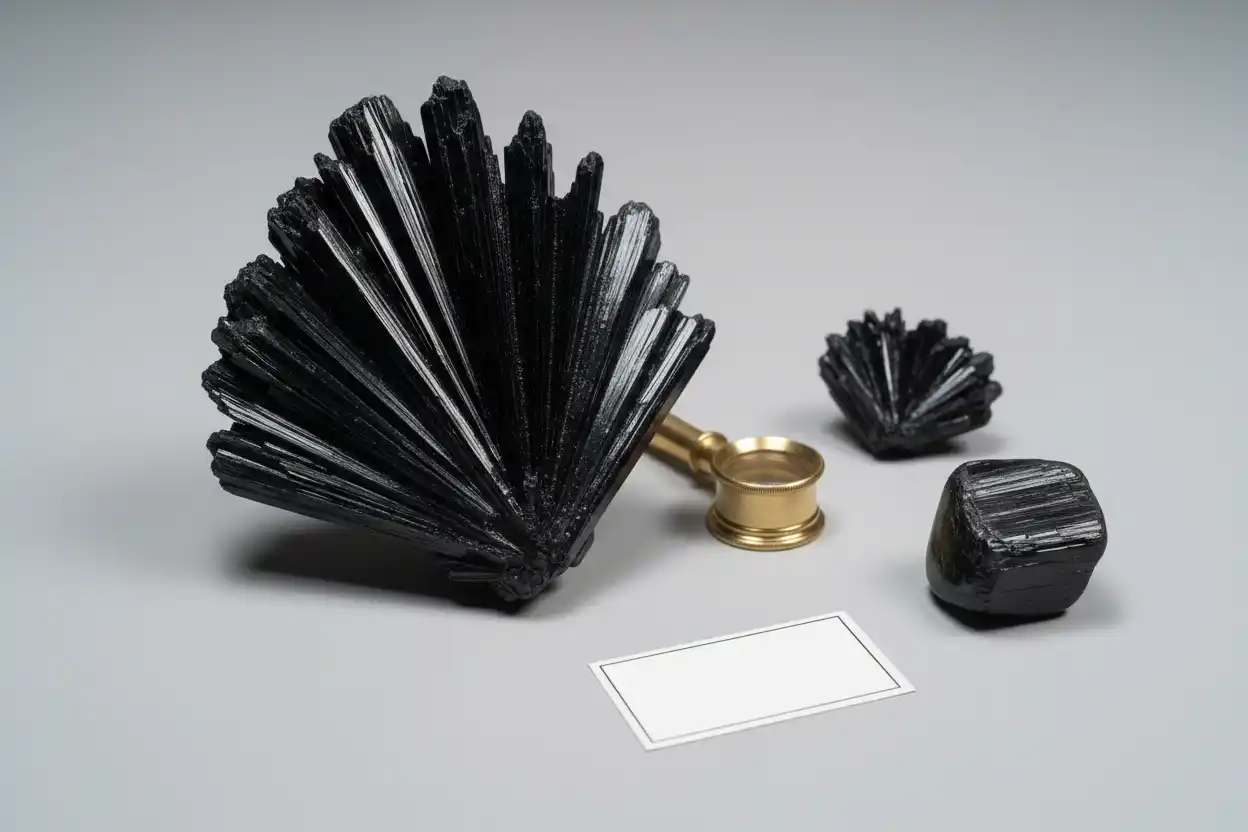
Real black kyanite is most often sold as fan-shaped, radiating or bladed mineral specimens rather than as transparent faceted gems. The dark material can be visually dramatic, but the retail name is frequently applied with more confidence than the seller’s identification supports. Dark amphibole clusters, mica-rich aggregates, tourmaline, painted blades and other black minerals may receive the same label.
Kyanite is an aluminum silicate that forms in metamorphic environments. It is known for strongly directional hardness: the resistance to scratching changes according to crystallographic orientation. It also has prominent cleavage and brittle tenacity, which makes thin blades vulnerable to splitting.
The black kyanite meaning and properties guide covers the variety’s identity and symbolic traditions. This page focuses on finding accountable sellers, evaluating blade structure, checking disclosure and avoiding mislabeled or reconstructed products.
What “Black Kyanite” Means in the Market
Black kyanite is not a separate mineral species. It is dark-colored kyanite, often sold as radiating sprays, flat blades or fan-shaped clusters. Dark coloration can result from abundant inclusions or associated dark minerals, and the precise cause may vary between deposits.
Because the material is often opaque and included, visual identification can be difficult. A seller who claims that every black blade is kyanite solely because it resembles a broom-shaped cluster is oversimplifying the issue.
A credible listing should distinguish among three possibilities:
| Seller description | What it should mean |
|---|---|
| Black kyanite | The blades have been identified as the mineral kyanite |
| Kyanite with graphite or dark inclusions | Kyanite identity is established and the dark component is separately described |
| Black bladed metamorphic mineral | The seller recognizes the form but does not claim confirmed species |
A cautious description is preferable to a confident but unsupported one.
Where to Buy Genuine Black Kyanite
Specialist mineral dealers
Mineral dealers are the strongest source for natural clusters because they understand crystal habit, locality, matrix and repair disclosure. A good dealer identifies black kyanite as a mineral specimen rather than treating it as a generic polished crystal.
Look for exact dimensions, locality information, clear photographs of the rear and base, and comments about broken or reattached blades. Ask whether the identification comes from the mine supplier, a previous collection label or analytical confirmation.
Gem and mineral shows
At a show, you can examine the blade shape and matrix under several lighting angles. Genuine kyanite commonly forms elongated, flattened or bladed crystals. Black retail material may occur in sprays or diverging fans, although shape alone does not prove species.
Inspect the specimen from the side. Some assembled clusters look convincing from the display face but reveal glued blades or artificial filler underneath. A loupe can expose adhesive, paint, broken edges and unrelated fragments.
Established online mineral shops
Online listings should show the exact cluster rather than a generic stock photograph. Since each fan has a different arrangement and break pattern, receiving a random piece without seeing the actual item makes condition difficult to judge.
The online gemstone buying guide explains how to evaluate contact details, payment protection and return terms. For black kyanite, also require a photograph showing the base and a video demonstrating the three-dimensional structure.
Lapidary and jewelry sellers
Black kyanite is occasionally polished, drilled or mounted in pendants. However, its cleavage and blade structure complicate cutting. Ask whether the polished object contains solid kyanite, a kyanite-bearing rock, resin stabilization or a backing layer.
Jewelry should protect the stone from direct impact. A pendant that holds a natural fan in a wire cage may still expose fragile tips, while a low bezel around a polished piece generally provides better support.
Recognizing Natural Crystal Habit
Kyanite most characteristically forms elongated, bladed crystals. In black specimens, the blades may be thin and radiating, bundled together or partly embedded in matrix. Individual blades can have parallel surfaces, uneven terminations and cleavage steps.
Natural fans normally show variation. Blade widths, lengths, angles and terminations should not be perfectly repeated. Matrix may appear between blades, and some crystals may end within the cluster rather than forming an ideal symmetrical spray.
Fresh breaks can expose lighter gray interiors even when the outer surface is nearly black. However, internal color is not a universal diagnostic because inclusion density and associated minerals vary.
Perfect radial symmetry, identical blades, rounded cast edges or a smooth resin base deserve further investigation.
Black Kyanite Versus Blue Kyanite
Both black and blue material should be kyanite, but their retail uses differ. Transparent to translucent blue kyanite may be faceted or cut as cabochons, whereas black material is usually specimen-grade and heavily included.
The blue kyanite guide covers the familiar blue variety, while the kyanite color guide separates color symbolism from mineral identity. The types of kyanite overview provides the broader variety context.
A seller should not describe black kyanite as a superior grade of blue kyanite. Color, transparency and crystal form create different collector markets rather than a simple better-or-worse scale.
Black Kyanite Versus Black Tourmaline
Black tourmaline, commonly known as schorl, can form dark prismatic crystals with longitudinal striations. Kyanite is typically flatter and more blade-like, while tourmaline commonly shows a three-sided or rounded triangular cross-section.
Still, broken clusters can be confusing. The black tourmaline guide is useful when a listing describes any dark striated mineral as kyanite.
Tourmaline is generally more durable than thin kyanite blades, although both can fracture. Magnetism, streak and scratch tests should not be treated as casual home solutions for finished or collectible pieces.
Black Kyanite Versus Mica and Amphibole
Mica-rich aggregates can form dark plates, fans or sprays. Mica usually separates into very thin flexible or elastic sheets, whereas kyanite cleaves differently and does not peel like a mica book. The mica mineral guide explains those sheet structures.
Dark amphiboles can also form bladed, fibrous or radiating clusters. Some may contain elongated crystals that resemble black kyanite in low-resolution photographs. Accurate separation can require microscopy, Raman spectroscopy or X-ray diffraction.
A seller who cannot identify the matrix or distinguish the blades from associated minerals should not attach a premium based on certainty.
Common Fakes and Misrepresentation
Painted mineral clusters
Pale blades or unrelated clusters may be coated with black paint. Pigment can collect in recesses, bridge small gaps and produce a uniform matte or glossy surface. Examine chipped edges and the underside for a different base color.
Molded resin fans
Resin casts may copy the general fan shape while showing rounded edges, repeated grooves, bubbles and a smooth molded underside. They can also feel lighter than expected, although weight alone is unreliable.
Glued or reconstructed clusters
Broken natural blades can be assembled into a more complete fan. A reconstructed piece may contain genuine kyanite yet still be materially altered. Look for adhesive at the base, unnatural blade alignment and glossy joins.
Other black minerals sold as kyanite
Tourmaline, amphibole, mica, hematite-rich aggregates and dark metamorphic rock can be mislabeled. These substitutions often result from weak supplier information rather than deliberate fraud, but the buyer still receives the wrong mineral.
Dyed material
Dye is less central to black kyanite than misidentification or paint. Nevertheless, porous matrix or pale blades can be darkened. Color concentrated in cracks or rubbing from the surface warrants caution.
The fake-crystal guide explains common indicators of casting, coating, assembly and incorrect trade names.
Hardness Is Not a Safe Home Test
Kyanite’s directional hardness is one of its defining physical properties. Values can range from approximately 4.5 to 7 depending on the direction tested. That unusual range is scientifically useful, but it makes destructive home testing especially misleading.
A steel tool might scratch one orientation more easily than another. Additionally, the specimen may contain graphite, mica, quartz or another associated mineral, so a scratch can test the wrong component.
Do not scratch finished jewelry, individual crystals or seller merchandise. The gemstone hardness chart should be used to understand wear resistance, not as an instruction to damage a stone.
The toughness-versus-hardness guide is equally important because kyanite’s cleavage and brittle tenacity govern how easily blades split under impact.
How to Judge a Black Kyanite Fan
Blade definition
Strong specimens show recognizable individual blades rather than a shapeless dark mass. The display face should have depth, natural spacing and an arrangement that can be appreciated without hiding major damage.
Condition
Some incomplete tips are common because the material is fragile. However, extensive fresh breakage, crushed ends and loose blades should reduce value. Ask whether any part moves when the specimen is gently handled.
Matrix and base
A natural matrix can add context and stability. In contrast, a smooth black platform, excess glue or colored filler may indicate assembly. Photographs of the rear and underside are essential.
Luster and surface character
Kyanite may show vitreous to pearly luster on cleavage surfaces. Dark inclusions can make the specimen appear duller. A uniformly plastic gloss suggests coating, while thick matte paint can obscure natural texture.
Locality
Black fan-shaped material is frequently marketed as Brazilian. Brazil does produce dark kyanite specimens, but country claims should come from supplier documentation rather than shape alone.
Stability
The best display specimen stands securely on its matrix or comes with a removable support. A delicate cluster glued permanently to a decorative base should be disclosed as mounted.
Buying Polished Black Kyanite
Polished black kyanite is less common than rough fans. Cabochons and palm stones may contain kyanite blades within a host rock rather than a single crystal. Consequently, ask what percentage of the material is believed to be kyanite.
Inspect the polish for rippling, pits and filler. Different minerals within the rock can polish unevenly. Resin may be used to stabilize fractures, and a backing layer may support a thin slab.
A polished surface should not erase every structural clue. Under oblique light, you may still see parallel blades, cleavage or variations in luster.
Buying Black Kyanite Jewelry
Black kyanite is better suited to pendants, earrings and brooches than exposed rings. Thin blades can split, while drilled holes can initiate fractures.
Natural fan pendants should have a setting that supports the base without squeezing the blade tips. Wire wrapping can be attractive, although tight wires across cleavage-prone areas may create stress.
Polished cabochons benefit from a protective bezel. Ask whether the stone is glued, backed or stabilized and whether the seller recommends occasional wear only.
The planned general kyanite buying guide will cover faceted blue material and the wider kyanite market, while this page remains specific to black specimens and dark lapidary products.
Treatments and Repairs
Black kyanite may be coated, painted, resin-stabilized, fracture-filled, repaired or assembled. No single standard commercial treatment defines the material, so seller disclosure must be product-specific.
Clear resin can strengthen a weak base or bond loose blades. Black filler may disguise the repair. A permanent display mount can also hide where several fragments were joined.
The gemstone treatments overview explains why stabilization and repair do not automatically make a piece unacceptable. The concern is whether the seller describes them accurately and prices the specimen accordingly.
Price and Value
Black kyanite value depends on blade development, fan symmetry, size, condition, matrix stability, luster, locality documentation and repair history. A compact fan with complete blades can be more desirable than a much larger specimen with extensive reconstruction.
Common commercial clusters should not receive extreme rarity premiums. Meanwhile, a well-documented locality specimen with unusual crystal development may deserve collector pricing.
Polished pieces are valued for pattern, stability and craftsmanship. Jewelry prices also reflect metal quality and setting labor.
Use the gemstone pricing guide to compare observable attributes rather than relying on labels such as “AAA black kyanite” or “master healer grade.”
Questions for the Seller
Ask whether the specimen has been identified as kyanite or merely purchased under that trade name. Request the precise locality and determine whether an original label is included.
Then ask about repairs, loose blades, paint, coating, resin, glue, stabilization and permanent mounting. For a cluster, request front, back, side and base photographs. For polished material, ask whether it is solid kyanite, kyanite-bearing rock or an assembled product.
Finally, confirm whether the exact pictured piece will be shipped and whether the return policy allows inspection under magnification.
Professional Identification
Raman spectroscopy or X-ray diffraction can identify kyanite without relying on color. Microscopy may reveal cleavage, mineral associations and surface coatings, while chemical analysis can help characterize inclusions.
Opaque and multi-mineral specimens require careful test placement. A reading from dark matrix does not prove that the radiating blades are kyanite, and a test on one blade may not describe the entire cluster.
Professional work is most worthwhile for expensive specimens, disputed localities, unusual crystal forms and bulk purchases where the supplier’s identification is uncertain.
Shipping and Handling
Each blade needs protection from direct pressure. The seller should immobilize the matrix inside a rigid specimen box, then suspend or cushion that box within a larger carton.
Loose packing material poured around exposed blades is inadequate because movement can transfer pressure to the tips. A cluster should never be packed with a heavy polished stone in the same compartment.
After delivery, lift the specimen from its base. Do not pull it from wrapping by holding a blade.
Responsible Buying
Ask where the material was collected and whether the dealer can trace it at least to a region or established supplier. Avoid claims of direct mine sourcing when the seller cannot name the mine, cooperative or exporter involved.
The ethical crystal sourcing guide provides a realistic framework for evaluating traceability without expecting complete mine-level documentation for every inexpensive specimen.
Cleaning and Storage
Use a hand air blower, soft artist’s brush or gentle dry microfiber cloth. Do not soak fan-shaped specimens, scrub between blades or place them in an ultrasonic cleaner. Vibration and trapped moisture can loosen fragile crystals, adhesive or matrix grains.
The planned ultrasonic-cleaner guide explains the risk posed by cleavage and repairs. Store the specimen in a protected display area away from vibration, pets, crowded shelves and direct contact with harder minerals.
For broader identification context, the general kyanite guide, B crystal directory, B gemstone directory and gemstone types guide can help place black kyanite within the wider mineral collection.
Choose Disclosure Over Perfect Symmetry
Natural black kyanite is often irregular, fragile and partly included. Those traits are not defects that must be hidden; they are part of the specimen’s identity.
A trustworthy seller will show broken areas, explain whether the fan was repaired, identify the locality cautiously and distinguish confirmed kyanite from a lookalike. A slightly imperfect natural cluster with honest documentation is a better purchase than a flawless reconstructed fan with no verifiable history.
Frequently Asked Questions
1. Is black kyanite a separate mineral?
No. It is a dark-colored form of the mineral kyanite rather than a separate approved mineral species.
2. What makes black kyanite black?
Dark color can relate to abundant inclusions and associated dark mineral phases. The exact cause can vary, so sellers should avoid presenting one explanation as universal without testing.
3. Is fan-shaped black kyanite always genuine?
No. The fan habit is characteristic of much commercial material, but other minerals, assembled fragments and resin casts can imitate the form.
4. How can I distinguish black kyanite from tourmaline?
Kyanite is generally flatter and more blade-like, while tourmaline commonly has a prismatic form and longitudinal striations. Damaged or included pieces may require laboratory confirmation.
5. Is black kyanite normally dyed?
Dye is not the primary buying concern. Paint, coating, resin, reconstruction and incorrect identification are more common issues.
6. Why do black kyanite blades break easily?
Kyanite has prominent cleavage and brittle tenacity. Thin blades can split when struck, squeezed or vibrated during shipping.
7. Can I use a scratch test to identify it?
Do not scratch the specimen. Kyanite’s hardness changes with direction, and mixed specimens can contain several minerals, making home scratch results unreliable.
8. Is black kyanite suitable for daily-wear jewelry?
It is not ideal for exposed daily wear. Protected pendants, earrings and occasional-wear pieces are safer than rings or loose bracelets.
9. Are repaired black kyanite fans worthless?
No. A disclosed repair can preserve an attractive specimen. However, the repair’s extent and visibility should affect the price.
10. Does Brazilian origin prove authenticity?
No. Brazil is an important source of dark kyanite, but a locality claim does not prove mineral identity. Ask for supplier records or a specimen label.
11. When should I request laboratory testing?
Testing is worthwhile for expensive specimens, uncertain identification, important locality claims or wholesale batches where a mistake would affect many purchases.
12. What is the biggest warning sign in a listing?
Be cautious when a perfectly symmetrical fan is photographed only from the front and the seller refuses to show the base, discuss repairs or provide a return policy.