Blue Lace Agate Meaning: Facts, History & Symbolism
Blue lace agate meaning is often summarized with words such as calmness, communication, patience, reassurance, and thoughtful expression, but those associations describe modern symbolism rather than the material’s measurable mineral properties. Mineralogically, blue lace agate is a pale blue, characteristically banded variety of agate, itself a form of chalcedony within the quartz family. Its identity depends on silica composition, microcrystalline structure, characteristic banding, and geological context—not on claims about healing energy, chakras, or emotional effects.
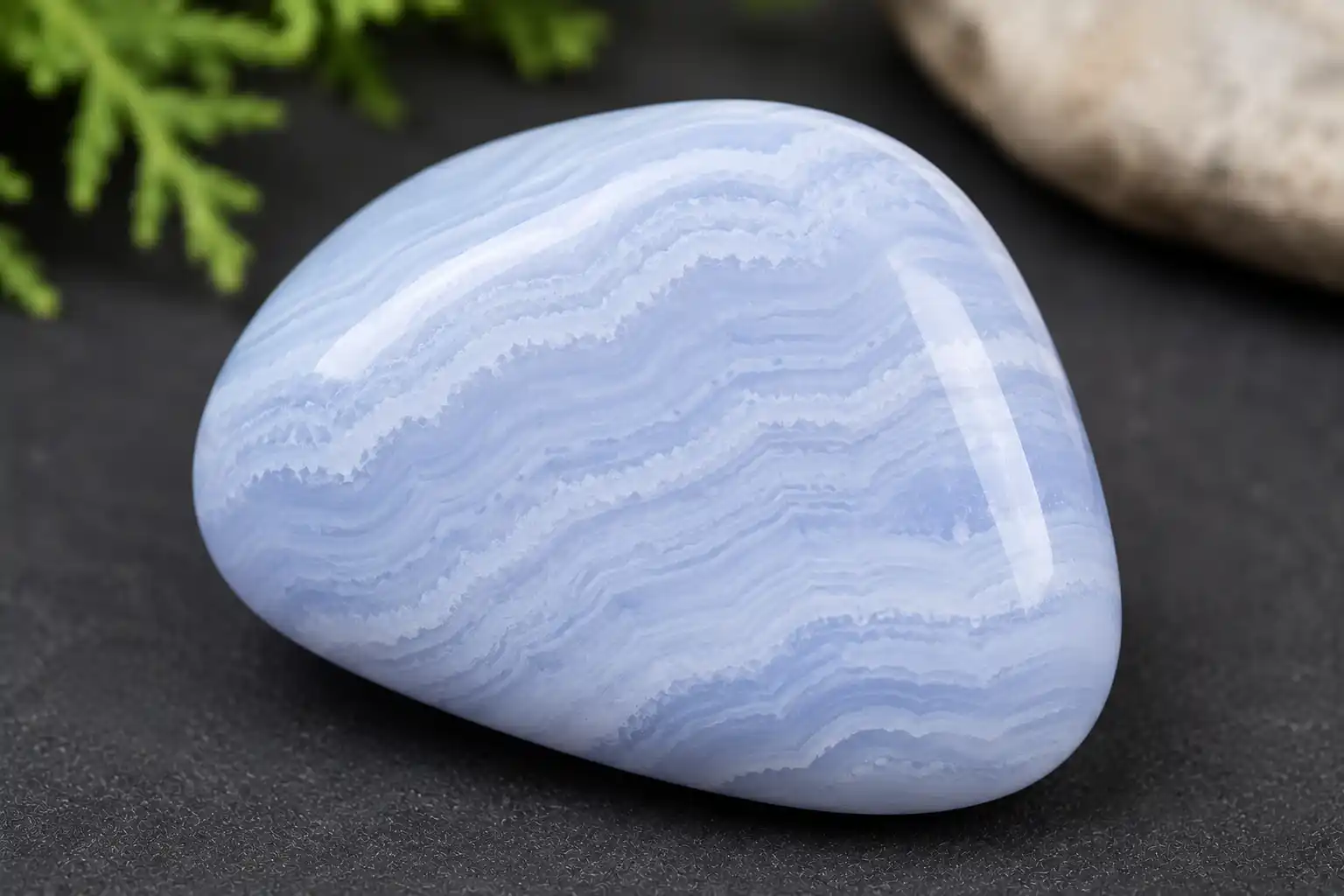
The “lace” in the name refers to its visual pattern. Fine white, pale blue, gray-blue, and sometimes nearly colorless chalcedony layers curve, fold, and repeat through the material, producing an appearance resembling delicate lace or flowing contour lines. The best-known geological material demonstrates that these bands were produced through successive stages of silica deposition rather than painted onto the stone or generated by a single blue pigment. Geological investigation of classic material from southern Namibia identifies it as hydrothermal banded chalcedony formed within fractures, with associated quartz and carbonate minerals.
The wider Healing Crystal guides use the same distinction throughout: the stone can be examined as a geological material while its symbolic interpretation remains a separate human layer.
What Is Blue Lace Agate?
Blue lace agate is not an independent mineral species. It is a variety of agate composed principally of silica, SiO₂, in the form of very fine chalcedony and related quartz structures. Mindat describes it concisely as a pale blue banded variety of agate or chalcedony and lists a Mohs hardness of about 7.
Agate itself is distinguished by patterned or banded chalcedony deposition. In blue lace agate, successive bands vary in translucency, texture, thickness, and apparent blue intensity, creating the characteristic lace-like pattern. Classic specimens can also contain small cavities, crystalline quartz, carbonate minerals, or remnants of associated geological material rather than consisting of perfectly uniform blue silica from edge to edge.
| Property | Blue lace agate characteristics |
|---|---|
| Material identity | Pale blue banded variety of agate/chalcedony |
| Mineral family | Quartz |
| Principal chemistry | SiO₂ |
| Structure | Microcrystalline to cryptocrystalline silica aggregate |
| Typical color | Pale blue, gray-blue, white and nearly colorless bands |
| Pattern | Curved, wavy, concentric or lace-like banding |
| Mohs hardness | Approximately 6.5–7 |
| Cleavage | None |
| Fracture | Commonly conchoidal to uneven |
| Luster | Waxy to vitreous when polished |
| Transparency | Translucent to locally opaque |
| Common forms | Slabs, cabochons, beads, carvings, polished pieces and mineral specimens |
| Separate mineral species? | No |
Because it is a variety rather than a mineral species, the name blue lace agate describes a recognizable combination of material and appearance. Two genuine specimens can differ substantially in band width, translucency, shade of blue, amount of white chalcedony, associated minerals, and pattern density.
Why the Lace Pattern Matters
The defining feature is not blue color by itself but the relationship between the blue color and the banded chalcedony structure. Successive silica layers create curved and often repeating boundaries that can follow the geometry of fractures, cavities, earlier deposits, or growth surfaces. In polished cross-sections, these layers can appear as tight parallel lines, broad translucent zones, swirling contours, or combinations of several patterns.
Classic specimens from the Ysterputs occurrence in southern Namibia visibly preserve sequences of chalcedony deposition. Documented specimens show blue lace agate together with chalcedony, quartz, calcite, dolomite, gypsum, and other associated minerals, while polished sections reveal successive internal layers rather than a homogeneous blue mass.
That makes pattern useful diagnostically. A plain blue quartz-family material with no recognizable lace banding may still be chalcedony, but the label blue lace agate becomes less precise unless the characteristic agate structure is present.
How Blue Lace Agate Forms
The classic southern African material provides an unusually informative geological model. Detailed geological study describes a hydrothermal vein deposit occupying fractures and a shear zone within dolerite. Silica-bearing fluids entered available spaces and deposited chalcedony in repeated layers, producing the characteristic banded agate. Much of the chalcedony in that occurrence was identified as quartzine, a fibrous silica texture associated in this case with a saline depositional environment.
The same study records an initial carbonate coating along fracture walls and later associations including quartz and several carbonate or sulfate minerals. This is important because it replaces the oversimplified statement that every blue lace agate “grew inside a volcanic gas bubble.” Agates can form in several cavity and fracture settings, and the documented geology of an important blue lace agate occurrence is specifically a hydrothermal vein system.
The full deposit-scale interpretation belongs in blue lace agate formation and deposit geology, where host rock, fluid movement, associated minerals, and vein architecture can be considered without turning this meaning reference into a complete geological monograph.
What Causes the Blue Color?
The blue color is more complex than the common claim that one trace element simply dyes the quartz blue. In classic blue chalcedony and blue lace agate, the pale blue appearance has been attributed to fine-scale scattering of light by extremely small cavities, inclusions, or silica-scale structures. Rayleigh-type scattering is frequently invoked to explain why the material can appear soft blue even without a conventional strongly colored pigment.
That interpretation fits the characteristic pastel appearance better than the idea of an intense chromophore producing saturated cobalt-like blue. It also helps explain why the stone may look different under changing illumination, against different backgrounds, or through sections of different thickness.
The exact optical behavior is specimen-dependent, however. Color zoning, translucency, band texture, microscopic inclusions, surface polish, and lighting geometry can all influence perceived color, which is why a single photograph should not be treated as an analytical determination. The dedicated blue lace agate optical properties and color behavior guide examines those variables in greater depth.
Natural Blue Is Usually Soft, Not Electric
Natural blue lace agate is typically associated with restrained shades: powder blue, pale gray-blue, soft sky blue, lavender-blue, and whitish bands. Highly saturated electric or uniformly intense royal-blue agate deserves additional scrutiny because chalcedony and agate are materials that can be dyed commercially.
That does not mean color intensity alone proves treatment. Photography can increase saturation, white balance can shift gray-blue toward cyan, transmitted lighting can alter apparent brightness, and some natural pieces are stronger in color than others.
The correct response to unusual color is therefore examination rather than assumption. Look for how color behaves across bands, fractures, surface-reaching pores, cut edges, and differently textured zones.
An Original Blue Lace Agate Specimen and Photo Checklist
This checklist is designed for first-pass evaluation of rough specimens, polished pieces, cabochons, beads, and listing photographs. It does not replace laboratory testing, but it helps separate useful evidence from marketing language.
Check for genuine lace-like banding
Look for curved, wavy, repeating, or contour-like bands rather than relying on blue color alone. The pattern should appear structurally integrated into the chalcedony.
Compare blue and white layers
Natural material commonly combines several shades rather than one perfectly uniform block of color. Observe changes in thickness, translucency, and texture from band to band.
Examine color at fractures
Color strongly concentrated inside open fractures, drill holes, or surface-reaching pores can justify investigation for dye. It is evidence for testing, not automatic proof.
Use neutral lighting
Inspect under diffuse white light before judging saturation. Highly warm, cool, or edited product photography can change the perceived blue significantly.
Backlight a thin area
Where possible, examine translucency through a thinner edge. Chalcedony commonly becomes more translucent as thickness decreases, although individual bands may transmit light differently.
Inspect the polish
A polished surface should reveal a waxy-to-vitreous silica luster. Surface coatings can alter gloss and should not be confused with the natural appearance of the material.
Look for silica-style fracture
Natural unpolished areas may show conchoidal or irregular fracture rather than the prominent cleavage expected in minerals such as calcite.
Search for associated minerals
Quartz-lined cavities, carbonate material, matrix remnants, or other natural associations can provide geological context. They do not automatically prove a particular locality.
Examine pattern continuity
Bands that continue naturally through a polished face and around irregular internal features are more informative than printed, painted, or surface-only patterns.
Do not expect perfection
Natural pieces can contain fractures, cavities, uneven bands, cloudy areas, rough matrix, and color interruptions. Flawlessness is not an authenticity requirement.
Be cautious with molded objects
Seams, unusually uniform glassy interiors, or production features may indicate manufactured material rather than natural agate.
Do not assign locality from pattern alone
A pale blue lace pattern can be compatible with famous material without proving its mine source.
Preserve an important label
Collector labels, acquisition records, photographs, and specimen numbers may carry provenance information that the stone itself cannot reproduce.
Avoid casual destructive tests
Do not scratch or acid-test an attractive specimen merely to confirm something that can be investigated through safer methods.
Separate metaphysical wording from identification
Terms such as calming, throat chakra, high vibration, communication stone, or healing grade provide no evidence that the material is natural blue lace agate.
For internal textures, microfractures, inclusions, surface features, and the limits of magnification, see the blue lace agate microscope inclusion notebook.
A Claim-versus-Evidence Table for Blue Lace Agate
The name attracts statements ranging from straightforward mineralogy to claims that cannot be established through gemological testing. Separating those categories makes blue lace agate meaning more useful.
| Claim | Evidence status | More accurate interpretation |
|---|---|---|
| Blue lace agate is a variety of agate/chalcedony | Supported | It is silica-rich banded chalcedony within the quartz family |
| Its formula is SiO₂ | Supported as principal chemistry | Associated minerals can occur with the agate |
| Lace-like banding reflects repeated deposition | Supported | Successive chalcedony layers create the characteristic pattern |
| Every blue band is colored by one specific metal | Too absolute | Fine-scale scattering is important in classic material; individual specimens still require evidence |
| Every blue stone with white bands is blue lace agate | Unsupported | Other natural and manufactured materials can imitate the appearance |
| Intense blue automatically proves dye | Too absolute | Unusual saturation deserves testing rather than immediate classification |
| Namibia is a documented important source | Supported | Ysterputs is a well-documented blue lace agate locality |
| Appearance alone proves Namibian origin | Unsupported | Provenance requires documentation |
| Blue lace agate improves communication biologically | Unsupported | Communication is a symbolic association, not a demonstrated physiological effect |
| Blue lace agate heals anxiety or throat disease | Unsupported medical claim | Mineral identification does not establish medical efficacy |
| Blue lace agate activates the throat chakra | Spiritual interpretation | This belongs to contemporary metaphysical practice |
| Blue lace agate emits calming energy | Metaphysical claim | No standard gemological measurement establishes such energy |
| Ancient cultures universally used blue lace agate for communication | Unsupported without documentation | Specific historical claims require identifiable evidence |
The point is not to reject every symbolic association. It is to prevent symbolic language from borrowing scientific authority from unrelated mineral facts.
Blue Lace Agate Versus Ordinary Blue Chalcedony
Blue chalcedony and blue lace agate are closely related, but the terms are not fully interchangeable. Blue chalcedony describes a broader category of blue chalcedony material, which can be comparatively uniform, cloudy, or weakly patterned. Blue lace agate adds the defining agate characteristic of pronounced lace-like or banded structure.
The distinction is easiest to understand visually. A smooth pale blue cabochon with no obvious banding may be accurately described as blue chalcedony. A cabochon with fine repeating blue and white curved layers fits the blue lace agate description more specifically.
The difference is therefore one of variety and texture rather than completely unrelated chemistry.
Hardness and Fracture as Practical Clues
As a quartz-family material, blue lace agate is considerably harder than many pale blue ornamental stones. Its Mohs hardness is generally near 7, giving it useful resistance to ordinary surface scratching.
Hardness is not unique enough to establish identity on its own, however. Other quartz varieties occupy essentially the same range, and dyed agate remains hard because treatment changes color rather than transforming the silica host into a softer substance.
Fracture can add context. Chalcedony lacks prominent cleavage and tends toward conchoidal or irregular fracture, unlike calcite, which is much softer and strongly cleavable.
What Magnification Can Reveal
A loupe or microscope may reveal whether the bands are structurally integrated, whether color concentrates along fractures, whether a cavity contains natural crystal growth, whether a polish has been coated, or whether foreign material fills cracks.
Magnification can also show the fine boundaries between translucent and more opaque bands. Some specimens preserve spherulitic or botryoidal textures related to chalcedony growth, while others have later quartz or carbonate minerals within cavities. Documented Ysterputs specimens illustrate this complexity clearly.
What a microscope generally cannot do by itself is prove an exact mine locality, identify every submicroscopic color-causing feature, or authenticate a historical ownership story.
Treatment and Dyed Agate
Agate and chalcedony have long been amenable to color treatment because different zones can vary in porosity and respond differently to introduced substances. Blue dyes can therefore create materials that imitate natural blue agate varieties.
A treated stone can still consist of genuine natural chalcedony. “Dyed” and “fake” are not automatically synonymous: one term describes treatment, while the other can imply an entirely different imitation material. Accurate disclosure is more useful than collapsing all modified material into one category.
Strong color concentration in cracks, drill holes, porous bands, or near the surface can justify further examination. Laboratory methods may be necessary when treatment status materially affects value or documentation.
Documented Geological History Versus Invented Ancient Lore
The strongest documented history of blue lace agate concerns its geological occurrences, mineral study, collecting, and lapidary use. Classic material from Ysterputs in southern Namibia is particularly well documented, including its banded chalcedony, associated minerals, vein setting, and unusual pseudomorphic forms.
That record should not be confused with claims that the modern trade category “blue lace agate” carried exactly the same metaphysical meaning in remote antiquity. Ancient cultures certainly worked agate and chalcedony, but establishing that an archaeological object was specifically blue lace agate requires material identification, while establishing its symbolic purpose requires archaeological or textual evidence.
Statements such as “ancient civilization X used blue lace agate to activate communication” therefore need evidence much more specific than the general fact that chalcedony was known historically.
Blue Lace Agate Meaning in Modern Symbolism
Modern blue lace agate meaning commonly emphasizes calm communication, patience, listening, measured speech, reassurance, emotional composure, and the ability to express difficult thoughts without unnecessary confrontation.
The symbolism is understandable without invoking a hidden physical mechanism. Its pale blue color can evoke sky, openness, quietness, and spaciousness, while its repeated flowing bands suggest continuity and gradual movement rather than abrupt change.
Someone may carry a polished piece as a reminder to slow down before responding, place it near a workspace when preparing for an important conversation, or use its lace pattern as a focus during reflective breathing or journaling. In these practices, the stone functions as a tactile and visual prompt.
That use can be personally meaningful without establishing that silica directly alters the nervous system or emotional state.
Blue Lace Agate and Communication
Communication is probably the most persistent modern symbolic association attached to blue lace agate. It is commonly described as a stone for clear speech, thoughtful listening, honesty, gentleness, and resolving tense conversations.
Used metaphorically, this can be practical. A person might associate the stone with three behavioral reminders: pause before speaking, state the actual issue clearly, and listen to the other person’s response before preparing a rebuttal.
Those behaviors can change a conversation. The stone can act as the chosen reminder, but the behavior—not a demonstrated mineral emission—is the mechanism that can influence the interaction.
Throat Chakra Associations
Blue lace agate is commonly linked with the throat chakra within contemporary crystal practice because blue stones are frequently associated with communication and expression.
A chakra is part of a spiritual or philosophical framework, not a property measured by refractive index, spectroscopy, microscopy, density, or crystallography. Gemological testing can establish whether the material is chalcedony; it cannot establish whether a chakra has been opened, cleared, activated, balanced, or aligned.
People who use chakra symbolism may still choose blue lace agate as a focus for communication-oriented meditation. The key is to describe the practice as spiritual interpretation rather than human anatomy or mineral physics.
Does Blue Lace Agate Have Healing Properties?
Blue lace agate has accumulated claims involving stress, anxiety, throat health, sleep, inflammation, emotional trauma, blood pressure, and other medical concerns. These claims are not established by the stone’s mineralogical properties.
Blue lace agate has real measurable characteristics: silica composition, hardness, microcrystalline structure, banding, refractive behavior, density, inclusions, fracture, and optical scattering. None demonstrates that holding, wearing, or placing the stone nearby treats a disease or psychiatric condition.
A personally meaningful object can still be included in meditation, journaling, breathing exercises, or a calming routine. That experience should be described as personal practice rather than gemstone medicine.
Calmness as Symbolism, Not Chemistry
The soft blue color and flowing pattern of blue lace agate can reasonably be described as visually gentle. Someone may prefer the stone precisely because its appearance feels quieter than a highly saturated or sharply patterned material.
A subjective response to color and pattern does not require a new form of mineral energy. Human perception, memory, symbolism, expectation, context, and aesthetic preference already provide plausible ways for an object to acquire emotional significance.
This distinction protects the useful part of symbolism while avoiding unsupported biological claims.
Cutting Reveals the Lace
Blue lace agate can look comparatively plain in weathered rough because the characteristic pattern may not become fully visible until the material is sawn and polished. Cutting across successive layers can reveal tight curves, broad translucent zones, concentric structures, or intricate lace-like networks.
Orientation therefore has a major effect on the finished appearance. A cutter may choose a face that crosses multiple bands, follows a particularly attractive contour, or preserves a section with balanced blue and white patterning.
The practical relationship among rough orientation, fracture control, pattern placement, cabochon shape, and final polish is covered in blue lace agate cutting, orientation and polish.
Blue Lace Agate in Jewelry
Its quartz-family hardness makes blue lace agate suitable for many jewelry applications, but hardness is only one component of durability. Thin edges, drilled holes, natural fractures, sharp carving details, and poorly protected settings can still chip.
Cabochons are particularly well suited to the material because a broad polished surface reveals the lace pattern. Beads, pendants, earrings, brooches, and carvings are also common applications.
Rings face greater impact and abrasion than pendants or earrings, so setting protection matters even with relatively hard chalcedony. The detailed mechanical considerations belong in blue lace agate setting and wear engineering.
Provenance and the Ysterputs Association
The Ysterputs occurrence in southern Namibia is exceptionally important in the documented geological story of blue lace agate. Mindat records blue lace agate there with chalcedony, quartz, calcite, and other associated minerals, while geological research describes the occurrence as a hydrothermal vein deposit.
That does not mean a polished blue lace cabochon can be assigned to Ysterputs from appearance alone. Cutting removes much geological context, and aesthetically similar blue chalcedony or agate can occur elsewhere.
A strong provenance claim relies on mine records, old labels, supplier documentation, collection history, specimen photographs, or another traceable chain. The blue lace agate provenance disclosure checklist provides a structured way to evaluate those claims.
Buying Context: Identify the Stone Before Buying the Story
A seller’s description should provide information about the object itself. Useful details include dimensions, weight, representative photographs, whether the material is natural or treated where known, condition, pattern, transparency, provenance if claimed, and return terms.
Statements such as “rare healing grade,” “guaranteed calming energy,” or “powerful communication crystal” do not authenticate the material. Likewise, a locality name without documentation should not automatically justify a premium.
Readers choosing among actual sellers can use where to buy blue lace agate rather than treating this meaning reference as a purchasing checklist.
Safe Ownership
Normal handling of an intact polished blue lace agate piece does not require extraordinary precautions. The important distinction is between a solid silica-rich stone and airborne dust produced during lapidary work.
Sawing, drilling, grinding, or polishing chalcedony can generate respirable crystalline-silica dust. Lapidary work should therefore use appropriate wet methods, local extraction, eye protection, and suitable respiratory controls rather than uncontrolled dry grinding.
Blue lace agate should not be powdered for consumption or used to prepare crystal elixirs. The fact that quartz-family material is familiar in jewelry does not make ingestion an appropriate route of exposure.
Important collector specimens can benefit from baseline photographs documenting fractures, attached minerals, polished surfaces, labels, and storage condition. The blue lace agate specimen conservation record provides a framework for recording those details.
Blue Lace Agate Within the Wider Blue Gemstone Family
Blue stones frequently get grouped together by color even when their structures and properties are completely different. Calcite, kyanite, chalcedony, tourmaline, apatite, sapphire, glass, and numerous other materials can all enter the blue range.
Blue lace agate belongs specifically to the silica-rich chalcedony branch of that landscape. Its lace-like banding, quartz-family hardness, lack of cleavage, microcrystalline texture, and characteristic soft blue appearance distinguish it from many alternatives.
The broader blue gemstones guide is useful when the starting question is color rather than a known material identity. By contrast, brown crystals illustrates why color categories should remain broad descriptive guides rather than mineral names.
A Practical Evidence Ladder for Blue Lace Agate
When evaluating a statement about blue lace agate, ask what type of evidence could actually establish it.
Direct observation can document blue and white banding, translucency, fractures, cavities, polished luster, associated minerals, dimensions, and visible condition.
Basic gemological testing can determine whether hardness, refractive behavior, specific gravity, and fracture are consistent with chalcedony.
Microscopy can examine band boundaries, inclusions, fracture filling, coatings, dye concentration, polish, and surface features.
Spectroscopic or structural analysis can provide stronger confirmation of silica identity and investigate unusual associated phases or treatment.
Geological evidence can explain how a documented occurrence formed but should not automatically be applied to every specimen carrying the same trade name.
Provenance documentation is needed for mine, locality, ownership, and collection claims that mineral testing alone cannot prove.
Historical evidence is needed before assigning a specific spiritual belief to an earlier culture.
Symbolic interpretation describes concepts such as calmness, communication, throat-chakra association, or personal reassurance. Additional laboratory testing cannot convert those subjective meanings into intrinsic physical properties.
What Blue Lace Agate Meaning Can Reliably Include
Blue lace agate meaning becomes clearer when its three main layers are kept separate. Mineralogically, it is a pale blue banded chalcedony variety composed primarily of silica, recognizable through lace-like agate structure, quartz-family hardness, lack of cleavage, characteristic translucency, and geological evidence of successive mineral deposition.
Historically, there is a genuine record of agate and chalcedony as ornamental materials and a strong documented geological and lapidary history for blue lace agate itself. What should not be added without evidence is an invented ancient tradition assigning the modern blue lace agate category precisely the same communication or chakra meanings found in contemporary crystal practice.
Symbolically, blue lace agate can represent measured speech, patience, listening, calmness, and reflective communication. Someone can use it as a personal reminder of those intentions without claiming that the stone medically treats anxiety, heals throat conditions, changes physiology, or emits a scientifically established calming field.
Gems Lore’s material-first approach is explained on the About page. The limits applying to health, spiritual, and informational claims are set out in the Disclaimer, factual corrections can be submitted through Contact, and site data practices are described in the Privacy Policy.
Seen through that evidence-first framework, blue lace agate does not need exaggerated claims to be distinctive. Its pale blue light-scattering appearance, intricate banding, hydrothermal formation documented in classic material, silica microstructure, lapidary potential, and modern communication symbolism already make it a compelling stone. Blue lace agate meaning is therefore most accurate when the geological material is established first and the meanings people assign to its appearance are presented for what they are: cultural, spiritual, and personal interpretations layered onto a natural banded chalcedony.