Blue Gemstones: Benefits, Uses & Practical Guidance
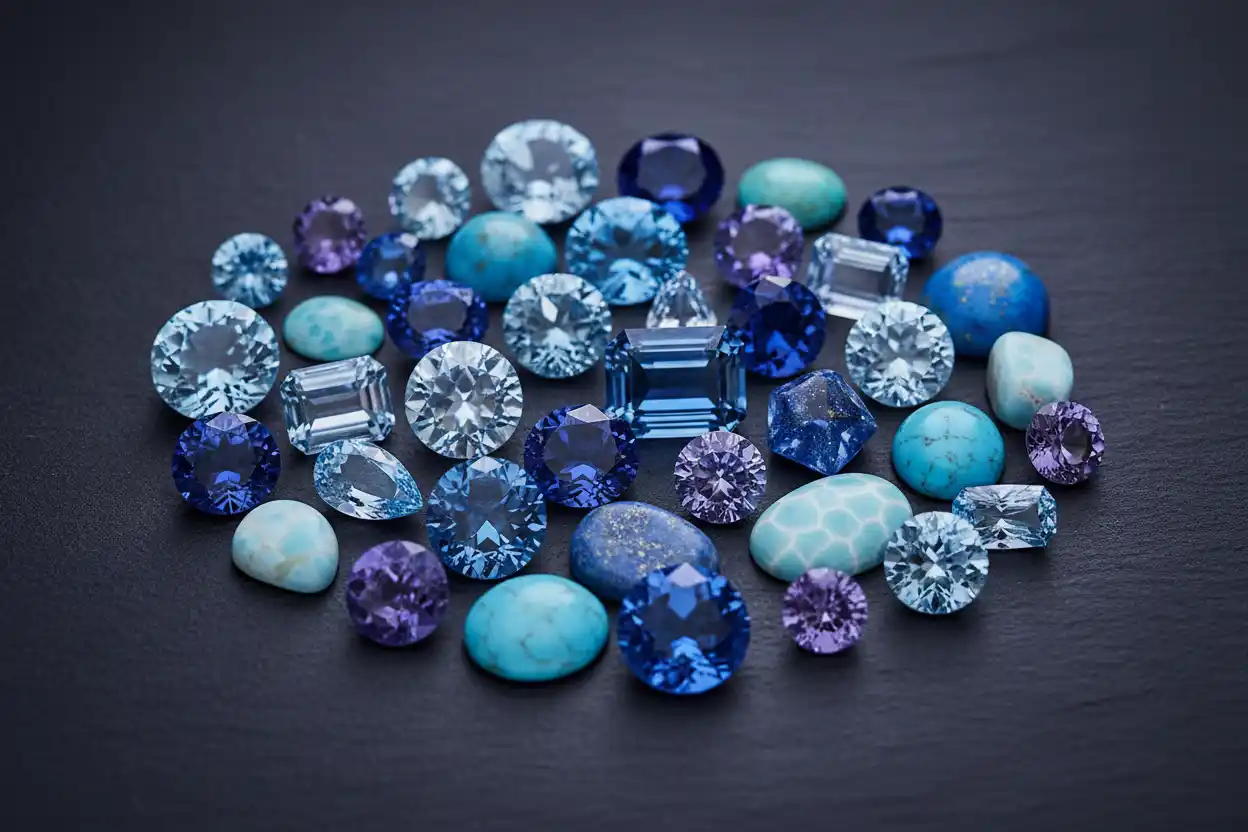
Blue gemstones cover an unusually broad range of gem materials, from transparent sapphire, aquamarine, spinel, topaz, zircon, and tanzanite to opaque turquoise, lapis lazuli, sodalite, and patterned chalcedony. Their colors can range from barely perceptible ice blue through sky blue, teal, royal blue, violet-blue, and dark inky navy, yet stones that look similar can differ dramatically in hardness, toughness, cleavage, treatment, rarity, value, and suitability for jewelry.
That makes blue gemstones more useful to compare gemologically than simply by color. Sapphire and blue spinel can tolerate demanding jewelry much better than apatite or kyanite. Aquamarine combines attractive transparency with practical durability, while blue topaz offers substantial size at a relatively accessible market position but requires respect for perfect cleavage. Tanzanite provides a distinctive violet-blue appearance but needs more protection from impact.
Opaque blue gemstones create another set of choices. Turquoise may be natural, stabilized, dyed, backed, or reconstructed; lapis lazuli is a rock rather than a single mineral species; and sodalite is a different mineral altogether even though all three may occupy a similar visual color range.
The practical benefits of blue gemstones therefore depend on what a buyer actually wants: a durable ring stone, a large pendant gem, a rare collector specimen, an opaque cabochon, a high-brilliance faceted stone, or a symbolic object associated with communication and thoughtful judgment. Physical properties determine how the gem performs. Symbolic meaning remains personal rather than a scientifically established effect.
Blue Gemstones at a Glance
| Blue gemstone | Material identity | Mohs hardness | Main durability issue | Common treatment concern | Strong uses |
|---|---|---|---|---|---|
| Blue diamond | Diamond, carbon | 10 | Can still chip along vulnerable areas | Irradiation, annealing, laboratory growth | Rings, earrings, pendants, bracelets |
| Blue sapphire | Corundum | 9 | Individual fractures or vulnerable cut edges | Heat, diffusion, filling, laboratory growth | Frequent-wear rings and most jewelry |
| Blue spinel | Spinel | 8 | Hard impact | Synthetic material, occasional treatment | Rings, earrings, pendants, bracelets |
| Blue topaz | Topaz | 8 | Perfect basal cleavage | Irradiation followed by heating; coatings | Pendants, earrings, protected rings |
| Aquamarine | Beryl | 7.5–8 | Fractures and sharp impacts | Heating; uncommon filling | Rings, earrings, pendants, bracelets |
| Indicolite | Tourmaline | About 7–7.5 | Brittle under impact | Heating or clarity treatment in some material | Rings with care, earrings, pendants |
| Iolite | Cordierite | About 7–7.5 | Cleavage and orientation | Generally limited treatment | Pendants, earrings, protected rings |
| Blue zircon | Zircon | About 6–7.5 | Brittle edges and abrasion | Heating | Earrings, pendants, careful rings |
| Tanzanite | Zoisite | About 6–7 | Cleavage and lower toughness | Heating, occasional coating or filling | Earrings, pendants, careful rings |
| Blue chalcedony | Microcrystalline silica | About 6.5–7 | Impact at thin edges | Dye | Cabochons, beads, rings, pendants |
| Blue lace agate | Banded chalcedony | About 6.5–7 | Thin edges and fractures | Dye or imitation | Cabochons, beads, pendants |
| Blue moonstone | Feldspar | About 6–6.5 | Cleavage and surface wear | Coatings or imitations | Cabochons, earrings, pendants |
| Labradorite | Feldspar | About 6–6.5 | Cleavage and abrasion | Imitations and composite products | Cabochons, pendants, protected rings |
| Blue opal | Hydrated silica | About 5.5–6.5 | Crazing, scratching, dehydration in some material | Dye, impregnation, composites | Earrings, pendants, protected cabochons |
| Turquoise | Copper-aluminum phosphate | About 5–6 | Porosity and surface wear | Stabilization, dye, reconstruction | Cabochons, signets, pendants, beads |
| Sodalite | Feldspathoid mineral | About 5.5–6 | Scratching and acid sensitivity | Dye | Cabochons, beads, carvings |
| Blue apatite | Apatite-group mineral | 5 | Scratching and brittleness | Possible treatments or misidentification | Earrings and pendants |
| Larimar | Blue pectolite | About 4.5–5 | Scratching, chipping, heat/light concerns | Resin or imitation | Pendants and protected cabochons |
| Blue kyanite | Aluminum silicate | Directional | Cleavage and directional hardness | Imitation or misidentification | Earrings and pendants |
| Lapis lazuli | Lazurite-bearing rock | About 5–5.5 | Scratching and acid-sensitive components | Dye and impregnation | Beads, cabochons, signets, carvings |
These blue gemstones should not be ranked by hardness alone. Toughness, cleavage, inclusions, treatment, setting construction, stone shape, and actual wearing conditions can be just as important.
What Qualifies as a Blue Gemstone?
Blue gemstones are gem materials valued for a blue body color, blue optical phenomenon, or commercially recognized blue appearance.
Some are single mineral species. Sapphire is corundum, aquamarine is beryl, spinel belongs to the spinel species, and zircon is zirconium silicate.
Others are rocks or aggregates. Lapis lazuli contains several minerals rather than being one uniform crystal species, while chalcedony consists of microscopic silica crystallites.
A few blue gemstones do not have a strongly blue body at all. Moonstone may show blue adularescence over a pale or nearly colorless base, while labradorite can display an intense blue flash against a gray body because of internal optical interference.
These distinctions matter because a color name does not determine how a gemstone should be valued or cared for.
The neighboring blue crystals category includes a broader range of specimens and symbolic-use materials. Blue gemstones are better evaluated through jewelry performance, gem species, treatment, cutting, value, disclosure, and buying considerations.
How Blue Gemstones Get Their Color
Blue gemstones develop color through several different mechanisms.
Trace elements can substitute into a mineral’s crystal structure and change which wavelengths of light are absorbed. Blue sapphire commonly involves interactions associated with iron and titanium, while aquamarine receives its blue-to-greenish-blue appearance from iron-related processes.
Copper is central to the appearance of turquoise and to the vivid blue-green color possible in Paraíba-type tourmaline.
Some rare blue spinel contains cobalt, although not every blue spinel is cobalt-rich and a vivid appearance alone does not prove a specific coloring element.
Blue diamond can involve natural structural and trace-element effects, but blue color can also be produced or modified through treatment. Laboratory-grown blue diamond creates another disclosure category.
Other blue gemstones depend heavily on treatment. Much commercial blue topaz begins as colorless or weakly colored material that is irradiated and heated, while heating commonly produces the familiar blue appearance of zircon from suitable rough.
Structural effects provide a completely different route. Labradorite and moonstone can display blue because their internal structures interact with light.
For buyers, the important question is therefore not simply, “Is this blue?” It is, “What material is this, what causes or modifies the color, and has that information been disclosed accurately?”
Best Blue Gemstones for Frequent-Wear Rings
A frequently worn ring encounters far more abrasion and impact than earrings or a pendant, so the strongest blue gemstones for rings are not necessarily the stones with the most dramatic color.
Blue Sapphire
Sapphire is the benchmark among blue gemstones for frequent ring wear.
Corundum ranks 9 on the Mohs scale, has no easy cleavage, and generally offers excellent practical durability. Blue sapphire can range from pale blue through medium, royal, violetish, greenish, and deep navy tones.
Color quality depends on more than saturation. A stone should retain an attractive blue appearance in ordinary lighting rather than becoming nearly black because of excessive tone or poor cutting.
Heat treatment is common and can be entirely acceptable when disclosed. Diffusion, filling, dye, coatings, and laboratory growth represent different market categories and should not be described as though they were equivalent.
Fine natural untreated material can receive a rarity premium, but a well-cut heated sapphire with strong color may be a better jewelry choice than an untreated stone with weak appearance.
Blue Spinel
Spinel is one of the most practical alternatives to sapphire.
It ranks 8 on the Mohs scale, generally has good toughness, and does not have the prominent cleavage concerns associated with topaz or tanzanite. Blue spinel may appear gray-blue, violet-blue, steely blue, or intensely saturated.
Fine natural cobalt-associated blue spinel can be rare and expensive, while darker or grayer stones are typically more accessible.
Synthetic spinel also exists, making natural-origin disclosure important when the price depends on rarity.
Aquamarine
Aquamarine is a strong choice when the preferred blue gemstones are lighter, cleaner, and more open in color.
Aquamarine is blue-to-greenish-blue beryl with hardness around 7.5–8. It commonly forms in comparatively large transparent crystals, allowing substantial center stones without the extreme rarity premiums found in some fine sapphire or diamond.
Very pale stones can appear almost colorless once mounted, especially at smaller sizes, while medium blue material generally shows its identity more clearly.
Aquamarine is suitable for many rings, although fractures, exposed corners, and tall settings still increase impact risk.
Anyone choosing between these stones specifically for a ring can compare the trade-offs in blue engagement ring stones.
Blue Topaz: Large, Bright, and Accessible
Topaz is one of the most widely available transparent blue gemstones.
It ranks 8 for scratch resistance, and large clean stones can be cut economically because suitable rough is relatively abundant. The familiar Sky Blue, Swiss Blue, and London Blue descriptions refer to commercial color categories rather than separate mineral species.
Most commercial blue topaz has received irradiation followed by heating.
That treatment is expected in much of the market and does not make the material an imitation. The important point is accurate disclosure.
Topaz has perfect basal cleavage, which makes durability more complicated than its hardness number suggests. A strong blow in an unfavorable direction can split the stone, and excessive pressure during setting can also cause damage.
For that reason, blue gemstones made from topaz are particularly attractive in pendants and earrings. Rings benefit from protective settings and sensible wearing habits.
Blue Zircon: High Brilliance With More Care
Zircon is a natural gemstone and should not be confused with cubic zirconia.
Well-cut blue zircon can produce strong brilliance, dispersion, and a lively appearance that makes it stand out among blue gemstones.
Much blue zircon receives heat treatment to develop desirable color. The treatment should be disclosed, particularly when the stone is being compared with untreated material from another gem category.
Zircon’s durability requires more attention than sapphire or spinel. It can be brittle, facet junctions may abrade, and repeated rubbing against harder materials can reduce the crispness of polished edges.
This makes zircon especially appealing for earrings and pendants, although carefully worn rings remain possible when the setting protects the stone.
Tanzanite: Distinctive Violet-Blue Color
Tanzanite occupies a distinctive position among blue gemstones because its appearance often sits between blue and violet.
It is the blue-to-violet gem variety of zoisite and commonly shows strong directional color. Cut orientation therefore influences whether a finished gem appears predominantly blue, violet-blue, or more strongly violet.
Heating is routinely associated with commercial tanzanite and is commonly used to bring forward blue-to-violet color from suitable material.
Its main compromise is durability.
Tanzanite has lower hardness than sapphire, spinel, aquamarine, or topaz, and cleavage creates additional impact risk. Earrings and pendants are therefore particularly practical. Rings require a wearer who understands that tanzanite should not be treated like sapphire.
Blue gemstones do not need to be equally durable to be desirable; they simply need to be matched to an appropriate use.
Indicolite and Blue Tourmaline
Blue tourmaline can range from muted blue through blue-green, teal, and deeper blue, and material described as indicolite belongs to this portion of the tourmaline color spectrum.
Tourmaline is a mineral group with substantial chemical complexity, so color and value vary widely.
Many blue tourmalines owe their color primarily to iron-related mechanisms. Copper-bearing Paraíba-type tourmaline can produce dramatically vivid blue-green or turquoise color and belongs to a much more specialized market.
The name Paraíba should not be applied to any bright teal stone merely because the appearance is similar.
Tourmaline generally provides useful jewelry hardness, but it can be brittle. Large inclusions, fractures, and thin corners deserve attention in rings.
Among blue gemstones, tourmaline is especially interesting for buyers who want colors that cross the boundary between blue and green.
Iolite: Pleochroic Blue-Violet Color
Iolite is gem-quality cordierite and is notable for strong pleochroism.
A single crystal can show visibly different colors from different viewing directions, including blue, violet-blue, gray, and yellowish or nearly colorless directions. Cut orientation therefore determines whether the finished stone presents an attractive blue face-up color.
Poorly oriented iolite may appear gray or washed out even when the rough contains a stronger blue direction.
Iolite can provide a relatively accessible alternative to some blue-violet sapphire and tanzanite appearances, but cleavage and impact considerations make earrings and pendants especially comfortable choices.
Protected rings are possible when the individual stone is sound.
Blue Apatite: Vivid Color, Limited Durability
Apatite can produce striking blue-to-blue-green material that sometimes resembles aquamarine or copper-bearing tourmaline in photographs.
Its hardness is only about 5.
That difference is critical because blue gemstones that appear almost identical online can perform very differently once worn.
Apatite scratches more readily and is brittle, so earrings and pendants are generally more practical than rings or bracelets.
Large transparent apatite can be visually impressive, but size alone does not compensate for a weaker durability profile. Buyers should inspect fractures, windowing, chips, and surface wear carefully.
Blue Kyanite: Sapphire-Like Color With Different Properties
Blue kyanite can produce attractive transparent to translucent blue gems, sometimes in colors that resemble sapphire.
Its physical behavior is entirely different.
Kyanite has directional hardness and prominent cleavage, which complicates cutting and makes thin or exposed pieces vulnerable to damage.
Blue gemstones made from kyanite are therefore better suited to earrings, pendants, and carefully designed occasional jewelry than unrestricted ring wear.
A low price relative to sapphire should not automatically be interpreted as a bargain if the intended use requires much greater durability.
Turquoise: Opaque Blue With Treatment Questions
Turquoise is one of the most historically recognizable opaque blue gemstones.
It is a hydrated copper-aluminum phosphate that occurs in blue, blue-green, and greenish shades, often with visible matrix.
Natural turquoise varies greatly in porosity and structural quality. Stabilization can improve material that would otherwise be difficult to polish or wear, while dyeing, impregnation, backing, and reconstruction create different commercial categories.
These processes should be disclosed because they affect value, care, and what the buyer is actually purchasing.
Turquoise works particularly well in cabochons, signets, beads, inlay, earrings, and pendants. It should be protected from cosmetics, oils, aggressive chemicals, and prolonged moisture, especially when treatment status is uncertain.
Lapis Lazuli: A Rock, Not a Single Mineral
Lapis lazuli is an important reminder that not all blue gemstones are individual mineral crystals.
Lapis is a metamorphic rock whose blue appearance is primarily associated with lazurite-bearing components, while calcite may create white areas and pyrite can appear as metallic gold-colored flecks.
Fine material is generally valued for an attractive rich blue appearance, good polish, and a visually pleasing balance of natural components.
Dye and impregnation can occur.
Because lapis contains softer and potentially acid-sensitive constituents, gentle cleaning is more appropriate than harsh chemical methods.
Its opacity makes lapis especially effective in cabochons, beads, signets, carvings, and inlay rather than transparent faceted styles.
Larimar: Patterned Caribbean Blue
Larimar is blue pectolite known for white-and-blue patterning that can resemble clouds, water, or branching textures.
Its color and geographic association give it a distinctive identity among blue gemstones, but it is considerably softer than quartz, sapphire, or aquamarine.
Larimar can scratch and chip, especially at exposed edges.
Pendants, earrings, beads, and protected cabochons are therefore safer choices than demanding rings.
Buyers should also be cautious with resin, glass, and other imitations. A perfectly uniform blue appearance may not reflect the natural variation expected in much genuine larimar.
Sodalite: Royal Blue Ornamental Material
Sodalite commonly appears royal blue with white areas or veining.
It is often confused with lapis lazuli, but the two materials are not interchangeable. Sodalite is a mineral, whereas lapis lazuli is a rock containing several minerals.
Sodalite generally lacks the characteristic balance of blue material, calcite, and pyrite associated with many lapis specimens.
Because sodalite is softer than quartz and can be affected by acids, it is better suited to beads, carvings, pendants, and cabochons than high-abrasion jewelry.
Dyed material may occur, so strong color concentrated in fractures or drill holes deserves closer inspection.
Blue Chalcedony and Blue Lace Agate
Blue chalcedony is microcrystalline silica with pale blue, gray-blue, or lavender-blue coloration.
Its compact structure and hardness near the quartz range make it one of the more practical opaque-to-translucent blue gemstones for beads, cabochons, pendants, earrings, and rings.
Dye can create stronger blue material, so natural-color claims should not be accepted solely from photographs.
Blue lace agate is a more specific banded chalcedony recognized by pale curved, layered, or lace-like patterns.
A uniform blue stone should not automatically receive the blue-lace name simply because the commercial term is familiar.
Both materials offer useful jewelry durability when structurally sound.
Blue Moonstone and Labradorite
Some blue gemstones owe their blue appearance primarily to optical phenomena rather than an evenly distributed blue body color.
Blue moonstone can display a floating blue adularescence over a pale body. Labradorite can show blue labradorescence against gray, dark, or multicolored material.
The quality of the effect depends strongly on cutting orientation.
A poorly oriented cabochon may show weak flash even when the rough contained a stronger optical phenomenon.
Feldspar also has cleavage, so these blue gemstones deserve more protection than their smooth polished surfaces might suggest.
For rings, low settings and protected edges are preferable. Pendants and earrings expose the stones to less repeated impact.
Blue Opal
Blue opal spans opaque to translucent material and may occur with or without play-of-color.
Its appearance can range from pale blue through blue-green and stronger turquoise-like shades.
Opal differs fundamentally from crystalline blue gemstones because it contains water within its silica structure and has lower hardness.
Some opal is susceptible to crazing, dehydration, dye, impregnation, stabilization, or composite construction depending on the material and commercial product.
The buyer should therefore identify the type of opal rather than assuming every blue opal has identical stability.
Pendants and earrings are generally lower-risk applications than highly exposed rings.
Hardness Is Only One Part of Jewelry Durability
One of the easiest mistakes when comparing blue gemstones is to treat the Mohs scale as a complete durability ranking.
Hardness measures resistance to scratching. It does not directly measure whether a gemstone will split, chip, or break.
Topaz demonstrates the distinction clearly. Its hardness is 8, yet perfect cleavage can make a sharp blow serious.
Tanzanite is softer and also has cleavage. Zircon can be brittle and develop abraded facet edges. Feldspar gems can cleave, while sapphire combines high hardness with a much more favorable structural profile.
Cut shape changes the risk further.
Round and oval shapes avoid sharp points. Pear, marquise, princess, kite, and similar cuts expose corners or tips that need greater protection.
A large surface-reaching fracture can weaken an otherwise durable gem.
When buying blue gemstones for jewelry, species-level hardness should be treated as the beginning of the durability assessment rather than the conclusion.
Treatments Are Common Across Blue Gemstones
Treatment is not automatically evidence of low quality or deception.
Disclosure is the key issue.
Blue sapphire commonly receives heat. Blue topaz frequently owes its commercial color to irradiation and heating. Blue zircon is commonly heated. Tanzanite usually reaches its familiar blue-to-violet appearance through heat treatment.
Turquoise may be stabilized, dyed, impregnated, backed, or reconstructed.
Chalcedony can be dyed.
Diamond may be naturally blue, color treated, or laboratory grown.
Sapphire, spinel, diamond, and other materials can also have laboratory-grown counterparts.
These categories should not be collapsed into the vague term “real.”
A laboratory-grown sapphire is genuine corundum but has manufactured origin. Dyed chalcedony is genuine chalcedony whose color has been modified. Blue glass made to imitate sapphire is not sapphire at all.
Accurate terminology allows buyers to compare like with like.
What Determines the Quality of Blue Gemstones?
Blue gemstones are too diverse for one universal grading system, but several factors apply broadly.
Color
Hue, tone, and saturation affect almost every blue gemstone.
The preferred balance varies by material. Sapphire may be valued for vivid medium-to-deep blue, aquamarine often performs best when its blue is visible without becoming dull, and tanzanite may be prized for a strong blue-violet appearance.
More saturation is not always better. Excessive darkness can make a stone look black in ordinary lighting.
Clarity and Texture
Transparent blue gemstones are judged partly by how inclusions affect beauty, transparency, durability, and rarity.
Opaque materials require a different approach. Matrix, veins, banding, inclusions, and pattern can contribute positively when they are characteristic and attractive.
Cut
Cut controls brightness, face-up color, symmetry, optical effects, and apparent size.
Pleochroic materials such as tanzanite and iolite require especially thoughtful orientation.
Moonstone and labradorite must be positioned to show their optical phenomena effectively.
Condition
Chips, abraded facet edges, cavities, unstable fractures, damaged drill holes, worn coatings, and repairs can influence both value and durability.
Treatment
Treatment can substantially change market category.
A natural-color stone and a treated stone may both be attractive, but they should not necessarily receive the same price.
Size
Larger size can add value when fine material becomes rarer as dimensions increase, but the effect varies greatly among blue gemstones.
Large blue topaz is relatively available, while comparable size in exceptional sapphire, spinel, or natural blue diamond can be much rarer.
Understanding Price and Value
There is no meaningful universal price-per-carat range for blue gemstones as a category.
A large treated blue topaz and a much smaller natural blue sapphire can occupy completely different markets despite both being transparent and blue.
The strongest value comparisons use the same material, treatment category, quality level, size range, cut quality, and documentation.
For expensive blue gemstones, distinguish asking price from actual transaction value. An appraisal prepared for insurance replacement is also not necessarily a realistic resale estimate.
Geographic origin can influence certain gemstone markets, particularly sapphire, but origin should be supported by credible evidence when it is being used to justify a premium.
Natural rarity also matters differently from visual beauty. Laboratory-grown sapphire or diamond can provide excellent optical and physical performance without carrying the geological rarity component of a natural stone.
Buy for the category you actually value rather than paying extra for terminology that has not been substantiated.
How to Choose Blue Gemstones for Different Jewelry
The intended piece should influence the gemstone before the design is finalized.
For frequent-wear rings, sapphire and spinel are particularly strong options, while aquamarine can also work well with sensible protection.
For earrings, the range expands considerably because the stones experience much less abrasion and impact. Tanzanite, zircon, apatite, kyanite, larimar, and opal become more practical.
Pendants are similarly forgiving and can accommodate softer or more cleavable blue gemstones.
Bracelets deserve greater caution because they frequently strike desks, furniture, and other hard surfaces. Sapphire, spinel, aquamarine, and durable chalcedony are generally easier to manage than soft or brittle stones.
Opaque materials such as turquoise, lapis lazuli, and sodalite work particularly well in cabochons, signets, beads, and substantial decorative settings.
Choose the gem and the mounting as one system rather than assuming the setting can compensate for every structural weakness.
Buying Blue Gemstones Online
Online photographs can distort color.
Dark backgrounds can make translucent blue gemstones appear more saturated, while bright lights can hide excessive darkness or windowing. Digital editing can also shift blue toward teal, violet, or a stronger saturation than the stone shows in ordinary viewing.
Request images or video of the actual gemstone from several angles and under more than one neutral lighting condition when the purchase is significant.
Compare dimensions as well as carat weight. Carat measures mass, not visible face-up size.
Ask explicitly about:
- Natural or laboratory-grown origin.
- Known treatments.
- Whether color is natural or modified.
- Stone dimensions and weight.
- Chips, fractures, repairs, or fillings.
- Return conditions.
- Laboratory documentation when relevant.
Generic commercial grades such as AAA should not be assumed to represent a universal independent gemological standard.
For higher-value blue gemstones, independent identification can be more important than elaborate seller terminology.
Symbolic Meaning of Blue Gemstones
Blue gemstones have been associated across different traditions with loyalty, truth, communication, wisdom, contemplation, trust, and commitment.
Pale blue may symbolize openness or measured communication, while deeper blue can represent authority, seriousness, or consistency.
These meanings can make jewelry personally significant, especially for gifts, commitments, or objects connected with a specific intention.
The interpretation should remain symbolic.
Blue gemstones do not force honesty, create loyalty, treat anxiety, improve communication automatically, guarantee protection, attract money, or alter another person’s decisions.
A gemstone can represent an intention. The person wearing or using it remains responsible for the action.
Cleaning Blue Gemstones Safely
There is no single cleaning method appropriate for every blue gemstone.
Warm water, mild soap, and gentle cleaning are suitable for many stable untreated stones, but the safest method depends on species, inclusions, treatments, and setting construction.
Sapphire and spinel generally tolerate routine jewelry care well when they are untreated or conventionally heated and structurally sound.
Aquamarine usually responds well to gentle washing, although fractured or filled material requires greater caution.
Topaz should not be exposed to steam, ultrasonic cleaning, strong heat, or abrupt temperature changes.
Zircon is better cleaned gently because of brittleness and abrasion concerns.
Tanzanite should also receive conservative care because of cleavage and lower toughness.
Turquoise, lapis lazuli, sodalite, opal, dyed chalcedony, coated stones, and impregnated materials can require substantially different treatment.
When identity or treatment is uncertain, the conservative option is preferable to aggressive cleaning.
Frequently Asked Questions
What are the most durable blue gemstones?
Sapphire is one of the strongest natural colored blue gemstones for demanding jewelry because it combines Mohs hardness 9 with generally excellent practical durability. Spinel and aquamarine are also strong choices.
Which blue gemstones are best for rings?
Sapphire and blue spinel are excellent choices for frequent-wear rings. Aquamarine can also perform well, while topaz, tanzanite, zircon, kyanite, and softer stones require more careful setting and wear.
What is the most affordable transparent blue gemstone?
Blue topaz commonly provides large transparent stones at an accessible market position because suitable material is abundant and treatment is widespread. Aquamarine, iolite, and zircon can also offer good value depending on quality.
What is the rarest blue gemstone?
There is no single useful answer without defining quality and category. Natural fancy-blue diamond, exceptional cobalt-associated spinel, fine sapphire, and vivid copper-bearing tourmaline can all be extremely rare in top qualities.
Is blue topaz naturally blue?
Natural blue topaz exists, but much commercial blue topaz receives irradiation followed by heat treatment to produce the familiar market colors.
Is blue zircon the same as cubic zirconia?
No. Zircon is a natural zirconium silicate mineral. Cubic zirconia is a manufactured material with a different composition and crystal structure.
Is lapis lazuli a gemstone or a mineral?
Lapis lazuli is used as a gemstone, but mineralogically it is a rock composed of several mineral constituents rather than a single mineral species.
Are blue gemstones always naturally colored?
No. Natural blue color occurs in many materials, while other blue gemstones commonly receive treatment. Blue topaz, blue zircon, sapphire, diamond, chalcedony, and turquoise can all present important treatment questions.
Which blue gemstones are opaque?
Turquoise, lapis lazuli, sodalite, many blue opals, and some chalcedony are commonly opaque or translucent rather than transparent. Their quality criteria differ from faceted transparent stones.
Which blue gemstones have the most brilliance?
Diamond, zircon, sapphire, and well-cut spinel can show strong brilliance, although their optical properties differ. Zircon can be particularly lively because of its dispersion.
Can tanzanite be worn in a ring?
Yes, but tanzanite requires more protection than sapphire or spinel because of moderate hardness, cleavage, and lower toughness. A low protective setting and careful wear improve practicality.
Is aquamarine suitable for frequent jewelry wear?
Yes. Aquamarine has useful hardness and performs well in many jewelry formats when the individual stone is sound and protected from hard impacts.
How can I tell whether a blue gemstone is treated?
Some treatments leave microscopic or spectroscopic evidence, but visual examination alone is often insufficient. Seller disclosure and an appropriate gemological report are more reliable for significant purchases.
Are laboratory-grown blue gemstones fake?
Not when correctly described. Laboratory-grown sapphire and diamond have the essential material identity of their natural counterparts but were created through manufacturing rather than geological formation. Glass or another substance made to resemble them is an imitation.
What should I look for when buying blue gemstones?
Confirm material identity, natural or laboratory-grown origin, treatment, color quality, cut, condition, dimensions, durability for the intended jewelry, and whether the price reflects the actual category being sold.
Choosing Blue Gemstones by Material, Not Color Alone
Blue gemstones offer far more variety than a single color category suggests. Sapphire, spinel, aquamarine, topaz, zircon, tourmaline, tanzanite, and iolite can all provide transparent blue jewelry, yet their durability, treatment, rarity, and price structures are very different.
Opaque blue gemstones expand the range further. Turquoise, lapis lazuli, sodalite, blue chalcedony, larimar, and blue opal each require their own standards for identification, quality, treatment, and care.
The strongest choice begins with intended use. A ring needs a different durability profile from a pendant. A collector purchasing rare natural color needs different documentation from someone choosing an attractive treated gem for jewelry. A buyer who values geological rarity will evaluate laboratory-grown material differently from someone prioritizing appearance and physical performance.
Color can start the search, but it should not finish it.
The best blue gemstones are the ones whose actual material identity, durability, treatment status, quality, price, setting, and intended use all support the same decision.