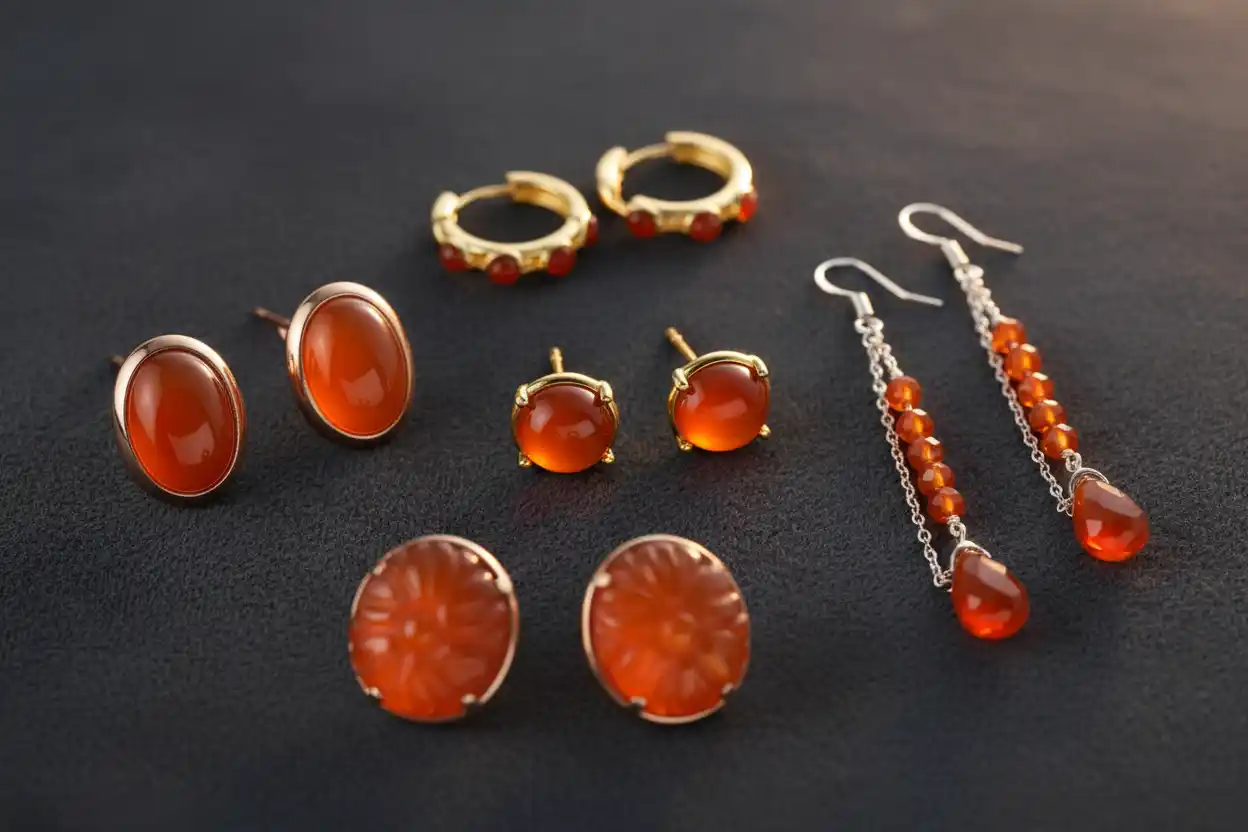
Carnelian Earrings: Styles, Settings & Buying Tips
Carnelian earrings bring the warm orange, red-orange, and reddish-brown color of chalcedony into one of the safest jewelry formats for this gemstone because earrings experience substantially less impact and abrasion than rings or bracelets. That relative protection makes carnelian earrings suitable for delicate cabochons, carved drops, translucent beads, faceted-style cuts, and larger statement stones that might be less practical on the hand.
The best carnelian earrings are not determined by color alone. Pair matching, stone dimensions, total earring weight, setting security, post thickness, back style, drop length, metal composition, treatment disclosure, and the way each stone faces when worn can affect comfort and quality more than a generic description such as “premium orange crystal.”
Carnelian itself is an orange-to-red variety of chalcedony within the quartz family. It generally has hardness around 6.5–7, no easy cleavage in the conventional gemological sense, and good practical toughness, giving carnelian earrings enough durability for regular wear when the stones are sound and the construction is secure. The broader carnelian meaning guide covers the mineral, geological, historical, and symbolic background, while this page focuses specifically on earring design, pair matching, hardware, comfort, treatment, care, and buying decisions.
Treatment remains important because commercial carnelian can be heated or dyed, while glass, resin, and other orange-red materials may imitate the look. A treated pair can still be attractive and wearable, but the description should distinguish natural chalcedony, heated material, dyed material, imitation, and composite construction accurately.
Carnelian Earrings at a Glance
| Feature | What Buyers Should Know |
|---|---|
| Gem material | Carnelian, an orange-to-red chalcedony |
| Composition | Primarily SiO₂ |
| Typical colors | Honey orange, orange, red-orange, reddish brown |
| Transparency | Usually translucent to nearly opaque |
| Mohs hardness | About 6.5–7 |
| Cleavage | None in the conventional gemological sense |
| Toughness | Generally good |
| Best earring formats | Studs, bezel drops, leverbacks, hooks, hoops with charms, cabochon earrings |
| Common stone forms | Cabochons, beads, carved drops, tablets, occasional faceted-style cuts |
| Main pair-quality issue | Matching color, translucency, dimensions, cut, and orientation |
| Common treatments | Heating and dyeing |
| Main construction concerns | Post security, back fit, jump rings, hook closure, stone setting, solder |
| Main comfort concern | Total weight and drop movement |
| Best cleaning | Mild soap, lukewarm water, and a soft cloth when construction permits |
| Symbolic themes | Motivation, creativity, courage, confidence, purposeful action |
Carnelian earrings generally require less protective metalwork than a carnelian ring because the stones rarely strike hard surfaces during normal wear. Nevertheless, construction still determines whether the pair remains secure.
Why Carnelian Works Well in Earrings
Carnelian has several physical and visual characteristics that make it particularly useful for earrings.
Its fine-grained chalcedony structure takes a smooth polish, while the absence of prominent cleavage reduces the risk of splitting along one preferred crystallographic plane. The gemstone remains brittle enough to chip under a severe blow, but ordinary earring wear exposes it to relatively little direct impact.
The difference between hardness and resistance to breaking is important. The gemstone toughness vs hardness guide explains why a stone with good scratch resistance can still be damaged by concentrated force.
Earrings reduce that force considerably compared with hand jewelry.
Carnelian also benefits visually from movement. Translucent orange material can appear darker against hair or clothing and then glow more brightly when light passes through the side or back as the wearer turns.
That changing appearance makes earrings especially effective for stones whose beauty depends partly on translucency.
Carnelian Stud Earrings
Studs provide the simplest and most compact form of carnelian earrings.
A stone sits directly against or near the earlobe and attaches through a post.
Common stud forms include:
- Round cabochons.
- Oval cabochons.
- Small faceted-style stones.
- Carved flowers.
- Flat tablets.
- Bezel-set circles.
- Prong-set stones.
- Minimal metal frames.
Stud carnelian earrings are generally easy to wear because they do not swing, catch clothing readily, or place much leverage on the piercing.
They are particularly suitable for everyday use.
Choosing the Right Carnelian Stud Size
Stone diameter changes the visual balance of a stud dramatically.
Approximate effects include:
| Stone size | Typical appearance |
|---|---|
| 3–4 mm | Very subtle accent |
| 5–6 mm | Small everyday stud |
| 7–8 mm | Noticeable but versatile |
| 9–10 mm | Strong statement stud |
| Above 10 mm | Large visual presence and increased weight |
Actual comfort depends on stone thickness and metal construction, not diameter alone.
A thin 10 mm carnelian cabochon can weigh less than a much deeper stone with the same face-up dimensions.
Ask for millimeter measurements and, for large studs, total earring weight.
Bezel-Set Carnelian Studs
A bezel wraps a rim of metal around the edge of the carnelian.
This design offers excellent protection and creates a smooth outer surface that is unlikely to catch hair or clothing.
Bezel carnelian earrings work particularly well for:
- Round cabochons.
- Oval cabochons.
- Flat tablets.
- Small carved stones.
- Thin translucent material.
Open-backed bezels can allow more light through a pale stone, increasing its orange glow.
Closed backs can make the color appear deeper, especially when the underlying metal is dark or opaque.
Neither design is universally better.
The choice should suit the individual stone.
Prong-Set Carnelian Studs
Prongs expose more of the gemstone and create a lighter-looking setting.
They can work well when the carnelian has:
- A sound edge.
- Adequate thickness.
- No major fractures near the contact points.
- Symmetrical cutting.
Each prong should touch the stone securely without leaning away from it.
If one prong is visibly higher, separated from the stone, or poorly finished, the earring deserves closer inspection.
For everyday studs, low-profile settings are generally more comfortable than tall basket-style mountings.
Carnelian Drop Earrings
Drop carnelian earrings suspend the gemstone below the earlobe.
The stone may hang from:
- A hook.
- Leverback.
- Post-and-drop construction.
- Chain.
- Hinged connector.
- Decorative metal link.
Drops allow larger stones to be worn comfortably because their weight hangs beneath rather than projecting directly from the lobe.
They also reveal carnelian translucency particularly well.
As the stone moves, different angles allow light through changing portions of the material.
Drop Length Matters
A photograph can make a drop earring appear shorter or longer than it actually is.
Ask for the complete measurement from the top of the ear wire or post to the lowest point of the stone.
Approximate visual categories might be:
| Drop length | Typical effect |
|---|---|
| Under 20 mm | Short, restrained drop |
| 20–35 mm | Versatile everyday dangle |
| 35–50 mm | Noticeable statement |
| Above 50 mm | Long dramatic design |
These are descriptive ranges rather than rules.
Neck length, hairstyle, clothing, and personal preference all influence how a carnelian earring looks when worn.
Weight Matters More in Long Earrings
Long carnelian earrings can look delicate while still being heavy.
The total load includes:
- Gemstone.
- Metal setting.
- Chain.
- Decorative links.
- Additional beads.
- Ear wire.
A pair may be visually attractive but uncomfortable after extended wear if each earring is too heavy.
When buying substantial carnelian earrings online, ask for weight per earring rather than relying on appearance.
A pair weighing 12 grams total means approximately 6 grams per ear when evenly matched.
That information is more useful than simply calling the earrings “lightweight.”
Carnelian Dangle Earrings
Dangles differ from compact drops because multiple components may move independently.
A carnelian bead can hang from a chain, several stones can form graduated sections, or metal and gemstone elements can articulate separately.
Movement increases visual interest but also increases mechanical wear.
Inspect:
- Jump rings.
- Wire loops.
- Chain connections.
- Drilled bead holes.
- Decorative links.
- Hook closure.
- Solder joints.
A single open jump ring can release an entire carnelian drop.
Carnelian Hoop Earrings
Carnelian hoop earrings generally use one of three approaches:
- Carnelian beads threaded around a hoop.
- One or more carnelian charms suspended from a hoop.
- Carnelian cabochons integrated into hoop-style metalwork.
Bead-covered hoops can become heavier than expected because many small stones accumulate substantial total weight.
Charm hoops place less gemstone mass around the ear but allow more swinging movement.
Check the hoop closure carefully.
A loose hinge or thin wire can become the weakest part of otherwise excellent carnelian earrings.
Huggie-Style Carnelian Earrings
Huggies are small hoops that sit close to the earlobe.
Carnelian may appear as:
- Tiny bead drops.
- Small cabochons.
- Inlaid sections.
- Short removable charms.
This style combines a compact profile with slightly more movement than a stud.
A removable carnelian charm can be particularly versatile because the hoop may also be worn alone.
Verify that the charm opening cannot slip over the hinge or clasp accidentally.
Carnelian Leverback Earrings
Leverbacks are among the most secure choices for drop carnelian earrings.
The wire passes through the piercing and closes with a hinged section at the rear.
Advantages include:
- Reduced chance of accidental loss.
- No separate butterfly back.
- Good support for moderate drops.
- Comfortable movement when correctly sized.
Check that both leverbacks close with similar tension.
One loose mechanism can make an otherwise matched pair unreliable.
French Hook Carnelian Earrings
French hooks are simple curved ear wires.
They create a lightweight appearance and allow the carnelian to move freely.
Their main disadvantage is retention.
An open hook can slide from the piercing during clothing changes or vigorous movement.
Small silicone or metal stoppers can improve security.
If a carnelian earring has substantial value, a leverback or closed hook may provide greater confidence.
Threader Earrings
Threader earrings use fine chain or wire that passes through the piercing.
Carnelian may hang at one or both ends.
This format creates a minimalist appearance, but the stone must remain light enough that the chain does not pull uncomfortably.
Inspect the transition between:
- Chain.
- Rigid post.
- Carnelian component.
Any rough solder joint or exposed wire end can affect comfort.
Carnelian Bead Earrings
Beads are among the most common forms of carnelian earrings.
Round beads can be used singly or arranged in vertical combinations.
A good bead should show:
- Smooth polish.
- Centered drilling.
- No major chips around the hole.
- Appropriate translucency.
- Secure wire attachment.
The drill hole deserves special attention because it creates a local stress concentration.
A fracture extending from the hole can enlarge if the bead swings and repeatedly strikes surrounding metal.
Carnelian Cabochon Earrings
Cabochons are ideal for displaying carnelian’s body color and translucency.
A cabochon has a polished rounded top rather than conventional facets.
Common shapes include:
- Round.
- Oval.
- Pear.
- Cushion.
- Rectangle.
- Freeform.
Thin translucent cabochons can glow brightly in open-backed earrings, while deeper reddish-brown cabochons create a richer and more opaque appearance.
The best pair should have compatible dome height.
One high-domed stone beside one flat cabochon can make an otherwise similar pair look mismatched.
Faceted-Style Carnelian Earrings
Transparent gem materials depend heavily on faceting for brilliance, while carnelian is generally translucent and receives less benefit from conventional brilliant cutting.
However, faceted or checkerboard-style surfaces can create attractive flashes from the polish.
Faceted carnelian earrings should be evaluated mainly for:
- Color.
- Surface reflections.
- Symmetry.
- Clean edges.
- Matching.
Do not expect diamond-like brilliance.
The stone’s strength is warm body color rather than extreme dispersion.
Carved Carnelian Earrings
Carnelian has a long history as a carving material because fine-grained chalcedony can hold detailed engraved surfaces.
Modern earrings may include:
- Leaves.
- Flowers.
- Drops.
- Animals.
- Symbols.
- Geometric shapes.
- Cameo-like profiles.
Thin projections require careful inspection.
A narrow carved leaf tip can break even though the main body of the carnelian is durable.
The design should preserve enough thickness around holes and attachment points.
Matching Is Crucial in Carnelian Earrings
A necklace can use one central stone.
A bracelet can use deliberate variation.
Earrings are different because the two stones are viewed as a pair.
This makes matching one of the most important form-specific buying criteria.
Good carnelian earrings should coordinate in:
- Color.
- Tone.
- Saturation.
- Transparency.
- Dimensions.
- Shape.
- Cut.
- Polish.
- Thickness.
- Setting.
- Orientation.
They do not need to be perfectly identical.
Natural stones rarely are.
The goal is visual balance.
Color Matching
Place both carnelian earrings beside one another under neutral light.
Ask:
Does one look bright orange while the other looks brown?
Is one substantially darker?
Does one have obvious banding while the other is uniform?
Do both stones respond similarly to backlighting?
Minor differences can look natural and attractive.
Large differences should appear intentional rather than accidental.
Transparency Matching
Carnelian normally ranges from translucent to nearly opaque.
A matched pair should ideally transmit a similar amount of light unless contrasting stones are part of the design.
One pale translucent stone and one dense opaque stone may look mismatched even if both are genuinely carnelian.
Backlighting is especially useful for evaluating pair consistency.
Shape and Dimension Matching
Two stones described as “8 mm oval” may differ slightly in actual dimensions.
For higher-quality carnelian earrings, compare:
- Length.
- Width.
- Thickness.
- Dome height.
- Outline.
Small differences are normal.
Large differences can cause one earring to appear visibly heavier or larger when worn.
Pair Orientation
Orientation matters when the stones contain:
- Bands.
- Clouds.
- Color zoning.
- Carved patterns.
- Irregular inclusions.
A well-matched pair may use mirrored orientation rather than identical orientation.
For example, elongated color zones can angle inward toward the face on both earrings.
That design decision can make natural variation look intentional and refined.
Total Carat Weight Can Be Misleading
Earring listings sometimes provide a combined carat weight for the pair.
A listing marked:
6 ct total weight
may mean approximately 3 ct per earring, assuming the stones are closely matched.
Do not assume each earring weighs 6 ct.
Ask whether the stated carat figure is:
- Per stone.
- Per earring.
- Combined gemstone weight.
- Complete jewelry weight.
Millimeter dimensions are often more useful than carat weight for opaque or translucent carnelian because they tell you directly how large each stone will look.
Carnelian Earring Color
Carnelian earrings can range from pale honey orange to deep reddish brown.
Common attractive shades include:
- Golden orange.
- Tangerine.
- Burnt orange.
- Red-orange.
- Rust red.
- Brownish red.
A darker pair is not automatically higher quality.
Pale translucent stones can show exceptional glow.
Deep stones may create stronger contrast against pale metal or skin.
Choose the appearance you actually prefer rather than assuming one shade is universally superior.
Why Carnelian Changes Appearance With Lighting
Translucent carnelian can appear different depending on whether light reaches the stone from the front, side, or back.
A stone that looks brown-red against dark hair can become vivid orange when sunlight reaches its edge.
Thickness also matters.
Thin drops transmit more light than deep beads.
That is why online photographs should ideally include more than one lighting condition.
A single brightly backlit image can make ordinary dark carnelian look unusually luminous.
Open-Back Settings and Translucency
An open-backed setting allows light to reach the rear of the gemstone.
This can improve the apparent brightness of pale or medium-tone carnelian earrings.
Open backs also make it easier to inspect:
- Stone thickness.
- Internal texture.
- Color concentration.
- Treatment clues.
- Cleaning residue.
The trade-off is greater exposure of the rear surface.
A closed back can provide a smooth finished appearance but may make translucent material look darker.
Closed-Back Settings
Closed backs can be appropriate when:
- The stone is opaque or very dark.
- The design includes engraving.
- The rear surface is unattractive.
- A metal frame contributes structurally.
- The maker wants a smooth finished back.
Check that the stone is not merely glued into a shallow closed cup when the design is being marketed as a secure fine-jewelry setting.
Adhesive can be appropriate in some constructions, but it should not replace sound mechanical design without disclosure.
Bezel Settings for Carnelian Earrings
Bezels are among the most practical settings for carnelian earrings.
Benefits include:
- Strong edge protection.
- Smooth profile.
- Reduced snagging.
- Good accommodation of cabochons.
- Clean visual outline.
The bezel should contact the stone evenly.
Look for:
- Gaps.
- Folded metal.
- Tool marks.
- Uneven rims.
- Stone movement.
- Excess glue.
A thin translucent carnelian may look brighter in an open-back bezel.
Prong Settings
Prongs can make carnelian earrings feel lighter visually because more of the stone remains exposed.
They work best when the carnelian is sufficiently thick and structurally sound.
For pear, marquise, or pointed carved shapes, protect vulnerable tips.
A V-prong or partial bezel can provide better protection than one small round prong resting directly on the point.
Check every prong on both earrings.
Matching stone quality means little if one setting is loose.
Wire-Wrapped Carnelian Earrings
Wire wrapping is common in handmade carnelian earrings.
A well-made wrap should:
- Hold the stone securely.
- Avoid sharp wire ends.
- Keep loops fully closed.
- Maintain balanced orientation.
- Avoid crushing drilled material.
- Feel smooth against skin and hair.
Inspect the top loop where the wrapped stone connects to the ear wire.
This small joint carries the full weight of the drop.
Glue-Set Carnelian Earrings
Some inexpensive studs and decorative earrings use adhesive rather than bezels or prongs.
Glue-set jewelry can be perfectly functional, but care becomes more conservative.
Repeated exposure to:
- Hot water.
- Steam.
- Solvents.
- Cosmetics.
- Hair products.
may affect certain adhesives.
If you cannot determine how the stone is attached, avoid prolonged soaking and ultrasonic cleaning.
Choosing Metal for Carnelian Earrings
Carnelian works with both warm and cool metal colors.
Yellow Gold
Yellow gold reinforces the orange and red tones in carnelian.
This combination creates a warm, traditional appearance and works particularly well with deep red-orange cabochons.
Rose Gold
Rose gold produces a softer tonal combination.
It can blend visually with pale orange or peach-toned carnelian and create a less contrasted look.
White Gold
White gold creates stronger warm-cool contrast.
Carnelian often appears brighter against a neutral white metal.
Rhodium-plated white gold may require periodic replating as the surface finish wears.
Sterling Silver
Sterling silver is one of the most accessible and versatile choices for carnelian earrings.
The cool metal emphasizes the gemstone’s warm color.
Normal silver tarnish is a surface-metal issue rather than deterioration of the carnelian.
Platinum
Platinum provides a durable premium white-metal option.
Its density makes substantial earrings heavier, so total pair weight matters when large settings are used.
Stainless Steel
Stainless steel offers strong everyday practicality in many contemporary designs.
Verify the exact alloy if skin sensitivity is a concern.
Gold-Plated and Silver-Plated Metals
Plated earrings can be visually attractive at a lower price, but friction, cosmetics, and cleaning can gradually expose the underlying metal.
Ask:
- What is the base metal?
- What type of plating is used?
- Is the post plated or solid?
- Is the earring back the same alloy?
Those questions matter because the components passing through or touching the ear deserve particular attention.
Metal Sensitivity Matters More in Earrings
A wearer may tolerate carnelian perfectly while reacting to nickel or another metal component.
Because posts and hooks pass through piercings, vague metal descriptions deserve caution.
Terms such as:
- Hypoallergenic.
- Premium metal.
- Gold tone.
- Silver tone.
- Jewelry alloy.
do not identify the actual composition.
For sensitive ears, look for clearly specified materials such as appropriate grades of titanium, solid gold alloys, platinum, suitable stainless steel, or other personally tolerated metals.
The gemstone and the ear wire are separate material decisions.
Carnelian Earring Backs
Stud carnelian earrings are only as secure as their backs.
Common types include:
- Butterfly backs.
- Friction backs.
- Screw backs.
- La pousette-style locking backs.
- Silicone backs.
- Disc-supported backs.
Butterfly backs are simple and common.
Screw backs provide additional security but take longer to put on and remove.
Large studs may benefit from broader backs that help support the earring and prevent the front from drooping.
Large Studs Need Better Support
A large carnelian cabochon can pull the front of the earring downward.
If the stud tilts, a wider backing disc can distribute pressure more effectively across the lobe.
The post position also matters.
A post attached too high or low on the setting can cause poor balance.
Before buying large carnelian earrings, ask for a side photograph showing the relationship between:
- Stone.
- Setting.
- Post.
- Back.
A design can look excellent from the front while hanging poorly in real wear.
Post Thickness and Length
Posts need enough length to pass comfortably through the lobe and engage the back without excessive looseness.
A post that is too short can feel tight.
One that is excessively long can press behind the ear or catch hair.
Exact ideal dimensions vary among wearers and earring constructions.
The safest buying approach is to compare the design with earrings you already find comfortable.
Carnelian Earrings for Everyday Wear
Studs and short leverback drops are generally the easiest carnelian earrings for daily use.
They combine:
- Low weight.
- Limited swinging.
- Good security.
- Reduced snagging.
- Simple cleaning.
Large hooks and elaborate dangles remain practical for occasional wear but may interfere with scarves, headphones, high collars, or long hair.
Jewelry suitability is contextual.
The same pair may be comfortable at dinner and inconvenient during a full workday wearing a headset.
Carnelian Earrings With Glasses
People wearing glasses should consider how large studs or upper-ear designs interact with frame arms.
Most ordinary lobe earrings do not interfere significantly.
However, large side-facing elements can catch glasses when putting them on or removing them.
A compact carnelian stud usually creates the least interaction.
Carnelian Earrings With Headphones
Over-ear headphones can press large studs and hoop-style carnelian earrings against the head.
That pressure can become uncomfortable.
If headphones are worn frequently, choose:
- Small studs.
- Flat-backed designs where suitable.
- Low-profile bezels.
Alternatively, remove larger earrings before extended headset use.
Comfort should be tested according to actual daily habits.
Heat Treatment in Carnelian
Heating is a well-established treatment for carnelian and related iron-bearing chalcedony.
Controlled heat can deepen or improve orange-to-red coloration.
A heated carnelian remains natural chalcedony if the original stone formed geologically.
The treatment changes its appearance rather than turning it into an imitation.
The main issue is disclosure.
A seller should not charge a significant untreated-color premium while withholding known heating.
Dyed Carnelian Earrings
Dye can produce or intensify orange-red color in chalcedony and agate.
Possible visual clues include color collecting:
- Around drill holes.
- Inside fractures.
- Along porous zones.
- Near surface cracks.
However, natural iron compounds can also concentrate irregularly.
Visual screening can suggest treatment but may not prove it.
The broader gemstone treatments guide explains why enhancement should be evaluated by type, stability, disclosure, and value rather than being treated automatically as evidence that the gemstone is fake.
Does Treatment Make Carnelian Earrings Fake?
No.
Several distinct categories need to be separated:
Natural untreated carnelian — geologically formed chalcedony without known color treatment.
Natural heated carnelian — geologically formed chalcedony whose color has been modified or enhanced through heat.
Dyed chalcedony — natural silica material with introduced color.
Imitation carnelian — glass, resin, ceramic, or another material used to imitate the appearance.
Composite jewelry — multiple materials assembled into one stone-like component.
These categories differ materially.
A seller should identify the one being offered.
Glass Imitations
Orange-red glass can resemble polished carnelian, especially in small earrings.
Possible signs include:
- Rounded gas bubbles.
- Flow structures.
- Highly uniform transparency.
- Molded components.
- Repeated identical appearance.
Natural chalcedony can also contain rounded-looking features, so one suspected bubble is not enough to prove glass.
Higher-value purchases are better handled through professional identification than through destructive home testing.
Resin and Plastic
Resin can imitate warm translucent stone and is particularly easy to mold into carved shapes.
Possible clues include:
- Lower apparent density.
- Mold seams.
- Soft surface.
- Perfectly repeated details.
- Numerous rounded bubbles.
Touch temperature is not a reliable standalone test.
Metal settings can cool resin quickly, while a small natural gemstone can warm rapidly against skin.
Use several observations.
Carnelian vs Red Jasper Earrings
Carnelian and red jasper can look similar because both are silica-rich materials commonly colored by iron compounds.
The most useful visual distinction is usually transparency.
Carnelian is typically translucent.
Red jasper is characteristically opaque.
The carnelian vs red jasper comparison explains why hardness and basic chemistry overlap too strongly to separate them reliably on their own.
For earrings, backlighting is especially useful because small cabochons and drops are often thin enough for genuine carnelian translucency to become obvious.
Carnelian Earrings vs Carnelian Necklace
A carnelian necklace places greater emphasis on chain length, pendant orientation, bail strength, and total pendant weight.
Carnelian earrings require different decisions.
The buyer needs to evaluate:
- Pair matching.
- Ear-wire security.
- Post length.
- Back style.
- Per-ear weight.
- Drop symmetry.
- Mirrored orientation.
The same gemstone does not make these jewelry forms interchangeable.
Carnelian Earrings vs Carnelian Ring
A carnelian ring receives much more impact and abrasion than earrings.
That difference allows earrings to use:
- Thinner cabochons.
- More delicate carvings.
- Larger exposed surfaces.
- Lighter prong settings.
- Longer shapes.
A design that would be vulnerable on a hand can perform well at the ear.
For buyers who want large carnelian with minimal wear risk, earrings are one of the strongest jewelry choices.
How to Evaluate Pair Quality Online
Ask for one photograph showing both carnelian earrings side by side under neutral lighting.
Then request a photograph or video with light passing through the stones.
Compare:
- Hue.
- Tone.
- Transparency.
- Size.
- Thickness.
- Orientation.
- Polish.
If the earrings are drops, ask for a photograph hanging naturally rather than placed flat on a table.
A pair can look perfectly matched when arranged manually but hang at different angles because of unequal connectors.
Ask for the Exact Pair
Carnelian varies naturally, so stock photographs can be particularly misleading.
The delivered pair may be:
- Darker.
- Browner.
- More opaque.
- More banded.
- Less matched.
than the example shown.
For inexpensive standardized earrings, stock images may be acceptable if the variation policy is clear.
For expensive or one-of-a-kind carnelian earrings, actual-pair photographs are preferable.
Check Neutral and Backlit Color
Warm photography can exaggerate orange saturation.
Ask for neutral indoor lighting or daylight-balanced photography.
Then evaluate transmitted light separately.
A stone may look dark red-brown in reflected light yet reveal attractive orange translucency when backlit.
Both appearances are real.
The goal is to understand how the carnelian earrings will look under ordinary wear rather than only in the seller’s most flattering photograph.
Buying Carnelian Earrings
A strong seller should clearly disclose:
- Gem material.
- Treatment.
- Stone dimensions.
- Metal type.
- Plating.
- Earring length.
- Pair weight or individual weight for substantial pieces.
- Post or hook construction.
- Back type.
- Setting method.
- Return terms.
The where to buy carnelian guide provides the wider seller-screening framework for natural stone claims, treatment, photographs, and authenticity.
For earrings specifically, pair consistency and hardware deserve additional attention.
Carnelian Earring Buying Red Flags
Be cautious when:
- Both stones differ substantially in color unintentionally.
- One earring hangs lower than the other.
- One post is visibly crooked.
- Butterfly backs differ in tension.
- Jump rings remain visibly open.
- Glue is obvious around the stone.
- Drill holes contain fractures.
- Metal composition is described only as “gold tone.”
- Plating is not disclosed.
- Treatment questions receive vague answers.
- Every pair is described as untreated without supporting basis.
- The seller uses only one highly saturated stock photograph.
- Actual stone dimensions are omitted.
- Large earrings have no weight information.
- “AAA” or “AAAA” appears without defined criteria.
- Glass or resin is represented as natural chalcedony.
- Spiritual claims replace gemstone details.
- Medical, financial, or relationship guarantees are attached to the purchase.
Good carnelian earrings should make sense as jewelry first.
Carnelian Earring Value
Carnelian itself is relatively accessible, so the price of carnelian earrings can depend heavily on craftsmanship and metal.
Important value factors include:
- Natural stone quality.
- Color.
- Translucency.
- Pair matching.
- Size.
- Carving quality.
- Treatment.
- Metal purity.
- Setting workmanship.
- Designer authorship.
- Antique provenance where relevant.
- Overall condition.
A pair of common commercial beads on inexpensive hooks should not carry the same value logic as carefully matched cabochons in handcrafted gold bezels.
Gemstone weight alone does not explain the difference.
Large Carnelian Earrings
Carnelian’s moderate density allows relatively large pieces to remain wearable compared with very dense gemstones, but thickness still matters.
A large carved drop may feel comfortable if it is thin and balanced.
A deep spherical bead can become heavy much faster.
For oversized carnelian earrings, request:
- Complete length.
- Maximum width.
- Stone thickness.
- Total pair weight.
- Weight per earring.
Comfort is a physical property of the whole design.
Lightweight Carnelian Earrings
If low weight is a priority, consider:
- Small cabochons.
- Thin carved drops.
- Open metal frames.
- Hollow hoops with small carnelian charms.
- Short leverbacks.
- Minimal studs.
A large visual outline does not always require large mass.
Flat tablets can create substantial face-up presence while remaining relatively light.
Carnelian Earrings for Sensitive Ears
The gemstone itself is not usually the limiting factor.
The post, hook, back, solder, and plating deserve more scrutiny.
Ask for the actual material of the components that touch the piercing.
For example, an earring advertised as “gold carnelian” may use:
- Gold-plated brass.
- Gold vermeil.
- Gold-filled findings.
- Solid gold.
- Mixed metals.
Those categories are not interchangeable.
If you know which metals your ears tolerate, buy according to specific alloy information.
How to Clean Carnelian Earrings
For straightforward earrings made from sound carnelian and water-compatible metal:
- Prepare lukewarm water with a small amount of mild soap.
- Moisten a soft cloth or very soft brush.
- Clean the carnelian and metal gently.
- Pay attention to residue behind the stone and around the post.
- Rinse briefly when the construction allows.
- Pat dry thoroughly.
- Allow the earrings to dry completely before storage.
Avoid unnecessary soaking when treatment, glue, plating, or construction is uncertain.
Cleaning Stud Posts and Backs
Earring posts and backs collect skin oils and residue.
Remove the back before cleaning when the design permits.
Clean around:
- Post base.
- Butterfly back.
- Setting underside.
- Stone-metal junction.
Do not pull the stone aggressively while holding the post because that can stress solder or adhesive.
The purpose is to maintain hygiene and appearance without weakening construction.
Avoid Ultrasonic Cleaning
Carnelian itself can be more durable than many colored gems, but ultrasonic cleaning is usually unnecessary for finished carnelian earrings.
Potential concerns include:
- Internal fractures.
- Dye.
- Adhesive.
- Plating.
- Loose prongs.
- Mixed gemstones.
- Delicate solder.
Manual cleaning is sufficient for routine maintenance.
Avoid Steam Cleaning
Steam adds heat and pressure without providing meaningful benefit for ordinary carnelian earrings.
It can affect:
- Adhesive.
- Treatment.
- Plated finishes.
- Certain mixed materials.
Warm soapy water is simpler and more controllable.
Perfume and Cosmetics
Put carnelian earrings on after applying:
- Perfume.
- Hairspray.
- Styling products.
- Makeup.
- Skincare.
This reduces residue on both the gemstone and metal.
Carnelian itself is relatively durable, but repeated exposure can affect plating and collect around settings.
The best care strategy often protects the jewelry components rather than only the stone.
Can You Shower With Carnelian Earrings?
Removing carnelian earrings before showering is the better routine.
Solid carnelian may tolerate brief clean-water contact, but finished earrings introduce additional factors:
- Soap.
- Shampoo.
- Conditioner.
- Hot water.
- Plating.
- Posts.
- Backs.
- Adhesive.
- Treatment.
A stone being water resistant does not make the complete jewelry item ideal for repeated shower exposure.
Can You Sleep in Carnelian Earrings?
Small studs may be physically possible to sleep in, but removing earrings generally reduces unnecessary pressure and wear.
Posts can press behind the ear.
Large backs can become uncomfortable.
Drop earrings can snag hair and bedding.
Hooks can move from the piercing.
Carnelian symbolism does not require continuous overnight wear.
How to Store Carnelian Earrings
Store each pair where stones and metal components cannot rub against harder jewelry.
A padded compartment or individual pouch works well.
Keep studs with their backs attached so the components remain together.
Lay long drops flat enough that chains cannot knot.
Do not place carnelian directly against:
- Diamond.
- Sapphire.
- Ruby.
- Topaz.
These harder gemstones can scratch polished chalcedony.
Inspect Earrings Periodically
Before wearing an important pair, check:
- Prongs.
- Bezels.
- Jump rings.
- Hooks.
- Leverbacks.
- Posts.
- Butterfly backs.
- Glue joints.
- Drilled beads.
Gently touch the stone.
It should not click or shift in the setting.
A moving cabochon deserves repair before the earring is worn again.
Carnelian Earrings and Symbolism
Carnelian symbolism commonly centers on motivation, courage, creativity, confidence, eloquence, and purposeful action.
Earrings can make those themes particularly appropriate for communication because they sit near the face and are visible during conversation.
A grounded symbolic interpretation might use carnelian earrings as a reminder to prepare before speaking.
Before a presentation, meeting, interview, or difficult conversation:
Clarify the main point.
Practice the opening.
Check important facts.
Decide what outcome you want.
Then communicate.
The gemstone does not improve speech physiologically.
Preparation creates the practical benefit.
Carnelian Earrings for Confidence
Confidence is often attached to carnelian symbolism.
A useful interpretation is confidence based on preparation rather than guaranteed success.
Wearing carnelian earrings before an important event can serve as a reminder:
I prepared.
I know the information I need.
I can participate without requiring certainty about the outcome.
This allows the jewelry to carry personal meaning without claiming that chalcedony changes brain chemistry or personality.
Carnelian Earrings for Creativity
Carnelian’s warm colors and long history in carving make creativity another natural symbolic theme.
A pair of carnelian earrings might mark:
- A performance.
- Exhibition.
- Presentation.
- Creative meeting.
- Recording session.
- New project.
The jewelry can become associated with showing work publicly rather than waiting indefinitely for perfection.
Again, the action comes from the wearer.
Carnelian Earrings and Chakra Traditions
Modern crystal traditions commonly associate carnelian with the sacral chakra and sometimes the root chakra.
These concepts belong to spiritual frameworks rather than established anatomy.
Wearing carnelian earrings does not change that symbolic association merely because the gemstone is located near the head rather than the lower body.
A symbolic system does not need literal anatomical placement to remain meaningful to the person using it.
There is no scientific evidence that carnelian earrings alter glands, hormones, circulation, fertility, hearing, neurological function, or energy centers.
Do Carnelian Earrings Have Healing Properties?
No medically established healing effect comes from wearing carnelian earrings.
Claims involving:
- Hearing.
- Fertility.
- Circulation.
- Hormones.
- Metabolism.
- Anxiety.
- Depression.
- Energy.
- Pain.
should not be presented as scientifically demonstrated consequences of chalcedony contact.
Carnelian earrings can be aesthetically attractive and personally symbolic without being medical devices.
Carnelian Earrings as Gifts
Carnelian earrings can work particularly well as gifts because earrings do not require ring sizing or bracelet circumference.
You still need to consider:
- Pierced ears.
- Preferred metal.
- Metal sensitivity.
- Stud versus drop preference.
- Earring weight tolerance.
- Color preference.
- Daily lifestyle.
Someone who wears only tiny studs may not appreciate a long carved drop even if the gemstone is beautiful.
A successful gift reflects the recipient’s actual jewelry habits.
Carnelian Earrings for Minimalist Style
Choose:
- 4–7 mm studs.
- Small bezel cabochons.
- Tiny bead drops.
- Compact huggies.
- Fine metal frames.
Strong orange carnelian can create enough color that the design does not need substantial size.
Carnelian Earrings for Statement Style
Choose:
- Large cabochons.
- Carved drops.
- Long articulated designs.
- Graduated beads.
- Bold gold or silver frames.
For large carnelian earrings, prioritize total weight and secure findings.
Statement jewelry should remain wearable long enough to enjoy.
Carnelian Earrings With Other Gemstones
Carnelian can coordinate with:
- Pearl.
- Onyx.
- Smoky quartz.
- Garnet.
- Citrine.
- Lapis lazuli.
- Clear quartz.
Pair construction should follow the most delicate material.
Carnelian-and-pearl earrings, for example, need pearl-appropriate chemical care even though the carnelian itself is more durable.
Mixed-material jewelry should always be maintained according to its weakest component.
Frequently Asked Questions
What are carnelian earrings?
Carnelian earrings are jewelry containing orange-to-red chalcedony in the form of cabochons, beads, carvings, drops, or other polished components.
Is carnelian good for earrings?
Yes. Carnelian’s hardness around 6.5–7, good practical toughness, and lack of easy cleavage make earrings one of its most suitable jewelry formats.
Are carnelian earrings durable?
Yes for normal wear, although hard impacts can still chip the stone and weak hardware can fail independently of the carnelian.
Are carnelian earrings more durable than carnelian rings?
In practical use, earrings usually experience much less impact and abrasion than rings, making them a lower-risk format.
What color should real carnelian earrings be?
Natural carnelian can range from pale honey orange through bright orange and red-orange to reddish brown.
Should carnelian earrings match perfectly?
No. Natural stones rarely match perfectly, but a quality pair should look balanced in color, size, translucency, shape, and orientation.
Why is one carnelian earring darker than the other?
Natural variation, thickness, iron distribution, treatment, or cutting can create different tones. Large unintended differences can reduce pair quality.
Should carnelian earrings be translucent?
Carnelian is generally translucent to nearly opaque. Many stones glow orange around their edges when strong light passes through them.
Are dark carnelian earrings better?
Not automatically. Dark material can be attractive, but lighter translucent orange stones may show stronger glow.
What is the best style for everyday carnelian earrings?
Low-profile studs and short leverback drops provide an excellent balance of comfort, security, and durability.
Are carnelian studs comfortable?
They can be very comfortable when the stones are appropriately sized and the posts and backs fit correctly.
Are large carnelian studs heavy?
They can be, particularly when the stone is thick or surrounded by substantial metal. Ask for total weight when size is significant.
What size carnelian stud is best?
Around 5–8 mm suits many everyday designs, while larger stones create stronger visual presence.
Are carnelian drop earrings practical?
Yes. Drops allow larger stones to be worn with relatively little impact exposure, although length and weight should remain comfortable.
Are leverbacks good for carnelian earrings?
Yes. Leverbacks provide secure closure and work particularly well for gemstone drops.
Are French hooks secure?
They are simple and comfortable but more open than leverbacks. Stoppers can reduce accidental loss.
Can carnelian be used in hoop earrings?
Yes. Carnelian beads or charms can be incorporated into hoops, although total weight and closure quality should be checked.
Is a bezel good for carnelian earrings?
Yes. Bezels protect edges and create a smooth, secure profile.
Can carnelian be prong set?
Yes. Prongs work when the stone has a sound edge and adequate thickness.
Can carnelian earrings be glued?
Some commercial earrings use adhesive. Glue-set designs need more conservative exposure to heat, water, and chemicals.
Is heated carnelian real?
Yes. Heated carnelian can still be natural chalcedony whose color was modified after geological formation.
Can carnelian earrings be dyed?
Yes. Dyed chalcedony and agate occur in the market, so treatment disclosure matters.
Does dyed carnelian mean the earrings are fake?
No. The underlying gemstone may still be natural chalcedony, but the introduced color should be disclosed.
How can I spot dyed carnelian earrings?
Look for unusual pigment concentration around fractures and drill holes, while remembering that visual inspection alone cannot always establish treatment.
Can glass look like carnelian?
Yes. Orange-red glass can imitate carnelian, particularly in small polished beads and cabochons.
How can I tell carnelian from red jasper in earrings?
Carnelian is usually translucent, while red jasper is characteristically opaque. Backlighting is one useful screening method.
What metal looks best with carnelian earrings?
Yellow and rose gold reinforce warm tones, while silver, white gold, platinum, and steel create greater contrast.
Are sterling-silver carnelian earrings good?
Yes. Sterling silver provides an attractive and accessible cool-metal contrast with orange-red carnelian.
Are gold-plated carnelian earrings durable?
They can be, but plating can wear. Ask about plating type and the base metal underneath.
What metal is best for sensitive ears?
The answer depends on individual sensitivity. Ask for specific post, hook, and back alloys rather than relying only on “hypoallergenic” marketing.
Why does earring weight matter?
Heavy earrings can pull on the piercing, tilt forward, or become uncomfortable during long wear.
Should sellers provide earring weight?
For large or elaborate carnelian earrings, total weight or per-ear weight is very useful.
What does total carat weight mean for earrings?
It commonly refers to the combined gemstone weight of both earrings, but sellers should clarify whether the number applies to the pair or to each stone.
Do carnelian earrings need a laboratory report?
Most ordinary pairs do not. Independent testing becomes more relevant when the earrings are unusually valuable or an untreated claim carries a significant premium.
How should I clean carnelian earrings?
Use mild soap, lukewarm water, and a soft cloth when the treatment and construction permit. Avoid prolonged soaking when glue or plating is present.
Can carnelian earrings go in an ultrasonic cleaner?
Manual cleaning is generally safer because treatment, glue, settings, and mixed materials may introduce vulnerabilities.
Can carnelian earrings be steam cleaned?
Steam is unnecessary and can create avoidable risks for adhesive, plating, and treated components.
Can I shower with carnelian earrings?
Removing them is better because shampoo, soap, heat, water, treatment, plating, and earring hardware all add maintenance concerns.
Can I swim with carnelian earrings?
Removing them before swimming is recommended because chemicals, saltwater, and the possibility of losing an earring create unnecessary risk.
Can I sleep with carnelian earrings?
Small studs may be physically wearable, but removing earrings generally reduces pressure on the ear and wear on the posts and backs.
Can I exercise in carnelian earrings?
Small secure studs may be manageable, but removing jewelry before strenuous activity reduces the chance of impact or loss.
How should carnelian earrings be stored?
Store them separately in a padded box or pouch away from harder gemstones that can scratch the carnelian.
What should I check before wearing carnelian earrings?
Inspect posts, backs, hooks, jump rings, prongs, bezels, drilled holes, and the stone itself for looseness or damage.
What do carnelian earrings symbolize?
Carnelian symbolism commonly includes motivation, courage, creativity, confidence, eloquence, and purposeful action.
Do carnelian earrings increase confidence?
There is no scientifically established effect on confidence. They can function as a personal reminder connected with preparation and action.
Are carnelian earrings good for creativity?
Carnelian is traditionally associated with creativity, but the stone does not directly generate creative ability. It can serve as a symbolic cue to begin or continue creative work.
Do carnelian earrings have healing properties?
There is no established evidence that wearing carnelian earrings treats medical conditions.
Carnelian Earrings Buying Checklist
Before buying carnelian earrings, confirm that the gemstone is described clearly as carnelian or carnelian-bearing chalcedony rather than simply “orange crystal.”
Ask whether the stones have been heated, dyed, coated, filled, or otherwise treated.
Compare the two stones for color, translucency, dimensions, thickness, polish, and orientation.
Check whether the listing gives the weight per earring when the design is substantial.
For studs, inspect post placement and backing style.
For drops, verify total length and attachment security.
For hooks, consider whether stoppers are included.
For leverbacks, make sure both mechanisms close securely.
For hoops, inspect hinges and clasps.
For drilled beads, look for chips or fractures around the holes.
For cabochons, compare dome height and outline.
For prong settings, inspect every prong.
For bezel settings, check that the rim contacts the stone evenly.
Confirm the actual metal rather than relying on words such as “gold tone” or “silver tone.”
If plating is present, identify the base metal.
If you have sensitive ears, confirm the composition of the components that pass through or touch the piercing.
Ask for photographs of the exact pair when natural variation materially affects the purchase.
Review the return policy before paying.
Most importantly, choose a pair that balances gemstone quality with comfort. A beautifully matched carnelian earring is not a strong purchase if the pair is too heavy to wear or the hardware is unreliable.
Final Thoughts on Carnelian Earrings
Carnelian earrings are one of the most practical ways to wear this warm-colored chalcedony because the ear protects the gemstone from much of the impact faced by rings and bracelets. Carnelian’s hardness around 6.5–7, lack of easy cleavage, generally good toughness, and ability to take a smooth polish make studs, cabochons, carved drops, beads, and longer dangles all realistic options.
Pair matching distinguishes carnelian earrings from most other carnelian jewelry. Two stones should coordinate in color, translucency, dimensions, thickness, cut, polish, and orientation, even when natural variation prevents them from being perfectly identical. A carefully mirrored pair can look more refined than two mechanically identical stones with weaker natural character.
Construction matters just as much. Studs need properly positioned posts and secure backs, leverbacks need reliable hinges, hooks need adequate retention, dangles need closed connectors, and large pieces need enough support to remain comfortable. If a pair is substantial, actual weight per ear can be more useful than a generic description such as “lightweight.”
Color also deserves nuanced judgment. Carnelian can appear honey orange, vivid orange, red-orange, rust red, or reddish brown, while translucency changes dramatically with lighting and stone thickness. Darker is not automatically better, and highly backlit photographs should not be mistaken for normal face-up appearance.
Treatment should be evaluated without oversimplification. Heated carnelian can remain genuine natural chalcedony, while dyed material is still natural stone if the substrate is chalcedony, though its color has been introduced. Glass, resin, ceramic, and other imitations belong to a different category. Accurate disclosure allows each product to be valued appropriately.
Care should follow the complete earring rather than the gemstone alone. Carnelian may tolerate gentle cleaning well, yet glue, plating, backs, posts, solder, and mixed gemstones can impose stricter limits. Mild manual cleaning, separate storage, periodic hardware inspection, and removal before showers, swimming, strenuous exercise, or prolonged cosmetic exposure provide a sensible routine.
Symbolically, carnelian earrings can represent motivation, courage, creativity, confidence, and purposeful communication. Those themes can make the jewelry personally meaningful before a presentation, performance, difficult conversation, or creative project, while remaining distinct from unsupported medical or predictive claims.
The strongest carnelian earrings ultimately combine four things: accurately represented gemstone material, well-matched stones, secure and comfortable hardware, and a design the wearer genuinely wants to use. When those practical details are right, carnelian’s orange-red color provides enough character without exaggerated rarity, generic jewelry advice, or promises that the stone itself can control outcomes.
For related gemstone settings, necklace construction, ring durability, bracelet fit, and jewelry-making considerations, browse the verified Jewelry & DIY collection.