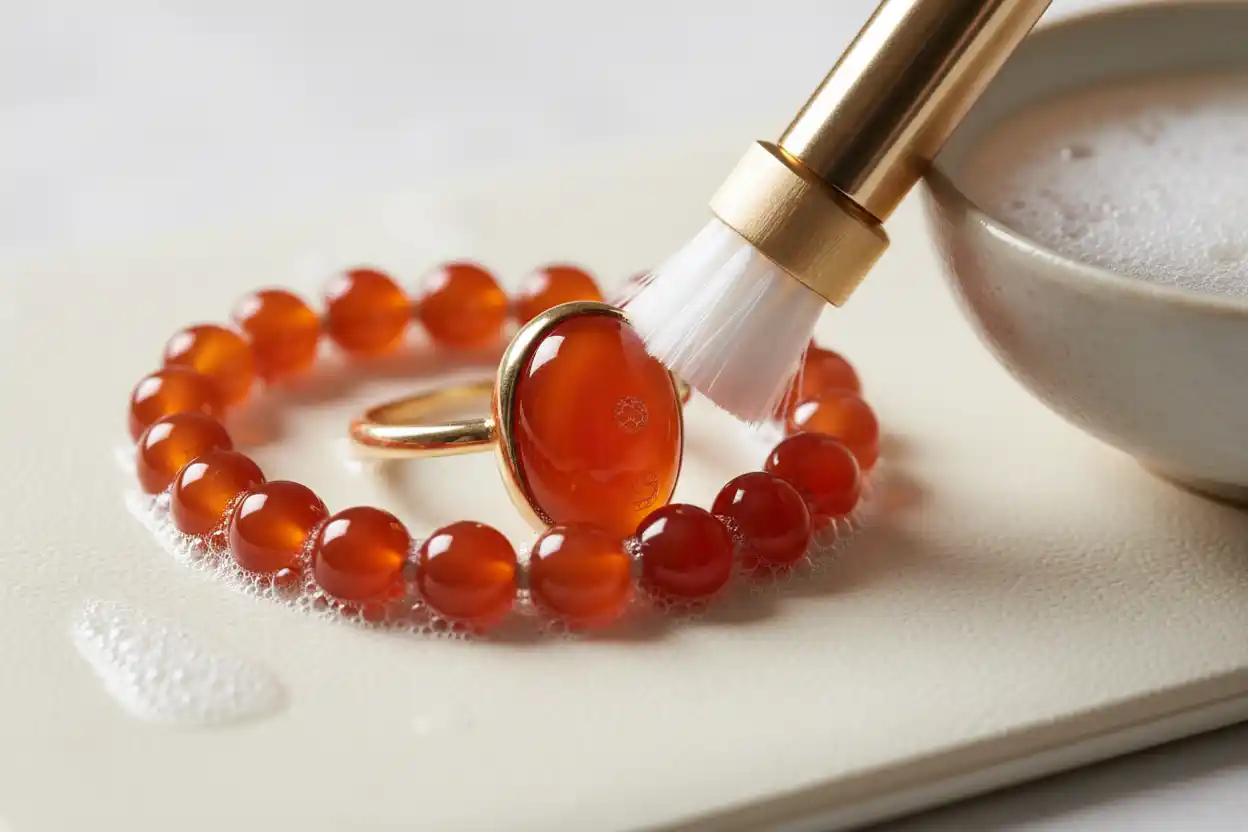
How to Clean Carnelian Jewelry Safely
Carnelian jewelry can usually be cleaned with lukewarm water, mild dish soap, and a soft brush or cloth. As a tough microcrystalline quartz material, solid untreated carnelian handles routine washing better than opal, amber, or turquoise.
Treatment and construction still matter. Dyed stones, glued cabochons, foil-backed pieces, antique jewelry, elastic bracelets, and strung beads should not automatically receive ultrasonic cleaning, steam, prolonged soaking, or strong chemical cleaners.
What Carnelian Is
Carnelian is an orange, red-orange, reddish-brown, or brownish-red variety of chalcedony. Its color comes primarily from iron-bearing compounds distributed through the microcrystalline silica.
The broader mineral and symbolic context belongs to the Carnelian meaning guide. Its parent material is explained in the Chalcedony guide and the overview of types of Chalcedony.
Carnelian typically has a hardness around 6.5 to 7. Because chalcedony consists of interlocking microscopic crystals, it is often tougher than visibly crystalline quartz.
| Property | Cleaning implication |
|---|---|
| Mineral family | Chalcedony and microcrystalline quartz |
| Mohs hardness | Approximately 6.5 to 7 |
| Toughness | Generally good |
| Cleavage | None |
| Safest routine method | Lukewarm water, mild soap, and a soft brush |
| Ultrasonic cleaning | Often tolerated by sound untreated stones, but avoid when dyed, fractured, glued, or strung |
| Steam cleaning | Usually unnecessary; avoid for treated or assembled jewelry |
| Common concerns | Dye, heat treatment, glue, stringing, scratches, and dull polish |
The gemstone hardness chart explains why carnelian resists everyday scratching reasonably well. However, hardness does not protect settings, elastic, glue, or softer accompanying materials.
Carnelian also has no cleavage, although a hard impact can still chip a thin edge or crack a bead around its drill hole. The distinction is covered in Gemstone Cleavage Explained and Gemstone Toughness vs Hardness.
Check Whether the Carnelian Is Dyed or Treated
Heat treatment has long been used to improve or deepen carnelian’s orange-red color. Some material may also be dyed, especially when color concentrates inside fractures, around drill holes, or along porous bands.
Heating is generally stable during ordinary care, but dye may react differently to prolonged soaking, solvent, bleach, alcohol, or strong cleaners.
Carnelian can also be confused with dyed agate, red glass, plastic, red jasper, or other chalcedony. The tracker’s How to Spot Dyed Crystals guide owns the dye-detection workflow.
Because carnelian and agate belong to the same chalcedony family, the treated Agate guide provides additional context for dyeing and heating without turning this cleaning page into an identification article.
Do not use acetone, bleach, scratching, hot needles, or prolonged sunlight as home authenticity tests.
Inspect the Jewelry
Look for chips, surface-reaching cracks, loose prongs, open bezels, damaged drill holes, frayed cord, stretched elastic, cloudy glue, or a cabochon that moves when touched.
A solid carnelian may tolerate water, but the jewelry holding it may not. Antique foil, shellac, cement, thread, silk, elastic, leather, and adhesive can impose stricter limits.
Examine beads around their drill holes. Fine fractures often begin where the hole reduces the amount of material supporting the bead.
If the stone or setting moves, arrange professional repair before washing it.
Prepare the Cleaning Solution
Fill a bowl with lukewarm water and add a few drops of mild liquid dish soap. Prepare a second bowl of clean lukewarm water.
Use a soft toothbrush, jewelry brush, or lint-free cloth. Cleaning over a bowl rather than an open sink protects small stones and loose components.
Avoid soaps containing bleach, abrasive particles, strong alkaline ingredients, heavy moisturizers, or aggressive degreasers.
The water should feel mildly warm rather than hot. Although solid carnelian is usually stable, hot water may soften glue, stretch stringing material, or affect accompanying components.
Clean Solid Carnelian Jewelry
Place a secure solid-carnelian piece briefly in the soapy water. Use the soft brush to loosen lotion, skin oils, soap film, and debris around the setting.
Carnelian is often cut as a cabochon rather than faceted. Wipe the curved surface gently and clean around the bezel, prongs, and underside.
Do not scrub dried grit directly across the polish. Rinse loose particles first because quartz-rich dust can produce fine wear over time.
Rinse the piece in clean lukewarm water. Blot it with a lint-free cloth and allow hidden moisture to evaporate at room temperature.
Cleaning Carnelian Beads and Bracelets
A Carnelian bracelet may contain elastic, thread, wire, metal spacers, knots, or glued components. Those materials usually determine whether the bracelet can be immersed.
For an elastic bracelet, wipe each bead with a damp soapy cloth rather than soaking the full strand. Stretching wet elastic during cleaning can shorten its useful life.
Dry the bracelet flat. Hanging it while wet concentrates the weight on the elastic or clasp.
With knotted necklaces or bracelets, keep the cord as dry as practical. Persistent discoloration in the string may require professional restringing rather than repeated washing.
Cleaning Carnelian Rings
A Carnelian ring collects hand lotion, soap, sanitizer, and household residue along the underside of the cabochon.
Brush around the bezel or prongs while supporting the ring by its shank. Do not press against a glued stone or attempt to lift debris with a metal pin.
Remove the ring before cleaning, gardening, sports, swimming, and heavy manual work. Carnelian’s toughness does not prevent damage to a raised cabochon or thin setting.
Cleaning Carnelian Earrings
Carnelian earrings need cleaning around the posts, hooks, backs, hinges, and drilled components.
Use a damp cloth on glued beads and carved drops rather than immersing them. Keep alcohol-based disinfectant on the metal fitting and away from dyed stones or adhesive.
Dry the fittings completely before wearing them again.
Cleaning a Carnelian Necklace or Pendant
A Carnelian necklace or pendant may collect perfume, sunscreen, and skin oils across its back.
Apply cosmetic products before putting on the necklace and allow them to dry. During storage, prevent the chain from rubbing across the polished carnelian.
For carved pendants, use a soft damp brush to clean recessed areas without forcing bristles into natural fractures.
Can Carnelian Go in an Ultrasonic Cleaner?
A sound, untreated, solid carnelian in a secure modern setting may tolerate ultrasonic cleaning. Nevertheless, the machine is unnecessary for ordinary home care and unsuitable when treatment or construction is uncertain.
| Condition | Ultrasonic recommendation |
|---|---|
| Sound untreated solid carnelian | Often tolerated |
| Dyed stone | Avoid |
| Visible fractures or damaged drill holes | Avoid |
| Glued cabochon or bead | Avoid |
| Elastic, thread, or leather construction | Avoid |
| Antique or repaired setting | Avoid |
| Treatment unknown | Use warm soapy water instead |
| Delicate accent stones | Follow the most vulnerable material |
Vibration can loosen settings, enlarge fractures, damage stringing, or disturb adhesive. The broader machine-safety comparison appears in Which Gemstones Can Go in an Ultrasonic Cleaner?.
Is Steam Cleaning Safe?
Solid untreated carnelian may tolerate moderate heat better than many delicate gems, but steam cleaning is rarely necessary.
Steam can affect dye, glue, foil, elastic, repaired settings, and accompanying stones. It can also expose a loose cabochon or weaken old cement.
For home maintenance, lukewarm soapy water produces an adequate result with less uncertainty.
Products and Methods to Avoid
Do not use toothpaste, baking soda, scouring powder, stiff wire brushes, or abrasive polishing compounds. These products may dull metal, scratch softer components, and wear carved details.
Avoid bleach, acetone, paint thinner, drain cleaner, oven cleaner, and concentrated acids or alkalis. Such chemicals may affect dye, filler, adhesive, plating, solder, and the setting.
Vinegar and lemon juice are unnecessary. Although brief exposure may not immediately damage solid chalcedony, acids can react with metals and other components.
Commercial silver dip should not contact carnelian. Clean tarnished metal locally or ask a jeweler to handle mixed-material jewelry.
Carnelian Versus Red Jasper
Carnelian is generally more translucent, while red jasper is usually more opaque because it contains more mineral inclusions. The distinction is examined fully in Carnelian vs Red Jasper.
Both are silica-rich materials and often tolerate mild soapy-water cleaning. However, dyed material, glued cabochons, coatings, and construction still override the base mineral’s durability.
The broader background for the comparison appears in the Red Jasper guide.
Water and Sunlight
A brief wash is normally safe for solid carnelian. However, that does not mean every carnelian bracelet, pendant, or glued carving should be soaked.
The wider material distinctions appear in Which Crystals Can and Can’t Go in Water.
Carnelian’s natural or heat-enhanced color is generally stable in ordinary wear. Prolonged strong sunlight is unnecessary, particularly when dye status is unknown. The tracker’s sunlight-safety guide covers the broader question.
Do not place wet jewelry on a sunny windowsill to dry. Room-temperature drying protects the setting and stringing materials.
Storage and Preventive Care
Store carnelian separately from harder gemstones such as diamond, sapphire, ruby, and topaz. Although carnelian can scratch softer gems, harder stones can abrade its polish.
Keep bead strands flat or loosely coiled. Check elastic, knots, wire, and clasps periodically.
Remove the jewelry before swimming or using household cleaners. Chlorine and other chemicals may affect metal alloys, elastic, dye, and glue even when the carnelian itself remains intact.
Buying Information That Affects Care
Ask sellers whether a carnelian has been heated, dyed, coated, assembled, repaired, or glued. A treatment does not automatically make the stone unsuitable, but it may change the cleaning method.
The tracker’s Where to Buy Real Carnelian guide owns the seller and authenticity workflow. Retain invoices and treatment disclosures so future jewelers know whether mechanical cleaning is appropriate.
Carnelian may also be sold under vague labels such as red agate. Comparing the stone with the broader Agate guide can help place it within the chalcedony family without using cleaning as an identification test.
Frequently Asked Questions
1. Can carnelian get wet?
Solid carnelian can usually be washed briefly. Avoid soaking jewelry containing elastic, thread, glue, leather, dye, or vulnerable settings.
2. What is the safest way to clean carnelian?
Use lukewarm water, a few drops of mild soap, and a soft brush or lint-free cloth.
3. Can carnelian go in an ultrasonic cleaner?
Sound untreated carnelian may tolerate ultrasound, but avoid it for dyed, fractured, glued, strung, antique, or unknown material.
4. Can carnelian be steam cleaned?
Steam is usually unnecessary and should be avoided when dye, glue, repair material, or delicate construction may be present.
5. Can I soak a carnelian bracelet?
Do not soak elastic or threaded bracelets. Wipe each bead with a damp cloth and dry the strand flat.
6. Can vinegar clean carnelian?
Vinegar offers no advantage over mild soap and may affect metals, dye, adhesive, or accompanying materials.
7. Can I use toothpaste on carnelian?
No. Toothpaste is abrasive and can dull the metal or polished stone.
8. Will hand sanitizer harm carnelian?
Untreated chalcedony may tolerate brief contact, but sanitizer can affect dye, glue, elastic, coatings, and metal finishes.
9. Why is color concentrated around my bead’s drill hole?
Color accumulation near drill holes or fractures may indicate dye, although professional examination is needed for confirmation.
10. Why does carnelian look dull after cleaning?
Soap residue, fine scratches, worn polish, wax, dye instability, or debris around the setting may be responsible.
11. How often should carnelian jewelry be cleaned?
Clean it when oils or residue reduce its luster. Wiping after wear reduces the need for frequent washing.
12. When does carnelian require professional care?
Seek help for loose settings, cracked drill holes, damaged carvings, frayed stringing, unstable dye, antique construction, or persistent cloudiness.
Conclusion
Carnelian is durable enough for straightforward home care, but the jewelry’s construction remains as important as the chalcedony itself. Lukewarm soapy water is appropriate for sound solid pieces, while beads, glue, dye, elastic, and antique settings call for lighter wiping. When a carnelian reacts poorly to cleaning, the next question should be whether it has been dyed or assembled—not whether a stronger chemical is needed.