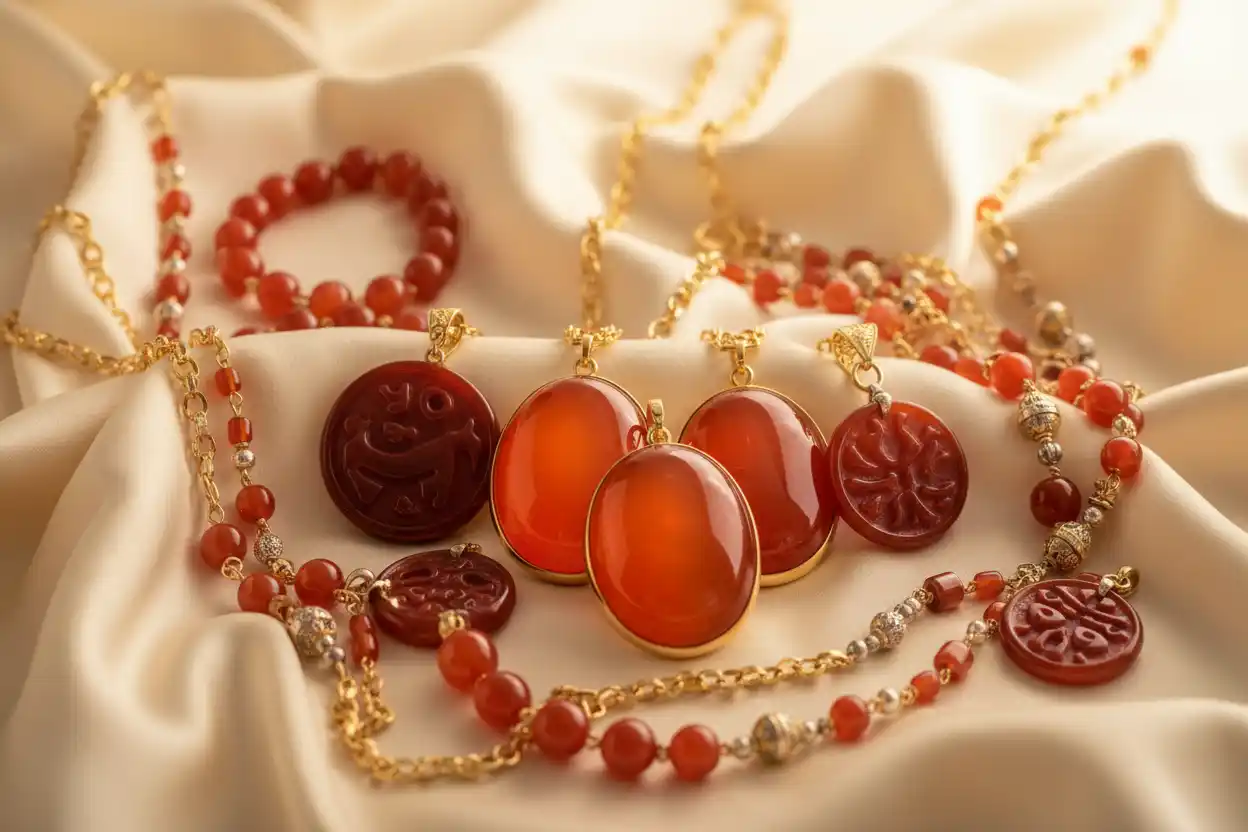
Carnelian Necklace: Styles, Lengths & Buying Tips
A carnelian necklace places the warm orange, red-orange and reddish-brown colors of chalcedony in one of the most practical jewelry formats for this gemstone, because a pendant or bead strand usually receives much less direct impact than a ring or bracelet. Carnelian is durable enough for regular jewelry use, yet choosing a good carnelian necklace requires more than finding an attractive orange stone: pendant weight, chain length, bail clearance, clasp security, stone thickness, translucency, drill-hole condition, treatment, metal quality and how the necklace sits against clothing can all determine whether the piece remains comfortable and wearable.
Carnelian itself is a translucent-to-nearly-opaque variety of chalcedony within the quartz family, composed primarily of silicon dioxide, SiO₂, with warm color associated largely with finely distributed iron-bearing compounds. Its hardness of about 6.5–7, absence of easy cleavage and generally useful toughness make a carnelian necklace significantly easier to wear than jewelry made from many softer or cleavage-sensitive stones, although sharp impact can still chip a cabochon, carving or drilled drop.
A carnelian necklace also benefits from the stone’s translucency. Thin orange pendants can glow when light reaches them from behind, while thicker red-brown cabochons may appear deeper and more opaque against dark clothing. That means the same carnelian can look substantially different according to stone thickness, setting back, chain position and clothing color, so photographs alone do not always reveal how a necklace will look when worn.
Treatment is another important buying consideration. Carnelian and related chalcedony can be heated to modify or intensify warm color, and commercial material may also be dyed. Neither treatment automatically makes a carnelian necklace undesirable, but sellers should distinguish untreated natural stone, heated natural chalcedony, dyed material, glass, resin and other imitations rather than using “natural crystal” as a substitute for actual disclosure.
The broader carnelian meaning guide covers the gemstone’s mineral identity, formation and symbolism. Here, the focus is narrower: how to choose a carnelian necklace whose stone, length, chain, setting and construction work together as one piece of jewelry.
Carnelian Necklace at a Glance
| Feature | What to Know |
|---|---|
| Gem material | Carnelian, an orange-to-red variety of chalcedony |
| Composition | Primarily SiO₂ |
| Typical color | Honey orange, orange, red-orange, reddish brown |
| Transparency | Usually translucent to nearly opaque |
| Mohs hardness | About 6.5–7 |
| Cleavage | None in the conventional gemological sense |
| Toughness | Generally good |
| Common necklace forms | Pendant, bead strand, station necklace, choker, lariat, carved drop, multi-strand |
| Common stone styles | Cabochon, bead, carved tablet, intaglio, drop, freeform, faceted-style surface |
| Common treatments | Heating and dyeing |
| Main setting options | Bezel, frame, prongs, wire wrap, drilled attachment, metal cap |
| Main hardware concerns | Bail, chain gauge, clasp, jump rings, crimps, thread and solder |
| Main fit decision | Chain length relative to neck, neckline and pendant size |
| Main care concern | Impact, soap residue, treatment, stringing and metal wear |
| Safest routine cleaning | Gentle lukewarm water and mild soap when construction permits |
| Symbolic themes | Motivation, courage, creativity, confidence and purposeful action |
The central buying principle is simple: a carnelian necklace should be judged as an integrated mechanical system. A beautiful stone cannot compensate for an undersized bail, weak chain or unreliable clasp.
Why Carnelian Works Particularly Well in Necklaces
Carnelian’s mineral structure makes it a useful jewelry material, but the necklace format makes it even more practical.
Chalcedony has a fine-grained microcrystalline structure that can take a strong polish and withstand ordinary handling reasonably well. Carnelian does not possess the prominent cleavage found in gemstones such as moonstone, fluorite, topaz or tanzanite, which reduces one major pathway for catastrophic splitting.
However, hardness and toughness are different, as explained in gemstone toughness vs hardness. Carnelian can resist ordinary scratches better than many softer ornamental stones while still remaining brittle enough to chip after a hard impact.
A carnelian necklace naturally reduces that impact exposure. Pendants tend to rest against the chest rather than striking desks and countertops continually, while bead strands usually move against skin or fabric instead of work surfaces.
This allows a carnelian necklace to use larger and more delicately carved stones than would often be sensible in a frequently worn ring.
Carnelian Necklace Styles
Carnelian supports several necklace formats, and each one changes what you should inspect before buying.
| Carnelian necklace style | Main advantage | Main buying concern |
|---|---|---|
| Solitaire pendant | Keeps attention on one stone | Bail and chain must support total weight |
| Bezel pendant | Protects stone perimeter | Closed back may darken translucent carnelian |
| Prong pendant | Allows more light around stone | Exposed edges need sound stone and secure prongs |
| Carved pendant | Highlights carnelian’s carving tradition | Thin carved areas may chip |
| Bead strand | Displays continuous color | Drill holes, stringing and clasp control durability |
| Station necklace | Lightweight and easy to layer | Stations may flip; connecting rings need security |
| Choker | Strong color near neckline | Accurate sizing and comfort are essential |
| Lariat | Adjustable and visually flexible | Heavy ends stress fine chains |
| Multi-strand necklace | Strong visual impact | Weight, clasp and tangling increase |
| Long pendant necklace | Suits substantial carvings | Chain gauge must match pendant weight |
These styles are not interchangeable buying decisions. A carnelian necklace built from beads has very different failure points from a single bezel-set pendant.
Solitaire Carnelian Necklace
A solitaire carnelian necklace places one stone at the center of the design.
Common shapes include:
- Oval cabochons.
- Round cabochons.
- Pear-shaped drops.
- Rectangular tablets.
- Shield forms.
- Freeform pieces.
- Carved seals.
- Intaglio-style pendants.
The main advantage is focus. Color, translucency and carving quality remain visually dominant instead of competing with many beads or decorative elements.
For a solitaire carnelian necklace, inspect the complete pendant from the side as well as the front. A stone that looks balanced face-up may be excessively thick, causing it to tilt or roll.
Bezel-Set Carnelian Necklace
A bezel surrounds the perimeter of the stone with metal, making it one of the strongest setting choices for a carnelian necklace.
Bezels offer several advantages:
- Edge protection.
- Smooth profile.
- Reduced snagging.
- Strong support for cabochons.
- Compatibility with irregular freeforms.
- Good suitability for thin translucent material.
An open-backed bezel allows light to reach the rear of the carnelian, which can make pale orange material appear noticeably brighter.
A closed back can deepen the visible color because less light passes through the gemstone.
Neither design is automatically superior.
For highly translucent carnelian, an open back often preserves more glow. For deeply colored material, a closed back may provide a rich, saturated appearance without sacrificing much transparency that was visible anyway.
Check Bezel Work Closely
The bezel rim of a carnelian necklace should contact the stone evenly.
Look for:
- Gaps.
- Folded metal.
- Rough tool marks.
- Uneven pressure.
- Loose areas.
- Visible glue.
- Stone movement.
A slightly irregular handcrafted bezel can still be excellent, but the carnelian should not rattle.
If the cabochon moves when touched gently, the setting needs attention.
Prong-Set Carnelian Necklace
Prongs expose more of the gemstone than a bezel and can create a lighter-looking carnelian necklace.
They work particularly well when the stone has:
- Sound edges.
- Adequate thickness.
- Limited surface-reaching fractures.
- A symmetrical outline.
- Good polish around the girdle.
Each prong should contact the carnelian securely.
One visibly lifted prong creates an avoidable loss risk.
Pointed shapes deserve additional protection. A pear-shaped carnelian necklace may benefit from a V-prong or partial bezel around the tip rather than a tiny round prong resting against the most vulnerable point.
Open-Back vs Closed-Back Carnelian Necklace
The setting back can materially change the appearance of carnelian.
Open Back
An open-back carnelian necklace allows light through the rear of the stone.
This can:
- Increase apparent translucency.
- Brighten orange color.
- Reveal natural internal clouds.
- Make thin areas glow.
- Allow easier visual inspection.
It also exposes the rear surface to skin oils and residue.
Closed Back
A closed setting covers most or all of the rear surface.
This can:
- Deepen body color.
- Hide an unattractive reverse.
- Provide space for engraving.
- Create a more finished metal appearance.
However, a dark backing can make deep carnelian look nearly opaque.
Ask to see the exact pendant in both direct and transmitted light whenever color is an important part of the purchase.
Carved Carnelian Necklace
Carnelian has a particularly strong relationship with carved jewelry because chalcedony’s fine grain can preserve detailed engraved lines.
A carved carnelian necklace may feature:
- Leaves.
- Flowers.
- Animals.
- Geometric motifs.
- Intaglios.
- Cameo-like profiles.
- Seals.
- Tablets.
- Abstract forms.
Carving quality matters more than complexity alone.
Inspect whether:
- Narrow sections retain enough thickness.
- Pierced areas show fractures.
- Tool marks are intentional and clean.
- The reverse is finished appropriately.
- The suspension point is structurally strong.
A large carved carnelian necklace can be visually impressive without being extremely heavy if the carving remains relatively thin.
Intaglio Carnelian Necklace
An intaglio is engraved below the surrounding surface rather than carved in relief.
Carnelian has a long historical association with this form because the stone can take a detailed polish and fine engraved line.
In an intaglio carnelian necklace, assess:
- Sharpness of engraving.
- Depth consistency.
- Surface polish.
- Stone thickness.
- Whether engraving is hand-cut or machine-produced.
- Setting condition.
- Wear on antique examples.
Age, provenance and workmanship can matter much more to value than raw gemstone size.
Carnelian Bead Necklace
A bead-strand carnelian necklace changes the buying process completely because dozens of individual stones and multiple construction points must work together.
Common bead shapes include:
- Round.
- Oval.
- Barrel.
- Faceted.
- Tube.
- Nugget.
- Flat disc.
- Graduated round.
A high-quality bead carnelian necklace should show strong finishing even when natural color varies.
Inspect every visible section for:
- Chipped drill holes.
- Cracks.
- Uneven polish.
- Damaged beads.
- Loose stringing.
- Exposed wire.
- Rough spacers.
- Dye concentration.
One damaged drill hole can become the point where the necklace eventually fails.
Round Carnelian Bead Necklace
Round beads create the most traditional continuous strand.
Common bead sizes can range from delicate 3–4 mm strands through substantial 10–14 mm designs and larger statement necklaces.
Bead diameter affects both appearance and total weight.
A long carnelian necklace using 12 mm beads can become surprisingly heavy because each bead adds considerable volume.
For everyday wear, moderate beads often provide a more comfortable balance than simply choosing the largest available size.
Graduated Carnelian Necklace
A graduated carnelian necklace places smaller beads toward the clasp and progressively larger beads toward the center.
This design offers several advantages:
- Greater visual emphasis at the front.
- Reduced weight near the neck.
- Smoother transition around the shoulders.
- More economical use of large beads.
Check that graduation occurs gradually.
Abrupt jumps in bead diameter can make the necklace look poorly matched unless intentionally designed.
Individually Knotted Bead Strands
Knots between beads can improve a carnelian necklace in two ways.
First, they reduce direct bead-to-bead contact.
Second, if the string breaks, fewer beads are likely to scatter.
Knotted construction is particularly valuable with:
- Large beads.
- High-quality matched beads.
- Long strands.
- Antique necklaces.
The knots should remain compact and consistent.
Large irregular gaps suggest poor restringing.
Beading Wire Versus Thread
A bead carnelian necklace may use flexible beading wire, silk, nylon or another thread.
Flexible Beading Wire
Benefits include:
- High tensile strength.
- Good resistance to stretching.
- Practical durability.
- Compatibility with many clasps.
Check the crimps carefully.
Silk or Soft Thread
Benefits include:
- Elegant drape.
- Traditional appearance.
- Easy knotting.
However, thread generally requires more protection from water, cosmetics and abrasion.
The best choice depends on bead weight and desired drape.
Carnelian Station Necklace
A station carnelian necklace places individual beads or bezel-set stones at intervals along a chain.
This design uses less stone than a full strand, making the necklace lighter and easier to layer.
The main mechanical concern is the connection between each carnelian station and the chain.
Inspect:
- Jump rings.
- Soldered links.
- Bezel loops.
- Wire connections.
- Chain gauge.
A station should either remain facing outward or look intentionally finished on both sides, because lightweight stations may flip as the wearer moves.
Carnelian Choker
A carnelian choker places warm color close to the neck and creates a much stronger visual line than a longer pendant.
Sizing matters more than with most other carnelian necklace styles.
A choker should never feel tight enough to restrict normal neck movement or create persistent pressure.
Measure the neck where the piece will sit, then allow sufficient comfort.
A rigid collar-style carnelian necklace requires particularly precise sizing because it has less flexibility than a bead strand.
Carnelian Lariat Necklace
A lariat does not always use a conventional clasp. Instead, the necklace may pass through a loop or sliding component with carnelian drops at the ends.
This style gives the wearer flexibility over where the focal stones sit.
However, the end stones create leverage.
A heavy carved carnelian on a very fine chain can:
- Stretch links.
- Pull jump rings open.
- Distort the slider.
- Feel unbalanced.
The chain gauge should match the combined weight of the decorative ends.
Multi-Strand Carnelian Necklace
A multi-strand carnelian necklace can create dramatic color through several rows of beads.
The main concern becomes cumulative weight.
Check:
- Clasp size.
- End caps.
- Cones.
- Strand attachment.
- Spacing.
- Total necklace weight.
- Whether strands twist together.
A tiny lobster clasp may be perfectly adequate for a delicate pendant but poorly matched to several heavy strands of chalcedony beads.
Choosing Carnelian Necklace Length
Necklace length changes both appearance and comfort.
Common reference lengths include:
| Necklace length | Approximate placement on many wearers |
|---|---|
| 14–16 in / 36–41 cm | Choker or close neckline |
| 18 in / 46 cm | Around collarbone |
| 20 in / 51 cm | Slightly below collarbone |
| 22–24 in / 56–61 cm | Upper chest |
| 26–30 in / 66–76 cm | Longer pendant placement |
| 32–36 in / 81–91 cm | Long necklace or layering |
| Longer than 36 in | Dramatic long strand; may allow doubling |
These positions are approximate because neck circumference, torso proportions, pendant dimensions and clothing all affect where a carnelian necklace actually sits.
The 18-Inch Carnelian Necklace
An 18-inch carnelian necklace is one of the most versatile starting points.
On many wearers, it positions the pendant near the collarbone, making it suitable for:
- Small cabochons.
- Medium carved pendants.
- Minimal bezels.
- Station necklaces.
- Everyday jewelry.
However, it is not universally ideal.
A person with a larger neck circumference may find an 18-inch carnelian necklace sits much closer to the neck than product photographs suggest.
Always measure rather than relying only on model images.
The 20-Inch Carnelian Necklace
A 20-inch carnelian necklace usually allows slightly more room and can suit medium-sized pendants particularly well.
This extra length can help when:
- The pendant is substantial.
- Neck circumference is larger.
- The wearer prefers relaxed placement.
- Clothing has a higher neckline.
- The pendant needs space to hang vertically.
The difference between 18 and 20 inches may sound minor, yet it can materially change where the gemstone sits.
Long Carnelian Necklace
Long chains around 24 inches or more work well with larger carnelian pendants.
A substantial carved tablet can look more balanced lower on the chest than directly at the collarbone.
However, long chains swing more.
The pendant may therefore contact:
- Desks.
- Counters.
- Seat belts.
- Handbags.
- Clothing hardware.
A longer carnelian necklace receives less constant contact than a bracelet, but it can gain impact risk from increased movement.
How Pendant Size Changes the Best Chain Length
A small carnelian pendant can disappear visually on a very long heavy chain.
A large carving can look crowded on an extremely short chain.
As pendant size increases, longer placement often improves proportion.
For example:
- Tiny 5–10 mm stone: short to medium chain.
- 10–20 mm pendant: broad flexibility.
- 20–35 mm pendant: medium chain often balances well.
- Large carved pendant: longer chain can improve drape.
These are visual guidelines rather than strict rules.
Chain Thickness Matters
A chain should support both the physical weight and visual scale of the carnelian necklace.
An ultra-fine chain can appear fragile beneath a large opaque cabochon even when its tensile strength is technically sufficient.
A substantial chain paired with a tiny stone can overpower the gemstone.
Look for proportional balance.
Chain types commonly used include:
- Cable.
- Rolo.
- Curb.
- Box.
- Wheat.
- Snake.
- Figaro.
- Paperclip.
- Rope.
Different patterns distribute stress differently and create different visual textures.
Box Chain With Carnelian
Box chains offer strong geometric links and can support many medium-sized pendants effectively.
Their structured appearance works particularly well with rectangular or geometric carnelian.
However, damaged box links can kink.
Inspect used or antique necklaces for sharp bends.
Cable Chain
Cable chains are versatile and available in many gauges.
A medium cable chain can suit both casual and formal carnelian necklace designs.
Look closely at the jump ring near the clasp because that small connection often carries more practical risk than the visible center of the chain.
Snake Chain
Snake chains create a smooth continuous surface that works particularly well with minimalist pendants.
They can, however, kink if sharply folded.
A large heavy carnelian pendant may also wear the same area of a thin snake chain repeatedly.
Store the necklace without tight bends.
The Bail Is Critical
The bail connects the carnelian pendant to the chain.
It deserves much more attention than it typically receives.
A good bail should be:
- Large enough for the chain.
- Strong enough for the pendant.
- Smooth internally.
- Correctly aligned.
- Securely soldered or attached.
One common online-buying problem is a pendant whose bail opening is technically wider than the chain itself but too small to pass over the chain’s clasp or end tag.
Measure the widest part that must pass through the bail.
Bail Clearance
Suppose the chain itself is 2 mm wide but its lobster clasp or end connector measures 4.5 mm.
A 3 mm bail opening will fit around the chain but will not allow the pendant to be installed.
If the carnelian necklace is sold as a complete piece, this is already resolved.
If you are buying the pendant separately, bail dimensions matter.
Ask for:
- Inside height.
- Inside width.
- Chain-end dimensions.
Fixed vs Articulated Bail
A fixed bail holds the carnelian in a relatively stable orientation.
An articulated bail uses a hinge or link that allows more movement.
Articulation can help a larger carnelian necklace lie flat as the wearer moves, especially when the pendant is broad.
However, every hinge adds another wear point.
Inspect the connecting pin or loop carefully.
Drilled Carnelian Pendant
Some pendants use a hole drilled directly through the stone instead of a metal setting.
This can create a simple design, but drilling introduces a structural concentration point.
Inspect the area surrounding the hole for:
- Chips.
- Radial fractures.
- Uneven drilling.
- Thin walls.
- Rough edges.
A heavy carnelian necklace should not hang from an extremely thin bridge of stone above the drill hole.
Top-Drilled Drops
A pear or teardrop carnelian may be drilled near its narrow top.
This looks elegant but places stress close to the thinnest part of the stone.
The hole should have enough surrounding material to remain structurally sound.
Wire or cord should move without sawing against a sharp drill edge.
Metal-Capped Carnelian Pendants
A metal cap can cover the upper portion of a drilled or undrilled carnelian.
Caps may be:
- Mechanically secured.
- Glued.
- Pinned.
- Combination mounted.
If adhesive contributes to the attachment, care becomes more conservative.
Avoid prolonged soaking, steam and strong solvents.
Matching Metal to Carnelian
Carnelian’s warm color pairs easily with several metals.
Yellow Gold
Yellow gold amplifies orange and red tones.
A rich gold carnelian necklace can create a warm, traditional appearance particularly suited to reddish-brown or strongly saturated material.
Rose Gold
Rose gold creates less contrast and a more tonal appearance.
It can work especially well with peach-orange or softer red-orange carnelian.
White Gold
White gold produces stronger contrast and may make the orange gemstone appear brighter.
Rhodium-plated white gold can require maintenance as the finish wears.
Sterling Silver
Silver is among the most common choices for a carnelian necklace.
Its cool color contrasts effectively with warm chalcedony.
Normal tarnishing of silver should not be mistaken for deterioration of the carnelian.
Stainless Steel
Stainless steel can offer good mechanical durability and a contemporary appearance.
Confirm alloy details when skin sensitivity matters.
Plated Metal
Plated chains and bails can provide an affordable gold- or silver-colored appearance.
However, the coating can wear at:
- Clasp areas.
- Bail contact.
- Chain links.
- Skin-contact surfaces.
A carnelian necklace worn frequently can expose plating wear gradually.
Sensitive Skin and Necklace Hardware
A wearer may tolerate carnelian perfectly but react to the chain or clasp.
Vague phrases such as:
- Hypoallergenic.
- Premium alloy.
- Gold tone.
- Silver tone.
- Fashion metal.
do not provide precise alloy information.
If metal sensitivity is important, ask specifically what the:
- Chain.
- Clasp.
- Bail.
- Jump rings.
- Backing.
- Solder.
are made from.
A carnelian necklace can contain several different metals in parts that look visually identical.
Carnelian Necklace Clasps
The clasp should match the necklace’s weight.
Lobster Clasp
A lobster clasp is a strong everyday option for many carnelian necklace styles.
Look for smooth operation and complete closure.
Spring Ring
Spring rings work well on lighter chains.
A very small spring ring can become awkward to operate and visually undersized on a heavy pendant necklace.
Toggle
Toggles are decorative and easy to manipulate, but they need sufficient bar length and correct necklace tension to remain secure.
Box Clasp
A box clasp can support more formal bead strands and multi-strand designs.
Safety catches provide an additional layer of security.
Magnetic Clasp
Magnetic closures are convenient but can release under pulling force.
A valuable or heavy carnelian necklace deserves careful consideration before relying solely on a weak magnetic connection.
Extension Chains
An extension chain allows one carnelian necklace to work at several lengths.
This can be particularly helpful for:
- Gifts.
- Layering.
- Different necklines.
- Changing seasonal clothing.
However, a long extension can dangle down the back and catch clothing or hair.
A short useful adjustment range is often better than excessive extra chain.
Carnelian Necklace Color
Carnelian can range from light honey orange to deep red-brown.
A strong carnelian necklace does not need the darkest possible color.
Consider how each shade behaves in the intended design.
Pale Orange
Often highly translucent and luminous.
Works especially well in open-backed settings.
Medium Orange
Provides a classic carnelian appearance and useful visibility against both light and dark clothing.
Red-Orange
Creates stronger saturation and often looks especially rich with yellow gold.
Reddish Brown
Can produce an earthy, understated appearance but may look almost opaque when the stone is thick.
The wider orange gemstones comparison helps place carnelian’s warm color beside other orange gem materials.
Translucency Is a Key Carnelian Feature
Carnelian is generally translucent rather than completely opaque.
Hold the stone against bright white light and observe the edges.
A genuine carnelian necklace may show:
- Orange glow.
- Cloudiness.
- Internal gradients.
- Faint bands.
- Darker iron-rich regions.
A very thick bead or carving may transmit little light through its center while remaining translucent around thin areas.
This is normal.
Carnelian vs Red Jasper in Necklaces
Red jasper and carnelian can overlap in color, especially when carnelian becomes dark red-brown.
The most practical difference is typically translucency.
Carnelian generally transmits some light.
Red jasper remains characteristically opaque.
The dedicated carnelian vs red jasper comparison explains the limits of this distinction, including thick carnelian and unusually thin jasper.
For a necklace, check around:
- Thin pendant edges.
- Drill holes.
- Bead edges.
- Carved recesses.
These areas provide the easiest opportunities for transmitted-light inspection.
Carnelian Treatments
Treatment needs to be considered separately from mineral identity.
The wider gemstone treatments framework distinguishes natural origin from enhancement.
A natural stone can still be treated.
Heated Carnelian Necklace
Heating iron-bearing chalcedony can alter or intensify orange-to-red color.
A heated carnelian necklace can still contain genuine natural chalcedony.
The appropriate description is not “fake.”
Instead, the seller should distinguish treated color from untreated color when treatment status affects value or buyer preference.
Heating is generally considered stable under ordinary wear.
Dyed Carnelian Necklace
Dye can create or intensify red and orange color in chalcedony and agate.
Possible warning signs include pigment concentrated:
- Around drill holes.
- Along fractures.
- Inside porous zones.
- Near pale chipped areas.
- Around bead surfaces.
These are clues rather than proof.
Natural iron compounds can also create uneven coloration.
Avoid solvent tests on finished jewelry because they can damage dye, adhesive, plating or polish.
Does Treatment Make a Carnelian Necklace Fake?
No.
The categories should be separated clearly.
Natural Untreated Carnelian
Natural geological chalcedony whose present color has not been intentionally altered.
Heated Carnelian
Natural chalcedony whose warm color has been modified or intensified through heat.
Dyed Chalcedony
Natural silica material with introduced color.
Imitation Carnelian
Glass, resin, ceramic or another substance made to resemble carnelian.
Composite Material
Natural stone fragments or components combined with resin, backing or other material.
These categories can have very different prices and care requirements.
Carnelian Necklace Authenticity
A consumer inspection should combine several observations.
Potentially useful natural-carnelian features include:
- Warm orange-to-red color.
- Chalcedony-like translucency.
- Fine internal cloudiness.
- Natural gradients.
- Occasional subtle banding.
- Good polished surface.
- No obvious mold seams.
- No abundant round gas bubbles.
None is decisive alone.
For an expensive carnelian necklace, professional gemological identification is more reliable than scratch tests, hot-needle tests or chemical experiments.
Glass Imitations
Orange-red glass can resemble carnelian closely.
Potential clues include:
- Round gas bubbles.
- Swirled flow structures.
- Extremely uniform transparency.
- Mold seams.
- Repeated identical beads.
However, natural inclusions can occasionally look bubble-like in photographs.
One suspicious internal feature should prompt further inspection rather than immediate certainty.
Resin and Plastic
Resin can imitate translucent orange stone and is particularly easy to mold into carved pendants.
Potential warning signs include:
- Very low apparent weight.
- Mold seams.
- Surface softness.
- Repeated identical carvings.
- Numerous rounded bubbles.
- Artificially uniform color.
Temperature-to-touch testing is weak because every small object rapidly approaches skin temperature.
Use material evidence, seller disclosure and professional testing when value warrants it.
Carnelian Necklace Value
Carnelian is generally accessible compared with rare transparent gemstones, so necklace value often depends heavily on construction and artistry.
Important factors include:
- Stone size.
- Natural-looking color.
- Translucency.
- Carving quality.
- Treatment.
- Matching in bead strands.
- Drill quality.
- Metal purity.
- Chain quality.
- Setting craftsmanship.
- Designer origin.
- Antique or historical provenance.
- Condition.
A simple bead carnelian necklace on inexpensive findings belongs to a different value category from a hand-carved intaglio in a substantial gold setting.
The stone name alone cannot explain the price.
Large Carnelian Pendant Value
Large size does not automatically make a carnelian necklace valuable because carnelian occurs in material large enough for substantial carvings.
For a large piece, inspect:
- Color consistency.
- Attractive translucency.
- Fractures.
- Polish.
- Carving.
- Setting quality.
- Treatment.
- Pendant weight.
- Bail construction.
A smaller finely carved natural piece can be more desirable than a large poorly polished block.
Bead Strand Quality
A higher-quality carnelian necklace made from beads should show intentional matching.
Evaluate:
- Diameter.
- Shape.
- Color family.
- Translucency.
- Polish.
- Hole alignment.
- Graduation.
- Stringing.
Perfect sameness is not required.
Natural variation can create an attractive strand.
The question is whether the variation looks curated.
Carnelian Necklace Weight
Weight matters particularly for large beads and carved pendants.
A substantial carnelian necklace can become uncomfortable when worn for several hours even if it looks excellent in photographs.
Ask for total necklace weight when:
- The pendant is large.
- The necklace contains large beads.
- Several strands are used.
- Heavy precious metal surrounds the stone.
A long necklace also swings more, increasing the apparent pull during movement.
Where the Pendant Should Sit
The best position depends on:
- Pendant size.
- Neck circumference.
- Neckline.
- Body proportions.
- Layering.
- Personal preference.
A small carnelian necklace may look balanced near the collarbone.
A large tablet may need more space lower on the chest.
Try reproducing the listed chain length with string before buying online.
This gives a far more realistic impression than a magnified product photograph.
Carnelian Necklace for Everyday Wear
For everyday use, prioritize:
- Moderate pendant weight.
- Secure bail.
- Strong chain.
- Reliable clasp.
- Smooth setting.
- Limited sharp projections.
- Comfortable length.
A bezel-set cabochon on a medium chain is one of the easiest carnelian necklace combinations for regular use.
Large carved pieces can also work, but they should not be suspended from chains chosen primarily for delicacy.
Carnelian Necklace for Formal Wear
Formal carnelian jewelry can use:
- Gold settings.
- Intaglios.
- Matched beads.
- Gemstone accents.
- Multiple strands.
- Sculptural metalwork.
In this category, craftsmanship may dominate the price.
Inspect the reverse of the pendant and clasp finishing as closely as the visible front.
Fine jewelry should be finished where practical even in areas that receive little attention in photographs.
Carnelian Necklace for Minimalist Style
A minimalist carnelian necklace may use:
- Small round cabochon.
- Thin oval.
- Tiny bead station.
- Simple bezel.
- Fine chain.
- Short carved drop.
Carnelian already has strong color, so a small stone can provide enough contrast without elaborate metalwork.
Carnelian Necklace for Statement Style
Statement pieces can use:
- Large carvings.
- Multiple strands.
- Oversized beads.
- Wide metal frames.
- Long drops.
- Large tablets.
For these designs, weight and balance become central.
A statement carnelian necklace should remain wearable rather than simply impressive in a still photograph.
Layering a Carnelian Necklace
Carnelian’s warm color layers well with plain gold or silver chains.
To reduce tangling, vary the lengths rather than placing multiple pendants at almost identical heights.
Try:
- Short plain chain.
- Medium carnelian necklace.
- Longer lightweight chain.
Avoid allowing hard gemstone pendants to strike carnelian continually.
Ruby, sapphire, topaz and diamond can all scratch polished chalcedony.
Carnelian Necklace With Other Gemstones
Carnelian pairs visually with:
- Onyx.
- Smoky quartz.
- Citrine.
- Garnet.
- Pearl.
- Lapis lazuli.
- Clear quartz.
Physical care should follow the most vulnerable gemstone in a mixed necklace.
A pearl-and-carnelian necklace, for example, needs pearl-sensitive handling because pearl is softer and more chemically vulnerable than carnelian.
Carnelian Necklace vs Carnelian Ring
The carnelian ring format faces much more abrasion and direct impact because the hand continually contacts surrounding surfaces.
That difference allows a carnelian necklace to use thinner and more exposed stones safely.
Large carvings, open-backed pendants and decorative drops can therefore make more practical sense around the neck than on the hand.
The comparison also explains why setting requirements differ: a ring needs stronger edge protection, while a necklace needs greater attention to bail, chain and clasp strength.
Buying a Carnelian Necklace Online
Online buying requires enough information to reconstruct the physical piece in your mind.
Ask for:
- Exact pendant dimensions.
- Pendant thickness.
- Chain length.
- Adjustable length range.
- Chain width.
- Bail opening.
- Total necklace weight.
- Gemstone treatment.
- Metal composition.
- Plating information.
- Clasp type.
- Photographs of the actual item.
- Side and back photographs.
- Return terms.
The seller-focused where to buy carnelian guide covers the wider authenticity and transaction questions.
For a necklace, add construction-specific scrutiny.
Ask for a Worn Photograph
Close-up gemstone photographs distort scale.
A 15 mm carnelian can fill an entire screen and look enormous.
A worn photograph provides context for:
- Pendant size.
- Chain position.
- Overall proportion.
- Drop length.
- Visual weight.
Do not rely on the worn image alone because model proportions vary.
Combine it with actual measurements.
Check the Side View
A side view reveals information that frontal photographs hide.
Look for:
- Excessive stone thickness.
- High cabochon dome.
- Loose bezel.
- Tall prongs.
- Bulging setting.
- Back plate.
- Bail angle.
- Glue.
- Fractures.
A carnelian necklace should hang relatively flat unless the design intentionally projects outward.
Actual-Item Photos Matter
Natural carnelian varies.
If a seller uses one photograph for dozens of supposedly identical necklaces, the delivered stone may be:
- Darker.
- More opaque.
- Browner.
- More banded.
- Less uniform.
For inexpensive commercial beads, reasonable variation can be expected.
For premium one-of-a-kind jewelry, photographs of the exact carnelian necklace are preferable.
Seller Disclosure Checklist
A useful product description should clarify:
- Is the gemstone carnelian?
- Is it natural chalcedony?
- Has it been heated?
- Has it been dyed?
- Is any resin present?
- What are the stone dimensions?
- What is the chain length?
- Is length adjustable?
- What metal is used?
- Is the metal plated?
- What type of clasp is used?
- How is the stone attached?
- Are there repairs?
- Are photographs of the exact item shown?
- What is the return policy?
Good disclosure reduces the need for exaggerated trust language.
Carnelian Necklace Buying Red Flags
Be cautious when:
- “Natural” is used without treatment information.
- Every deep-red stone is described as untreated.
- Chain length is missing.
- Pendant dimensions are missing.
- A large pendant hangs from an extremely fine chain.
- Bail dimensions are unavailable for pendant-only purchases.
- Metal is described only as “gold color.”
- Plating is omitted from the description.
- Glue is visible around the stone.
- Drill holes contain obvious fractures.
- Bead strands have exposed wire.
- Jump rings remain visibly open.
- Stock photography hides natural variation.
- Color looks dramatically more vivid only under backlighting.
- Glass or resin is represented as carnelian.
- Seller-defined “AAAAA” grades have no clear criteria.
- A common necklace receives a large premium because of promised wealth, fertility, attraction or guaranteed success.
A carnelian necklace should justify its price through material and craftsmanship, not unverifiable outcomes.
Does a Carnelian Necklace Need a Laboratory Report?
Most ordinary carnelian jewelry does not justify an individual laboratory report because the testing cost can exceed the gemstone value.
Independent testing becomes more reasonable when:
- The carnelian necklace is unusually expensive.
- Untreated status creates a substantial premium.
- Antique provenance contributes heavily to price.
- The stone may be glass or another material.
- Precious metal content is substantial.
- The item is an important designer piece.
For ordinary commercial jewelry, transparent seller disclosure and a practical return policy often provide more value than a generic “certificate.”
Care for a Carnelian Necklace
Carnelian itself is reasonably durable, but the complete necklace may contain more vulnerable components.
Always consider:
- Chain.
- Clasp.
- Plating.
- Thread.
- Elastic.
- Leather.
- Glue.
- Other gemstones.
A water-resistant stone does not make every necklace water resistant.
How to Clean a Carnelian Necklace
For a straightforward carnelian necklace with stable stone and water-compatible construction:
- Prepare lukewarm water with a small amount of mild soap.
- Dampen a soft cloth or very soft brush.
- Clean the carnelian gently.
- Remove residue around the setting and bail.
- Rinse briefly if the construction permits.
- Pat dry.
- Allow the necklace to dry completely.
Avoid unnecessary soaking.
For bead strands on silk or uncertain thread, use a damp cloth rather than immersing the entire piece.
Cleaning Around an Open-Back Setting
Open-backed pendants can collect:
- Skin oils.
- Lotion.
- Soap.
- Dust.
This residue may make a translucent carnelian necklace appear darker or cloudier.
Clean the rear gently rather than assuming the stone has lost color.
A soft damp cloth can restore the optical effect when the setting and treatment tolerate moisture.
Avoid Harsh Chemicals
Do not routinely expose a carnelian necklace to:
- Bleach.
- Strong acids.
- Aggressive alkaline cleaners.
- Abrasive powders.
- Unknown solvents.
- Chemical jewelry dips not intended for the complete piece.
The carnelian may tolerate conditions that damage dye, glue, plating or another gemstone in the necklace.
Care follows the weakest component.
Ultrasonic Cleaning
Ultrasonic cleaning is usually unnecessary for a carnelian necklace.
Although sound untreated chalcedony may tolerate more mechanical cleaning than many fragile gems, the finished jewelry can contain:
- Fractures.
- Glue.
- Plating.
- Delicate links.
- Mixed gemstones.
- Uncertain treatment.
Gentle manual cleaning avoids these variables.
Steam Cleaning
Steam also provides little practical benefit.
Heat can stress adhesive, plating and construction while creating unnecessary uncertainty about treatment.
A carnelian necklace does not require extreme cleaning conditions to maintain a good polish.
Perfume and Cosmetics
Apply perfume, lotion, hairspray and similar products before putting on the necklace where practical.
This reduces residue on:
- Carnelian surface.
- Chain.
- Metal backing.
- Clasp.
- Plating.
Repeated cosmetic exposure can make a necklace look dull even when the gemstone itself has not been chemically damaged.
Can You Shower With a Carnelian Necklace?
Removing it before showering is the better routine.
Carnelian itself usually tolerates brief clean-water exposure reasonably well, but a carnelian necklace also includes hardware and possibly:
- Thread.
- Dye.
- Glue.
- Plating.
- Leather.
- Other gems.
Shampoo, conditioner and soap can accumulate around the setting.
Routine shower wear therefore adds maintenance without offering a physical benefit.
Can You Swim With a Carnelian Necklace?
Remove it before swimming.
Pools and hot tubs expose jewelry to chemicals and create a real loss risk.
Saltwater can leave residue on metal and in drill holes.
Waves, movement and wet skin also increase the chance of losing the necklace.
The stone surviving water is not the only consideration.
Can You Sleep in a Carnelian Necklace?
Removing necklaces before sleep is generally preferable.
Chains can:
- Twist.
- Snag.
- Pull against the pendant.
- Become trapped under the body.
- Stress the clasp.
A heavy carnelian pendant can also become uncomfortable when pressed between the body and mattress.
The necklace does not need continuous contact for symbolic meaning.
How to Store a Carnelian Necklace
Store the piece separately enough that the carnelian cannot rub repeatedly against harder gemstones.
For pendant necklaces:
- Close the clasp.
- Lay the chain flat or hang it safely.
- Prevent knots.
- Keep the pendant from striking other jewelry.
For bead strands:
- Store them without sharp bends.
- Avoid hanging very heavy strands indefinitely if the stringing could stretch.
- Inspect thread and clasp periodically.
Inspect the Necklace Regularly
Check:
- Bail.
- Chain.
- Clasp.
- Jump rings.
- Bezel.
- Prongs.
- Drill holes.
- Thread.
- Crimps.
- Beads.
A slightly open jump ring can lead to complete pendant loss.
Maintenance is most effective before visible failure.
Carnelian Necklace Symbolism
Traditional and modern carnelian symbolism commonly includes:
- Motivation.
- Courage.
- Creativity.
- Confidence.
- Eloquence.
- Initiative.
- Purposeful action.
A carnelian necklace can make these themes especially convenient because it remains visible in a mirror or can be touched briefly without interfering with hand movement.
At Gems Lore, carnelian symbolism is most useful when the necklace becomes a reminder linked to a specific behavior rather than a promise that the stone itself will produce the result.
Carnelian Necklace for Motivation
A practical symbolic use is to connect the carnelian necklace with one unfinished task.
Rather than assuming the stone creates motivation, define the next action.
For example:
Open the document, complete one section, then review what remains.
The necklace becomes the cue.
The behavior creates progress.
Carnelian Necklace for Confidence
Confidence symbolism works best when supported by preparation.
Before an interview, presentation or difficult conversation, a carnelian necklace might represent:
- Practice completed.
- Evidence gathered.
- Skills already developed.
- A decision to participate despite uncertainty.
The stone does not guarantee success.
It can symbolize willingness to act without requiring a guaranteed outcome.
Carnelian Necklace for Creativity
Carnelian’s long use as a carving material makes creativity an intuitive symbolic theme.
A carved carnelian necklace can become a particularly suitable reminder to move from planning into making.
That might mean:
- Write the first paragraph.
- Sketch the rough idea.
- Record the draft.
- Build the prototype.
- Prepare the materials.
Creative work becomes tangible through action rather than crystal chemistry.
Carnelian Necklace and Communication
Historical symbolism often connects carnelian with eloquence and visible confidence.
A grounded interpretation uses a carnelian necklace as a cue before communication.
Ask:
What is the main point?
What evidence matters?
What needs to be said clearly?
What should be omitted?
What outcome is realistic?
The gemstone does not alter the throat, vocal cords or nervous system.
Preparation improves communication.
Carnelian Necklace and Chakra Traditions
Modern crystal systems frequently associate carnelian with sacral-chakra symbolism and sometimes root-chakra themes.
These are spiritual frameworks rather than anatomical findings.
Wearing a carnelian necklace higher on the body does not invalidate symbolic use, because the practice is interpretive rather than a scientifically measured energy-transfer process.
There is no established evidence that necklace placement changes:
- Hormones.
- Fertility.
- Digestion.
- Circulation.
- Reproductive function.
- Metabolism.
The symbolism can remain meaningful without those claims.
Does a Carnelian Necklace Have Healing Properties?
There is no established clinical evidence that wearing carnelian treats medical conditions.
Claims involving:
- Fertility.
- Sexual function.
- Circulation.
- Pain.
- Hormones.
- Depression.
- Anxiety.
- Energy levels.
- Immune function.
should not be presented as demonstrated effects of chalcedony.
A carnelian necklace can accompany a personal reflection or spiritual routine while remaining ordinary gemstone jewelry rather than a medical treatment.
Carnelian Necklace as a Gift
A carnelian necklace works well as a gift because it does not require precise ring or wrist sizing.
Still, consider:
- Preferred chain length.
- Pendant size.
- Metal color.
- Clothing style.
- Metal sensitivity.
- Layering habits.
- Interest in symbolism.
- Preference for beads versus one pendant.
An adjustable 18–20 inch carnelian necklace can provide useful flexibility when exact preferences are unknown.
For someone who favors larger statement jewelry, a 22–24 inch chain may balance a substantial pendant better.
Carnelian Necklace for Men
Carnelian is not gender-specific.
Design options can include:
- Leather cord.
- Heavy silver chain.
- Geometric tablet.
- Minimal bezel.
- Carved seal.
- Matte metal frame.
- Dark red-brown beads.
The best carnelian necklace depends on personal style rather than gender labels.
Carnelian Necklace for Women
The same principle applies.
Options range from:
- Delicate gold pendants.
- Fine orange cabochons.
- Bead strands.
- Carved drops.
- Long layering necklaces.
- Bold silver settings.
Choose scale, metal and color according to the wearer.
Frequently Asked Questions
What is a carnelian necklace?
A carnelian necklace is neck jewelry containing carnelian, an orange-to-red translucent variety of chalcedony, as a pendant, bead strand, station, carving or other decorative component.
Is carnelian good for necklaces?
Yes. Carnelian has hardness around 6.5–7, no easy cleavage and generally useful toughness, while necklace placement protects it from much of the direct impact faced by rings and bracelets.
Is a carnelian necklace durable?
A properly made carnelian necklace can be suitable for regular wear. Chain quality, setting, drill holes, fractures and treatment still influence overall durability.
What is the best carnelian necklace style?
There is no single best style. A bezel pendant offers excellent protection, bead strands emphasize continuous color, and carved pendants highlight carnelian’s long history as an engraving material.
What is the best carnelian necklace length?
Around 18 inches is a versatile everyday starting point for many wearers, while larger pendants often balance well around 20–24 inches. Individual neck and body proportions matter.
Is an 18-inch carnelian necklace short?
On many wearers it sits near the collarbone, but placement depends on neck circumference.
Is a 20-inch carnelian necklace good for everyday wear?
Yes. It provides slightly more room than an 18-inch chain and works well with many medium-size pendants.
What length is best for a large carnelian pendant?
Large pendants frequently balance well on 20–24 inch or longer chains, depending on body proportions and pendant dimensions.
Should a carnelian necklace have an adjustable chain?
Adjustability is useful for changing necklines, layering and gifts, though it is not essential.
What chain is best for a carnelian pendant?
Cable, box, curb, wheat and several other chain styles can work. Chain gauge and tensile strength should suit the pendant’s weight.
Can a thin chain hold a large carnelian pendant?
Possibly, but a chain that is too fine may look visually unbalanced and wear more quickly. Match chain strength to the complete pendant weight.
Why does bail size matter?
The bail must support the pendant and allow the chain or its end fittings to pass through.
What is an open-back carnelian pendant?
An open-back setting leaves much of the stone’s rear exposed, allowing additional light through translucent carnelian.
Is open-back or closed-back better for carnelian?
Open backs often brighten pale translucent stones, while closed backs may deepen the appearance of darker carnelian. Neither is universally better.
Is a bezel good for a carnelian necklace?
Yes. A bezel protects the stone’s edge and creates a smooth, secure pendant.
Can carnelian be prong set?
Yes, provided the stone has structurally sound edges and the prongs make secure contact.
Are carved carnelian pendants durable?
They can be, but thin carved projections and drilled areas deserve closer inspection than a thick rounded cabochon.
Are carnelian bead necklaces durable?
Yes when beads are properly drilled and strung. Thread, wire, knots and clasp quality determine much of their practical durability.
Should a bead carnelian necklace be knotted?
Individual knots can reduce bead contact and limit bead loss if the strand breaks, particularly for valuable or large beads.
What color should a real carnelian necklace be?
Carnelian can range from honey orange and bright orange to red-orange and reddish brown.
Is dark carnelian better?
Not automatically. Lighter translucent material can show stronger glow, while deep material provides richer saturation. Color preference is partly aesthetic.
Should carnelian be translucent?
Carnelian is generally translucent to nearly opaque. Thin edges frequently transmit warm orange-red light.
Why does my carnelian necklace look brown indoors?
Thick or strongly colored carnelian can appear red-brown in reflected light while becoming much brighter orange when backlit.
Is carnelian the same as red jasper?
No. Carnelian is generally translucent chalcedony, whereas red jasper is characteristically opaque and contains more mineral impurities.
Can a carnelian necklace be heat treated?
Yes. Heating can develop or intensify warm iron-related color in chalcedony.
Is heated carnelian fake?
No. Heated carnelian can still be genuine natural chalcedony whose color was enhanced after formation.
Can a carnelian necklace be dyed?
Yes. Dye can create or strengthen orange-red coloration and should be disclosed.
Does dyed carnelian mean the necklace is fake?
Not necessarily. The underlying material may still be natural chalcedony, but the color has been introduced.
How can I spot dyed carnelian?
Color concentrated strongly inside fractures, around drill holes or within porous zones can suggest dye, but visual evidence is not always conclusive.
Can glass imitate carnelian?
Yes. Orange-red glass can resemble carnelian and may show round bubbles, flow features or unusually uniform appearance.
Can resin imitate carnelian?
Yes. Resin can reproduce translucent orange color and carved shapes, particularly in inexpensive jewelry.
What metal looks best with a carnelian necklace?
Yellow and rose gold emphasize warmth, while silver, white gold, platinum and stainless steel provide stronger contrast.
Is sterling silver good with carnelian?
Yes. The cool silver color contrasts attractively with orange and red carnelian.
Are gold-plated carnelian necklaces durable?
They can be suitable fashion jewelry, but plating can wear through repeated skin and clasp contact.
What should people with metal sensitivity check?
Confirm the actual metal used in the chain, clasp, bail, jump rings and backing rather than relying solely on “hypoallergenic” terminology.
Can I wear a carnelian necklace every day?
Yes, assuming sound construction. Remove it during activities likely to create heavy impact, chemicals or snagging.
Can I shower with a carnelian necklace?
Removing it is preferable because water, shampoo, soap, plating, treatment, glue and chain construction create more concerns than the carnelian alone.
Can I swim with a carnelian necklace?
It is better to remove it before swimming because chemicals, saltwater, movement and loss risk can affect the complete piece.
Can I sleep with a carnelian necklace?
Removing necklaces before sleep is generally safer because chains can twist, snag or place pressure on the pendant and clasp.
Can I exercise wearing a carnelian necklace?
Light activity may be possible with a secure design, but removing jewelry for strenuous exercise reduces impact, sweat and snagging risks.
How should I clean a carnelian necklace?
Use a soft cloth and, when construction allows, lukewarm water with mild soap. Avoid aggressive chemicals and unnecessary prolonged soaking.
Can I ultrasonic-clean a carnelian necklace?
Manual cleaning is usually safer because glue, treatments, plating, mixed gemstones or fractures may be present.
Can I steam-clean a carnelian necklace?
Steam is unnecessary and can introduce heat-related risks for adhesives, plating and treatment.
How should I store a carnelian necklace?
Store it separately or in a padded compartment, with the chain closed and untangled and the carnelian protected from harder gemstones.
Can I layer a carnelian necklace?
Yes. Use different chain lengths to reduce tangling and prevent harder pendants from repeatedly striking the carnelian.
Does a carnelian necklace need certification?
Most ordinary pieces do not need an individual laboratory report. Testing becomes more useful when a high price depends on untreated status, antique provenance or gemstone identity.
What should I ask before buying a carnelian necklace online?
Ask for exact stone dimensions, chain length, bail size, total weight, treatment, metal composition, setting method, actual-item photographs and return terms.
What does a carnelian necklace symbolize?
Carnelian symbolism commonly includes motivation, courage, creativity, confidence, eloquence and purposeful action.
Which chakra is associated with a carnelian necklace?
Modern crystal traditions usually associate carnelian with the sacral chakra and sometimes the root chakra, although these are spiritual rather than anatomical concepts.
Does wearing a carnelian necklace increase confidence?
There is no established scientific evidence that carnelian changes confidence biologically. The necklace can function as a symbolic reminder connected with preparation and action.
Can a carnelian necklace increase motivation?
The stone itself does not create motivation, but it can be used as a cue to begin a specific planned action.
Can a carnelian necklace attract success or money?
There is no evidence that carnelian guarantees financial or professional outcomes.
Does a carnelian necklace have healing properties?
No medical healing effect from wearing carnelian has been scientifically established.
Carnelian Necklace Buying Checklist
Before buying a carnelian necklace, confirm the gemstone is represented accurately as carnelian or carnelian-bearing chalcedony rather than simply “orange crystal.”
Check the exact pendant dimensions.
Ask for stone thickness as well as length and width.
Confirm the chain length and whether it is adjustable.
For pendant-only purchases, measure the internal bail opening and make sure the chain’s clasp or end fitting can pass through it.
Match chain thickness to pendant weight.
Inspect jump rings.
Check the clasp.
Look at the stone from the side and back.
For bead strands, inspect drill holes, knots, wire, crimps and clasp construction.
Evaluate color under ordinary lighting rather than only strong backlighting.
Check translucency.
Ask whether the carnelian has been heated, dyed, coated, filled or combined with resin.
Confirm the metal type.
Ask whether it is solid, filled, vermeil or plated where applicable.
If skin sensitivity matters, identify the chain, clasp and bail alloys.
Request photographs of the exact carnelian necklace when natural variation materially affects the purchase.
Check the return policy before paying.
Most importantly, judge the stone and necklace together. A strong carnelian necklace should hang correctly, remain comfortable, protect the gemstone appropriately and use hardware that matches the size and weight of the design.
Final Thoughts on Choosing a Carnelian Necklace
A carnelian necklace is one of the most practical ways to wear this warm-colored form of chalcedony because the necklace position protects the gemstone from much of the repeated impact and abrasion experienced by hand jewelry. Carnelian’s hardness around 6.5–7, lack of easy cleavage and generally useful toughness support regular wear, while its translucency makes pendants and beads especially responsive to changing light.
The gemstone alone, however, does not determine necklace quality.
A pendant depends on its bail, chain, setting and clasp.
A bead strand depends on drill-hole condition, thread or wire, crimps, knots and clasp construction.
A lariat depends on its sliding mechanism and the weight of its ends.
A multi-strand carnelian necklace depends on substantial end fittings capable of supporting cumulative bead weight.
Length deserves equal attention. An 18-inch chain can provide versatile collarbone placement, but it is not universally correct. Larger neck circumference, a substantial pendant or a preference for lower placement may make 20–24 inches more comfortable. Long carnelian necklaces create greater movement, so chain strength becomes increasingly important as pendant weight and drop length grow.
Color should be evaluated in real wearing conditions. Pale orange carnelian can glow dramatically through an open-backed setting, while deep red-brown material may look nearly opaque against dark clothing. Neither is automatically higher quality. The strongest color is the one the wearer actually finds attractive across ordinary lighting.
Treatment should be understood rather than oversimplified. Heating can modify iron-related color while leaving the material natural chalcedony. Dye can introduce or intensify color. Glass and resin belong to different imitation categories. Accurate descriptions allow each carnelian necklace to be valued for what it actually is.
Care should follow the complete piece rather than the stone alone. Carnelian may tolerate gentle washing reasonably well, while silk thread, plating, adhesive, pearl accents or other components impose stricter limits. Mild manual cleaning, removal before swimming or showering, separate storage and periodic hardware inspection protect the necklace without unnecessary aggressive methods.
Finally, carnelian symbolism can add personal significance without replacing gemstone facts. A carnelian necklace may represent motivation, courage, creativity, confidence or purposeful action, yet those ideas work most responsibly as reminders connected with real behavior rather than guarantees of health, wealth, attraction or success.
The best carnelian necklace is therefore not merely the largest, darkest or most spiritually marketed option. It is the piece in which gemstone identity, natural appearance, treatment disclosure, pendant design, chain length, hardware strength, comfort and craftsmanship all support the way the necklace will actually be worn.